
HOW SINGAPORE EDUCATION WORKS · Spatial Language and Turning Shapes in Kindergarten
Find your next learning step
Choose the question closest to your situation, or read the full guide in order.
Full chapter index · Practice and checking · Sources and next reading · How Singapore Education Works
Help a child understand position by naming two things and showing their relationship: the toy is under the bridge, beside the cup or between two blocks. Then change one position and let the child explain or demonstrate what changed. For shapes, turn the same card and ask which features stayed the same. A square remains a square when it rests on a corner.
These are suggested learning activities for kindergarten families and educators. They are not a readiness test or a timetable every child must meet. Use large, suitable objects, keep the play comfortable and follow the preschool educator's advice about the child's learning.
The choices at a glance
| What you notice | Possible issue | Useful next move |
|---|---|---|
| The action differs from the instruction | The position word may be uncertain | Compare two visible arrangements |
| The action is correct but the label is missing | Vocabulary may be the main demand | Accept pointing and model the word |
| A turned square gets a new identity | Appearance is overriding properties | Trace the same sides and corners |
| Left and right descriptions conflict | The reference viewpoint may differ | Identify whose left is intended |
Full chapter index
Understand relationships and shape properties
Inspect the worked scene and repair difficulty
Practise independently and return later
Connect languages, global learning and questions
CHAPTER 1 OF 8 · Understand relationships and shape properties
1. Position describes a relationship
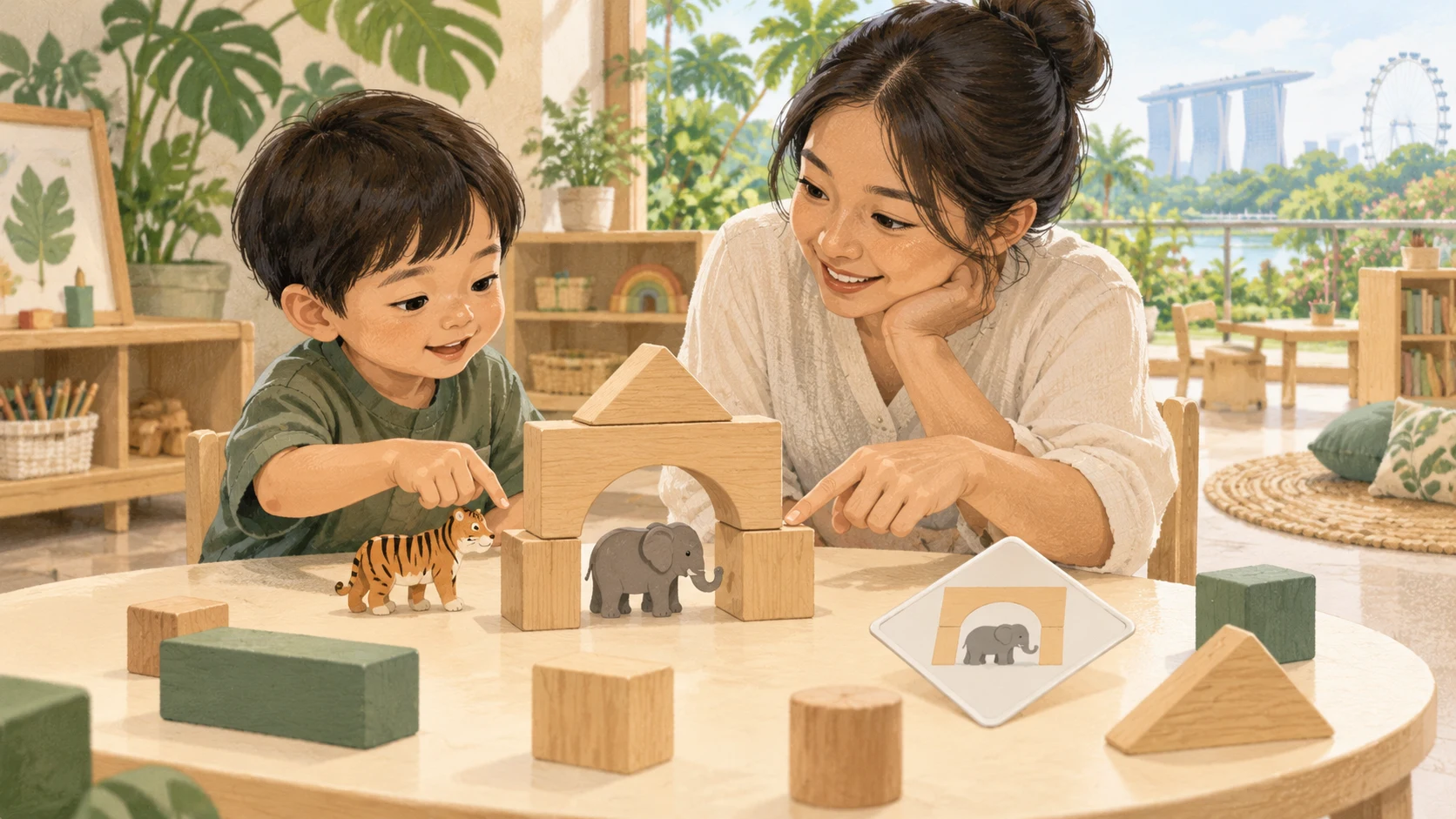
“Under” needs a reference: under what? A toy elephant might be under a block bridge and beside a cup at the same time. The two descriptions can both be accurate because they compare the elephant with different objects.
Start with relationships the child can see and change. Put a large toy next to a box, then inside it. Say what happened while pointing to both objects. Invite the child to arrange the objects rather than only repeat the words.
MOE's Nurturing Early Learners guidance on shapes and spatial concepts includes naming shapes and awareness of position, direction and distance in relation to oneself. A home activity can make these ideas concrete without becoming a worksheet drill.
Begin with inside, outside, on, under, beside and between. Left and right add a further demand because the reference person or viewpoint matters. A clear early explanation names the reference object and keeps the viewing position stable.
CHAPTER 2 OF 8 · Understand relationships and shape properties
2. Turn a shape without changing its identity
Place a square card on a table with one side along the table's edge. Count its four sides and four corners. Turn the same card so one corner points toward you. Its orientation changed, but you did not stretch, cut or replace it.
The four equal straight sides and four right-angle corners remain. The child does not need to use formal angle vocabulary immediately. They can trace the sides, match the card with its earlier outline or turn it back to check that it is the same object.
Avoid teaching “diamond” as a reason that this particular square has stopped being a square. Everyday labels can describe an appearance, while geometric names describe properties. Equally, do not say every shape that looks like a diamond is a square: some have unequal angles.
Compare with a long rectangle card. Turning it upright does not make it taller by stretching it; its longer side now points in a different direction. Keep that distinction visible before adding more shapes or asking the child to imagine a turn without handling the card.
CHAPTER 3 OF 8 · Inspect the worked scene and repair difficulty
3. A worked case: describe the toy scene
Assume an invented play scene contains a block bridge, an elephant beneath its opening, a cup beside the bridge and a tiger outside the opening. The job is to describe the elephant's position relative to the bridge. “Under the bridge” fits the scene. “Beside the cup” could also be true, but it answers a different comparison.
Now ask the child to move the elephant between two separate blocks. Make sure the blocks are far enough apart to show the elephant in the gap. The relevant check is whether the elephant lies between those two named objects, not whether it occupies the centre of the whole table.
Next place a square card beside the scene. Turn it a quarter turn on the table. It is still a square. Since a plain square looks the same after a quarter turn, add a small removable dot near one corner if you want the child to track which way it moved. The dot marks orientation; it does not define the shape.
This case has several separate questions: position relative to an object, movement into a new relationship and identification after a turn. Success on one does not automatically establish the others. Observe the particular step that needs support.
CHAPTER 4 OF 8 · Inspect the worked scene and repair difficulty
4. Repair the first uncertain part
If the child places a toy on a bridge after hearing “under,” demonstrate the two positions side by side. Ask them to choose the scene that matches your description. If choosing is easier than arranging, use that success as a bridge into the next attempt.
If the child demonstrates correctly but cannot produce the English word, accept pointing or a home-language explanation. You can model the English label while preserving the evidence that the relationship is understood. Difficulty naming something is not identical to difficulty recognising it.
If a rotated square is called a different shape, turn that same card slowly while keeping all its edges visible. Ask whether any side was added or removed. Compare its features with a genuinely different card, such as a triangle, so the child can see what a change in shape would involve.
If left and right cause disagreement, check your positions. Two people facing each other have different left-hand sides. Stand alongside the child and identify whose left you mean. A viewpoint problem needs a clearer reference, not louder repetition of the instruction.
For families already exploring fine motor learning, keep movement and spatial reasoning separate: a child can direct an adult to move a card when handling it is difficult.
CHAPTER 5 OF 8 · Practise independently and return later
5. Practise with help, then change roles
For guided practice, give two instructions separately: put the large toy inside the open box; then put the cup beside the box. Let the child complete each before introducing the next. Ask them to describe one relationship in any clear way.
Checking answer: the toy is inside the box and the cup is beside the box. The cup does not need to be on a particular side unless that condition was stated. A complete checking explanation compares the named objects rather than relying on the adult's unspoken preferred layout.
For an independent task, ask the child to make a scene where a toy is between two blocks and another toy is outside a box. Then let them give you one instruction to change the scene. Follow their actual words and ask for clarification when a reference is missing.
Try a shape task separately. Offer a square, a triangle and a long rectangle in different orientations. Ask the child to choose the card with three straight sides, then explain how they checked. The triangle is the answer; pointing upward is not a necessary property of a triangle.
Stop after a useful attempt. Record the support that mattered, such as “recognised under after comparing two scenes,” rather than rating the child globally as good or bad at space.
CHAPTER 6 OF 8 · Practise independently and return later
6. Return later and change the representation
On another day, ask the child to recall one position word by making a scene without a model. If the word is forgotten, provide two contrasting examples and let them show the difference. The aim is to locate what remains available after the first conversation.
For transfer, draw a simple picture of a toy under a table and invite the child to recreate it with objects. Moving from a flat picture to a three-dimensional scene adds a new demand. Let them compare picture and scene instead of assuming that earlier success will transfer instantly.
Change viewpoint next. Walk around the scene and ask what stayed true: an object inside a box remains inside it, even when viewed from the other side. “On my left” may change when the speaker turns. This comparison makes the reference frame visible through ordinary play.
Later links include describing a route, reading a diagram and explaining where a component belongs. A young child does not need a formal geometry lesson to begin that habit. A precise relationship between two familiar objects is a worthwhile learning step in itself.
CHAPTER 7 OF 8 · Connect languages, global learning and questions
7. A global connection through shapes and language
The University of Cambridge's NRICH article on shape and space in the early years discusses spatial language, construction and attention to the features of shapes. It offers an international teaching comparison, rather than a compulsory Singapore activity sequence or a promise of examination results.
An everyday cross-language conversation can be useful. A family member may describe a toy's position in another language while the child arranges it. Then another person can describe the same relationship in English. What matters is preserving the relationship as the words change, rather than assuming a word-for-word translation always carries the same viewpoint.
Keep cultural claims specific. A pattern or shape on a building may invite observation, but recognising its geometry does not establish its historical meaning. Find a suitable source before explaining the maker's intention.
Connect this guide with repeating patterns in kindergarten: one activity asks what group returns, while this one asks how objects relate and which properties survive a turn.
CHAPTER 8 OF 8 · Connect languages, global learning and questions
8. Questions about early spatial learning
Must a child know all the shape names first?
No fixed vocabulary sequence is required for these suggestions. A child can compare sides, point to a corner or fit a piece before confidently naming it. Add accurate words to a relationship they can inspect.
Is a square also a rectangle?
Under the usual inclusive mathematical definition, yes: a rectangle has four right angles, and a square meets that condition while also having four equal sides. With a young child, focus first on the visible properties and coordinate terminology with the educator.
Should I correct every description?
Choose the learning point. If the task is “under,” an unrelated vocabulary correction may distract from it. Clarify an ambiguous reference and model a precise sentence without interrupting every attempt.
What if the child avoids these activities?
Try a familiar interest, a simpler scene or a different response method. Share specific observations with the educator if difficulties persist across situations. One home activity cannot diagnose a learning condition.
Sources and next reading
Checked 22 October 2026. MOE NEL: Shapes and spatial concepts supplies Singapore curriculum context. NRICH: The Importance of Shape and Space in the Early Years supplies the international educational comparison. The toy scenes and practice tasks are original suggested activities.
Continue with purposeful play and the Primary 1 bridge or return to the education hub.