
HOW SINGAPORE EDUCATION WORKS · School theatre
Find your next learning step
Treat every cue as a handover: a clear trigger, one named action, one responsible person and visible confirmation that the action happened.
Full chapter index · Practice and checking · Sources and next reading · How Singapore Education Works
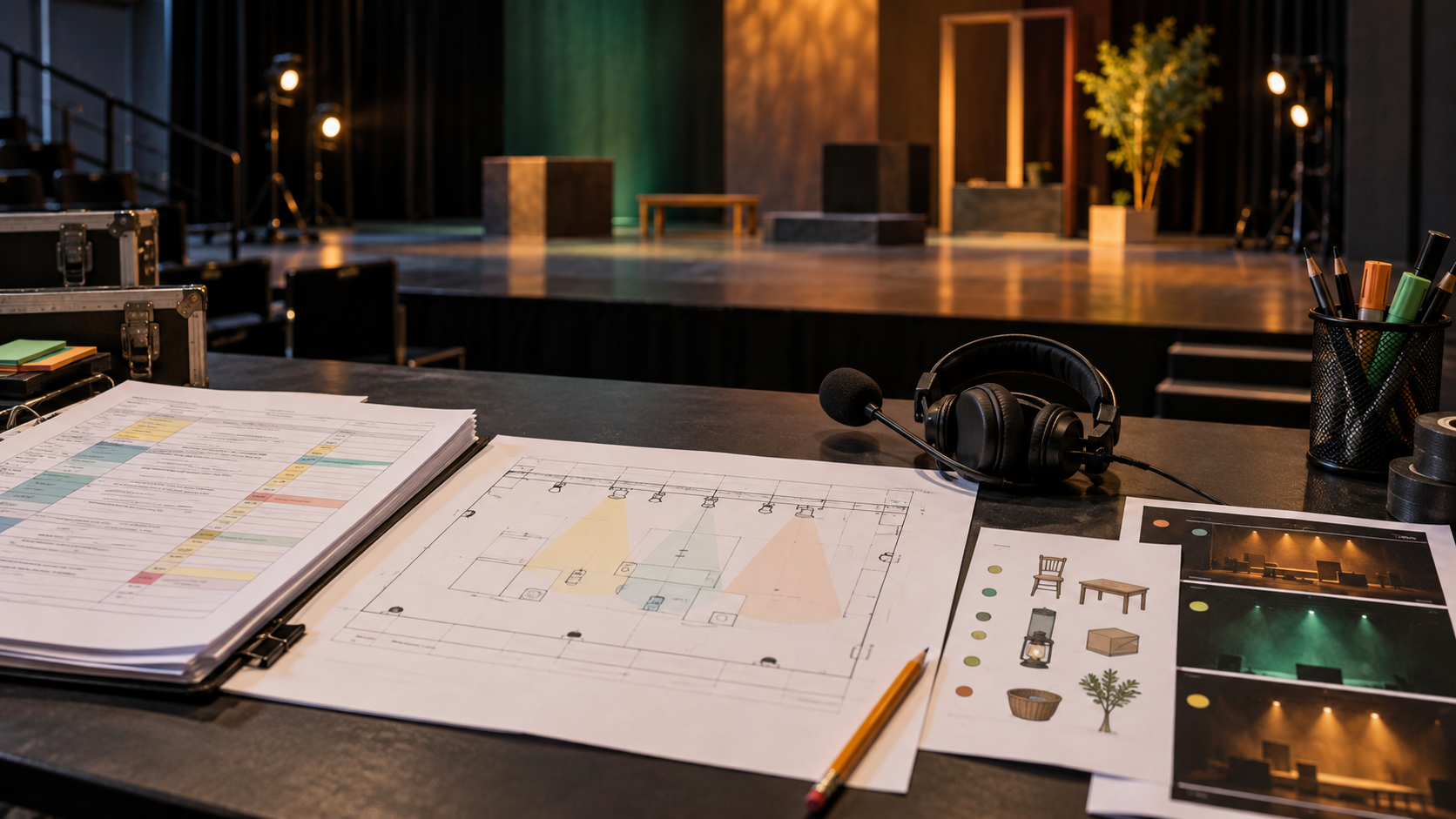
A performance becomes repeatable when the people backstage can see exactly when an entrance, sound, lighting change or prop move should happen. A cue sheet turns a script into timed handovers; a stage plot shows where people and objects belong.
This article offers a classroom and co-curricular rehearsal method, not an examination rule or a substitute for a school’s safety procedures. MOE’s Drama teaching syllabus integrates making, presenting and responding; individual schools and teachers decide the production processes appropriate to their students and spaces.
The choices at a glance
| What you notice | Likely issue | Useful next move |
|---|---|---|
| The action happens, but always late | The cue names an effect but not its trigger | Write the exact word, movement or beat that starts it |
| Two students act on the same cue | Ownership is ambiguous | Assign one caller and one operator for each action |
| A prop blocks an entrance | Sequence is clear but space is not | Add the prop and traffic path to a simple stage plot |
Full chapter index
See the structure
Work and diagnose
Repair and practise
Recall, transfer and questions
A note such as “music soon” leaves timing open. A usable cue states the trigger, the action and who owns it: “On Mei’s line ‘We begin’, sound operator starts Track 2.”
The trigger must be observable. Avoid private intentions such as “when the scene feels tense”. Use a line, gesture, completed movement, count or clearly defined visual state.
The check is the next person’s readiness. If the cue caller cannot see or hear the trigger, change the calling position or appoint a relay rather than pretending the system is reliable.
Use one row per action and number cues in performance order. Keep the script reference short enough to scan under pressure.
| Cue | Trigger | Action | Owner | Confirmation |
|---|---|---|---|---|
| S1 | “We begin” | Start Track 2 | Sound operator | Music audible |
| L2 | Actor reaches centre mark | Change to warm wash | Lighting operator | Stage visibly warm |
| P3 | Door closes | Place letter on table | Props crew | Letter visible before next entrance |
Do not maintain conflicting private copies. Record changes on the shared master, date the revision and tell the whole team which version is current.
Assumptions: two actors enter from opposite sides. A bell sounds after Actor A places a book on the centre table. The light changes when Actor B says, “The library is closing.” A letter must be on the table before Actor A exits.
Order the actions: E1 Actor A enters; E2 Actor B enters; P1 Actor A places the book; S1 bell after the book is visibly down; L1 warm-to-dim on the closing line; P2 props crew places the letter after Actor B crosses upstage; E3 Actor A sees the letter and exits.
Checked answer: S1 cannot precede P1 because its trigger is the book landing. P2 must occur before E3 because the exit is motivated by seeing the letter. The stage plot keeps the upstage crossing clear of the props route.
If the trigger happened but the action did not, check hearing, sightline and ownership. If the action happened at the wrong moment, check whether the trigger wording is precise enough. If the action was correct but unsafe, the spatial plan overrides the timing plan.
Mark the first failure, not every later consequence. One late entrance may cause a missed sound and a rushed prop move; repairing all three separately hides the original problem.
Use neutral language: “Cue L2 was called before the centre mark” is more useful than “lighting was careless”. Production notes should make the system better, not assign character judgments.
Draw the performance area from above. Mark entrances, fixed scenery, actor positions, prop tables, cables or no-go areas, and the audience direction. The drawing does not need artistic detail; it needs shared orientation.
Test every moving path at walking speed before adding performance energy. If two paths cross, change the timing or location. Never improvise around electrical, rigging or venue hazards; follow the supervising adult and venue procedures.
Update the plot when blocking changes. A cue sheet and plot are a pair: one explains when, the other explains where.
Guided cue-to-cue
- Teacher or stage manager stops after each trigger.
- Operator states the action before completing it.
- Team confirms the result and records any change.
Shared run
- Run connected groups of three to five cues.
- Pause only for safety or a broken dependency.
- Rehearse the reset as carefully as the action.
Independent run
Run the scene without coaching. Observers record cue number, expected trigger, observed action and one repair. A clean run means the sequence can be repeated, not merely that everyone remembers the story.
At the next rehearsal, begin with a blank cue sheet and ask the team to reconstruct the critical handovers. Compare with the master and discuss which cues were easy or hard to remember.
The same logic appears in theatre, concerts, assemblies, broadcast studios and events around the world. Cue labels and job titles vary, but observable triggers, clear ownership, spatial safety and version control remain useful.
Changed-context check: convert the live scene into a short recorded performance. Some cues can be captured during filming; others become editing decisions. Label which handovers moved and why.
Does every school performance need professional notation?
No. Use the simplest notation the team can read reliably. Consistency matters more than copying an industry format without understanding it.
Who should call cues?
Use one agreed caller for the run unless the supervising teacher sets another arrangement. Shared responsibility does not mean several people giving competing instructions.
What if a cue changes during rehearsal?
Update the master, mark the revision and communicate it. Do not rely on people hearing the change informally.
Is this an MOE assessment requirement?
No. It is a teaching and rehearsal method. Refer to the applicable syllabus, teacher instructions and school procedures for actual requirements.
Sources and next reading
- MOE Singapore — Drama Teaching and Learning Syllabus, Upper Secondary (2024 implementation)
- SEAB — 2027 G3 Drama SEC syllabus
Continue inside eduKateSG
- Reading a play script at school
- Reading repeat signs in a music score
- Counting musical rests at school