
HOW SINGAPORE EDUCATION WORKS · Kindergarten puzzles
Find your next learning step
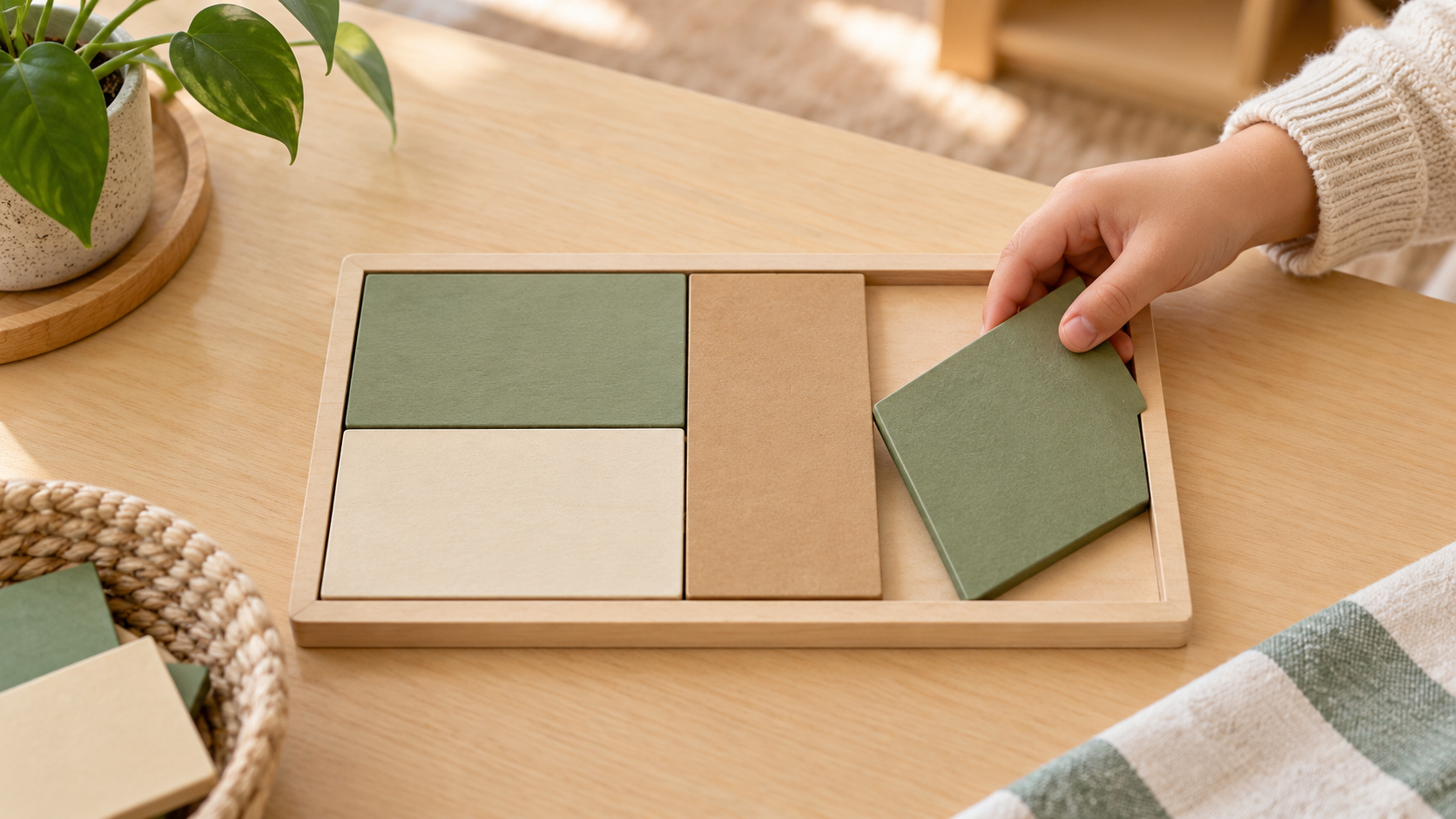
Start with the outline of the whole. Let the child turn one piece with their hands, test its edges and explain the fit before adding more pieces.
Full chapter index · Practice and checking · Sources and next reading · How Singapore Education Works
A whole–part puzzle becomes easier when a child stops treating each piece as a picture and starts checking what stays true when the piece turns: its size, side lengths, corners and boundary. Begin with two or three large pieces and a visible frame. The useful question is not “Can you do it quickly?” but “What tells you this piece belongs here?”
This is a play-based teaching suggestion, not a developmental test or a prescribed preschool lesson. Singapore’s Nurturing Early Learners Framework 2022 includes using basic shapes to form other shapes or figures and developing spatial concepts. Preschools decide how these broad goals appear in their own programmes.
The choices at a glance
| What you notice | Likely issue | Useful next move |
|---|---|---|
| The child rejects a correct piece when it is turned | Orientation is being mistaken for identity | Trace one edge, then rotate the piece slowly without changing it |
| The piece covers the space but crosses the frame | Area is noticed, but the boundary is not | Check corners and outside edges before pressing it down |
| The child tries every piece rapidly | Testing has no stated reason | Ask for one prediction: which edge or corner might match? |
Full chapter index
Work and diagnose
Repair and practise
Recall, transfer and questions
The whole is the finished region or figure. The parts are pieces that cover it without gaps or overlaps. A useful puzzle therefore has three kinds of evidence: the outer boundary, the shared edges between pieces and the picture or pattern, if one is present.
Begin with shape-only pieces before a detailed picture. Put two rectangles together to make a larger rectangle, or two triangles together to make a square. Say what changed—the position—and what did not—the piece’s size and shape.
When the child can point to the frame, a matching edge and a completed region, the explanation becomes visible rather than a guess.
A quarter-turn can make a tall rectangle look wide. The piece has not stretched. Its long and short sides have only changed direction. Let the child hold the piece above the board and turn it before trying to fit it.
| What to notice | Before the turn | After the turn |
|---|---|---|
| Number of corners | Four | Four |
| Long sides | Point up and down | Point left and right |
| Size | Unchanged | Unchanged |
| Possible fit | Too tall for the gap | May match the wide gap |
Avoid naming every turn at once. “Turn it once” and “turn it again” are enough at first. More formal language such as quarter-turn and half-turn can be added when it helps the child describe what happened.
Assumptions: a paper board is a rectangle six squares wide and four squares high. One piece covers the left two-by-four strip. A second piece covers the top-right four-by-two region. The uncovered region is therefore the bottom-right four-by-two rectangle.
Three candidates are offered: a two-by-four rectangle, a three-by-two rectangle and a four-by-one rectangle. The two-by-four piece looks too tall in its starting position. Turn it once so that it becomes four squares wide and two squares high, then place it in the uncovered region.
Checked answer: the rotated two-by-four piece has the required four-by-two dimensions. It meets the frame on the bottom and right, meets the other pieces on the top and left, and creates no gap or overlap. The other candidates have areas of six and four squares, while the missing region has area eight, so they cannot complete the board.
If a candidate almost fits, locate the first mismatch rather than declaring the whole attempt wrong. Is a corner outside the frame? Is one edge too short? Is there a thin gap? Each observation points to a different next move.
If the child relies only on the printed picture, turn all pieces picture-side down and rebuild the outline. If the child ignores the picture, finish the shape first and then check whether lines or colours continue across shared edges.
If repeated turning becomes random, place the piece back at a named starting orientation. Test one turn at a time and say what new edge now faces the gap.
Keep every piece that already has two kinds of evidence—for example, it matches the outer frame and a neighbouring edge. Remove only the first piece that creates a gap, overlap or broken picture line.
Compare the empty region with the candidate before placing it. Match one corner, slide along one edge, then lower the rest of the piece. This turns repair into a controlled test rather than a fresh scramble.
After the repair, trace the outside boundary with one finger and the internal joins with another. A complete puzzle should feel like one whole while still showing how the parts are organised.
Guided round
- Adult identifies the whole and one empty region.
- Child chooses between two pieces and predicts a matching edge.
- Together, rotate once and check gap, overlap and boundary.
Shared round
- Child places one piece; adult places the next.
- Include one plausible but wrong piece and explain the mismatch.
- Swap roles so the child asks the checking questions.
Independent round
The child completes a three- to five-piece puzzle, then draws or builds a new whole for another person. The new solver should be able to use the frame and edges without being told the answer.
On another day, present the same pieces in different orientations. Ask which piece the child remembers and which evidence still needs checking. Memory starts the attempt; the boundary verifies it.
Transfer the idea to tangram figures, quilt blocks, mosaics, map pieces and packaging layouts. Traditions and images differ around the world, but rotation, adjacency and whole–part reasoning travel across them.
Changed-context check: remove the frame and show only a photograph of the completed puzzle. The child must now infer the outer boundary as well as the internal joins. Reduce the number of pieces if both demands become too large.
Should the child work against a timer?
Usually not. Speed can hide random trial-and-error. First build a repeatable check: predict, turn, place, inspect and explain.
What if the child avoids rotating pieces?
Model one slow turn in the air and name what stayed the same. Larger pieces with clear long and short edges make the change easier to see.
Are picture puzzles or shape puzzles better?
They ask for different evidence. Shape puzzles foreground boundaries; picture puzzles add line and colour continuity. Use the simpler source of evidence first.
Does one correct placement prove understanding?
No. Ask for a reason, revisit the puzzle later and change the orientation. Understanding is more visible when the child can transfer the method.