
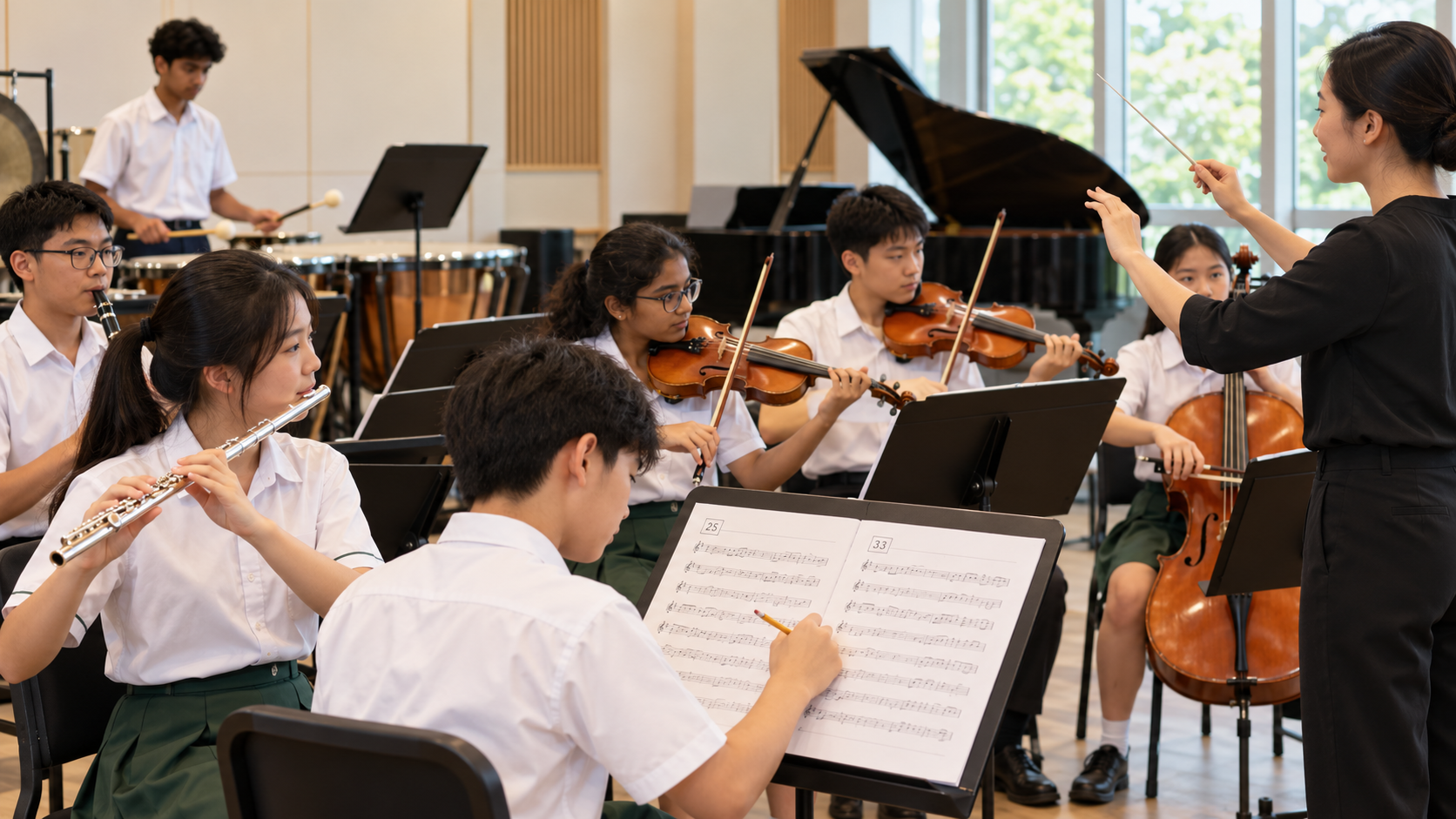
HOW SINGAPORE EDUCATION WORKS · School music, ensemble listening and purposeful rehearsal
Find your next learning step
Record the bar, cue, musical issue and agreed action. Practise the smallest repair, rejoin the ensemble, listen across parts and check whether the shared sound changed.
Full chapter index · Practice and checking · Sources and next reading · How Singapore Education Works
A rehearsal note is useful when it changes the next attempt. “Practise more” is too vague; “bars 21–28, enter after the bass cue, count two silent beats, then match the section’s softer dynamic” gives a learner somewhere to begin.
This is a learning workflow, not a national CCA rule or a substitute for the conductor’s instructions. Use the notation, rehearsal etiquette, safeguarding, instrument-care, hearing-safety and attendance arrangements of the actual school or ensemble. Never record or share classmates without permission.
The choices at a glance
| What you notice | Likely issue | Useful next move |
|---|---|---|
| The same passage breaks each rehearsal | Feedback was heard but not located or practised | Mark the bar range, issue and one repair action |
| One section plays correctly but the ensemble sounds unbalanced | Players are listening only to their own line | Name the reference part and a balance target |
| A practice log lists minutes but no evidence | Time is recorded without a musical check | Add tempo, repetitions and a final run-through result |
Full chapter index
See the structure
Work and diagnose
Repair and practise
Recall, transfer and questions
Ensemble performance combines individual preparation with shared timing, tuning, balance, articulation, phrasing and response to direction. A record should connect a heard problem to a location and an action.
MOE’s upper-secondary Music syllabus organises learning through listening, creating and performing. School ensembles may also operate as CCAs with their own goals and routines. This article offers a transferable method rather than claiming one uniform programme.
The basic chain is hear, locate, mark, repair, rejoin and verify.
| Field | Example | Why it helps |
|---|---|---|
| Location | Movement 2, bars 21–28 | Finds the passage |
| Entry cue | Bass figure, then two beats | Connects one part to another |
| Issue | Clarinet entry early | Names the heard event |
| Action | Count rests aloud; play at 72 bpm | Defines practice |
| Reference | Match flute articulation | Requires cross-part listening |
| Check | Three correct entries in context | Shows whether repair transferred |
Use the conductor’s bar numbers, rehearsal letters or timestamps. Do not invent conflicting labels. If the score is licensed or school-owned, keep copies and annotations within permitted use.
Write only what is needed. A rehearsal note is not a place to criticise a classmate’s character.
Assumptions: a fictional mixed ensemble rehearses bars 21–28 at 96 beats per minute. The melody section sustains a phrase; clarinets enter at bar 25 after two silent beats. In three ensemble attempts, the clarinets enter one beat early twice and correctly once.
The section records: “B25 entry; listen for the bass figure at B24, count 1–2, breathe together, enter piano; practise at 72 bpm, then 96.” In section practice, they complete four correct entries at 72 and three at 96. On rejoining, two of three full-ensemble entries are correct; one is on time but too loud.
Checked result under these assumptions: timing improved from one correct attempt in three to two in three in the full context. The repair is incomplete because balance became the next observable issue.
The log preserves progress without calling the passage “fixed”. It identifies the next rehearsal question: can the section keep the cue and match the softer dynamic?
If the student cannot find the passage, repair score navigation first. If they find it but miss the cue, isolate listening and counting. If it works alone but not in ensemble, practise the transition with the reference part.
If balance changes by venue or seating, record the context. A successful classroom balance may not transfer unchanged to a hall.
If fatigue, pain, ringing ears or unsafe volume appears, stop and use the school’s responsible route. More repetitions are not the answer to a health or equipment problem.
- Hear the specific event and confirm the conductor’s priority.
- Locate the bar, rehearsal letter, cue and affected part.
- Mark one concise instruction in the permitted score or log.
- Practise slowly enough to make the desired action repeatable.
- Rejoin with the cueing part and restore the ensemble context.
- Verify timing, sound and balance across more than one attempt.
A metronome can stabilise tempo during isolation, but the final check must include musical cues and conductor direction. Ensemble playing is not synchronized solo practice.
Keep the log small enough to use. Three ranked priorities are often better than a page of undifferentiated comments.
Guided
The conductor supplies the location and issue; students mark the agreed cue and action.
Shared
A section identifies one repeated problem, proposes a slow-practice check and confirms it with the conductor.
Independent within role
The learner maintains a concise record, completes the planned check and arrives ready to test it in ensemble.
At the next rehearsal, reconstruct the priority before opening the log, then use the record to check accuracy. Later recall should retrieve the musical decision, not only the page number.
Ensembles around the world use different notation, oral traditions, rehearsal languages, leadership structures and concepts of balance. The transferable habit is respectful listening across parts and an explicit route from feedback to shared sound.
Changed-context transfer: move from the rehearsal room to a larger venue. Recheck cue audibility, balance and articulation rather than assuming the old result still holds.
Should every rehearsal be recorded on video?
No. Follow school consent and privacy rules. A bar-number note may be sufficient and less intrusive.
Is practice time the best measure?
Time matters, but a musical check—such as three accurate contextual entries—shows more about the result.
May students change bowings, breath marks or phrasing?
Follow the conductor or section leader so individual annotations support the agreed ensemble interpretation.
What if the instrument is not working properly?
Stop and use the school’s maintenance or repair route. Do not improvise repairs beyond authorised competence.
Sources and next reading
- MOE Singapore — Upper Secondary Music Teaching and Learning Syllabus
- MOE Singapore — Band CCA Reference Guide
- National Arts Council — Music in Singapore
Continue inside eduKateSG
- Music rhythm, notation and ensemble listening
- How CCAs work in Singapore
- School musical instrument loans and repairs