
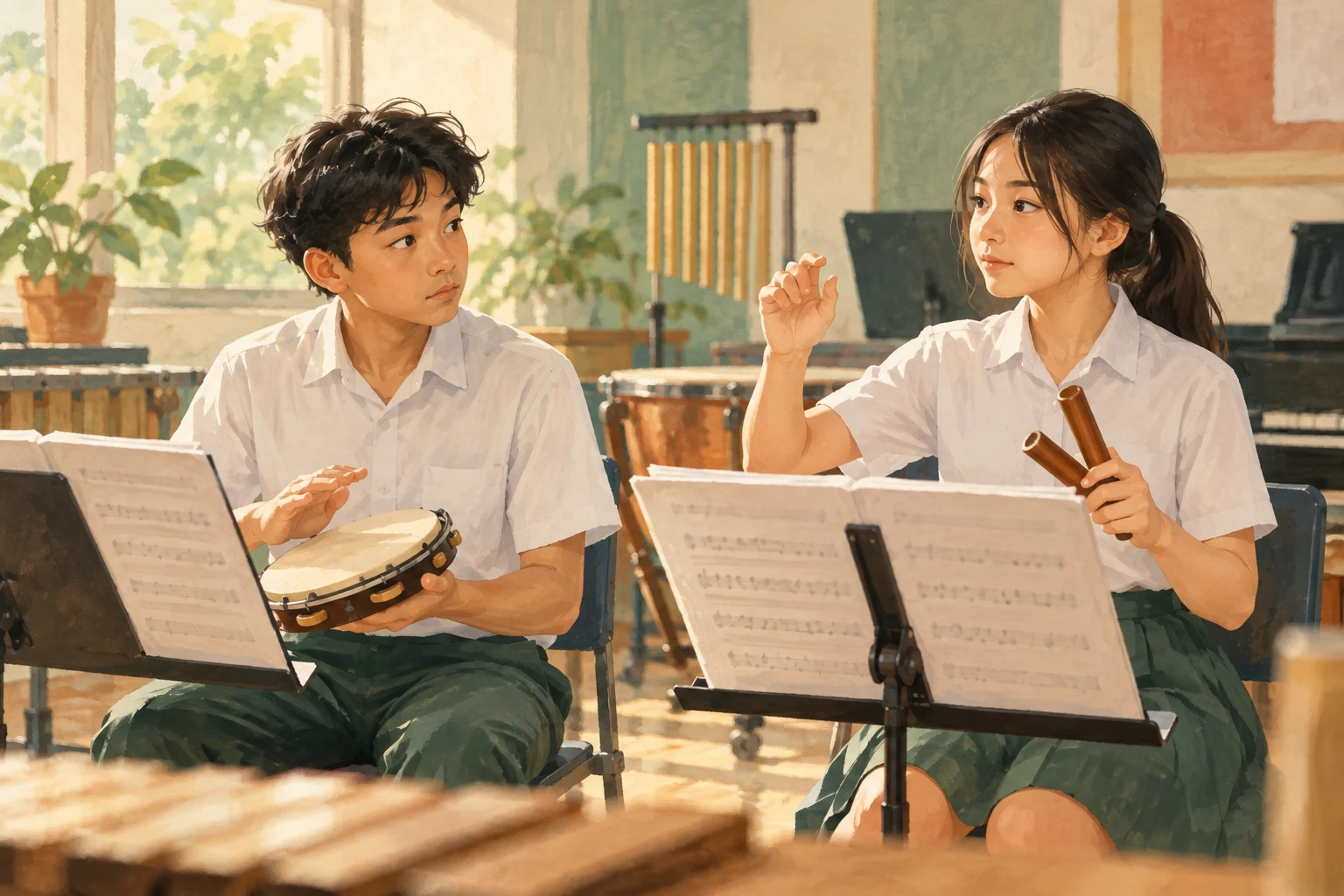
G3 Higher Music Higher Performing is not merely a request to play a longer recital. It asks a candidate to perform contrasting music with demonstrable musical understanding and then explain, in a short viva voce, why particular rehearsal and interpretative choices were made. A reliable performer can do more than remember the notes: they can listen across an ensemble, respond to a musical partner, control a stylistic detail and evaluate what changed after practice.
This independent eduKateSG Ministry of Education V3.0 Reference 360 explains the 2027 Singapore–Cambridge SEC G3 Higher Music K351 Paper 32 Higher Performing elective. The official scheme specifies an 8–12-minute recital of two contrasting pieces, including one ensemble performance, plus an immediately following 3–5-minute viva voce. The recital contributes 40 marks and the viva 10 to the separate 50-mark elective assessment. This guide includes twenty-six original hypothetical examples, a twelve-stage rehearsal method, a fictional three-pupil tutorial and diagnostic questions for parents and tutors.
The Higher Performing elective is one choice alongside Higher Creating and the Research Essay, not a replacement for the compulsory Music Studies, Creating and Performing core. The two chosen elective pieces must be different from those presented for the compulsory Paper 3. All passages and practice situations below are invented and do not reproduce commercial scores or recordings. This article cannot assess an individual child’s health, technical safety or readiness and is not an official marking scheme. Schools and authorised teachers remain responsible for confirming repertoire, facilities, examination instructions and authentic candidate preparation.
Fast route for parents, performers and tutors
- Check the official Paper 32 elective and keep its two pieces distinct from core Paper 3.
- Plan an 8–12-minute live programme with two contrasting items, including one ensemble performance.
- Study accuracy, phrasing, tone, expressive structure and ensemble cues together.
- Practise explaining actual repertoire and rehearsal decisions in concise original language.
- Use safe supervision and a new music task to test independent transfer.
1. Read the official K351 Paper 32 rules
The 2027 K351 Higher Music syllabus gives Paper 32 two parts: a live recital worth 40 marks and an oral viva voce worth 10. It is an elective separate from compulsory Paper 3. The two pieces should contrast, with a total recital duration of 8–12 minutes. One piece must be an ensemble item, and the other can use one of the stated solo, ensemble, accompaniment or improvisation routes. The candidate’s teacher should check the official programme form, allowed instrumentation and current logistics before the repertoire is fixed.
2. Two contrasting items do not mean two unrelated skills
Contrast might arise through style, tradition, character, musical texture, tempo, technique or instrumentation, but it should be audible and musically relevant. A fast and a slow movement may differ in speed yet demand the same phrasing habits; two pieces of similar tempo may contrast strongly in metre or expressive language. Explain the distinctive interpretative task in each chosen item. A student should not rely on a title alone to prove that the performances contrast.
3. The ensemble requirement must be real
The syllabus requires one ensemble performance and warns against extensively doubling the candidate’s part, because the examiner needs to judge actual ensemble skills. An arrangement where another instrument continuously plays the candidate’s entire line can conceal independent musicianship. Strong ensemble work shows listening, precise entry, phrasing coordination, balance and thoughtful response to other performers. The other ensemble members do not all have to be examination candidates, but the candidate must be audibly responsible for their own part.
4. The second piece offers several legitimate routes
After meeting the one-ensemble requirement, the other item may be a solo on instrument or voice, another ensemble performance, an accompaniment, or a solo/ensemble improvisation in a chosen tradition. A pupil should choose based on musical aptitude, the available ensemble, instrument, preparation time and the exact K351 rules. No option automatically brings higher marks: each should show suitable technical and musical challenge for the candidate’s developmental stage.
5. The elective recital and core recital are not interchangeable
The pieces presented for Higher Performing must be different from those submitted for compulsory Paper 3. Reusing a favourite piece with a slightly altered ending does not necessarily establish a genuinely different item. Keep a repertoire register recording the title, version, composer or tradition, performers and which paper receives which work. The official school’s forms govern the final declaration; a home spreadsheet is only a planning aid.
6. Performance time has a boundary, not a target for virtuosity
Eight to twelve minutes is the specified total for the two elective items. The candidate should plan the complete programme and check how performed repetitions, introductions or improvisatory sections affect the final timing. A ten-minute selection is not inherently better than an eight-and-a-half-minute one. Longer technical passages are useful only when they serve musical communication and fall within approved requirements. The supervisor should confirm the precise timing method for examination purposes.
7. Musicality is more than note accuracy
Correct pitches and rhythms matter, but musicality also includes phrasing, articulation, dynamic contour, balance, stylistic awareness and the relationship between tension and release. A technically accurate performance can still feel mechanically uniform. Conversely, expressive intention without stable rhythm and intonation may not communicate clearly. Students should understand how technical control supports musical decisions rather than treating accuracy and expression as competitors.
8. A phrase has direction
A phrase can move toward an arrival, relax into a cadence or lead into a contrasting gesture. Players need to identify the important notes, changes of harmony or rhetorical points that make that direction audible. Breath, bowing, fingering, touch or articulation may support the result depending on the instrument. Copying another performer’s rubato without knowing the phrase structure is weaker than forming a thoughtful, personally justified approach.
9. Rhythm and metre support ensemble trust
A shared pulse allows performers to coordinate even when individual parts use syncopation or contrasting rhythmic patterns. A learner who practises an isolated part at the correct tempo may still lose their place when another musician enters. Rehearsal should include listening for cues and understanding how the parts interlock. Do not confuse exact mechanical timing with musical rigidity: planned flexibility can coexist with a shared ensemble intention.
10. Intonation and tone quality are contextual
Depending on voice or instrument, pitch stability, articulation and tone can be affected by technique, instrument condition, acoustics and musical style. A student’s response should identify what can be adjusted through safe, supervised rehearsal, without diagnosing physical or vocal health concerns. When the repertoire uses pitch inflection or timbral effects deliberately, ‘correct’ playing may differ from a generic Western classroom model. The intended tradition should inform evaluation.
11. Balance requires listening beyond one’s own part
An ensemble member may play accurately but too loudly for the main melody to remain clear, or may fail to support an important rhythmic cue. Rehearse with the full group and identify who carries the musical foreground at each moment. Balance is not always equal volume: accompaniment often has a supporting role, while deliberate dialogue may require alternating prominence. Ask the student what the audience is meant to hear, and where their own contribution sits in that texture.
12. Contrasting styles require different evidence
A piece from one tradition may value particular ornaments, rhythmic feel, articulation or improvisatory interaction, while another uses different expressive conventions. Research authorised stylistic sources and consult knowledgeable teachers rather than applying a single performance template. An unfamiliar ornament should be learned through an appropriate source and safe instruction, not guessed from decorative notation. A student’s viva should explain their choices in relation to the selected repertoire, not stereotypes about an entire culture.
13. Improvisation is a defined musical practice
The syllabus permits solo or ensemble improvisation in a chosen improvisatory tradition as a second-item option. A strong improvised performance still operates within musical relationships: pulse, harmony, mode, motif, call-and-response or other tradition-specific conventions. ‘Making it up’ is not sufficient preparation. Students can practise developing an idea and responding to a partner, while preserving authentic personal decisions and complying with the approved repertoire and examination route.
14. Accompaniment can demonstrate serious musicianship
An accompanying part may require attention to breathing, phrasing, rubato, harmonic movement and dynamic restraint. The accompanist is not merely someone playing an easier line. If the candidate chooses accompaniment as the second item, it should provide an appropriate level of assessable musical involvement under the syllabus guidelines. Rehearsal evidence may focus on how the candidate anticipates a soloist’s phrase and responds without dominating.
15. Live examination changes the rehearsal context
The official Paper 32 recital is examined by two examiners at a live performance. A polished home recording may not reproduce the acoustic conditions, performance pressure or sightlines of a live assessment. Students can practise ordinary concert routines with their teacher, including entering, preparing equipment and recovering from small lapses. The goal is not to force a child to perform through pain or illness; wellbeing and authorised school procedures always take precedence.
16. The viva occurs immediately after the recital
Paper 32’s viva voce lasts 3–5 minutes including questioning and follows the recital. Students should be able to move from action to reflection while details remain fresh. The assessment covers understanding of chosen music, specific musical and technical aspects, and rehearsal and preparation. It is not a general oral examination on all music history. A useful preparation habit is to explain actual musical decisions after normal supervised rehearsal, not memorise speeches unrelated to the performance.
17. Three viva categories guide thinking
The syllabus asks examiners to draw questions from knowledge of the chosen repertoire or improvisations, analysis of specific aspects of the music and performance techniques, and rehearsal and preparation. A pupil can organise personal rehearsal notes under those headings. Each answer should link an identifiable musical point to the way it was approached. Saying ‘I practised hard’ alone does not explain what the musician changed or why.
18. Evidence gives an answer substance
Compare two hypothetical responses. One says, ‘I played softly because the music is sad.’ Another identifies a quiet entry, explains how reduced dynamics allow a second instrument’s line to be heard and describes a rehearsal adjustment. The second answer connects a technical choice to a specific musical relationship. Good viva responses are honest and concise; they do not require elaborate theoretical claims that the performer cannot support.
19. A rehearsal log should show cause and effect
A useful personal log may state a problem, the method tried, the result and the next check. ‘The opening phrase sounded rushed; we rehearsed the shared upbeat slowly; the second entry became more reliable’ is testable. ‘Practised for two hours’ is not evidence of learning by itself. Keep logs authentic, not scripted retrospective success stories. Student-specific records may be required under separate school arrangements; this article provides only teaching principles.
20. Diagnose an error before multiplying repetitions
If ensemble entries are inconsistent, the root cause might be unclear cues, a misunderstood rest, competing pulse interpretations or inadequate individual preparation. Repeating the whole piece twenty times may preserve the same problem. Identify the earliest point where a performer no longer knows what to listen for, repair it in a small phrase, then rehearse the transition in context. This reflects the first-principles small-group teaching approach.
21. Manage physical and vocal limits responsibly
Healthy rehearsal requires appropriate rest, warm-up, suitable instrument setup and attention to discomfort. This guide does not prescribe individual vocal techniques, instrumental posture or injury treatment. Candidates should consult their qualified teacher and responsible adults, especially when new technical demands or recurring pain arise. A technically ambitious selection is not worth disregarding wellbeing or approved safety procedures. The strongest programme respects the musician’s developmental stage.
22. Do not use speed as a substitute for expressive control
An impressive fast passage may need slower diagnostic practice to clarify articulation and rhythm. Once the structure is secure, speed can be rebuilt under teacher guidance. A performance that runs faster than the student can shape often sacrifices phrasing and tone. The question is whether the musical intention survives at the chosen tempo, not whether a stopwatch records a personal best. In a viva, explain the musical and technical reasons for the decision.
23. Recording can support feedback without replacing the live task
A rehearsal recording may help a learner hear balance, pacing and articulation that were difficult to notice while playing. But microphone location and playback volume can alter perceived sound. Use recordings as provisional evidence and verify in the actual ensemble setting. Protect privacy and obtain appropriate permission before recording other students. No recording guarantees the live recital’s outcome, and authorised school rules determine what may be brought into examination preparation.
24. Transfer means solving a new performance problem
A pupil who has memorised how to rehearse one tricky entrance should be able to diagnose a different phrase where the issue is phrasing or balance. Give an invented ensemble excerpt, describe one performance difficulty and ask what evidence would locate the cause. Then ask for a brief, truthful viva-style explanation of a hypothetical revision. Independent musical judgement—not a rehearsed collection of adjectives—is the intended capability.
25. Twelve-stage rehearsal and reasoning protocol
Stage 1 — Confirm registration and timing
Check elective Paper 32, two pieces, total 8–12 minutes and one ensemble requirement.
Stage 2 — Choose suitable contrasting items
Compare technique, style, texture and actual musical demands rather than titles alone.
Stage 3 — Keep core and elective repertoire distinct
Track which pieces are used for K351 Paper 3 and Paper 32.
Stage 4 — Understand each musical form
Identify phrase structures, returns, transitions and significant interpretative decisions.
Stage 5 — Plan safe technical study
Discuss technique, instrument fit and physical limits with a qualified teacher.
Stage 6 — Rehearse individual responsibility
Learn entries, rhythm, intonation and the candidate’s part independently.
Stage 7 — Integrate ensemble listening
Practise cues, balance, shared pulse and reactions to other players.
Stage 8 — Test interpretation
Compare the intended effect with what a listener or rehearsal recording actually reveals.
Stage 9 — Record one reasoned adjustment
Document problem, changed method, observation and next test in original language.
Stage 10 — Explain choices after rehearsal
Use short viva practice grounded in repertoire, technique and preparation.
Stage 11 — Audit readiness and logistics
Confirm duration, accompaniment, equipment, forms and permitted school procedures.
Stage 12 — Transfer independently
Use a new fictional ensemble difficulty to diagnose the problem without a model answer.
26. Fictional three-pupil ensemble workshop
Three invented secondary-school musicians examine a short original rehearsal scenario. One identifies the exact bar in which a candidate enters incorrectly, another analyses the ensemble’s tempo cue, and a third checks whether a loud accompaniment masks the melodic foreground. They then exchange roles and explain their diagnoses without performance jargon they cannot support. After five minutes of teaching feedback, all three receive different unfamiliar scenario cards and individually specify what they would listen for, how they would verify the problem and what a truthful viva answer would need to mention. This is conceptual preparation, not a prescription for a particular child’s playing.
27. Twenty-six original worked examples
Worked Example 1 — A recital that is too short
Two invented recital items last 3 minutes 20 seconds and 4 minutes 15 seconds. The total is 7 minutes 35 seconds, below the 8-minute minimum. The candidate should select or plan appropriate repertoire under teacher guidance, not artificially stretch silence. Timing is a formal requirement, while the quality of the actual musical interpretation remains a separate consideration.
Worked Example 2 — A recital within the window
A hypothetical ensemble item takes 4 minutes 40 seconds and a solo takes 5 minutes 5 seconds. Combined time is 9 minutes 45 seconds, within the stated 8–12-minute range. That calculation checks only the duration. The performer must still satisfy contrast, suitability, ensemble contribution and separate repertoire requirements.
Worked Example 3 — An over-length programme
Two hypothetical pieces last 6 minutes 15 seconds each, a combined 12 minutes 30 seconds. This exceeds the specified upper limit. A pupil should work with the authorised teacher to choose appropriate versions or different works, rather than rush performance dangerously or omit musical material without reason.
Worked Example 4 — Two fast pieces are not automatically contrasting
A student proposes two brisk works from similar arrangements. They have different titles but nearly identical rhythmic and expressive demands. A better comparison identifies whether their textures, genres, phrasing or musical ideas genuinely contrast. The decision belongs to the candidate and supervisor; a worksheet title alone cannot establish the assessment condition.
Worked Example 5 — A slow piece and an energetic piece
An invented sustained melody followed by a rhythmically active ensemble work may provide clear contrast in texture and energy. The tutor should still examine what technical or interpretative qualities each reveals, rather than awarding hypothetical marks solely because one tempo is slower. Contrast has to be heard and supported by choices.
Worked Example 6 — Ensemble part hidden by doubling
The candidate’s melody is copied exactly by two stronger players in a fictional rehearsal. Examiners may have difficulty distinguishing the candidate’s independent ensemble contribution. The syllabus cautions against extensive doubling. A supervisor should select or arrange an appropriate part that allows the candidate’s musical skill to be judged.
Worked Example 7 — An independent ensemble cue
An imagined violinist must enter after two bars of piano accompaniment. The student repeatedly misses the entrance because they count only their own rests and ignore the piano’s cadence. The diagnostic fix is to identify a reliable audible cue and practise that transition with the partner. It is an ensemble-listening problem, not necessarily a fingering problem.
Worked Example 8 — Accompaniment that dominates
An invented pianist plays with excellent rhythmic accuracy but masks a singer’s phrase endings. The candidate should identify when the vocalist carries the foreground and adjust balance and timing appropriately. Accompanying well includes hearing what the other performer needs, not merely reproducing the written chord pattern.
Worked Example 9 — One instrument, two contrasting articulations
A student plays two fictional passages with identical detached articulation despite one asking for long connected phrasing. The tutor asks the performer to compare the function of articulation in each phrase and practise a clear distinction. A musical choice is justified by the repertoire, not by habit.
Worked Example 10 — A rushed phrase opening
A musician accelerates before a difficult entry. The class isolates the transition, identifies where the shared pulse is lost and practises the cue at a comfortable pace. When the phrase is reassembled, the performer checks whether the intended expressive contour survives. ‘Practise more’ is not a sufficient diagnosis.
Worked Example 11 — A small intonation problem
In an invented ensemble, two sustained notes clash unexpectedly. The class must distinguish an intended dissonance from tuning or pitch instability by checking the written music and listening to the context. The teacher guides technical adjustment safely. A student should not claim every harsh sonority is an error.
Worked Example 12 — An ornament without stylistic basis
A pupil adds an improvised ornament to a fictional passage because a video makes it look impressive. Before adopting it, the performer should study whether that tradition and passage allow the gesture and whether it serves the phrasing. Ornamentation should demonstrate musical understanding, not decorate every sustained note.
Worked Example 13 — A meaningful dynamic contrast
A fictional ensemble answer places a quiet inner line under a more prominent melodic entrance. The candidate explains how reduced accompaniment volume makes the new theme audible. This is stronger than saying ‘I played quietly because I felt like it’. The interpretation is connected to an audible relationship.
Worked Example 14 — An improvised response
In an imagined improvisatory exercise, one player introduces a short rhythmic phrase and the candidate responds with a variation. The student can discuss what repeats, which parameter changes and how the shared groove is maintained. Improvisation may be creative and spontaneous, but it is still a musically accountable practice under its tradition.
Worked Example 15 — Improvisation with no shared pulse
Two invented musicians trade ideas but repeatedly lose their position in the underlying cycle. The repair may involve agreeing on a clear cue and rehearsing the structure without improvisation first. The goal is more reliable interaction, not a rigid ban on musical flexibility. A tradition-specific teacher should guide performance choices.
Worked Example 16 — Programme item repeated from Paper 3
A student plans to reuse their compulsory recital piece as an elective solo. The 2027 Paper 32 syllabus requires items different from Paper 3, so this selection needs revision. A clear repertoire record should distinguish both parts before examination paperwork is completed.
Worked Example 17 — No ensemble available yet
An otherwise suitable soloist has no confirmed ensemble partner. Because one Paper 32 item must be ensemble work, planning cannot end with a complete solo programme. The student should consult the authorised school supervisor about workable partners and instrumentation rather than assume an accompaniment recording meets the requirement.
Worked Example 18 — What a viva answer should contain
A fictional examiner asks why the candidate altered a phrase’s articulation. A strong personal explanation identifies the point in the music, the original issue and the musical effect of the choice. The student should speak honestly about actual work rather than recite a paragraph written by a tutor.
Worked Example 19 — A weak viva claim about improvement
The candidate says, ‘I improved because I practised every day.’ This describes routine, not the specific development. A better response explains which error changed, what exercise or rehearsal method addressed it, and what evidence showed improvement. The musical claim should remain truthful even if results are mixed.
Worked Example 20 — A three-question viva rehearsal
A teaching-only rehearsal asks the student to explain the selected repertoire, one audible phrasing decision and one challenge in ensemble practice. These categories reflect the assessment but are not leaked or predicted examination questions. The student should give concise original answers tied to music they know.
Worked Example 21 — A misleading rehearsal recording
A quiet part sounds loud in a rehearsal phone recording because the device was close to that instrument. The student should compare what they heard in the room and consider microphone placement. A single recording is useful evidence but not a perfect representation of the ensemble balance experienced by examiners.
Worked Example 22 — A wrong entrance after a tempo change
An invented piece changes tempo before the candidate enters. Rehearsing the old pulse repeatedly does not resolve the problem. The student identifies the transition cue, discusses the new speed with the group and tests their response. The earliest fault lies in the model of shared timing.
Worked Example 23 — A difficult passage rehearsed too fast
A pupil repeatedly makes the same articulation error during a high-speed passage. Reducing tempo under teacher guidance may expose the uneven grouping; a targeted repair then supports rebuilding the intended speed. The aim is accurate control in service of music, not a predetermined fastest possible tempo.
Worked Example 24 — A performance that ignores discomfort
An imaginary student reports recurrent pain while practising a technically demanding phrase. The appropriate response is to stop unsafe activity and seek responsible-adult and qualified-teacher guidance, with medical advice when needed. This reference is not a substitute for clinical assessment or a physical-training plan.
Worked Example 25 — A second piece from a different tradition
A candidate considers a second item from a less familiar tradition. The tutor can help them find legitimate contextual resources and knowledgeable teachers, while avoiding stereotyped descriptions of how the music ‘must’ sound. The practical question is whether the performer understands and can authentically realise suitable musical conventions.
Worked Example 26 — Independent transfer to an unfamiliar ensemble
A new fictional piece contains staggered entrances and a shifting foreground melody. The learner identifies a likely cue, plans a rehearsal test, names a balance issue and formulates a short viva-style explanation of the choice. They must not copy another student’s actual performance account. This demonstrates adaptable musicianship rather than a memorised speech.
28. Ten common errors and corrective decisions
1. Treating Paper 32 as the same recital as compulsory Paper 3
Keep distinct repertoire for the two assessment components and confirm with the supervisor.
2. Forgetting the ensemble requirement
Plan one genuinely assessable ensemble item before finalising the programme.
3. Choosing two items by title instead of audible contrast
Explain contrasting musical and technical demands with actual repertoire evidence.
4. Ignoring the 8–12-minute combined duration
Time both pieces and confirm programme requirements before submission.
5. Making an ensemble part hard to hear by extensive doubling
Ensure the candidate’s contribution is independently assessable under K351 guidelines.
6. Equating loudness or speed with expressive success
Describe phrasing, balance, articulation and musical intention using specific evidence.
7. Repeating a failing passage without diagnosis
Find the earliest cue, technical or listening failure and repair a small section first.
8. Memorising generic viva answers
Explain genuine repertoire knowledge, rehearsal changes and personal choices rather than a template.
9. Treating phone recordings as perfect live evidence
Account for device position, acoustics and ensemble context while evaluating.
10. Pushing through strain to meet a performance demand
Prioritise safe supervised rehearsal and appropriate professional guidance.
29. Three-pupil small-group diagnostic session
For a ninety-minute study session, start by discussing the official Paper 32 rules and asking each learner to identify two distinct repertoire requirements. Follow with a guided listening comparison of different original or authorised examples. Next, examine a fictional rehearsal record, diagnose the first failure and practise one authentic explanatory response in the learner’s own words. In the final segment, each pupil privately analyses a new ensemble scenario to prove independent transfer. The teacher may teach repertoire understanding and rehearsal technique but does not supply prepared assessed viva answers, performance arrangements or a grade guarantee.
30. Depth–Load–Transfer check
Depth means explaining how ensemble listening, technical accuracy and interpretative intention interact. Load means managing the two-piece programme, total duration, contrasting style, ensemble requirement, separate Paper 3 repertoire and viva preparation without confusing them. Transfer means independently diagnosing a fresh performance problem that differs from the practised repertoire. Categorise weakness as score reading, pulse, cue listening, balance, interpretation, documentation or self-explanation. Teach the earliest unstable concept, then retest with a changed example under appropriate supervision.
31. Parent and tutor feedback prompts
Useful questions include ‘Who has the musical foreground here?’, ‘What cue did you listen for?’, ‘Which passage shows a contrast?’, ‘Why did you choose that articulation?’, ‘How did your approach change after rehearsal?’ and ‘Can you describe a different performance problem independently?’ Give specific feedback on the identified decision rather than general praise for speed or volume. An adult should never ask a child to conceal discomfort, and private rehearsal recordings of other learners require appropriate permission.
32. Independent practice and answer checks
Practice 1 — Time audit
Calculate a hypothetical total for two pieces lasting 4:35 and 5:10, then explain why timing alone cannot establish readiness.
Practice 2 — Ensemble requirement
Explain why a candidate part fully doubled by other players may not demonstrate independent ensemble skill.
Practice 3 — Music versus title contrast
Describe two musical parameters that could make invented pieces genuinely contrasting beyond their titles.
Practice 4 — Entrance cue
Use a new imaginary four-bar score description to select an audible cue for a musician entering after rests.
Practice 5 — Balance comparison
Explain why an accompaniment should not always have the same dynamic weight as the melody.
Practice 6 — Phrasing observation
Distinguish a phrase that moves toward an arrival from a series of isolated notes.
Practice 7 — Improvisation practice
Name one repeated feature and one variation that make an improvised response musically related to its opening phrase.
Practice 8 — Viva rehearsal
Give a hypothetical honest answer explaining a rehearsal change, without borrowing candidate-specific stories.
Practice 9 — Safety and pacing
Explain why repeated pain or excessive fatigue calls for teacher and responsible-adult support, not more forced repetitions.
Practice 10 — Transfer task
Diagnose a different invented ensemble problem and defend a two-step rehearsal check independently.
33. Frequently asked questions
How long is the Higher Music Paper 32 recital in 2027?
Eight to twelve minutes in total across two contrasting pieces, as stated in the official K351 syllabus.
Does Higher Performing require an ensemble?
Yes. One of the two items must be an ensemble performance. The candidate’s part should not be extensively doubled.
Can the second item also be an ensemble piece?
Yes. Permitted second-item routes include solo, ensemble, accompaniment and eligible solo or ensemble improvisation.
Can I reuse my compulsory Paper 3 pieces?
No. The elective pieces must differ from the compulsory Paper 3 recital repertoire.
How long is the viva voce?
Three to five minutes, including questions, immediately after the recital. It contributes 10 marks to the 50-mark elective.
What are viva questions about?
The chosen repertoire or improvisations, specific musical and technical aspects, and the candidate’s rehearsal and preparation.
Are two contrasting tempos sufficient?
Tempo may contribute to contrast, but choices should demonstrate actual contrasting musical characters or techniques. Consult the authorised teacher.
Is the candidate judged only on technical accuracy?
No. Technical control and musicality or sensitivity both contribute to performance assessment under the official criteria.
Should parents or tutors write viva answers?
No. Support listening and reasoning, but assessed explanations must genuinely reflect the candidate’s own understanding and practice.
Is this an official SEAB paper?
No. It is an independent explanatory and tutorial reference; the original K351 syllabus and school instructions control all assessment details.
34. Closing principle
Higher Performing joins an audible recital with thoughtful musical explanation. The best preparation does not simply repeat hard passages or memorise impressive adjectives: it makes the musical structure clear, builds secure technique, strengthens ensemble responsibility and produces truthful reflection on what practice actually achieved. A successful tutor helps each learner diagnose problems and express decisions independently within the published rules, while leaving the assessed performance and viva voce authentically the candidate’s own.
Official sources and connected eduKateSG references
Official 2027 SEAB Higher Music K351 syllabus, Paper 32 · Official 2027 SEC G3 syllabus listing · Reference 359 — Higher Creating · Reference 358 — Research Essay · Reference 349 — Music Listening · MOE V3.0 library · Immutable Clementi diagnostic teaching standard.