
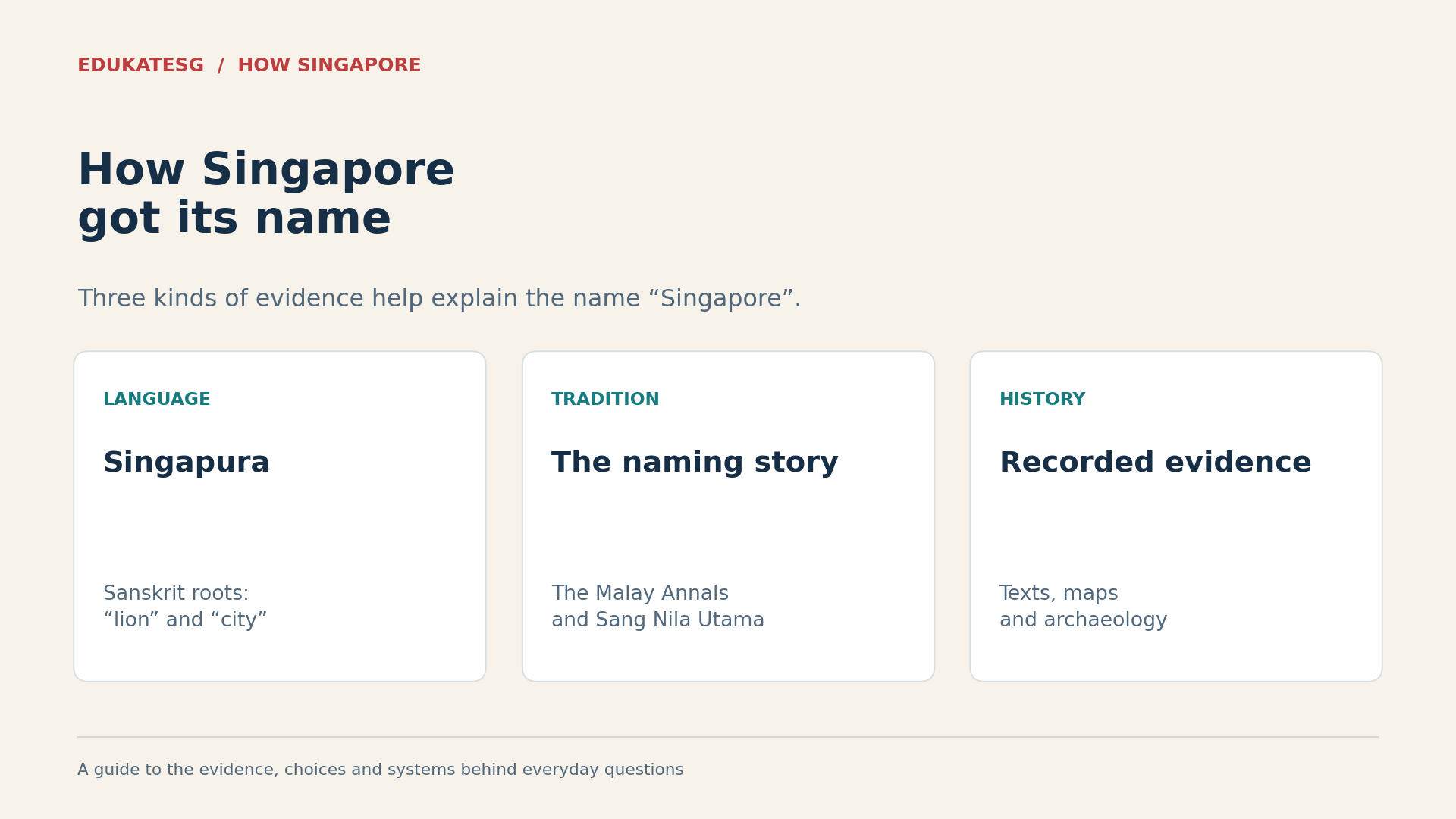
Singapore got its name from Singapura, a name formed from Sanskrit words commonly translated as “Lion City”. The familiar explanation comes from the Sejarah Melayu, or Malay Annals: Sang Nila Utama encounters an animal identified as a lion and gives the settlement its name. The meaning of the name is much clearer than the historical circumstances of that encounter. ISEAS explains the accepted etymology, while NLB describes the naming tradition.
Understanding the full story means following several kinds of evidence: an older name, Temasek; a royal narrative recorded much later; objects excavated from the ground; different spellings on maps; and the languages and symbols Singapore uses today. Together, they explain how a place name can preserve both history and cultural memory.
- Meaning: Singapura is conventionally understood as “Lion City”.
- Traditional explanation: the Malay Annals associates the name with Sang Nila Utama and a lion sighting.
- Historical caution: the encounter and the traditional date of about 1299 are not independently established as a documented naming ceremony.
- Earlier history: written records and archaeology support a settlement and trading activity before the British arrived.
- Modern understanding: the origin of a name, the establishment of a colonial trading station and the independence of a country are different events.
Research checked: 5 November 2026. Historical interpretations are distinguished from documentary and archaeological evidence throughout this guide.
Find the explanation you need
- What “Singapore” and “Singapura” mean
- The Sang Nila Utama story
- How to read the Malay Annals
- Temasek and Singapore’s other early names
- What archaeology can establish
- How the name travelled across languages and maps
- Naming, colonial settlement and independence
- One country, four official languages
- Why Singapore still uses the lion
- How to explain the story accurately
- Places and objects that make the story visible
- Worked examples: reasoning from evidence
- A four-week exploration plan
- Frequently asked questions
- Useful vocabulary
- Sources and further reading
1. What “Singapore” and “Singapura” mean
The familiar breakdown is simha, meaning lion, and pura, meaning city. Singapura carries that Sanskrit-rooted meaning into the Malay name of the country. The form Singapore is used in English. Researchers continue to examine the circumstances in which the name developed and the associations a lion would have carried in the region. An ISEAS seminar on the name’s origins distinguishes the established “lion city” explanation from more specific scholarly proposals about royal symbolism.
Three questions help keep the explanation clear. What do the components of the name mean? How did people come to use that name for this place? What does the name mean to people living here now? The first concerns language. The second concerns history. The third concerns identity. A short answer can address the first, while the other two need a wider view.
Think of a person whose name contains a word meaning wisdom. Knowing the word’s meaning does not tell us who selected the name, what the family intended or how the person’s identity developed. We need different evidence for each question. Place names work in much the same way. An etymology explains the word’s formation; it cannot, by itself, reconstruct every decision surrounding its adoption.
Why a Sanskrit-rooted name appears in the Malay world
Words can travel with religious ideas, trade, learning and royal traditions. A community can adopt a word, adapt its pronunciation and make it part of its own language and identity. The history of a borrowed word therefore need not match a modern political boundary. The language from which a word originated and the community that came to use it are separate parts of its journey.
For Singapore’s name, the wider setting matters. The National Library’s discussion of lion imagery in Singapore’s history places the emblem within Southeast Asian traditions of prestige and royal authority, as well as later heraldry. A lion could communicate an idea about power and status without functioning as a description of the animals living nearby.
This gives readers a useful habit: ask whether a name describes a landscape, records a person, expresses an aspiration or signals authority. Several of these purposes can coexist. The literal meaning remains useful, but the social meaning helps explain why a name becomes memorable and continues to matter.
2. The Sang Nila Utama story
In the familiar tradition, Sang Nila Utama, a prince associated with Palembang, reaches the island of Temasek. There he sees an impressive animal, which is identified as a lion. He establishes a settlement and names it Singapura. The story is commonly associated with about 1299. These details belong to the account preserved in the Malay Annals; they should be introduced with phrases such as “according to the tradition” or “the story tells us”. NLB’s Sang Nila Utama entry sets out this traditional account and the historical questions surrounding it.
The story is easy to remember because its parts fit together. A journey brings a ruler to a new place. An unusual encounter supplies a sign. A decision gives the place a name. The animal then becomes a memorable explanation for that name. This is an observation about how the narrative works; it does not establish that each event happened exactly as described.
Was the animal definitely a lion?
The encounter has not been independently verified. Historical discussion of Singapore’s lion also treats it as a symbol, rather than a reliable record of local wildlife. The NLB study of the lion’s changing role explains why symbolic meaning deserves attention. A confident claim that the animal was definitely a tiger would require evidence of its own.
Consider what would be needed to identify an animal from a historical story. We would want a dependable eyewitness account, a clear description, knowledge of the account’s transmission and evidence about the setting. Each missing piece increases uncertainty. Guessing a more plausible animal may produce an interesting hypothesis, but plausibility alone cannot verify a particular encounter.
A careful explanation can preserve the story’s significance while keeping that uncertainty visible. Families can enjoy the narrative and then ask a second question: how do we investigate the past? That question makes the story a starting point for historical thinking. It also avoids teaching children that respect for cultural heritage requires every detail of a traditional narrative to be treated as proven.
3. How to read the Malay Annals
The Sejarah Melayu, also known as Sulalat al-Salatin, is central to the naming tradition. NLB’s The First Print exhibition account explains an essential time difference: the story concerns a much earlier period, while the work took shape in the seventeenth century. A narrative’s setting and the date of the surviving text must be kept separate.
Historian Derek Heng’s study of Sang Nila Utama examines differences between versions of the Annals. He explains that the narrative helped articulate royal genealogy, legitimacy and the place of Singapura within the wider Malay world. He also notes the absence of independent corroboration for the founding episode as described.
To use such a source well, begin with its purpose. A chronicle concerned with rulers and ancestry may preserve valuable memories, but the choices made by its compilers matter. Who appears at the centre of the narrative? Which relationships receive attention? What kind of authority does the story explain? These questions help us read the work more carefully.
A source can answer some questions better than others
Suppose a royal narrative describes a ruler as brave, legitimate and descended from respected ancestors. It may be particularly revealing about the qualities that its audience associated with kingship. Establishing the exact details of that ruler’s life would require further investigation. The value of the source depends partly on the question we ask of it.
This principle applies far beyond early Singapore. A diary can reveal how its author experienced an event, yet leave out what other people knew. A public announcement can show what an authority wanted people to hear, while private discussions may have been more complicated. A family story can preserve an important memory even after dates or details have shifted. Every source has a position.
A practical reading method is to write three headings: what the source says, what this supports and what remains uncertain. Under the first, record the claim accurately. Under the second, state a limited conclusion. Under the third, identify the evidence that would strengthen it. This encourages useful judgment without dismissing a source merely because it has limits.
For the naming story, this method helps readers appreciate a powerful tradition while understanding the work involved in evaluating it.
4. Temasek and Singapore’s other early names
Temasek is an older name associated with Singapore. Historian Kua Bak Lim’s account of Singapore’s ancient names identifies forms such as Temasik, Tumasik and Danmaxi in historical records. It also explains that the origin of “Temasek” has been interpreted in different ways. A common explanation connects it with tasik or tasek, associated with water, but the precise derivation should be treated cautiously.
The same account discusses Pulau Ujong, referring to an island at the end of the peninsula, and Long Ya Men, or Dragon’s Teeth Gate, associated with a waterway and its rocky features. These names do different jobs. A geographical description, an island name and a navigational landmark need not identify exactly the same area.
| Name or expression | Main connection | Question to ask |
|---|---|---|
| Temasek and related forms | An older name associated with the settlement or island | Which spelling, period and source are being discussed? |
| Pulau Ujong | A geographical description of an island at the peninsula’s end | How has the historical place been identified? |
| Long Ya Men | A maritime passage or landmark | Is the writer describing a strait, a landmark or a wider area? |
| Singapura | The name connected with the Lion City tradition | Are we studying its meaning, a naming story or a dated occurrence? |
Why an older name can continue after a newer one appears
Imagine a harbour with a formal administrative name, a shorter name used by sailors and a local name used by residents. All three might circulate at once. An outsider could record one of them, while another traveller records a different one. A change of ruler might alter official usage without immediately changing every conversation or map.
That imagined example shows why a tidy sequence of names can be misleading. A school timeline is useful for orientation, but it may hide overlapping usage. Before writing that one name “replaced” another on an exact date, ask what the evidence establishes. Does it show a legal order, a story, a map label or simply the earliest surviving use found so far?
There is also a difference between the earliest surviving record and the first time a word was spoken. A word may have circulated for years before anyone recorded it in material that survives. Conversely, a writer may copy an old name from an earlier source. The date printed on a document helps us locate the document; interpreting the name still requires context.
For ordinary readers, the useful conclusion is straightforward: Singapore’s early names reflect several ways of seeing the place. Geography helps sailors recognise it. Language makes it speakable in different communities. Stories give it meaning. Political authority may formalise particular uses. A place name can carry all of these layers.
5. What archaeology can establish
The history of early Singapore is supported by material evidence as well as written accounts. The National Heritage Board’s Fort Canning archaeological account describes excavations beginning in 1984 and finds including pottery, Chinese ceramics and coins. These discoveries support the existence of a settlement involved in trade during the fourteenth century.
Why are fragments useful? An object does not need to survive intact to provide information. Its material, manufacturing technique, decoration and place of discovery can all matter. Several objects found in a carefully recorded context may help researchers identify patterns of use, exchange or occupation. The reasoning comes from the relationship between the finds and their context.
The Singapore Stone
The Singapore Stone is a surviving fragment of an inscribed boulder that once stood near the Singapore River’s mouth. NHB describes the stone as dating within a broad tenth-to-fourteenth-century range and notes that its inscription has not been fully deciphered. Much of the original boulder was destroyed in 1843. These details make the surviving fragment valuable, while also explaining why interpretation has limits. See NHB’s account of the Singapore Stone.
The stone invites a tempting leap: because an inscription exists, perhaps it contains the exact answer to the naming question. That remains a proposition to investigate. A partially understood inscription cannot safely be used as a complete certificate for a specific person, event or date. Readers should distinguish the existence of the object from a proposed reading of its text.
| Evidence | A reasonable use | What needs additional support |
|---|---|---|
| Imported ceramics in an excavated context | Investigating contact, exchange and consumption | The identity of a particular person who owned them |
| A dated map with a place name | Showing that its maker used that name | The exact day local people first adopted it |
| A traditional account of a naming | Studying a remembered origin and its meaning | Independent confirmation of every event described |
| An incompletely deciphered inscription | Studying surviving writing and its material context | A confident translation of the missing or uncertain parts |
These are examples of reasoning, not a ranking in which one type of source always defeats every other. A map is better suited to some questions; an excavated object is better suited to others. Researchers gain confidence when different lines of evidence support a conclusion independently.
Consider a hypothetical imported bowl found at a coastal settlement. It supports an investigation into connections with the place where the bowl was made. It does not automatically show that a foreign ruler controlled the settlement. Trade, gifts, resale and migration offer different possible routes for an object. The next step is to test those explanations against further evidence.
The same care helps with Singapore’s name. Strong evidence for a pre-colonial settlement does not require every episode in a royal narrative to be verified. Different conclusions can have different levels of certainty within the same history.
6. How the name travelled across languages and maps
Early maps preserve recognisable variations of the name. NLB’s collection guide to pre-colonial maps, texts and artefacts includes a 1561 map labelled “Cinca Pula”, which scholars associate with Singapore, and a 1604 map by Manuel Godinho de Erédia using “Sincapura”. A 1606 map uses “Sinca Pora”. These examples place related written forms centuries before the British trading settlement.
They also show why spelling requires interpretation. Someone hearing a place name in an unfamiliar language must decide how to represent its sounds. Another person may copy the written form. A printer may reproduce it in a different convention. A later mapmaker may use an earlier chart while changing the surrounding geography. A similar-looking name can therefore travel through several hands.
Reading an old map in four steps
- Find the label. Copy the spelling as it appears instead of silently modernising it.
- Identify the object. Check whether the label points to an island, a settlement, a strait or a coastal feature.
- Read the map’s date and purpose. A navigational chart and an administrative map may prioritise different information.
- Compare another source. Look for a second map, a catalogue explanation or a written account that helps identify the place.
Imagine finding a familiar name beside a coastline that looks unfamiliar. It is reasonable to pause. Coastlines may have been drawn inaccurately; the map may be oriented differently; or the label may refer to a broader geographical feature. The right response is to investigate those possibilities rather than force the image into the shape of a modern map.
For the transition from Singapura to Singapore, it is safer to describe a history of forms used across languages than to invent a single moment when someone replaced the final letters. The evidence discussed here supports the name’s long circulation. It does not identify a simple, universally documented spelling ceremony.
This matters when answering the popular question, “Did the British give Singapore its name?” The dated maps provide a direct way to see that related names were already in circulation. British colonial history is important to the later English-speaking administrative context, but the name’s earlier life can be investigated on its own evidence.
7. Naming, colonial settlement and independence are different events
Many confusing explanations begin by using the word “founded” without saying what was founded. A settlement, a trading station, a colonial administration and a sovereign republic are different things. Each can have its own historical turning point. Being precise about the object of the sentence makes the chronology much easier to understand.
NLB records that the treaty of 6 February 1819 involved Stamford Raffles, Sultan Hussein and Temenggong Abdul Rahman in establishing the British settlement. The account of Raffles’s arrival places this event within an existing local and regional setting. It should not be used as the date when people first lived on the island or when the Lion City tradition began.
For independence, a different kind of evidence survives: the Proclamation of Singapore held by the National Archives. It documents the separation from Malaysia and the emergence of an independent and sovereign republic on 9 August 1965. This is a modern constitutional event with surviving contemporary documentation.
| Period or date | What the entry concerns | How to describe it |
|---|---|---|
| About 1299 in the traditional account | Sang Nila Utama and the naming of Singapura | A date associated with the naming tradition |
| Fourteenth century | Settlement and trade | Supported through historical records and archaeology |
| Sixteenth and seventeenth centuries | Related names on surviving maps | Documentary examples of the name’s circulation |
| 1819 | Establishment of the British trading settlement | A colonial turning point |
| 1942–1945 | Japanese occupation and the name Syonan-to | A wartime imposed name |
| 9 August 1965 | Independence as a sovereign republic | A constitutional turning point |
The wartime name is another reminder that naming can express political power. NLB’s study of occupation-era newspapers explains the use of Syonan-to during Japanese rule and shows the name appearing in newspaper titles. This belongs to the history of occupation and should be understood within that painful context.
A useful question for any timeline is: what changed at this point? The answer might be the name used by an administration, the institution governing a place, or its constitutional status. Asking that question prevents a date from carrying more meaning than the evidence supports.
8. One country, four official languages
The country’s name appears in more than one script and language. Singapore’s Constitution identifies Malay, Mandarin, Tamil and English as its four official languages and Malay as the national language. These provisions appear in Article 153A of the Constitution.
| Language | Name |
|---|---|
| English | Singapore |
| Malay | Singapura |
| Mandarin Chinese | 新加坡 |
| Tamil | சிங்கப்பூர் |
A banknote offers an everyday way to notice this. The Monetary Authority of Singapore explains that the front of Portrait Series notes carries the name Singapore in the four official languages. Its currency guide identifies this alongside other design features. Looking closely turns a familiar object into a small lesson about public identity.
There are two useful language ideas here. Translation conveys meaning. Transliteration represents the sounds of a word in another writing system. The names a country uses in different languages may reflect pronunciation, established convention and historical usage. Readers should therefore avoid assuming that every written character must reproduce the original name’s literal meaning.
For example, when you meet a person whose name is written in two scripts, the second form may help readers approximate its sound. Translating each character separately could produce a misleading account of what the person’s name means. Place names deserve the same care. Identify the naming convention before interpreting individual letters or characters.
The practical benefit is respectful precision. A family discussing Singapore’s name can begin with the form it uses at home, compare it with another and ask how both point to the same country. This is a manageable way to discuss language diversity without implying that only one present-day community has a relationship with the country’s past.
9. Why Singapore still uses the lion
The continued use of a lion can be understood through memory and recognition. Once a name and an image become associated, either can bring the other to mind. A person may recognise an emblem before reading its label. A repeated image can also gather new associations as institutions and communities use it.
The Merlion has its own modern history
The Merlion combines a lion’s head with a fish’s body. NHB records that Alec Fraser-Brunner created it in 1964 for the Singapore Tourist Promotion Board. The familiar explanation connects its head with the Lion City story and its body with Singapore’s maritime origins. The NHB history of the Merlion explains that modern design history.
A symbol can compress a complicated history into a form that is easy to recognise. That compression is useful for identity and communication, but it also leaves things out. A fish body cannot show the full complexity of trade, political authority or daily life in early Singapore. Readers gain a richer understanding when they treat the emblem as an invitation to investigate the history behind it.
The Lion Head symbol serves a different public role
The National Heritage Board explains that the Lion Head symbol was introduced in 1986 to provide a recognisable expression of national identity. Its official account of the symbol gives its origin and significance. It is a different design from the Merlion, with its own history and purpose.
When looking at a national image, ask who created it, when it was introduced and what it was intended to communicate. These questions prevent all lion images from being placed into one undifferentiated story. An ancient narrative, a colonial coat of arms, a tourism emblem and a modern national symbol can share an animal while belonging to different contexts.
This also explains how a country can preserve an old association while giving it new uses. The name supplies continuity; each later use adds a particular emphasis. People can recognise the familiar animal and still learn that the meaning of a symbol has a history of its own.
10. How to explain the story accurately
A good explanation should fit the listener and the question. A young child asking about the Merlion needs a manageable starting point. A student writing a historical paragraph needs evidence and qualification. A visitor studying a map may want help identifying older spellings. Accuracy can be preserved at each level.
A short explanation for a child
“The name Singapore is connected to Singapura, which means Lion City. A famous old story tells how Sang Nila Utama saw an animal said to be a lion and named the place. We can learn the story and also look at old objects and writings to find out more about the past.”
The useful feature of this explanation is the phrase “a famous old story”. It keeps the narrative accessible while signalling what kind of account the child is hearing. A follow-up question might be, “What would you look for if you wanted to investigate the story?” Children can suggest writing, maps or objects before learning the formal word evidence.
A paragraph for a more demanding question
Begin with the meaning. Identify the source of the traditional explanation. State a material limitation. Then connect the name to the wider historical setting. This gives the paragraph a clear progression: answer, evidence, qualification and significance.
A useful revision exercise is to examine every strong verb. “Proves” demands more than “suggests”. “Records” means that a source contains a statement; it does not automatically validate everything stated. “Commemorates” identifies what later people chose to remember. Choosing the right verb often improves historical accuracy more than adding another date.
How to avoid overconfident explanations
Replace a statement about the past with a statement about the evidence when that is all the evidence allows. For example, a dated document can establish that a name appears in that document. It may leave the first use of the name unknown. This is a positive skill: the explanation becomes more precise about what is known.
Likewise, avoid turning uncertainty into an empty shrug. Readers can still know that a tradition exists, understand the conventional meaning of a name and recognise material evidence for settlement. It is possible to hold those conclusions securely while remaining cautious about a particular scene or person.
For schoolwork, follow the wording of the actual question and the sources provided. This guide offers background understanding and examples of reasoning; it does not establish a particular examination’s required answer or marking rule. A well-supported answer addresses the question directly, uses relevant evidence and keeps its conclusion within the evidence’s reach.
11. Places and objects that make the story visible
You can explore the question through an object, a landscape and a document. Choose one of each and ask what it contributes. This creates a purposeful visit or reading session: each stop answers a different question rather than repeating the same story.
Fort Canning: distinguish remains from interpretation
NParks describes the historical gardens at Fort Canning, including the Artisan’s Garden and Sang Nila Utama Garden. The latter recreates features inspired by earlier Southeast Asian gardens; the Artisan’s Garden relates to archaeological investigation. Read the official garden descriptions to understand what each space presents.
During a visit, use two columns in a notebook: “what I can observe” and “what the interpretation tells me”. A stone path, a planted garden and an excavated fragment belong in different categories. All may support learning, but their relationship to the past differs. A modern reconstruction can help imagination without becoming an untouched survival from the period it represents.
NParks also provides heritage walking information. Check the current route and visitor notices when planning a trip. For learning purposes, one carefully observed location can be enough; there is no need to cover every stop to complete the exercise.
The Singapore Stone: learn from a limit
Look at an official image or collection description before trying to explain the inscription. Write down what can be observed directly: the material, the surviving marks and the fragmentary form. Then list what requires expertise, such as reading the script or estimating a date. This makes the boundary between observation and interpretation visible.
A map or banknote: connect the distant past with ordinary life
Choose one old map from the National Library’s collection guide and one modern banknote image from MAS. On the map, identify the name and what it labels. On the banknote, find the different written forms. Ask what each object was made to do. A navigation aid and a piece of currency communicate in different ways, yet both help carry a place name.
Finish with a short caption for each object. Identify it, explain one relevant feature and state one limit.
12. Worked examples: reasoning from evidence
The following are original practice scenarios. They show how to make a careful inference without needing to memorise every historical detail in this guide.
Example A: a map contains an unfamiliar spelling
Scenario: You find an old map with a name resembling Singapura near the end of the Malay Peninsula. A caption identifies the map’s date.
Question: Can you conclude that the name was invented in the year printed on the map?
Reasoned answer: The map can support a claim about the name’s recorded use. It does not automatically reveal when people first began using it. The maker may have learned the name from local speakers or copied an earlier source. To investigate its origins, compare earlier evidence and study the map’s production history.
Changed condition: Suppose an earlier map with a related label is discovered. The earliest surviving example available to you moves further back. The actual first use may still remain unknown. New evidence can improve a date boundary without settling the entire question.
Example B: an imported object is excavated
Scenario: A museum label says a ceramic object was made overseas and found at an early coastal settlement.
Question: Does this prove that people from its place of manufacture governed the settlement?
Reasoned answer: The object establishes a connection that needs explanation. It could have arrived through trade, a gift, resale or movement of people. Political control is a more specific claim requiring further support. Identify what the object reveals before deciding which larger story it fits.
Changed condition: Suppose many similar objects appear in several carefully dated contexts. The pattern can strengthen an argument for repeated contact. It still does not make every possible explanation equally likely or establish political rule by itself.
Example C: two versions tell different stories
Scenario: Two versions of an old narrative agree that a ruler founded a settlement but disagree about his family relationships.
Question: Must you either accept both accounts completely or discard both?
Reasoned answer: Compare the versions, their dates, audiences and purposes. The disagreement may reveal how the story was transmitted or adapted. Record the shared elements and the differences separately. Then look for independent evidence relevant to the particular claim you want to make.
Changed condition: Suppose a contemporary document confirms one relationship. That helps resolve that relationship; it does not automatically verify every other episode in the same version. Evaluate claims individually.
Example D: a modern emblem depicts a mythical creature
Scenario: A city uses an emblem combining two animals.
Question: What can the design tell you?
Reasoned answer: Research its designer, date and intended meaning. The emblem can provide evidence about how people represented the city when it was created. Its existence alone does not establish that the creature existed or that every story associated with it is historical fact.
13. A four-week exploration plan
This optional plan turns a familiar name into a manageable investigation. Each week produces a small piece of work that can be discussed, corrected and kept. A family, student or interested adult can use the same structure and adjust the reading depth.
| Week | Main question | Activity | A useful outcome |
|---|---|---|---|
| 1 | What does the name mean? | Read the opening sections and compare the name in two languages. | A short explanation separating meaning from origin story. |
| 2 | What does each source show? | Compare a narrative, a map and an archaeological description. | Three evidence cards stating one conclusion and one limit each. |
| 3 | How does the past appear around us? | Explore an official digital collection or one relevant heritage location. | An annotated image or observation page. |
| 4 | Can I explain it clearly to someone else? | Write a short account, then answer a follow-up question. | A revised explanation with sources and appropriate uncertainty. |
In the first week, keep the explanation short enough to say aloud comfortably. If the listener cannot tell which part is the meaning and which part is the story, revise the sentences. Add detail only after that distinction is clear.
In the second week, give each evidence card a title and a source link. Avoid writing “this proves everything”. Make the conclusion specific. One card might establish that a particular spelling appears on a dated map; another might describe what an excavated object contributes to understanding contact.
In the third week, choose a question before opening a collection or setting out. “What has been reconstructed here?” is useful at a heritage garden. “What does this label point to?” is useful for a map. A precise question makes a short activity more productive than collecting disconnected facts.
In the fourth week, invite someone to ask what remains uncertain. Revise the explanation so it answers that question without losing its main point. The final result should be readable and proportionate: enough detail to explain the name, enough evidence to support the history and enough care to avoid inventing certainty.
14. Frequently asked questions
Who named Singapore?
The traditional answer is Sang Nila Utama, as described in the Malay Annals. For a historical explanation, identify it as the traditional account rather than presenting a surviving contemporary record of a naming event. NLB provides the account and context.
Was Singapore called Temasek before Singapura?
Temasek is an older name associated with the island and its settlement. Historical usage involved different languages and spellings, so a precise universal changeover date needs stronger evidence than a simplified sequence provides. See the historical overview of the names.
Does Singapore mean “Lion City” in English?
“Lion City” explains the inherited meaning of the Sanskrit-rooted name Singapura. Singapore is the English name of the country. A name can carry an older linguistic meaning even when people use it as a proper name in another language.
Did the Merlion give Singapore its name?
The Merlion design is modern: NHB dates its creation to 1964. Its imagery refers back to older associations with the place. This is a useful example of a later symbol commemorating an earlier name and story. Read the design’s history.
Can we say the lion was actually a tiger?
That would turn a proposed explanation into a settled identification. The encounter itself lacks independent verification. A careful answer states the limit and, if discussing an alternative, labels it as a hypothesis. The aim is to keep the strength of the conclusion matched to the evidence.
Why do different articles give slightly different early dates?
Check what each date refers to: an event in a tradition, the creation of a text, a later manuscript, a translation or an archaeological estimate. These dates answer different questions. Differences may also reflect scholarly interpretation, which should be explained rather than hidden.
Does uncertainty make the naming story unimportant?
Its cultural importance and the verification of its events are different questions. People can investigate how a story has been preserved, what it communicates and why it continues to be retold while also testing claims about the past. Careful reading makes room for both forms of understanding.
What should I check before repeating a historical claim?
Identify the source, its date and the exact statement it supports. Check whether the writer has separated evidence from interpretation. Then ask whether your own sentence adds certainty that the source does not contain. A small adjustment such as “the account describes” can make a large difference.
15. Useful vocabulary
- Etymology: the study of a word’s origin and development.
- Chronicle: an account organising events or rulers over time.
- Legend: a traditional narrative associated with a person, place or past event, whose details may be difficult to verify.
- Corroboration: additional evidence that supports a claim.
- Archaeology: the study of the human past through material remains and their contexts.
- Artefact: an object made or modified by people.
- Inscription: writing marked on a surface such as stone or metal.
- Transliteration: representing words from one writing system in another.
- Genealogy: an account of family descent and relationships.
- Sovereignty: supreme governing authority; in the international context, a state’s independent authority.
- Inference: a conclusion drawn from evidence and reasoning.
- Commemoration: an act or object intended to preserve the memory of something.
16. Sources and further reading
For a wider view of the settlement behind the name, continue with Temasek as a maritime settlement and Singapore before 1819.
These links lead to institutional records, collection explanations and named historical research. They serve different purposes: some describe objects or documents in a collection, some explain public symbols, and others present scholarly interpretations.
- ISEAS – Yusof Ishak Institute: The Inception of Lion City — accepted etymology and scholarly proposals.
- National Library Board: Sang Nila Utama — the traditional account and its historical context.
- National Library Board: The First Print — the Malay Annals and the transmission of early stories.
- Derek Heng, BiblioAsia: Sang Nila Utama: Separating Myth from Reality — versions, royal genealogy and evidence limits.
- Kua Bak Lim, Singapore Chinese Cultural Centre: Singapore’s Ancient Names — names and historical geography.
- National Library Board: Bukit Larangan — early maps, texts and artefacts.
- National Heritage Board: Archaeological Excavation Site at Fort Canning Park — evidence from the ground.
- National Heritage Board: Singapore Stone — the surviving inscription and its uncertainties.
- National Library Board: Stamford Raffles’s Landing in Singapore — the 1819 context.
- National Archives of Singapore: Proclamation of Singapore, 1965 — a contemporary constitutional document.
- BiblioAsia: Propaganda Paper — wartime naming and newspapers.
- Singapore Statutes Online: Constitution, Article 153A — official languages and the national language.
- Monetary Authority of Singapore: Circulation Currency Notes — the name in the four official languages.
- BiblioAsia: The Lions of the Lion City — the changing uses of lion imagery.
- National Heritage Board: Celebrating 50 Years of the Merlion — the modern emblem’s creation.
- National Heritage Board: The Lion Head Symbol — the symbol’s origin and purpose.
- NParks: Historical Gardens at Fort Canning Park — curated landscapes and archaeological interpretation.
- NParks: Heritage Walks and Tours at Fort Canning Park — current visitor information.
Explore Singapore
Continue with the question you want to understand next.
- How Singapore Negotiated Independence | The 1965 Separation Agreement and the Albatross File — The agreement, constitutional steps and records behind the 1965 separation.
- How Singapore Measures Economic Progress — How to read GDP, household income, inflation, jobs and productivity.
- How Singapore Qualified for the 2027 AFC Asian Cup — The six results, points calculation and rules that secured Singapore’s place.
- How Singapore Works | The Whole Machine — see how Singapore’s everyday systems connect.
- Browse the How Singapore Works guides.