
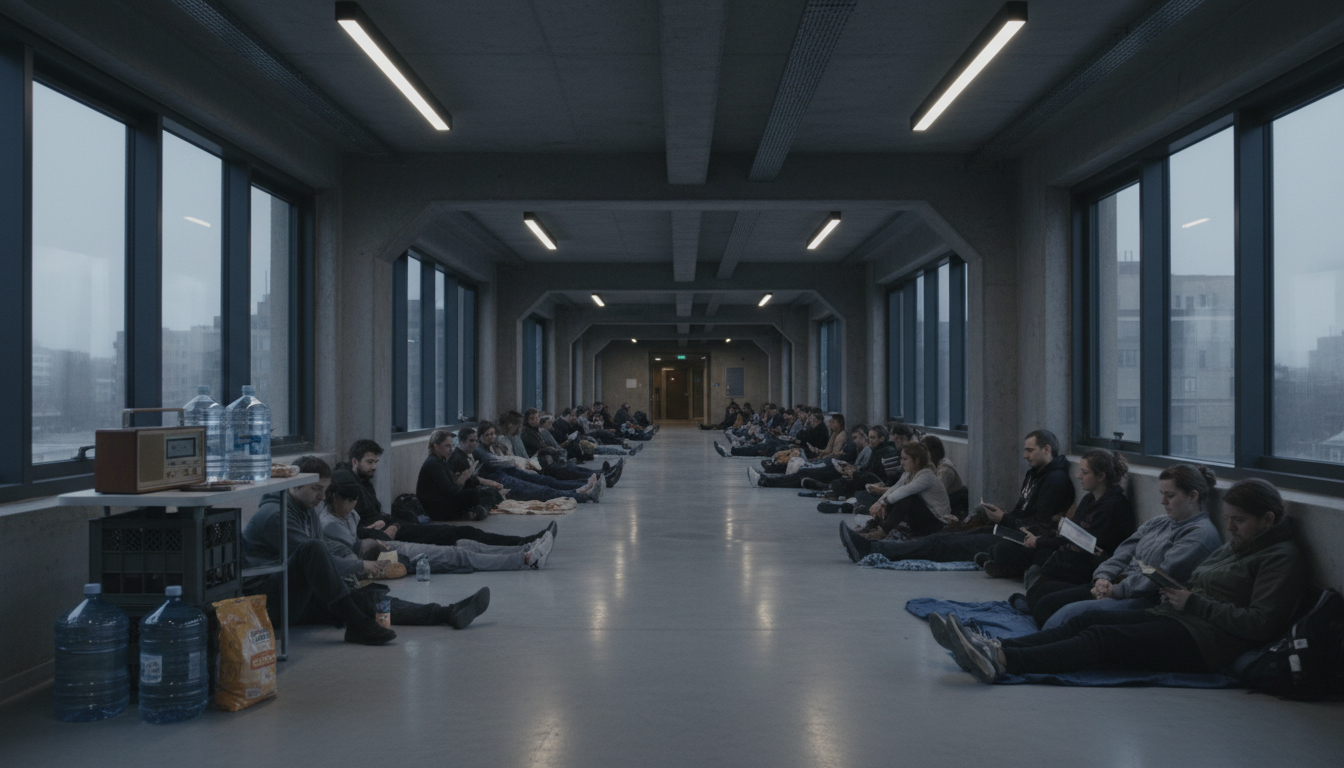
If authorities warn of radioactive fallout, get inside a substantial building as quickly as you safely can, move to a basement or central interior area away from exterior walls, roof and windows, close exterior openings, and follow official emergency instructions. If you were outdoors, carefully remove potentially contaminated outer clothing and wash exposed skin. Do not drive around to find family members, do not take potassium iodide unless specifically instructed by public-health authorities, and do not assume that a mask alone can protect you from radiation.
This first-24-hours playbook explains the choices a household may face after a nuclear detonation or another serious radiological release: choosing shelter, reducing contamination, protecting children, using safe food and water, obtaining reliable updates and knowing when not to leave. It is a hypothetical preparedness guide, not an assessment that a nuclear incident is likely or imminent in Singapore. Real events vary enormously; the instructions of emergency officials at the scene take priority over general advice.
- If a nuclear flash or blast occurs nearby, protect yourself immediately from the blast effects, then reach shelter as soon as you safely can.
- Get inside a sturdy building, preferably concrete or masonry; an interior room or suitable basement offers greater shielding than a car or open air.
- Close windows and exterior doors and turn off systems bringing outside air indoors if possible.
- If exposed outdoors, remove outer clothing carefully, bag it away from people, and gently wash skin and hair.
- Stay inside and monitor verified authorities. The first 24 hours are especially important, but do not leave at 24 hours unless told it is safe.
- Use sealed drinking water and food already inside or in closed packaging; do not assume boiling removes radioactive contaminants.
- Do not self-medicate with iodine, table salt, supplements or other supposed radiation remedies.
- If the building is on fire, collapsing or otherwise immediately life-threatening, move to a safer shelter and seek emergency guidance.
Quick information: three actions that protect people
The US Centers for Disease Control and Prevention summarises radiological emergency response as get inside, stay inside, stay tuned. See its Radiation Emergencies response guidance. A building provides shielding; time indoors lets the most hazardous early fallout weaken; and verified instructions help people avoid a dangerous journey into contamination.
If you live in Singapore, treat this page as general education drawn from radiation emergency preparedness materials. It does not identify a Singapore-wide designated fallout shelter, and it must not be read as a map of safe places. In a real event, follow the relevant Singapore government, emergency-service and civil-defence directions for your exact location.
What is nuclear fallout and why does the first day matter?
A nuclear detonation creates several distinct dangers. Near the blast, heat, pressure, flying debris, fires and initial radiation can cause severe injury. Fallout is different: radioactive particles may be carried by the atmosphere and settle on surfaces, people and buildings after the explosion. The highest risks and geographical impact depend on many factors, including location, weather, terrain, detonation characteristics and shelter quality.
You do not need to calculate a radiation dose from a social-media map in order to take the first protective step. If officials warn of fallout or there is credible reason to believe radioactive material may be approaching, seek indoor shelter. A brick or concrete multi-storey building or basement generally provides better protection than being outdoors or in a car.
The CDC advises that staying indoors for at least 24 hours may protect people during a radiation emergency because radioactive materials become weaker with time. However, 24 hours is not an automatic all-clear. Real evacuation and release decisions must be made from measured conditions and official advice. An incident involving a different radioactive source may require a different response.
First seconds near a nuclear explosion: protect against the blast
If a detonation occurs and you are close enough to see an intense flash, immediately turn away and cover your eyes rather than stare at it. The CDC’s nuclear blast FAQ advises dropping to the ground face down and remaining flat until the blast effects pass. This may reduce injury in some circumstances, but survival near the centre of a large explosion cannot be guaranteed by any simple posture.
Once the immediate blast danger has passed and you can move, find the nearest intact substantial building rather than staying in the open to record video. Avoid damaged structures, spreading fires, fallen cables, blocked entrances and unstable debris. A sturdy building that is close enough to reach safely is more useful than a theoretically ideal shelter several kilometres away.
If you have not experienced the blast but receive a credible fallout warning, do not waste time looking for the cloud. Radiation is not reliably visible, and radioactive dust need not look unusual. Act on official directions rather than attempting to identify it with your eyes.
The first ten minutes: enter the best nearby shelter
- Move indoors promptly. A basement or central area of a substantial intact building is preferable where accessible and safe.
- Avoid exterior walls, windows, roofs and open stairwells when a more protected interior space is available.
- Bring children and pets already with you inside, but do not go back outside for belongings or to collect distant relatives.
- Shut exterior doors and windows and reduce outside-air intake if possible; do not interfere with essential life-safety systems.
- If you entered from outdoors, remove potentially contaminated outer layers without shaking them; place them in a bag or closed container away from occupants.
- Wash exposed skin gently and change into clean clothing when available. Seek specific instructions if you have significant injuries or contamination.
- Switch on a battery radio or other official emergency-information source, conserve phone power and send a short location message if communications are available.
The goal is a shelter that works right now. Someone may ask whether a particular train station, civil-defence shelter or basement is automatically suitable. Do not assume that every underground place is accessible or safe: entrances can be damaged, flooded, locked, crowded or affected by the incident. Choose according to credible local instructions and actual structural conditions.
Why the middle of a building is safer than the window
Radiation from settled fallout can be reduced by distance and shielding. The exterior surfaces of buildings may collect particles. More material between you and those surfaces can lower exposure. That is why emergency guidance favours central interior rooms, basements and substantial construction over balconies, top floors directly under a roof or vehicles parked outside.
An interior room does not need to resemble a movie bunker. The priority is solid surrounding material, separation from outer surfaces, and keeping contaminated dust from being carried into shared spaces. Curtains, plastic bags and ordinary clothing are not equivalents to concrete shielding. You should not spend precious minutes building a flimsy structure while a safe interior room is already accessible.
If your existing building is unstable, heavily damaged or burning, remaining there can be more dangerous than moving. The proper response is to seek a nearby intact shelter or follow a safer emergency route, even though unnecessary outdoor travel is otherwise discouraged.
If you were outdoors: the decontamination steps
Step 1: remove outer clothes carefully
According to the CDC self-decontamination guidance, removing an outer layer can remove up to 90% of radioactive material deposited on clothing. Handle garments gently so dust does not spread, place them in a sealable bag and keep that bag away from people and pets until officials advise disposal.
Step 2: wash exposed skin and hair
Use soap and lukewarm water to wash gently. Do not scrub, scratch, scald or irritate the skin. Wash hair with shampoo or soap if available, and do not use conditioner during decontamination because it can make radioactive material stick to hair. Protect cuts from contamination and seek medical advice about significant wounds.
Step 3: if there is no shower
Use a sink to clean hands, face and other uncovered areas. If running water is unavailable, use a damp clean cloth or moist wipe, including around the eyes, nose and ears. Contain used wipes in a bag away from others. Changing into clothing stored inside and away from contamination is preferable.
Step 4: keep the shelter clean
People who entered from outside should try to keep contaminated outerwear away from food, bedding and shared surfaces. Wipe surfaces with a damp cloth if advised, and handle the cloth as potentially contaminated waste. There is no reason to sprinkle chemicals, scrub a whole apartment with corrosive cleaners or repeatedly send someone outdoors.
The first hour: divide the family into tasks
One adult checks shelter integrity and external openings. Another checks people for injuries, medication needs and missing household members. A third person, if present, monitors official instructions. Children can help by staying together, keeping a torch available and not opening the external door. Assign a single communications lead so several people do not drain their phones with repeated speculative messages.
Take a headcount without treating every missing relative as an immediate rescue mission. A child at school, a person at work and a resident in another building may be safer staying indoors where they already are. The CDC advises people not to leave their shelters to retrieve loved ones from schools, daycares or other institutions during a radiation emergency. Their staff and responders will have directions appropriate to the setting.
If someone is seriously injured, obtain emergency medical guidance and give appropriate first aid where safe. A severe wound, trouble breathing or unstable building changes the urgency. Sheltering guidance is not an instruction to ignore immediate threats to life.
The first six hours: manage time, information and contamination
A sheltering household should resist the urge to open the door for a look. Outside conditions are not reliably assessed by sight or smell. Rely on confirmed public alerts and professional radiation measurements. Images of a cloud, strange colour in the sky or a panic message from another country are not substitutes for local radiation instructions.
Preserve phone batteries and keep a battery-operated radio available where practical. Record the time and content of major official notices. If the network is crowded, concise text messages can be more practical than lengthy calls. Use emergency numbers for life-threatening situations rather than repeated requests for forecasts.
Keep everyone hydrated with suitable supplies and maintain essential medicines. Provide a quiet area for children or anyone distressed. High anxiety can make a family repeatedly change shelter rooms, open doors or seek reassurance outside. A simple plan and a reliable update schedule help prevent those harmful impulses.
Food, drinking water and medicine: what is safe?
The CDC’s Food, Drinking Water and Medicine Safety guidance explains that sealed food and drinks, and items that were already safely inside, can generally be used. Wipe potentially contaminated outer packaging before opening it. Avoid fresh food exposed outdoors until authorities determine it is safe.
Sealed bottled water is a strong emergency supply. Boiling water does not remove radioactive materials. Authorities may test water supplies and issue drinking-water guidance; follow that guidance rather than assuming all tap water is safe or unsafe. CDC guidance says tap water can be used for washing and decontamination even when bottled water is preferred for drinking.
Continue essential prescribed medicines unless medical advice says otherwise. If a medication container was outdoors, wipe its exterior as recommended. Do not stop a critical therapy merely because the situation feels abnormal. If a life-sustaining device loses power, seek its specific backup or emergency support plan.
Why taking iodine tablets on your own can be harmful
Potassium iodide, often abbreviated KI, is not a general radiation shield. It protects the thyroid against certain exposures to radioactive iodine, not against external radiation or all radioactive materials. It has limits, timing considerations, contraindications and adverse effects. Taking it for no indicated reason can be harmful.
The CDC KI guidance says to take potassium iodide only when instructed by public-health or emergency-response officials or a healthcare provider. Ordinary iodised salt, supplements and iodine-rich foods are not substitutes. Do not rely on an online pill-dose table, stockpile dangerous quantities or give tablets to a child based on a rumour.
During a real incident, authorities will consider what radioactive material is involved, where exposure occurred and which groups may benefit. That judgement cannot be made from the name ‘nuclear emergency’ alone. Shelter and verified instructions remain the first actions.
What if you are in a vehicle when the warning arrives?
A car is not an adequate fallout shelter. It offers much less shielding than a substantial building. If a safe building is accessible, enter it promptly. Close vehicle windows while relocating to nearby shelter, avoid contaminated dust where possible and do not keep driving toward home across an uncertain affected area.
If roads are damaged or unsafe, do not make a reckless journey. Contact responders for advice and use the safest available immediate protection while identifying an intact building. A travel plan must account for fire, debris, flooding, traffic and radiation warnings together; the instruction to ‘drive as far as possible’ is not reliable.
What if someone is outside your locked building?
Protecting others and keeping the shelter cleaner are compatible. The CDC notes that offering shelter to someone outdoors can save a life. If it is safe to admit someone, guide them to remove their outer layer, wash exposed skin and change before entering shared clean areas. Keep the contaminated clothing contained.
Do not turn strangers away automatically because you think radioactive exposure makes a person radioactive forever. External contamination is material that can be removed; exposure alone does not make someone a source of contamination. There may still be real needs for medical assessment or specific decontamination precautions.
If the building cannot admit people safely or is itself damaged, contact responsible personnel or responders rather than improvising a dangerous rescue. The priority is avoiding new casualties while following official emergency arrangements.
Children, schools and separation anxiety
A nuclear emergency is an especially difficult subject for children because they may imagine images from films. Give a simple instruction: ‘We are staying inside because the building helps protect us. We will listen for the next official update.’ Explain that school staff will look after children who are at school and that adults should not travel through a hazard to reunite immediately.
Keep ordinary caregiving wherever possible: water, a familiar blanket, a story and a calm adult voice. Do not stream graphic incident footage repeatedly. If a child asks whether everyone will die, neither dismiss the fear nor pretend to know the outcome. Say what the family is doing to reduce risk and what information is not yet known.
For infants, pregnant people, residents with disabilities or those needing regular medicine, check their immediate needs without inventing special treatments. The correct medical advice depends on the person and the actual hazard. Ask health professionals when urgent or specific guidance is required.
First-night shelter routine
- Set a safe place for people to sit or sleep away from outside walls and potentially contaminated belongings.
- Use battery lighting and keep pathways uncluttered; do not use open flames in confined spaces.
- Maintain access to a toilet and handwashing supplies where available.
- Keep drinking water, sealed food and essential medicine within reach.
- Use a phone or radio to check verified official instructions periodically, rather than continuously.
- Write a brief record of household health concerns, symptoms, medicines and known contacts.
- Avoid unnecessary trips to outside doors, balconies, roofs or vehicles.
- Stay alert to fire, structural damage, urgent medical deterioration or official evacuation instructions.
A family does not improve its safety by staying awake all night watching speculation. Rest, hydration and a reliable division of tasks matter, particularly when children or older family members need support. If officials instruct you to move, follow the verified route rather than your own assumption about the prevailing wind.
When is it safe to leave after 24 hours?
There is no universal hour when everybody can go outdoors. Radiation levels and hazards change with location, weather, source and time. The CDC advises people to stay indoors until emergency officials say it is safe, unless a life-threatening condition or unsafe building requires movement. A decision to evacuate may depend on measured contamination and routes organised by responders.
Do not treat the 24-hour mark in this title as a promise. It is a planning focus on an especially consequential early period. Some people may receive instructions to remain sheltered longer, others to evacuate earlier or move for medical reasons. The safest choice is conditional on credible information.
Four scenarios: what would you do?
Scenario 1: you are at work and your child is at school
The first instinct is to leave and collect the child. During a fallout warning, this may expose both parent and child to greater danger. Shelter where you are, follow the workplace plan and obtain official school communications. Arrange reunification only when the authorities say it is safe.
Scenario 2: you live near the top of a tall apartment block
An external wall and roof may offer less shielding than a central interior or lower appropriate level. If the building is intact and routes are safe, move to a more protected interior space as advised. Do not take a risky journey through open courtyards to reach a different building purely because its name sounds more secure.
Scenario 3: somebody says bottled water has run out
Review all sealed supplies already inside, and follow official water notices. Boiling does not remove radioactive materials. The CDC gives separate guidance for washing and drinking water, so do not refuse essential washing simply because bottled drinking water is preferred. Seek authorised supply information when communication is possible.
Scenario 4: a relative wants to take iodine supplements
Explain that potassium iodide is not a universal protective drug and can cause harm when used without indication. Do not administer iodine products as a substitute for shelter. Wait for explicit public-health instructions on whether KI is appropriate.
A compact emergency ready bag for a sheltering household
- A battery-operated torch, spare batteries and battery-operated radio.
- A charged power bank, charging cables and paper emergency contact details.
- Sealed drinking water, familiar non-perishable food and a manual can opener if needed.
- Essential prescribed medicines and a brief list of medical or accessibility needs.
- First-aid supplies, tissues, soap, wipes and disposable bags for contaminated outer clothing.
- Spare clothes stored protected indoors, including supplies for children and infants.
- Necessary identification, family contact and insurance records in protected form.
- Pet supplies and information needed if an authorised evacuation is later announced.
The Singapore Civil Defence Force Ready Bag guidance is a practical starting point for general emergency preparation. A ready bag helps with portability, but a radiation shelter also depends heavily on the building itself. Buying expensive equipment does not replace choosing a safer room and following official instructions.
A four-week preparation plan without alarmism
Week 1: identify practical shelter choices
Look at the building where you spend most time—home, school or workplace. Identify interior spaces away from outside windows and who manages access during an emergency. Do not enter restricted areas, assume official designation or create hazards by altering shared spaces.
Week 2: prepare information and family contacts
Write down one out-of-household contact, school emergency procedures, employer instructions and the basic ‘inside, stay, tuned’ rule. Explain to children that people in different buildings should remain with the responsible adults until officials advise otherwise.
Week 3: gather ordinary supplies
Refresh the portable ready bag with a torch, radio, water, sealed food, hygiene items and necessary medicines. Remove outdated batteries and expired products. Resist frightening shopping lists that make ordinary families feel they need a private bunker.
Week 4: practise calm decision-making
Discuss a hypothetical warning without performing a dangerous physical drill. Ask: ‘Where would we go inside? What if we were outside? Who would monitor official news? What would make us leave?’ The key is remembering a small number of safe actions under pressure.
Frequently asked questions
Should I leave the city immediately after a nuclear warning?
Not automatically. Outside travel may increase fallout exposure and create traffic or other hazards. Get into a substantial building promptly, remain sheltered and follow official evacuation instructions. If your current building is immediately dangerous, seek the nearest safer option.
Is my car an acceptable fallout shelter?
A vehicle provides limited shielding against fallout. CDC guidance recommends entering a substantial building such as a brick or concrete multi-storey structure or basement as quickly and safely as possible.
Does a medical mask block nuclear radiation?
No. A mask may reduce inhalation of some dust in certain circumstances, but it is not a radiation shield. Distance, structural shielding, decontamination and official guidance are the central protective actions.
How long should I stay indoors?
The CDC advises staying indoors for at least 24 hours in many radiation emergencies, until officials provide further guidance. The first-day period is not an automatic all-clear. Duration depends on actual measured conditions and the nature of the incident.
Can I boil water to remove radioactive contamination?
No. Boiling does not remove radioactive materials. Use sealed drinks or sources authorised as safe by public-health officials. Tap water can generally still be used for cleaning and decontamination under CDC guidance.
Can I take potassium iodide tablets just in case?
Do not take KI unless instructed by public-health or emergency officials or a healthcare provider. It is not a general radiation remedy and can cause side effects. Table salt and dietary iodine supplements are not substitutes.
What if I was outside when fallout arrived?
Get indoors, carefully remove potentially contaminated outer clothing, contain it and wash exposed skin and hair with soap and water. Avoid vigorous scrubbing or shaking contaminated clothing; follow any specialised local decontamination guidance.
Should I collect my child from school?
In a radiation emergency, the CDC generally advises sheltering where you are rather than travelling to collect children from schools and childcare centres, whose staff have emergency procedures. Follow the institution and local responders’ specific instructions.
What if my shelter has broken windows or fire?
A seriously damaged or burning building may be unsafe. Seek a nearby intact structure through the safest available route, and follow emergency directions. Sheltering guidance does not require staying in a building that is about to collapse or burn.
Can I safely eat food that was already inside?
CDC guidance says sealed food and food already stored inside away from contamination are generally safe. Avoid fresh food exposed outside until clearance. Wipe any possibly contaminated external packaging and follow official food and water advisories.
Is radiation exposure the same as radioactive contamination?
No. Exposure means radiation reached a person; contamination means radioactive material is on or in the person. Removing outer clothing and washing can reduce contamination but cannot undo radiation exposure already received.
What should I do if someone has vomiting, burns or breathing trouble?
Seek medical guidance, especially if severe symptoms, injuries or emergency warning signs occur. Provide appropriate first aid while minimising exposure, and follow authorities on safe movement to medical services. Do not attempt unverified radiation cures.
A short reminder about why preparations should remain proportionate
Radiological emergencies are serious, but a hypothetical planning page should not cause people to assume one is currently unfolding. Reusing an ordinary portable ready bag and knowing the difference between sheltering and evacuation are valuable for many emergencies. Do not purchase unsafe chemicals, attempt to build structural shielding without proper assessment or tamper with public facilities because of a frightening rumour.
The most protective habit is learning to change course when authoritative instructions change. A family may initially shelter, later be told to move, or be directed to medical screening. Those are different stages of one response, not contradictions. Keep the plan factual, portable and responsive to verified incident-specific advice.
The four-part Black Swan and Doomsday survival series
Choose the playbook that addresses the risk you actually face. A crisis can involve more than one problem, so keep related guides accessible without treating every scenario as equally likely.
Reliable official guidance
- US CDC — What to Do in Radiation Emergencies.
- US CDC — Get Inside.
- US CDC — How to Self-Decontaminate.
- US CDC — Food, Drinking Water and Medicine Safety.
- US CDC — Potassium Iodide: When and Why Not to Take It.
- US CDC — Nuclear Blast FAQ.
Continue reading on emergency continuity
A severe radiological emergency may also interrupt electricity, transport and communication. Read How to Survive a Black Swan Power Grid Failure for practical household continuity, and The Gold Standard of Scenario Planning for the broader idea of making decisions under uncertainty.
The essential message: do not let the word ‘doomsday’ replace a useful plan. A sheltering family needs a sturdy interior place, clean clothing, safe supplies and reliable official instructions. Get inside, stay inside and stay tuned. The right moment to move is determined by real conditions and authorised guidance, not by fear or a countdown.