
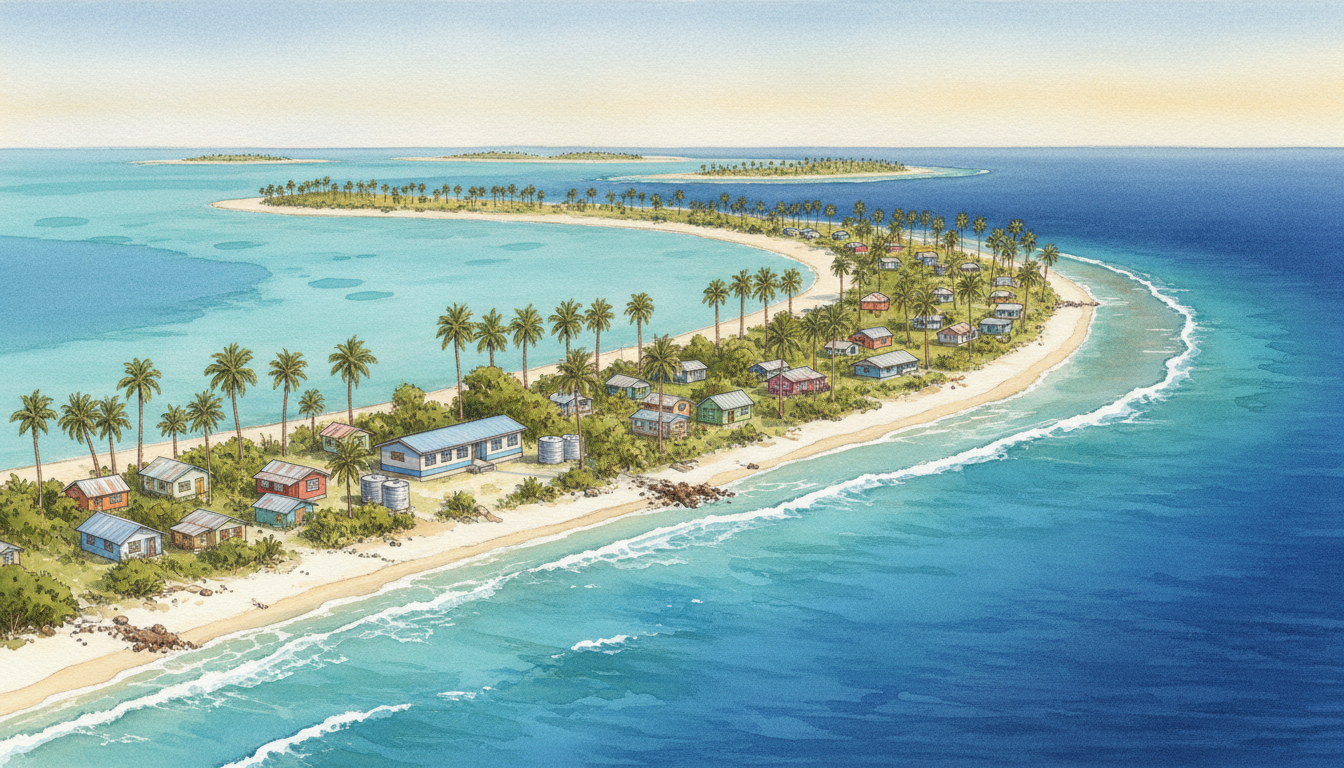
How does Tuvalu work? Tuvalu is an independent Pacific island country whose Parliament, community institutions, fisheries, water systems, transport and international partnerships support everyday life across nine islands. Understanding climate adaptation means understanding sovereignty and the choices of Tuvaluans as well as sea level.
This is the Tuvalu entry in How Countries Work — A–Z Guide to 195 Countries. The guide follows real services, explains the Australia–Tuvalu Falepili Union and distinguishes current facts from planned projects.
Tuvalu at a glance
Official name: Tuvalu. Capital: Funafuti. Region: Central Pacific Ocean. Islands: nine low-lying islands spread across a very large ocean area. Government: parliamentary democracy and constitutional monarchy, with the king as head of state represented by a governor-general. Currency: Australian dollar, alongside locally issued coins. Key systems: fisheries, shipping, freshwater, schools, healthcare, energy, telecommunications and climate adaptation.
Imagine a child’s school needs a new water tank. The tank must be chosen, funded, transported across the ocean, installed and maintained. A country’s geography becomes very practical when the ocean separates communities and rainwater cannot always be taken for granted.
How does Tuvalu work in one minute?
Tuvalu is an independent Pacific state whose people live on nine small, widely dispersed islands. National institutions make laws and manage budgets, while island communities and services address local needs. Fisheries, international assistance, remittances, transport and government activity help support the economy.
Climate change and sea-level rise create serious challenges, but Tuvalu is not simply a country waiting to disappear. Its people, government and partners are working on adaptation, continued sovereignty and choices for future generations. A treaty with Australia explicitly recognises continuing Tuvaluan statehood despite sea-level rise.
Where exactly is Tuvalu?
Tuvalu lies in the Pacific northeast of Australia and includes islands and atolls separated by long stretches of ocean. Funafuti is the capital, and other island communities have distinct transport and service needs. Land area alone gives a misleading picture of national distance.
An island resident’s access to a hospital, secondary education or imported goods may depend on boat or air connections. When a ship is delayed, problems can appear simultaneously in shops, building projects and clinics. The transport network is therefore part of the social infrastructure.
Why are Tuvalu’s islands so low?
Many of Tuvalu’s islands are coral atolls or low-lying reef islands. Their small elevation makes them vulnerable to coastal flooding, wave overtopping, erosion and saltwater effects. Geography, ocean conditions, land management and climate change all interact.
Not every shoreline changes identically, and physical land-area changes do not on their own show whether a settlement is safe or whether groundwater remains drinkable. A careful account measures exposure, habitability and locally available adaptation rather than relying on one dramatic photograph.
Who governs Tuvalu?
Tuvalu is a parliamentary democracy within the Commonwealth. The king is head of state and is represented locally by a governor-general. The prime minister leads the government, and Parliament makes laws and exercises oversight under constitutional procedures.
This is not a government run directly from London or Canberra. Tuvalu is an independent sovereign state. The distinction between head of state, head of government, elected representatives and public-service agencies matters when following responsibility for a budget or local infrastructure programme.
How does Tuvalu’s Parliament work?
Members of Parliament represent island constituencies under the country’s electoral arrangements. The prime minister is chosen through parliamentary processes, and Cabinet oversees public policy. Tuvalu’s small population does not make its constitution, laws or diplomatic rights any less real.
For a clinic repair or new desalination project, follow the decision from policy and appropriation through contracting, island implementation and maintenance. The last step is usually where success is most visible to residents.
How do island councils and communities fit in?
Island-level administration and community organisations help identify local priorities and coordinate activities. Families, churches and community structures also contribute to everyday social life, while national institutions retain legal and financial responsibilities under the country’s framework.
Local knowledge is particularly important for water, coastal conditions and transport. A successful project should involve those who will use and maintain it. Consultation is not a substitute for engineering or funding, but ignoring it can result in equipment that fails to fit actual island needs.
Where does Tuvalu get drinking water?
Rainwater harvesting is crucial on many islands, with storage tanks and community arrangements supporting supply. Fresh groundwater can be limited or vulnerable to salinity and contamination. Desalination and water deliveries can provide additional support in some circumstances.
A roof, gutters, storage tank, safe handling and maintenance form one system. If one part is dirty or damaged, the water may be unsafe despite adequate rainfall. Households and public services need clear guidance on water safety and emergency reserves.
Why does drought matter even in the Pacific?
Rainfall varies, and periods of low rain can empty tanks and pressure scarce supplies. Drought is especially challenging when an island cannot simply divert water from a large river. Safe reserves, water-saving measures and robust supply options are important.
An expensive emergency water shipment may keep services operating but is not the same as a permanent solution. A long-term plan also needs leak prevention, water-quality management, energy provision and regular repair budgets.
How does sea-level rise affect daily life?
Rising sea level can increase coastal flooding and the effects of high tides or waves, threaten infrastructure and affect groundwater. Because islands are low-lying and narrow, setbacks that would be available in a large country may be limited.
Climate adaptation involves coastal engineering, improved land use, safer housing, water resilience, environmental monitoring and protection of cultural sites. Tuvaluans should be described as decision-makers and experts in their own lives, not merely passive recipients of aid.
Does climate change mean Tuvalu will stop being a country?
No automatic legal conclusion like that follows. Article 2 of the Australia–Tuvalu Falepili Union treaty explicitly recognises that Tuvalu’s statehood and sovereignty will continue despite climate-related sea-level rise, along with the rights and duties associated with statehood.
The treaty entered into force on 28 August 2024. This matters because sovereignty, citizenship and international rights are distinct from a short-term measurement of a coastline. Tuvalu also continues to work internationally on broader recognition and protection of statehood.
What is the Australia–Tuvalu Falepili Union?
The Falepili Union is a bilateral relationship with Australia centred on climate cooperation, security, development and a special mobility pathway. ‘Falepili’ reflects traditional values associated with good neighbourliness, care and mutual respect. The treaty was signed in November 2023 and entered into force in August 2024.
It is not a merger of the two countries. Tuvalu remains independent, and the treaty recognises its sovereignty. The agreement reflects commitments made by both states; the details of programmes and implementation should be read in the source documents.
Can Tuvaluans move to Australia under the treaty?
The treaty supports a special visa pathway through which eligible Tuvaluan citizens may be able to live, work and study in Australia. This creates additional personal choices and opportunities for skills, income and family support, but it is not an automatic right for every person to enter without application.
The inaugural mobility ballot opened in June 2025 for up to 280 visa places; yearly numbers and procedures can change by agreement. People seeking to apply must consult current official Australian immigration guidance rather than assume that older ballot dates or criteria remain valid.
Why do Tuvaluans want to stay as well as have mobility options?
Land, language, families, culture and community identity are deeply important. Climate adaptation aims to help people continue living safely in their homeland, while voluntary mobility can provide opportunities and a choice for those who wish to move.
Presenting migration as the only possible solution overlooks work on land reclamation, coastal protection, water security and infrastructure. A dignified approach respects both the choice to stay and the choice to seek opportunities elsewhere.
How does Tuvalu earn money?
Public revenue and the wider economy include fisheries-related income, public services, external grants and other sources. Domestic opportunities include small-scale trade, fishing and local services. Families may also benefit from money earned abroad.
Small economies can be sensitive to changes in international agreements, climate shocks and transport costs. Financial sustainability matters because a school or clinic needs recurring operating budgets, not merely money for its initial building.
Why are fisheries important?
Tuvalu’s maritime area is vast compared with its land. Fisheries rights, licensing and regional cooperation can support state revenues. But a large ocean area does not mean every family operates a commercial fishing vessel.
Managing fish stocks depends on monitoring, conservation, international agreements and responsible enforcement. Income from fishing access is a public finance question; food security for local households is a related but separate issue.
Why are shipping and air connections essential?
Ships and flights carry people, food, fuel, equipment and medicines. Distances and schedules make delivery expensive or irregular. Small island demand can mean that a single missing component delays an important repair.
Public planning can reduce risk through sensible stocks, reliable port equipment, safe vessel operations and contingency plans. A transport timetable is also an education and health document when patients or students depend on the journey.
How does Tuvalu get electricity?
Electricity systems may combine diesel generation, solar technology and storage according to island needs. Fuel imports are costly, and renewable systems can reduce some dependence on shipping but still need maintenance and technical support.
A solar installation is not a complete energy strategy. Batteries, spare parts, grid stability, weather resilience, billing and trained technicians matter. For an outer-island clinic, the measure of success is whether medicines stay safely cold and lighting remains available.
What role do telecommunications play?
Communications help islanders contact family, conduct public administration, use digital services and receive emergency warnings. Connectivity may involve submarine cables, satellite links and local networks. Access and performance differ across islands and over time.
An internet connection becomes useful when people can afford and safely use services. Schools also need devices, teachers and appropriate learning materials; a cable landing cannot automatically improve comprehension in the classroom.
How do schools work across widely separated islands?
Education relies on teachers, school facilities, learning materials and sometimes travel or boarding arrangements for students seeking programmes not available on their home island. Language, family support and safe communications matter as much as buildings.
A student’s chance to continue learning should not depend solely on whether their island has a full range of specialist subjects. Planners need to consider teacher support, connectivity, transport costs and reliable assessment of learning.
How does healthcare reach outer islands?
Healthcare can involve island health facilities and referrals to more specialised services. Transport delays, medicine supply, sanitation and emergency communication can make a large difference. A clinic must function within an island’s wider infrastructure.
Good service design includes dependable water, refrigeration, essential medicines, staffed facilities and clear patient-referral arrangements. A new building alone does not guarantee good care across a dispersed archipelago.
Worked example: getting a water tank to an outer-island school
Imagine a school reporting that its rainwater storage leaks. The school and island authorities confirm the fault, a supplier provides a suitable tank, a shipment crosses the ocean, installers secure it, and staff learn cleaning and inspection routines.
This is an illustrative example rather than a record of a named school. A useful evaluation asks whether water is safe after installation and whether the school can arrange repairs a year later. The answer connects procurement, shipping, health and education.
Worked example: how a fisheries licence becomes a public service
Imagine a lawful foreign fishing operation paying a licence fee under a relevant arrangement. Revenue enters public finance, Parliament considers national expenditure, an agency procures equipment, a vessel carries it to an island, and local technicians install it.
The chain shows why fishing licences, budgets, audit rules and maintenance matter to residents. Government revenue does not instantly become a functioning hospital freezer or working classroom; each stage must succeed.
How should students compare Tuvalu and other island countries?
Compare Tuvalu with Kiribati or the Maldives by asking where freshwater comes from, how supplies reach different islands and how residents manage climate risks. Similar geography can produce different policies, budgets and levels of access.
Use dated evidence. Avoid statements implying that everyone has already migrated, that the country has no future, or that a treaty has merged it into another state. Its people retain agency, culture and sovereign institutions.
Frequently asked questions about Tuvalu
Where is Tuvalu? In the central Pacific, northeast of Australia.
What is Tuvalu’s capital? Funafuti.
How many islands does it have? Nine.
What currency is used? Australian dollar, with local coins also issued.
Is Tuvalu still independent? Yes.
What is the Falepili Union? A treaty-based partnership with Australia covering climate cooperation, security and mobility.
Does the treaty guarantee Australian residence for all citizens? No. The mobility programme has eligibility and application requirements.
Why is freshwater so important? Low-lying islands have limited and vulnerable natural freshwater resources.
Does the treaty protect continued statehood? It explicitly recognises that Tuvalu’s statehood continues notwithstanding climate-related sea-level rise.
Sources and connected guides
Authoritative sources: Australian DFAT — Tuvalu country information, Australia–Tuvalu Falepili Union treaty overview and the full treaty text. Always check current immigration instructions separately from the treaty’s principles.
Continue at How Countries Work A–Z and compare with How Kiribati Works — Atolls, Ocean and Freshwater.