
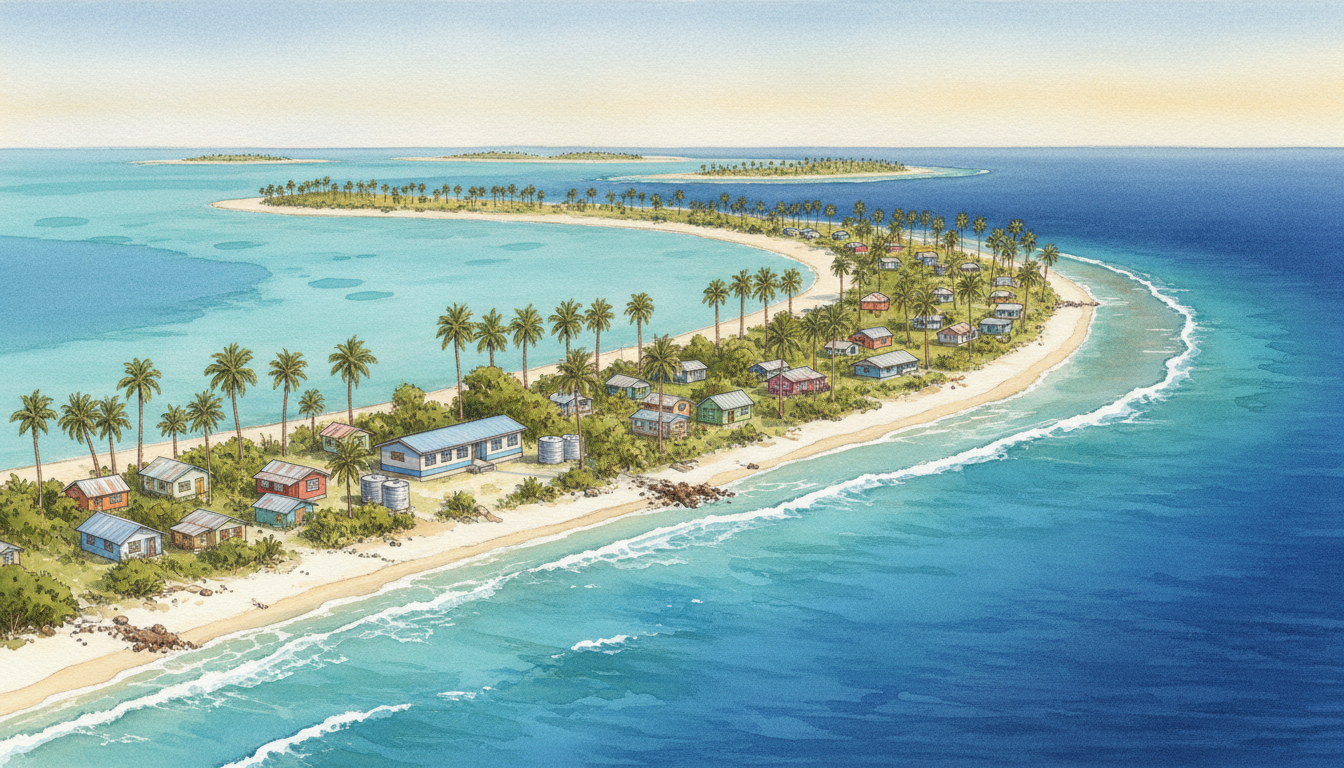
Tuvalu is a low-lying Pacific island nation with Funafuti as its capital. Its nine islands depend on shipping, fishing revenue, rainwater collection and climate adaptation.
To understand how the country works, follow an ordinary family through government rules, budgets, transport, water, energy, education, healthcare and jobs. An announcement is only a beginning; delivery and maintenance determine the outcome.
Quick answer
Tuvalu is a low-lying Pacific island nation with Funafuti as its capital. Its nine islands depend on shipping, fishing revenue, rainwater collection and climate adaptation.
1. Constitutional monarchy and parliament
Tuvalu is a parliamentary constitutional monarchy. Its prime minister leads government, while parliament makes laws and scrutinises spending.
For a practical test, identify the responsible institution, funding, infrastructure and workers. Then ask what a household actually experiences and whether that outcome can be verified.
2. Nine islands and transport
Funafuti, Nanumea, Nanumaga, Niutao, Nui, Nukufetau, Nukulaelae, Vaitupu and Niulakita are connected through sea and limited air services. Transport reliability affects schools, healthcare and trade.
For a practical test, identify the responsible institution, funding, infrastructure and workers. Then ask what a household actually experiences and whether that outcome can be verified.
3. Climate and sea levels
Coastal flooding, saltwater intrusion, storms and drought threaten low-lying land. Adaptation involves coastal protection, land-use planning and water security.
For a practical test, identify the responsible institution, funding, infrastructure and workers. Then ask what a household actually experiences and whether that outcome can be verified.
4. Water supply
Rainwater harvesting, tanks and supplementary desalination support supply. Drought preparedness and maintenance are essential.
For a practical test, identify the responsible institution, funding, infrastructure and workers. Then ask what a household actually experiences and whether that outcome can be verified.
5. Electricity
Diesel generation and solar projects supply island grids. Fuel imports, batteries and skilled maintenance affect reliability.
For a practical test, identify the responsible institution, funding, infrastructure and workers. Then ask what a household actually experiences and whether that outcome can be verified.
6. Fisheries and public finance
Tuna fishing access arrangements provide revenue, while the .tv domain also contributes income. Public spending must still be managed transparently.
For a practical test, identify the responsible institution, funding, infrastructure and workers. Then ask what a household actually experiences and whether that outcome can be verified.
7. Schools and healthcare
Outer-island facilities need trained workers, safe buildings, water and medical transport. Specialist care may require overseas referrals.
For a practical test, identify the responsible institution, funding, infrastructure and workers. Then ask what a household actually experiences and whether that outcome can be verified.
8. Digital continuity
Tuvalu has explored digital preservation of national records and culture as part of climate planning. Digital preservation complements, rather than replaces, physical adaptation.
For a practical test, identify the responsible institution, funding, infrastructure and workers. Then ask what a household actually experiences and whether that outcome can be verified.
9. Worked example
A medicine shipment delayed by rough seas can affect a remote clinic. Backup supplies, electricity, communications and contingency planning must work together.
For a practical test, identify the responsible institution, funding, infrastructure and workers. Then ask what a household actually experiences and whether that outcome can be verified.
Frequently asked questions
Where should readers start? Begin with Tuvalu’s government, geography and everyday services. Why do policies change? Laws, budgets, political decisions and economic conditions evolve. How can claims be checked? Use current primary sources and distinguish a proposed reform from a completed project.
Continue exploring
This article is part of How Countries Work, the international companion to How Singapore Works.
Sources and review
Reviewed 20 October 2026. Refer to the World Bank, United Nations and the country’s competent authorities for current data. Worked examples are illustrative.
Continue with the fuller explanation: Read the complete How Tuvalu Works country guide for the institutions, public services and real-world examples behind these quick facts. Browse the How Countries Work A–Z directory for related country studies.