
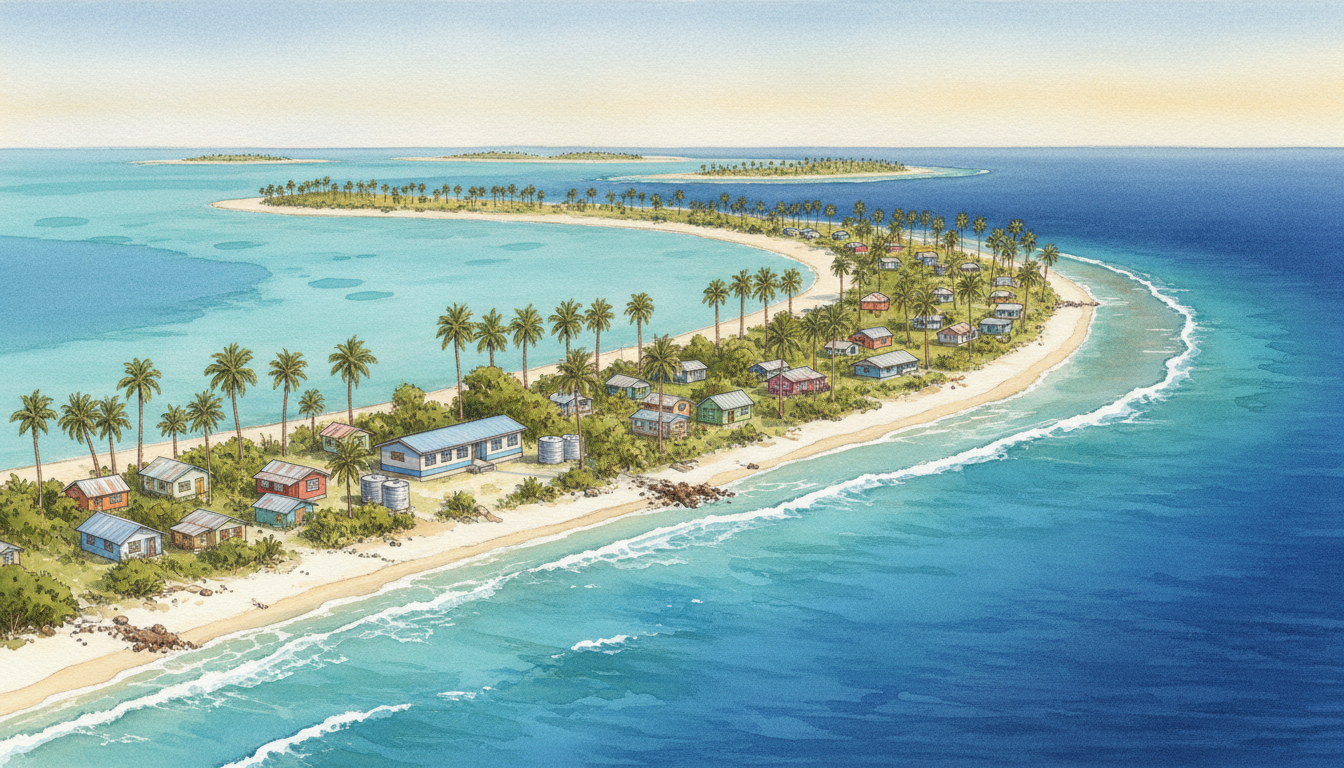
Where is Tuvalu, why is Tuvalu famous for sea-level rise, and can it remain an independent country as the ocean rises? Tuvalu is a sovereign island nation in the western-central Pacific Ocean, in the region called Polynesia. Its capital is Funafuti, a low-lying coral atoll whose narrow inhabited land separates the open ocean from a turquoise lagoon. Tuvalu consists of nine islands—six atolls and three reef islands—spread across an enormous ocean area despite occupying only about 26 square kilometres of land. It is known for its traditional Pacific community life, fishing, ocean stewardship, distinctive .tv internet domain, climate diplomacy, land-reclamation projects and the Australia–Tuvalu Falepili Union treaty, which recognises Tuvalu’s continuing statehood and provides a limited annual permanent-residency pathway for eligible Tuvaluan citizens.
Everything about Tuvalu in one practical country guide: the nation is neither simply a beach postcard nor a place whose people have already surrendered their home. Families live, learn, fish, work, worship and build infrastructure on islands where the highest land is only a few metres above sea level. Fresh drinking water depends heavily on rainfall, storage and carefully managed supplies. Travel between islands requires suitable boats, flights, weather and communications. Government finance is unusually linked to international tuna fishing rights, grants and the .tv domain. Tuvalu’s 2022–23 population census counted 10,643 residents nationally; that is a dated census result, not a live 2026 headcount. In October 2026, Tuvalu also hosted a major Pacific climate meeting and demonstrated raised-land construction intended to strengthen its communities’ future. This article answers the big questions first and connects geography, culture, history, climate, public services, education, law and international relations.
Tuvalu at a glance: the essential facts
- Official name: Tuvalu.
- Continent and region: Oceania, Polynesia, Pacific Ocean.
- Is Tuvalu independent? Yes, an independent sovereign state since 1 October 1978 and a United Nations member since 2000.
- Capital: Funafuti, including the principal inhabited islet Fongafale.
- How many islands? Nine, commonly classified as six atolls and three reef islands.
- Nine islands: Nanumea, Nanumaga, Niutao, Nui, Vaitupu, Nukufetau, Funafuti, Nukulaelae and Niulakita.
- Land area: around 26 km²; its ocean jurisdiction is much larger.
- Population: 10,643 in the national 2022–23 census; the census reported 6,613 in Funafuti and 4,030 on outer islands.
- Languages: Tuvaluan and English have official roles; local varieties and other language traditions also exist.
- Currency: Australian dollar (AUD), with Tuvaluan coins also issued under national arrangements.
- Time zone: UTC+12:00, without seasonal daylight-saving clock changes.
- Government: parliamentary democracy and constitutional monarchy; King Charles III is head of state represented by a governor-general.
- Prime Minister in October 2026: Feleti Teo.
- Independence: 1 October 1978, after the separation of the Ellice Islands from the colonial Gilbert and Ellice Islands arrangements.
- Major public revenue connections: tuna fishing licence fees, development grants, trust-fund income and the
.tvcountry-code domain. - Important household livelihoods: fishing, public and private employment, small trade, food growing, services, seafaring and remittances.
- World Heritage: no property inscribed on the UNESCO World Heritage List as of October 2026. A cultural landscape on its Tentative List does not yet equal an inscription.
- Falepili Union treaty: signed 9 November 2023, in force since 28 August 2024.
- 2026–27 Australian mobility ballot: opened 1 May 2026 and closed 1 June 2026; up to 280 people, including family dependants, may receive places after selection and eligibility assessment.
- 2026 climate event: Tuvalu hosted international delegates on 6 October ahead of COP31, demonstrating new reclaimed and elevated land in Funafuti.
- Core reader question: what does a sovereign country’s everyday life require when its land is small, its ocean vast and its climate risks severe?
The original evidence matters. Tuvalu’s Central Statistics Division publishes the 2022–23 census; Australia’s Department of Foreign Affairs and Trade describes the Falepili treaty; the IMF’s September 2025 report explains the economy; and UNESCO lists Tuvalu’s official heritage status. Counts, projections, treaty rules and construction milestones should always be labelled by source and date.
1. Where is Tuvalu on a map of the Pacific?
Tuvalu lies roughly between Hawaii and Australia, near Fiji, Kiribati, Nauru and other Pacific island states. Its tiny landmasses form a loose north-to-south chain, with substantial ocean distances between communities. The national coastline is not a continuous edge around one big island; it consists of many separate reef and atoll margins. A map that zooms out to display the whole country can make the inhabited islands almost invisible.
Because of that geography, an ocean channel is both a source of life and a transport barrier. Fishing boats provide livelihoods, larger vessels carry supplies, and aviation connects Funafuti with international and some regional routes. What seems like a short straight line between two islands may depend on an infrequent ship, sea conditions and available cargo space. Logistics are therefore not a minor topic; they affect food, medicines, school supplies and public administration.
Is Tuvalu in Australia?
No. Tuvalu is independent. It has close diplomatic, economic and mobility relationships with Australia, and both are members of Pacific regional institutions, but Tuvalu has its own Parliament, constitution, government and international legal personality. The special Falepili pathway provides some Tuvaluans with a legal option to live in Australia; it does not make Tuvalu an Australian territory.
Is Tuvalu part of Fiji or Kiribati?
No. Both are separate sovereign states. Tuvalu was historically linked to the Gilbert Islands under colonial administration, but the islands that became Tuvalu separated before independence. Modern Fiji has different languages, population, geography and institutions. Travel or visa rules in one island country cannot simply be applied to another.
Does Tuvalu have a large ocean area?
Yes. Its exclusive economic zone and associated maritime jurisdiction cover vastly more area than the 26 km² of dry land. Fisheries, marine environments and international maritime law are central to national revenue and stewardship. The right to manage marine resources is a major economic asset even if a map of land alone makes the country look tiny.
What is an atoll?
An atoll is a coral-reef and island system commonly surrounding a lagoon, formed over long geological timescales around subsiding volcanic foundations. Atoll land is often low, narrow and made of coral-derived materials rather than extensive rock or deep mountain soil. Its ecology includes reefs, lagoon and ocean habitats, vegetation and porous ground. A narrow strip of land may have the lagoon on one side and open ocean surf on the other.
Why does a small national land area make infrastructure harder?
A hospital, airport runway or school requires space, suitable foundations, access and protection. An island settlement cannot easily expand inland to higher ground when no high inland ground exists. Construction materials may need shipping, and freshwater reserves are limited. The challenge is not simply choosing a more expensive building; it is fitting essential services into a physically constrained and environmentally sensitive place.
Worked example: the true distance between two islands
Imagine a secondary school pupil living on an outer island who needs to attend classes on Funafuti. Their route may involve a boat booking, safe weather, lodging and family planning, not a daily public bus. The timetable matters as much as the kilometres. This is a hypothetical student, but it illustrates a real difference between island geography and a dense mainland school network.
2. What are the nine islands of Tuvalu?
The nine are Nanumea, Nanumaga, Niutao, Nui, Vaitupu, Nukufetau, Funafuti, Nukulaelae and Niulakita. Different spellings may be encountered in older records and transliteration practices, but they are distinct named island units. Funafuti is the seat of government and biggest population concentration in the census. Other islands have their own histories, community structures and challenges, not simply smaller versions of the capital.
The Census Division’s 2022–23 report shows that 6,613 of the 10,643 residents counted were in Funafuti, while 4,030 were on outer islands. This does not mean those figures remain unchanged in October 2026 or that all outer islands have identical numbers.
What is Fongafale?
Fongafale is the principal inhabited islet of the Funafuti atoll and the location of many government and commercial activities, including the airport and other facilities. Funafuti is the capital atoll and administrative centre; Fongafale is not a separate sovereign national capital. Precise local geography helps explain why density and services matter in such a narrow settlement.
Is Vaitupu a major education centre?
Vaitupu has an important place in the country’s history of secondary education, including Motufoua Secondary School. Education pathways may require students to live away from their home island, and the facilities, boarding arrangements and assessment rules must be understood for the relevant year. The specialist Understanding the Education System of Tuvalu article details this issue.
Why do outer islands need different planning?
A clinic without nearby specialist care may depend on referral and transport, while a school may have a smaller teaching staff. Supplies can be affected by shipping intervals, and emergency communication may be crucial during storms. A national law may be the same throughout Tuvalu, but implementing it across scattered islands requires different local arrangements.
How does a traditional island community relate to the national government?
Island communities have locally important institutions and customs, while national government provides constitutional and statutory authority. Tuvalu’s Falekaupule community and island council arrangements are part of the local governance landscape. Understanding which body is responsible for water, repairs or a school building requires current law and local practice, not simply the assumption that every decision is made in the capital.
A worked example: an island’s water tank fails
A community rainwater tank develops a leak. Local households need an immediate plan, a technician must assess the failure, replacement material may need to arrive by sea, and the relevant authority must arrange funds. The formal policy may be national, but the repair chain is intensely local. This hypothetical case shows why supply routes, maintenance and community participation matter.
3. Why is Tuvalu so vulnerable to rising sea levels?
Most Tuvaluan land is only a few metres above sea level. High tides, storm-driven waves, coastal erosion, saltwater intrusion and long-term sea-level rise can therefore affect homes, roads, freshwater and public facilities. The country’s vulnerability is not measured simply by whether a particular beach has lost a few metres of sand. Water may flood low land during extreme events or penetrate groundwater and sanitation systems even where the apparent shoreline remains unchanged.
Climate change is increasing global mean sea levels through the warming and expansion of seawater and melting land ice. Local relative sea level can also be influenced by ocean conditions, vertical land movement and natural variability. Those distinctions matter for interpreting monitoring records and the likely effects on individual islands.
Is Tuvalu already completely underwater?
No. People live and work there in 2026. Tuvalu has not ceased to exist as territory or a sovereign state. The serious concern is the growing risk of flooding, salinisation and damage to habitation and infrastructure in coming decades. Headlines that describe Tuvalu as “already gone” erase its living communities, government and adaptation work.
Will every island disappear on exactly the same date?
No. Atolls are dynamic, and natural sediment and wave processes can move shorelines or sometimes increase some local land areas. But that does not mean sea-level rise is harmless. A higher measured land area does not establish safe drinking water, stable homes or protection from future flooding. The key practical measure is whether people can live safely with reliable services, not only whether a satellite image shows dry land.
What happens during a king tide?
A king tide is a particularly high astronomical tide. Combined with wave action, rain, local topography and sea-level rise, high water can reach places normally dry. The date and severity depend on local tidal and weather conditions. A photo of a flooded road needs a location and date; it should not automatically be presented as a permanent condition.
Why does saltwater intrusion matter?
Freshwater in porous atoll ground can mix with or be displaced by salty water as conditions change. Salinity may affect household supplies, wells, gardens and some crops. The right response depends on water monitoring, alternative supply, rainwater harvesting, conservation and long-term planning. See Tuvalu’s atoll groundwater learning guide for careful explanations of water lenses and measurement.
Worked example: a high tide reaches a school
Imagine seawater temporarily floods a low road leading to a primary school. Even if the classrooms remain undamaged, pupils and teachers may struggle to attend, cleaning may be required and water tanks may need inspection. A coastal protection project aims to reduce such cascading disruption. This is hypothetical, but it illustrates why “sea-level rise” has an educational and economic meaning, not just a geographic one.
4. How is Tuvalu building safer land in 2026?
Tuvalu is actively investing in coastal protection, reclaimed and elevated land, improved planning and adaptation capacity. The Tuvalu Coastal Adaptation Project (TCAP) and its subsequent phases bring together the government, donors, engineers, local communities and the United Nations Development Programme. The aims include protecting vulnerable shores, creating higher ground for essential activity and building technical capacity among Tuvaluans.
A particularly recent event occurred on 6 October 2026, when leaders from Pacific and other nations visited Tuvalu ahead of pre-COP31 discussions and watched work on a new raised-land and shoreline-protection site in Funafuti. Reuters reported the event, noting approximately 21 hectares of planned additions across a series of reclamation works and describing a particular six-hectare section showcased to delegates. These are programme figures, not proof that every hectare was already occupied by permanent, serviced homes on that date.
What is land reclamation?
In this context, it involves adding suitable material to create or raise land, with design intended to withstand flooding and wave pressures. Engineers must consider the seabed, sediment sources, wave dynamics, drainage, settlement, freshwater, habitat effects and long-term maintenance. Reclaimed land can create valuable space, but calling it “new land” does not by itself establish ecological safety or affordability.
How much reclaimed land has Tuvalu gained?
UNDP’s reporting describes more than seven hectares of elevated reclaimed land from the first phase in Funafuti and additional work planned or under construction. The figures differ between completed sites, work in progress and proposed long-term projects. For that reason, use UNDP’s Tuvalu Coastal Adaptation Project page and its 2026 adaptation update to distinguish stages. Never combine a donor allocation, construction target and completed serviced area into one number.
Can a new seawall solve the entire climate problem?
No. Shoreline protection can reduce specific hazards, but it does not by itself address rising global temperatures, all future extreme events, freshwater limitations, housing costs or the ecological needs of coral reefs. Adaptation is a portfolio of measures including effective warning systems, planning, durable infrastructure, safe water and international emissions reductions.
Are residents involved in adaptation decisions?
They should be. A project has implications for land use, settlement, cultural sites, fishing access and community life. Consultation and local expertise help determine which areas need protection and how plans affect the people who rely on them. A technically impressive structure that harms vital livelihoods or ignores local priorities may fail to achieve its purpose.
Worked example: choosing where to build a clinic
Imagine a clinic currently sits on low land repeatedly exposed to flooding. Planners may consider raising the existing building, protecting the road and utilities, or moving essential services to safer reclaimed land. The decision must weigh long-term hazard risk, patient access, electricity, staffing, costs and cultural preferences. This is a hypothetical planning problem that shows why adaptation is more than sand and seawalls.
5. What was Tuvalu’s history before and after independence?
Tuvalu’s islands have a long history of Pacific settlement, seafaring, fishing, community institutions, language and exchange. Local accounts, oral histories and archaeology provide different kinds of evidence about that past. European contact and later colonial rule reshaped parts of island society through commerce, missions, labour movements and administration. Tuvalu’s modern independence emerged from political choices involving the former Gilbert and Ellice Islands colony.
- Long before European contact: Pacific communities settled islands and developed maritime, agricultural, social and cultural knowledge.
- European encounters and trade: navigators, traders and missionaries brought new relationships and changing institutions.
- British colonial period: the Ellice Islands were administered with the Gilbert Islands under British rule.
- 1974: a referendum and subsequent processes supported separation of the Ellice Islands from the Gilberts, which later became Kiribati.
- 1975: the colony’s separation arrangements were implemented.
- 1 October 1978: Tuvalu became independent, retaining the King as constitutional head of state.
- 2000: Tuvalu joined the United Nations.
- 2000s–2020s: climate diplomacy, fisheries management, digital identity, migration and adaptation became major policy issues.
- 2023: a revised constitution reinforced Tuvalu’s continued existence and maritime rights despite climate-driven changes.
- 9 November 2023: Australia and Tuvalu signed the Falepili Union treaty.
- 28 August 2024: the treaty entered into force.
- 2025: the first Falepili permanent-residency ballot opened and major coastal-protection work continued.
- 2026: the second mobility ballot closed in June; Tuvalu hosted pre-COP climate discussions and demonstrated land-reclamation work in October.
Tuvalu’s modern identity is not defined only by colonial separation or climate diplomacy. Local social organisations, language, dances, food, religion and intergenerational relationships are also important. National history should not make island communities appear passive subjects of choices made elsewhere.
Why is the name Tuvalu meaningful?
It is commonly explained as referring to “eight standing together”, reflecting the historically inhabited islands associated with the emerging nation. Today the geographic total is nine, including Niulakita, whose settlement history differs. This makes the national name a useful entry into community history, rather than a contradiction in a geography quiz.
Why did the Ellice Islands separate from the Gilbert Islands?
Different cultural and political identities and concerns about representation were important. The referendum and subsequent arrangements created a path toward separate states. The present nations of Tuvalu and Kiribati should be understood independently, while acknowledging their shared colonial history and continuing Pacific connections.
Is Tuvalu still under British colonial rule?
No. It has been independent since 1978. King Charles III is its head of state in a constitutional arrangement, but Tuvalu’s democratically accountable government, Parliament and legal system operate under its own constitution. Commonwealth membership and a shared monarch do not mean Tuvalu is controlled as a British overseas territory.
Why does the 2023 Constitution matter?
It strengthened the state’s assertion that its sovereignty and rights should continue regardless of the physical effects of sea-level rise. This is both a legal and diplomatic approach to the challenge of low-lying states’ long-term existence. The constitutional text cannot stop the ocean rising, but it clarifies the national position on statehood and maritime entitlements.
6. How does Tuvalu’s government work in 2026?
Tuvalu is a constitutional monarchy with a parliamentary form of government. King Charles III is the sovereign head of state, represented in Tuvalu by a governor-general. The Prime Minister leads the government and is selected through the parliamentary process. As of October 2026, Feleti Teo is Prime Minister. The national Parliament, Cabinet, courts and local island institutions have different responsibilities. This is not the same system as an elected executive president or a distant colonial governor directing local policy.
Parliament is relatively small, reflecting the country’s population, geography and constitutional choices. Political participation may involve personal relationships and island constituencies; the familiar large national party system of bigger countries is not a reliable template. To understand a decision, identify the constitutional authority, the responsible minister and whether an island council or public agency must carry it out. The existing How Tuvalu Works | Government, Climate Change, Islands and the Falepili Treaty offers a specialist explanation.
Who is the Prime Minister of Tuvalu?
Feleti Teo, who became Prime Minister following the 2024 election and parliamentary selection. His official role includes leading Cabinet and representing Tuvalu in regional and international affairs. Reuters identified him as Tuvalu’s Prime Minister during the 6 October 2026 climate gathering. For a future appointment or cabinet change, use a newer official source rather than treating a 2026 guide as an evergreen personnel register.
Does Tuvalu have a President?
Not as its constitutional head of state. Tuvalu’s sovereign is King Charles III, represented domestically by a governor-general, while the Prime Minister leads government. The system resembles other constitutional monarchies in some broad ways, but Tuvalu’s local institutions and scale require their own explanation.
What does the Parliament actually do?
It passes legislation, considers budgets, examines government business and participates in the processes that establish the executive government. Laws alone do not deliver public services: agencies need staff, funding, facilities, transport and accountability. A bill authorising an improved school can be meaningful without proving that the classroom is already functioning.
What is the role of the Falekaupule?
A Falekaupule has a customary community-governance context, while island councils and formal statutory arrangements organise local public responsibilities. Customary leadership and state administration can interact, but a visitor should not assume that any local elder exercises every public-law power. Island-level decisions can affect land, water, events and facilities, depending on law and community practice.
Why are national budgets difficult for a small country?
Tuvalu must maintain basic national functions while serving a small population scattered across multiple islands. Specialist workers, medical supplies, aviation equipment and building materials can be expensive per resident. Revenue from fishing licences or international support can fluctuate. A national budget needs to pay for routine maintenance as well as major climate adaptation, and it must plan for sudden shipping or storm disruption.
Worked example: an outer-island clinic needs a new generator
Imagine a health post needs reliable power. A national ministry may authorise funding, but a supplier must deliver equipment, workers must install it and island personnel must maintain it. The clinic’s real outcome is safer operation, not the purchase receipt. This is a hypothetical case, illustrating why a small country still needs careful public finance and delivery systems.
7. What is the Australia–Tuvalu Falepili Union treaty?
The treaty is a formal bilateral agreement between Tuvalu and Australia, signed 9 November 2023 and in force from 28 August 2024. It combines climate cooperation, recognition of Tuvalu’s continuing sovereignty and statehood, arrangements for security cooperation and a special mobility pathway. Its name draws on the Tuvaluan idea of falepili, often explained in terms of neighbourly care, duty and good relationships.
The treaty is important because it explicitly recognises that Tuvalu’s statehood and sovereignty should continue despite climate-related sea-level rise. It also recognises the Tuvaluan people’s desire to stay safely in their islands wherever possible. Australia’s official treaty overview and the treaty text provide the strongest source for these commitments.
Does the treaty mean Tuvalu is being evacuated?
No. The agreement creates an option for some people to move while also supporting climate adaptation and Tuvalu’s continuing statehood. It does not order all residents to leave or transform Tuvalu into an Australian dependency. Describing the pathway as compulsory evacuation would misrepresent both the treaty and the choices facing Tuvaluan families.
What are the security provisions?
The treaty contains commitments about responding to major natural disasters, pandemics or military aggression after a Tuvaluan request, as well as provisions about consultation and mutual agreement concerning some security and defence-related arrangements with other countries. These provisions have generated debate about sovereignty and strategic relationships. The best way to understand them is to read their exact scope and the associated explanatory memorandum, not reduce the entire treaty to a slogan.
Why is the treaty unusual in international law?
It addresses the risk that rising seas could threaten the traditional assumptions connecting statehood with habitable land, while affirming continued legal rights. It can inform other discussions about small island states, maritime boundaries and climate justice. A bilateral treaty is legally significant between its parties, but it does not by itself settle every possible international question for every country.
What does “mobility with dignity” mean?
It means migration should be a genuine, supported choice rather than a forced abandonment of community, identity and rights. Practical dignity requires informed decisions, lawful status, housing, access to work and study, and the ability to maintain relationships with Tuvalu. The availability of a visa cannot substitute for addressing climate causes and strengthening conditions for people who stay.
8. Can Tuvaluan citizens move permanently to Australia under the Falepili pathway?
Yes, some eligible Tuvaluan citizens may obtain Australian permanent residence through a ballot and subsequent visa application. The Falepili Mobility Pathway is known legally as the Pacific Engagement visa (subclass 192), Treaty stream (Tuvalu). It is not an unrestricted right of immediate entry for everyone. Each programme year provides up to 280 visa places, counting eligible family dependants, and selection is by a pre-application ballot.
The 2026–27 ballot opened on 1 May 2026 and closed on 1 June 2026. As of 22 October 2026, that ballot is closed; a prospective applicant must use official future programme announcements rather than an obsolete registration link. See the official pathway overview and Australian Home Affairs’ treaty-stream page.
How does the ballot work?
First, an eligible Tuvaluan citizen registers during a formally announced window. A random selection process identifies people invited to apply for a visa. Selection creates an opportunity to apply; it is not itself a granted visa. Applicants must then meet the visa’s legal and administrative requirements. A fee and eligibility documents may be required under the rules in force for that year’s ballot.
Does the visa include spouses and children?
Eligible partners and dependent children may be included under specified rules. However, the 280-place allocation counts dependants, not only primary applicants. A headline that says “280 selected households” would therefore be misleading. The size of each selected household affects the number of people covered.
Who is eligible?
The official 2026–27 eligibility included Tuvaluan citizenship not obtained through investment, a valid Tuvaluan passport, age at least 18 for the primary applicant when the ballot opened, specified personal or family birthplace connections with Tuvalu, and other rules including New Zealand citizenship exclusion. Future rules must be checked rather than copied from a previous round. See the official ballot eligibility information.
Why does permanent residence not mean all family costs disappear?
Relocation involves travel, accommodation, transport, work, health and schooling arrangements. Permanent residence can confer important entitlements, but applicants and families still need to understand practical expenses, locations and employment conditions. The Australian support-service website explains help available before and after arrival. Responsible advice distinguishes visa eligibility from an affordable, workable family plan.
Worked example: a student whose family considers the pathway
Imagine a Tuvaluan family with a teenager considering future study. They need to ask whether anyone in the household is selected, which visa requirements apply, which school in Australia would accept the student’s records and where the family can afford to live. They also may wish to keep strong relationships with their home island. This is a fictional family; it illustrates why migration and education planning should be connected rather than treated as one successful application.
9. How does Tuvalu earn money from fishing rights and the .tv internet domain?
Tuvalu’s most important economic assets do not all appear on a map of its land. The surrounding ocean allows the state to regulate and license fishing under its maritime rights, especially valuable tuna fisheries. The government also receives revenue connected with the country-code top-level internet domain .tv, widely used by media and video-related websites. Other income and resources include grants, taxes, financial investments and some remittances.
The IMF’s September 2025 review highlighted the country’s unusual dependence on fisheries licence fees and grants, alongside the Tuvalu Trust Fund and state-owned enterprises. Its figures for 2025 and 2026 are projections under that review, not completed final budget accounts.
Why are fishing licences financially important?
Foreign fishing vessels and fleets may obtain authorised access to fish in Tuvalu’s maritime jurisdiction, subject to laws and regional management arrangements. Fees can provide national revenue despite the country’s limited land area. However, income can vary with licence terms, tuna location, fleet activity, climate conditions and international demand. A strong policy also needs effective enforcement and long-term sustainable stock management.
Is a fishing licence the same as the value of all tuna caught?
No. The fee paid to the state for access is a different financial measure from the total commercial sale value of fish. A large catch does not automatically appear as equal income in the national budget. Rights, quotas, vessel operations, landing sites, processing and local employment determine how value is distributed.
Why does .tv matter?
Every recognised country-code top-level domain is associated with a particular national code. Tuvalu’s .tv is commercially attractive to some video and streaming services because “TV” is widely understood as television. Agreements involving domain administration and commercial licensing can generate income. But a popular website using a .tv address is not thereby based in Tuvalu, and a domain’s revenue is not the same as the island’s entire digital economy.
What is the Tuvalu Trust Fund?
It is an important long-term financial arrangement intended to help support public finances and development over time. Investment returns and distributions must be handled under governance and funding rules. A fund’s assets are not equivalent to cash freely available for any project this week. The value can fluctuate with markets; fiscal planning must distinguish investment principal, sustainable distributions, grants and recurrent spending.
How do household remittances matter?
Family members working abroad can send funds that support food, medicine, schooling or home improvements. Such income depends on employment, transfer costs and the sender’s ability to contribute. A national remittance total cannot reveal which families benefit or whether local public services are functioning.
Worked example: a tuna boat and an island clinic
Imagine a country receives additional fisheries licence revenue. Some funds may be allocated to health services, but turning the budget allocation into reliable supplies for an outer-island clinic still requires procurement, shipping, trained staff and maintenance. The fishing fleet and clinic are not directly connected by a single payment, yet the revenue chain can link them. This is an illustrative system example.
10. What is the difference between the Australian dollar and Tuvaluan money?
Tuvalu uses the Australian dollar as its everyday monetary standard, and Tuvalu has issued its own coin designs. It does not operate a large independent national monetary system with a freely floating Tuvaluan exchange rate. The currency choice can simplify some payments and financial relationships with Australia, but it does not make local prices equal to those in Sydney or eliminate high freight costs.
Because almost every imported good must travel by sea or air, residents can face high and variable prices even if the currency is familiar. Availability can change with ship schedules, global commodity markets, storms and distribution costs.
Is Tuvalu a part of Australia’s banking system?
The currency and some financial relationships are closely connected, but Tuvalu is a separate sovereign state with its own institutions and financial rules. Use of the Australian dollar is not a legal statement that Tuvalu is governed by Australia. Banking access and cross-border payments need appropriate institutions, accounts and compliance.
How does the price of imported rice or fuel change?
A retailer must pay for purchase, transport, handling, storage and other costs before selling in a small market. A shipping delay or higher freight rate may increase prices even when the invoice currency remains Australian dollars. A household’s purchasing power therefore depends on income and local logistics, not only an overseas price comparison.
Why do small markets face economies-of-scale problems?
A supplier bringing goods for 10,000 people may have fewer customers over whom to spread fixed transport and warehousing costs than a supplier serving several million. Some specialised machinery or medicine may be ordered infrequently. Good planning can use joint procurement and reliable systems where appropriate, but scarcity of scale cannot be wished away.
Worked example: the hidden cost of a solar panel
Imagine buying a solar panel on an international website. Its sticker price is only one component. Transport to Tuvalu, batteries or other equipment, installation, maintenance, warranties and eventual replacement can materially change the project’s costs. This example shows why products cannot be assessed through mainland retail prices alone.
11. How do Tuvalu’s people get fresh drinking water?
Freshwater is a central challenge on coral atolls. Rainwater captured from roofs and held in tanks is a major source for households and public buildings. Some places also rely on managed groundwater or other supplies, but a freshwater lens in porous coral land is not a vast underground lake immune to salinity. Drought, saltwater contamination, poorly maintained tanks and growing demand can all affect reliability.
The distinction between a source and a safe service matters. Rain falling on a roof still needs clean collection surfaces, suitable gutters, protected storage, treatment where necessary and regular maintenance. A full tank does not automatically guarantee water is safe to drink. Water management must also consider hospitals, schools, sanitation and households with different needs.
What is a freshwater lens?
In some atoll environments, rainwater seeps into porous ground and forms a zone of relatively fresh groundwater above saltier water because of density differences. The shape, quality and extent vary with geology, rainfall, tides and withdrawals. A diagram of a perfect flat lens is a teaching simplification, not a substitute for site measurements. The atoll groundwater vocabulary guide explores these concepts with careful explanations.
Why can rainfall be plentiful but drinking water still scarce?
Rain may fall intensely and run off before sufficient clean water is stored, while drought periods follow. Leaks, poor maintenance, contaminated roofs and small storage capacity can limit usable supply. A national annual rainfall total cannot tell us how many days a particular family has safe water at the tap.
Is seawater desalination an option?
Desalination can produce freshwater from seawater, but it uses equipment and energy and generates concentrated brine that requires proper management. It may be suitable for particular services or emergencies under appropriate arrangements; it is not a free substitute for sustainable water planning. Each project needs financing, technical skills and a maintenance programme.
Why do schools need reliable water?
Children need safe water for drinking, hygiene and sanitation, while teachers and staff need functioning facilities. A supply failure can disrupt attendance or increase illness risks, even if the building itself has survived a storm. Water security is part of education quality rather than a separate environmental issue.
Worked example: how to measure a working water service
Imagine a community reports that all houses have rainwater tanks. That statistic says nothing about storage capacity, leaks, quality or months when tanks run dry. A useful monitoring system records how often safe water is available, who collects it, how much time is spent and what happens during drought. This is a hypothetical measurement framework, not an actual Tuvalu water survey.
12. How do the islands get electricity and communications?
Tuvalu’s electricity networks and generators must serve relatively small communities separated by water. Funafuti has a more concentrated network, while outer-island systems may use combinations of solar, batteries, diesel and other distributed technologies. Renewable energy offers opportunities to reduce imported fuel use, but practical reliability depends on system size, maintenance, weather, storage and local technical skills.
A national energy statistic must identify whether it describes installed generation capacity, electricity actually delivered or the share produced from particular sources over a specified year. A solar array can generate a large proportion in sunny conditions but not necessarily support a clinic all night without suitable storage and reliable system operation.
Why is diesel historically important?
Diesel generators can provide electricity for small isolated grids, but fuel must be bought, shipped, stored safely and used in maintained equipment. Costs and emissions can be significant. A delayed fuel delivery or mechanical failure can affect multiple services in one small community.
Can solar panels make an island self-sufficient?
They can reduce fuel dependence and support important loads, but a dependable system also needs batteries or other suitable balancing resources, controls, safe electrical installation and skilled maintenance. “100% solar” is not a useful promise unless the claim includes real output, reliability, seasonal demand and backup provisions.
What does a mini-grid do?
A mini-grid supplies electricity to a relatively small, defined group of users without requiring a connection to a large mainland national grid. It needs meters or other arrangements, safety controls, maintenance and procedures for resolving faults. A small grid is still an institution and an engineered public service.
What about internet and the .tv domain?
Tuvalu’s .tv is a country-code internet domain with international commercial appeal. But domain licensing and residents’ actual internet speed are different things. Islanders require affordable connections, devices, skills and resilient communication systems. A commercial website using a .tv domain may be hosted far away and does not establish good broadband access in an outer-island classroom.
Worked example: a power failure disrupts three services
Suppose one island’s grid goes out during an evening storm. A household loses lighting; a health post checks its refrigeration backup; a communications facility switches to emergency power. Restoring safe electricity requires the right technician and spare parts, sometimes delivered by ship. The scenario is hypothetical, illustrating why energy resilience supports healthcare and communications at the same time.
13. How do ships and flights connect Tuvalu with the world?
For a country spread across nine islands, transport is a public-service and economic priority. Funafuti has the main international airport, connecting Tuvalu through regional aviation arrangements, including services linked with Fiji subject to current schedules. Ships carry essential cargo, fuel and materials and provide important outer-island passenger or freight connections. Small-scale boats also have community and economic roles.
The availability of a runway or jetty does not prove that a plane or ship operates daily. Weather, operator capacity, technical maintenance, safety and cargo volumes all matter. A travel map is useful only when combined with an actual service schedule and the conditions applying on the intended date.
Does Tuvalu have its own major international airline hub?
No. Funafuti’s small airport is not comparable with giant airport hubs in Singapore or Dubai. Regional connections typically involve onward travel through another Pacific airport. Flight schedules and carriers can change, and a cancelled service can have significant consequences for health referrals and official duties as well as tourists.
Why is cargo shipping so important?
Many goods needed for daily life are imported: fuel, construction materials, equipment, vehicles, medicines and some foods. Reliable shipping influences prices and project delivery. A new school or coastal defence may be delayed by a missing component even when the financing was approved months earlier.
How do people travel between outer islands?
They depend on available ships and boats, weather and suitable local services, with particular constraints where there is no regular airport. Families planning a medical appointment or a school term may need to coordinate lodging and transport well in advance. The precise arrangement should be verified with the operator and government rather than inferred from geographic proximity.
Worked example: why a box of textbooks can take weeks
Imagine a shipment of textbooks enters Funafuti and must continue to a school on another island. It needs customs and receipt procedures, secure storage, a sea connection and a person to receive it. The textbooks are not in the pupils’ hands merely because they have arrived at the national airport or port. This is a hypothetical shipment illustrating the last-mile challenge.
14. How does Tuvalu’s education system work?
Education in Tuvalu connects island schools with national assessment, boarding and regional study routes. Primary education is generally organised through Year 8, followed by secondary stages with national or regional assessments and pathways to technical and higher education. Formal requirements depend on the specific programme and year; a learner’s pathway may involve travel to a different island or overseas study.
The existing Understanding the Education System of Tuvalu guide provides a detailed account of school entry, Year 8 assessment, Year 10 and Year 12 certificates, Year 13 and regional qualifications, maritime training, university access and recognition. A broad country overview should not duplicate the full specialist credential map.
Are all primary schools on Funafuti?
No. There are primary-school provisions across different island communities. But teacher recruitment, school resources and subject-specialist access can vary by location. A school physically existing on an outer island does not mean every later qualification can be completed without moving.
Why does boarding matter for secondary education?
When more advanced schooling is concentrated in selected institutions, students from outer islands may need boarding or other residence arrangements. That creates costs and care requirements for families and institutions. The student’s educational opportunity depends on both curriculum quality and the living arrangements that allow regular attendance.
Is English used alongside Tuvaluan?
Yes. Tuvaluan and English play roles in schooling and wider public life, and the choice of language can vary by subject, stage and institution. A student may understand a science concept in Tuvaluan but need help expressing it in academic English. Good teaching assesses both subject understanding and the language required for the qualification.
Can a Tuvaluan student go to university abroad?
Yes, subject to academic admission, recognised qualifications, fees, migration and scholarship conditions. Regional institutions such as the University of the South Pacific provide routes relevant to Pacific students. A particular bachelor’s or professional programme may have its own prerequisites. A country’s population size does not determine whether its students can achieve advanced degrees.
What is the connection between education and maritime work?
Seafaring and other maritime activities can provide employment and skills opportunities. But completion of a training course is not automatically the same as holding a valid professional licence or meeting employer safety requirements. Qualifications, supervised sea time, international standards and recognition must be checked for the actual occupation.
Worked example: a student prepares for a new school on another island
Imagine a pupil completing Year 8 and preparing to enter secondary boarding arrangements. The family needs a recognised school record, the correct application, transport plans, fees or assistance information, accommodation and a clear learning plan. A helpful tutor first checks the pupil’s actual curriculum and gaps instead of promising a generic qualification. This example is hypothetical but illustrates a realistic type of planning problem.
15. How do healthcare and public-health services reach Tuvalu’s outer islands?
A small population dispersed among islands needs both local healthcare access and reliable referrals. Princess Margaret Hospital on Funafuti is an important national facility, with outer-island health services serving local communities. Specialist treatments may require referral or overseas arrangements depending on the health need and the facilities available. Staff, medicines, energy, safe water and transport all matter.
An island clinic is useful only when it has functioning supplies, trained professionals and a way to manage emergencies. Bad weather or an unavailable boat can create serious access problems that are not visible in a table listing facilities. Health planning should therefore consider resilience and the entire patient pathway.
Does everyone receive exactly the same care?
Not necessarily. Legal entitlement, service availability and actual accessibility are different questions. A resident on Funafuti may be near the main hospital, while someone on an outer island may need transport for specialist care. A visitor also cannot assume that every local healthcare entitlement extends to them. Check current Tuvalu health guidance and suitable insurance for any actual journey.
Why are climate and health connected?
Flooding and water contamination can increase public-health risks; storms can damage clinics and disrupt supplies; heat can affect vulnerable people. Food and livelihood pressures can influence nutrition and wellbeing. Climate adaptation therefore has an important health dimension alongside shore protection.
What is the role of Australia and regional partners?
Health and medical cooperation may include capacity-building, specialist support and referral arrangements under specific programmes. The Falepili treaty also establishes obligations regarding Australian healthcare access for successful Treaty stream visa holders. These are legally defined provisions, not a declaration that anyone standing in Tuvalu can automatically receive all Australian social benefits.
Worked example: a doctor needs a test unavailable locally
Imagine a clinician determines that a patient needs a test unavailable on their island. The system must arrange referral, records, safe travel, funding or coverage and follow-up care. The referral chain may be as important as the medical expertise at either end. This is a hypothetical example, not personal medical advice.
16. What does Tuvaluan culture look like beyond the climate headlines?
Tuvaluan culture includes Pacific seafaring and fishing knowledge, Tuvaluan language and oral traditions, family and island-community organisation, music, dance, weaving, food practices, places of worship and relationships with land and sea. Different islands have their own histories and customs. Cultural continuity matters to people who remain on the islands and to Tuvaluans studying or working abroad.
The idea of falepili connects to good neighbourliness and reciprocal obligations. Community meeting spaces such as the maneapa can be significant to collective life. Cultural expressions are living practices, not costumes frozen in time for visitors.
What is fatele?
Fatele is a form of Tuvaluan song-and-dance tradition associated with communal performance, rhythm and shared cultural identity. Its significance extends beyond entertainment; performers and audiences participate in an inherited practice that can be adapted and passed on between generations. Do not assume the same details apply to every island event.
What foods are associated with Tuvalu?
Seafood, coconut, breadfruit, pulaka and other local foods form part of the traditional food landscape, with household and island differences. Imported rice, flour and other goods are also significant in contemporary food supply. A diet’s affordability and nutritional adequacy depend on both local production and reliable import transport.
What is pulaka?
Pulaka is a traditional swamp taro crop cultivated in suitable pits and soil-water conditions in parts of Tuvalu. Growing it on low-lying coral land requires environmental knowledge and careful management. Increased salinity can threaten cultivation. The crop therefore connects food, local identity, groundwater conditions and climate adaptation.
Why does oral history matter?
Not all historical knowledge is preserved in printed archives. Stories, place names, songs and community testimony may record events, kinship and environmental knowledge. Their interpretation needs care and the involvement of the communities concerned. Preserving culture in digital form can be valuable, but recording a performance without permission or context may fail to respect its meaning.
Worked example: a cultural performance filmed for the internet
Imagine a community agrees to record a fatele performance for relatives overseas. The recording can help maintain a connection, but responsible sharing should consider participants’ consent, attribution and local expectations. The video’s popularity is not itself evidence that the community intended unrestricted commercial reuse. This is an illustrative ethical example.
17. Does Tuvalu have any UNESCO World Heritage Sites?
As of October 2026, Tuvalu has no properties inscribed on the UNESCO World Heritage List. That does not mean the country lacks cultural or natural heritage. UNESCO welcomed Tuvalu’s ratification of the World Heritage Convention in 2023, and Tuvalu submitted the “Pacific atoll-island cultural landscape of Tuvalu” to the Tentative List in 2024 as part of its emerging effort to secure international recognition. A tentative entry is a proposal for possible future nomination, not an already-inscribed World Heritage property.
Consult UNESCO’s Tuvalu country register and UNESCO’s 2023 ratification announcement. The distinction between joining a treaty, proposing a heritage site and receiving an inscription prevents the common mistake of counting cultural achievements as if they were automatically World Heritage properties.
Why might an atoll cultural landscape be globally important?
The value can lie in relationships among low-lying islands, reefs, traditional land use, community organisation, spiritual and cultural practices, sustainable resource knowledge and the built environment. Heritage is more than one old monument; an inhabited landscape can preserve generations of interaction between people and nature. Scientific ecology and community experience both contribute evidence.
Does a Tentative List guarantee future inscription?
No. UNESCO inscription requires a separate nomination process, evaluation and formal decision based on the World Heritage Convention’s criteria. A nomination can be revised, deferred or unsuccessful. A heritage campaign has value in documentation and public discussion even if it has not yet produced an inscription.
Can heritage survive when families move overseas?
People can maintain language, food, dance, faith, family relationships and cultural knowledge across borders. Digital recordings, education and community events may help, but some practices also depend on specific places and communal relationships on the islands. Protecting culture therefore involves choices about rights, access, archives and continuing physical homeland links.
18. What is Tuvalu’s digital-nation project, and can a country exist online?
Tuvalu has developed a digital-nation vision to help preserve cultural information, government records and aspects of national identity as climate impacts increase. The initiative has attracted attention because it connects technology with a deeper legal question: what happens to sovereignty, boundaries and public institutions if habitability changes? It should not be confused with a completed plan to move the whole population into virtual reality or replace physical homes with a computer simulation.
Digitisation can be useful for preserving historical records, traditional knowledge, maps, photographs and public documents, subject to consent, privacy, reliable storage and access. Digital infrastructure still relies on power, telecommunications, security and trained people. The Falepili treaty and Tuvalu’s 2023 constitutional approach address sovereign continuity through legal commitments, not a claim that sovereignty can be generated by software alone.
Why would Tuvalu digitise government records?
A storm or flood can damage paper archives and local buildings, while off-island backups may support continuity. Digital records can also make certain public services more accessible for citizens abroad. But records need identity protection, cybersecurity, resilient servers, maintenance and clear legal rules to remain useful and trustworthy.
What about a digital map of disappearing coastlines?
Time-stamped maps and imagery can help monitor changes and inform planning. Yet an image alone cannot measure safe freshwater, community wellbeing or legal maritime entitlement. A scientific record needs coordinates, method, dates and uncertainty, and cultural places must be documented in collaboration with local people.
Is a digital state the same thing as a recognised UN member?
No. Tuvalu already is a recognised sovereign state and UN member. Digital technologies may support its administration and identity, but legal continuity rests on constitutional and international legal processes. The country’s policy is to protect its territorial life and rights, not simply abandon physical responsibilities.
19. Why is Tuvalu important to global climate diplomacy?
Tuvalu’s scale makes the consequences of sea-level rise especially visible, but its voice matters because it is a sovereign state participating in international law and negotiation. The country has repeatedly emphasised that people who contributed relatively little to historic global emissions may face extraordinary risks. Climate discussions involve mitigation, adaptation, financing, loss and damage, legal responsibility and the practical choices of affected communities.
Tuvalu’s diplomacy also insists on agency. The country participates in decisions about how to protect its territory, manage marine rights, invest in services and enable families to choose opportunities elsewhere. In this sense, Tuvalu is not simply an object of outside assistance but a participant shaping international arrangements.
What happened at the October 2026 Pacific gathering?
On 6 October 2026 Tuvalu hosted delegates from Pacific and other nations in connection with the regional pre-COP31 process. Reclaimed land and shoreline protection were showcased as a practical adaptation response. Tuvalu’s Prime Minister Feleti Teo and Foreign Minister Paulson Panapa emphasised the need for action, while Australian officials and others also participated. Reuters’ report dated 6 October distinguishes the work displayed, the planned projects and comments by leaders.
What does “loss and damage” mean?
In international climate negotiations, loss and damage concerns adverse consequences of climate change that may not be avoided entirely through mitigation or adaptation, including economic and non-economic harms. For Tuvalu, the discussion can include risks to land, infrastructure, livelihoods, culture and the ability to remain safely in ancestral places. Legal and funding arrangements require precise reading rather than assuming every climate fund already pays compensation to every household.
Why do other countries care about Tuvalu’s maritime rights?
The preservation of maritime zones despite sea-level rise may have implications for other low-lying island states and principles of international law. Fishing, seabed rights, environmental obligations and regional governance are involved. The Falepili treaty’s recognition of continuing Tuvaluan sovereignty is important evidence of how two states have addressed this question, while wider international legal debates continue.
Worked example: how to evaluate a climate-finance announcement
Imagine donors announce funds for a coastal project. To judge progress, ask how much has been committed, disbursed and spent, which engineering works have been completed, whether residents can safely use them and how maintenance is financed. These are separate milestones. A funding figure is not the same as an inhabited, serviced, protected neighbourhood.
20. What should visitors know before travelling to Tuvalu?
Tuvalu can be a rewarding place for cultural and ecological learning, but its geography creates unusually important logistical constraints. Entry rules depend on nationality and purpose. Flights, shipping, accommodation, healthcare availability, internet connectivity and emergency transport should be checked with current authoritative sources. A country article cannot guarantee that today’s available flight will still be offered for a proposed future date.
Visitors should respect local community arrangements, religious and cultural practices, restricted areas, water and energy constraints and the fragility of reef ecosystems. A small population does not turn public spaces or homes into unrestricted tourist attractions. The existing Top 10 Places to Visit When Touring Tuvalu explains cultural subjects and places, while practical booking requires updated schedules.
Is there a major international airport?
Funafuti International Airport serves the national capital atoll. It is a small Pacific airport, not a continuous worldwide hub, and many journeys involve another regional country. Weather and service availability can affect itineraries. The runway is also a conspicuous part of the small island’s urban geography, illustrating how much physical space an essential transport facility occupies.
Can tourists visit all nine islands easily?
No promise should be made without checking maritime schedules, weather and local arrangements. The islands are separated by substantial ocean distances, and some journeys require planning around limited transport availability. “Nine islands” is a geographical count, not a package of nine automatic day trips.
Is Tuvalu safe to visit?
Safety depends on the planned activity, health needs, weather, transport and current official advice. Strong seas and local flood conditions can create risks even in scenic weather. Use qualified travel and medical guidance, reputable transport information and suitable insurance; a beautiful lagoon is not proof that boating or swimming is safe.
21. How can Tuvalu balance staying, adapting and moving?
The most important choice is not simply between abandoning Tuvalu and doing nothing. Communities, government and partners are pursuing stronger land, safer infrastructure and international mobility options in parallel. Different families may reasonably make different decisions based on age, health, education, work, cultural ties and resources.
Adaptation can help people remain in Tuvalu, while migration can widen opportunities or support family resilience. But neither option is free from trade-offs. Building higher land demands finance and careful engineering. Moving to another country can bring housing costs and social challenges even with permanent-residency rights. Families may also want to maintain meaningful physical and cultural links across the Pacific.
Why is the choice to stay important?
People’s ties to land, ancestors, island community, language and practices have value not captured in a relocation budget. The Falepili treaty explicitly recognises the desire of Tuvaluans to remain on their territory with safety and dignity where possible. A sound policy does not treat departure as the only definition of progress.
Why is the choice to move important?
Some individuals may seek education, specialist care, employment or more predictable living conditions elsewhere. Legal movement can improve opportunity and produce remittances, but it should be accompanied by proper information and support. The Falepili programme’s ballot limitation and eligibility conditions must be understood so people can plan realistically.
How can education help preserve national identity?
Schools can teach literacy and global academic skills while maintaining the Tuvaluan language, history, environmental knowledge and arts. Overseas students can also contribute knowledge and resources to their home communities, depending on circumstances. Preserving identity requires living use and relationships, not merely collecting cultural objects.
Worked example: one family makes a long-term plan
Imagine a household with an older relative, two working adults and a student. Staying may be meaningful but requires access to care and climate-resilient housing. Moving might create educational opportunities but also impose rent and family-separation costs. The best decision depends on their legal eligibility, informed preferences and support network. The family is fictional; the central principle is that public policy should enable choices rather than force every citizen into a single imagined outcome.
22. What does Tuvalu teach us about how countries work?
Tuvalu shows that a nation’s importance cannot be measured by land area alone. Its surrounding ocean gives it significant fisheries and international responsibilities. Its people maintain diverse island-community institutions. Its government must provide public services across water rather than through one continuous road network. Its legal efforts to secure sovereignty in a changing climate may influence wider international discussions. Meanwhile, schools, clinics and households depend on the same practical systems found in far larger countries: water, energy, transport, budgets, skilled people and reliable information.
Consider how one event spreads: a storm damages a port; fuel and medicines arrive late; electricity repairs are delayed; a clinic needs backup supplies; a pupil’s school trip becomes uncertain; a family may need to draw on savings or overseas support. That chain is a useful way of studying Tuvalu without reducing it to a stereotype of helplessness.
Can Tuvalu be compared with Singapore?
Yes, but they are distinct sovereign states with very different physical and economic constraints. Singapore is a dense trading and urban city-state with major international ports, while Tuvalu is a dispersed atoll nation with tiny land area and immense ocean distances. Both depend on efficient public infrastructure and external relationships, but the design of those systems cannot simply be copied from one to the other. Explore How Singapore Works | Civilisation as a contrasting case study.
What is the practical lesson for a young reader?
When you see a climate headline, ask what it means for a particular person’s school, water supply, home, job or family ties. When you see a treaty announcement, ask who is eligible and what stage of implementation has occurred. When you see a construction project, ask what is completed and whether the service works. Those questions give a more useful understanding of countries than a one-line population ranking.
Frequently asked questions about Tuvalu
Is Tuvalu a real country?
Yes. Tuvalu is an independent sovereign Pacific nation and United Nations member, with its own constitution, Parliament, public institutions and international relationships.
Where is Tuvalu located?
In Polynesia in the Pacific Ocean, near Fiji, Kiribati and other Pacific island countries. It is an island nation in Oceania rather than a part of Australia.
What is Tuvalu’s capital?
Funafuti, the capital atoll. Fongafale is its principal inhabited islet and important location for government and transport functions.
How many islands are in Tuvalu?
Nine: Nanumea, Nanumaga, Niutao, Nui, Vaitupu, Nukufetau, Funafuti, Nukulaelae and Niulakita.
How big is Tuvalu?
Only about 26 square kilometres of land in total, spread over nine island groups. Its maritime economic and resource jurisdiction covers a much larger ocean area.
How many people live in Tuvalu?
The official 2022–23 population and housing census recorded 10,643 residents. That is a dated census count, not an exact total for October 2026. Later estimates can differ by date and methodology.
What languages do Tuvaluans speak?
Tuvaluan and English have important official and educational roles. Speech varieties, community practices and individual language skills also vary among islands and families.
What money is used in Tuvalu?
The Australian dollar, alongside Tuvaluan coin issues. The common currency does not make Tuvalu an Australian state or mean imported goods cost the same as in Australia.
Is Tuvalu a democracy?
It has a parliamentary democratic system under a constitutional monarchy, with a Prime Minister and Parliament. Local community and island institutions also matter.
Who is Tuvalu’s Prime Minister in October 2026?
Feleti Teo, confirmed in reporting on the Pacific climate gathering held in Tuvalu on 6 October 2026.
Is King Charles III Tuvalu’s head of state?
Yes. Tuvalu is a constitutional monarchy with King Charles III as head of state, represented by a governor-general. Tuvalu is nevertheless an independent country.
When did Tuvalu become independent?
On 1 October 1978. It emerged from the former Ellice Islands portion of British colonial arrangements and joined the UN in 2000.
Is Tuvalu going underwater in 2026?
Tuvalu is not completely submerged. It remains inhabited and sovereign, but sea-level rise, high-water flooding, salinity and coastal erosion pose very serious threats to safety and habitability.
How high above sea level is Tuvalu?
Much of the inhabited atoll land lies only a few metres above sea level. Individual elevations vary, and the hazard depends on tides, waves, local geology and infrastructure. A single average elevation cannot describe the safety of every building.
Does Tuvalu have mountains?
No high mountains. Its islands are low-lying coral atolls and reef islands, unlike the mountainous volcanic islands of some other Pacific countries.
Why does Tuvalu collect rainwater?
Reliable freshwater is limited on porous coral islands. Rainwater harvesting and properly maintained storage provide an important source, particularly where groundwater is vulnerable to saltwater.
What is the Falepili Union treaty?
A Tuvalu–Australia treaty signed in November 2023 and in force since August 2024. It addresses continuing Tuvaluan sovereignty despite sea-level rise, climate adaptation, security cooperation and a special mobility pathway.
Can all Tuvaluans automatically live in Australia under Falepili?
No. The permanent-residency Treaty stream is subject to annual places, a random pre-application ballot and subsequent eligibility checks. The 2026–27 ballot closed on 1 June 2026.
How many Falepili visas can be granted each year?
Up to 280 treaty-stream places under the current announced annual allocation, including eligible family dependants. It is not 280 guaranteed visas for every selected household or an unlimited open application route.
Can a Falepili visa holder study in Australia?
The visa provides a permanent-residency pathway with the right to live, work and study, subject to applicable requirements. Particular schools and higher education programmes retain their own enrolment and qualification rules.
What is Tuvalu’s largest source of public revenue?
Fishing licence fees for access to valuable tuna resources have been an important revenue source, alongside grants and other receipts. Exact annual rankings vary with budgets, world markets and fishing arrangements.
Why is the .tv domain associated with Tuvalu?
It is the country’s assigned internet country-code top-level domain. The letters are also attractive to video and television-related websites, which can create licensing revenue for Tuvalu.
Is Tuvalu’s internet fast because of .tv?
Not automatically. Owning a commercially popular domain and having affordable, reliable broadband or mobile connectivity on an outer island are different things.
Does Tuvalu have UNESCO World Heritage Sites?
No inscribed World Heritage property as of October 2026. Tuvalu joined the World Heritage Convention in 2023 and has a proposed atoll cultural landscape on the Tentative List. A tentative nomination is not an inscription.
What did Tuvalu show world leaders in October 2026?
Coastal adaptation and reclaimed-land work during a gathering on 6 October before COP31. The works were presented as practical measures for protecting places and communities; construction targets and completed usable land must be distinguished.
Can reclaimed land solve sea-level rise?
It can improve conditions at particular sites, but it cannot substitute for global climate mitigation, reliable freshwater, careful environmental planning and long-term maintenance.
What is Tuvalu’s digital nation?
A programme and vision to preserve digital records, identity and cultural material and help maintain government continuity as climate risks increase. It is not proof that all services or people have moved online.
What foods are associated with Tuvalu?
Fish, coconut, breadfruit, pulaka and other local foods, alongside imported foods important to today’s households. Recipes and food access vary among islands and families.
Does Tuvalu have a large university on every island?
No. Education pathways connect island schools, selected secondary facilities and regional or overseas tertiary study. A family must check the exact qualification, boarding or transport needs and admissions rules.
Is Tuvalu safe to visit?
Travel safety depends on current entry rules, health needs, weather, shipping, flight schedules and the planned activities. A small population or beautiful lagoon does not eliminate the risk of severe weather or limited emergency access.
What is the greatest lesson from studying Tuvalu?
Small territory does not mean small sovereignty, cultural importance or practical complexity. The country illustrates how ocean rights, public finance, education, technology, adaptation, migration and community identity work together.
Continue reading: Tuvalu’s country knowledge library
This article gives the broad national introduction. The existing eduKateSG specialist guides explain important questions without repeating the whole country’s story:
- How Tuvalu Works | Government, Climate Change, Islands and the Falepili Treaty — institutions, public services and practical constraints.
- How Tuvalu Works | Nine Islands, Climate Change, Freshwater and Sovereignty — a systems-focused approach to the country’s geography and constitutional future.
- How Tuvalu Works | Quick Reference to Islands, Water and Climate — a shorter institutional reference.
- Understanding the Education System of Tuvalu — primary, secondary, maritime training and higher education routes.
- Top 100 Atoll Groundwater Vocabulary Words | Tuvalu — accurate language for freshwater lenses, salinity and atoll monitoring.
- Top 10 Places to Visit When Touring Tuvalu — cultural and natural settings, separate from operational travel advice.
- How to Decide Which Mathematics Tutor to Go To | Tuvalu — curriculum-aware decisions about learning support.
- Everything About Countries · 195-country A–Z directory — the broad 195-country atlas collection.
- How Countries Work — the systems-focused country reference library.
- How Singapore Works | Civilisation — a contrasting sovereign island-country case study.
Primary sources, verified dates and evidence limits
This guide is prepared for 22 October 2026. The underlying source and date are essential, particularly for visa rules, population counts, economic forecasts, project phases and travel arrangements.
- Tuvalu Central Statistics Division — 2022–23 population census. Official national and Funafuti/outer-island counts.
- International Monetary Fund — Tuvalu 2025 Article IV review. Macroeconomic outlook, fisheries revenue, grants, resilience and structural constraints; later years are projections.
- Australia Department of Foreign Affairs and Trade — Falepili Union treaty. Signing and entry-into-force dates and core terms.
- Australia–Tuvalu Falepili Union — complete treaty text. Statehood, mobility, climate cooperation and security provisions.
- Australian Government — Falepili Mobility Pathway overview. Treaty-stream selection, family places and 2026 ballot dates.
- Australian Department of Home Affairs — subclass 192 Treaty stream. Visa requirements, ballot closure and application sequence.
- Reuters — leaders visit Tuvalu’s reclaimed land, 6 October 2026. Current adaptation works, figures and statements.
- UN Development Programme — Tuvalu Coastal Adaptation Project. Phase-specific technical work and planned sites.
- UNDP — Pacific climate adaptation progress. Completed land and subsequent adaptation work.
- UNESCO World Heritage Centre — Tuvalu. Ratification, Tentative List and absence of inscribed World Heritage properties.
- UNESCO — Tuvalu’s 2023 World Heritage Convention ratification. The heritage process, not a site inscription.
- Tuvalu Fisheries Authority. Fisheries management, regulations and licensing context.
Editorial maintenance: keeping Tuvalu accurate and useful
A high-quality country guide must not turn forecasts into certainties or invent a moment when a whole nation suddenly disappears. Tuvalu’s census has a reference period; a visa ballot has opening and closing dates; a land-reclamation project has distinct funded, constructed and completed stages; a UNESCO nomination has a legal status; and fisheries revenue changes over time. Preserve those distinctions in future updates.
The most important story is about people and institutions. Tuvaluans are sustaining communities and making choices about education, work, safety and culture while confronting extraordinary environmental pressure. Their country’s geography, marine rights, public finance, climate diplomacy and everyday services are connected. Once those connections are understood, Tuvalu is not just a symbol in a sea-level headline. It is a functioning sovereign nation making decisions about its future.