
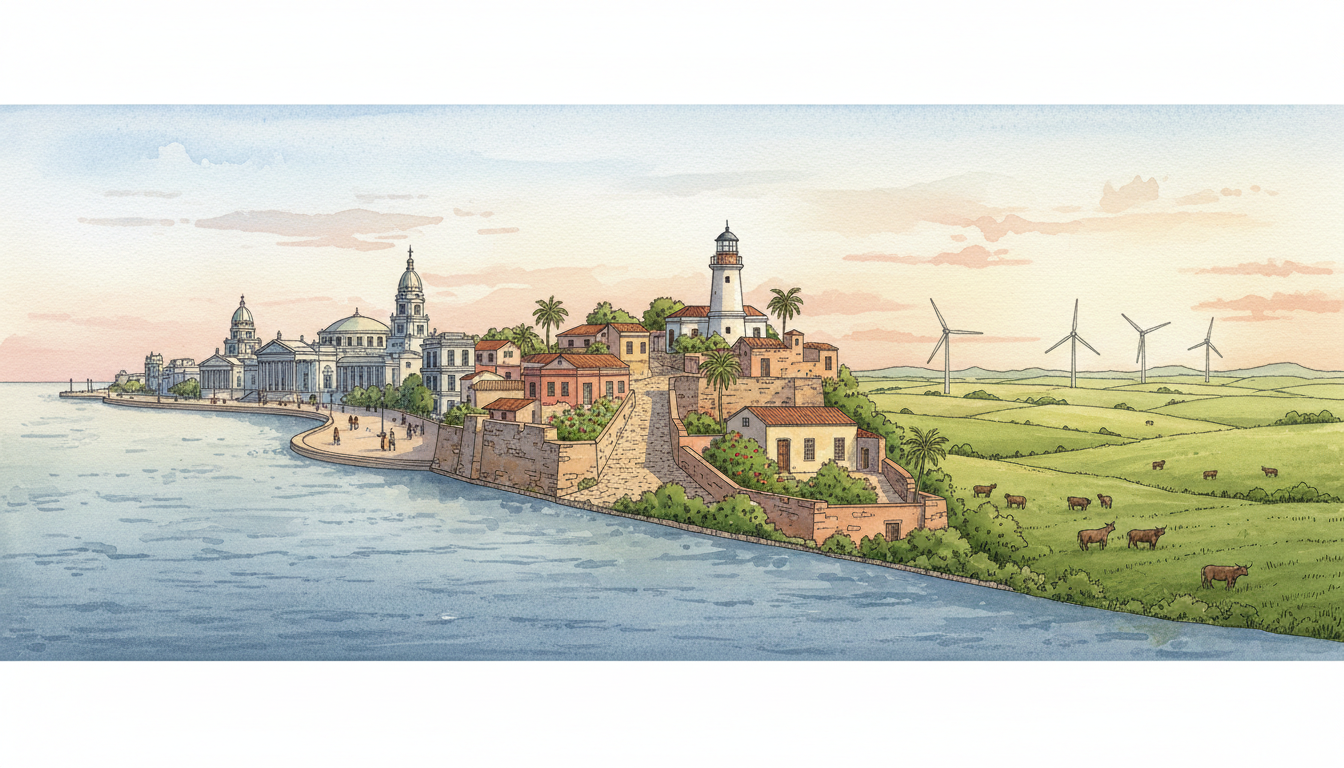
Uruguay generated about 98% of its electricity from renewable sources in 2025, according to its Ministry of Industry, Energy and Mining. The mix was 46% hydropower, 34% wind, 14% biomass and 4% solar, leaving about 2% from fossil fuels. The result was not achieved by finding one miraculous power plant. It came from years of energy policy, investment contracts, hydroelectric facilities, wind farms, electricity forecasting, grid operation and cooperation among public and private institutions.
This is a guide to the electricity system, not a claim that 98% of Uruguay’s cars, cooking fuels and industrial processes already use renewables. Electricity is one part of total energy. The practical question is how Uruguay can produce so much renewable power while maintaining supply when wind slows, river flows change and demand rises.
Uruguay’s 2025 electricity mix at a glance
The official January 2026 report gives the following shares for 2025 generation delivered to the national interconnected system: hydroelectricity 46%, wind 34%, biomass 14%, solar 4%, and fossil-fuel generation 2%. The ministry reported 13,040 GWh delivered to the Sistema Interconectado Nacional under that reporting basis, and stated that about 8% of the year’s generated electricity was exported. These are dated figures from the 2025 preliminary report.
The broader preliminary energy balance subsequently published in March 2026 used a different generation reporting scope and reported 15,855 GWh of total generation. Do not subtract or combine those totals without examining the statistical definitions. What is consistent across the government’s summaries is the approximate 98% renewable share. The primary references are the January generation bulletin and March 2026 energy balance.
Does 98% renewable mean the country never burns fuel?
No. A 98% annual renewable generation share leaves fossil-fuel generation in the annual mix, and individual hours or months can vary considerably. Wind may fall, rainfall can be weak, and the grid may call on flexible generation or cross-border electricity exchanges. A high annual share is a measure of what was generated over a period, not a promise about every minute.
The distinction matters when judging energy claims. An electric kettle used on a breezy morning may indirectly draw on a different combination of plants than one used during a period of low wind. The electrical grid supplies a common network, so customers cannot normally identify which generator powered each individual socket. A strong claim identifies the year, the type of energy and the measurement method.
How did Uruguay begin changing its energy system?
Uruguay established a long-term national energy policy in 2008, building on earlier planning and investment activity. The approach supported a more diverse supply, a high share of renewables, energy efficiency and reduced exposure to imported fossil-fuel price shocks. That long horizon matters: dams, wind developments and transmission lines cannot be built instantly after prices rise.
The International Energy Agency describes Uruguay’s 2008 National Energy Policy as a multi-party framework with objectives through 2030. Broad political agreement helped support investment across changing administrations. This does not mean everyone agreed with every contract or project; it means the general direction could survive longer than one electoral cycle. Long-term predictability is a major ingredient in infrastructure finance.
Why did wind power grow so quickly?
Wind turbines convert moving air into mechanical rotation and then electricity. Uruguay’s wind resources made turbines an attractive addition to the existing hydroelectric system. Electricity purchase agreements and other investment arrangements created more predictable revenue streams for generation developers, allowing substantial wind capacity to be built.
A wind farm does not need diesel fuel delivered each morning, but it does require land arrangements, equipment, roads, grid connections, maintenance and accurate forecasts. Wind power succeeds at scale when developers, financiers, regulators, network operators and dispatch planners agree about what will be built and how it will be operated. UTE publishes examples of wind-generation purchase contracts, making part of that institutional machinery visible.
What does a wind turbine actually produce?
Wind turns a rotor linked to a generator. The amount of output depends strongly on wind speed and turbine design, and output can change across hours and seasons. Turbines are connected through electrical equipment to the wider network. A project’s stated capacity in megawatts describes its maximum rated output under specified conditions, not the number of megawatt-hours it produces every hour.
For a classroom example, a 2 MW turbine running at full output for one hour produces 2 MWh. If the wind provides only half the rated power during that hour, it produces about 1 MWh instead. Actual generation depends on weather, availability and operational limits. Distinguishing MW from MWh prevents many misleading headlines about new wind farms and national electricity supply.
Why are forecasts important for wind energy?
A grid operator must balance electricity generation and consumption continuously. Because wind changes, operators use weather forecasts and statistical tools to estimate tomorrow’s and the next hour’s output. Better forecasts make it easier to plan hydropower, thermal backup and electricity exchanges without excessive cost or reliability risk.
Uruguay’s electricity-market administrator, ADME, has published research on improving wind generation forecasts using statistical and machine-learning methods. The research reported potential improvements in forecast accuracy under its model comparisons. The key takeaway is simple: power engineers do not wait blindly for the wind. They plan how the entire system can respond. Read ADME’s technical reports for this operational perspective.
What does ADME do?
ADME, the Administración del Mercado Eléctrico, is involved in administering the electricity market and optimising the dispatch of generation resources. Dispatch means deciding how available generation should be scheduled to meet demand while respecting the technical and economic conditions of the system. It is not the same task as sending a technician to fix one household’s meter.
Forecasts about river inflows, wind conditions, electricity demand and generating units help determine the schedule. Electricity also crosses national borders under the applicable market arrangements. A sophisticated grid requires data, engineering rules and continuous operational decisions. ADME’s English-language introduction to optimal electricity generation dispatch explains the mechanics in accessible technical detail.
How does hydropower complement wind power?
Hydropower uses flowing or falling water to drive turbines. Unlike wind, a reservoir can sometimes store water and allow generation at a chosen time, subject to storage, water availability and environmental constraints. That flexibility can help balance changes in wind and solar generation. But it is not unlimited: prolonged drought reduces the useful water available for electricity.
Imagine a particularly windy period. The grid may be able to supply much of its demand with wind while using water resources carefully. When wind falls, hydro may contribute more if conditions permit. This is a simplified explanation, not a statement that one automatic rule always governs real dispatch. Actual choices account for reservoir levels, forecasts, prices, ecological rules and electricity demand.
Which rivers and dams generate electricity?
Uruguay has hydroelectric facilities associated with major river systems, including the Río Negro installations and the binational Salto Grande complex on the Uruguay River. Plants such as Rincón del Bonete, Baygorria and Palmar are connected to the Río Negro system. Each has its own engineering, maintenance and water-management requirements.
Large dams are not simply permanent stores of free electricity. Their operating plans need to account for river flows, dam safety, equipment condition and downstream consequences. Shared river facilities also require cooperation with neighbouring authorities. The geography of water is therefore part of both electricity planning and regional relationships.
Why doesn’t hydropower alone provide all the electricity?
Rainfall is variable and river systems have competing functions. A very wet period may produce abundant hydroelectric output, while drought limits it. Dependence on one source can expose households and businesses to environmental shocks. Wind, biomass and solar diversify the conditions under which electricity can be generated.
Uruguay’s different energy sources do not all fail at the same time or for the same reason, although correlations and broader weather patterns still matter. A balanced system can provide more options during a disruption. Diversity is valuable because it reduces reliance on one vulnerability; it does not eliminate the need for maintenance, backup, planning or regional cooperation.
What happens to electricity during a drought?
Low rainfall can reduce reservoir inflows and constrain hydropower generation. Operators may make greater use of other generators or electricity imports, depending on conditions. Electricity prices and emissions may respond to changing generation costs. Water supply and agriculture can also come under pressure, illustrating how a single climate condition affects several systems.
Uruguay experienced serious drought conditions during 2022–2023. That period is a reminder that high renewable percentages are not an unchanging physical entitlement. Reservoir planning and diversification help, but long-term resilience must also address drought preparedness, drinking water, agriculture and climate trends. The relevant comparison is between a robust system and the shocks it can withstand, not one year chosen because it looks especially impressive.
What is biomass electricity?
Biomass generation uses organic materials, residues or fuels derived from biological sources to produce energy. Some industrial processes, including wood-processing and agricultural operations, can generate usable residues. Equipment converts available energy into heat and electricity under particular technical and environmental arrangements.
In Uruguay, biomass supplied about 14% of electricity generation in the official 2025 mix. Its value partly comes from connecting energy production to other industries. However, renewable classification does not imply that every biomass project has zero emissions or no environmental impacts. Feedstock sustainability, local air emissions, transport, land management and plant efficiency remain important.
Why do mills and agricultural industries matter to the grid?
A factory handling substantial plant material can sometimes use residues to support its own energy requirements and, under the appropriate arrangements, supply electricity to the grid. This links industrial processing with the power system. It can reduce disposal problems and create an additional productive use for material that would otherwise have limited value.
But industrial heat demand, seasonal operation and access to suitable feedstock influence generation. A biomass plant still needs qualified operators, boilers or other conversion equipment, emissions controls, grid connections and maintenance. It should be evaluated as an operating industrial system, not counted as automatically sustainable because its fuel originated from a plant.
Why is solar’s share smaller than wind’s?
Solar photovoltaic panels convert sunlight into electricity. Uruguay had expanded solar capacity by 2025, but official figures still put solar at about 4% of its generation mix that year, smaller than hydro or wind. Different technologies entered the investment programme at different scales and times. Solar output is concentrated in daylight hours and varies with clouds and seasons.
A smaller historical share does not mean solar has no future role. Rooftops, businesses, utility-scale installations and energy-storage systems may create opportunities under current rules. The right design depends on demand, grid capacity, project costs and tariff conditions. In October 2026 UTE advertised a solar-electricity purchase procurement, illustrating continued investment interest rather than proving a forecast of future solar output.
Can a Uruguayan home install its own solar panels?
UTE describes arrangements under which eligible customers connected to distribution networks may install generation for self-consumption and, subject to the applicable rules, feed electricity into the grid. Equipment choices, approvals and the commercial treatment of exported electricity vary with the connection and regulatory conditions. These are not automatic rights to install any panel or battery without technical review.
The UTE subscriber-generation guidance records 2026 registration requirements for installations operated in parallel with the grid. A household must consider roof suitability, safe wiring, installer qualification, meter arrangements and financial return. This article is not a substitute for a utility connection study or an electrician’s design.
What happens when solar panels generate more than the home uses?
If permitted and correctly connected, surplus power may flow through the customer’s meter into the distribution network. The commercial value and crediting rules depend on the relevant contract and regulation. A solar installation operating beside the grid needs equipment that follows grid safety requirements, including protections for power cuts and other abnormal conditions.
A rooftop panel cannot be treated like an isolated battery. Its connection affects the shared system used by neighbours and maintenance workers. That is why utilities ask for technical documents and authorisation. A financial decision should consider both electricity generated and the costs of equipment, maintenance, financing and any network charges.
Who is UTE?
UTE, Administración Nacional de Usinas y Trasmisiones Eléctricas, is Uruguay’s state electricity utility. It plays major roles in the power system, including electricity networks and customer services, alongside other relevant institutions and generating companies. It is not identical to the electricity regulator or the dispatch administrator.
A customer receiving a bill or reporting a local electrical fault encounters a different task from a wind developer negotiating a power contract. UTE’s official website supplies operational information. Understanding the division between utility, generation developers, regulator, ministry and market administrator is essential to understanding how a national renewable programme becomes electricity at a wall socket.
Who makes the energy policy?
The Ministry of Industry, Energy and Mining and its National Energy Directorate help shape and report national energy policy, while the relevant statutory bodies carry out regulation and system operations. UTE and generators own or operate infrastructure under their applicable powers and contracts. No single agency personally performs all these functions.
An energy project must move from policy objective to legal permission, site selection, environmental requirements, financing, connection, dispatch and long-term maintenance. Each stage has a different risk and responsible organisation. A country gains reliability when that chain is clear and predictable. The official ministry’s site is a starting point for policy and statistical documentation.
What are electricity purchase agreements?
A power purchase agreement, or PPA, is a commercial contract setting conditions under which electricity is sold by a generator to an authorised buyer. Long-term arrangements can help a developer finance equipment because expected revenue is more predictable than relying only on uncertain short-term sales. The exact terms, payment structure and risk sharing vary by agreement.
A wind project might require large initial expenditure on turbines and grid connection but relatively low fuel costs after completion. A PPA can help distribute those costs over years. Contracts do not eliminate risk or make electricity free; they change who manages price, construction and operating uncertainties. Uruguay’s published UTE wind-contract documents illustrate why institutional finance is as important as meteorology.
How does a wind farm reach the national grid?
A wind farm needs internal cables, transformers and a connection to suitable grid infrastructure. Transmission networks carry electricity toward distribution systems or major customers. Operators monitor voltage, frequency and system conditions. A generator can be producing electricity yet still face constraints if the relevant line is unavailable or cannot safely carry additional output.
This is why building capacity without coordinating network improvements can be inefficient. Engineering must account for where generation is located relative to demand and other power plants. The grid is a transport system for energy: it needs enough capacity, suitable intersections, maintenance and clear operating rules. Much like a road system, it depends on connected infrastructure rather than isolated impressive assets.
How does Uruguay balance electricity supply and demand?
Every moment, consumers collectively use some quantity of power and generators collectively supply it. The system operator plans which resources to run or adjust based on forecasts, technical constraints and cost. Wind and solar variability make forecasting important, while hydropower, other dispatchable resources and exchanges offer different forms of flexibility.
Frequency and voltage need to remain within safe operating conditions. Reserve capacity, protection systems and skilled operators help maintain stability. A chart showing 98% renewable generation over a year cannot by itself prove that balancing is effortless. Reliable grid management is a continuous engineering service, not a once-a-year accounting exercise.
Why do Uruguay and its neighbours exchange electricity?
Interconnected electricity systems can trade power across national borders when suitable links and agreements exist. Exports may allow surplus generation to serve other markets; imports may help meet demand or improve system efficiency under different conditions. The commercial and technical arrangements depend on network capacity and operating agreements.
Uruguay’s ministry reported exports equal to around 8% of its generated electricity in 2025, with hydropower accounting for much of the exported electricity. Cross-border trade can improve flexibility, but it is not a permanent guarantee of available imports during a regional emergency. A strong system plans for simultaneous stress across neighbouring areas, too.
Can renewable electricity reduce energy-import costs?
Wind, solar and hydro have no purchased fossil fuel consumed each hour of generation. Replacing some fossil-fuel generation can reduce exposure to international gas, oil or coal prices and to the cost of importing these fuels. However, infrastructure, finance, maintenance and operating costs remain. A country’s total cost depends on its contracts and system design.
Uruguay’s policy was partly motivated by security and reducing vulnerability to imported energy. The benefits can include greater price predictability over time, but claims that electricity became exactly ‘half price’ should be checked for which costs and years they compare. A household tariff may include network charges, taxes and service costs beyond wholesale generation. A renewable mix is not proof of a particular bill reduction for every customer.
Does the 98% share make all Uruguay’s energy clean?
No. Electricity is only part of total final energy use. Cars, trucks, industrial processes, heating and other activities may depend on petroleum products or other fuels even in a country with very renewable electricity. Electricity generation shares also differ from primary energy and final energy consumption shares.
A useful classroom exercise is to draw three circles: electricity generated, total energy supplied and final energy used. They overlap but do not describe identical quantities. Uruguay’s March 2026 preliminary energy balance discusses fuel and industry consumption separately from the renewable electricity achievement. Accurate energy writing always names the denominator before celebrating a percentage.
What is transport electrification?
Transport electrification means using electricity to power vehicles or related transport functions that may previously have relied on combustion engines. Electric buses, cars and other suitable technologies can reduce direct fuel combustion where they are practical. But total environmental outcomes depend on vehicle production, electricity generation, driving patterns and infrastructure.
Uruguay’s energy ministry reported a strong rise in electricity consumed by transport during 2025, although it remained a small share of national electricity delivered that year. This suggests an important next challenge: extending the advantages of low-carbon electricity beyond the grid into activities that still burn fuel. Charging networks, maintenance capacity, vehicle affordability and public transport policy all matter.
What about green hydrogen?
Green hydrogen is generally made by using renewable electricity to split water, creating hydrogen that can be used for certain industrial, energy or transport purposes. It has attracted attention in countries with renewable generation capacity. But hydrogen production requires water, electrolysers, electricity, handling, infrastructure and buyers, and it loses energy during conversion.
A pilot or proposed export project is not the same as a proven competitive national industry. The relevant questions are where the electricity will come from, how much water is required, what the end use is and whether there are economically sound alternatives. Uruguay’s clean electricity gives it potential advantages, but transparent project appraisal remains essential.
How does renewable electricity affect farms?
Farms and agricultural processors need power for pumping, refrigeration, milking, sorting, manufacturing and digital operations. A reliable national grid can reduce the need for expensive local backup, while distributed generation may help in appropriate locations. A renewable share does not automatically solve weak rural power lines or the cost of equipment.
Imagine a dairy producer storing fresh milk before collection. The quality of the product depends on reliable cooling and a timely truck, not only the generation source. A cheap generator at the wrong voltage cannot rescue a broken milk collection route. The productive value of energy depends on the next handoff to a working business system.
How does power reliability affect hospitals and schools?
Hospitals need electricity for critical equipment, lighting, refrigeration, communication and water systems. Schools need lighting, safe buildings, digital infrastructure and sometimes specialised equipment. For both, dependable distribution and backup arrangements matter. The source of grid generation is important, but a failure at a local transformer can still interrupt service.
A well-functioning national power system should be evaluated through outages, restoration capability, safety and customer experience as well as generation mix. A sustainability indicator is not a substitute for measuring whether pupils can learn and patients can receive care. This is why energy policy belongs inside wider national development planning.
How do public data make the achievement measurable?
The strongest evidence is a dated statement of actual generated electricity by source, supported by the national ministry’s statistics and the system operator’s data. Distinguish preliminary from final figures. Electricity sold, electricity generated, electricity delivered to the grid, net exports and domestic final consumption are different metrics.
For 2025, the January preliminary generation bulletin reported roughly 98% renewable electricity. The March preliminary national balance provided additional production and consumption details under its own reporting methodology. Scientists, journalists and students should always write the year beside the percentage and explain what it measures. Without that, readers may incorrectly infer that every electrical device uses renewable power at every moment.
Case study: the wind is strong and rivers are full
Consider a hypothetical day with strong wind and good reservoir levels. Wind farms produce abundant electricity, while operators determine how much hydropower to use or conserve. System conditions and market arrangements might support exports if there is more suitable electricity available than domestic demand requires.
The important step is dispatch, not simply energy abundance. Transmission lines must carry the power and regional buyers must be able to receive it. If a line becomes constrained, some available generation may not be deliverable where needed. This reveals why a renewable electricity milestone rests on grid capacity, accurate forecasts and continuous coordination.
Case study: a dry spell and less wind
Now imagine a dry spell that limits hydropower together with several lower-wind days. The system must use available flexibility, which might include imports or limited fossil generation under the applicable operational conditions. A high annual renewable share can coexist with such periods.
The correct response is not to declare the programme a failure whenever fossil capacity is used. Backup and flexible resources can have a reliability function even when their annual output is small. The engineering challenge is to provide energy safely while reducing emissions over time and maintaining affordable service. Measuring only the best day or worst day gives a distorted picture of annual performance.
Case study: a family installs rooftop solar
A family considers rooftop panels to reduce purchased electricity. They calculate potential production, roof orientation, household demand, system cost and maintenance. Before installing, they check UTE requirements, current regulatory registration and the conditions governing parallel operation with the grid.
If the household wants to export excess power, its contract and metering arrangement matter. A reputable installer must handle electrical protection and safe commissioning. The correct comparison is not ‘solar panels are free after installation’ but total lifetime costs and benefits under real conditions. This is the connection between national energy ambition and responsible household-level decision-making.
Case study: a food processor uses biomass
A processing business produces organic residues and studies whether an appropriate energy plant could use them. It must assess feedstock quantity, seasonal production, emissions, water, equipment, skills and finance. A commercial agreement might allow surplus electricity to be supplied under the applicable rules.
If residues have other valuable uses or environmental effects, those alternatives must be included in the analysis. A project should not receive a sustainability label simply because its fuel is biological. Careful material accounting and verified performance protect both business viability and public trust.
What should other countries learn from Uruguay?
The general lessons concern planning, diversity, regulatory clarity, infrastructure finance, forecasting and the difference between a generation milestone and the whole energy transition. Another country may lack Uruguay’s wind resources, river system, existing grid, market size or institutional structure, so copying the same percentages would not automatically be sensible.
The transferable method is to map the resources and constraints, set durable targets, build credible contracts, strengthen the network and measure real outcomes. Then inspect how electricity helps families, farms, hospitals and industries. Compare this with How Singapore Works, where geography, imported fuel and limited domestic renewables lead to different energy choices. Systems thinking explains both without declaring one national blueprint universal.
Frequently asked questions
Is Uruguay 100% renewable? No. The official 2025 electricity mix was approximately 98% renewable; total energy use has a different mix. Which renewable source produced the most electricity? Hydropower led in 2025 at roughly 46%, followed by wind at 34%. Does Uruguay use fossil generation? Yes, roughly 2% of 2025 electricity generation. Is wind always available? No. Output changes with weather.
How does Uruguay balance the grid? Through dispatch planning, hydro flexibility, other resources, forecasting and cross-border exchanges. Who provides electricity? UTE is a major state utility, alongside generators and other responsible institutions. Does 98% renewable mean cheaper household bills? Not automatically, because tariffs include more than generation. Can homeowners add solar? Potentially, under current technical and registration rules. Is 98% the figure for 2026? It is a verified 2025 result, not a final annual figure for 2026.
Continue exploring How Countries Work
Read the wider How Uruguay Works | Government, Departments and Economy guide, the How Countries Work archive and How Zimbabwe Works | Currency, Farming and Electricity.
Compare with the Zambia Hydropower and Power Cuts article and Singapore’s interconnected transport network. In each case, one resource has value only when it can reach its end users reliably.
Read the Companion Country Systems
Read the other three new companion studies: Uzbekistan: double landlocked trade | Yemen: groundwater and water security | Zimbabwe: ZiG and US dollars. Each follows a different country system and links back to the wider How Countries Work collection and its sibling How Singapore Works.
Sources and editorial review
Primary statistics: MIEM 2025 generation report (2 January 2026), MIEM 2025 preliminary energy balance (27 March 2026). Institutional sources: IEA National Energy Policy, UTE wind PPAs, and ADME dispatch methods.
Editorial review: 20 October 2026. The 2025 percentages are anchored to that year; electricity-generation statistics, connection procedures, market arrangements and energy prices can change. This educational article does not guarantee costs, current tariff eligibility or grid connection permission for any specific project.