
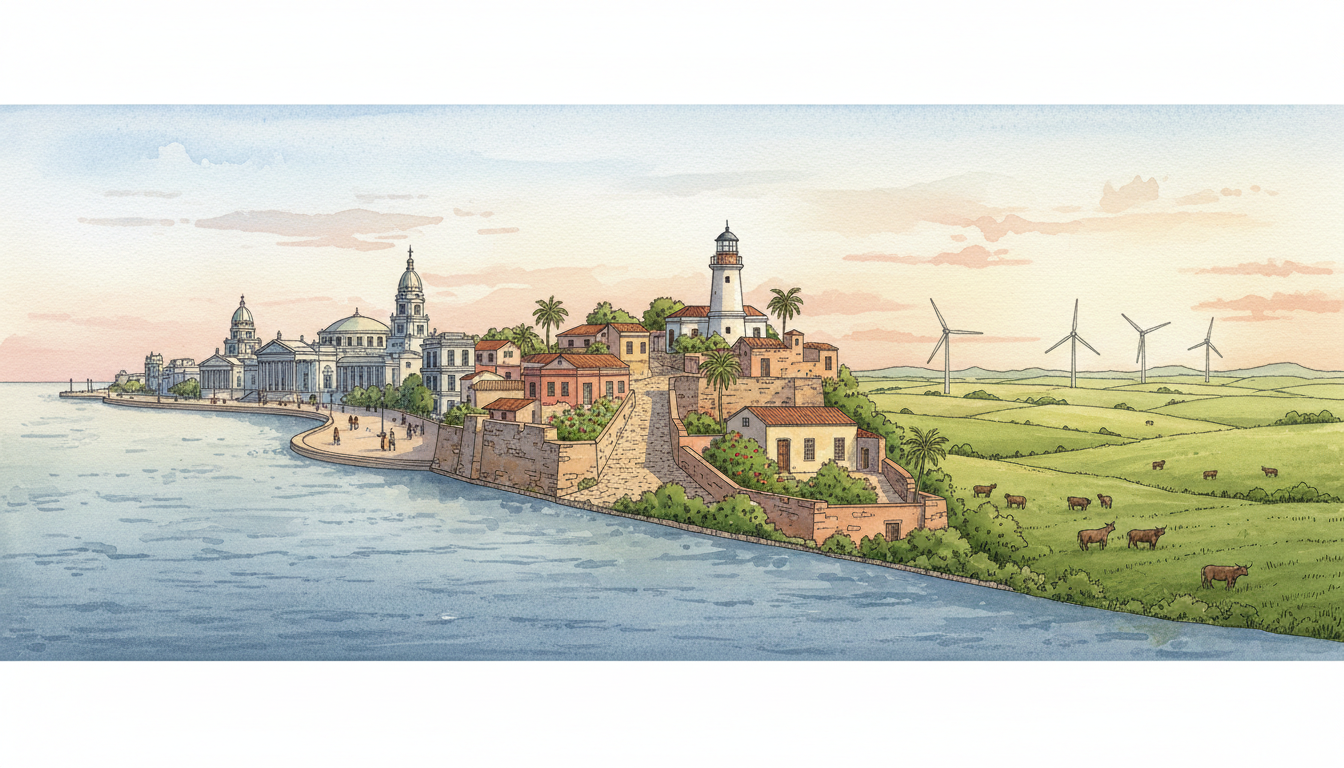
Uruguay is a democratic republic on South America’s Atlantic coast. It has a directly elected President and Vice President, a two-house national legislature called the General Assembly, courts, and elected departmental and municipal governments. Its economy connects farming and food exports with logistics, tourism, technology, healthcare, education and an electricity system supplied mainly by renewable generation. Montevideo is the national capital, and the Uruguayan peso is its currency.
To understand Uruguay, follow one everyday journey: a farm produces beef or milk; electricity and water support production; a road moves goods to processing and export; government agencies set health and trade rules; banks settle the payment; and households use income for school, transport and healthcare. None of these parts works entirely alone. The useful question is who is responsible for each handoff and what happens when it breaks.
Uruguay at a glance
Country: Oriental Republic of Uruguay, a sovereign state between Argentina and Brazil. Capital: Montevideo. Political system: presidential democratic republic. National legislature: 99 elected representatives and 30 elected senators, with the Vice President presiding over the Senate and General Assembly. Local government: 19 departments and municipalities. Currency: Uruguayan peso. Key systems: farming, ports, tourism, social services, water and renewable electricity.
Do not confuse Uruguay with Paraguay: both are independent South American countries, but Uruguay has an Atlantic coastline and Paraguay is landlocked. Nor should a map of Montevideo be treated as a map of the entire country. Local services and farming conditions vary significantly among departments.
Where is Uruguay, and why does the map matter?
Uruguay lies east of Argentina and south of Brazil, between the Uruguay River, the Río de la Plata and the Atlantic Ocean. Its rolling countryside, major waterways, ports and coastal settlements influence how goods and people travel. Inland farms can reach export gateways through road networks. Coastal cities depend on tourism, trade and urban services.
Geography shapes costs before a product even reaches a market. A dairy producer needs refrigeration and road access; a visitor arriving at a coastal destination needs transport and safe services; a coastal community needs flood and erosion planning. A small country can still have diverse local problems. Geography is not scenery attached to a government: it shapes what that government must deliver.
Who is Uruguay’s President in 2026?
Yamandú Orsi became President on 1 March 2025 for the 2025–2030 constitutional period; Carolina Cosse became Vice President. The official Presidency announcement documents that transition. Unlike a parliamentary monarchy, Uruguay’s President heads the executive and is separately chosen through national presidential elections.
Ministers and departments perform the executive government’s specialised work. A presidential promise concerning schools, for example, must become authorised expenditure, administrative instructions, properly staffed classrooms and an accountable results process. Remembering the name of the President is useful current affairs; understanding that sequence explains how the country functions even after leaders change.
How does the General Assembly make laws?
Uruguay’s national legislature, the General Assembly, has a Chamber of Representatives and a Senate. Members examine laws, debate public concerns, oversee the executive and consider budgets within their constitutional roles. Uruguay elects 99 representatives and 30 senators; the Vice President also presides over the Senate. The Inter-Parliamentary Union’s Uruguay records explain this arrangement.
A law does not build a classroom or inspect a food processor by itself. It establishes powers and obligations that competent authorities then apply. A useful way to read legislation is to ask what it permits or requires, which department must act, what funding is provided and how a resident can challenge a mistake. Lawmaking and service delivery are different, connected jobs.
How do elections and political parties work?
Uruguay holds competitive national elections and uses a presidential runoff when necessary. Citizens also participate in departmental and municipal elections according to the applicable electoral calendar and rules. Political parties offer competing programmes on taxes, development and public services. Uruguay’s sustained democratic period since 1985 is important background, but it should not be confused with a claim that every policy has unanimous support.
Voting is only one part of accountable government. Citizens need trustworthy information, institutions that administer elections, parliamentary debate, independent courts and opportunities for public scrutiny. Election rules, eligibility and compulsory-voting requirements should be checked against the Corte Electoral rather than guessed from another country’s system.
Why are there 19 departments?
Uruguay is divided into 19 departments. Each has a departmental government and elected political institutions, while municipalities provide an additional local level in designated areas. A July 2025 official announcement reported the start of new administrations across all 19 departments and 136 municipalities. That number of municipalities is a dated count, so check updates before quoting it as permanent.
Departments coordinate place-specific work: local roads, waste and environmental services, planning and other functions established in law. A decision made in Montevideo may affect the whole country, but the pothole near a rural market or the arrangements for a local public space require nearby operational knowledge. For the current structure, see the Office of Planning and Budget’s local-government report.
What do municipalities and intendencias do?
An intendencia is the executive administration of a department, headed by an elected intendente. Municipal governments have mayors and councillors for their legally assigned tasks. Do not treat these offices as identical to national ministries or imagine that a municipality can approve every kind of document. Responsibility depends on the precise service and legal framework.
Imagine someone asking about a business sign or rubbish collection. The departmental or local government may be the useful starting point. But tax obligations, immigration, national identity or health-system regulation may belong to different national authorities. A strong service directory tells residents which office owns each decision and how records move between them. That is the human meaning of decentralisation.
How do courts and legal institutions function?
Courts interpret and apply laws and resolve legal disputes. Different questions—employment, contracts, criminal matters and constitutional issues—require different procedures. The legal system relies on qualified professionals, fair hearings, clear evidence and decisions that can be carried out in practice. Legal independence and public trust matter as much as the wording of statutes.
A local farmer and a transport contractor might disagree over a delivery. A credible legal process can clarify rights and obligations. If every commercial disagreement becomes an indefinite uncertainty, investment and trust suffer. Readers should distinguish ordinary administrative service complaints from disputes requiring professional legal advice; this educational explanation is not a substitute for a lawyer or relevant public office.
What is Montevideo’s role in Uruguay?
Montevideo is Uruguay’s capital, largest metropolitan hub and a centre of government, finance, universities, port logistics, culture and healthcare. Its port connects businesses with international shipping. This concentration of jobs can attract workers and students from other areas, creating demand for housing, roads, public transport and public services.
Being a national capital does not mean every department is a suburb. Regional towns, coastal communities and inland agricultural districts perform essential economic roles. A country’s development should be assessed by the connections between its capital and other places, not solely by the quality of a waterfront promenade or central business district.
Why is Uruguay known for cattle and beef?
Cattle raising and related food industries are significant parts of Uruguay’s economic history and modern exports. Farms, veterinary care, land management, slaughter and processing facilities, traceability, refrigeration and shipping work together to deliver food to consumers. A country’s reputation for a product depends on standards throughout that chain, not on a single attractive ranch photograph.
Traceability can help identify an animal’s origin and the associated records. This supports food-safety, market and commercial objectives when systems are implemented reliably. Export rules also depend on destination markets and sanitary approvals. For a consumer, the practical question is whether the complete chain can be verified; for a farmer, it is whether high standards bring sustainable market opportunities.
How does Uruguay export food and agricultural goods?
Uruguay exports a variety of agricultural and processed products, including beef, dairy and crop commodities, while other sectors contribute services and manufactured goods. Commercial success requires farmers, processors, transporters, ports, regulators, trading firms and buyers to coordinate. A shipment of perishable produce needs a particularly dependable cold chain.
Suppose a refrigerated truck reaches a terminal too late for its scheduled vessel. Good farm output is not enough: the business may lose time, pay extra fees or struggle with product quality. Ports and roads are not separate from agriculture; they are part of how agriculture earns money. The central systems question is which stage limits the performance of the whole chain.
What jobs exist beyond agriculture?
Uruguay has urban employment in government, education, health, tourism, logistics, commerce, financial and professional services, software and other technologies. Manufacturing, construction and support industries also matter. Workers and firms use a common national infrastructure while participating in markets with different risks and skills needs.
A successful software exporter and a successful dairy processor seem very different, yet both need trained staff, secure payments, dependable electricity, internet access and enforceable contracts. Diversification helps reduce dependence on a single product, but it also creates new requirements for training and regulation. Economic complexity is built through complementary capabilities, not one magical industry.
Why is Uruguay’s electricity supply unusual?
Uruguay has developed a high share of renewable electricity from hydroelectric, wind, biomass and solar generation. According to the Ministry of Industry, Energy and Mining, 98% of electricity generated for the national system in 2025 came from renewable sources: 46% hydro, 34% wind, 14% biomass and 4% solar. Fossil sources provided about 2% for that year.
These are electricity-generation figures for 2025, not a promise that every year is identical or that all energy used in transport and industry is renewable. Generation changes with rainfall, wind conditions and demand. The distinction between clean electricity and the entire energy system is essential. Read the January 2026 official electricity report.
How do wind farms and hydropower complement each other?
Wind generation depends on suitable wind conditions; hydropower depends on water and reservoir operations. Biomass and solar add other production profiles. Having multiple types of generation can improve the options available to grid operators, although every source has technical, environmental and financial constraints. The grid must match electricity supply with demand continuously.
A turbine on a hill is not the same as a powered refrigerator in a village. Electricity passes through transmission and distribution networks, meters and customer equipment. The reliability of poles, substations and repairs matters even when national production is abundant. Technical diversity and dependable delivery are two different kinds of resilience.
How do water and electricity interact?
Water is needed for homes, farming, industry and ecosystems. Treatment plants and distribution pumps often require power. Hydroelectricity also depends on water availability, creating a two-way infrastructure connection. Uruguay experienced a serious drought from 2022 to 2023, demonstrating how climate conditions can affect drinking-water systems and wider economic activity.
A household with a tap still depends on source protection, treatment, pipelines, testing and storage. During drought, authorities must weigh supply options, communicate quality conditions and plan for sustained reliability. A good water policy is not merely a new reservoir; it includes leakage reduction, environmental protection and a realistic maintenance budget.
What does Uruguay’s public health system look like?
Uruguay operates a National Integrated Health System (SNIS) involving public and private providers within a common national framework. ASSE is an important public healthcare provider, while collective medical-assistance institutions and other authorised providers serve other users. Enrollment, entitlement and financing depend on applicable rules and the person’s circumstances.
The Ministry of Public Health oversees and monitors aspects of the system. But a person seeking treatment still needs a practical path: registration, primary care, tests, specialists, prescriptions and follow-up. A system is only as useful as the continuity of that journey. The official SNIS overview explains provider roles and health-system information.
How does education work in Uruguay?
Education includes early years, primary, secondary, technical and tertiary pathways with national and institutional responsibilities. ANEP is a major public education administration, while other bodies and universities handle different levels and types of provision. Families should check the curriculum, age of entry, assessment and transfer requirements relevant to a particular school.
Uruguay is also internationally known for Plan Ceibal, a long-running public digital-learning initiative. Computers, connectivity and learning platforms can widen opportunity, but they do not replace teacher feedback or foundational literacy and numeracy. A school improvement should be measured by what pupils can understand and do, not only by devices distributed. See the existing Understanding the Education System of Uruguay for a focused education guide.
What makes digital education actually useful?
A student may have a tablet, yet struggle because a lesson is not clearly explained. Digital access, teacher preparation, curriculum quality and home conditions must support one another. A useful system lets students retrieve learning material, practise, receive corrections and continue with human guidance when needed.
Imagine two students: one uses an online science simulation with feedback from a teacher; another merely clicks through screens without understanding the evidence. Both may be counted as connected. Their learning outcomes differ. The same principle applies to administrative digital services: technology improves a system when it helps complete the task, not when it just moves a paper form onto a screen.
How do public services collect and use taxes?
Tax revenue and other government resources support health, education, infrastructure and administration. The national tax authority, public finance institutions and local governments have distinct roles. Businesses may encounter corporate, consumption, employment or other tax obligations, depending on their activities; local charges are not necessarily administered by the same agency as national taxes.
Public budgets reveal priorities but not automatic success. Money allocated to a road must turn into careful procurement, construction, inspection and maintenance. Money allocated to healthcare must support staff, supplies and accessible services. Measuring spending alone tells less than evaluating what improved for residents. People should verify current tax rates with the competent Uruguayan authority before making financial decisions.
What does the Central Bank of Uruguay do?
The Banco Central del Uruguay has monetary and financial-system responsibilities. It is not a retail bank where every household opens an ordinary savings account. Monetary conditions influence inflation, credit and financial stability, while commercial banks, payment services and businesses handle many day-to-day transactions.
A rise in food prices may be influenced by weather, transport and international markets as well as broader monetary conditions. A central bank cannot directly increase rainfall or repair a coastal road. Students should distinguish the currency, inflation and exchange rate rather than using them as interchangeable terms. For current indicators, start with the Central Bank of Uruguay.
How do wages, pensions and social protection fit together?
Public and private employment, taxation and contributions connect to social protection arrangements. Pensions, disability support and other programmes follow different eligibility and financing rules. A legal entitlement needs a registration system, reliable records, funding and a method for someone to correct an error.
An older resident might receive a pension while needing healthcare and accessible transport. Managing only the payment and ignoring mobility, housing and care leaves part of the person’s problem unresolved. Social systems work best when different agencies understand their boundaries and residents can find the right entry point. Current eligibility details should be confirmed with the relevant official institution.
Why does tourism matter to the economy?
Uruguay’s beaches, cities, heritage and cultural experiences attract visitors from neighbouring countries and elsewhere. Tourism supports accommodation, restaurants, local transport, retail, guides and cultural venues. Seasonal demand may bring strong revenue to particular towns while creating planning and staffing pressures at busy times.
A successful tourism destination needs more than a postcard beach. Roads, drinking water, wastewater, safety, clean public spaces and workers trained in hospitality all matter. Local authorities also need to protect residents’ quality of life and the environments that attract visitors. Existing coverage of destinations can be found in Top 10 Places to Visit When Touring Uruguay.
How does Uruguay connect to Mercosur?
Uruguay is a member of Mercosur, a South American regional integration arrangement. Its relationships with Brazil, Argentina and other trade partners affect commercial opportunities, customs processes and investment decisions. Membership of a trade bloc does not erase national laws or make every product automatically move without paperwork.
A factory considering customers across the region must examine actual tariffs, rules of origin, standards, taxation and logistics. A border crossing still requires the correct documents and infrastructure. The useful question is not whether ‘free trade’ exists as a slogan, but which rules apply to that product, on that route, at that moment.
Why do Montevideo’s port and roads matter?
Montevideo’s port connects inland producers and urban businesses to international shipping. Freight must still arrive via roads, rail connections where available and logistics yards. Customs, cargo handling, storage, labour and finance support these links. A port is a gateway, not a complete distribution network.
A farm’s refrigerated truck can arrive at the seaport on time yet face a delayed vessel or paperwork problem. Conversely, a perfectly functioning vessel cannot collect cargo stranded behind a blocked rural bridge. Comparing this network with How Singapore Connects | Roads, Expressways and Junctions reveals the common engineering challenge: match each type of route to the journey it is supposed to complete.
What is the role of railways and public transport?
Urban buses, road transport and railway infrastructure perform different jobs. Public transport helps residents reach work and services; freight systems move products economically; walking and cycling solve short local connections. The right mix depends on density, demand, geography and investment.
A new transport terminal is not automatically a better commute. It has to link to the routes people use, publish understandable fares and schedules and be accessible to people with different mobility needs. Service quality should be evaluated by the time and reliability of the entire trip, not only the appearance of new infrastructure.
How do housing and city planning work?
Urban plans determine where housing, workplaces, parks, schools and utilities can fit. Local governments have important planning and public-space responsibilities within the applicable national framework. The challenge is to provide sufficient homes while protecting drainage, access, historic places and the environment.
Suppose a neighbourhood adds apartment buildings but not school capacity or bus frequency. Residents gain homes but struggle to reach ordinary services. Good planning schedules infrastructure and housing together, and consults people affected by the changes. Maintenance after the grand opening is part of planning, not an optional extra.
What does Uruguay’s coast need protection from?
Coastal Uruguay includes beaches, estuaries, urban waterfronts and ecologically sensitive environments. Storms, erosion, rising sea levels and changes in rainfall can affect people, public facilities and natural habitats. The risks differ by location, land use and the time horizon considered.
Building barriers may protect one property but alter erosion or drainage elsewhere. Useful responses include monitoring, setbacks, ecosystem care, resilient designs and clear local planning rules. The goal is not a promise that water will never reach the coast. It is to make communities safer and avoid placing critical systems where they are likely to fail.
Why is an ageing population a planning question?
Uruguay has an ageing demographic profile relative to many other Latin American countries. That affects healthcare demand, pensions, housing design, public transport and the size and skill profile of the workforce. Population ageing is neither a catastrophe by definition nor an automatic sign that every older person needs the same support.
Planning should consider prevention and community care, accessible streets, lifelong training and financially sustainable public services. An older worker may wish to remain economically active; another resident may need daily assistance. Good systems preserve dignity and practical choices rather than treating all people over one age as a single category.
Case study: a beef shipment from rural farm to port
A livestock producer manages animal health and grazing. After the relevant inspections and processing, refrigerated products travel through road logistics to a suitable export gateway. Customs, documentation, temperature control and a customer contract complete the chain. Each handoff has a different operator and type of risk.
What happens if a rural road floods? Transport becomes uncertain. If refrigeration fails, quality and safety may be affected. If the paperwork is incomplete, goods may wait at the terminal. This explains why export competitiveness depends on routine services and accurate records more than any single photograph of cows or shipping containers.
Case study: a family changes department
A family moves from Montevideo to a town in a different department. They must understand address changes, school arrangements, healthcare-provider access and local services. Some national identity and tax records continue to apply, while local council or provider processes change.
Their practical checklist is not simply ‘we moved within Uruguay’. It is: Which national details need updating? Which departmental services are relevant? Is the new school able to interpret the child’s prior learning? Where is the nearest suitable health provider? Administrative continuity is measured by how easily people can move between places without losing important records.
Case study: wind energy reaches a village business
A wind turbine adds electricity to the national network under suitable conditions. Grid operators balance sources and demand; transmission networks move power; distribution equipment supplies local customers. A food processor uses that electricity for cold storage, equipment and lighting.
If the power is generated cleanly but the local transformer is unreliable, the processor may still lose stock. If electricity is dependable but the road to market is poor, the business faces another constraint. Uruguay’s renewable electricity achievement is significant, but the productive value of electricity depends on a complete network of supply, distribution and end use.
How to study Uruguay as a working country
Draw three connected diagrams. The first shows the President, Parliament, courts and 19 departmental governments. The second shows farms, processing plants, roads, the Montevideo port and customers. The third follows a family using schools, healthcare, transport and payments. Mark which office, utility or business controls each step.
Next, remove one link from a diagram. A drought affects farms and hydropower; a transport delay affects exports; an administrative mistake affects a family’s service. This reveals why strong institutions, infrastructure and climate planning matter together. Compare with the How Singapore Works collection: one is an Atlantic South American republic, the other a city-state, but both depend on coordinated everyday systems.
Frequently asked questions about Uruguay
Is Uruguay a democracy? Yes. It is a constitutional presidential republic with competitive elections, a bicameral legislature and elected local authorities. Who is its President in 2026? Yamandú Orsi, inaugurated in March 2025. What is its capital? Montevideo. How many departments are there? Nineteen. Does it use the US dollar? Its national currency is the Uruguayan peso; foreign currencies can play commercial roles but are not interchangeable with the official unit.
Why is Uruguay famous for renewable electricity? Its 2025 generation mix was about 98% renewable, according to the national energy ministry; the mix varies by year. Is Uruguay in the EU? No. It is in South America and is part of Mercosur. What does SNIS mean? The National Integrated Health System. Is Uruguay’s economy only farming? No. Agriculture is important, but services, logistics, tourism, technology and other sectors also contribute.
Continue exploring countries and systems
Read the sibling How Countries Work archive, How Uzbekistan Works, How Vanuatu Works and How Vatican City Works. A complementary South American resource is Top 10 Places to Visit When Touring Uruguay. Browse the complete How Countries Work A–Z directory of 195 countries for all country guides.
For infrastructure thinking, compare Singapore’s road network and the broader How Singapore Works sister series. The goal is to understand connected systems, not rank countries by an imaginary universal blueprint.
Official sources and editorial date
This guide uses Uruguay’s Presidency, Office of Planning and Budget, national electricity figures, Ministry of Public Health, World Bank country overview, Electoral Court and Central Bank. Editorial review: 20 October 2026. Figures and service procedures have dates; check the latest official instructions before making a real-world decision.