
How does Yemen work? Yemen has a long history of mountain farming, Indian Ocean trade, skilled urban building and maritime connections, but its present-day institutions and everyday services are severely disrupted by prolonged conflict. The internationally recognised government and Houthi de facto authorities exercise control in different areas, and local arrangements vary. To understand Yemen in 2026, you need to follow four systems together: political authority, water, transport and the practical ways families obtain food, schooling, healthcare and livelihoods.
Is Sana’a the capital? Yes, Sana’a is the historic and constitutional capital, but it is under Houthi control, while the internationally recognised government has operated from Aden. Why is Yemen’s economy struggling? Conflict, damaged infrastructure, limited oil exports, fragmented institutions, high costs and heavy dependence on imported food have weakened production and purchasing power. The United Nations warned in October 2026 that fighting had again widened across multiple fronts. This guide explains the country’s underlying systems without treating either its people or its centuries of civilisation as merely a headline about war.
Yemen at a glance
- Location: Southern Arabian Peninsula, with a Red Sea coast, Gulf of Aden coast, highland and desert regions, and islands including Socotra.
- Political reality: A recognised state whose effective government and service delivery are divided by ongoing armed conflict.
- Main cities: Sana’a is the capital; Aden is an important port and seat of internationally recognised government institutions; Taiz and other regional centres have distinct roles.
- Key resources and pressures: Water scarcity, agriculture, ports, imports, energy supply, local markets and remittances.
- Humanitarian situation: The 2026 UN response plan identified more than 22 million people in need of humanitarian assistance and protection.
- Best way to understand it: Compare the country that institutions are meant to serve with the services actually available in a particular place and period.
Why is Yemen’s geography so important?
Yemen is not one flat, dry landscape. Its steep western highlands, coastal plains, inland plateaus, eastern desert regions and offshore islands create very different conditions for farming, settlement and travel. Some highland areas have cooler temperatures and receive seasonal rain; other regions face intense heat and limited surface water. These contrasts explain why ancient communities developed terraces, irrigation and trading towns in different places.
A journey between highland settlements and the coast can cross difficult terrain. That affects how food reaches markets, how patients reach hospitals and how road closures harm communities. Ports can connect Yemen to international commerce, but transport inland still requires functioning roads, safe access and fuel. Geography created opportunities for trade long before the present conflict and continues to shape reconstruction choices. A policy made for one region may be unsuitable in another with different rainfall, routes and local needs.
What does Yemen’s position beside the Red Sea mean?
The Bab al-Mandab Strait lies near Yemen at the southern entrance to the Red Sea, connecting the Gulf of Aden and routes toward the Suez Canal. The broader corridor is strategically important to global shipping. Yemen’s western coast, ports and nearby islands are therefore part of an international transport geography, not merely a local coastline.
A narrow sea passage makes commercial reliability depend on safety beyond one port. Ships, insurers, shipping lines, port authorities and security agencies respond to changing risks. Yemen’s maritime location can support trade and jobs, but conflict near coastal routes can also raise costs or interrupt economic activity. The UN’s 9 October 2026 warning described renewed fighting affecting areas around the Bab al-Mandab. Details of control can change quickly; this article does not present any front line as permanent.
How did Yemen develop such an old civilisation?
Yemen’s landscape and location helped sustain ancient South Arabian kingdoms, irrigation systems, caravan routes and coastal exchanges. The historic Kingdom of Saba, associated with the Marib region, is one important part of that story. Later Yemen participated in Red Sea and Indian Ocean commercial and intellectual networks, including the movement of goods, scholarship and religious traditions.
History matters because the institutions of a country are built in places shaped by earlier choices. An old market street may still organise movement; terraced hillsides reflect centuries of adaptation to water and slope; a harbour may remain valuable because of a natural coastal advantage. None of these historical achievements cancels the present suffering, but they prevent readers from confusing Yemen’s current crisis with the entire identity of the country. UNESCO records five Yemeni World Heritage properties, including important historic urban landscapes and the Socotra Archipelago.
Why do Sana’a’s tower houses matter?
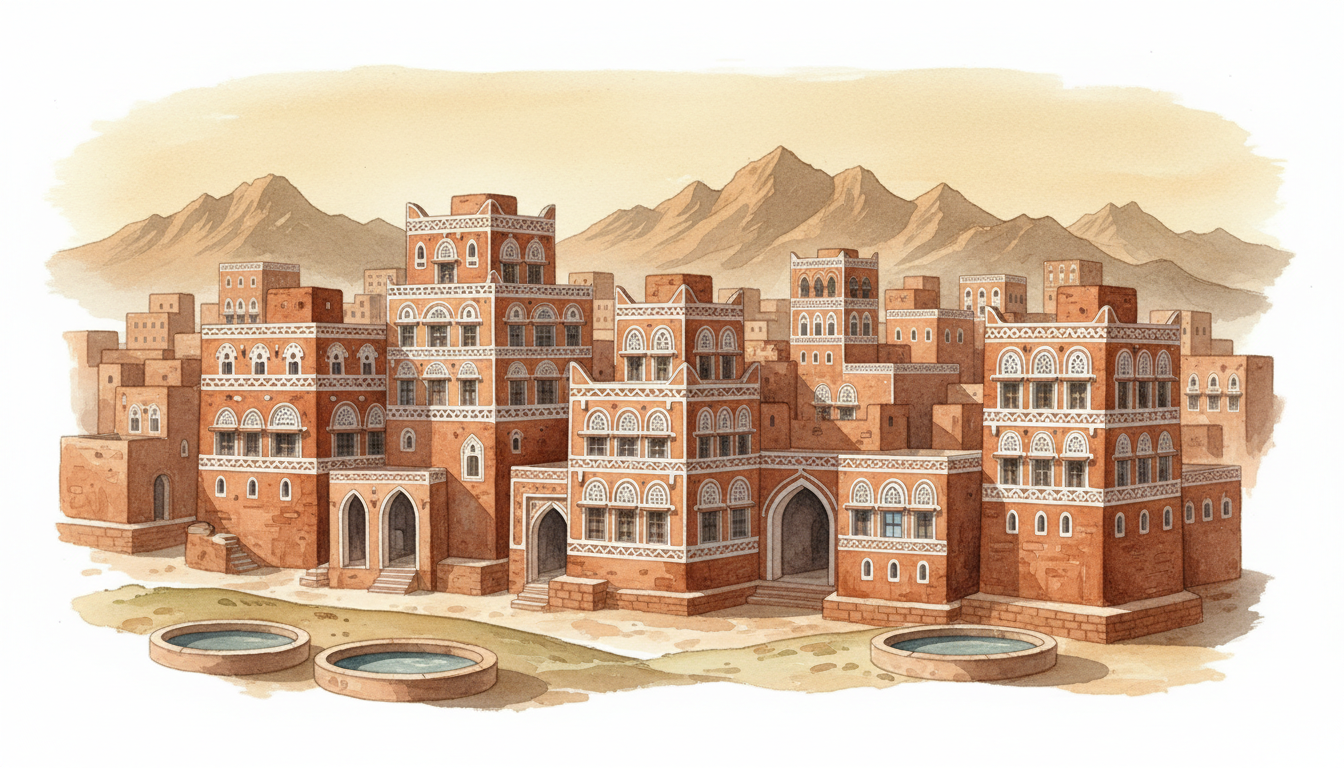
The Old City of Sana’a is famous for multi-storey buildings decorated with geometric brickwork and white gypsum. Its architecture is more than an aesthetic curiosity. Dense urban construction, courtyard or garden spaces, building materials and the street network show generations of adaptation to climate, defence, community life and craft knowledge. UNESCO describes Sana’a as a historic settlement in a mountain valley at around 2,200 metres altitude.
These homes also reveal the maintenance challenge that old cities face. Historic buildings require skilled repairs and suitable materials; war damage, economic hardship and unplanned changes can threaten the fabric that gives them value. Safeguarding heritage is a question of housing, community income, engineering and governance, not only photography. UNESCO’s Old City of Sana’a profile provides the architectural background. Heritage protection should respect the people who live there, not treat their neighbourhoods as empty monuments.
Who governs Yemen in 2026?
Yemen remains an internationally recognised state, but authority on the ground is fragmented. Houthi, or Ansar Allah, de facto authorities control Sana’a and substantial northern and western territory. The internationally recognised government operates in other areas, historically centred on Aden, while other local political and armed actors have also influenced control and administration. Which organisation actually runs a service can depend on the district and the date.
That distinction is essential. The existence of a recognised government does not prove that it can operate every school, road or ministry across the whole country. Equally, describing de facto authorities as if control were identical to international recognition would blur different legal and political questions. The UN Special Envoy’s October 2026 Security Council briefing documents the renewed conflict and the need for a political path. Because the situation changes, readers should verify current humanitarian and security information directly before making decisions.
How did Yemen reach this political fragmentation?
Yemen’s modern political history includes the unification of North and South Yemen in 1990, subsequent conflict and complex debates over representation, power and regional interests. Political upheaval during and after the 2011 protests did not produce a settled national transition. The Houthi movement’s seizure of Sana’a in 2014 and the major escalation of war in 2015 contributed to a prolonged crisis involving Yemeni factions and regional powers.
This summary is a starting point, not a claim that one sentence can capture every cause or grievance. Conflicts are shaped by local histories, institutions, military developments, economic pressures and external intervention. A careful reader separates documented events from political narratives about responsibility. For the purpose of understanding how the country works today, the key consequence is that administrative control, financing, trade and public services have become divided, fragile or interrupted in different ways.
Why is political recognition different from effective control?
International recognition concerns the legal status of a government and its place in diplomatic relationships. Effective control concerns the practical ability to administer territory, issue orders and deliver services. In a stable country those often align closely. In a fragmented country they may diverge. This is not a minor academic distinction: it changes how budgets, salaries, customs, travel documents and aid operations function.
Imagine two residents who both live in Yemen but need the same public record. Their local offices may answer to different administrative authorities and use different procedures or technology. A document accepted in one setting may need additional verification elsewhere. This can create uncertainty for families, employers and aid providers. Real people must navigate the system that exists locally, not an imagined uniform national process. Responsible analysis identifies that gap without suggesting that fragmentation is normal or desirable.
How does conflict affect the economy?
A functioning economy requires more than shops being open. Farmers need inputs and safe roads; factories need power and materials; employers need to pay workers; households need money that retains purchasing power. War can damage each link at once. It also makes future investment less predictable, limits the activity of financial institutions and disrupts public spending.
The World Bank reported in May 2026 that Yemen’s real GDP contracted again in 2025 and faced another projected contraction in 2026. Blocked oil exports, weak demand, limited financing and reduced external support were major pressures in that assessment. Such figures are forecasts or dated estimates, not fixed facts for all future years. What they illustrate is the mechanism: disrupted production reduces incomes, weak incomes reduce demand, and reduced public resources make it harder to maintain services.
Why are food imports so important to Yemen?
Yemen relies heavily on imported food. The United Nations’ 2025 country results report, published in June 2026, estimated that imports supply around 90 per cent of Yemen’s food. This makes port access, shipping costs, currency conditions and domestic distribution unusually important to household food security. A country can have farms and traditional agricultural knowledge while still depending on international markets for much of what people eat.
Think of the route from an overseas wheat supplier to a family’s bread. Goods must be purchased, shipped, unloaded, cleared, milled or distributed, transported safely and sold at prices people can afford. Disruption at any stage can create scarcity or cost increases. The price of bread is therefore a window into trade, finance, security and household income. Food availability and the ability to buy food are related but different problems.
How do ports such as Aden and Hodeidah matter?
Ports are vital entry points for goods, fuel and humanitarian supplies. Aden and Hodeidah are important examples of coastal gateways, but their operating conditions and the institutions controlling them have been affected by conflict. A vessel’s arrival does not mean its cargo is already available to a household inland. Terminal handling, inspections, storage, road transport, fuel supply and wholesale markets must all work.
A port is part of a chain, not a single building. When a road is closed or unsafe, supplies can be delayed even after discharge. When financing or documentation becomes difficult, importers face additional costs. When workers cannot move safely, trade slows. Port improvements help, but they cannot on their own repair fragmented markets or assure access across front lines. The enduring lesson is that Yemen’s coastal position remains an economic asset while reliable trade requires conditions far beyond the shoreline.
Why does Yemen struggle with water?
Large parts of Yemen are arid or semi-arid, and rainfall varies greatly by region and season. Communities have long managed scarce water through terraces, tanks, traditional irrigation and careful land use. Modern population needs, groundwater extraction, changing weather patterns and damage to infrastructure have placed severe pressure on water availability and safety. Drinking water is a daily household challenge for many people.
Water scarcity is not identical to lack of treatment. A community may need to secure a physical source, pump or transport water, store it safely and prevent contamination. Electricity or fuel may be needed to run pumps. When a pipeline breaks, a water truck may become part of the supply system, but cost and quality can differ. The UN estimated that 14.4 million people required water, sanitation and hygiene assistance in its 2026 plan. This is a national development issue and an immediate public-health issue.
How do groundwater and water harvesting fit together?
Groundwater is stored below the surface in aquifers. It can help households and farms through dry periods, but pumping faster than recharge can deplete the available resource. Rainwater harvesting collects seasonal rain for later use. In Yemen’s highlands, traditional water-management and terracing knowledge demonstrates long experience in slowing runoff and protecting soil.
No method is cost-free. Wells require pumps and monitoring; tanks require safe design and maintenance; hillside terraces need continuous repair and communal coordination. Groundwater that supports one farm today may not be sustainable for the wider area if extraction becomes excessive. Water policy therefore has to consider who has access, how water is shared, how sources recover and whether drinking-water needs are protected. This is a practical example of why environmental management and local institutions cannot be separated.
How do hillside terraces support farming?
Terraces turn steep slopes into smaller steps that slow runoff, hold soil and create usable planting areas. They can help communities make productive use of land that would otherwise lose soil quickly during rainfall. But terraces are built systems: walls need repair, channels need clearing and farmers need incentives and the means to maintain them.
Consider a hillside after heavy rain. A maintained terrace helps capture water and reduce erosion; a neglected wall may fail and damage land below. Conflict, displacement and reduced agricultural income can make maintenance harder. Supporting farming may therefore require road access, local cooperation, seed supplies, market demand and the repair of physical structures. The terrace is a reminder that ‘infrastructure’ is not only concrete highways; it can also be traditional landscape engineering sustained across generations.
Why is agriculture important despite reliance on imports?
Agriculture still provides work, food and local identity in many Yemeni communities. Production varies with rainfall, water access, elevation and market conditions. Farmers grow different crops and raise livestock across diverse landscapes. The fact that national food imports are large does not make domestic agriculture unimportant: locally produced food can be vital to livelihoods and food access.
A farmer’s success depends on a set of connected services. Seed and feed must arrive, water must be available, transport should reach the market and buyers must be able to pay. Damage to a rural road can be economically serious even if the farm itself remains productive. Programmes that support smallholders may combine irrigation repair, veterinary services, soil management and local market recovery. This is why agricultural resilience is about systems rather than one isolated crop.
What role do fishing and coastal livelihoods play?
Yemen’s coasts have fishing communities and marine ecosystems that support food, jobs and trade. To reach consumers, fishers need safe access to sea routes, working boats, fuel, landing sites, cold storage and transport. Local ecosystems also need protection from overexploitation and pollution. A coastal household can face economic difficulty even when fish are present offshore if the route to market has failed.
Cold storage is a useful example. Fish spoils quickly without appropriate handling. Refrigeration needs power, ice or functioning equipment; transport must be coordinated with landing time. That small chain shows the importance of electricity and logistics for a traditional occupation. It also shows why economic recovery can be built from household-scale livelihoods, not only national megaprojects. Local safety conditions and environmental sustainability remain essential.
Why do money and prices work differently across regions?
Yemen’s financial system has been fragmented by the conflict, with competing monetary and administrative arrangements in different areas. The Yemeni rial remains the national currency in name, but access to cash, exchange conditions, banking operations and regulations have not been uniform across the country. A price or exchange-rate observation from one city cannot automatically be used for another.
For a family, this means that receiving money and buying essential goods may involve practical uncertainties. A business needs reliable payment channels to order supplies. An aid organisation needs to deliver assistance without creating extra financial or safety risks for recipients. Fragmented monetary institutions can raise transaction costs even when goods exist physically. This is one reason the World Bank describes Yemen as having divided economic zones and severe liquidity pressures. Any quoted exchange rate must be dated and tied to a specific market.
What are remittances, and why can they matter?
Remittances are money sent by people working away from their families, often across national borders. They can help households purchase food, pay medical bills or support schooling when local employment is weak. Yemen has longstanding connections to migration and regional labour markets, making private family support an important part of many livelihoods.
Remittances are not a substitute for functioning public services. If water treatment, hospitals or roads fail, extra household money may not be sufficient to restore access. Transfers also depend on jobs abroad, costs of moving funds and reliable channels. From a systems perspective, remittances connect international labour markets to individual household budgets. Their importance shows how economic survival can depend on networks far beyond a country’s formal public institutions.
Why is electricity supply a daily-life issue?
Electricity supports water pumping, refrigeration, lighting, phones, healthcare and small businesses. Disruption can multiply rapidly: without power a clinic may struggle to store temperature-sensitive medicines, a water pump may stop and a shop may lose refrigerated stock. A power plant is only one part of the problem; distribution lines, fuel, maintenance and safe access also matter.
Decentralised solar systems can provide valuable electricity where grid service is unreliable, and development agencies have supported solar-based solutions in Yemen. However, panels require suitable equipment, batteries or other storage where appropriate, skilled installation and repairs. Solar power cannot by itself replace all the functions of a modern national grid. The sensible question is which critical service needs power, how dependable the supply is and what happens during prolonged interruption.
How does healthcare function under pressure?
Healthcare is delivered through public facilities, humanitarian programmes, private providers and local professionals, but years of conflict have damaged buildings, supply chains and workforce capacity. The UN’s 2026 response materials reported that roughly 59 per cent of health facilities were fully functional. That statistic describes the scale of disruption; it does not imply that all other facilities are entirely closed or that those marked functional have every medicine or specialist.
Imagine a person requiring emergency treatment. Access may depend on roads, cost, available staff, medicines, fuel, the presence of a suitable facility and whether travel is safe. Preventive care, vaccination, maternal health and nutrition programmes face separate challenges. The operating-system lesson is that health is not simply the existence of a hospital on a map. It is the ability to complete the journey from need to appropriate, safe and continuous care.
Why are schools still important amid conflict?
A school can provide learning, routine, social connection and a pathway to future opportunity. Yet displacement, damaged buildings, unpaid staff, economic pressures and insecurity have interrupted schooling for many children. Education systems require more than a curriculum: teachers must be present, pupils must travel safely, materials must reach classrooms and families must have the capacity to keep children enrolled.
For a household, an interrupted school year may result from several linked problems rather than a lack of interest in education. Repairing a school building helps, but the children may also need transport, catch-up learning and protection from hunger or displacement. Educational recovery should combine safe access, instructional quality and support for pupils who have missed foundational work. For the dedicated national education-system guide, see Understanding the Education System of Yemen.
What is the difference between humanitarian aid and long-term development?
Humanitarian response prioritises urgent needs such as food, water, health, shelter and protection, especially where lives are at immediate risk. Long-term development aims to make livelihoods and institutions more resilient: functioning schools, reliable water systems, repairable roads and productive local businesses. The two approaches overlap, but their timescales and objectives differ.
A water-trucking operation might meet an immediate need after a pipeline fails. Restoring the pipeline, protecting the water source and building local maintenance capacity is a longer-term solution. If insecurity prevents access, even a funded repair project may be difficult to implement. Good programmes recognise those dependencies rather than treating one delivery as proof that the underlying system has recovered. The UN 2026 Humanitarian Needs and Response Plan explains the scale and priorities of emergency assistance.
What does displacement do to a community?
Displacement occurs when people are forced to leave homes because of violence, disaster or other serious threats. The UN estimated approximately 5.2 million internally displaced people in Yemen during 2026. People who move may lose access to land, livelihoods, school records, relatives and trusted local support. Communities receiving displaced families also face greater demand for water, housing, clinics and classrooms.
The administrative challenge is complex. A family may need proof of identity, safe shelter, access to education and a way to earn income. Public services are not designed only for the population recorded in an old census. When people move, capacities and budgets need to adjust. The human lesson is equally important: displaced people are individuals with skills, relationships and aspirations, not merely a statistic. A functioning response should protect their dignity and opportunities.
How do cultural heritage and local identity survive crises?
Yemen’s cultural heritage includes historic cities, architecture, poetry, craft traditions, distinctive regional cuisine and landscapes shaped by centuries of human work. Communities continue cultural practices even under severe pressure. Cultural identity is not a luxury extra; it can support belonging, livelihoods, education and mutual assistance.
The old walled city of Shibam, the historic town of Zabid and the ancient Saba landmarks near Marib are part of a wider story of construction, scholarship and trade. Socotra adds globally important natural heritage and local cultural knowledge. The risk of reducing Yemen to one word—war—is that these achievements and communities disappear from view. Preservation also requires careful documentation and safe, locally informed maintenance, especially where historical buildings or ecosystems are vulnerable.
Why is Socotra different from mainland Yemen?
Socotra is an archipelago in the Indian Ocean near the Gulf of Aden, with unusually distinctive plants, animals and ecological conditions. UNESCO recognises its extraordinary biodiversity, including a high share of endemic species found nowhere else. The island’s famous dragon’s blood trees are part of this fragile ecological landscape.
Distance and island geography create practical constraints. Services and supplies depend on local capacity and external connections. A conservation decision must consider livelihoods, safe access and the ecological limits of a unique environment. Socotra is therefore a powerful example of why one country’s regions can demand very different governance and planning approaches. Read UNESCO’s Socotra Archipelago account for the scientific and cultural significance. Biodiversity protection should not be confused with a guarantee that tourism is currently safe or accessible.
Case study: trace a family’s journey to safe drinking water
Start with a household that needs enough clean water for drinking, cooking and hygiene. First identify the source: perhaps a functioning network, local well or delivered supply. Then consider pumping or transport, water quality, the cost of obtaining it and safe household storage. Ask which stage depends on electricity, fuel, payment or road access.
Now imagine a pipeline breaks or a route closes. The family may need more time, money or physical effort to reach another source. A hospital and school in the same neighbourhood may face related problems. This reveals why water, health, transport and household income must be planned together. A programme that repairs a pump but cannot secure safe distribution has only fixed part of the journey. The complete outcome is water that people can use safely and dependably.
Case study: follow a bag of flour from port to bakery
A ship delivers grain or flour to a Yemeni port. Port workers and administrative processes handle the consignment, transport businesses move it inland, wholesalers provide stock and a bakery converts flour into bread. Workers need fuel and wages, while households need enough income to purchase the bread. Each point can add costs or delays.
Now add conflict-related disruption, financial fragmentation or a damaged bridge. The commodity may exist in one location while being unaffordable or inaccessible in another. That is why food security cannot be measured only in tonnes arriving at a harbour. The economic question is whether supplies reach people reliably and whether people have purchasing power. A useful map shows the complete path, including markets and families, not just the first ship.
Case study: reopening a school after repairs
Assume a damaged school building is repaired. The community still needs safe travel routes, teachers, materials, water, sanitation and a system for pupils who have missed lessons. If families have moved, class sizes and the age mix may be different from before. A building that looks complete may not yet be a fully functioning school.
A realistic reopening plan asks who maintains the premises, whether teachers are available, how learning gaps are assessed and which children cannot attend because of costs or safety. The same logic applies to healthcare clinics and public offices. Restoring an asset is not the same as restoring a service. That distinction is central to understanding Yemen’s long-term recovery needs and to evaluating development claims anywhere.
What would a durable recovery depend on?
A sustainable recovery would require improved safety and an inclusive political process alongside practical restoration of services, livelihoods and trusted institutions. Roads, ports, electricity, water, health facilities, schools and payment systems interact, so repairing them in isolation can leave bottlenecks. Accountability, local capacity and clear responsibilities are vital to making progress last.
This is not a prediction of a near-term peace agreement or a claim that one blueprint could resolve Yemen’s political divisions. The timing and form of any settlement depend on actors and circumstances beyond this educational guide. What systems thinking can show is why rebuilding a hospital requires a supply chain, staffing and finance, and why reopening trade routes can matter to food prices. It also explains why Yemeni communities’ local knowledge and participation are essential to decisions that affect their lives.
How should students study Yemen fairly?
Start with two maps. One should show relatively durable physical geography: mountains, coasts, cities, the Bab al-Mandab and Socotra. The other should carry a clear date if it shows current political or military control, because those boundaries can change. Then choose an ordinary service—water, schooling, a market or transport—and trace the institutions, resources and people involved.
Separate the long history of Yemen from its present conflict, while recognising that the latter is reshaping the former’s cities, farms and livelihoods. Use dates beside every humanitarian estimate and distinguish official data from projections. Read at least one current UN or World Bank assessment and ask which local perspectives are absent. This method builds empathy and analytical precision: the country is a place where people live, learn and work, not merely a puzzle of factions.
Frequently asked questions
Is Sana’a still the capital of Yemen?
Sana’a remains the capital, but it has been under Houthi de facto control. The internationally recognised government has operated principally from Aden. Political control is not uniform across the country.
Why does Yemen have more than one centre of authority?
Prolonged political conflict and war have divided administrative and territorial control among the internationally recognised government, Houthi authorities and other local actors. The situation has changed over time.
Why is Yemen important to world shipping?
Its location near the Bab al-Mandab connects the Red Sea and Gulf of Aden, placing nearby coasts along strategically important maritime routes.
Why is water scarce in Yemen?
Arid conditions, uneven rainfall, groundwater pressure, infrastructure damage and economic constraints interact. Water access also varies greatly by locality.
Does Yemen produce its own food?
Yes, but the country is heavily dependent on food imports. Domestic farming and fishing remain important to many communities and livelihoods.
Is Yemen only a desert?
No. It includes high mountains, terraced slopes, coastal plains, inland drylands and islands with distinctive biodiversity.
How many people need humanitarian assistance in Yemen?
The 2026 UN humanitarian response plan estimated more than 22 million people in need. Figures are time-specific and should be checked against updated UN assessments.
Can Yemen’s institutions be described as a single normal system in 2026?
No. Legal structures and practical control are fragmented. An accurate explanation must identify place, date and the relevant authority or service provider.
Continue exploring How Countries Work
Explore the How Countries Work | A–Z Guide to 195 Countries and Everyday Life to compare country systems, governments, infrastructure and education, then return to the specialist guides below.
- How Countries Work | Global Civilisation Guides.
- How the United Arab Emirates Works — federation and integrated public services.
- How Vietnam Works — national administration, manufacturing and trade.
- How Zimbabwe Works — currency, farming, electricity and everyday services.
- How Singapore Works | Civilisation — the sister series of connected systems.
- Top 10 Things to Learn When Visiting and Touring Yemen — heritage and geography, not a live travel-safety advisory.
Sources, dating and safety
Primary references are the UN Special Envoy’s 9 October 2026 briefing, the 2026 UN Humanitarian Needs and Response Plan, the May 2026 World Bank economic assessment, the UN country results report, and UNESCO’s Yemen heritage inventory. Last editorial review: 20 October 2026. This is an educational systems guide, not a travel or security recommendation. Humanitarian figures and territorial control can change rapidly; verify recent UN and official advisories before relying on current conditions.