
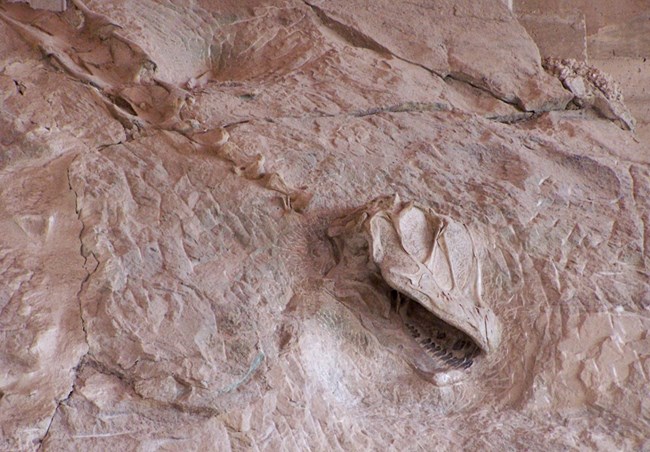
Improving children’s vocabulary through dinosaurs and fossils begins with a question that children already love: “How do we know what an animal looked like if it lived millions of years ago?” Words such as fossil, skeleton, footprint, sediment, reconstruct and evidence help children understand how scientists investigate the ancient past.
Parents searching for dinosaur vocabulary for kids, fossil words for children, prehistoric animals for kids or how to explain dinosaurs to children can use the forty-word guide, fossil investigation examples and ten safe activities below. No fossil needs to be purchased or dug up. Museum photographs, scientifically labelled books and drawings are enough to begin.
The biggest lesson is that dinosaurs are not simply giant lizards from a story. They were a diverse evolutionary group of animals, and modern birds are surviving dinosaurs. Fossils provide evidence about anatomy, environments and behaviour, but many details remain uncertain. Learning the words helps children distinguish evidence from an artist’s reconstruction.
- Choose a trustworthy dinosaur image or fossil: one museum-labelled photograph is enough.
- Name one visible feature: skull, teeth, vertebrae, footprints or preserved impressions.
- Explain the word: a fossil is preserved evidence of ancient life, not necessarily a complete skeleton.
- Ask what it tells us: bones can reveal some anatomy; tracks may suggest movement.
- Identify a limit: a skeleton alone cannot prove an animal’s exact colour or behaviour in every situation.
- Return to the concept: use the word in another fossil, museum label or animal comparison.
Why dinosaur vocabulary teaches more than animal names
A child may memorise Tyrannosaurus and Triceratops but still be unsure whether a fossil is an animal, a rock or a scientist’s drawing. These are different ideas. An extinct species is a kind of organism. A fossil is surviving evidence. A reconstruction is an interpretation created from evidence. A museum cast is a copy of a specimen, not necessarily the original fossil.
The Smithsonian National Museum of Natural History’s dinosaur and fossil resources explain how fossils reveal ancient life and environments. The Natural History Museum in London discusses how scientists infer characteristics from teeth, tracks, eggs, skin impressions and other evidence.
This makes a rich vocabulary lesson: observation, evidence, inference, uncertainty and revision. A child can learn that scientists update reconstructions when a better fossil is found. Saying “we do not know yet” is often the correct answer, not a weakness.
Forty dinosaur, fossil and prehistoric-life words
Words 1–10: fossils and how they form
| Word | Plain-language meaning | Helpful example |
|---|---|---|
| fossil | preserved remains or evidence of past life, generally ancient | A fossil leaf can preserve information about an old plant. |
| body fossil | preserved part or remains of an organism | A fossilised tooth is a body fossil. |
| trace fossil | preserved evidence of an organism’s activity | A footprint can become a trace fossil. |
| sediment | loose material deposited by water, wind or other processes | Mud and sand can become layers of sediment. |
| sedimentary rock | rock made by accumulation and later consolidation of sediments or related processes | Many fossils are found in sedimentary rocks. |
| layer | a stratum or band of material | The fossil was discovered in a rock layer. |
| stratum | a particular geological layer; plural strata | Scientists describe the stratum around a fossil. |
| excavation | careful removal of material to expose or investigate something | The museum documents a fossil excavation. |
| palaeontologist | a scientist who studies ancient life using fossils | A palaeontologist investigates the specimen. |
| evidence | information supporting or challenging an explanation | The fossil tooth is evidence about anatomy. |
Not every fossil is a whole skeleton or a bone that has literally turned into ordinary rock in the same way. Fossil preservation involves several possible processes, including impressions and mineral replacement. A child can start with the broad definition and explore the details later.
Words 11–20: dinosaur diversity and living things
| Word | Plain-language meaning | Helpful example |
|---|---|---|
| dinosaur | an animal belonging to the evolutionary group Dinosauria, including birds | Birds are living dinosaurs. |
| theropod | a dinosaur in a group that includes many meat-eating forms and the ancestors of birds | T. rex is a theropod. |
| ornithischian | a dinosaur from one major evolutionary branch including familiar horned and plated dinosaurs | Triceratops is an ornithischian dinosaur. |
| herbivore | an animal that eats plants | Many long-necked dinosaurs were herbivores. |
| carnivore | an animal that feeds on other animals | Some theropods were carnivores. |
| omnivore | an animal that eats both plant and animal material | Diet varies by species and evidence. |
| bipedal | moving mainly on two legs | Many theropods were bipedal. |
| quadrupedal | moving on four limbs | Many large sauropods were quadrupedal. |
| feather | a specialised body covering found in birds and many non-avian dinosaurs | Some fossils preserve feathers. |
| crest | a raised structure on an animal’s head or body | Some dinosaurs had head crests. |
Avoid treating the words herbivore, carnivore and omnivore as permanent classifications for every named dinosaur without evidence. Palaeontologists infer diet from teeth, jaw mechanics, preserved stomach contents and comparisons, but the strength of the evidence varies.
Words 21–30: bodies, tracks and reconstructions
| Word | Plain-language meaning | Helpful example |
|---|---|---|
| skeleton | the body’s supporting system made of bones or other structures in context | The display shows a reconstructed dinosaur skeleton. |
| skull | bones forming the head’s main framework in vertebrates | The skull includes parts of the jaws. |
| tooth | a hard structure often used in feeding | Tooth shapes can suggest feeding habits. |
| claw | a curved pointed structure found on some digits | The claw’s shape can be described from a fossil. |
| limb | an arm, leg or related appendage | The limb bones help reveal posture. |
| vertebra | one of the bones forming the vertebral column | The fossil spine contains vertebrae. |
| tail | the body extension behind the trunk in many animals | Tail bones may reveal body proportions. |
| trackway | a sequence of footprints made by a moving organism | A trackway may help infer a path or gait. |
| cast | a copy or replica made from a mould or scan in a museum context | The displayed skeleton may include casts. |
| reconstruction | an evidence-based model or interpretation of a past object or organism | An artist made a reconstruction of the dinosaur. |
An artistic reconstruction can be informed by many fossils but still include uncertain details. A skeleton assembled for display may combine original material with casts or reconstructed parts. Ask the label what is authentic and what is inferred rather than assuming every bone comes from one complete animal.
Words 31–40: time, change and reasoning
| Word | Plain-language meaning | Helpful example |
|---|---|---|
| Triassic | a geological period during which early dinosaurs emerged | Early dinosaurs evolved in the Late Triassic. |
| Jurassic | a period after the Triassic and before the Cretaceous | Many familiar dinosaur groups lived in the Jurassic. |
| Cretaceous | the geological period following the Jurassic | T. rex lived in the Late Cretaceous. |
| extinction | the disappearance of every member of a species or group as defined | Many dinosaur lineages became extinct. |
| asteroid | a relatively small rocky or metallic body orbiting the Sun | An asteroid impact is linked to the end-Cretaceous extinction. |
| ecosystem | living organisms and their physical environment interacting | Dinosaurs lived in varied ancient ecosystems. |
| adaptation | an inherited feature shaped through evolution that helps in a particular context | Feathers evolved in dinosaur lineages and later served multiple roles. |
| evolution | change in inherited characteristics of populations across generations | Birds evolved within the dinosaur lineage. |
| inference | a conclusion drawn from evidence rather than directly observed | Tracks can support an inference about movement. |
| uncertainty | what is not yet reliably known | The exact colour of many dinosaurs remains uncertain. |
Geological periods span millions of years. They are not names for one species or one climate. A dinosaur from the Jurassic did not necessarily live beside every other dinosaur shown in a generic children’s poster. Use a labelled timeline to keep the periods distinct.
Was every prehistoric reptile a dinosaur?
No. Pterosaurs were flying reptiles closely related to dinosaurs but not themselves dinosaurs. Ichthyosaurs, plesiosaurs and mosasaurs were marine reptiles outside Dinosauria. The Natural History Museum’s explanation of dinosaurs carefully distinguishes these groups.
This is a valuable category lesson. Prehistoric means belonging to a time before written historical records, but dinosaur is a narrower scientific group. Reptile has its own complex evolutionary context. Children can learn not to use “dinosaur” as a blanket label for anything ancient, large or reptile-like.
Try four cards: Triceratops, a flying pterosaur, a marine plesiosaur and a modern sparrow. Ask which are dinosaurs. Triceratops and the sparrow are; the pterosaur and plesiosaur are not. Explain that modern birds belong to the dinosaur evolutionary lineage, even though the non-avian dinosaurs became extinct.
Worked example: what teeth can tell us
Imagine two museum fossil photographs, one showing sharp recurved teeth and another showing broad grinding surfaces. Ask what is directly observed: tooth shape, spacing, wear and preserved position, where visible. Then discuss which feeding actions those shapes might support. Cutting, gripping and grinding are different functions.
A palaeontologist may use teeth alongside jaws, tooth wear, preserved plant remains, coprolites and other evidence to infer diet. A child’s hypothesis can be reasonable without being proven from one picture alone. Say “The teeth suggest…” rather than “The teeth prove this animal ate only one thing.”
Now ask the child to compare a modern animal’s tooth form with a fossil. Explain that similarities can suggest functions but do not mean two animals were identical. The new words compare, evidence, function and infer apply outside palaeontology.
Worked example: a fossil footprint is not a fossil foot
A fossilised footprint is a trace left by an organism’s movement. It is not the same thing as a preserved foot bone. A sequence of impressions forms a trackway, which may help researchers examine direction and approximate stepping patterns.
But a trackway cannot automatically tell us the exact species, sex, colour or motivation of an animal. Preservation, substrate and later erosion influence the impression. A child can describe the visible toe marks and their spacing without overclaiming.
An ordinary impression made safely in soft modelling material can illustrate the idea of a trace, but it is not an ancient fossil. Teach that difference explicitly. A model can demonstrate a process without becoming original evidence of prehistoric life.
Worked example: why scientists revise dinosaur pictures
Older popular pictures sometimes portrayed nearly all non-avian dinosaurs as giant scaly reptiles. Discoveries of feather impressions and other fossil evidence have altered reconstructions for many species. The Natural History Museum’s guide to how dinosaurs evolved into birds explains the evolutionary relationship and the role of feathered fossils.
That does not mean all dinosaurs were fully feathered, or that every species’ exact appearance is known. Some fossils preserve skin impressions, other fossils show feathers, and many preserve neither. A scientifically informed illustration may use a combination of evidence and cautious interpretation.
Ask: “Which part of the illustration is supported by a fossil? Which details are an artist’s plausible choice?” This encourages the child to use evidence, reconstruction, inference and uncertainty accurately.
Why birds count as living dinosaurs
Birds evolved from small theropod dinosaurs. Modern birds inherited many skeletal features through that evolutionary lineage. In evolutionary classification, a group includes its descendants, so birds belong to Dinosauria. The statement that “dinosaurs are all extinct” is therefore inaccurate unless the speaker means non-avian dinosaurs.
The Natural History Museum’s explanation distinguishes the extinction of non-avian dinosaurs around 66 million years ago from the survival of bird lineages. It also explains why feathered dinosaurs and modern birds share a meaningful ancestry.
This helps children see the difference between everyday labels and scientific groups. A sparrow is not a miniature Triceratops. But a sparrow belongs to the dinosaur evolutionary tree. Vocabulary such as ancestor, descendant, lineage and evolution can be introduced gradually when the child is ready.
Ten safe dinosaur-word activities without digging
- 1. Fossil or reconstruction: Compare a real museum fossil photo with an artist’s restoration and label which is which.
- 2. Trace versus body: Sort pictures of a tooth fossil, a footprint impression and a modern animal drawing.
- 3. Three-period timeline: Arrange Triassic, Jurassic and Cretaceous in order without suggesting they are equal in length.
- 4. Dino or not: Categorise a pterosaur, a marine reptile, a dinosaur and a bird with suitable factual guidance.
- 5. Tooth detective: Discuss what tooth shapes may suggest and what they cannot prove by themselves.
- 6. Body-part labels: Identify skull, vertebrae, limbs and tail from a labelled skeleton diagram.
- 7. Trackway drawing: Use paper arrows and animal footprints to explain direction and spacing.
- 8. Artist’s revision: Redraw an extinct animal using an identified new piece of evidence and mark remaining unknowns.
- 9. Museum caption: Write a two-sentence caption describing one genuine fossil and one inference.
- 10. Today-to-prehistory comparison: Discuss how a modern bird is evolutionarily connected to dinosaur ancestors.
Twenty questions children can ask about dinosaurs
- What is a dinosaur?
- What is a fossil?
- What makes a trace fossil different from a body fossil?
- Can a footprint become a fossil?
- What is sediment?
- Why are many fossils found in sedimentary rocks?
- Who studies ancient life?
- How is a skeleton different from a reconstruction?
- Could a museum skeleton include casts?
- Which bones are visible here?
- What might teeth suggest about feeding?
- Can teeth alone prove an entire diet?
- What can a trackway tell us?
- What cannot a trackway tell us?
- Why are pterosaurs not dinosaurs?
- How are birds related to dinosaurs?
- What happened to non-avian dinosaurs around 66 million years ago?
- Why might an artist’s reconstruction change?
- What part of this claim is evidence and what part is inference?
- Which new word would help us explain a different fossil?
Choose only two or three questions for a particular picture or fossil. Children may want to explore a named animal or make up an adventure story; encourage imagination while distinguishing fiction from scientific explanation.
Fossil safety, museum care and responsible collection
Do not take children to dig in quarries, unstable cliffs, construction sites, caves, excavations or protected land as a vocabulary exercise. Loose rocks, slopes and machinery can be dangerous. Many fossil sites have legal restrictions, and a specimen’s scientific value often depends on recording its original geological context.
Museums frequently display authentic specimens alongside casts and reconstructions. Follow venue rules about touch, flash photography and access. A child can learn vocabulary from images, safe prepared educational kits and professionally presented exhibitions without removing or damaging any real fossil.
A child does not need to buy fossil specimens to learn. Where the origin or legality of a commercial fossil is unclear, choose museum resources instead of encouraging unverified collection or trade.
Adapting dinosaur language for different ages
Preschool: Begin with dinosaur, bone, fossil, big, small, teeth, claw and footprint, using safe illustrations and simple true explanations. Do not insist on geological numbers.
Early primary: Add herbivore, carnivore, skeleton, trace, reconstruction, extinct, Triassic, Jurassic and Cretaceous. Use a timeline and distinguish dinosaur from other prehistoric reptiles.
Older children: Discuss fossilisation processes, evolutionary classification, geological context, scientific inference, uncertainty and why birds are surviving dinosaurs.
Multilingual families: Explain the science in the language a child understands best, then connect English labels. A concept learned through a home-language museum guide remains useful knowledge.
A two-week dinosaur vocabulary routine
- Days 1–2: Learn dinosaur, fossil and evidence from one authentic specimen photo.
- Days 3–4: Compare body fossils and trace fossils; explain why a footprint is not a foot bone.
- Days 5–6: Label skeleton parts and use herbivore or carnivore carefully.
- Day 7: Place the Triassic, Jurassic and Cretaceous on a simple timeline.
- Days 8–9: Compare a dinosaur with a pterosaur or marine reptile.
- Days 10–11: Discuss feathers, birds and evolutionary lineage.
- Days 12–13: Compare a museum fossil photo with an artist’s reconstruction.
- Day 14: Invite the child to explain three words accurately using a new fossil image.
This plan is illustrative, not a promise of mastery in two weeks. Interest and background knowledge vary. A shorter discussion repeated across books and museum visits may be more effective.
Common mistakes families can avoid
- Calling every prehistoric reptile a dinosaur.
- Claiming all dinosaurs are extinct without recognising living birds.
- Assuming every museum skeleton is entirely original fossil bone.
- Treating a colourful illustration as evidence of exact skin or feather colour.
- Inferring an animal’s entire behaviour from one footprint or tooth.
- Confusing a model footprint with an ancient fossil.
- Assuming all famous dinosaurs lived together in one geological period.
- Digging at unsafe or protected sites to collect specimens.
Frequently asked questions
What are dinosaur vocabulary words for kids?
They include words for ancient animals and the evidence scientists use: fossil, skeleton, skull, trackway, sediment, palaeontologist, herbivore, extinction and reconstruction.
Are pterosaurs dinosaurs?
No. Pterosaurs were a related group of flying reptiles, not dinosaurs. Marine reptiles such as plesiosaurs also fall outside Dinosauria.
Are birds dinosaurs?
Yes. Modern birds evolved within the theropod dinosaur lineage, so they are living dinosaurs in evolutionary classification.
Can fossils tell us exactly what dinosaurs looked like?
Some fossils preserve important bones, skin impressions or feathers, but many details remain uncertain. Scientific reconstructions may combine evidence with cautious interpretation.
Do children need to collect fossils to learn the words?
No. Museum labels, authentic fossil photographs, labelled diagrams and nonfiction books are sufficient and safer starting points.
Related eduKateSG vocabulary routes
This article owns dinosaur, fossil and deep-time vocabulary. For wider factual reading visit Nonfiction Books and Science Words; for museum display terms see Museums and Exhibitions; for the language of evidence see Science Experiments and Inquiry. Sorting and Categories helps children understand why ancient animals belong to different groups.
Sources and editorial note
Primary scientific sources: Smithsonian National Museum of Natural History: Dinosaurs and Fossils; Natural History Museum: What Are Dinosaurs?; Natural History Museum: What Can Scientists Learn About Dinosaurs?; and Natural History Museum: Why Are Birds the Only Surviving Dinosaurs?. The glossary and examples are original explanatory writing and do not replace formal palaeontological expertise.