
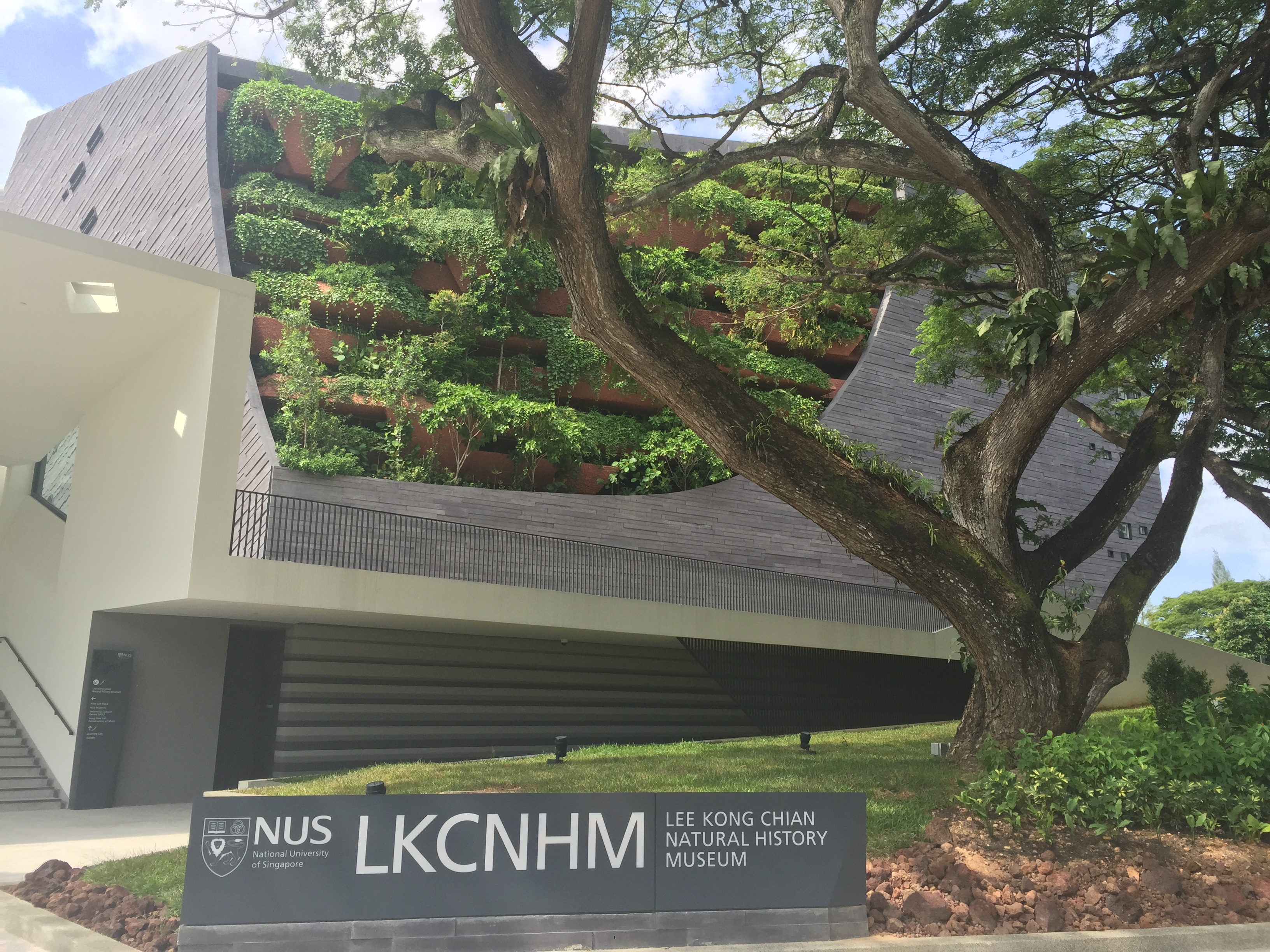
What to do in Singapore if you want to understand dinosaurs, biodiversity, extinction and the extraordinary natural history of Southeast Asia? Visit the Lee Kong Chian Natural History Museum at the National University of Singapore. Its three real sauropod dinosaur fossils, specimens of animals and plants, and galleries tracing the history of scientific collecting provide a memorable way to learn how researchers investigate life on Earth.
The strongest visit is not simply a dash toward the dinosaur skeletons. Choose a question: How can a fossil tell us about an animal that died millions of years ago? What separates scientific classification from ordinary naming? Why do museums preserve specimens? How does a locally extinct species reveal environmental change? A short, carefully observed collection can answer these questions better than rushing through every display.
The museum’s current visitor guide lists 2 Conservatory Drive, Singapore 117377, opening Tuesday to Sunday, 10 a.m.–6 p.m., with last admission 4.30 p.m. and closure on Mondays even when the day is a public holiday, unless specially announced. Three entry sessions begin at 10 a.m., 1 p.m. and 4 p.m. Important November 2026 detail: selected Mammal Zone displays are being removed, and the entire Mammal Zone is scheduled to close for renovation in late November, with a refreshed appearance expected in 2027. Verify which exhibits will be available on your date instead of promising every animal specimen.
Quick notes: focus on two specimens and one idea
- Book the appropriate 10 a.m., 1 p.m. or 4 p.m. admission session and allow time before the 6 p.m. closing.
- Begin with the three large dinosaur skeletons in the Biodiversity Gallery.
- Read how a palaeontologist uses bones, location and comparison to classify an ancient organism.
- Choose one Singapore biodiversity specimen, such as the Changi Tree or a documented animal.
- Add the Heritage Gallery to see why preserving specimens matters to Singapore’s science history.
- Treat display labels, original material and reconstructions as different kinds of evidence.
- Note the late-November 2026 Mammal Zone renovation warning and current gallery access.
- Finish with one supported conclusion and one scientific question still unanswered.
Why natural history is not just dinosaur history
Natural history is the study and documentation of organisms, their diversity, environments and changes through time. Dinosaurs attract attention because their fossils are dramatic, but a natural history museum may also hold plants, insects, marine animals, birds and records of species found today. The Biodiversity Gallery covers fifteen thematic zones, ranging from plants and amphibians to mammals and prehistoric life. A useful visitor chooses examples that connect the distant past with present biodiversity. The question is not simply which specimen looks biggest, but how objects help researchers understand life and its changing environments.
The museum is a research institution
The Lee Kong Chian Natural History Museum is part of NUS, and its work extends beyond the public displays. Researchers document biological diversity, study collected specimens and publish scientific findings. The museum’s research pages explain this broader role. Visitors may see only a curated portion of the holdings, so a full collection should not be confused with the galleries open that day. A specimen can be valuable for future research even when it looks ordinary to a casual viewer. Museum research requires preservation, records, ethical methods and specialist expertise, not simply arranging impressive objects behind glass.
The museum’s institutional history is long
The current museum building opened on 18 April 2015, but its collections have roots in earlier Singapore institutions, including the former Raffles Library and Museum. The official museum history traces scientific collecting through successive institutional changes and the development of the Raffles Museum of Biodiversity Research. A visitor can ask how a collection survives when its buildings and names change. Some specimens have been cared for across generations of researchers. That history is distinct from the age of the museum’s present architecture, so do not describe all the objects as collected in 2015.
Biodiversity means more than a species count
Biodiversity includes variation among organisms and the ecosystems in which they live. Species counts are useful, but they do not tell us everything about genetic differences, ecological relationships, population trends or habitat condition. Two places with the same number of recorded species may have very different environmental histories. At the museum, choose one display showing different animal groups and ask how their forms and functions differ. Do not assume the number of specimens on a shelf equals the population of those organisms in the wild. A collection is a curated source of evidence, not a living census.
The first impression: three giant sauropods
The museum is famous for three genuine diplodocid sauropod fossils, often called Prince, Apollonia and Twinky. Its Biodiversity Gallery description explains that the specimens were discovered in the United States between 2007 and 2010 and that two skeletons preserve skulls, an unusual feature of sauropod finds. Look at how their long necks, body structures and tails differ from the animals that share our world today. Do not assume every visible component is untouched fossil bone; professional mounting may use supports or reconstructed parts to help visitors understand the animals.
What makes a fossil useful
A fossil is preserved evidence of ancient life, which may include mineralised bones, impressions, tracks or other traces. The value of a fossil depends on its condition, geological context and how carefully it is documented. A large bone does not automatically reveal the animal’s complete behaviour or appearance. Palaeontologists compare anatomy, sediment and other finds to develop interpretations. A student can look at one vertebra and ask what role it played in supporting the animal. The most useful habit is to distinguish what the fossil directly shows from what researchers infer using wider evidence.
How the dinosaurs reached this museum
The specimens came from fossil-bearing formations in the United States rather than being excavated from Singapore. The museum’s 2024–2025 annual report identifies the Morrison Formation in Wyoming and records specialist study of the trio in 2025. This is an important geographical distinction: an international fossil collection can support scientific education in Singapore without claiming the creatures once walked the present campus. A map helps students locate the source region, then ask what geological conditions allowed ancient bones to be preserved and discovered millions of years later.
Dinosaur skeletons are not always complete
A mounted skeleton can look whole, yet fossils are often found in fragments. Museum experts may make carefully documented reconstructions to represent missing parts, using comparative anatomical evidence. The Lee Kong Chian museum describes the large sauropod skeletons as unusually complete, with some specimens over eighty percent preserved. But a display percentage does not mean every bone has remained unchanged or all aspects of the animal are known. Ask how museum specialists decide which fragments belong together and how they distinguish an original fossil from support material. Scientific interpretation becomes stronger when uncertainty is explained.
The skull is unusually informative
Sauropod skulls are relatively uncommon in many fossil collections because small, delicate cranial elements are less likely to survive in association with large body skeletons. The museum emphasises that two of its diplodocid specimens preserve skulls. A skull may provide anatomical clues relevant to feeding and classification, but one preserved skull cannot reveal every aspect of diet or behaviour. A child can compare the skull’s size with the long vertebral column, while a Secondary student can ask which bone features researchers use to distinguish groups. Fossil evidence should be analysed through comparison rather than imaginative guesses about personality.
Why a neck could be so long
Sauropods were large herbivorous dinosaurs with distinctive necks and body structures. Researchers investigate how skeletons supported these forms through vertebrae, muscles and other anatomical evidence. A museum visitor may see a long series of neck bones and think the animal could reach every tree in any direction. That claim would require biomechanical evidence rather than appearance alone. Ask how the neck relates to feeding opportunities and the body’s mass. A simple diagram can introduce relationships among form, function and constraint, but a mounted skeleton is not a demonstration of every movement the living animal performed.
The name diplodocid is a classification
Diplodocid identifies a group of sauropod dinosaurs sharing evolutionary and anatomical characteristics. It is more informative than calling every big long-necked fossil the same species. Palaeontologists compare bones and phylogenetic evidence to establish relationships among groups. A student can learn that scientific names describe classifications that may be revised when new evidence appears. Do not assume a familiar museum nickname such as Prince is the formal species designation. Nicknames make fossils memorable for the public; classification requires specialist evidence. Keeping those roles distinct helps learners understand how science communicates with both experts and visitors.
What was the Morrison Formation?
The Morrison Formation is a geological unit in western North America known for Late Jurassic fossil deposits, including many sauropods. The museum’s dinosaur specimens are linked to fossil discoveries in this region. Their source helps palaeontologists place them within a broader environmental and chronological context. A fossil’s age is not calculated simply from how old the bone looks; researchers consider geological evidence and dating methods. A student can ask what sedimentary layers tell us about the environment in which remains accumulated. That question connects fossils with Earth Science rather than treating dinosaur identification as a visual guessing game.
The difference between a real fossil and a cast
An original fossil contains preserved material from the ancient organism or its trace, while a cast is a reproduction produced from a mould or digital model. Museums may use both to protect fragile objects, complete a display or allow people to compare shapes. The Lee Kong Chian sauropods are notable for including substantial real fossil material, but visitors should still follow the particular labels. Do not claim every dark surface or reconstructed component has the same provenance. A responsible caption identifies the exhibit and distinguishes original material where documented. Authenticity is an evidentiary question, not simply a matter of appearance.
Why fossil colour can mislead
Mineralised fossil material may vary in colour depending on geology and preservation, while supports or replicas can be made to look visually compatible. A dark bone is not automatically older than a light one, and colour does not by itself prove authenticity. Ask what information the museum supplies about the fossil’s origin and preparation. The educational method is simple: describe the visual feature, consult the interpretation and state which scientific claim is supported. The same habit matters when analysing minerals, old photographs and archaeological objects. A visual impression starts a question but does not necessarily answer it.
A fossil cannot prove everything about behaviour
The skeleton can show anatomy, but ancient animals also had skin, muscles, internal organs and behaviour that may not fossilise. Scientists use related fossils, physical models and comparisons with living organisms to develop hypotheses. A scene portraying a sauropod walking in a herd may be an interpretation rather than a direct recording. The museum’s annual report notes research into whether the three fossils may belong to a herd or family grouping; such possibilities require careful evidence. A strong student answer separates well-supported anatomical facts from more uncertain reconstructions of social behaviour.
The three fossils invite comparison
Choose two visible skeletons and compare size, neck or tail structure from approved visitor areas. Are the differences necessarily evidence of separate species? Not without considering age, growth, individual variation and anatomical detail. A younger specimen may differ from an older one even within the same lineage. The museum’s research work is a useful illustration of how specialists investigate such questions. A visitor need not solve the classification to learn the method. The most worthwhile outcome is understanding why experts require multiple kinds of evidence rather than assigning names from size alone.
A scientist may revise a species name
Classification systems can change when new fossils or analytical methods become available. A label based on the best evidence at one time may be updated as research advances. That is not necessarily evidence science failed; it reflects the process of revising explanations in light of new information. The museum’s collection supports continuing evolutionary research, including digital comparisons of fossil anatomy. A student can ask which features are used to propose a relationship and what new evidence might change the conclusion. This is a useful lesson in scientific humility and the difference between a nickname, a specimen identifier and a taxonomic name.
The Biodiversity Gallery has fifteen zones
The official gallery overview introduces life through fifteen thematic areas covering major biological groups and ecological stories. Do not assume all zones are the same size or equally available during renovations. Instead of rushing between them, select three examples that demonstrate different forms of life. A plant, invertebrate and vertebrate can reveal how organisms solve different problems of movement, feeding and reproduction. A child can notice obvious visual differences, while an older student can discuss common ancestry and classification. The strength of a natural history gallery is comparison across diversity rather than one dazzling specimen.
The Mammal Zone is changing in November 2026
The museum’s official live visitor page states that selected Mammal Zone cases are being cleared and that the entire zone will close temporarily from late November 2026 for renovation, with refreshed exhibits planned in 2027. This creates an important uncertainty for anyone expecting the Singapore sperm whale skeleton or other mammal displays. Do not promise it will remain available on a particular late-November date. A family can still enjoy dinosaurs, other biodiversity zones and the Heritage Gallery, subject to actual operations. Verify the specific exhibit’s access through the museum before planning a special trip around it.
The Singapore sperm whale story
The Biodiversity Gallery description explains that a 10.6-metre female sperm whale was found dead off Jurong Island in July 2015, the first recorded sperm whale specimen in Singapore. Museum researchers recovered and studied the animal, and its skeleton was exhibited in the Mammal Zone. This is evidence of a recorded occurrence, not proof that a breeding population lives permanently near Singapore. The discovery has value for documenting regional biodiversity and understanding large marine mammals. During the 2026 Mammal Zone works, check current display availability before including the skeleton in a promised itinerary.
Why a stranded animal can advance science
A dead animal found near a coastline can provide information about anatomy, diet, health and the regional presence of a species. Proper study requires specialists, preservation methods and consideration of the circumstances of the find. A visitor should not conclude the exact cause of death without reading the researchers’ evidence. The sperm whale record shows how scientific data can emerge from an unexpected event and why museums maintain expertise to respond. It also illustrates the value of specimen records: an unusual find may become an important reference long after the original discovery.
A museum whale is not a living aquarium animal
A skeletal specimen helps visitors investigate anatomy and body scale, while a living animal in a managed aquarium would raise different welfare and observation questions. The sperm whale displayed at Lee Kong Chian was not an animal held alive in a tank. A child should understand that the skeleton came from a deceased whale recovered for scientific study. This can be explained respectfully without graphic imagery. The scientific value lies in preserved evidence, not entertainment through watching an animal swim. A student can compare the different methods of studying living behaviour, fossils and preserved bodies without treating them as interchangeable.
The Changi Tree tells a conservation story
The museum’s biodiversity highlights include a slice of the Changi Tree, identified as *Hopea sangal*, locally known as chengal pasir. The official gallery account states that an individual thought to represent a locally extinct species was found in 2002 and illegally felled that same year. Its preserved wood allows future visitors to study the organism and remember the circumstances. The lesson is not simply that a large tree disappeared. It is that an individual may be scientifically important because it represents a scarce local occurrence, and human actions can destroy irreplaceable evidence and habitat.
Locally extinct is not globally extinct
A species described as locally extinct has disappeared from a particular place or area but may still exist elsewhere. Global extinction means no living individuals of the species remain anywhere. Confusing these categories can produce misleading conservation stories. The Changi Tree example invites students to ask what evidence researchers used to assess local status and whether populations survive outside Singapore. Do not assume one surviving specimen proves current forests contain large populations. A museum slice documents a particular individual and scientific history, not the full global distribution of the species. Precise vocabulary helps readers understand conservation claims.
Why tree specimens are preserved
A preserved wood slice may reveal structure and help future researchers compare botanical material. It can also become a historical reference connecting a species with a particular location and date. The value depends on careful labelling, provenance and protection from damage. Do not touch or scratch displayed wood without permission. A child can compare a tree slice with the living trees outside and learn that wood contains biological structures formed during growth. An older student can ask what information different specimens—wood, leaf, seed and DNA—might provide. Natural history collecting preserves evidence, not merely attractive objects.
The Heritage Gallery goes beyond organisms
The Heritage Gallery traces the development of scientific collecting in Singapore from the nineteenth-century Raffles Museum and related institutions. It contains five zones and helps visitors understand how scientists, communities and museums built records of biodiversity. This part of the visit explains why the specimens exist in Singapore today and how different generations have cared for them. Do not assume every object in the collection was collected under contemporary research practices. The history of science includes changing methods and ethical questions. A thoughtful visitor can appreciate the collection while recognising its evolving institutional context.
The 1883 leatherback turtle record
The Heritage Gallery highlights include a leatherback turtle specimen found dead near Siglap beach in 1883 by Malay villagers. The museum describes it as Singapore’s only known historical record of a leatherback turtle. This is a valuable example of how an old preserved specimen documents a species’ occurrence. But one record does not reveal its historic population size or breeding status. A student can ask what researchers learn from rare occurrences and how communities contributed to scientific knowledge. The specimen illustrates the importance of collection history as much as the turtle’s remarkable anatomy.
Leatherback turtles differ from hard-shelled turtles
Leatherback sea turtles have a different shell structure from many familiar hard-shelled turtles, with a flexible leathery covering and an adapted body for marine life. A museum specimen provides a chance to compare anatomy while respecting display boundaries. Do not assume all turtle species live in the same habitats or migrate identical distances. Read the species label and consult authoritative biology references for detailed ecological claims. An older learner might investigate marine adaptation and conservation threats. A younger child can begin with the simple observation that animals called turtles can still have very different forms and life histories.
Sunda pangolins have keratin scales
The museum’s Heritage Gallery describes the **Sunda pangolin (*Manis javanica*)** and its protective scales, which are made of keratin, a material also found in human hair and nails. This makes a memorable Science connection. But a scale’s biological function does not mean it has medicinal value for humans. The museum explicitly warns against baseless health beliefs associated with pangolin scales. A student can ask why misleading demand threatens wildlife and how researchers establish conservation status. Do not infer that a pangolin specimen is an invitation to touch or purchase protected animal products.
Why wildlife trade matters
Some animals are threatened by habitat loss and illegal capture for products. Pangolin trafficking is a serious conservation concern, but specific legal and population claims should be grounded in reliable sources. A museum can introduce how demand for animal parts affects species beyond national borders. A child can learn simply that wild animals should not be purchased as souvenirs. A Secondary student can investigate the roles of law enforcement, public education and habitat protection. Avoid implying that one museum visit solves the trade problem. Effective conservation involves several institutions and decisions over time.
What a specimen label should tell us
A scientific specimen is more useful when associated with information such as species name, collection location, date and record history. Without that context, it may be difficult to interpret an object accurately. At the museum, read a label before claiming where an animal lived or how old it was. Some objects were collected long ago, and their original records may be incomplete. A student can note which information is provided and which remains uncertain. This teaches that scientific evidence includes documentation as well as physical material. A preserved specimen is not just a photograph-worthy object.
How scientific naming works
Biologists use scientific names to reduce ambiguity across languages and regions. A common name may refer to different organisms in different places, while a formal taxonomic name locates a species within an evolving classification framework. A name does not by itself reveal the entire biology of an organism. At one display, record the common and scientific names and ask what larger group it belongs to. A Secondary student can explore genus and species, while a Primary child can simply notice that one animal may have several names. Accurate naming helps communication, especially when comparing rare or regionally distinctive biodiversity.
Classification is not ranking
Taxonomy groups organisms according to evidence of relatedness and biological characteristics. A classification system is not a ladder ranking species from simple or inferior to advanced or superior. An insect, flowering plant and mammal each have evolutionary histories and adaptations to particular environments. A museum gallery containing very different forms makes that point visible. Ask what traits connect two organisms rather than which one looks more intelligent or attractive. This is an important correction to common misunderstandings about evolution. Modern biodiversity can be viewed as a branching history, not a single line progressing toward humans.
What an adaptation is
An adaptation is an inherited feature related to survival or reproduction in particular conditions. Different species have different adaptations because of evolutionary history and their environments. A shell, wing, scale or bill might have a relevant function, but the function should be verified rather than guessed from appearance. The museum’s Singapore Biodiversity and Adaptation programme teaches these relationships to school groups using appropriate specimens and instruction. An ordinary visitor can observe the displays and form questions without handling collection objects or assuming that a particular workshop is available without booking.
Camouflage is one kind of adaptation
Some organisms have colours or forms that reduce visibility in their environments. Others use movement or behaviour to avoid threats. But a brown insect is not necessarily camouflaged in every habitat, and an attractive pattern may have other functions. A student can choose a documented specimen and ask where it normally lives and what its appearance might accomplish. Avoid making a definitive claim from colour alone. A natural history museum provides close views that are hard to obtain in the wild, making it useful for careful comparison. The wider ecological explanation still requires information about living behaviour and habitat.
Marine specimens show another world
Southeast Asia contains diverse marine environments, including coral reefs, seagrass beds, mangroves and deeper waters. Museum specimens can reveal forms of life that are difficult for visitors to observe safely at sea. A preserved coral or marine invertebrate may illustrate structure but not the colours or movements of a living organism. Ask which features are retained in preservation and which would need a different kind of observation. The collection can inspire interest in coastal conservation without encouraging people to remove animals from intertidal habitats. Research institutions study life partly to help societies understand what they risk losing.
Coral is not a stone decoration
Corals may look rock-like, but reef-building corals are colonies of living cnidarian animals associated with mineral structures and, in many species, symbiotic microorganisms. Their ecology is more complex than a white skeleton suggests. A museum display may include preserved coral material, which should not be assumed to be alive. A student can distinguish the living colony from the structure it leaves behind. Avoid collecting coral fragments from beaches as souvenirs. The educational lesson is that natural history objects often represent formerly living systems whose relationships are invisible after preservation.
Fungi and other overlooked life forms
Visitors drawn to large dinosaurs may overlook smaller organisms, including fungi, insects and other groups central to ecosystems. Yet decomposers and tiny animals contribute to nutrient cycling and food webs. A natural history museum can encourage recognition of life forms that do not make spectacular photographs. Choose a small specimen and ask what ecological role its group may play, using the label and suitable sources. Do not assume a larger organism is automatically more important. Biodiversity is a network of interactions, and many essential processes occur through organisms that people rarely notice during a casual forest walk.
The old Raffles Museum legacy
The museum’s historical material traces how collections and scientific institutions developed from the Raffles Library and Museum era. Singapore’s natural heritage was recorded through changing scientific practices and contributions by many individuals and communities. The modern NUS institution inherits selected records and specimens from those earlier settings. A visitor should not treat the collection as detached from colonial history, but neither should the present exhibition be reduced to one period. A careful student can ask how methods, institutional purposes and understanding of biodiversity changed over time. The Heritage Gallery is valuable because it gives context to the scientific objects in the adjacent display.
Alfred Russel Wallace and Southeast Asia
The history of evolutionary biology includes the work of Alfred Russel Wallace in the Malay Archipelago. His observations contributed to discussions about natural selection and patterns of species distribution. A natural history museum in Singapore provides an opportunity to investigate that regional context, but a visitor should consult the museum’s own historical materials before attributing a particular specimen to Wallace. The broader lesson is that the study of island biodiversity helped scientists notice differences among related species and environments. Geography and evolution are deeply connected, yet scientific understanding developed through the work and knowledge of many people, not one person alone.
The role of local collectors and communities
Specimens may enter collections through field researchers, community reports, accidental discoveries and collaborations. The leatherback turtle found by Malay villagers and the 2015 whale recovery show that natural history knowledge can involve people outside academic laboratories. But the precise contribution of each individual should be described from documented sources rather than imagined. Ask how museums credit the people who found, preserved or studied an object. This develops a more inclusive understanding of scientific work. A public collection is not just the achievement of the named institution; it can reflect cooperation across many roles and generations.
Museums preserve information across generations
A specimen collected a century ago can answer new questions when improved scientific methods become available. Digital imaging, DNA techniques or better comparative data may reveal information earlier researchers could not access. But not every preserved object is suitable for every test, and destructive sampling requires professional approval. A student can ask why careful preservation matters even when the specimen is not on public display. The answer is about future knowledge: preserving evidence allows later scientists to investigate questions we may not yet know how to ask. Collection care is therefore both historical and forward-looking.
Why specimen handling is restricted
Natural history objects may be fragile, irreplaceable or treated with preservation materials requiring appropriate care. Touching a display can damage its surface or compromise conservation. Only specified educational activities with trained instructors may allow direct examination of suitable teaching specimens. Do not assume a museum ticket includes hands-on access to the scientific collection. A family can learn through labels, models and permitted interactive features. The restraint protects scientific evidence and other visitors. Understanding why a museum keeps objects behind glass is itself part of learning how research collections remain useful over many decades.
The fossil display is not a playground
Large dinosaur bones and skeleton mounts attract excited children, but they contain fragile scientific material and structural supports. Never climb barriers, lean on the mounts or allow children to reach beneath exhibit structures. Read and follow the official gallery rules. A child can compare the skeleton’s shape from an appropriate public viewing area and draw it later. The aim is developing respect for evidence, not physical contact with a huge object. A carefully observed fossil can provide an excellent learning moment without becoming an improvised climbing structure or prop for a risky photograph.
A museum photograph needs context
A photograph can capture the size of a dinosaur exhibit or the building’s distinctive exterior, but it should not be labelled as evidence of an animal’s exact colour or skin texture in life. Historic fossils are interpreted through scientific methods that go beyond appearance. A photo of the museum taken in 2015 also does not confirm the status of the Mammal Zone in late 2026. When publishing an image, identify the object, the date and any relevant difference between the historic record and current access. Accurate captions make the photograph useful for learning instead of reinforcing misconceptions.
The museum exterior is a contemporary design
The current NUS museum building has a distinctive angular exterior with planted sections, designed to accommodate natural history collections and visitors. A person may notice the contrast between its modern architecture and the ancient specimens inside. But an attractive façade does not reveal the museum’s internal temperature, humidity or storage arrangements. Research collections require careful environmental management, and their technical requirements should be verified through authoritative institutional information. A student can ask how an architect balances public access with protection of fragile objects. The design story is separate from, but connected with, the history of the specimens it houses.
Opening days: Monday is the exception
The official museum hours are Tuesday–Sunday, 10 a.m.–6 p.m. and closed Monday, including Mondays that fall on public holidays unless a special exception is announced. This differs from some national museums that open daily. A family should verify the actual date rather than assume every public holiday is an opportunity to visit. Last admission is at 4.30 p.m., earlier than the building’s closing time. Arriving close to that cutoff may leave too little time for both galleries. A thoughtful plan sets enough time for the intended specimens and the return journey, not merely enough time to enter before the door closes.
Why the museum uses three sessions
The visitor guide lists entry sessions at 10 a.m., 1 p.m. and 4 p.m. for crowd management. It also says there is no strict duration limit after entering, provided visitors leave by the 6 p.m. close. The sessions should not be confused with mandatory one-hour guided tours. A person who books a 4 p.m. session has much less time before the museum closes than someone entering at 10 a.m. Choose accordingly. Timed sessions help manage visitor numbers but do not guarantee that every exhibit is uncrowded or that all special programmes are available at the same time.
Residents and visitors pay different rates
The current admission table lists Singapore-resident adults at S$18, with S$10 for eligible children, students, seniors and persons with disabilities. Standard non-resident adult admission is S$27, with S$16 concession categories. NUS students and staff receive free admission under the stated policy, and children under three are admitted free. These are dated published prices, not a promise that promotions remain unchanged. Proof of category eligibility may be required, and families should check the current SISTIC or counter ticket information before buying.
NUS students and staff have a separate privilege
The museum offers free general admission to NUS students and staff under its eligibility rules. This does not automatically extend to every person accompanying a student or to everyone studying at another local institution. The museum’s price table distinguishes NUS privilege from broader resident concessions. Bring the required identification. A student should not assume a university card from an unrelated institution provides the same entitlement. This is a straightforward planning point, but it matters to a family comparing multiple museums in Singapore. The actual admission rules of Lee Kong Chian differ from those of many free national heritage galleries.
Ticketing counter payments are cashless
According to the official visitor guide, the museum ticket counter accepts NETS or credit/debit cards, not cash. Online admission through SISTIC is recommended to secure the chosen session and reduce waiting. Booking fees are included in the published price table under the stated conditions. Do not arrive assuming cash is sufficient. A family can make the outing easier by confirming tickets, identification and transport before leaving. The goal is to preserve time for the fossils and biodiversity exhibits rather than spend the first part of the visit solving preventable payment problems.
Large groups need advance contact
For thirteen or more visitors, the museum asks organisers to contact nhmvisit@nus.edu.sg about large group tickets. School groups have additional education-programme options, but those are separate from ordinary admission. A teacher should verify the programme, participant age, number of chaperones and the accessibility needs of the class. Do not assume a large group can automatically join a small public volunteer tour. Protect the collection and the experience of other visitors by coordinating entry. A good educational trip has one learning objective and a realistic schedule rather than an attempt to cover every specimen in the building.
Volunteer tours are not guaranteed
The visitor guide offers free one-hour volunteer gallery tours when guides are available, with groups of up to ten people, first-come first-served. The published schedule includes English tours at 10.30 a.m. and 1 p.m. on weekends and a Chinese tour at 2 p.m., but availability can change. Do not promise a guide to your family or class without confirmation. A self-guided visit can still be excellent with a specimen-focused question. If you want a particular educational workshop, use the museum’s separate education booking arrangements rather than assuming it is included with the general entrance ticket.
Getting to NUS by bus
The museum’s directions identify bus 151 to Museum stop B16161 and bus 96 or 151 to Raffles Hall B16169 as public transport options. From Clementi MRT, the guide recommends transfer to bus 96 at Clementi Bus Interchange. Check current service frequency and the return route, especially on Sundays and public holidays when NUS internal shuttle operations may be reduced. The building is on a university campus, not directly inside Clementi MRT station. Correct transport planning makes the visit much more manageable for children and older relatives.
The exact museum address matters
Lee Kong Chian Natural History Museum is at 2 Conservatory Drive, National University of Singapore, Singapore 117377. It should not be confused with the National Museum of Singapore on Stamford Road or the Singapore Science Centre in Jurong East. All are useful educational institutions, but their exhibitions, ticketing and routes are different. Enter the exact address into your journey planner. If travelling by car, the official guide identifies NUS Car Park 3A and a carpark near Yong Siew Toh Conservatory of Music. Rates and space availability may change, so verify the live arrangements rather than assuming an unlimited free visitor lot.
A family needs a realistic duration
A family captivated by the dinosaurs might spend a long time reading labels and comparing skeletons, while younger children may prefer a shorter visit before needing rest. The museum’s three admission sessions provide flexibility, but the 6 p.m. closing creates a firm end. For a first visit, choose a morning or early-afternoon session and plan one or two substantial themes. Do not assume every child will enjoy reading every scientific panel. The visit succeeds when everyone develops one clear explanation about fossils or biodiversity, not when they feel rushed through all fifteen zones and the Heritage Gallery.
A simple one-hour dinosaur visit
Begin with the mounted sauropods and choose two questions: how fossils are preserved, and how scientists infer relationships among dinosaur groups. Read the identification labels and compare visible anatomy. Then visit one related display or interpretive panel and note an unanswered question. A child may draw the long neck and tail; an older learner can investigate vertebral structure. If time remains, step into the Heritage Gallery to see how research collections are documented. The hour is illustrative and does not imply that every display is equally accessible during maintenance. A short, concentrated experience can be scientifically rewarding.
A half-day biodiversity investigation
Choose a morning session, spend time with the dinosaur fossils and then compare three very different modern organisms from accessible zones. Focus on adaptation, classification or habitat. Finish in the Heritage Gallery with one example of a local record, such as the leatherback turtle or Sunda pangolin. This approach connects deep time, present species and the history of scientific collecting. Allow time for breaks and keep track of the museum’s actual operating condition. The goal is to form a coherent explanation rather than make every exhibit into a separate unrelated photograph.
A Primary-school observation worksheet
Give a child four boxes: what I see, what it was, where it was found and what I wonder. For a dinosaur, the child might record long neck bones, its name, the fossil’s source region and a question about feeding. For a modern animal, they might compare a scale or shell. Use the museum’s labels for verified facts. Do not force the child to memorise long scientific names immediately. The worksheet promotes observation and curiosity while teaching that fossils provide evidence about organisms once alive. A single accurate drawing can be a successful educational result.
A Secondary Biology classification exercise
Ask the student to choose three organisms from different major groups and record their common and scientific names where available. Identify the key characteristics used to distinguish those groups, using the gallery and a reputable Biology reference. Do not treat the display’s organisation as a ranking from primitive to advanced. A strong answer discusses relatedness, shared traits and the limits of appearance alone. If a particular section is closed in late November, choose an alternative zone without fabricating observations. The exercise supports syllabus concepts of biodiversity and classification while remaining grounded in actual specimens.
A Secondary Geography conservation question
Ask: What can a museum specimen reveal about environmental change in Singapore? The Changi Tree and 1883 leatherback turtle provide different kinds of evidence. One documents an important individual plant and human action; the other records a rare historical animal occurrence. Compare their dates, contexts and the limits of what each can establish. Do not infer a full population trajectory from one specimen. A good report identifies which additional records would be needed to assess ecological change. This is a useful lesson about how museum archives contribute to environmental research without replacing field surveys.
A Secondary Science investigation of fossils
Ask how scientists decide which bones belonged to the same animal and what geological context can establish about age. Observe the mounted diplodocids and read the official description, then consult a suitable palaeontology source for fossil formation. A strong explanation distinguishes original remains, anatomical inference and reconstructed display elements. Avoid using museum photographs to measure exact living dinosaur mass or speed without validated methods. The activity develops the ability to reason from evidence rather than accept cinematic dinosaur depictions as established science. The specimens are compelling precisely because their study continues.
A mathematics lesson using skeletons
A student may estimate the proportion of a dinosaur skeleton preserved from official descriptions such as “over eighty percent complete.” But the percentage does not specify which bones are missing or how anatomical completeness was measured. A calculation alone cannot determine the living animal’s height, age or mass. Ask which definitions and measurements would be necessary to make an accurate comparison. This teaches the limits of quantitative reasoning: a number can be correct within its source while still requiring context. A dinosaur gallery is a useful place to demonstrate that precision in mathematics begins with well-defined quantities.
An English vocabulary pack
Learn specimen, fossil, taxonomy, adaptation, biodiversity and extinction. A specimen is an individual object retained for study. A fossil preserves evidence of ancient life. Taxonomy concerns classifying organisms. An adaptation is an inherited feature connected to survival or reproduction. Biodiversity describes variation in life. Extinction means the disappearance of a species or group from a defined region or the world, depending on context. Use each word in a sentence about a verified exhibit. Precise vocabulary helps students explain scientific reasoning rather than merely describe objects as fascinating or unusual.
How extinction differs from an individual death
A sperm whale specimen comes from an animal that died, but that does not mean sperm whales as a species are extinct. Extinction concerns the loss of all individuals in a defined taxonomic and geographic context, while individual organisms die as part of ordinary life histories. Similarly, a local record of an uncommon species does not prove a permanent local breeding population. A student can compare the fossil dinosaur lineage, the Changi Tree and the whale record to understand these distinctions. The museum helps make abstract conservation vocabulary concrete, but labels must be read accurately to avoid conflating fundamentally different claims.
Why museum evidence complements field observation
At a nature reserve, animals may be hidden and observers must keep a safe distance. A museum presents preserved specimens that can be examined visually without disturbing living organisms. But preserved objects cannot demonstrate every behaviour or ecological relationship of a living animal. The two approaches complement each other. After examining a pangolin specimen, a visitor can learn why encountering a wild pangolin requires restraint and habitat protection. Do not treat museum accessibility as permission to collect wildlife yourself. Scientists work with specimens under ethical and legal procedures, while ordinary nature outings should emphasise non-destructive observation.
A museum cannot show every species
Even a large institution with an extensive collection must select a fraction of material for public display. Some organisms are too small, fragile or difficult to preserve in their original form, and some research material remains in secure storage. This does not make the exhibition incomplete in a negligent sense; curation involves choosing examples that communicate important ideas. A visitor should not assume an unrepresented species is unimportant or absent from Southeast Asia. The best way to use the gallery is as a starting point for further research rather than a complete inventory of every organism living in the region.
Why some specimens look different from living animals
Preservation methods may change colour, posture or texture. Skeletons lack the skin and muscle that would shape a living animal’s appearance. Specimens fixed in fluid or mounted for display may not reproduce natural movement. Read the label and distinguish what is original from what is represented. A child should not assume that a dull-looking preserved bird had exactly the same colour when alive, or that a skeleton stands in its natural posture. The scientific lesson is that evidence has a physical condition shaped by how it was collected and preserved. Interpretation must consider those limits.
Science is a process of revising explanations
Museums preserve specimens partly because future technologies and comparisons can change what researchers know. A name, relationship or conservation assessment may be revised. The goal is not to make visitors distrust science; it is to understand how evidence-based knowledge improves through testing and correction. The dinosaur trio’s continuing study illustrates this principle. A Secondary student can ask which features are currently well established and what uncertainties remain. The most useful scientific attitude combines confidence in supported findings with openness to new information. A natural history museum is an excellent place to practise that balance.
The collection also has an ethical history
Specimens were collected in different periods under changing laws, institutions and scientific practices. Modern museum work may involve permissions, welfare, community collaboration and careful decisions about research use. A visitor should not assume an old collection followed exactly today’s methods, or that the presence of a specimen makes harmful collecting acceptable now. The Heritage Gallery can begin a discussion of how science and society change together. A balanced account recognises the value of historical evidence while asking who collected it, how it was documented and how institutions should care for it responsibly.
What school groups can book
The museum’s education directory lists curriculum-related tours and workshops. Its Singapore Biodiversity and Adaptation programme is intended for upper-primary school groups, and its Animal Classification workshop targets secondary and older learners. These are separately organised activities with eligibility, minimum group size and fees, not ordinary public drop-in stations. Teachers should confirm the actual programme and dates before promising students hands-on specimens. A self-guided trip can still meet learning goals when structured around two or three exhibits with appropriate questions and discussion.
Museum Magic is not the same as general admission
A specialised children’s programme may include an instructor, structured activities or selected teaching material. General admission usually provides access to the public galleries rather than those additional services. If a parent sees a workshop advertised online, check whether registration, minimum age or school affiliation is required. Do not assume every child can walk into an organised lesson on the day. The same distinction applies to guided nature walks offered by the institution elsewhere. A reliable itinerary identifies the actual product or programme rather than bundling every museum-related activity into one assumed admission fee.
The gift shop is an optional supplement
The museum shop offers books, postcards and other natural history-themed goods. These may help a curious learner continue reading, but they are not required to complete an educational visit. A child might prefer to sketch a dinosaur and borrow a library book afterwards. If purchasing a publication, choose something suitable for the student’s age and interests. Do not measure the trip’s success by money spent on souvenirs. The central value comes from seeing genuine evidence and learning how scientists explain it. A modest learning notebook can be as useful as a large purchased model.
Food and rest around NUS
The museum’s visitor guide lists campus food options within walking distance but does not promise that every business is open on weekends or public holidays. Plan a suitable meal and hydration, especially for families travelling from another part of Singapore. Follow rules about food and drink in specimen galleries. A short break can improve concentration before studying the Heritage Gallery. An NUS campus destination may require more walking than a mall-based attraction. Good logistics support the learning purpose instead of distracting from it.
Visiting with grandparents
An older relative may remember old museum displays or be interested in Singapore’s earlier scientific institutions. A child may concentrate on the dinosaur skeletons. Invite those different viewpoints while respecting individual mobility and energy needs. The museum’s FAQ notes a limited supply of wheelchairs and a nursing room in the lobby; ask staff about current facilities. A family can choose a short route with seating and breaks without needing to visit every zone. An intergenerational conversation comparing childhood understandings of dinosaurs can be enjoyable, but historical claims should still be checked against museum evidence.
Access and visitor comfort
The museum’s FAQ says stroller parking is available outside the gallery and limited wheelchairs can be requested. An adult should check the actual level access and personal needs with staff rather than infer every zone is equally comfortable from a general accessibility statement. Darker exhibit lighting, large skeletons and dense information may affect different visitors differently. A child who is frightened by giant fossils can begin with smaller specimens. A useful educational experience should be adapted to people’s comfort, not forced because the dinosaur display is famous.
Photography must preserve the displays
Follow the museum’s current photography and behaviour rules. Do not use equipment that could disturb other visitors or interfere with conservation conditions, and do not climb barriers to improve an image. A photograph of a fossil should be captioned with its correct classification and source, not used as proof of an invented prehistoric scene. The featured museum exterior image used in this article was photographed in 2015 and does not indicate which galleries are open in late 2026. Accurate dates and labels matter. The best image is one that supports learning rather than an exaggerated claim about what the camera captured.
Do not touch specimens without permission
A specimen may be rare, treated for preservation or structurally fragile. Touching it can introduce oils, moisture or mechanical damage. Museum staff and instructors may permit handling of suitable teaching materials under controlled conditions in specific programmes, but that is different from general visitor access to the collection. Keep children behind barriers and explain why the objects are protected. A fossil already survived enormous geological time; damaging it during an ordinary museum outing would be a preventable loss. Respectful observation is a real form of participation in conserving scientific knowledge.
The Mammal Zone closure changes a school plan
A teacher arranging a late-November 2026 visit should not design the entire lesson around the sperm whale, pangolin-related mammal zones or other displays that may be removed. The official website warns of a full Mammal Zone renovation from late November and a planned refreshed opening in 2027. Confirm which specimens will remain available and identify alternative learning objectives, such as dinosaurs, plant diversity or the Heritage Gallery. Flexible planning avoids disappointed students and ensures the excursion still has educational value. A collection undergoing maintenance remains a research institution even when one public zone is temporarily unavailable.
Why the present building is not the whole institution
The scientific history behind the collection reaches into earlier decades and buildings. The 2015 facility represents a new home for a much older project of gathering evidence. When entering a contemporary museum, ask what research happens beyond the public gallery and how preservation allows objects to remain meaningful across time. The institution has roles as a research centre, teaching resource and public attraction, and those roles overlap without being identical. A visitor can appreciate the building’s modern architecture while acknowledging the contributions of earlier collectors, scientists and communities. Its continuity illustrates how knowledge is accumulated rather than created all at once.
The difference from a zoo
A zoo presents living animals under managed care, with welfare and behavioural interpretation central to the experience. The Lee Kong Chian museum primarily uses preserved specimens, fossils and research material. A skeleton may reveal structure exceptionally well but cannot show live feeding or movement. A zoo animal provides a living encounter but does not automatically reveal ancient evolutionary history. The two venues answer different educational questions. A learner can visit Bird Paradise for living bird behaviour and this museum for classification and long-term biodiversity evidence, while respecting the distinct limitations and responsibilities of each institution.
The difference from Singapore Science Centre
Singapore Science Centre uses interactive demonstrations across a wide range of science and technology topics. Lee Kong Chian Natural History Museum specialises in organisms, specimens, fossils and the region’s natural heritage. A child interested in trying physical experiments may prefer a science-centre activity, while someone fascinated by dinosaurs or biodiversity classification may find the museum a better choice. Neither is automatically more scientific. A good outing starts with the question the student wants to investigate and chooses the institution with suitable evidence. The museum’s distinctive strength is access to material records of real organisms across time.
What if a child asks whether dinosaurs still exist?
Modern birds are part of the surviving dinosaur evolutionary lineage, while the iconic non-avian dinosaurs represented by large sauropod fossils became extinct long ago. The distinction is useful but should be explained at the learner’s level. A child may imagine dinosaurs and modern birds as completely unrelated because they look very different. A natural history museum can introduce the idea that evolutionary relationships are not based solely on resemblance. Avoid turning one explanation into a claim that every modern bird shares the exact size or abilities of a sauropod. The scientific story is about branching ancestry and change.
One strong question about extinction
Ask: How can a natural history museum help us recognise species loss? The fossil record shows organisms from earlier eras. The Changi Tree slice documents a modern local conservation story. The sperm whale record documents a species occurrence near Singapore. These objects relate to change in very different ways. A good answer should not conflate ancient mass extinction, local plant loss and the death of one marine mammal. The exhibition is especially useful because it brings contrasting evidence into one setting. A student who can explain the difference among these examples has made a meaningful scientific advance.
A five-part evidence notebook
Record object, where and when it came from, what is directly visible, what the museum explains, and what remains uncertain. For a diplodocid, note the fossil’s region and anatomy, then a question about its behaviour. For the Changi Tree, note the documented 2002 event and the difference between a preserved slice and a living population. This format teaches that research is more than copying an impressive label. The student learns to connect evidence with claims and to recognise why some questions require additional scientific studies. No collection handling is necessary.
Common mistakes to avoid
Do not assume the museum is free for every Singapore resident; it charges resident admission unless a specific privilege applies. Do not visit on an ordinary Monday expecting it to open. Do not promise the Mammal Zone will remain available after late November 2026. Do not describe the dinosaur fossils as discovered in Singapore, or treat all mounted parts as original without reading labels. Do not infer every animal’s behaviour from its skeleton, and never touch fragile specimens. Each correction makes the experience more honest, useful and respectful of the institution’s scientific work.
The biggest lesson about natural history
A spectacular fossil can attract our attention, but science advances through careful recording, comparison, preservation and revision. A small preserved plant can be as important to a conservation question as a huge skeleton is to a palaeontological one. Biodiversity includes organisms that are alive today and the history of lineages that no longer exist. The museum’s strength is making those relationships visible through authentic evidence. A visit succeeds when a learner can explain what one specimen reveals and what it cannot, rather than simply remembering that the dinosaur hall was enormous.
Frequently asked questions
Where is Lee Kong Chian Natural History Museum?
At 2 Conservatory Drive, National University of Singapore, Singapore 117377.
What are the museum opening hours?
Tuesday–Sunday, 10 a.m.–6 p.m., with last admission at 4.30 p.m. It normally closes Mondays, including Monday public holidays.
Are admission sessions required?
The museum lists 10 a.m., 1 p.m. and 4 p.m. admission sessions for capacity management. Visitors may stay until closing.
How much do Singapore residents pay?
The current published rates are S$18 adult and S$10 for eligible child, student, senior or disability concessions; NUS staff and students have separate free admission.
How much do other visitors pay?
Standard rates published by the museum are S$27 adult and S$16 for eligible concession categories, subject to current ticket rules.
Does the museum have real dinosaurs?
Yes. Its three major diplodocid displays include substantial genuine sauropod fossil material originally excavated in the United States.
Were the dinosaurs found in Singapore?
No. The museum’s three sauropod fossils were found in Wyoming in the western United States.
Is the Mammal Zone open all of November 2026?
The museum warns that some displays are being cleared and the whole zone will close from late November 2026. Check the specific date and exhibit.
What is the Singapore sperm whale specimen?
A female sperm whale found dead off Jurong Island in July 2015, documented and preserved by the museum; the display’s availability is affected by Mammal Zone works.
Is there a free guided tour?
Volunteer tours are free when available, normally on weekends with small first-come groups. They cannot be guaranteed.
Can large school groups visit?
For thirteen or more people, the museum asks organisers to contact its visitor service; structured school workshops have separate requirements.
Can children touch the fossils?
Not in ordinary gallery admission. Treat specimens as protected scientific objects and follow all barriers.
Which MRT station should I use?
Clementi MRT with a transfer to bus 96 is one of the museum’s recommended approaches.
Is it the same as Singapore Science Centre?
No. The NUS museum focuses on natural history specimens, fossils and biodiversity, while Science Centre has broader interactive science exhibits.
Official sources and connected eduKate learning
Check the Lee Kong Chian Natural History Museum visitor guide, Biodiversity Gallery and current Mammal Zone notice, Heritage Gallery, museum history, education programmes, museum FAQ and the 2024–2025 dinosaur research report before travelling.
Continue with What to do in Singapore | Learn Bird Conservation at Bird Paradise, What to do in Singapore | Observe Freshwater Marshes at Kranji Marshes, What to do in Singapore | Explore Rainforest Ecology at Bukit Timah Nature Reserve and What to do in Singapore | Build a Hands-On Science Discovery Day.
Featured photograph: Lee Kong Chian Natural History Museum exterior, by KennethTan1971, 24 July 2015, Wikimedia Commons, licensed CC BY-SA 4.0. Unaltered archival photograph; it does not confirm 2026 gallery availability.

Your next step
Choose a museum session with enough time for two or three specimens. Read their provenance, compare what is directly visible with what scientists have inferred, and make one note about a remaining uncertainty. The experience is worthwhile because natural history teaches us not only what living things looked like but also how evidence survives, how knowledge changes and why protecting biodiversity matters today.