
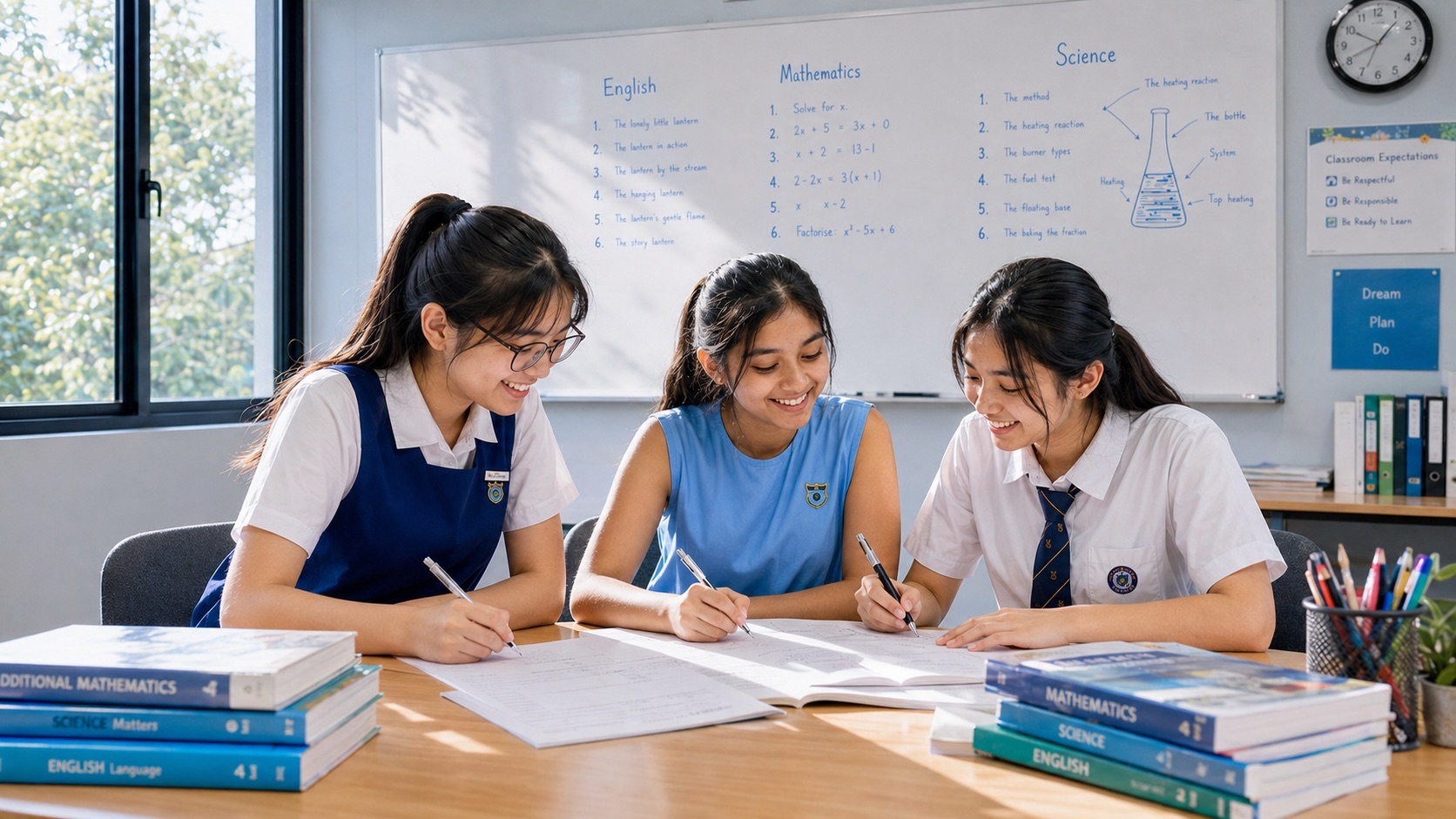
Is Dunman Secondary School a good school? It can be a good fit for a teenager who enjoys making things, investigating a real problem and explaining how a solution works. Its STEMviaDT design-thinking direction, published ICT programme and applied approach to Mathematics give parents specific learning experiences to investigate.
If you are researching a Dunman Secondary School review, coding opportunities or practical STEM learning for Secondary 1, begin with the exact school. Dunman Secondary School and Dunman High School are separate institutions. For Dunman Secondary, ask how your child would move from noticing a problem to testing an idea, while building the subject knowledge that makes the work possible.
Did you know? Dunman Secondary’s character-and-citizenship page connects lower-secondary design work with everyday questions. It describes Secondary 1 self-care themes and Secondary 2 sustainability projects. These provide a concrete starting point for asking what students design, whose needs they consider and how they improve their work.
eduKateSG · Secondary school fit
A practical route for a child who likes asking how things work
Read the three reasons, then use the questions to check the match with your child. Learning experiences · Questions for your visit · Admission and daily routine
| Feature | What to investigate |
|---|---|
| STEMviaDT | Design work linked to everyday needs and sustainability. |
| ICT | Media literacy, coding and project work in the published programme. |
| Mathematics | Inquiry, feedback and applications beyond routine exercises. |
Read the sibling pair
Start with Why go Dunman Secondary School? for the wider school introduction. This companion review focuses on whether its learning direction fits your child. Compare other secondary-school sibling pairs.
Reading index: reasons, questions and next steps
1. Design thinking puts a human question before a prototype
2. Digital learning includes judgement as well as creation
3. Mathematics offers another way to examine a real problem
Parent questions · Admission and routine · Learning support · Fit verdict · Official sources
REASON 1 OF 3 · SCHOOL FIT
Design thinking puts a human question before a prototype
The school describes Secondary 1 work involving Figma interface prototypes and 3D modelling. Its Secondary 2 account connects sustainability themes with coding and micro:bit prototypes. Later-year descriptions include community partnership and outreach. Confirm the tasks planned for the incoming cohort.
Our fit interpretation is that this direction may interest a child who enjoys both making and thinking about who will use the result. A prototype has more meaning when the learner can explain the need it addresses.
Try a family question: “What small part of an ordinary school day would you like to improve?” Before suggesting an app or device, ask who experiences the problem and how you would find out more. This is a suggested reflection, not a description of a school lesson.
On a visit, ask students or teachers about an idea that changed after feedback. What did the team learn? How did they know whether the revision helped? These questions let you explore the thinking behind an attractive display.
Official source: Dunman Secondary Character and Citizenship Programme
REASON 2 OF 3 · SCHOOL FIT
Digital learning includes judgement as well as creation
The published ICT page includes first-year media literacy, Secondary 2 coding and ICT-driven project work. Its descriptions cover evaluating media as well as creating digital products. It also reports advanced activities and earlier project examples; parents should verify their current availability and access.
Our interpretation is that this is a useful direction for a teenager interested in moving from using technology towards understanding and creating with it. Enjoying a device and enjoying the patient work of building something are different starting points to explore.
Ask what a beginner is expected to know, how groups share tasks and how students receive help when their code or model does not work. A good fit conversation should make the learning process visible.
Media judgement also gives families something useful to discuss at home. When your child sees an impressive claim online, ask where it came from and what would make it more trustworthy. Connect curiosity with checking, rather than treating digital confidence as proof of understanding.
Official source: Dunman Secondary ICT Programme
Contents · Previous reason · Next reason
REASON 3 OF 3 · SCHOOL FIT
Mathematics offers another way to examine a real problem
The Mathematics Department describes inquiry-based learning, design-thinking skills, differentiated instruction and formative feedback. Its page gives a dated 2023 example in which lower-secondary students collected and interpreted data about wellbeing habits. That example illustrates the approach; it is not a confirmed task for every future cohort.
Our fit interpretation is that a student who often asks “When would I use this?” has something concrete to investigate. Ask how a real situation becomes a mathematical question and how teachers help students explain the answer.
For example, a family can compare two simple journey records and ask what the numbers reveal and what they leave out. A shorter average journey might still include an unreliable connection. This is an everyday illustration of examining data carefully, not a claim about the school’s lesson materials.
Applications work best when the underlying ideas are understood. During a visit, ask how the school supports students who can describe a situation but struggle with the calculation, or who can calculate but cannot interpret the result. Both questions are more precise than asking whether Mathematics is generally difficult.
Official source: Dunman Secondary Mathematics Programme
Contents · Previous reason · Parent questions
Questions to take to your school visit
1. What will the incoming lower-secondary cohort actually do in STEMviaDT?
2. How are beginners supported in coding, media work and group projects?
3. How do teachers check each student’s understanding within a shared product?
4. How does feedback help students connect practical work with Mathematics?
Ask your child which part of a project they would enjoy: investigating, sketching, calculating, building, testing or explaining. A team needs several kinds of contribution. Then ask which part they would like to become better at, and look for a credible route to practising it.
Check admission details and the everyday routine
Check Dunman Secondary’s current subject offerings, CCA arrangements and support information for the right intake. Some official pages include examples from earlier years, so ask which tools and activities are used now. Use the school’s own admissions information and MOE SchoolFinder when checking eligibility; programme interest alone does not determine admission.
Use MOE SchoolFinder for Dunman Secondary School as a starting point for current official information. Check the intake year carefully, and confirm the arrangements that matter most directly with the school. Try the morning journey and consider the return after CCA before ranking your choices.
Build the learning support around the actual need
Begin with the school teacher and a specific question about your child’s learning. Can they understand the idea, choose an approach and explain their answer? Look for the point where the work becomes uncertain, then agree on a manageable next step.
For families considering independent external Mathematics support, eduKate’s Secondary 1 Mathematics guide for Clementi students describes premium 3-pax tutorials near Sixth Avenue MRT. Read the current arrangements and consider whether the journey fits. This is separate tuition information; it does not imply a school partnership.
Our verdict: a good school is a good-fitting school
Dunman Secondary is worth exploring for a teenager interested in practical problem-solving, digital creation and connecting subject learning with daily life. Its published programmes give that judgement a clear basis. The final decision should include your child’s interest in the actual tasks, the available support and a weekly routine that leaves space to learn well.
Why go Dunman Secondary School? · Explore the Dunman Secondary STEMviaDT guide · Secondary-school sibling hub
Official sources and fact-check note
Fact-checked: 10 October 2026. Programme descriptions were checked against the school’s official pages below. Fit judgements and family activities are eduKateSG editorial interpretations. Dated examples remain labelled by year; confirm future-cohort provision and selection with the school.
Dunman Secondary Character and Citizenship Programme
Dunman Secondary ICT Programme
Dunman Secondary Mathematics Programme
This independent guide helps families investigate school fit. It is not an official school statement, ranking or promise of an individual outcome.