
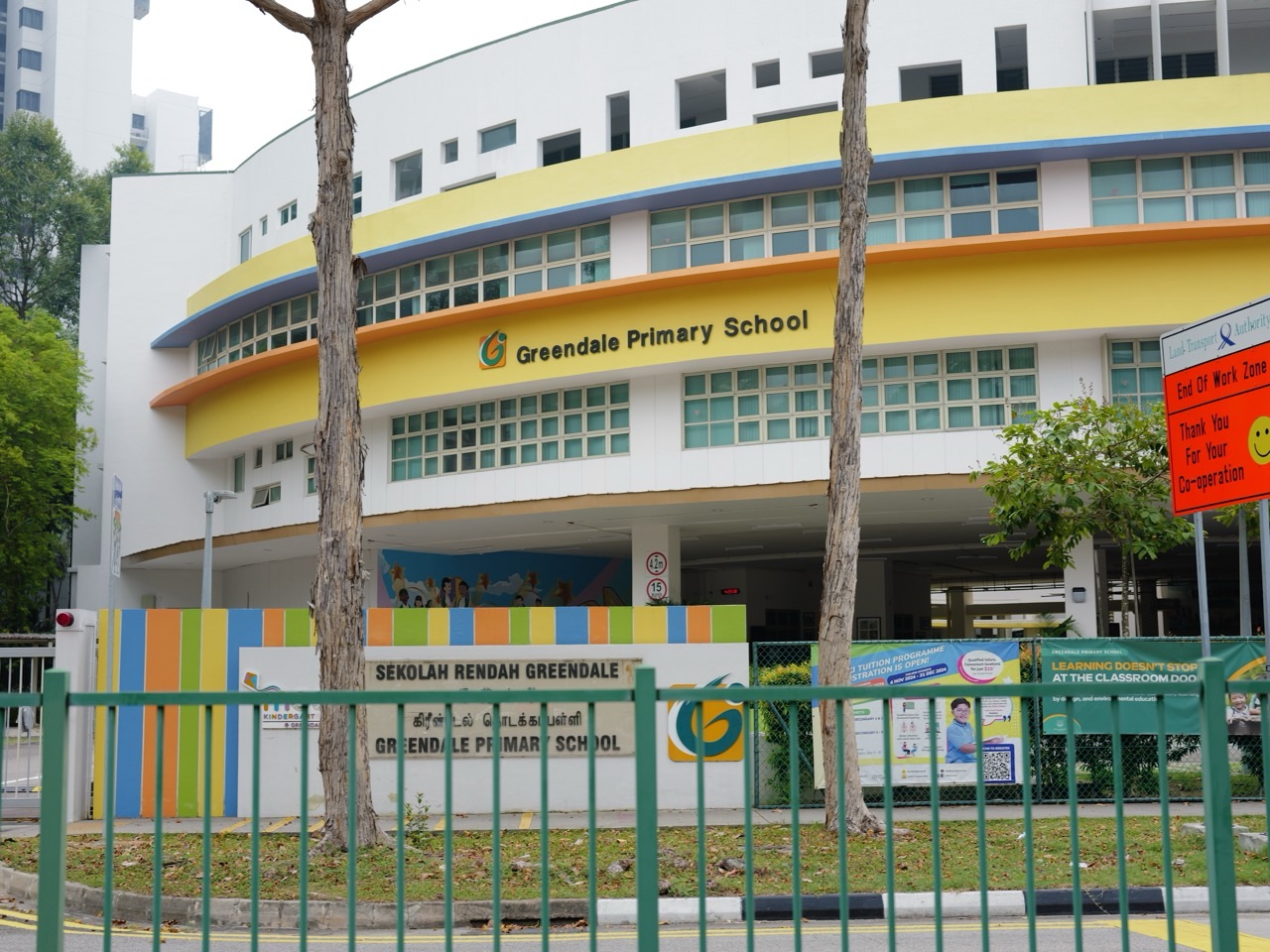
Is Greendale Primary School a good school? Yes — it is especially worth exploring for a child who enjoys inventing useful things, trying unfamiliar ideas and learning outside the classroom. Greendale Primary School in Punggol combines Learning by Design, an Applied Learning Programme using Design Thinking from P1 through P6, with a whole-school Outdoor Education Learning for Life Programme. The pairing offers a distinctive path: understand a problem, revise an idea, then experience responsibility and teamwork in real environments. That can make it a good fitting school for some children, but not every family.
If you’re searching for a Greendale Primary School review, Greendale Primary School ALP Learning by Design, Greendale outdoor LLP, P1 registration Punggol or primary schools near Coral Edge LRT, the first three facts are practical. The campus is at 50 Edgedale Plains; the school’s August 2026 ALP lists different design experiences from P1 visual arts to P6 Games Carnival; and its Outdoor Education programme progresses from guided lower-primary exploration to a P5 three-day, two-night camp and P6 culmination. Families can therefore investigate an actual learning sequence instead of relying on reputation.
Did you know? Greendale’s P4 Design Thinking theme is Happiness by Design, while P5 focuses on Eco Stewardship. Earlier pupils learn design through visual arts, drama and character-making. The school also runs Maker Monday each term during recess, guided partly by selected Design Ambassadors. The result is a very particular question for parents: will a child be helped to understand other people’s needs and improve an idea, rather than just produce an attractive model?
Greendale Primary School: the two-part school-choice guide
Why go Greendale Primary School? — the fuller school introduction. Is Greendale Primary School a good school? — a fact-checked review of strengths, trade-offs and student fit. Parents & Pathways Hub.
Greendale Primary School: at a glance
| Location | 50 Edgedale Plains, Singapore 828848 |
|---|---|
| Closest LRT named by school | Coral Edge LRT, reached via Punggol LRT; nearby buses listed as 3, 62, 83, 381 and 386 |
| Applied Learning Programme | Learning by Design – Authentic Problem-solving through Design Thinking |
| P1–P2 | P1 Design Thinking in Visual Arts during PAL; P2 Design Thinking in Drama during PAL |
| P3–P4 | P3 character design through Ad Astra Carnival; P4 Happiness by Design |
| P5–P6 | P5 Eco Stewardship; P6 Games Carnival |
| Maker Monday | Recess maker sessions once per term, including LEGO and recycled materials |
| ALP Tier 2 | Selected P4 Design Ambassadors support Maker Monday and may enter competitions |
| Learning for Life Programme | Outdoor Education across P1–P6, integrating PE, Science, CCE and reflection |
| Outdoor progression | P1–P3 guided exploration; P4 neighbourhood hike; P5 3D2N camp; P6 culmination |
| Official reference | Greendale ALP · Outdoor LLP |
The special feature is a six-year design progression
At P1, most children are only beginning to explain their thoughts through words and pictures. Greendale starts with design in visual arts rather than assuming young pupils can immediately run a sophisticated technology project. By P2, drama adds another medium. By upper primary, the tasks involve considering happiness, the environment and a shared games experience.
That sequence matters. It acknowledges that designing an answer requires different abilities as a child grows. A learner needs to learn to understand the task, draw or describe an idea, think about who benefits and explain why a particular change was made.
Parents should ask how the school makes the progression visible. Do pupils get to revisit the same reasoning habits in harder contexts, or are activities remembered mainly as separate events? A six-year education gains value when the child’s thinking becomes increasingly clear across time.
Did you know? P1 and P2 design can happen without a robot
Greendale’s official programme table names a P1 Design Thinking-enabled visual arts experience and a P2 drama programme during PAL lessons. This is an excellent detail for parents who worry that a child’s lack of technical experience makes a school unsuitable.
A child drawing a solution needs to decide which idea to show. A child acting out a situation needs to notice how another person feels or responds. Both can help build the beginnings of user empathy and inventive thinking before any complex equipment is needed.
Ask what teachers expect of a child who cannot yet write fluently or confidently perform in front of peers. Does the learner begin with a sketch or a partner conversation? Are children helped to explain their ideas at the appropriate level? The current school programme describes the direction; the actual teaching practice requires a visit or enquiry.
P3 character design: creativity becomes something explainable
The published Primary 3 task is the Ad Astra Carnival Design Thinking Challenge involving character design through Art lessons. A character is more than a drawing when a pupil has to explain what it represents, how it is intended to be used and why the chosen features suit the purpose.
A young learner might propose several versions, discover that one detail confuses the audience or change the drawing after feedback. This is the kind of reasoning parents can look for, rather than expecting the most colourful product to be automatically the strongest.
If your child enjoys stories and visual creation, this can be an inviting way into inventive thinking. If your child dislikes drawing, ask how different strengths are acknowledged and how a pupil still participates meaningfully in the thinking task.
P4 Happiness by Design: a thoughtful word in a STEM conversation
The Primary 4 theme is Happiness by Design. On its own, the title sounds cheerful; its educational importance is the need to consider how an experience works for another person. Understanding someone else’s needs is a more demanding task than designing only for oneself.
Ask what current P4 pupils are asked to observe, which evidence they collect, how they develop possible ideas and what they do after feedback. The school’s description shows an age-specific theme but does not establish one fixed object or partner for every class.
The best design activities make room for humble revision. A child can learn that an idea may have been imaginative but unsuitable, and that changing it is a sign of better understanding rather than failure.
P5 Eco Stewardship and P6 Games Carnival: different beneficiaries, similar habits
P5 shifts towards an environmental theme. A pupil considering ecological stewardship must use knowledge about real systems and consequences. P6 Games Carnival then invites older pupils into a shared activity with a different set of users, rules and collaboration needs.
There is a useful developmental connection: the child has to apply design and communication to more varied situations. An environmental problem may require factual observation, while a game may require considering fairness, clarity and whether participants can follow the rules.
The activities are not automatically equally suited to every learner. Ask how teachers teach the subject knowledge needed, support uneven group participation and assess what each student understands.
Maker Monday: experimentation during recess, not an automatic advanced course
The school runs Maker Monday every term during recess. The August 2026 ALP page names LEGO and recycled materials as resources pupils use to investigate a design challenge, and describes how Design Ambassadors help guide the sessions.
For a child who loves tinkering, a recurring making space is a reason to be interested. A pupil may test a structure, realise why it collapses and try another version. The most educational part may be the moment when the child explains what changed.
But families should check current access, age eligibility and supervision. A named maker session is not a promise of unlimited resources, immediate access for every child or sophisticated coding equipment. An ordinary model can support excellent thinking when teaching is clear.
Design Ambassadors: one of the most important access distinctions
Greendale’s Tier 2 selects Primary 4 pupils as Design Ambassadors. The school describes opportunities for them to support peers at Maker Monday and represent the school in national Design Thinking competitions.
This is exciting for some children but should not dominate the family decision. Tier 1 Design Thinking is available across all primary levels; a Tier 2 ambassador role is a different kind of opportunity, with selection and further responsibilities.
Ask how ambassadors are identified and how ordinary pupils are supported when they want more challenge but are not selected. A child who never competes can still learn to think carefully, make something useful and contribute to classmates.
The outdoor programme starts with wonder rather than extreme adventure
Greendale’s Outdoor Education LLP is described as a school-wide journey integrated with PE, Science, English, Social Studies and Character and Citizenship Education. P1–P3 pupils begin through guided nature walks and school-based experiences, focusing on curiosity, safety and awareness of place.
That is a reassuring way for parents to understand the progression. A new pupil need not arrive knowing how to camp. The early learning can begin with noticing a plant, following simple safety rules, walking with a group and describing what was seen.
A family can ask what happens afterwards. Do pupils reflect on a decision or experience? Are children helped to connect observations with accurate vocabulary? A short walk becomes an educational experience when children understand what they have learned.
P4 neighbourhood hikes have a local example: Coney Island
The school’s 2026 programme page identifies a P4 neighbourhood hike, giving Coney Island as an example. The stated aims include navigation, teamwork and environmental awareness. For a child in Punggol, learning that a familiar surrounding area contains real habitats and routes can make outdoor education relevant to everyday life.
A hike need not be long to be meaningful. Students can practise staying with a group, noticing how a route changes and making choices that protect a shared space. The educational goal should involve safety and reflection, not only covering distance.
Coney Island is presented as an example rather than a guaranteed destination for every future cohort. Ask about the confirmed site, supervision, accessibility and alternatives if your child has a particular health or mobility need.
The P5 camp: three days and two nights, with preparation
Greendale’s current LLP outlines a Primary 5 camp lasting three days and two nights, intended to support resilience and leadership. That is an important practical detail for families who need to consider a child’s confidence with overnight experiences.
A child who enjoys outdoor challenges may look forward to it. Another may be worried about sleeping away from home or unfamiliar physical activity. Neither reaction automatically determines whether the school is a good match.
Ask about preparation, adult supervision, medical and dietary needs, safeguarding and the school’s procedure when a pupil needs help. The goal is safe, supported development, not requiring a child to pretend an unfamiliar experience is easy.
P6 culmination: transfer matters more than one adventure
The upper-primary progression ends with outdoor adventure learning and reflection. The school wants pupils to become more self-directed, collaborative and environmentally responsible over time. Those are ambitions worth exploring.
A P6 pupil might be able to explain how their response to an unfamiliar challenge differs from what they would have done in P1. That is a more convincing indicator of growth than a one-day photograph of an exciting activity.
Parents can ask whether pupils revisit earlier learning, how they reflect on decisions and how the experience prepares them for increased independence after PSLE. Such reflection can give the programme a purpose beyond the activity itself.
How Design Thinking and outdoor learning may reinforce one another
Both strands invite a child to meet a situation that does not have a single immediately obvious answer. In a design task, the learner tests an idea. Outdoors, they may need to notice the environment and work with a group. Both can require patience, communication and practical judgement.
This is an educational interpretation, not a claim that Greendale uses one identical lesson plan for art, a hike and a prototype challenge. Each has subject-specific knowledge and safety requirements.
A helpful school enquiry asks how teachers connect the pupil’s understanding across subjects. Does a child learn that careful observation and thoughtful explanation are useful in several places? That kind of transfer can be valuable for learning continuity.
The quiet child and the enthusiastic builder can both need different support
A confident maker may struggle when asked to write a detailed explanation. A quiet student may have strong observations that they do not yet express aloud. A child who loves nature might be anxious about overnight camp. These are different starting points, not one simple measure of ability.
Ask Greendale how teachers diagnose what is difficult and guide the pupil towards a manageable next step. What can the child already do independently? Where does the sequence break? What feedback helps the child rejoin the task?
A good programme is strongest when it meets learners where they are. No published school description can settle a specific support plan without an individual conversation.
English, Mathematics and Science still need their own evidence
Design projects and outdoor learning can motivate reading, measurement, Science observations and oral explanation. But they do not automatically prove attainment or prepare a pupil for every PSLE question.
Ask separately about the teaching of English, Mother Tongue, Mathematics and Science, how mistakes are corrected and how families receive updates about learning gaps. A student may understand a Science experiment but find it difficult to explain a relationship in words or numbers.
The right school protects foundational learning while making knowledge more meaningful in projects. A high-quality applied programme is a complement to careful academic teaching, not a replacement for it.
The actual Punggol route: Coral Edge LRT and Edgedale Plains
The campus is at 50 Edgedale Plains, Singapore 828848. The school names Coral Edge LRT among nearby landmarks and lists buses 3, 62, 83, 381 and 386. From the North East Line, its published directions recommend transferring at Punggol MRT to the LRT.
These are useful transport references, not a journey-time guarantee. Walk the actual route with the expected arrival time, gates and weather in mind. Ask about student care, after-school activities and how the family will manage a camp or an additional session.
A child who spends less time in exhausting travel may have more energy to read, play and talk about what they learned. That practical advantage should be weighed alongside the programmes when comparing schools.
Who should shortlist Greendale — and who may prefer somewhere else?
Shortlist Greendale if your child enjoys drawing, drama, design, problem-solving or nature, and if you want a structured progression rather than a single annual maker event. It may also appeal to a family that values outdoor independence and reflection.
Compare other schools if the commute is difficult, a required support arrangement has not been confirmed, or the decision rests entirely on joining the selected Design Ambassador track. The school-wide learning should remain worthwhile even without a special appointment.
The right answer depends on the child who will attend, not another parent’s ranking. Can that child participate, make progress, ask for help and enjoy the ordinary six-year journey?
Four questions to bring to Greendale
- How does P1 visual arts introduce Design Thinking, and what changes by the P4 Happiness by Design project?
- Which Maker Monday activities are broadly accessible, and how are P4 Design Ambassadors selected?
- How does the school prepare pupils for the P4 hike and P5 3D2N camp, including individual needs and supervision?
- Can we see an ordinary pupil’s explanation before and after feedback, not just the finished design?
Primary 1 admission remains a separate decision
A school’s distinctive programme does not establish an admission entitlement. Check the applicable MOE P1 registration phases and dates and dated vacancies and balloting history for the correct year, phase, citizenship and address.
For P1 entry in 2028, MOE has announced changes to the 2027 registration exercise. Consult the new P1 framework and do not assume the special Two-Track Scheme applies to every primary school. Earlier ballot outcomes are historical demand, not a school-quality score or a future place guarantee.
The Greendale Primary School verdict
Yes — Greendale Primary School can be an excellent fit for a child who enjoys creating, revising and learning through the world outside the classroom. Its published P1–P6 Design Thinking sequence and outdoor progression provide a clear, specific rationale for a shortlist.
A good school is one where the child can access those experiences, receive patient teaching, learn from mistakes and have enough energy for the ordinary rest and play that make learning sustainable.
Quick answers for parents
Where is Greendale Primary School? 50 Edgedale Plains, Singapore 828848, near Coral Edge LRT.
What is its ALP? Learning by Design, using age-progressive visual arts, drama and Design Thinking challenges.
What is its LLP? Outdoor Education, beginning with guided exploration and progressing to upper-primary camps, adventure and reflection.
Official sources and editorial fact-check
Reviewed 10 October 2026 against the school’s 2026 ALP, LLP and contact pages. Published level modules are current descriptions, not guaranteed future itineraries or selective places. This independent eduKate article is not a school endorsement, ranking or admission forecast.