
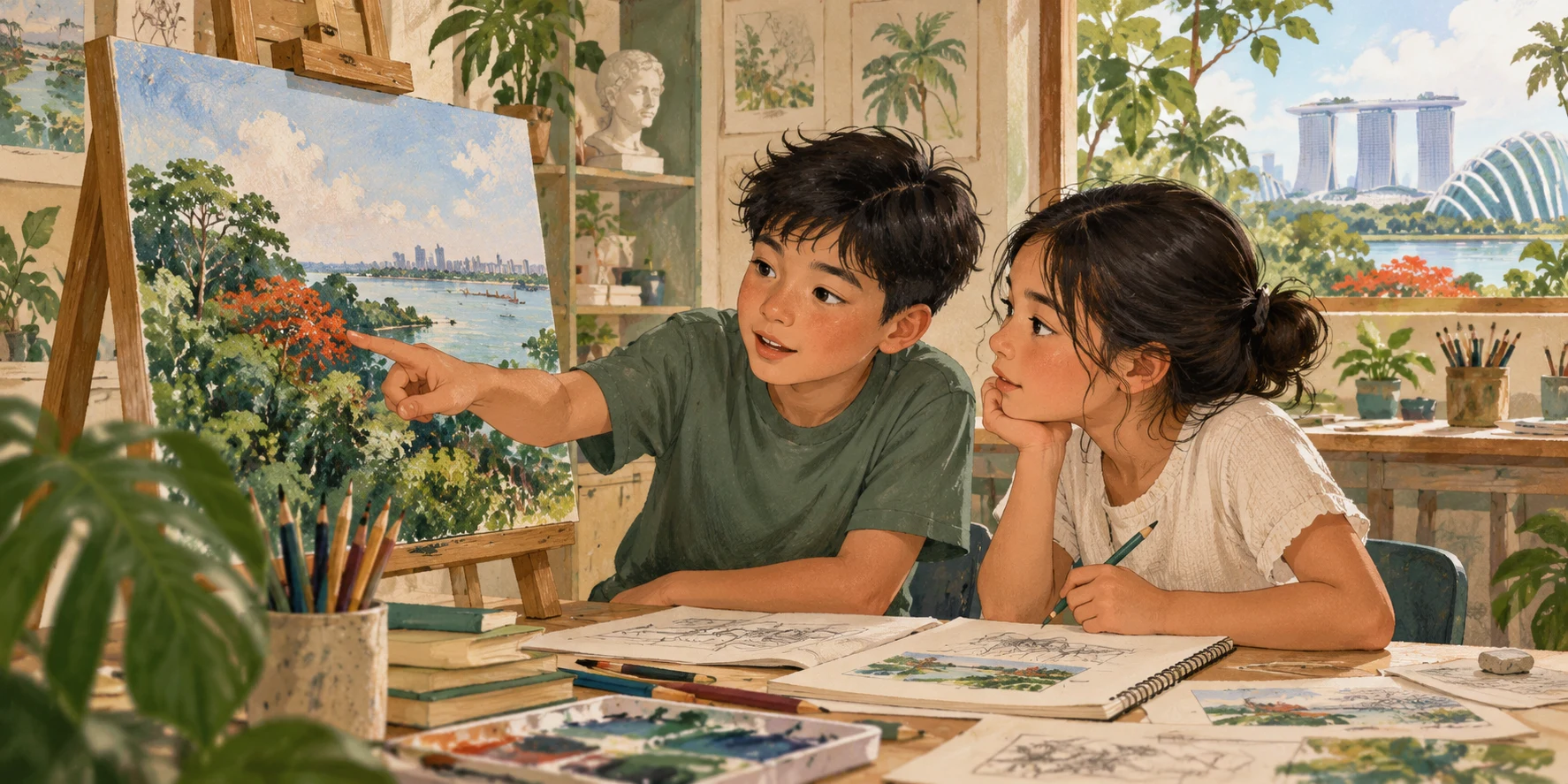
What does Secondary Art in Singapore involve under the MOE and SEAB syllabuses, and how is Art examined for the Singapore–Cambridge Secondary Education Certificate (SEC)? Art is not simply drawing attractive pictures or being ‘naturally talented’. Students learn to observe carefully, understand visual qualities, explore materials, communicate ideas and reflect on their own and other people’s artworks. The subject combines creative investigation with evidence of an artistic process. Parents searching for SEC Art paper formats, portfolio requirements, G1/G2/G3 differences, art journalling or ways to help their child can begin with a useful principle: the development of an idea matters as well as the finished artwork.
For the 2027 SEC, Art is offered at G1 K126, G2 K236 and G3 K347. The levels have distinct practical and portfolio requirements. G1 has a one-hour-thirty-minute written-and-practical Art examination contributing 40% and a portfolio contributing 60%. At G2 and G3, the Visual Response paper lasts two hours fifteen minutes and carries 50%, with a portfolio carrying the other 50%. The portfolio limits and commentary tasks differ. This guide explains what parents should expect, how to interpret artistic feedback and how to support authentic student work without taking over the assessed project.
Do you know why Art is an academic subject?
Art gives students a way of investigating and communicating ideas through visual forms. Looking closely at an image requires observation and discrimination. Producing artwork requires planning, experimentation, adjustment and judgment. Discussing another artist’s work requires evidence, interpretation and an awareness of context.
Consider an ordinary scene: a nearly empty bus stop in the rain. One student might create a quiet drawing emphasising reflection and distance; another might use a bold arrangement of shapes to suggest movement and noise. The subject is not simply deciding which image is prettier. It asks what each student wants to communicate and how material, colour, composition and detail shape that communication.
Art education can develop persistence. A student may try a material, discover that it behaves differently from expected, revise an approach and explain the change. That process resembles enquiry in other disciplines, even though the questions and forms of evidence are distinct.
Do you know the MOE Art curriculum’s three learning domains?
The SEC Art syllabus describes three related domains: perceive, communicate and appreciate. To perceive is to observe closely, analyse visual qualities and gather information. To communicate is to use visual or tactile forms to develop and express ideas. To appreciate is to reflect on artworks, their meanings and their cultural or social roles.
These domains are not three isolated chapters. A student perceives shapes and textures in a market scene, uses those observations to create a visual response, then discusses which parts of the work effectively communicate the intended feeling. Each stage influences the others.
A parent can ask the child which of the three is currently strongest. A learner with strong practical handling may still need to practise explaining the choices. Another who discusses art perceptively may need experience experimenting with different media. The domains offer a better diagnosis than saying the child is simply ‘good’ or ‘bad’ at Art.
Do you know how MOE teaching goals differ from SEAB examination requirements?
MOE’s curriculum sets the broad educational purpose of Art and the intended learning experiences, such as art conversations, art journalling and portfolio development. SEAB publishes examination-specific papers, time limits, marks and submission requirements for each subject code and year.
A teacher might take students to study a public sculpture or compare representations of a local street. That is a learning experience supporting observation, discussion and cultural awareness. The national examination may use an unseen visual stimulus and ask students to analyse and respond through drawing or sketching.
Use the school’s programme to understand what the child is learning this term, and consult SEAB for the formal endpoint. Do not assume a project from an earlier cohort has the same permitted page count or submission structure in 2027. The correct level and year are essential.
Do you know how G1, G2 and G3 Art differ?
All three levels value artistic observation, practical exploration and reflection. They differ in the expected depth and in how the 2027 examinations combine written or visual response with portfolio work. The subject-demand level is not a label that defines a child’s creative potential.
At G1, the assessed portfolio contains visual materials and two artworks. At G2 and G3, portfolio preparation includes selected records of exploration and a written commentary reflecting on artistic growth. The maximum number of screens, minimum range of art forms and commentary limits become more demanding at G3.
A learner choosing Art should consider interest, readiness to work steadily, willingness to revise and the school’s available subject combination. Some students enjoy drawing but dislike documenting how a piece developed; this can be learned, but it should not be ignored when choosing the subject.
Do you know what the 2027 G1 K126 Art examination requires?
G1 Paper 1 is an Art Examination lasting 1 hour 30 minutes, carrying 40 marks and 40% of the total assessment. Its sections include objective items such as matching and multiple choice, a short-answer component and a short Art task. Candidates must address the prescribed knowledge as well as create a visual response.
G1 Paper 2 is a portfolio worth 60%, completed in 18 hours within eight weeks. The required visual materials comprise ten screens of research, drawings, experiments or developing work, exploring at least two art forms and media, one of which must be design. Two artworks using different media are also submitted, and they must not be the same works as those chosen for the visual materials.
These details show why parents should never treat Art as only a last-minute drawing paper. Portfolio evidence, material exploration and steady documentation have a direct role in assessment. The student should follow the school’s supervision and submission guidance.
Do you know what G2 K236 Art requires in 2027?
G2 Paper 1, Visual Response, lasts 2 hours 15 minutes, carries 50 marks and contributes 50%. It has visual analysis and exploratory sketching in response to an unseen stimulus. Students need to examine, interpret and develop ideas rather than reproduce a memorised composition.
G2 Paper 2, Portfolio, carries the remaining 50%. The published specification allows a maximum of ten screens of artistic exploration and processes involving at least two art forms and media. The commentary reflects personal artistic growth through two works, with a limit of 500 words and fewer than eight A4 pages. The work is completed in 30 hours within twelve weeks.
A thoughtful portfolio therefore needs selecting and explaining, not simply uploading every page ever drawn. Ask how each selected screen demonstrates a relevant step in the student’s exploration. Clear evidence of development matters more than a large folder of decorative material.
Do you know what G3 K347 Art requires in 2027?
The G3 Visual Response Paper 1 also lasts 2 hours 15 minutes and carries 50%. It includes visual analysis of an unseen stimulus and exploratory sketching leading towards a visual concept. A student must notice relevant qualities and communicate a purposeful response under time constraints.
The G3 Paper 2 portfolio contributes 50% and is completed in 30 hours within twelve weeks. It includes a maximum of fifteen screens covering artistic exploration through at least three art forms and media. The commentary is based on three works and is limited to 800 words and fewer than ten A4 pages.
G3 students must balance experimentation with selection. More materials and a longer commentary allowance do not automatically create stronger work. Each visual decision and written reflection should make the artistic intent and growth clearer.
Do you know what the Visual Response paper tests?
Visual Response asks students to examine a stimulus and develop a creative response. It combines thinking through images with the practical ability to sketch, annotate and communicate an idea. The student must decide which aspects of the stimulus matter, not simply copy the image.
For example, a stimulus might show repeated windows in a city building. A student could explore pattern, confinement, rhythm, community or anonymity. The response should connect to something observable in the image. A completely unrelated pre-prepared drawing might be attractive yet fail to answer the task.
A useful practice session is to look at an unfamiliar image for a few minutes, list key visual qualities, propose two possible interpretations and sketch a response to one. Afterwards, ask why those choices relate to the stimulus. This is more flexible preparation than memorising a single favourite composition.
Do you know what visual analysis actually means?
Visual analysis identifies what is present and explains how features affect meaning or perception. It can include colour, line, shape, form, texture, space, balance, contrast, emphasis and composition. The vocabulary matters because it helps the student describe observations precisely.
Compare two imaginary paintings of the same busy street. One uses muted colours and a distant viewpoint; another uses close-up figures and strong diagonals. Even without knowing either artist’s intention, students can discuss how these choices affect atmosphere, attention and the sense of movement.
A weak answer lists devices: ‘There is colour, line and shape.’ A stronger answer selects two relevant qualities and explains what they do in this particular work. Parents can support analysis by asking, ‘Where does your eye go first, and which feature causes that?’ The answer should be supported by visible evidence.
Do you know why colour is not just decoration?
Colour can organise attention, establish relationships, create contrast and influence emotional interpretation. Different hues, values and saturation levels can change the character of the same scene. A student should choose colour deliberately rather than assume brighter always means better.
Imagine a portrait rendered in subdued greys with one small red object. The isolated red may become an emphasis or symbolic element, depending on the surrounding visual context. The student should explain how viewers are likely to encounter it before claiming a universal interpretation.
Experiments with limited palettes can be useful. Ask the learner to create two variations of a sketch with different colour relationships, then discuss which better communicates the intended atmosphere. The process makes colour choice a reasoned decision.
Do you know why line and shape matter in artistic expression?
Line can describe edges, motion, rhythm, pressure or direction. Shape establishes recognisable forms and relationships. Lines that are light and flowing may create a different effect from jagged, forceful marks, but context determines the final interpretation.
A simple exercise uses one ordinary object, such as a chair, drawn with continuous contour lines and then with strong fragmented marks. The subject remains the same while the visual language changes. The learner can compare whether one approach suggests calm observation and another tension or movement.
The goal is not to declare a ‘correct’ emotional meaning for every mark. It is to recognise that artistic choices shape how a viewer looks and feels. Explanations become stronger when they identify a specific part of the work rather than rely on generic statements.
Do you know how composition directs the viewer?
Composition concerns the arrangement of visual elements within a work. Scale, position, negative space, balance, repetition and contrast can make particular features prominent. A small item placed against a large area of emptiness may draw as much attention as an object painted in bright colour.
Suppose a drawing shows a single person seated near the edge of a vast empty platform. The empty area might create a feeling of isolation or anticipation, depending on other details. Moving the person to the centre changes the relationship and possibly the meaning.
Students can test composition with quick thumbnail sketches before developing a large work. Small sketches make it easier to compare alternatives and avoid becoming committed to the first arrangement. The ability to articulate those comparisons is valuable portfolio evidence.
Do you know why observational drawing is different from copying a photograph?
Observational drawing asks students to study relationships among proportion, perspective, light, shadow, contour and space. It encourages close seeing rather than drawing an object as the student believes it should look. A copied photograph can be a useful study where permitted, but direct observation adds distinct learning.
A student drawing a cup may make its opening too circular because that is the familiar symbol for a cup. Careful observation reveals an ellipse that changes with viewpoint. This is a small but revealing distinction between a mental shortcut and evidence from seeing.
Parents can encourage drawing everyday items under changing light. Instead of correcting the child’s lines, ask which edge is most visible, where the shadow falls and whether the proportions are consistent. Questions preserve student ownership of the drawing.
Do you know what texture and material experiments contribute?
Texture may be actual, felt physically through a surface, or visual, suggested by marks and patterns. Materials and techniques influence what an image can communicate. Ink, charcoal, paint, collage and digital media can support different kinds of visual exploration depending on the task and syllabus.
A rough surface might enhance the idea of an old building, while a smooth, controlled surface might support a different interpretation. But students should not assume that the most technically demanding material is automatically most appropriate.
Art journalling can record a small experiment: materials tried, marks produced, difficulties noticed and a possible next use. This turns trial and error into a visible learning process. It also helps students understand which technique can reliably achieve a chosen effect under examination constraints.
Do you know why art conversations are part of the syllabus?
Talking about art requires the student to notice, interpret and support a response. Two viewers may initially disagree about the meaning of an image. A productive conversation examines the evidence each notices, the cultural or historical context and how the artist’s decisions may shape interpretation.
A parent could ask the child to compare two public artworks or illustrations. Which qualities make each distinctive? What assumptions do viewers bring? What additional information would help interpret them more fairly? There is no need to assign one simplistic moral to every artwork.
The conversation becomes strongest when observation precedes judgement. Saying ‘I dislike it’ can begin a dialogue but should lead to ‘Which visual choices make you respond that way?’ Artistic confidence includes the ability to reflect respectfully on alternative readings.
Do you know why context matters in Art?
Artworks emerge within cultures, histories, places and social relationships. An image may refer to a familiar local environment, a community’s memory or an idea shared across cultures. Understanding context can deepen interpretation, but it should not replace looking closely at the work.
For example, a depiction of a Singapore market may be read differently by someone familiar with its everyday rhythms and someone seeing the place for the first time. Relevant context can explain details such as objects, interactions or spatial arrangements. Yet students should not invent an artist’s intentions without evidence.
Art education encourages connection with self and society. Parents can help by visiting accessible public art, observing the built environment or discussing illustrations encountered in ordinary life. Those experiences should support curiosity, not become a demand to collect impressive cultural references.
Do you know what artistic intent means?
Artistic intent is what the student is trying to explore or communicate through a work. It may involve a theme, feeling, question, memory or formal experiment. It should be clear enough to guide choices but need not reduce the work to one simple sentence.
Suppose a learner explores the theme of belonging. That idea could become a series of drawings about doors, gatherings or overlooked corners of a neighbourhood. The student should explain which observations influenced the work and why a particular medium or composition was chosen.
A strong portfolio records how the intent develops. An early sketch may suggest one interpretation while later experiments reveal a more interesting direction. Reflecting honestly on that change shows artistic growth rather than inconsistency.
Do you know what a strong Art portfolio shows?
A portfolio should make the student’s enquiry visible. It includes selected observations, research, material explorations, drawings, work in progress and evidence of reflection appropriate to the relevant syllabus. The sequence lets the reader understand how an idea developed and why the student chose a particular direction.
A weak portfolio may contain many polished images with little explanation of connections. Another may contain long pages of generic reflection that do not refer to the actual work. Better evidence is specific: ‘The first charcoal study obscured the focal point, so I reduced the dark area and tested a different arrangement.’
Parents can ask the student to walk through three pieces of evidence: the original question, one important experiment and the decision that followed. If the child can explain the progression independently, the portfolio has a stronger foundation.
Do you know why selecting portfolio work is a skill?
An assessment portfolio has limits. G1 requires specified screens and works; G2 and G3 specify different maximum screen counts and commentary conditions. Selecting material asks which evidence best represents growth and learning, rather than treating every sketch as equally informative.
Students should look for variety with purpose. Several nearly identical studies may be less useful than an observation, a contrasting experiment and a revision showing what changed. The selection should support a coherent story about artistic development while remaining true to the student’s work.
This does not mean discarding unsuccessful attempts. A failed technique may be important if it led to a meaningful discovery. The question is whether including it helps explain the student’s thinking, not whether every displayed page is beautiful.
Do you know what makes a reflective commentary convincing?
A reflection describes what the learner intended, what choices were made, what was discovered and how that learning influenced later work. It should refer to actual artworks and specific evidence. ‘I learnt a lot and became more creative’ is pleasant but too vague to show the process.
A clearer reflection might say that an initial attempt to suggest depth through darker outlines made all objects equally prominent, while later changes in value and overlapping shapes improved spatial clarity. The explanation identifies a visible problem and the response to it.
G2 and G3 have explicit commentary limits in their 2027 portfolios, so economy of expression matters. The student’s authentic voice should be preserved. Adults should not rewrite the commentary into language the student cannot explain.
Do you know how to practise an unseen visual task?
Unseen tasks demand adaptable skills. The student will not know the exact stimulus in advance, but can practise careful observation, idea development, exploratory sketching and annotation. Timed practice should follow basic confidence in these operations.
Choose an unfamiliar image and begin with five observations, then two possible interpretations. Select one and produce several thumbnail responses with different visual strategies. Finally, annotate why one approach better communicates the chosen idea.
The exercise should not become a rigid formula applied without looking. The stimulus’s distinctive features should guide the interpretation. A student who automatically draws the same subject regardless of the visual prompt may not yet be responding authentically.
Do you know why Art portfolio deadlines need early planning?
Portfolio preparation extends over a limited period under school supervision and SEC rules. Students need time for observation, exploration, reflection, revision and suitable selection. A last-minute rush can create work that is technically complete but poorly developed.
Use the school’s timeline to identify milestones: initial investigation, visual experiments, selection decisions, draft commentary where required and final review. Leave room for materials that fail or ideas that change, since iteration is normal in creative work.
Parents can assist with a calendar and ensuring ordinary study routines remain workable. However, the decisions and assessed artwork must be genuinely the student’s. Helping organise time is not the same as producing a portfolio on the learner’s behalf.
Do you know why plagiarism and source attribution matter in Art?
Students may study existing artworks and images as research, but the assessed work should be original and follow the school’s academic-integrity rules. Copying another person’s image without acknowledging its source can misrepresent the student’s own contribution.
The G2 and G3 Art syllabuses include appropriate source attribution and citation within their learning objectives. Students should keep useful records of inspiration and references during research rather than trying to reconstruct where every image came from at the deadline.
A reference can inform a composition without becoming an unexamined copy. Ask the student what they learnt from the source and which decisions are genuinely their own. The distinction protects integrity while encouraging thoughtful engagement with other art.
Do you know what digital art tools add—and what they do not replace?
Digital tools can expand possibilities for drawing, editing, composition and documenting work. The current syllabus contains guidance on personal learning devices and relevant artistic processes. Using a device does not by itself produce strong observation or meaningful artistic intent.
A student may explore several digital variations of colour or layout efficiently. Those variations are useful when the learner evaluates them thoughtfully. Generating many versions and choosing one at random does not automatically show deeper artistic growth.
Examination and school restrictions around media, permitted devices, source attribution and AI-assisted production should be followed. Parents should not assume that a tool available in a commercial app is permitted for assessed SEC work. Ask the school for the relevant rules.
Do you know why a beautiful artwork can still receive limited credit?
Assessment includes knowledge, application and communication, not merely an overall visual impression. A student may create a carefully rendered drawing that does not respond to the prompt, show little experiment or fail to explain the choices. Another student may demonstrate powerful visual thinking with relatively simple materials.
When reviewing feedback, ask whether the obstacle was observation, interpretation, form, technique, research, annotation or reflection. The next lesson depends on the diagnosis. ‘Draw more carefully’ may not help if the actual problem is that the response does not communicate an identifiable concept.
Look for the first weak link. A student who chooses an idea unrelated to the stimulus needs a different intervention from one who has a relevant idea but struggles to control the material. That distinction is the basis of effective improvement.
Do you know how lower-secondary Art can prepare students for examination Art?
Lower-secondary learning introduces exploration, observation, basic visual language, reflection and appreciation. A student may experiment with several media while learning to discuss meaning. These foundations help the learner decide whether upper-secondary Art is a suitable elective.
A strong transition does not require a private portfolio of professional-quality drawings. More important are curiosity, perseverance, willingness to revise and capacity to explain choices. Technical skill can develop through purposeful practice when the student receives helpful feedback.
Families should consult the school’s subject-option guidance about eligibility and pathways. G1, G2 and G3 are different subject demands, not rankings of a child’s right to enjoy art. Genuine engagement is valuable across the levels.
Do you know how parents can support Art without interfering with assessed work?
Ask open questions: ‘What did you notice?’, ‘Why did you choose this angle?’, ‘Which experiment surprised you?’ and ‘What might you change after looking again?’ Such prompts encourage reflection while leaving decisions with the learner.
Provide reasonable space, time and safe basic materials where feasible, but follow school instructions for assessed portfolios. Parents should not paint sections of a child’s work, design a polished final composition for submission or write the commentary. Authentic student ownership is central to the learning.
A family visit to a public artwork or a conversation about an illustration can develop visual literacy even without a purchase or a formal gallery visit. Art exists in signs, spaces, textiles, architecture, books and everyday objects. Consistent observation is a valuable form of practice.
Do you know when extra Art instruction might help?
Students may benefit from focused help with observational drawing, medium control, composition, visual analysis or portfolio reflection when the same difficulty recurs. The support should target the actual obstacle rather than merely produce more finished pictures.
The Clementi small-group tutorial example is about Mathematics, but its central teaching logic applies across learning: observe the work, identify where understanding breaks down, model a better method and test independent use. In Art, this could mean analysing the stimulus carefully before practising another elaborate drawing.
If the issue is a missed portfolio milestone or uncertainty about allowed materials, consult the Art teacher first. The school manages the official coursework process, and external support should not compromise independent assessment.
Do you know the answers to these frequent parent questions?
Is Art simply a talent subject?
No. Observation, visual analysis, material control, decision-making and reflection can be developed through practice. Individual interests and strengths differ, but artistic learning is broader than a fixed notion of natural talent.
Does G1 Art have a portfolio?
Yes. The 2027 K126 syllabus includes a portfolio worth 60%, with specified visual materials and artworks, alongside a Paper 1 Art Examination worth 40%.
Are G2 and G3 Art paper timings the same?
Their 2027 Visual Response papers both last two hours fifteen minutes and contribute 50%, but their portfolio requirements differ, including screen limits and commentary expectations.
Is the G3 portfolio just a larger version of G2?
No. G3 calls for evidence across at least three art forms and media, with different maximum screens and commentary limits. The assessment level and expectations are separately specified.
Can a student use online artwork as inspiration?
Research can be valuable when sources are properly attributed and assessed work remains authentic. Follow the exact syllabus and school academic-integrity rules rather than assuming every use is acceptable.
Will a perfectly drawn picture guarantee high marks?
No. Response to the prompt, artistic thinking, exploration, communication and other assessment objectives matter. Technical finish is only one aspect of the work.
Must students study famous artists by memorising biographies?
Art appreciation may include artistic contexts, but the syllabus requires meaningful visual analysis and cultural understanding rather than indiscriminate biography memorisation. Check the prescribed learning outcomes for the student’s level.
What should parents ask at a parent–teacher meeting?
Ask whether the most important next improvement concerns seeing and observation, technical handling, responding to stimuli, developing artistic intent, documenting process or reflecting on work. Request an example of evidence that would demonstrate improvement.
Do you know what successful Art learning looks like?
A student making progress observes with care, explores more than one possibility, chooses materials deliberately, can explain an artistic decision and revises a work based on insight. The learner respects influences and sources while developing a personal visual voice.
The best parent support is to recognise Art as sustained intellectual and practical work. Confirm the actual SEC syllabus, organise time around genuine portfolio milestones, encourage thoughtful discussion and protect the student’s creative ownership. The finished artefact then becomes evidence of a learning journey rather than its only purpose.
Official 2027 Art references
The current subject codes are listed on SEAB’s G1, G2 and G3 school-candidate syllabus pages. Refer directly to the 2027 G1 K126 Art syllabus, G2 K236 Art syllabus and G3 K347 Art syllabus. The student’s school should confirm portfolio supervision, permissible techniques, assessment timeline and submission instructions.