
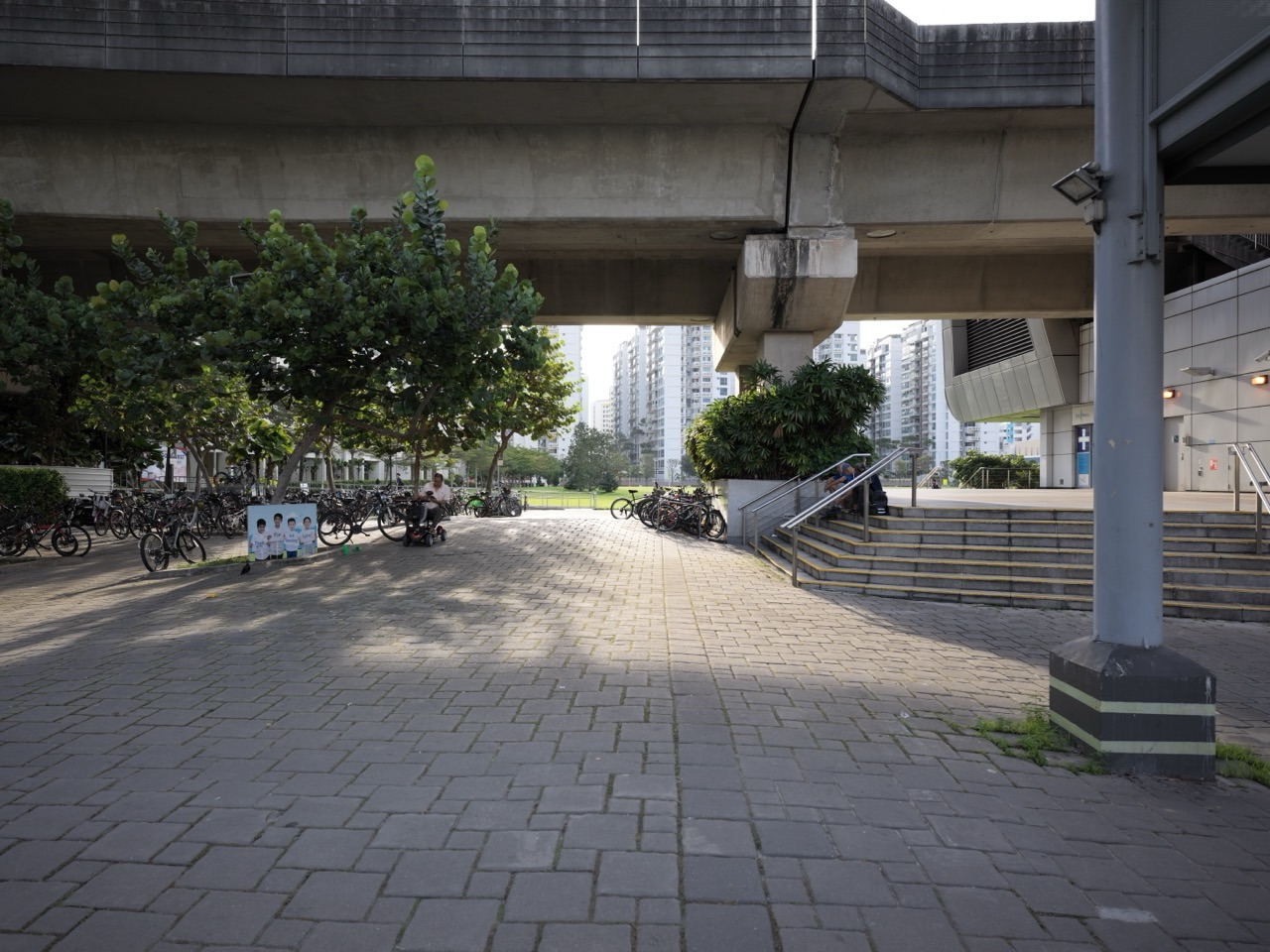
Punggol LRT Station (PTC), connected to Punggol MRT (NE17), is the central transfer point for both the Punggol East and West Loops. It is also a good place to get off for an actual outing: Waterway Point shopping mall at 83 Punggol Central is directly connected, while Punggol Waterway Park is a larger outdoor destination with public walking routes and named attractions. Choose shopping, food or a specific waterway section first—there is no need to spend the whole day trying to see everything.
For a simple first visit, use Exit A from Punggol MRT/LRT to reach Waterway Point, as the mall operator directs. Inside, visitors can shop, eat, browse or use a booked cinema screening. For a park walk, identify the entrance and bridge or zone you want on NParks’ map before starting. The entire waterway is not immediately outside a single station exit, and some park features are better approached from Damai LRT.
This guide explains what to do near Punggol PTC/NE17, how to choose the East or West Loop, which public destinations are genuinely convenient, and what families and visitors should check before leaving home. It uses current published information available on 1 November 2026; hours, tenants, paths and train service can change.
Punggol PTC/NE17 at a glance
- Rail interchange: Punggol MRT NE17 on the North East Line, PTC for the Punggol LRT.
- East Loop: Cove PE1, Meridian PE2, Coral Edge PE3, Riviera PE4, Kadaloor PE5, Oasis PE6 and Damai PE7.
- West Loop: Sam Kee PW1, Teck Lee PW2, Punggol Point PW3, Samudera PW4, Nibong PW5, Sumang PW6 and Soo Teck PW7.
- Direct mall: Waterway Point, 83 Punggol Central, Singapore 828761, via Punggol MRT/LRT Exit A.
- Outdoor choice: Punggol Waterway Park, with its nature, recreation, heritage and green-gallery areas.
- Food and shopping: Waterway Point’s operator publishes dining, grocery, retail and cinema destinations; individual operator hours differ.
- Bus connection: Punggol Bus Interchange beside the station; check service number and actual berth.
- Alternative nearby attractions: One Punggol civic hub is closer to Sam Kee PW1, and Punggol Coast MRT NE18 is useful for the district farther north.
- Visitor priority: confirm whether the purpose is shopping, a named bridge, a family meal, a programme or a specific onward LRT station.
Why Punggol interchange is an especially useful place to start
The best feature of Punggol interchange is flexibility. Someone arriving on the North East Line can decide whether to stay in the town centre or continue on a neighbourhood loop. The shopping mall, rail interchange and bus interchange are grouped together, so a first-time visitor can complete a useful outing without a car.
That does not mean every named Punggol attraction is equally close to this point. Punggol Point Park and its jetty are farther north, One Punggol Regional Library is by Sam Kee, and the Punggol Coast Digital District has its own MRT and LRT access choices. Treating those places as interchangeable creates unnecessary walking and unhelpful directions.
The station is also a useful introduction to how a new town is planned. Housing, shopping, buses, trains and green spaces are connected so that daily needs can be met on foot or by transit. You can appreciate this system without needing a ticketed attraction or a formal tour.
1. Visit Waterway Point without adding another train ride
Waterway Point’s operator gives the address as 83 Punggol Central, confirms direct connectivity to Punggol MRT/LRT, and explicitly recommends Exit A. This is a concrete instruction you can use when travelling with a child, older relative or somebody who has never visited before.
The mall lists a broad range of retail, food, supermarket and entertainment operators. Its published general opening hours are 10am to 10pm, although individual tenants and facilities can have different hours. For example, the supermarket may trade longer than the mall’s customer service counter, and a cinema screening has its own advertised start and finish.
Waterway Point has multiple wings and levels. If meeting somebody, share the exact unit or a clear public meeting point, not merely the mall name. A family can choose one meal and one errand, then return via Exit A. Attempting to visit every store only increases fatigue and makes it more difficult to keep the group together.
A useful indoor outing can consist of shopping for essentials, choosing lunch, spending time in an accessible public area and deciding whether another activity fits the budget. The value is convenience rather than the largest possible number of purchases. Check the mall directory when a particular brand or product matters.
Do not mistake Waterway Point for One Punggol, a different civic development containing Punggol Regional Library. A visitor who wants a library should use One Punggol near Sam Kee, rather than searching the mall for a regional-library entrance.
2. Choose a comfortable meal, not an imaginary food tour
The mall operator identifies restaurants, cafés and a food court among its offerings. Food choices change over time, so it is more responsible to identify the actual venue and compare current menus rather than publish a permanent list of ‘best stalls’ that may not still be trading.
For a family, choose one type of meal and allow a little time to find seating. Ask about allergies or dietary requirements directly with the vendor. A food court can include several independent operators, and the building’s general opening hours do not guarantee that every stall is preparing food at every time.
With younger children, a short lunch followed by a waterway walk may be more enjoyable than several restaurants in succession. With older adults, the indoor meal might be enough. Your visit should fit the people travelling rather than making everyone complete a prewritten checklist.
Set a spending limit before arriving. It is possible to enjoy the public mall area and surrounding open spaces without buying expensive goods or paying for entertainment. Shopping, dining and cinema experiences are separate optional costs.
3. Walk towards Punggol Waterway Park with a specific destination
NParks lists Punggol MRT among the stations near Punggol Waterway Park, alongside Damai LRT. This confirms that Punggol interchange is a practical starting point for the park, but the park covers a broad area and contains more than one entrance and walking section.
Choose whether you want a short view of the water, a particular bridge or a longer park stroll. NParks highlights Jewel Bridge, Kelong Bridge, Sunrise Bridge and historical remnants of Old Punggol Road. These are different features in different locations; it would be misleading to say they are all a couple of minutes from the fare gates.
A short out-and-back on a clearly public promenade can be complete in itself. Choose a comfortable turning point and allow for the return walk. If a child is already tired from shopping or the weather changes, keep the park visit optional instead of forcing everyone through a long uncovered route.
Public park access normally requires no admission ticket, but stay on appropriate paths. NParks explicitly prohibits fishing in Punggol Waterway Park. The water is not a public swimming area. Supervise children near bridge railings and give cyclists room on shared routes.
NParks identifies the park as wheelchair accessible. This is useful but does not mean every approach, slope or temporary diversion is equally convenient. Check the particular entrance and route if someone uses a wheelchair or pram.
4. See how Punggol’s bridges tell different stories
Punggol Waterway Park is especially interesting because its bridges serve two purposes. They allow people to cross the water, and their designs provide landmarks with distinct identities. A visitor can learn something about local history and engineering simply by looking carefully at one bridge.
NParks describes Kelong Bridge as inspired by a kelong, a traditional offshore fishing platform. It therefore connects the modern town to an earlier form of coastal livelihood. Jewel Bridge has a dome-shaped structure and is associated with sunset views. Sunrise Bridge is at the eastern side of the park, as its name suggests.
Do not try to visit all of these on a short outing from Punggol MRT. Choose a bridge by what interests you and its actual position on the map. A family with small children may prefer a closer public viewpoint over a long walk simply to photograph a named structure.
Stay behind railings, keep pathways clear and avoid posing on exposed edges or moving into cyclists’ space. A good photograph is not worth creating danger for somebody else.
5. Plan a family learning activity around public transport
Punggol interchange gives children an excellent real-world way to learn about maps, codes and decisions. On a station diagram, compare NE17 with PTC and the numbered PE and PW stations. Explain that the North East Line links different districts, while the two LRT loops distribute passengers around Punggol’s neighbourhoods.
Ask the child to choose a destination from two options: Waterway Point at the interchange or Oasis Terraces by Oasis PE6. Then identify whether a second train is needed. Repeat with One Punggol at Sam Kee PW1 and Punggol Point Park near PW3. The goal is to understand why different destinations require different routes.
Do not turn a simple outing into a test with thirty station names. One accurate choice—such as finding the right loop for Sam Kee—teaches more than memorising a map without understanding what the stations serve.
Safety matters during the learning activity. Children should stay behind platform markings, use lifts or escalators appropriately and avoid rushing through fare gates. Do not practise navigation in a way that obstructs passengers.
6. Use the East Loop when the destination actually lies on it
The East Loop serves the Cove, Meridian, Coral Edge, Riviera, Kadaloor, Oasis and Damai neighbourhoods. These stations offer different kinds of outings: Coral Edge is a practical choice for Punggol Plaza, Oasis for Oasis Terraces, and Damai for a Punggol Waterway Park-oriented visit.
Riviera is notable for the future Cross Island Line interchange currently targeted for 2032, but that planned MRT connection is not operating in November 2026. Do not use a future network diagram as if it were a present passenger service.
If the destination is merely Waterway Point, remain at Punggol interchange. Taking the East Loop for the pleasure of riding it may be fun, but it should be a conscious optional activity rather than an unnecessary transfer to reach a mall already beside you.
7. Use the West Loop for civic, coast or neighbourhood destinations
The West Loop includes Sam Kee, Teck Lee, Punggol Point, Samudera, Nibong, Sumang and Soo Teck. Sam Kee PW1 is the practical choice for One Punggol, its regional library, hawker centre and the nearby SAFRA Punggol complex.
Teck Lee PW2 serves an approach to Punggol Digital District and the Singapore Institute of Technology campus surroundings. The exact building matters; Punggol Coast MRT NE18 may be more convenient for some destinations around the new district and mall.
Punggol Point PW3 is a gateway to the north coastal area, but the park and restaurants require an onward walk. Samudera PW4 makes more sense for Northshore Plaza and the Northshore neighbourhood. The other West Loop stops mainly serve housing and public everyday routes.
A useful journey begins by naming the place, then checking the station. If a restaurant is in the coastal settlement or a university event is at a particular SIT block, the right approach is determined by the address rather than by a similar-looking station name.
Three realistic plans from Punggol interchange
An easy 30–45-minute visit
- Arrive at Punggol MRT/LRT and follow Exit A to Waterway Point.
- Choose one food, retail or essential errand.
- Return through the same transport connection without adding a long outdoor walk.
This is suitable when the goal is convenience, especially with a child or older family member. It can be a satisfying outing even without visiting the waterway.
A 60–90-minute town-centre and waterway visit
- Choose a short public waterway path or specific park viewpoint in advance.
- Complete the outdoor part in safe weather and comfortable daylight.
- Use Waterway Point for a meal or sheltered break when convenient.
- Return before the group becomes tired or the weather worsens.
Avoid assigning a guaranteed duration to an unnamed bridge or path. The actual entrance, walking pace and return route determine the time required.
A half-day outing with one other LRT destination
- Start at Punggol MRT and choose East or West Loop according to a real destination.
- Travel to one neighbourhood stop, such as Sam Kee for the library or Oasis for its shopping centre.
- Enjoy that destination rather than chasing multiple station names.
- Return via Punggol interchange and allow for the actual train direction and service notices.
One secondary stop is often enough. With several people travelling together, agreeing on one main activity avoids unnecessary transfers and disagreements.
Getting here and choosing the right station exit
Punggol is on the North East Line as NE17 and is the interchange for both Punggol LRT loops as PTC. Follow the station’s displayed directions to Waterway Point, the bus interchange or the appropriate LRT loop. The mall operator specifically directs visitors to Exit A for its entrance.
The East and West Loops may have direction-specific boarding arrangements. Read the station code and displayed list of stops before boarding, particularly when travelling with someone unfamiliar with LRT loops. Do not assume the first train arriving at a platform necessarily serves your intended loop or takes the shorter direction.
Public bus services also use Punggol Bus Interchange. Check the actual bus service and berth when connecting, and follow any temporary signage if operators adjust their stops. An online listing may show a route that has subsequently changed.
If your final destination is a shop in Waterway Point, do not assume that a bus or LRT diversion is needed merely because Punggol is a large town. The interchange’s direct mall connection is precisely what makes it convenient.
Costs, accessibility and family safety
Cost: public parks and ordinary public mall browsing generally do not require an admission ticket. Meals, purchases, cinema screenings and rail or bus trips are separately charged. Use SimplyGo’s fare guidance for the actual trip and eligibility.
Accessibility: check the complete step-free route to your destination, not only the presence of a lift in the MRT station. A mall entrance, park walkway and specific bridge can each have different access conditions.
Heat and rain: the mall is an indoor fallback. Park paths can be exposed, and lightning or heavy rain should lead to a shortened or postponed outdoor plan.
Children: supervise at escalators, platforms, roads and the waterway. A public park or promenade is not a swimming pool, and playground equipment should be checked for safe condition before use.
Courtesy: keep lifts, shared paths and station entrances clear. Do not treat residents’ buildings or places of learning as open sightseeing attractions.
Common mistakes worth avoiding
- Leaving Punggol interchange to reach Waterway Point even though Exit A gives a direct mall connection.
- Confusing the Punggol Regional Library at One Punggol with a library inside Waterway Point.
- Choosing a waterway bridge by name without checking which entrance is closest.
- Expecting all four park zones to be within a short walk of the interchange.
- Taking the West Loop for an East Loop station, or vice versa.
- Treating the planned Riviera Cross Island Line interchange as a service already open in 2026.
- Confusing the Punggol MRT town centre with Punggol Coast MRT and Punggol Digital District farther north.
- Quoting a single fare, fixed train frequency or guaranteed shop opening time for every visitor.
Frequently asked questions
Which exit should I use for Waterway Point?
The mall operator identifies Punggol MRT/LRT Exit A.
What is the station code for Punggol LRT?
PTC, interchanging with the North East Line at Punggol NE17.
Can I reach the waterway from Punggol MRT?
Yes. NParks identifies Punggol MRT as a nearby station for Punggol Waterway Park. Choose a specific park entrance or section and check the public route.
Is Punggol Waterway Park free?
Ordinary public access does not require an admission ticket. Transport, food and managed activities may have separate costs.
Where is Punggol Regional Library?
At One Punggol, the civic hub near Sam Kee PW1, rather than inside Waterway Point.
What is the difference between the East and West Loops?
They serve separate groups of Punggol neighbourhood stations. Check the PE or PW code for the destination before boarding.
Can I take the Cross Island Line at Riviera today?
Not as of 1 November 2026. The Riviera Cross Island Line interchange is planned for a future stage.
Is Punggol Point Park directly next to Punggol interchange?
No. It lies farther north by the coast and requires another transport leg or a substantial onward journey.
Is the mall open around the clock?
Waterway Point publishes general hours of 10am to 10pm; individual operators may use different schedules.
What is an easy family itinerary?
Choose a meal and one shopping or reading-related activity, or a short safe waterway walk with a sheltered mall fallback.
Official sources and connected station guides
- Waterway Point official visit page: address, Exit A and tenant information
- NParks official Punggol Waterway Park details and station access
- LTA Sengkang–Punggol LRT network
- SimplyGo official public transport fares
- LRT Guide: Sam Kee PW1 for One Punggol
- LRT Guide: Oasis PE6 for Oasis Terraces
- LRT Guide: Damai PE7 for Punggol Waterway Park
- LRT Guide: Punggol Point PW3 for the north coast
Reviewed 1 November 2026. This guide separates confirmed public destinations from suggested itineraries. It does not promise fixed train service, individual shop hours or the condition of every park route. Follow the latest station signs and operator notices.