
What laws govern Malaysia’s haze problem?
Malaysia’s haze response operates through national environmental laws and ASEAN regional cooperation, not a single rule that can stop every fire across a border. The ASEAN Agreement on Transboundary Haze Pollution (AATHP) was signed in Kuala Lumpur on 10 June 2002 and entered into force on 25 November 2003. It provides a framework for countries to prevent, monitor and mitigate fire-related haze through national action and cooperation. Malaysia’s Environmental Quality Act 1974 separately includes prohibitions and responsibilities relating to domestic open burning.
Can a Malaysian resident use the ASEAN treaty to fine the owner of a fire in another country? Not simply by citing the treaty or sharing a satellite hotspot. Cross-border responsibility, evidence, jurisdiction, domestic laws and enforcement procedures are different questions. Malaysia’s Department of Environment (DOE) explains the domestic open-burning provisions; the ASEAN Haze Portal provides the treaty background. This guide explains what these instruments mean and, just as importantly, what they do not promise.
For today’s outdoor decision, use the Malaysia APIMS official Air Pollutant Index and relevant health or school instructions. Legal frameworks address prevention and accountability over time; a public index addresses measured local air quality.
The haze law and governance map in 60 seconds
- Malaysia domestic law: Environmental Quality Act 1974, including open-burning provisions within sections 29A–29C, and relevant subsequent amendments and regulations.
- Malaysia air-quality monitoring: DOE and APIMS; readings do not, by themselves, identify a legal culprit.
- ASEAN treaty: AATHP, signed in 2002 and operative since 2003, focuses on national prevention plus regional cooperation.
- ASEAN 2023–2030 roadmap: A regional strategy with objectives and indicators, not a guarantee that smoke ends by 2030.
- Peatland strategy: ASEAN Peatland Management Strategy 2023–2030 addresses hydrology, conservation, fires and livelihoods.
- Financing: ASEAN’s haze-free sustainable land management investment framework seeks resources for prevention at meaningful scale.
- Investigation: A hotspot, concession map, eyewitness report and court finding are different kinds of evidence.
- For residents: Monitor actual exposure, follow applicable advice, report local suspected burning through official channels and distinguish verified facts from allegations.

Why haze becomes an international governance problem
Malaysia can investigate a suspected local open burn under Malaysian law. But smoke crossing from a source in another country creates an additional problem: the people suffering the pollution may not have direct authority over the land where burning occurred. Air moves across borders while legal jurisdictions remain territorial.
ASEAN cooperation seeks to make prevention, monitoring, early response and assistance possible across that boundary. The useful objective is to stop fires before they become severe, share timely information and address degraded fire-prone landscapes.
International coordination should not be confused with a substitute for domestic action. Every participating government still needs competent agencies, enforcement, financing and local implementation. The Malaysia haze geography guide explains why smoke can cross the Strait of Malacca or Borneo’s international borders.
What the ASEAN Agreement actually says
The ASEAN Agreement on Transboundary Haze Pollution was developed after destructive late-1990s land and forest fires. Its stated purpose is preventing, monitoring and mitigating transboundary haze pollution from land and forest fires through national and regional efforts.
ASEAN reports that Malaysia approved the agreement on 3 December 2002 and deposited its instrument on 18 February 2003. The agreement entered into force on 25 November 2003 after the required ratifications. Indonesia ratified later, in 2014, with its instrument deposited in 2015.
Treaty commitments create an institutional framework. They do not mean that every individual fire leads automatically to an enforceable cross-border damages claim by a resident, or that the regional secretariat can operate another state’s firefighting forces without appropriate arrangements.
What does Malaysia’s Environmental Quality Act cover?
Malaysia’s DOE open-burning page explains the framework under the Environmental Quality Act 1974, including section 29A on prohibition, section 29AA on exclusions, section 29B on owner or occupier responsibility and section 29C on defences.
Those provisions concern activities within the applicable Malaysian legal jurisdiction. The wording of offences, exceptions, penalties and procedures should be checked against the latest consolidated legislation and competent authority guidance; a summary is not legal advice.
An unlawful local fire must be established through applicable evidence and process. Seeing smoke over one’s housing estate is not enough to identify which particular person or company committed an offence.
An open-burning prohibition is not an overseas police power
A domestic environmental prohibition is essential for Malaysian prevention, but it does not transform Malaysian enforcement officers into police with automatic powers in Indonesia or another country. For fire incidents abroad, the source country’s laws, regulators and courts may be relevant, alongside diplomatic cooperation.
This jurisdictional distinction is often missed in social-media debates. One side asks why Malaysia does not directly arrest a suspected operator across the border; another assumes a regional treaty has no purpose unless it does that. Both views oversimplify how environmental governance functions.
The practical answer is coordinated investigation and prevention, national enforcement, credible source data and regional diplomacy, while maintaining Malaysia’s own air-quality protection.
What counts as evidence of a fire?
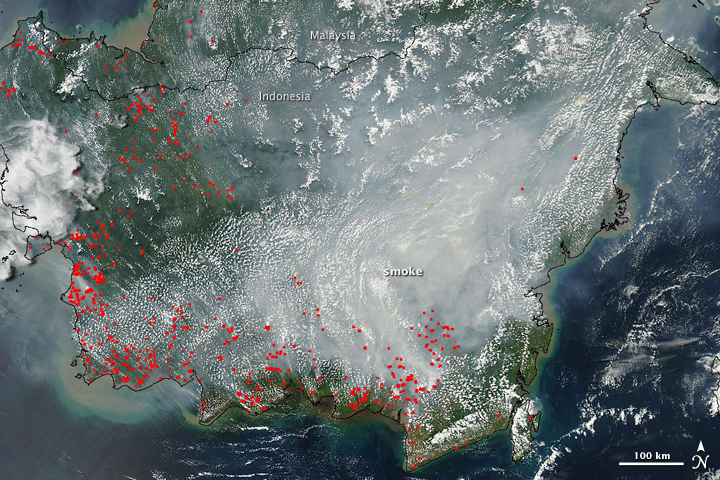
Satellites detect unusual thermal signals that may indicate active fires. The ASEAN Specialised Meteorological Centre also provides maps of possible hotspots, smoke and winds. These help direct field investigation and understand likely plume movement.
But red dots on a map do not establish ownership, ignition date, intention, illegal conduct or the legal responsibility of a named company. Cloud, viewing times and smouldering peat may also complicate detection.
Evidence sufficient for one purpose may be inadequate for another. A regional hazard alert may use satellite detections; a prosecution or claim requires the necessary legally admissible information about who did what, where and under which law.
Why land boundaries and concession maps need care
Plantation and concession maps may identify where land rights or operating areas are recorded. Yet a thermal detection near a boundary is not proof that the concession holder ignited the fire, or that the fire began inside the plotted boundary. Mapping precision and the timeliness of boundary records matter.
A credible investigation may need ground reports, land and permit records, fire histories, chain-of-custody evidence and a competent authority’s findings. Reporting uncertainty protects both public trust and due process.
This does not mean companies are beyond scrutiny. It means accountability is strongest when allegations can withstand careful examination rather than resting on one dramatic satellite screenshot.
The ASEAN 2023–2030 haze-free roadmap
ASEAN adopted its Second Haze-Free Roadmap in August 2023. The roadmap renews a vision of a transboundary haze-free ASEAN by 2030 and sets out goals, targets, indicators, strategies and means of implementation.
A roadmap is a management instrument: it helps coordinate goals, identify priority measures and track progress. It is not an official prediction that no fire or smoky day can occur in 2030.
A worthwhile evaluation asks whether verified fires, affected populations, peatland degradation and regional pollution exposure decline over comparable periods—not simply whether enough meetings took place.
Peatland strategy: governance below the surface
The ASEAN Peatland Management Strategy 2023–2030 addresses the ecological and economic complexities of tropical peatlands. Drained organic soil can become unusually fire-prone during drought, with smouldering fires that are difficult to extinguish.
Land management therefore needs attention to drainage and water levels, restoration, agricultural alternatives and sustained maintenance, not only penalties after a major smoke event.
The eduKate peatland prevention reference explains the fire mechanics and practical responses. This article focuses on how institutions create accountability, resources and cooperative action.
Funding the regional response without treating a target as money received
ASEAN’s Investment Framework for Haze-Free Sustainable Land Management was endorsed in 2023 and describes a goal of mobilising about US$1.5 billion by 2030 for land-management and haze-reduction actions.
That is a framework target, not proof that the entire sum has already been collected, spent or delivered to every community. Real accountability asks how much was actually allocated, disbursed, maintained and independently verified.
The framework seeks bottom-up participation and workable alternatives for landholders and smallholders. It recognises that lasting fire reduction is difficult where households lack equipment, secure tenure or feasible non-burning livelihoods.
The ASEAN Conference of the Parties and regional coordination
Under the treaty’s governance framework, ASEAN member states cooperate through meetings, technical programmes and information-sharing arrangements. These can support collective priorities and response coordination.
The phrase Conference of the Parties may sound abstract, but it refers to states working through an agreed institutional process. It is different from an international criminal court or a private damages tribunal.
Meeting outcomes deserve accurate time stamps. An announced future discussion does not become a binding new law merely because press coverage uses assertive language.
What 2026 has changed—and what has not yet been decided
The 2026 regional fire and haze season has renewed public debate about enforcement, cross-border assistance, corporate accountability and ASEAN cooperation. Reuters reported in October that ASEAN foreign ministers expected to discuss the problem at later meetings. That was a reported plan, not proof that a new regional penalty had already entered into force.
Conditions, diplomatic positions and incident investigations may change after this article’s editorial checkpoint. Readers should verify the newest official statements and avoid presenting proposals as enacted law.
A durable guide separates established treaty history from ongoing 2026 political and operational developments.
Firefighting assistance needs a legal and practical route
An offer to send personnel, aircraft or equipment may be valuable in a difficult fire season. But an offer is not automatically an accepted mission, and an announced mission is not proof that fires have been extinguished.
Assistance typically requires coordination about permission, sovereignty, resources, command, safety and logistics. A regional institution can facilitate discussions; the relevant authorities must establish the actual arrangements.
Reports about acceptance or refusal of assistance should be quoted with their dates because negotiations can change quickly.
Complaints about suspected local burning
For a suspected local open burn in Malaysia, members of the public should use the appropriate DOE public information and complaint channels or other responsible local authority rather than approaching an unsafe fire themselves.
A useful report contains a location, time, observable activity and any safe, lawfully obtained supporting information. A person should not trespass, confront unknown people or expose themselves to smoke merely to obtain an image.
The authority investigates. An individual’s suspicion is a reason to report responsibly, not a completed finding of guilt.
Corporate accountability begins with verified practices
Companies managing fire-prone land can establish documented no-burning practices, maintain appropriate water and fire controls, train response teams, monitor suppliers and investigate incidents.
A formal policy on a website is not the same as verified compliance. A sustainability report gains credibility when it explains monitoring methods, limitations, corrective action and independent checks.
Customers and investors can reasonably ask for evidence of risk management, while respecting the difference between a suspected fire and an established violation.
Smallholders need alternatives to destructive burning
A small agricultural operator may face genuine limits on access to machinery, credit, knowledge and labour. A blanket ban without workable alternatives may leave the economic incentive for burning intact.
Effective programmes can combine fair rules, technical support, shared equipment, sustainable land practices and suitable local participation. The region needs safer livelihoods as well as prevention.
This is the core governance question: how do institutions alter incentives and capabilities before severe smoke crosses borders? An effective answer is more than punishment after the fact.
Why source attribution matters for both public health and fairness
Residents need to know whether the air they breathe is unhealthy, even when the exact source remains uncertain. Emergency exposure decisions should not be delayed until investigators identify every fire.
Legal responsibility is a separate process. Public health can act on monitored pollution and relevant warnings while enforcement authorities assemble the evidence needed for any finding.
This separation makes the response both faster and fairer: protect people now, investigate causes seriously, and avoid premature accusations.
A worked case: a hotspot near a border
Hypothetical teaching scenario: ASMC marks a possible hotspot in Kalimantan. Regional winds suggest smoke may move towards Sarawak. A Kuching station later reports an elevated API. Which statements are supportable?
The hotspot and wind information make transboundary transport plausible. The station reports conditions at its monitoring location. Together they support further investigation. They do not identify the person who lit the fire or calculate the precise pollution share from that hotspot.
The student’s strongest answer explicitly separates observation, hypothesis, exposure and legal responsibility. That pattern is useful in science, reporting and civics.
A worked governance metric: incidents and baselines
Invented evaluation data: A region records 80 verified fire incidents in one defined period and 60 in a later comparable period. The observed reduction is 20 incidents, or (80 − 60) ÷ 80 × 100 = 25%.
Can a minister announce the programme alone caused a 25% improvement? Not yet. Weather, detection coverage, reporting methods and land use might also have changed.
A stronger monitoring framework uses several years and measures ecological conditions, verified response times and human exposure. Good governance treats uncertainty as a reason to evaluate carefully, not to stop evaluating.
A second metric: money pledged versus action delivered
Suppose a hypothetical programme announces RM10 million for peatland work but has actually disbursed RM4 million and verified RM2.5 million in completed work. These are three different figures: commitment, disbursement and verified delivery.
It would be misleading to describe the entire RM10 million as completed restoration. A serious public dashboard differentiates them and records maintenance or long-term outcomes.
The arithmetic is simple; the institutional skill is to label it accurately.
What a Malaysia parent should do regardless of the legal debate
A family does not need to resolve international responsibility before reducing unnecessary smoke exposure. Use APIMS, follow the relevant Malaysian Ministry of Health and school guidance, and consider the needs of children and vulnerable relatives.
Regional policy affects future risk; individual protective actions affect the current day. Both matter, but they operate on different time horizons.
The Malaysia API and haze health impact guides address these practical decisions in more detail.
What a civics student should ask about ASEAN haze governance
Identify the treaty, the domestic authority responsible for the suspected offence, the location of the fire, and the institutions that exchange scientific information. Then ask whether the available evidence supports an operational warning, a policy recommendation or a legal allegation.
A thoughtful student should be able to argue for stronger accountability while distinguishing a proposed rule from one already in force. The debate is richer when it considers smallholders, company practices, regional sovereignty and the rights of affected communities.
The learning outcome is not memorising a treaty date alone; it is understanding why a borderless pollutant needs several accountable institutions.
From an early warning to a legally useful report
A regional haze alert can be issued on the basis of environmental evidence and reasonable concern. A legal case asks a more demanding set of questions: what conduct occurred, who was responsible, where it happened, and what rules apply? The standard of proof and available procedures depend on the jurisdiction and type of proceeding. Neither process should be confused with a public warning issued to protect residents.
A useful investigation timeline preserves the initial satellite or witness observation, its exact time and location, verified field reports, relevant land records and subsequent agency findings. It should also record uncertainty. Careful documentation helps genuine accountability far more than guessing a culprit from the colour of a satellite map.
Why water management belongs in a legal discussion
Drained peat is particularly vulnerable during dry conditions, and water control may cross property or administrative boundaries. Rules about land use and drainage can therefore influence long-term fire risk even before there is an obvious open burn. The relevant requirements vary between countries, regions, activities and types of land tenure.
Policy discussions should distinguish prohibiting fire, promoting appropriate peatland hydrology and providing people with practical alternatives. A prosecution after an incident is one tool. Preventing recurring ignition through credible land management, clear responsibilities and maintenance can be just as important to reducing future Malaysian exposure.
How ASEAN monitoring and national enforcement fit together
The ASEAN Specialised Meteorological Centre can help the region understand hotspots, winds and smoke movement. National environmental agencies and competent authorities are responsible for actions under their own legal frameworks. Cooperation may involve exchanging observations, technical resources and verified information.
That institutional division avoids two mistaken expectations. ASMC is not a courtroom deciding corporate guilt, and a national index station is not a police investigator. When these different institutions do their intended jobs and share relevant information, the overall regional response can be stronger without pretending that all authority belongs to one map or organisation.
A policy scoreboard that people can understand
A useful public dashboard might show the number of verified fire incidents, time from confirmed detection to response, performance of long-term water management, independently checked restoration progress and changes in exposed populations over comparable periods. Each indicator needs a method and a time frame.
For example, a lower hotspot count may reflect cloud cover rather than fewer fires; an improvement in urban API may reflect changing winds rather than better enforcement. Policy evaluation should therefore combine satellite observations, field verification, meteorology and measured local exposure instead of claiming a programme succeeded after one rainy week.
What should a buyer ask about a zero-burning claim?
A company saying ‘we prohibit burning’ is making an important policy statement but not proving every supplier followed it. A responsible buyer may ask about monitoring coverage, fire-risk assessments, supplier engagement, independent checks, how complaints are handled and what corrective action follows verified incidents.
A map of an active-fire detection does not automatically settle contractual or legal responsibility. Equally, a written zero-burning policy does not establish perfect compliance. The strongest due diligence assesses both the integrity of the commitment and the quality of the evidence that operational practice matches it.
A classroom exercise: legal responsibility versus atmospheric cause
Consider a hypothetical fire detected close to a mapped land boundary. Smoke seems to move towards a Malaysian district where the API rises. Ask students for two separate paragraphs. The science paragraph can say that the observed fire and wind make transport plausible. The legal paragraph must explain what further evidence is needed to identify the actual operator and applicable offence.
A student who says ‘the satellite proves the company broke the law’ has skipped the required steps. A stronger student identifies map accuracy, investigation, land records, verified ignition and due process. This is a practical lesson in fairness, environmental literacy and the limits of digital evidence.
What residents can do while agencies investigate
Families should not wait for final source attribution before following appropriate health and school guidance during elevated pollution. Meanwhile, verified domestic fire sightings can be reported to the responsible Malaysian authorities through appropriate channels without trespassing or exposing anyone to danger.
The public can also ask officials for clear, dated updates on monitoring, response actions and prevention programmes. Productive questions focus on what is known, what remains under investigation and when the next update is expected. Being well informed does not require announcing conclusions before the evidence supports them.
Frequently asked questions about haze law in Malaysia
When was the ASEAN haze agreement signed? It was signed in Kuala Lumpur on 10 June 2002 and entered into force on 25 November 2003.
Did Malaysia ratify the treaty? Yes. ASEAN lists Malaysia’s approval in December 2002 and deposit in February 2003.
Does the treaty instantly fine a plantation operator? No. Individual legal liability requires the applicable law, jurisdiction and evidence; the treaty provides a regional cooperation framework.
Are all satellite hotspots verified illegal burning? No. They are possible fire detections; source identification and culpability require investigation.
Can Malaysia act against local open burning? Malaysia’s Environmental Quality Act contains open-burning provisions enforced through its applicable national framework.
Does the 2030 roadmap guarantee haze will vanish? No. It is a target and implementation framework to be assessed through results.
Can residents report suspected burning? They can use appropriate Malaysian environmental or local-authority channels, without approaching dangerous fires.
What about fires in another country? National jurisdictions, cooperation and verified evidence matter. Malaysia’s domestic officers do not gain automatic overseas enforcement powers from the treaty.
Does the October 2026 political debate create a new law? A proposal or announced future meeting is not itself enacted law. Check later official notices.
Where do families check air quality now? Use Malaysia’s official APIMS and current relevant health or school advisories.
Connected reading across eduKate’s Malaysia haze library
Primary laws, official strategy and editorial scope
Editorial checkpoint: 18 October 2026. This is public civics and environmental education, not legal advice, a legal conclusion about an individual actor or a real-time emergency declaration. Proposed or scheduled political changes after this date are not treated as enacted. Featured NASA image is from a historical smoke episode, not today’s live fire map.
From legal frameworks to public information: The Malaysia Haze Community Alerts and WhatsApp Communication guide shows how to distinguish an environmental observation, a forecast, a school or workplace instruction and an allegation of legal responsibility. It explains how residents can check official sources, preserve dates and avoid treating a satellite hotspot or an older screenshot as a new government order.
Further Malaysia haze cross-subject learning
Environmental law and regional cooperation are complemented by the civic perspective on fair evidence, empathy, responsibility and the difference between a fire detection and a legal finding. Continue with Pendidikan Moral and Sivik: empathy, fair source evidence and ASEAN. The supporting resources identify invented exercises and link to responsible official monitoring, and should not be treated as a current school, business or medical directive.