
Economics of Malaysia haze: the direct answer
Malaysia haze is a clear example of a negative externality: one activity can generate costs that are paid by people who did not choose it. When fire or damaging land management contributes smoke to the wider atmosphere, the consequences may include healthcare, reduced outdoor productivity, tourism disruption and protective spending in another region or country. The initial decision-maker may not bear all those costs, creating a difference between private and social cost.
Why is this suitable for KSSM Economics? The Malaysian school-hosted Form 4–5 Ekonomi DSKP collection includes scarcity, choice, opportunity cost, markets, productivity and externalities. In particular, the Form 4 curriculum’s productivity-and-externality section addresses social costs and benefits. The worked models here use those concepts to explore a real environmental issue; they are not official past SPM questions or a government estimate of 2026 losses.
What does real Malaysian research contribute? A 1999 Jurnal Ekonomi Malaysia paper on the 1997 transboundary haze used health-related valuation concepts to investigate costs. It shows that the topic has an established Malaysian economics research history, but its historical findings should not be relabelled as current national damages.
Haze economics in one minute
- Scarcity: Land, water, budgets, equipment and labour are limited, so choices involve trade-offs.
- Opportunity cost: Choosing one use of a resource means forgoing the best relevant alternative.
- Private cost: A cost borne directly by the actor making a production or consumption decision.
- External cost: A cost imposed on others outside that private decision.
- Social cost: Private cost plus external cost under the defined framework.
- Market failure: A market outcome may not account for the full external harm.
- Productivity: Output relative to inputs; a smoky workday may alter operations, but actual productivity needs measurement.
- Cost-benefit: Compare credible expected benefits and costs of prevention and response.
- Distribution: Costs are not shared equally among businesses, schools and households.
- Transboundary cooperation: A regional pollution problem may need action across national jurisdictions.
Economic categories needed to understand haze costs
| Concept | Whose decision or cost? | Teaching example | What not to infer |
|---|---|---|---|
| Private cost | Actor undertaking a production activity | Labour and machinery expense | That it includes all regional health effects |
| Marginal external cost | Others affected by one extra unit | Extra smoke-related harm under a model | A confirmed RM value from the API |
| Marginal social cost | Private and external marginal cost together | MSC = MPC + MEC | That average cost and marginal cost are identical |
| Opportunity cost | Best feasible alternative forgone | Budget used for one project not another | Sum of all imagined alternatives |
| Productivity | Output relative to inputs | Units per worker-hour | That haze caused every observed change |
| Net benefit | Expected benefit minus costs | RM3.2m − RM2m = RM1.2m | A real Malaysian project appraisal |
Reader note: The table is for structured learning and clear information retrieval. Its categories and illustrative examples do not replace official Malaysian monitoring, curriculum documents, healthcare advice or legal findings.
Begin with scarcity and choice
Economics studies how people and institutions allocate scarce resources among competing uses. Fire-prone peatland can be used, conserved or restored in different ways, each creating costs and benefits. A household may allocate money to an air cleaner, transport changes or other priorities.
Scarcity does not mean one group deserves to suffer pollution; it means real choices have trade-offs and that a policy proposal needs to identify which resources it requires.
A good answer states the decision-maker, alternatives and constraints before calculating any cost.
What is opportunity cost?
Opportunity cost is the value of the best alternative forgone when a choice is made. If a local authority directs funds to one environmental project, it may forgo another use of that same money. The opportunity cost is not automatically the entire budget of every possible competing project.
In haze policy, prevention spending may avoid later expenses, but the two time horizons and possible uncertainties must be considered. The cheapest apparent option today is not necessarily the one with the smallest long-term social cost.
Use the best relevant alternative rather than making up an unlimited list of imaginary losses.
Worked opportunity cost: choosing one project
Fictional decision: A council has RM500,000 that can support either a particular community monitoring programme or an alternative local service project, under the rules of its grant. If it selects the monitoring programme, the forgone benefits of the best feasible other project are its opportunity cost.
Do not answer that the opportunity cost is RM1 million simply by adding the price of both options. The concept concerns the best alternative not selected.
Project benefits require actual evidence; the exercise teaches identification of opportunity cost, not whether a particular council should choose one option.

A negative production externality explained
A negative production externality occurs when production creates costs for others that are not fully included in the producer’s private decision. An illustration is a land-clearing process that produces smoke affecting communities beyond the site.
Private costs may include equipment, labour and land management. External costs may include increased protective expenses, healthcare demands and disrupted business activity elsewhere, if causally supported.
The problem is not that all farming is harmful. It is that an actor may lack incentive to account for the full consequences of a particular damaging practice.
MPC, MEC and MSC: the three key curves
In a simple model, marginal private cost (MPC) is the extra private cost of one more unit of an activity, marginal external cost (MEC) is additional cost imposed on outsiders, and marginal social cost (MSC) is their sum.
An externality diagram typically shows MSC above MPC when marginal external cost is positive, all else equal. The gap explains why an unregulated market may produce more of a harmful activity than a socially efficient allocation.
This is a model of incentives. It does not claim a specific fire produced an exact amount of RM per tonne without measurement.
Worked externality calculation: one additional unit
Hypothetical textbook numbers: MPC for one extra unit of a polluting activity is RM80, while the estimated MEC is RM35. Then MSC = MPC + MEC = RM115 per unit.
The external part is RM35 under the example assumptions. Do not interpret RM35 as the officially assessed health cost of Malaysia haze or the private expense of every farmer.
The calculation is valid because the three values refer to the same additional unit and time period. Mixing total costs with marginal costs would be an error.
Why the private market may produce too much pollution
When the decision-maker faces only MPC but the wider community bears additional MEC, the private price may not reflect the full social damage. A standard model can show a private production level above the social optimum, depending on demand and cost curves.
The concept illustrates an incentive problem, not a moral judgement about every person who works in agriculture. Regulations, access to alternatives and economic realities all affect actual choices.
Students should explain the curve diagram verbally before drawing it, so the labels have real meaning.
A conceptual externality diagram without fake numbers
Draw quantity on the horizontal axis and marginal cost or benefit on the vertical axis. Show demand or marginal benefit, an upward private-cost curve, and a higher social-cost curve reflecting external harm. The private intersection and social intersection may differ.
Label the output levels carefully and discuss why interventions could move behaviour towards the lower social-cost outcome. Do not put Malaysia’s API on the price axis: it is an index, not a price or marginal cost.
Advanced extensions can discuss deadweight loss, but the basic model should remain internally consistent with the chosen scenario.
Social cost is more than a hospital bill
Possible costs include actual additional healthcare treatment, lost work time, changes to outdoor events, transport disruption, protective equipment and environmental damages. Some have observed market prices; others require careful nonmarket valuation.
A policymaker should avoid simply adding every headline estimate. For example, lost worker earnings and the value of lost output can overlap, depending on the accounting method. Double counting produces an exaggerated total.
The Malaysia haze economic costs reference treats the broader impact categories. This article shows students how economists reason about them.
What the 1999 UKM research actually studied
The Jurnal Ekonomi Malaysia article ‘Cost of Trans-boundary Haze Externalities’ examined valuation of health-related damages during the 1997 haze episode, including a dose-response approach.
The researchers were addressing a real Malaysia policy problem: costs of regional pollution can be compared with the potential merits of other resource uses or regional cooperation. That is evidence of the topic’s economic significance, not a current RM total.
Students should cite the year and method and avoid substituting a 1997 valuation directly for 2026 damages without adjustments and new observations.
What is a dose-response function in environmental economics?
A dose-response relationship connects a measure of exposure with an observed biological or health outcome, using data and an analytical method. Economists may then estimate economic consequences associated with a change in the expected number of cases.
Such a function requires reliable outcome data, appropriate exposure measures and consideration of confounding influences. It is not simply an equation that converts one API point into one hospital admission.
A source study must identify its population, time, conditions and limitations before a coefficient can be used in another context.
Historical valuation is not a live national forecast
Prices, wages, medical costs, demographics, pollution measurement methods and population locations can change over decades. A value estimated for 1997 cannot be presented as the precise Malaysia haze loss in October 2026.
Benefit transfer is one economic technique for applying research estimates elsewhere, but it requires careful adjustments and uncertainty disclosure rather than copying a historical figure.
Responsible analysis identifies what was observed, which values are modelled and which period the estimate actually covers.
Business productivity and lost work time
A business may adjust outdoor operations or change staffing during high pollution. Its output may fall, shift to another date or be maintained through reassignment. Not every altered schedule translates into a full loss.
Productivity should compare output with the inputs used over a stated period. A two-hour pause in one activity is not necessarily equal to two hours of lost productive work if employees perform other duties.
Workers’ safety remains governed by applicable Malaysian guidance; the economic calculation cannot justify continuing unsafe work.
Worked productivity example: output per worker-hour
Fictional small firm: A team produces 240 units in 60 worker-hours on a comparison day, giving 4 units per worker-hour. On another day it produces 180 units in 60 worker-hours, giving 3 units per worker-hour.
The measured output-per-hour decrease is 1 unit, or 25% relative to the first rate. But the example does not prove haze caused the change; equipment faults, orders or work mix might also differ.
State the measured outcome and propose evidence needed to attribute a cause.
Hawker stalls, small firms and outdoor workers
Outdoor food vendors, construction crews, delivery riders, farmers and port workers can have less control over their exposure than office employees in well-managed buildings. Operational decisions can change income, customer flows and shift patterns.
However, claiming every business closed during haze is often incorrect. Many continue with precautions, while others adjust timings or activities.
The DOSH workplace haze guide discusses occupational considerations. This Economics section asks how choices and costs fall on different actors.
Tourism and the concept of demand
Travel demand may change when visitors perceive a destination as smoky or an outdoor attraction becomes less appealing. Haze could influence bookings or spending, but real demand also depends on price, season, income, transport and alternative destinations.
A hotel booking decline and a restaurant’s change in sales cannot automatically be attributed entirely to haze without comparison and contextual information.
The Malaysia tourism guide explains practical activity choices, while Economics looks at how changing preferences and constraints affect demand.
Worked demand example: a change in sales
Imaginary restaurant data: An outdoor dining venue sells 200 meals on a comparison Saturday and 150 on another Saturday during a reported smoke period. The difference is 50 meals, or 25% of the original count.
That calculation is accurate for the example, but other influences—rain, marketing, public events and prices—could explain part of the change. Nor does the sales decrease equal lost profit, because costs may have changed.
Students should distinguish revenue, costs, profit and units sold before interpreting an economic impact.
Airlines and ports: the difference between visibility and API
Transportation may be affected by reduced visibility, operational decisions or worker exposure, but a high Malaysian API alone is not an automatic flight or port closure order.
Costs might include delays, changed schedules or protective measures. An economist needs real operational records and a defined period to estimate a financial effect.
Do not treat the news phrase ‘haze at an airport’ as a numerical loss estimate without checking which services were actually disrupted.
Fishing and food supply: avoid invented shortages
Fisheries and agriculture may face smoke, visibility or labour challenges. Yet an air-quality headline does not demonstrate a national shortage or a fixed rise in fish prices.
Fish supply also depends on seasons, weather, storage, imports and markets. Actual landing and sales records must be examined before concluding that haze reduced availability.
The Malaysia fishing haze guide separates real authority statements and risks from blanket predictions.
Healthcare spending and the burden on households
Individuals may buy appropriate filtration, change travel plans or seek medical care during an episode. Some expenses are directly observable; others represent time or lost wellbeing that require careful valuation.
Households with less disposable income may have fewer opportunities to buy equipment or move work indoors. The same environmental episode can therefore impose unequal burdens.
Economics should consider who can pay for risk reduction rather than assuming every Malaysian family has an identical budget.
What is distributional impact?
Distributional impact asks which people or groups receive costs and benefits. For haze, children, older adults, outdoor workers, business owners, low-income renters and wealthier households may have different exposure and resource constraints.
A measure that reduces pollution may benefit many people, while its costs fall on governments, landholders, businesses or consumers in differing proportions. Fairness depends on real local conditions and policy design.
Distribution is different from total efficiency, so an excellent policy appraisal considers both.
Costs to public institutions
Schools, clinics, local councils and agencies may need to communicate, adjust activities, maintain facilities or deploy personnel. These uses of staff time and equipment are resources, even when they do not appear as a new line on a household’s receipt.
Counting them reliably requires actual administrative records. A public announcement alone does not reveal the cost of operating a clinic or rescheduling a field trip.
An accurate budget discussion distinguishes planned funding from money actually spent and outcomes verified.
Private benefits and social benefits
Private benefits accrue directly to a decision-maker, whereas external benefits reach others. Social benefit includes both under the defined framework. For example, effective fire prevention on one landscape may reduce future smoke exposure for downwind communities.
The size of the benefit is uncertain and depends on whether the intervention actually prevents a fire, how severe the counterfactual episode might have been, and where winds would have carried emissions.
Economists need cautious scenarios rather than claiming a restoration project will prevent every future haze day.
The economics of non-burning alternatives
Mechanical clearing, biomass processing or other appropriate residue methods may require more equipment or labour than burning in some settings. If the private costs are higher, landholders may need viable alternatives, training or financing to change behaviour.
A rule without enforcement can be weak; a rule without practical compliance options can also be difficult to sustain. Combining fair standards with technical support can change incentives.
The Malaysia prevention guide explains upstream land management, peatland water control and ASEAN cooperation.
What is a subsidy in this context?
A subsidy is support that can lower the private cost of a chosen activity. A programme might help eligible smallholders obtain non-burning equipment or restoration assistance under specific rules.
The economic logic is to change relative costs and encourage behaviour with wider benefits. Poorly designed subsidies can also be wasteful or benefit actors who would have acted anyway.
Students should distinguish a proposed subsidy from an actual Malaysian policy. This article does not announce a new nationwide grant or eligibility scheme.
Can penalties and enforcement change incentives?
Appropriate legal penalties and enforcement can increase expected costs of violating an open-burning prohibition. But their effectiveness depends on detection, credible investigation, consistent application and the opportunity for lawful alternatives.
An environmental law does not automatically empower Malaysian authorities to enforce offences in another country. Regional cooperation and national jurisdiction both matter.
The ASEAN and Malaysia haze law guide explains those institutional limits.
Negotiation and the transboundary collective-action problem
A country suffering pollution may benefit from prevention outside its territory, while the source country or land managers may bear many immediate costs of changing practice. This creates incentives that are misaligned across borders.
Regional treaties, information sharing and support for sustainable land management can help coordinate the response. Yet an agreement alone does not ensure all landscape projects are completed or maintained.
Economics explains why shared environmental benefits require credible institutions as well as sound science.
What is cost-benefit analysis?
Cost-benefit analysis compares the expected consequences of alternative options over a relevant period, translating some into monetary units where defensible. It is not the same as adding a handful of unrelated headlines.
An evaluation should define the baseline, project costs, avoided damages, time horizon, risk and how nonmarket benefits or harms will be handled. Environmental and ethical limits matter too.
Do not treat benefits as guaranteed simply because a project has an impressive title or a 2030 target.
Worked cost-benefit calculation
Fictional project: A prevention programme costs RM2 million and is estimated to avoid RM3.2 million of damages over the same stated horizon, before further adjustment. The simple net benefit is RM3.2m − RM2.0m = RM1.2m.
The simple benefit-cost ratio is 3.2 ÷ 2.0 = 1.6. These are invented teaching numbers, not a real Malaysian haze programme appraisal. A proper study needs evidence, timing, discounting, uncertainty and safeguards against double counting.
The calculation shows the structure of an appraisal, not approval for an actual public investment.
Why future benefits may need discounting
A cost paid today and a benefit received years later are not always treated as economically equivalent in formal appraisal. Analysts may discount future cash flows according to relevant guidance and assumptions.
A basic present-value model is PV = FV ÷ (1 + r)^t, where FV is the future amount, r the discount rate per period and t the number of periods. The method itself does not decide an ethically appropriate rate.
Advanced students should examine how different reasonable discount rates change a long-term ecological investment’s apparent attractiveness.
Worked present value example
Illustrative numbers: A benefit of RM110,000 one year from now, with a stipulated 10% annual discount rate for the exercise, has present value 110,000 ÷ 1.10 = RM100,000.
This is a mathematical demonstration, not a recommended government discount rate or an assumption appropriate for every environmental project.
In actual assessment, benefits spanning decades and possible irreversible ecosystem damage warrant careful method choice and transparent sensitivity testing.
Sensitivity analysis: when the result is uncertain
An estimated project benefit may change if fire frequency, plume direction or future economic activity differs from expectations. Sensitivity analysis recalculates outcomes under alternative assumptions to see which variables matter most.
Suppose a fictional project has benefits of RM3.2 million in a central case but only RM1.4 million in a pessimistic case against RM2 million costs. The net benefit changes from positive RM1.2 million to negative RM0.6 million.
The exercise shows why a single optimistic forecast should not substitute for a range of defensible scenarios.
Avoid double counting lost earnings and production
If workers lose wages because an activity is cancelled, the resulting household loss and the firm’s change in output may overlap in a total social-cost calculation. Adding both uncritically can exaggerate the same underlying disruption.
Similarly, money spent on an air purifier is an expenditure, while the purifier is also a purchased asset providing a service; careful appraisal avoids treating every related transaction as an independent welfare loss.
Economic accounting needs clearly defined categories and boundaries to remain trustworthy.
GDP is not identical to human welfare
Some economic costs show up as reduced market output. Others, including discomfort, damaged biodiversity or unequal access to cleaner air, are not fully captured by the sum of national market transactions.
Conversely, some spending on medical treatment or new filtration equipment can increase measured market transactions while reflecting an unwanted health or pollution problem. Growth in spending is not automatically evidence that society is better off.
Environmental economics examines welfare more broadly than a single GDP change.
Supply chains connect regions
Haze-related disruption in one transport corridor or production region may affect businesses far away through deliveries and schedules. But the size and direction of the impact depend on actual operations and contracts.
A port, farmer, logistics firm and restaurant can experience different timing and costs. A regional air-quality report cannot directly calculate the national supply-chain effect.
The business continuity and SME reference covers practical preparation, while this chapter explains the economic relationships.
A trade-off between current protection and long-term prevention
Household filtration and adapted school routines help manage exposure now. Restoring appropriate peatland hydrology and preventing avoidable burning can reduce future regional smoke sources. These interventions work over different timescales and have different decision-makers.
Economists should not compare them as though one must eliminate the need for the other. An effective system needs both immediate protective measures and longer-term source reduction.
Costs should be valued transparently, with attention to who pays and who benefits.
A four-week Ekonomi haze study plan
Week 1: Learn scarcity, opportunity cost and the difference between private, external and social cost.
Week 2: Draw a correctly labelled negative externality diagram and complete original MPC/MEC/MSC problems.
Week 3: Investigate dated Malaysia research on 1997 haze health-related damages and compare sectors without inventing 2026 totals.
Week 4: Produce a short cost-benefit scenario, discuss distributional effects and propose a realistic preventive policy with limitations.
What actually belongs to KSSM Ekonomi
The school-hosted KSSM Ekonomi Tingkatan 4 and 5 DSKP includes scarcity, opportunity cost, market systems and productivity/externality concepts. This makes environmental haze a relevant application.
Advanced appraisal and transboundary environmental-valuation methods may extend beyond standard examination expectations and are presented as enrichment. The current official DSKP and teacher guidance determine the applicable requirements.
An honest educational article distinguishes curriculum concepts from original practice problems and professional policy analysis.
Frequently asked economics questions about Malaysia haze
What is an externality?
A cost or benefit affecting third parties outside the decision-maker’s private transaction.
Why is haze a possible negative externality?
Smoke-related costs may fall on communities not responsible for the underlying activity.
Does every farmer create the same external cost?
No. Land uses and environmental practices differ and require specific evidence.
What is marginal private cost?
The extra direct private cost of one additional unit of activity.
What is marginal external cost?
The extra cost imposed on others by that unit.
What is marginal social cost?
The sum of marginal private and marginal external cost under the model.
If MPC is RM80 and MEC RM35, what is MSC?
RM115 per comparable marginal unit.
Is Malaysia API a measure of social cost in ringgit?
No. API is an air-pollution index, not money.
What is opportunity cost?
The value of the best relevant alternative forgone when a choice is made.
Can local businesses lose revenue during haze?
They may, but losses and causes need actual sales and operational evidence.
Do lost sales equal lost profits?
No. Costs, margins and other factors matter.
Does every Unhealthy API close airports or ports?
No. Operational decisions use applicable rules and conditions.
Can a medical visit be valued economically?
Some treatment and related costs can be measured, while broader health welfare requires careful methodology.
Is the 1999 UKM haze study a current 2026 damage report?
No. It analysed the historical 1997 haze and its methods.
What is a dose-response function?
A method relating exposure to an outcome under specific data and modelling assumptions.
What is benefit transfer?
Using research valuation findings in another context with appropriate adjustments and limitations.
What is a subsidy?
Financial or other support reducing the private cost of a chosen activity.
Can enforcement influence burning incentives?
Yes, when applicable rules and credible enforcement change expected costs of violations.
Is a new environmental agreement automatically effective?
No. Implementation, financing and measurable results matter.
What is cost-benefit analysis?
An assessment of expected costs and benefits of alternatives over a defined period.
Does a benefit-cost ratio above 1 guarantee a real project should go ahead?
No. Uncertainty, distribution, environmental constraints and methodology still require evaluation.
Why use sensitivity analysis?
To test how conclusions change when key assumptions differ.
Can haze affect low-income workers differently?
Yes. Exposure and financial flexibility may differ, requiring evidence and fair policy design.
Why is GDP not identical to welfare?
It measures market activity and does not fully capture environmental harm or wellbeing.
Are these official SPM Ekonomi questions?
No. They are original applied exercises using relevant curriculum concepts.
Read the eduKate Malaysia haze economics network
Economics curriculum and research sources
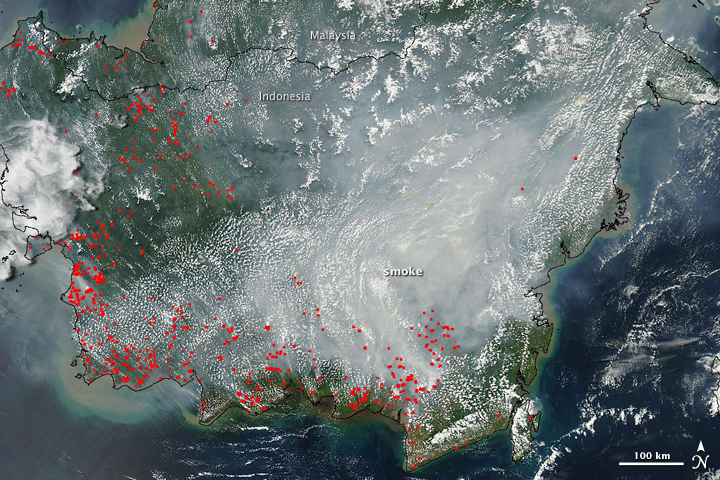
Editorial checkpoint: 18 October 2026. All ringgit values, firm figures and mathematical examples are fictional teaching exercises, not official Malaysian economic damage estimates, grants, prices or investment approvals. The featured NASA image illustrates a historical regional haze episode, not economic survey data.
Further Malaysia haze cross-subject learning
Economic externalities connect directly to business continuity, staff scheduling and cash flow, while moral reasoning addresses who bears environmental costs and how to communicate risks without unsupported blame. Continue with Perniagaan: Malaysia haze business continuity and worked financial problems; Pendidikan Moral and Sivik: empathy, fair source evidence and ASEAN. The supporting resources identify invented exercises and link to responsible official monitoring, and should not be treated as a current school, business or medical directive.