
Quick answer: can haze change Malaysian weather?
Yes, haze can modify the passage of sunlight through the atmosphere and influence how certain clouds form. Smoke contains tiny airborne particles called aerosols. Some scatter sunlight, others absorb it, and some can act as cloud condensation nuclei. These are measurable physical mechanisms. But it is not accurate to claim that every haze episode makes Malaysia colder, stops rain, or creates a drought. The actual response depends on particle chemistry, altitude, concentration, cloud type and regional weather.
When Malaysia experiences transboundary smoke, first check the official API/IPU map for local exposure, then the ASMC regional haze situation and METMalaysia weather information to understand the atmospheric background. API is an air-quality index; it is not a direct measurement of how much sunlight reaches a crop field or how many millimetres of rain will fall.
This article focuses on the science of what haze can do to sunlight, clouds and rainfall, rather than duplicating the national guides to fire causes, health precautions and API categories.
At a glance: six ways smoke and weather interact
- Scattering: Many haze particles redirect sunlight, reducing direct sunlight at the surface and making the sky appear washed out.
- Absorption: Dark soot, including black carbon, absorbs solar energy and can warm the layer of air containing it.
- Cloud droplets: Some aerosol particles act as seeds around which cloud droplets form, potentially altering droplet numbers and sizes.
- Atmospheric stability: Heating an elevated smoke layer while reducing surface heating can weaken some rising air currents.
- Rain removal: Raindrops can remove suspended particles locally, but not automatically extinguish peat fires far away.
- Monsoon and El Niño: These larger weather and climate systems influence rainfall and fire conditions, but cannot be reduced to a single aerosol effect.

The first distinction: haze is an air-quality condition, not a kind of cloud
Clouds typically consist of droplets of water or ice particles formed in humid air. Haze is associated with suspended aerosol particles—solid or liquid material including products of combustion—that can reduce visibility. They may occupy the same region of sky and interact, but they are not interchangeable.
A white or grey horizon can result from a mixture of humidity, mist, clouds, smoke and other suspended particles. Camera settings and distance exaggerate or diminish the appearance. A hazy photograph cannot reveal a specific PM2.5 concentration or a radiative effect without supporting instruments.
Students should make two observations before drawing conclusions: what the sky looks like and what the actual measurement shows. A photograph is useful visual evidence; an instrument and its documented method supply the quantitative evidence.
Why the particles matter more than the colour of the sky
An aerosol is a suspension of small particles or droplets in a gas. Biomass-burning smoke contains organic material, soot and other compounds, often mixed with pollutants emitted elsewhere. Particles differ in size, shape and optical properties. Those properties influence how much incoming light is reflected, scattered forward, or absorbed.
NASA’s Aerosols: Tiny Particles, Big Impact explains that light-coloured or translucent aerosols often scatter sunlight, while darker black carbon absorbs energy. An atmosphere containing both can shade the ground and heat particular atmospheric layers at the same time.
This means a haze episode has no single universal temperature effect. The surface may receive less direct light while some air above it warms. The outcome must be assessed using real optical, meteorological and surface data.
Direct sunlight and diffuse sunlight: the practical difference
On a clear day, sunlight follows a relatively direct path to the ground. In smoky air, light scattering spreads some of the sunlight over a wider range of directions, increasing the proportion of diffuse light under some conditions while reducing the direct beam.
That difference can matter to a person photographing a landscape, a solar panel receiving energy or a crop canopy with leaves at several depths. But less direct sunlight does not automatically mean zero useful light. Different surfaces and technologies respond differently to the mix of direct and diffuse radiation.
An accurate field study would measure solar irradiance or photosynthetically active radiation rather than estimating it from how orange a sunset appears.
Black carbon: why one smoky layer can warm the atmosphere
Black carbon is an absorbing component of some combustion smoke. When sunlight meets a soot-rich layer, some energy is retained by the aerosols and surrounding air. Heating at that altitude may change the vertical temperature profile and atmospheric stability.
At the same time, aerosol particles can block or scatter a fraction of sunlight that would otherwise reach the surface. The resulting combination—air-layer warming and surface shading—can weaken convection in certain circumstances. Convection is the rising movement of warmer, often moisture-bearing air from near the ground.
NASA describes this mechanism in its study of smoke, clouds and rainfall. The key word is can: the sign and strength of the effect vary with concentration, vertical placement and cloud type.
Why clouds need tiny nuclei
Cloud droplets generally form when water vapour condenses onto microscopic particles known as cloud condensation nuclei. Natural sea salt, dust and many other aerosols can act as nuclei. Smoke can add to that population when the particles have suitable properties.
If the available liquid water is divided among more nuclei, a cloud can have more numerous but smaller droplets in some situations. This may change reflectivity, lifetime or the process by which droplets merge into raindrops. Yet it does not guarantee that a polluted cloud will produce more or less rain on a particular Malaysian afternoon.
The NASA explanation of aerosol indirect effects is an excellent starting point. Separate what an individual droplet does from the entire weather system moving across a state.
Cloud brightening is not a weather forecast
When cloud droplets become smaller and more numerous, the cloud may scatter more sunlight and appear brighter. This is sometimes called the aerosol indirect effect or cloud-albedo effect. Scientists study it because clouds influence how much solar energy Earth absorbs.
However, cloud outcomes depend on humidity, rising air, droplet formation, ice processes, precipitation and the position of the aerosol layer. A simple sentence such as ‘more haze creates more rain clouds’ is not robust. Under other conditions, absorbing smoke can suppress low-level cloud development.
The appropriate conclusion is that haze particles can modify cloud properties. Proving their net influence on Malaysian rainfall requires a careful observational or modelling study.
Does thick smoke suppress rainfall?
In some studied tropical environments, yes. NASA’s More Smoke Can Mean Less Rain explains observations in which absorbing smoke heated the atmosphere, stabilised the lower layers and reduced convection and rainfall.
But a finding from one region, season and cloud environment cannot simply be copied into Kuala Lumpur or Sarawak as a guaranteed effect. Smoke of different chemistry or height can behave differently, and larger monsoon circulation may overwhelm a local aerosol contribution.
A responsible headline says that smoke may influence rainfall formation in particular settings, not that every Malaysian rainfall deficit is caused by haze. Water shortage and El Niño influence fire risk independently of any feedback from smoke.
Can haze make the day feel cooler?
Smoke can reduce incoming direct sunlight and therefore sometimes reduce surface solar heating. A shaded outdoor surface may feel less intensely sunlit. But comfort also depends on actual air temperature, wind, humidity, exertion and radiant heat from buildings or pavement.
It would be misleading to advise someone to exercise outdoors because haze makes the afternoon look less bright. Fine-particle exposure may remain elevated even if the sun is dim. Air-quality precautions should follow the Malaysian official index and personal circumstances, not the apparent pleasantness of the light.
The larger climate effect cannot be estimated simply by measuring how cool one person feels on a balcony.
Can haze make the atmosphere warmer instead?
Yes, at some altitudes. Absorbing aerosols such as black carbon can warm the air containing them. That may affect stability, cloud development and how much energy is distributed vertically. The smoke’s optical properties and its relationship to bright or dark underlying surfaces matter.
NASA’s Smoke Above the Clouds shows why an absorbing aerosol above a bright cloud layer can produce different radiative results from particles over a dark ocean.
These mechanisms teach a valuable distinction: surface temperature, temperature of a smoky air layer and global climate forcing are three different quantities. Avoid treating them as interchangeable.
Why haze cannot be said to cancel climate change
Some aerosol types reflect sunlight and can have a short-term cooling influence. But biomass fires also release carbon dioxide and other greenhouse gases, damage vegetation and sometimes consume long-stored peat carbon. These processes have different chemical lifetimes and environmental consequences.
It would be poor science to claim that severe smoke is beneficial because it shades the surface. It harms air quality and may release long-lived greenhouse gases. Climate scientists evaluate the combined effects across time and space rather than converting a cooler afternoon into a net environmental benefit.
Peatland fire prevention and habitat restoration therefore remain important even when some smoke particles have a reflecting effect on sunlight.
Malaysia’s Southwest and Northeast Monsoons set the larger stage
METMalaysia describes broad Southwest Monsoon and Northeast Monsoon seasons with different regional rainfall and wind characteristics. These large-scale patterns influence whether fire-prone landscapes become dry and where released smoke is transported.
The Southwest Monsoon is often associated with relatively drier conditions across much of Malaysia, while the Northeast Monsoon brings substantial rain to certain east-coast and Borneo regions. But individual days can differ from seasonal averages.
A monsoon is not generated by one local haze plume. It is a much larger circulation system. An aerosol event interacts with the weather, but a precise explanation must keep these scales separate.
El Niño affects drought probability, not every individual cloud
El Niño involves coupled changes in tropical Pacific sea-surface temperatures and atmospheric circulation. It can change regional rainfall probabilities across the Maritime Continent. During some El Niño episodes, landscapes with lowered peat water levels become especially fire-prone.
As of October 2026, ASMC’s seasonal outlook describes continuing concern about relatively dry conditions and regional haze risk under El Niño conditions. That is a dated seasonal prediction, not a guarantee that any particular Malaysian village will remain dry tomorrow.
Climate provides a background risk distribution; weather describes the local, short-term state. Ignition and land management remain important links between drought and actual smoke.
Rain washes out particles, but it does not erase the source
Raindrops can collect aerosol particles as they fall, reducing some local atmospheric particulate concentrations. This is called wet deposition or scavenging. The degree of removal depends on rainfall intensity, particle size, the vertical distribution of smoke and continuing inflow.
A shower over Petaling Jaya cannot directly extinguish every burning pocket in Kalimantan or Sumatra. New smoke may arrive with subsequent winds. Even within Malaysia, rain can be patchy, with one suburb experiencing heavy showers while another remains dry.
A bright post-rain photograph is therefore not sufficient evidence to declare the end of a haze episode. Confirm with later official station readings.
Humidity and the milky haze illusion
Some aerosol particles take up water at higher humidity. When they grow, their ability to scatter sunlight can change, making the sky appear more opaque even when the dry-particle mass has not changed proportionally.
The appearance of reduced visibility may also include natural mist and clouds. That is why meteorologists distinguish visibility, particulate concentration, relative humidity and cloud cover. They can be related but are not equivalent.
For photography students, this explains the low-contrast look of some tropical skylines. For environmental students, it is a reminder that a camera is not a calibrated particle monitor.
Sunsets and orange skies: interesting optics, unreliable diagnosis
Low sunlight travels a longer path through the atmosphere. Scattering along that path can alter which wavelengths reach the eye or a camera. Smoke can change the visual effect, but orange and red sunsets also occur without a severe air-quality event.
A photograph is evidence that a particular visual scene occurred. It cannot identify the dominant pollutant, exact particle size or Malaysian API value. Use it as an opening observation, not the conclusion of a scientific report.
Claims such as ‘the sky is orange, therefore API must be hazardous’ are a reasoning error. The correct response is to consult official measurement alongside the visual clue.
Solar panels: potential impacts on incoming irradiance
Photovoltaic panels depend on incoming solar energy. A smoke plume that reduces surface irradiance can temporarily reduce the energy available for generation under some conditions. However, diffuse light, cloud cover, panel orientation, temperature and local maintenance all shape actual output.
No national solar-power loss can be inferred from a single air-quality index. A meaningful analysis compares measured solar irradiance and electricity generation at the same installation, while controlling for clouds and other factors.
This is a useful application for secondary-school science: pollution in one landscape can influence energy available at a distant site without the solar plant being physically near the fire.
Agricultural light: rice and vegetables require crop-specific evidence
Leaves absorb sunlight for photosynthesis. Severe haze can reduce or change the light available to plants, yet the response depends on crop species, canopy structure, growth stage, soil water and nutrient conditions. A short-term reduction in solar radiation is not automatically the same percentage reduction in harvest.
The companion Malaysia haze and agriculture guide discusses Malaysian rice research and the distinction between observed plant physiology and claims about yield. It is a more precise question than assuming all farms decline equally every haze season.
Weather, disease, irrigation and farming decisions need to be recorded alongside the pollution history if a crop study aims to identify a haze contribution.
A worked example: measuring a reduction in sunlight
Hypothetical classroom dataset, not a current Malaysian observation: A rooftop light sensor reports average midday irradiance of 820 W/m² on a selected clear comparison day and 615 W/m² during a smoky observation period. The difference is 205 W/m². The proportional reduction relative to the comparison value is (820 − 615) ÷ 820 × 100 = 25%.
That arithmetic is correct, but the dataset alone does not prove haze caused the entire 25% difference. Cloud cover, solar elevation, rain and sensor issues could have changed. A stronger study uses matched times and weather records.
The same numerical result does not mean a crop loses 25% of yield or that solar panels generate exactly 25% less daily electricity. The measured quantity was irradiance at a particular time, not harvest or full-day output.
Another worked example: two different measurements
Imaginary situation: A Malaysian station reports API 145 at one hour. A rooftop sensor separately reports solar irradiance of 530 W/m². Which number gives an outdoor health category? The official API does. Which reports incoming radiant energy at the measurement surface? The irradiance sensor.
Can a student add them, average them or use one as a direct substitute for the other? No. They describe different physical and constructed quantities with different units and methods.
This simple distinction is one of the most useful lessons in environmental data literacy: related variables are not automatically interchangeable. Their relationship can be investigated, but it cannot be assumed.
Where a satellite adds evidence and where it cannot
Satellites can observe regional smoke, aerosol optical properties and cloud conditions across a large geographic area. Ground instruments measure conditions where they are installed. Weather stations add wind, temperature and rainfall; field radiometers add incoming light.
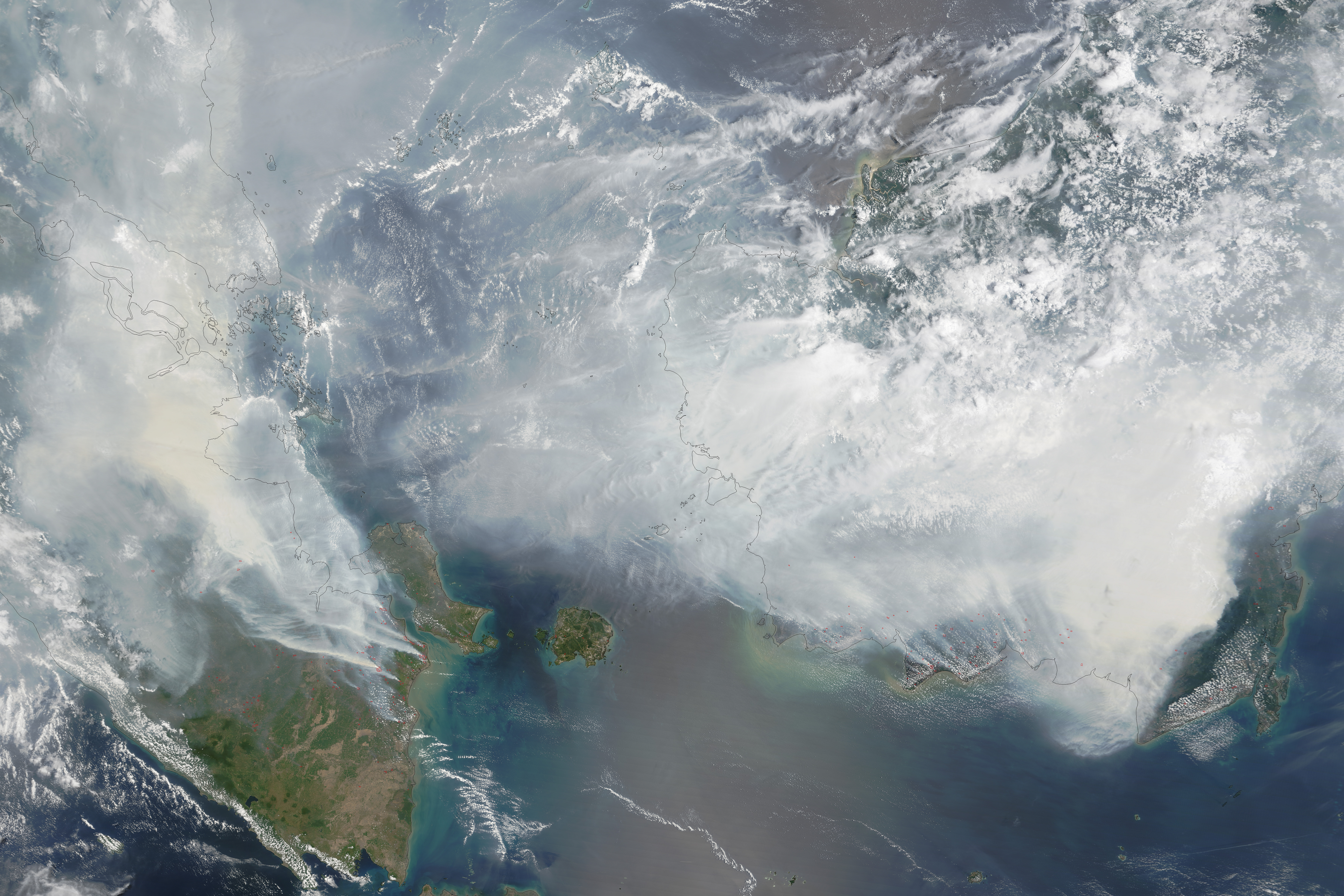
One scene from space may show haze extending across Sumatra and Malaysia. That is valuable geographical context. But the image cannot by itself quantify radiation received by a particular paddy field below clouds, nor the exact particle exposure inside a classroom.
To study aerosol-cloud relationships, combine observations from several sensors and consider the altitude of the smoke. NASA’s aerosol research provides general mechanisms; Malaysian observations are needed for event-specific claims.
A student enquiry: compare smoke, cloud and rain maps responsibly
Choose a past date for which NASA or ASMC satellite observations exist. Locate the smoke plume and possible hotspots. Then obtain contemporaneous rainfall or cloud observations, plus the local API if available. Mark their times and geographical scales.
Write one hypothesis—for example, ‘the aerosol layer may have altered surface sunlight’—and one alternative, such as cloud cover alone reducing radiation. Explain which extra instrument would distinguish the hypotheses. Avoid saying that haze prevented rain merely because the maps show smoke and no cloud in the same frame.
This exercise develops honest causal reasoning: describe the mechanism, test it against evidence, and state the uncertainty.
What families should do when haze makes the sky dim
Reduced brightness is not an air-quality safety signal. Families should use the latest Malaysia APIMS reading and health-authority guidance before deciding on outdoor sports or long walks. People with respiratory or cardiovascular conditions should follow their clinical care plans.
Indoor alternatives may help reduce unnecessary smoke exposure, but indoor air depends on infiltration, filtering, cooling and ventilation. A darkened room with windows sealed unsafely is not a complete health strategy.
For exposure and household arrangements see Malaysia home and cleaner-air guide. This article’s purpose is to explain optical and weather physics, not make an individual medical diagnosis.
Frequently asked questions about haze, clouds and sunlight
Does haze in Malaysia always make it rain less?
No. Some aerosol mechanisms can suppress convection or alter precipitation under particular conditions, but the effect depends on smoke properties and weather. No universal rule predicts local rainfall from haze alone.
Why is the sun sometimes a red disc during haze?
Scattering and absorption can change the visible spectrum along a long atmospheric light path. Colour is not a calibrated PM2.5 measurement.
Can haze temporarily shade the ground?
Yes. Scattering and absorption can reduce direct solar radiation at the surface, but the size of the change must be measured.
Does less direct sunlight always mean less plant growth?
No fixed percentage follows. Crop species, growth stage, diffuse light, water and other factors influence response.
Can smoke help create cloud droplets?
Some aerosol particles can act as condensation nuclei, but cloud outcomes depend on the whole weather environment.
Can dark soot warm air and cool the ground simultaneously?
Yes, in some configurations. Absorbing soot heats its atmospheric layer while some radiation is prevented from reaching the surface.
Is a cloudier day necessarily hazier?
No. Clouds, mist and pollution are distinct though they can interact.
Does rainfall permanently remove haze?
A local shower can remove some particles, but continuing fires and transport can produce new exposure.
Does El Niño directly create smoke particles?
No. It can influence rainfall and drought risk; combustion releases smoke, and winds transport it.
Can an API index estimate solar-panel output?
No. Index values indicate public air pollution categories, not irradiance or electrical energy.
Connected Malaysia haze reading in eduKate
Primary science and agency sources
Editorial checkpoint: 17 October 2026. The physical mechanisms in this guide come from published atmospheric research. Their magnitude and even direction can differ between Malaysian locations and weather regimes. The featured NASA imagery is historical, not a current Malaysian observation.
The oceanic climate patterns behind some haze seasons
Read ENSO, Walker circulation, Indian Ocean Dipole and the 2019 comparison; and Read why soil moisture and water tables mediate the drought-to-fire relationship. These specialist guides complement the current article: satellite fire detections do not automatically prove emissions, a climate anomaly does not identify ignition, and the current Malaysian API must be checked through the responsible official monitoring service rather than copied from historical graphics.