
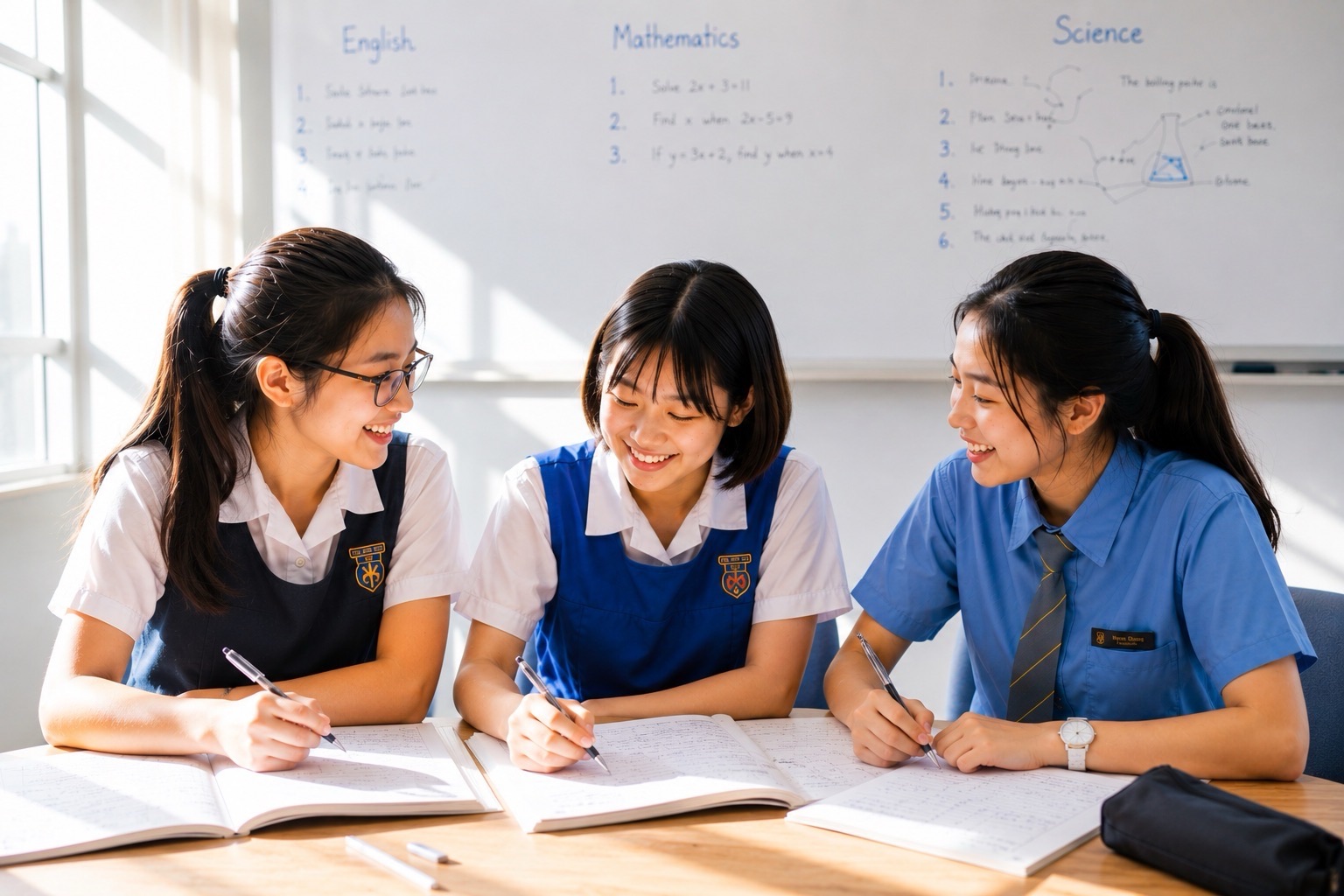
Mathematics tuition for Choa Chu Kang students in focused 3-pax classes. Strengthen foundations and prepare for PSLE, G1–G3, E-Math and A-Math.
eduKateSG Mathematics Tuition supports Choa Chu Kang Primary and Secondary students through careful diagnosis, first-principles teaching, focused 3-pax classes and structured preparation for school and national examinations.
Mathematics Tuition Choa Chu Kang
Finding Mathematics tuition in Choa Chu Kang is easy.
Finding the correct kind of Mathematics tuition requires a little more thought.
A child may need help because marks have fallen. Another may be passing but taking far too long to complete ordinary work. A stronger student may understand the syllabus yet remain unable to convert that understanding into dependable examination results.
These students do not have the same problem.
They should not automatically receive the same worksheet, explanation or learning plan.
At eduKateSG, Mathematics tuition begins by identifying what is actually preventing the student from moving forward. We then teach from the correct starting point, strengthen the necessary foundations and guide the student towards increasingly independent performance.
The purpose is not simply to complete more questions.
It is to help the student understand how Mathematics works, recognise what a question requires, choose a valid method and carry that method through accurately.
Good Mathematics tuition does not hide a student’s weaknesses beneath more practice. It finds the important break, repairs it and reconnects the student to the learning route ahead.
Parents who would like to understand our wider Mathematics architecture may begin with How Mathematics Works, which explains Mathematics as a system of defined objects, valid rules and reliable transformations rather than a loose collection of formulas.
One-Sentence Answer
Mathematics tuition in Choa Chu Kang is most useful when it identifies whether a student is struggling with foundations, meaning, method, transfer or examination execution, then repairs the weakness in the correct order.
What Parents Are Usually Seeing at Home
Parents rarely begin with a technical diagnosis.
They begin with something visible.
“My child understands in class but cannot do the homework alone.”
“She is making too many careless mistakes.”
“He can answer standard questions but becomes lost when the wording changes.”
“My child did well in lower Primary, but Mathematics suddenly became difficult.”
“Secondary Mathematics has become too abstract.”
“He is managing E-Math but falling behind in Additional Mathematics.”
These observations are important. However, the visible difficulty may not be the root difficulty.
| What the parent notices | What may be happening underneath |
|---|---|
| The student forgets a method after a few days | Learning was remembered temporarily but not consolidated |
| The student knows a formula but does not know when to use it | Recognition and transfer are weak |
| Homework looks acceptable but tests remain poor | The student may rely on examples, hints or unlimited time |
| Careless mistakes occur repeatedly | Working discipline or cognitive load may be unstable |
| Word problems cause immediate confusion | Mathematical language or representation may be weak |
| Algebra feels mysterious | Earlier arithmetic relationships may not have become symbolic understanding |
| Marks rise and fall sharply | Knowledge is present but performance is not yet dependable |
| The student leaves difficult questions blank | The student may lack entry strategies and recovery habits |
The correct intervention depends on which part of the learning system is failing.
A child who does not understand fractions does not need only more percentage worksheets.
A student who understands concepts but works too slowly may need fluency, method selection and time control rather than complete reteaching.
A strong student aiming for distinction may need unfamiliar-question transfer, deeper connections and more disciplined execution.
Good tuition separates these cases before deciding what to do next.
Mathematics Is Built in Layers
Mathematics is cumulative.
Each stage carries structures into the next one.
Number sense supports arithmetic.
Arithmetic supports fractions, ratio, rate and percentage.
These ideas later support algebra.
Algebra supports equations, graphs, functions, coordinate geometry, trigonometry and Additional Mathematics.
A weakness can therefore remain quiet for some time before it becomes visible.
For example, a Primary student may memorise a percentage procedure and pass a topical exercise. The weakness becomes clearer later when percentage is combined with ratio, discount, profit, repeated change or a multi-step word problem.
Similarly, a Secondary student may survive simple algebra by copying familiar steps. The weakness becomes expensive when algebra is used inside functions, graphs, trigonometry or differentiation.
This is why Mathematics should not be taught only chapter by chapter.
Students need to see the connections between chapters and understand which earlier structures are supporting the current work.
The eduKate Mathematics Learning System describes mastery as cognitive progression, confidence construction and systemised thinking rather than memorisation alone.
A practical student route can be written simply:
Understand → Represent → Operate → Practise → Connect → Transfer → Perform → Review
A student first needs to understand what the mathematical idea means.
The student then needs to represent it accurately using numbers, symbols, diagrams, tables, graphs or models.
Next comes the operating method.
Practice makes that method more stable. Connections allow the student to use it alongside other topics. Transfer allows the student to recognise the same structure in an unfamiliar question.
Only then does examination performance become consistently reliable.
Primary Mathematics Tuition for Choa Chu Kang Students
Primary Mathematics builds the first working mathematical system.
During the earlier years, questions may be shorter and more direct. As the child progresses, Mathematics requires stronger reading, longer chains of reasoning and greater independence.
The child is no longer being asked only:
“Can you calculate?”
The child is increasingly being asked:
“Can you identify the relationship, select a method, organise several steps and decide whether the answer makes sense?”
Primary 1 and Primary 2 Mathematics
At Primary 1 and Primary 2, the priority is a calm and accurate mathematical foundation.
Students need to develop:
- number sense;
- place value;
- addition and subtraction;
- early multiplication and division;
- comparison;
- measurement;
- shapes and spatial relationships;
- mathematical vocabulary;
- and orderly working habits.
A young child may calculate accurately but misunderstand the sentence describing the calculation.
Words such as “altogether”, “remaining”, “difference”, “more than” and “fewer than” carry mathematical instructions. When this language is unstable, the child may appear careless even though the real problem is interpretation.
Early Mathematics tuition should therefore build meaning, not merely accelerate the child into harder worksheets.
Primary 3 and Primary 4 Mathematics
Primary 3 and Primary 4 are important expansion years.
Multiplication and division become more demanding. Fractions become central. Measurement develops. Word problems require the child to hold several pieces of information in mind.
This is often when memorised procedures begin to lose their usefulness.
A student may know how to multiply but not recognise a multiplicative relationship inside a word problem.
Another may be able to shade a fraction but not understand how fractions behave when compared, added or used as part of a quantity.
Useful tuition at this stage helps the child:
- recognise question structures;
- translate words into mathematical relationships;
- use diagrams or models correctly;
- show working in a logical order;
- and connect new chapters to earlier knowledge.
Primary 5 Mathematics
Primary 5 is one of the most important transition points in Primary Mathematics.
Fractions, decimals, percentages and ratio begin interacting more intensely. Area, volume, rate and multi-step problem-solving increase the processing load.
Students who previously depended on one-step recognition may begin to struggle.
A Primary 5 student may need support with:
- fraction fluency;
- multiplication and division;
- ratio and percentage relationships;
- model drawing;
- question classification;
- multi-step planning;
- checking;
- or repairing earlier Primary topics before Primary 6 begins.
This is the year in which an orderly repair programme can protect the student’s PSLE route.
Waiting until Primary 6 may still allow improvement, but the available runway becomes shorter and the child must repair foundations while also preparing for examination performance.
Primary 6 and PSLE Mathematics
Primary 6 brings the Primary Mathematics system together.
Students must coordinate:
- content knowledge;
- non-routine problem-solving;
- question-reading accuracy;
- calculation fluency;
- calculator discipline;
- multi-step working;
- time allocation;
- and checking.
SEAB publishes the applicable PSLE formats for each examination year, including the revised Mathematics format examined in 2026. Parents should refer to the current official information rather than relying on older assumptions about the paper.
PSLE preparation should not become an endless sequence of papers completed without diagnosis.
Each paper should reveal useful information:
- Which topics are unstable?
- Which questions are consistently misunderstood?
- Where does the student lose time?
- Which errors are conceptual?
- Which errors are procedural?
- Which mistakes repeat even after correction?
- Can the student complete the method independently?
- Does performance remain stable when topics are mixed?
This changes the purpose of practice.
The student is no longer merely collecting completed papers. Each paper becomes a map showing what should be strengthened next.
Families may also explore the Primary Mathematics Master Index: Primary 1 to PSLE Mathematics Control Route, which frames Primary Mathematics as the foundation for PSLE, Secondary Mathematics and later abstract thinking.
Secondary Mathematics Tuition for Choa Chu Kang Students
The move into Secondary Mathematics is not simply a larger version of Primary Mathematics.
It changes the kind of thinking required.
Primary students often work with visible quantities. Secondary students increasingly work with symbols, general relationships, negative values, graphs and abstract structures.
A student who performed well at Primary school may therefore need time to recalibrate.
This does not necessarily mean the student has become weaker.
It may mean the student is meeting a new mathematical operating language.
Secondary 1 Mathematics
Secondary 1 is the recalibration year.
Students meet a broader and more symbolic environment involving areas such as:
- algebraic notation;
- equations;
- negative numbers;
- ratio and rate;
- geometry;
- mensuration;
- graphs;
- statistics;
- and formal written working.
Algebra is often the first major pressure point.
A student may be taught that a number “moves across the equal sign and changes sign”. This shortcut may produce an answer, but it hides the actual mathematical operation.
A stronger understanding recognises that equality must be preserved and that a valid operation is applied consistently.
This matters because Mathematics becomes increasingly unforgiving when students depend on rules they cannot reconstruct.
Our guide to How Secondary 1 Mathematics Works in Singapore examines the transition, topic demands and subject levels under Full Subject-Based Banding.
Secondary 2 Mathematics
Secondary 2 is an important consolidation year.
The subject begins linking more tightly.
Algebra affects graphs.
Graphs carry equations and relationships.
Geometry becomes more formal.
Mensuration requires stronger spatial and algebraic control.
Statistics and probability require careful interpretation.
Students may still appear to be coping because upper-Secondary examination pressure has not fully arrived. However, unresolved Secondary 2 weaknesses frequently become Secondary 3 problems.
A student entering upper Secondary with unstable algebra will have to learn new chapters while continuously compensating for the old weakness.
Secondary 2 tuition should therefore protect the student’s next transition, not merely the next test.
Secondary 3 Mathematics
Secondary 3 is the upper-Secondary integration year.
The pace increases and the relationships between topics become more important.
Depending on the student’s school route and subject level, the work may include:
- algebraic manipulation;
- equations and inequalities;
- functions and graphs;
- coordinate geometry;
- geometry;
- mensuration;
- trigonometry;
- statistics;
- probability;
- E-Math;
- and Additional Mathematics.
This is also when a student’s working habits become much more visible.
Poor notation, missing steps, sign errors and weak checking may damage an entire solution even when the student broadly understands the topic.
The correct response is not always to repeat the full chapter.
Sometimes the student requires a narrower repair:
- manipulating brackets;
- factorisation;
- fraction control;
- substitution;
- graph interpretation;
- or recognising which mathematical object is being transformed.
Secondary 4 Mathematics
Secondary 4 is the performance-conversion year.
The student must now convert accumulated understanding into marks under time and examination conditions.
That requires:
- rapid question recognition;
- efficient method selection;
- accurate execution;
- sufficient working;
- careful use of notation;
- time allocation;
- strategic checking;
- and recovery after a difficult question.
SEAB lists the official 2026 GCE O-Level syllabuses for school candidates, including Additional Mathematics. The first Singapore-Cambridge Secondary Education Certificate examinations under the newer framework begin from 2027 for the relevant cohort.
Tuition should therefore be aligned to the student’s actual cohort, subject level and school route.
It should not rely on an old label or assume that every Secondary student is moving through an identical syllabus.
Understanding G1, G2 and G3 Mathematics
Under Full Subject-Based Banding, students may take subjects such as Mathematics at G1, G2 or G3 according to their learning needs and readiness.
Posting Groups help place students into Secondary school, while subject levels provide greater flexibility within the student’s curriculum.
This changes the language used around Secondary education, but it does not remove the need for strong foundations.
A student taking G1 Mathematics still needs understanding, accuracy and confidence.
A G2 student may need to strengthen the route towards more demanding upper-Secondary work.
A G3 student may require greater algebraic depth, speed, unfamiliar-question transfer and preparation for more advanced Mathematics.
The tuition programme should therefore respond to the actual Mathematics being studied.
The class should consider:
- the student’s current subject level;
- school topics;
- pace;
- examination requirements;
- foundation condition;
- and whether movement between subject levels is a suitable objective.
The label alone does not diagnose the student.
Two G3 students may have completely different needs. One may be struggling with basic algebra. The other may be performing well but losing distinction through weak transfer and time management.
E-Math and Additional Mathematics Are Different Learning Problems
Elementary Mathematics and Additional Mathematics share foundations, but they place different demands on the student.
E-Math
E-Math requires broad and reliable control.
Students work across a substantial range of topics such as:
- numbers and algebra;
- graphs;
- geometry;
- mensuration;
- trigonometry;
- statistics;
- and probability.
Its challenge is often breadth and dependable execution.
The student must recognise many structures, choose the correct method and work accurately across the paper.
Additional Mathematics
A-Math is more symbolically concentrated.
It places greater pressure on:
- algebraic manipulation;
- functions;
- identities;
- equations;
- logarithms;
- trigonometry;
- differentiation;
- integration;
- and precise notation.
A small algebraic weakness can travel through several lines of otherwise correct reasoning.
Students who simply watch solutions may feel that they understand A-Math. The difficulty appears when they must reproduce the transformation independently.
A-Math tuition should therefore reveal the student’s thinking.
The tutor needs to see:
- which structure the student recognises;
- which operation is selected;
- whether each transformation is valid;
- where signs or brackets become unstable;
- and whether the student can check the result.
How Additional Mathematics Works describes the subject as a loop of recognising structure, applying valid transformations, solving, checking, correcting and retesting until the skill becomes stable.
Why eduKateSG Uses 3-Pax Mathematics Classes
Mathematics errors are highly individual.
Two students can produce the same incorrect answer for completely different reasons.
One misunderstood the concept.
One selected an unsuitable method.
One made an algebraic error.
One copied a number incorrectly.
One knew the topic but rushed after spending too much time on the previous question.
The final answer does not reveal enough.
The tutor needs visibility over the process.
A 3-pax class makes it easier to observe:
- how each student enters a question;
- where hesitation begins;
- whether working is organised;
- which prompts are required;
- what type of errors repeat;
- and whether the student is becoming more independent.
The group remains small enough for close correction while retaining the benefits of learning beside others.
Students can hear useful questions, compare methods and explain ideas. Explanation is especially valuable because a student who can teach a method clearly is often beginning to understand its structure.
eduKateSG already provides a dedicated Secondary Mathematics Tuition Choa Chu Kang—3-Pax Small Groups route for Secondary 1 to Secondary 4 Mathematics, including E-Math and A-Math, with lessons conducted at its Sixth Avenue MRT campus.
Small Does Not Automatically Mean Effective
A three-student class can still be poorly designed.
The class loses its value when:
- every student receives identical work regardless of need;
- the tutor explains continuously without checking understanding;
- students wait passively for answers;
- errors are marked but not analysed;
- one student receives most of the tutor’s attention;
- or lessons merely repeat the school worksheet.
The benefit of a 3-pax class comes from visibility, diagnosis, correction and carefully managed participation.
It is an instructional system, not simply a small number.
How an eduKateSG Mathematics Route Works
1. Read the Student’s Current Position
We begin by examining what is happening now.
Useful information may include:
- recent examination papers;
- topical tests;
- homework;
- repeated error patterns;
- school topics;
- present subject level;
- time taken to complete work;
- and the student’s own description of the difficulty.
A score is useful, but incomplete.
A student with 65% may have a strong foundation and poor examination control.
Another student with the same score may have several hidden conceptual gaps and be relying heavily on memorised procedures.
The number does not tell us which route is needed.
2. Identify the Earliest Important Break
The visible problem may not be the earliest problem.
A student struggling with quadratic equations may need factorisation repair.
A student struggling with algebraic fractions may have weaknesses in ordinary fractions and manipulation.
A student struggling with percentage may not fully understand the base quantity being compared.
We therefore trace the problem backwards until we find a useful repair point.
3. Rebuild Meaning
Students need to understand what the mathematical objects represent.
A fraction is not merely two numbers separated by a line.
An equation is not merely a string of symbols to rearrange.
A graph is not merely a drawing.
Each one carries a relationship.
Meaning reduces dependence on arbitrary memorisation and gives students a way to reconstruct a method when memory is incomplete.
4. Establish a Reliable Method
Understanding needs an operational form.
Students learn how to:
- organise working;
- apply steps in the right order;
- use correct notation;
- substitute accurately;
- label diagrams;
- retain units;
- and verify a result.
A method should be clear enough to repeat and strong enough to survive a change in question wording.
5. Practise With Controlled Variation
Ten nearly identical questions can create a comforting sense of fluency.
The student may still be unable to recognise the same concept when its surface appearance changes.
Practice should therefore vary:
- numbers;
- diagrams;
- wording;
- contexts;
- representations;
- and combinations with other topics.
The purpose is to teach the student to recognise the underlying mathematical structure.
6. Classify Errors
An error should produce information.
We may classify it as a:
- knowledge error;
- meaning error;
- method error;
- transfer error;
- reading error;
- calculation error;
- notation error;
- or checking failure.
This prevents every mistake from being dismissed as “carelessness”.
Repeated carelessness is often a system signal.
It may indicate excessive cognitive load, weak working habits, rushed reading or a method that is not yet automatic enough.
7. Reduce Support Gradually
A student may complete a question correctly after several hints.
That is progress, but it is not yet independent mastery.
Prompts should be reduced carefully.
The student should gradually take responsibility for:
- recognising the question type;
- choosing the first step;
- completing the method;
- and checking the answer.
The desired outcome is not permanent dependence on the tutor.
It is increasing self-command.
8. Prepare for Performance
Once understanding and methods are stable, students need mixed and timed practice.
This may include:
- mixed-topic worksheets;
- school-style tests;
- examination sections;
- past-year papers;
- time checkpoints;
- error logs;
- and targeted retesting.
Performance practice should not replace teaching.
It should test whether teaching has survived realistic conditions.
Teaching Ahead Without Racing Ahead
eduKateSG teaches ahead of the school schedule when the student’s foundations and class route make it useful.
Prior exposure can reduce the pressure of meeting a difficult topic for the first time in school.
The school lesson then becomes reinforcement. The student is more prepared to listen, ask questions and recognise the structure being taught.
However, learning ahead is only useful when the earlier system is stable enough to carry the new load.
A student should not be pushed into advanced algebra while ordinary fraction operations remain unreliable.
The preferred sequence is:
Repair what is necessary → Introduce what is coming → Practise until stable → Reinforce through school learning
Moving ahead should create readiness.
It should not create a second layer of unfinished work.
Different Students Need Different Mathematics Routes
The Student Who Is Falling Behind
This student may have accumulated several gaps and may already feel anxious about the subject.
The first lessons may return to apparently simple work.
This is not lowering expectations.
It is restoring the load-bearing structure required for future progress.
The route should produce early, honest wins while gradually reconnecting the student to current school Mathematics.
The Student Who Is Passing but Unstable
This student may understand most chapters but lose marks through:
- incomplete working;
- poor checking;
- slow recall;
- weak question recognition;
- or difficulty combining topics.
The priority is often to make existing knowledge more dependable.
The Student Who Works Hard but Does Not Improve
More effort does not always repair the correct problem.
A student may complete many questions using a weak method. Repetition then makes the weak method more familiar.
This student needs better feedback, not simply more workload.
The Student Who Is Strong but Has Plateaued
A plateau may come from:
- overreliance on familiar question patterns;
- insufficient transfer;
- inefficient methods;
- weak explanation;
- limited checking;
- or poor time allocation.
Stronger students need carefully selected challenge, not indiscriminate difficulty.
The Student Approaching a Transition
Important transition points include:
- Primary 2 to Primary 3;
- Primary 4 to Primary 5;
- Primary 6 to Secondary 1;
- Secondary 2 to Secondary 3;
- movement between G1, G2 and G3;
- the addition of A-Math;
- and entry into an examination year.
Tuition should prepare the student before the new load fully arrives.
A transition is easier when the next system has been anticipated rather than encountered as a surprise.
How Parents Can Tell Whether Mathematics Tuition Is Working
Parents do not need to teach the syllabus themselves.
They can observe changes in the student’s behaviour and work.
Useful signs include:
- clearer working;
- fewer repeated errors;
- better mathematical explanations;
- more accurate questions;
- less dependence on prompts;
- improved homework independence;
- calmer responses to unfamiliar questions;
- and more stable test results.
Progress may begin before a dramatic mark increase appears.
The first signs can be quiet:
- the student starts work with less avoidance;
- a previously blank question now has a valid first step;
- the child notices an error without being told;
- working becomes easier to read;
- the student can explain why a method works;
- or a difficult paper no longer causes a complete collapse.
These are not minor changes.
They show that the underlying learning system is becoming more stable.
Mathematics Tuition Near Choa Chu Kang: Choosing by Fit
Choa Chu Kang families may have many tuition choices across the western and north-western parts of Singapore.
Location matters.
So do travelling time, school schedules and the child’s weekly energy.
However, proximity should not be the only consideration.
A suitable class should also match:
- the student’s level;
- school syllabus;
- current weaknesses;
- pace;
- learning temperament;
- examination route;
- and timetable.
eduKateSG’s existing Choa Chu Kang Secondary Mathematics programme is conducted near Sixth Avenue MRT rather than within Choa Chu Kang itself. Families should therefore consider the complete weekly journey before deciding whether the class is a sensible fit.
For one student, travelling to a precisely matched 3-pax class may be worthwhile.
For another, the journey may create unnecessary fatigue.
A careful consultation should consider both academic quality and practical sustainability.
Who May Benefit From eduKateSG Mathematics Tuition?
The programme may suit students who:
- need Mathematics rebuilt from first principles;
- are repeatedly losing marks despite substantial practice;
- need closer correction than a large class provides;
- are preparing for PSLE Mathematics;
- are moving from Primary to Secondary school;
- require G1, G2 or G3 Mathematics support;
- are preparing for E-Math or A-Math examinations;
- have weak algebraic foundations;
- struggle to transfer familiar methods into unfamiliar questions;
- or are aiming to move from acceptable results towards distinction.
When a 3-Pax Class May Not Be the Right Arrangement
A small-group programme may not be suitable where:
- the student needs uninterrupted one-to-one behavioural supervision;
- the student has specialised needs requiring a different professional setting;
- no available group matches the student’s academic route;
- travelling would make the weekly routine unsustainable;
- or the student is currently unable to participate in guided practice.
The responsible decision may be a different form of support.
Good tuition should begin with suitability rather than enrolment at any cost.
Frequently Asked Questions
Is Mathematics tuition only for students who are failing?
No.
Students may attend tuition for foundation repair, transition preparation, greater consistency, movement between subject levels, examination training or distinction work.
The important question is not whether the student is already passing.
It is what function tuition needs to perform.
My child understands the tutor’s explanation but cannot answer alone. Why?
Recognition during an explanation is easier than independent retrieval.
The student may understand while the method is visible but be unable to reconstruct the first step later.
Useful tuition gradually removes prompts and checks whether the student can perform independently.
Why does my child keep making careless mistakes?
“Carelessness” can describe several different problems.
The student may be:
- reading too quickly;
- carrying too many steps mentally;
- using disorganised working;
- making sign or notation errors;
- rushing under time pressure;
- or failing to check the most vulnerable parts of the solution.
The repeated pattern should be studied before it is corrected.
Can eduKateSG teach Mathematics from scratch?
Yes.
Where foundations are weak, we return to the earliest prerequisite that is materially affecting current work.
This does not mean repeating every chapter. It means identifying the correct starting point and rebuilding forward in a controlled sequence.
Does eduKateSG teach ahead of school?
We teach ahead when the student’s foundation and learning route make it appropriate.
The aim is useful prior exposure and stronger readiness, not speed for its own sake.
How long will improvement take?
This depends on:
- the depth of the weakness;
- how long it has been present;
- the student’s attendance and independent practice;
- the examination timeline;
- and whether the problem concerns knowledge, understanding, transfer or performance.
Some execution errors can improve relatively quickly.
A deeply accumulated foundation may require a longer runway.
The first measure should be whether the student is becoming clearer, more accurate and more independent.
Does eduKateSG provide PSLE Mathematics tuition?
Yes.
Primary Mathematics support may include foundation repair, word-problem interpretation, topic integration, examination practice, error correction and preparation for the current PSLE format.
Do you support G1, G2 and G3 Mathematics?
Yes.
Placement and lesson design should follow the student’s actual subject level, school topics and readiness.
Do you teach E-Math and A-Math?
Yes.
E-Math and A-Math are taught as related but distinct learning routes, with attention to their different structures, workloads and error patterns.
What should parents prepare for a consultation?
Helpful materials include:
- recent school examination papers;
- class tests;
- worksheets showing repeated difficulty;
- the student’s current school and subject level;
- present school topics;
- and a short description of what the family is observing.
These materials help us identify a more accurate starting point.
A Considered Next Step for Choa Chu Kang Families
Parents do not need to diagnose every Mathematics difficulty before beginning a conversation.
Start with the most persistent concern.
Perhaps the child is taking too long to finish ordinary work.
Perhaps word problems remain difficult.
Perhaps algebra has become unstable.
Perhaps marks are acceptable but unpredictable.
Perhaps the student is entering Primary 6, Secondary 1, Secondary 3 or an examination year and the family would like a clearer route.
Bring that concern together with the student’s recent work.
We can then consider:
- what the student already knows;
- where understanding becomes uncertain;
- whether the foundations can support the next stage;
- which errors are repeating;
- what the school will require next;
- and whether an available 3-pax class is an appropriate fit.
Mathematics often feels overwhelming when several small difficulties become tangled together.
The first step does not need to be overwhelming.
Find the earliest important break. Repair it carefully. Reconnect the student to the route ahead.
Start with How Mathematics Works
Explore the eduKate Mathematics Learning System
Explore Primary 1 to PSLE Mathematics