
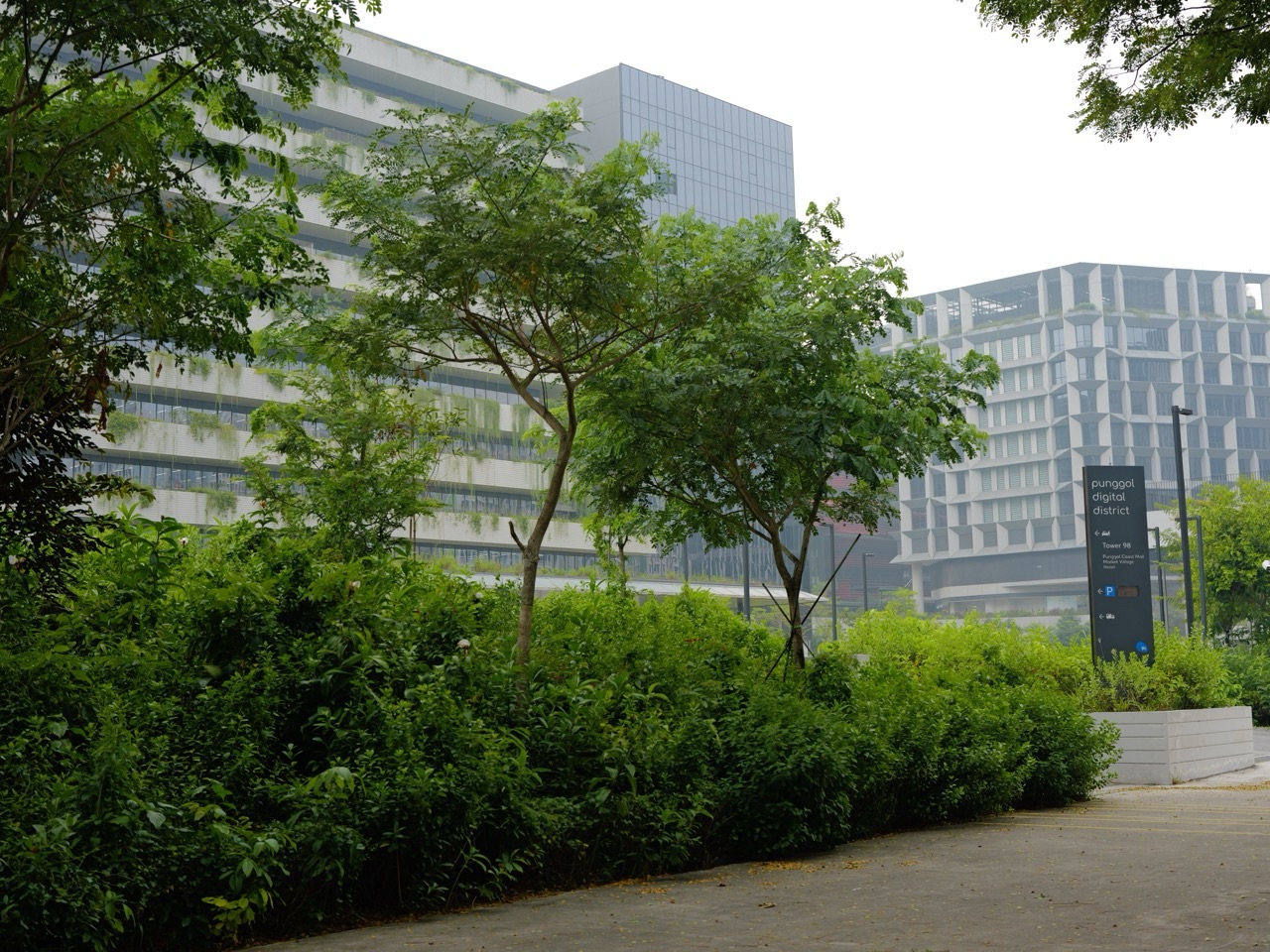
Quick answer: Punggol Coast MRT Station (NE18) is the North-East Line’s northern terminus and a convenient gateway to Punggol Digital District. Visitors can eat at Punggol Coast Hawker Centre, explore Punggol Coast Mall, walk the first 400 metres of the Punggol Heritage Trail that JTC says are open, look at public art such as the Shaping Hearts mural and understand how the Singapore Institute of Technology (SIT) campus sits alongside workplaces and community amenities. A good first visit takes roughly 90 minutes to two hours.
Both Exit 1 and Exit 2 of Punggol Coast MRT are within Punggol Digital District, according to JTC. The station is not the same as Punggol MRT (NE17), where the Punggol LRT loops connect. Punggol Coast is an ideal starting point for the newer district; Punggol Point Park and Coney Island are other destinations that may require a longer trip, not sights directly outside the fare gates.
This Punggol Coast MRT guide explains what is open, how to plan food and walking, what to expect from the district’s technology theme, and what not to mistake for a guaranteed attraction. As of 31 October 2026, JTC identifies the mall, a 40-stall hawker centre and an initial 400-metre heritage-trail section as usable neighbourhood amenities. Future phases should be treated as announcements rather than promises that every connection is already complete.
Punggol Coast MRT at a glance: a different kind of Singapore outing
Punggol Coast (NE18) extends the North-East Line beyond Punggol (NE17) into the northern waterfront district. It serves the purpose-built Punggol Digital District, a place that combines higher education, workplaces, dining, retail and public spaces. The station may look like an ordinary commuter stop, but the setting makes it interesting for anyone curious about how new Singapore neighbourhoods are designed.
The official Punggol Digital District site gives its address as 88 Punggol Way, Singapore 829913, and says both station exits are within the district. The connected campus and business buildings are real working spaces, not an all-access tourist exhibition. You can explore public-facing areas and amenities without assuming that classrooms, laboratories and restricted office floors welcome drop-in visitors.
This is a sensible low-pressure outing for families, students and people who live nearby. It is not primarily a heritage museum or a waterfront resort. The appeal is seeing a new urban district at work: how a train station, public hawker centre, university and retail services support one another.
The five most useful things to do near Punggol Coast MRT
1. Punggol Coast Hawker Centre: eat local food at the 576-seat, 40-stall hawker centre inside Punggol Digital District. It is at 84 Punggol Way, Level 2, and opened in July 2025. Individual stall operating hours vary.
2. Punggol Coast Mall: browse shops, eat, find practical services and enjoy an indoor break. JTC describes more than 120 food and retail brands, though exact tenants can change.
3. Punggol Heritage Trail: explore the initial 400-metre section that is open to the public. The complete 1.3-kilometre trail is a staged plan and should not be described as fully available until officially confirmed.
4. Shaping Hearts mural and public spaces: look for the large hand-painted community artwork highlighted by JTC and observe how public art gives a newly built district its own identity.
5. SIT and the innovation district setting: see how the university and industry are located together from lawful public vantage points. Learn about the district’s sustainability and robotics plans without claiming that restricted labs or scheduled demonstrations are free walk-in attractions.
Stop 1: Punggol Coast Hawker Centre—the easiest way to begin
The Punggol Coast Hawker Centre is one of the most practical stops because it serves residents, students, office workers and visitors. JTC identifies its address as 84 Punggol Way, Level 2, Singapore 829911. It opened on 25 July 2025 and has 40 stalls and 576 fixed seats, according to the official launch material.
The hawker centre features both familiar dishes and newer concepts, making it a useful place for a group with different tastes. Its operator, Kopitiam, has highlighted a mix of longstanding recipes and emerging hawkers. A visitor can enjoy the variety without treating the centre as a contest to find the one definitive ‘best’ stall.
A sensible first visit means walking through the available stalls, reading current menus, checking prices and choosing a meal that fits your appetite. The official opening material lists broad centre operating hours of 6am–10pm, but that does not guarantee every individual stall will serve breakfast, lunch and dinner. Hawkers can have their own days off, early sell-outs and changed menus.
The original launch programme described affordable meal options, but promotional or concessionary prices can change. Do not assume a 2025 price is still offered in late 2026 without checking the actual counter. Likewise, if you have a dietary restriction, ask the stall or check its current halal certification and allergen information rather than guessing from the cuisine type.
Return used trays, keep food aisles clear and be considerate of people on short lunch breaks. The centre is part of everyday community infrastructure, not a staged dining exhibition. The ideal visit leaves you well fed and interested in the district, not exhausted by queueing.
Stop 2: Punggol Coast Mall—shops and services inside the district
Punggol Coast Mall is an everyday shopping and dining destination within Punggol Digital District. JTC’s community page describes more than 120 food, beverage and retail brands, making it a practical place to browse, eat, meet a friend or cool down before an outdoor walk.
The mall is different from a traditional tourist attraction. Its appeal is convenience and the changing collection of businesses serving nearby residents and a university-and-workplace community. A visitor does not need to buy anything to understand how it fits the district, although private shops and restaurants charge for their products.
Use the official Punggol Digital District store directory to find a specific tenant. Do not rely on an unverified fan website or an old list of shop openings. A 2026 tenant count is a snapshot; one business can close or move without the entire mall becoming inaccessible.
Families may find the mall a useful anchor for toilets, meals and an indoor pause, but should check the specific amenities available in the section they plan to visit. A group can agree on a meeting location inside the mall and then explore publicly accessible parts of the district with less pressure.
Stop 3: the Punggol Heritage Trail—what is open and what is still planned?
The heritage trail is an especially interesting feature because it connects modern district development with the older Punggol landscape. JTC says the first 400 metres are open and identifies a connection between Punggol North Avenue and the district’s Campus Boulevard. The route retains distinctive features of Old Punggol Road.
When complete, JTC describes a 1.3-kilometre trail weaving through green spaces and connecting the district with wider Punggol destinations. That is a long-term route description, not evidence that all 1.3 kilometres can already be walked uninterrupted on 31 October 2026.
This difference matters. A visitor who sees an illustrated full-route map may assume it is time to walk to Punggol Waterway Park, Punggol Point Park or Coney Island without encountering any closed section. Instead, follow the currently marked open segment and check JTC updates before trying to extend your route.
One useful family activity is to compare the old and new. What might an older road have connected before the digital district existed? What do preserved trees or route alignments tell us about a place that is changing? What makes a historical feature worth retaining when new buildings are constructed?
Take the trail at a comfortable pace and respect temporary boundaries. Do not cross a construction area simply because an eventual route is shown on a public planning illustration.
Stop 4: the Shaping Hearts mural and public artwork
JTC highlights the Shaping Hearts mural as one of the district’s community features and describes it as Singapore’s longest hand-painted mural. This provides a good reason to look beyond shopping and consider how a rapidly developed neighbourhood gains shared identity.
The useful activity is simple: find the mural using current official district directions and observe its themes. What does the artwork suggest about community, history, young people or aspirations for the future? Why might a district invest in a large public artwork rather than only signs and retail?
Public art should be enjoyed from permitted viewing spaces. Do not block busy corridors for lengthy photography sessions or enter restricted areas to see a different angle. If there is construction or an event around the mural, accept the diversion and return another time.
Families can turn the visit into a ten-minute visual literacy activity. Ask a child to describe one element literally, then explain what they think it symbolises. The distinction between observation and interpretation is valuable in English, art and critical thinking.
Stop 5: Singapore Institute of Technology and the campus setting
Punggol Digital District includes the Singapore Institute of Technology’s Punggol campus, integrated with research and industry spaces. The arrangement is intended to encourage collaboration between education and companies. From public areas, visitors can see a contemporary campus environment and consider how education connects to the world of work.
This is especially interesting for Secondary-school students thinking about pathways after school. A student may see laboratories and industry buildings nearby and ask what people study or work on there. It can open conversations about applied learning, engineering, cybersecurity, robotics and other fields without treating an ordinary campus walk as an official admission tour.
Keep boundaries clear. SIT is an operating educational institution. Publicly accessible exterior paths do not imply permission to wander into classrooms, residences, labs, offices or research equipment rooms. If the purpose is to learn about a programme, use the university’s official admissions information or attend an authorised open-house event.
An exterior visit can still be useful. Look at the relationship between the MRT, campus, shops and public green corridors. Ask why placing these functions together might improve daily life for students and workers.
What makes Punggol Digital District a ‘digital’ district?
The word digital can sound abstract to a visitor. JTC describes Punggol Digital District as an ecosystem for technology companies and education, with sustainability features and planned testbeds for new services. Much of that work occurs within working buildings and technical systems that visitors cannot inspect simply by turning up.
One visible aspect is the district’s design: sheltered passages, connections to transport, public spaces and buildings arranged for work and learning. A less visible aspect is the district-level energy infrastructure and data systems that JTC describes, including a smart grid and energy management intended to support efficient operations.
In May 2026, JTC described plans to test physical AI and multi-operator robots in the district’s mixed-use public spaces later in the year. This is an announcement of a testbed, not a guarantee that you will watch a particular robot make a delivery on the day of your trip. Demonstrations, pilot phases and operator permissions can change.
Use the setting to ask what would make a technology useful to ordinary people. Would a delivery robot save time without blocking an accessible route? How should an autonomous system behave around children or elderly pedestrians? What evidence would show that an energy system works better? These questions connect modern technology with responsibility.
Never approach, obstruct or handle operational equipment for a photograph. If a test or event is organised publicly, follow its posted instructions.
The Punggol Coast coast: what the station name does not promise
A station named Punggol Coast can create the impression that a beach or open sea is directly outside the exit. In reality, the station is an access point for the digital district. The public heritage and green-space network may eventually connect with Punggol’s wider waterfront, but the best route and distance depend on which section is complete.
Punggol Point Park, Coney Island Park and Punggol Waterway Park are separate destinations. A longer route or different transit choice may suit them better. Do not describe all three as ‘five minutes from Punggol Coast MRT’ simply because they appear under the same wider town name.
If your primary goal is Coney Island, check the park’s current access points and opening hours before deciding how to travel. If your primary goal is a convenient meal and short public walk, Punggol Coast MRT already offers enough nearby to make the outing worthwhile.
How to arrive: MRT, LRT, bus and the two exits
JTC’s official directions state that both Exit 1 and Exit 2 at Punggol Coast MRT are within the district. Use the station’s current directional signs to reach the mall, hawker centre, campus or public trail. A specific building may be closer to one exit or require a different lift route.
Visitors approaching from the Punggol LRT can use Teck Lee (PW2) station and follow the official directions from Exit B. This is an alternative for some local journeys, not a claim that the Punggol Coast MRT stop itself includes LRT platforms.
The district also has bus access. JTC and the district website list the Punggol Coast Interchange and nearby stops for several routes, with services subject to change. Check LTA or your trip planner for the current bus service and stop rather than copying a bus list from an old guide.
If coming from elsewhere on the North-East Line, stay on the train to the terminal at NE18 if that is the service destination. During any disruption, follow the operator’s live travel notices; this article does not provide real-time train running information.
A 60-minute Punggol Coast MRT plan
An hour is enough for a focused food or shopping visit. Exit the station, identify the hawker centre or mall, eat a meal or browse a few practical shops, and return. If your group has more energy, use the remaining time to look at the public district architecture and wayfinding.
Do not combine the hawker centre, a long heritage trail, mural photography and campus exploration into one hour. The district is walkable in parts, but that does not remove queueing, walking between buildings and time spent checking signs.
For a family visit, choose the food centre as a main anchor and give children one small observation task: find two features that make this district different from their usual town centre.
A two-hour Punggol Coast visit: food, a walk and a reason to learn
Begin at Punggol Coast MRT and take a slow walk through publicly accessible parts of Punggol Digital District. Find the official Punggol Heritage Trail entrance and enjoy the currently open initial section, subject to site access. Continue to the mural if the route and weather suit you, then return towards the hawker centre or mall for food.
Allow enough time for the trail rather than measuring the entire outing by a headline distance. The first 400 metres of the heritage trail can be a useful learning experience even if the full planned path is not ready.
Finish at the hawker centre for a casual meal or use the mall if your group prefers an air-conditioned stop. A two-hour plan leaves room for choices: you do not need to complete both food venues and every public feature.
A half-day visit for students and curious families
Choose the district as an urban-learning destination. Begin with the station and observe how travellers move into nearby buildings. Spend time looking at the publicly accessible environment around SIT and the business district. Read JTC’s explanations of the district’s sustainability ideas, then compare those goals with what can actually be seen.
Next, walk the open heritage trail portion and discuss how older features can be incorporated into modern development. Follow with lunch at Punggol Coast Hawker Centre, and end with the mall or public artwork.
If a school group wants more than public-space observation, arrange formal permission with the relevant institution or organiser rather than presenting an unscheduled campus visit as a guided educational programme. Good field learning is respectful of people who live, teach and work there.
How much does a visit cost?
Riding the MRT or LRT has a normal transport fare. Public walking and observation around authorised district spaces generally require no attraction admission ticket. Punggol Coast Mall is a shopping facility, and Punggol Coast Hawker Centre charges for food and drinks, with menus and prices varying between tenants.
The operator’s 2025 launch information included value meal initiatives, but it is not an authority for every current 2026 menu price. A fair guide tells readers to check displayed prices, portions and available payments on the day.
If you want a low-cost outing, choose the free public features and a modest meal. If you plan to buy merchandise or join a special event, check separate costs. A district-level technology testbed is not a public ticket that can be purchased at the station.
Families, children and students: what to notice
A young child may enjoy the practical differences between places: how a hawker centre works, where a public artwork sits, and how a green path connects streets. Keep the activity short. The purpose is not to force a child to understand all of Singapore’s digital economy in one afternoon.
For older students, the district can be used to discuss what a job might require. Ask how an engineer, designer, food operator, security professional, researcher or public-transport planner contributes to daily life here. This is a concrete introduction to careers without inventing future vacancies.
Parents should keep children close near roads, bus lanes and work areas. A new district can have construction barriers and temporary circulation changes as parts of it develop. Follow current signs and never enter a fenced-off section for a shortcut.
Older visitors, wheelchairs and comfortable route choices
Both station exits being within the district is helpful, but it does not prove that every future section of the Punggol Heritage Trail is accessible today. Choose your destination and check its specific lift and ramp connections using current maps.
An easier visit may be the mall, hawker centre and a short public plaza walk, rather than an ambitious circuit of the wider town. Build in seated breaks, and avoid the strongest midday heat.
If you are supporting somebody who needs a step-free route, confirm entrances, lift operation and temporary diversions before setting off. Construction and new tenant openings may change paths. The right route is the one the whole group can use safely.
Rain, heat, haze and the district as a flexible outing
Punggol Coast has both indoor and outdoor choices, making it relatively easy to shorten an outing. During thunderstorms, avoid exposed walks and sheltered pathways that are unsafe because of flooding or lightning. Move to an appropriate indoor public venue if open rather than insisting on finishing the heritage section.
In strong sunshine, do the outdoor trail portion earlier and eat or shop later. Carry water, particularly with children. During haze, consult official Singapore advisories and reduce outdoor exertion where appropriate.
Good navigation does not require rushing. The district is a place people use every day; visitors should adjust around conditions and treat access notices as more authoritative than a travel itinerary.
2027 and beyond: confirmed places versus planned additions
Punggol Digital District will continue to evolve. JTC describes the full heritage trail as a 1.3-kilometre planned route and LaunchPad @ PDD as an expansion intended to open in phases from late 2026. Additional amenities such as childcare centres and a hotel or serviced residence are listed as upcoming.
A planned completion or opening window is not the same as verified public access. A visitor in 2027 should not assume that every segment, building or new service is ready. Check the district operator’s pages close to the visit.
The best plan uses facilities that JTC already identifies as open—such as the hawker centre, mall and first trail segment—while treating the rest as reasons to return later. This gives readers useful current information without turning announcements into fictional present-day experiences.
What people often get wrong about Punggol Coast MRT
Mistake 1: mixing up Punggol MRT and Punggol Coast MRT. Correction: Punggol Coast is NE18, the northern terminal; Punggol is NE17 and has LRT connections.
Mistake 2: assuming the whole Punggol Heritage Trail is open. Correction: JTC identifies only the first 400-metre section as open as of this guide’s review.
Mistake 3: expecting a beach immediately outside the MRT gates. Correction: the station opens into the digital district; the wider coast and parks require separate navigation.
Mistake 4: visiting SIT expecting to enter laboratories and classrooms without permission. Correction: public spaces are not the same as unrestricted institutional access.
Mistake 5: expecting guaranteed public demonstrations of robots. Correction: technology testbeds operate by schedule, phase and operational requirements.
Mistake 6: trusting a third-party mall fan site as the landlord. Correction: use the official JTC or Punggol Digital District directory for up-to-date tenants and amenities.
Frequently asked questions about Punggol Coast MRT
Which MRT line is Punggol Coast on? The North-East Line, station NE18, beyond Punggol NE17.
Which exit leads to Punggol Digital District? According to JTC, both Exit 1 and Exit 2 are within the district. Follow destination-specific signs.
Can I eat near the station? Yes. Punggol Coast Hawker Centre at 84 Punggol Way, Level 2, and the wider Punggol Coast Mall are main options.
Is the hawker centre already open? Yes. It opened on 25 July 2025 with 40 stalls, though each stall may follow its own schedule.
Is Punggol Coast Mall open? JTC lists the mall as a current district amenity and provides a store directory. Check individual tenant hours.
Is the Punggol Heritage Trail fully open? No. JTC says the initial 400 metres are open, while the full intended trail is 1.3 kilometres.
Can I see Coney Island from the MRT immediately? Do not treat it as an immediate station-side attraction. Check the separate route, access point and park hours.
Can visitors enter SIT classes and offices? Not without appropriate permissions. Enjoy public spaces and use official admissions or events for structured access.
How long should I spend? Roughly an hour for food or shopping, 90–120 minutes for food plus an open heritage segment, and more for a planned educational visit.
Reality check: the promise of an honest MRT guide
JTC, the official Punggol Digital District site and its 2025 hawker-centre launch material support the main claims in this guide. The distinction between already-open public amenities and future phases is deliberate. It protects readers from travelling for a trail segment or demonstration that is not yet available.
The practical rule is to plan around the mall, food centre and currently open public routes, then recheck any time-sensitive feature on the operator’s own website. A good visit should help you understand the district without requiring you to believe every marketing rendering depicts the present.
Official sources and related reading
- JTC: Punggol Digital District community amenities, mall and heritage trail
- Punggol Digital District: official MRT exits, buses and directions
- Punggol Digital District: Punggol Coast Hawker Centre location and stalls
- JTC: July 2025 official hawker centre opening details
- JTC: sustainability and district infrastructure
- JTC: May 2026 robotics and physical-AI testbed announcement
- LTA: Singapore MRT network
- eduKateSG: Punggol Coast MRT and the student commute
Independent guide, not an official campus tour or development promotion. Verify current public access, routes, shops and future openings before travel. Last reviewed 31 October 2026.