
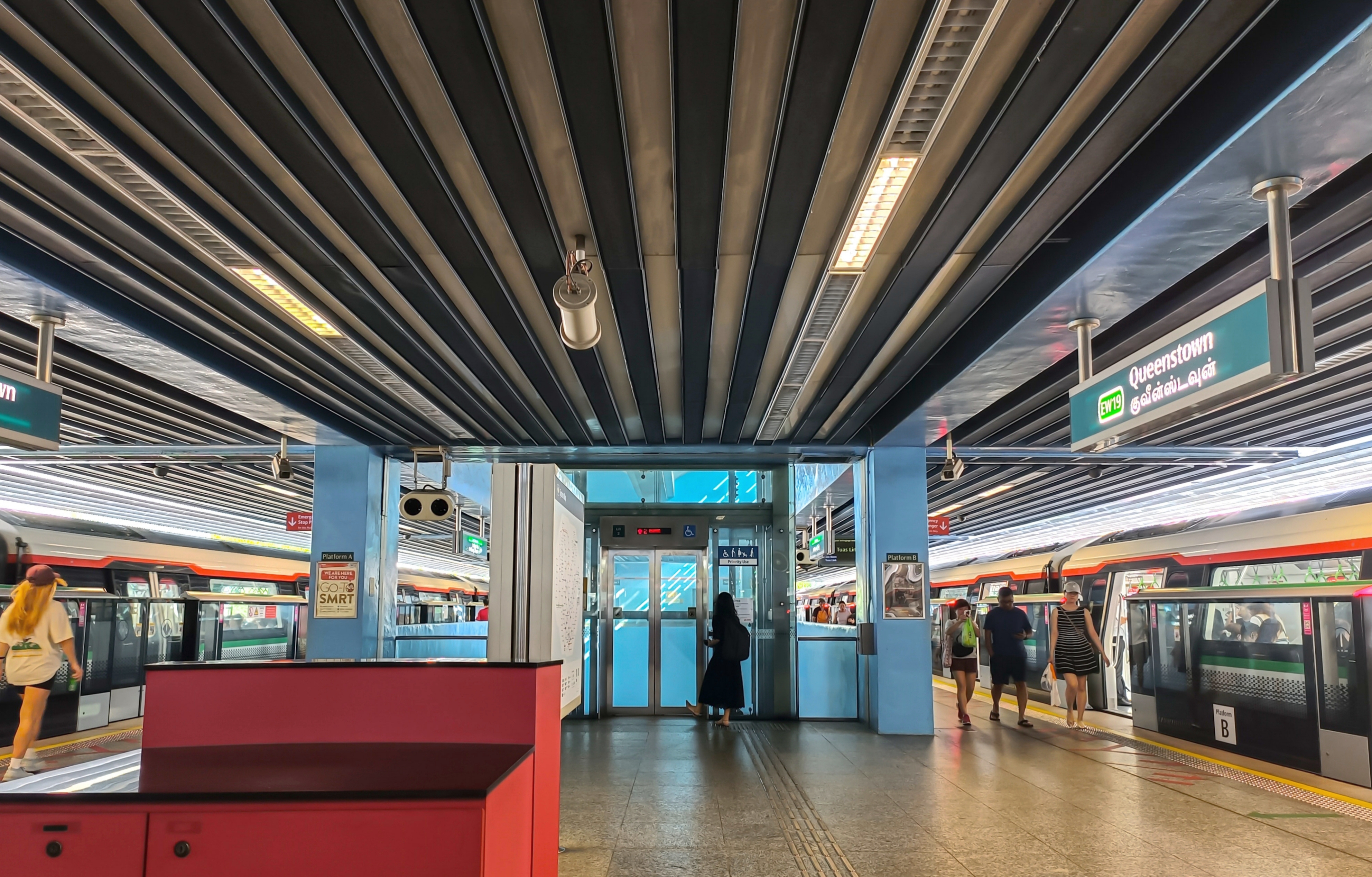
Queenstown MRT Station (EW19) on the East–West Line is a convenient starting point for exploring Singapore’s pioneering public-housing town. The most accessible outdoor option is the 1.4-kilometre Alexandra Canal Linear Park, a wheelchair-friendly connector beginning at Queenstown MRT and continuing through Strathmore and Dawson towards Tanglin Road. You can also visit Margaret Drive Hawker Centre at 38A Margaret Drive for an ordinary local meal or plan a session at the newly reopened Queenstown Sport Centre at 473 Stirling Road. For history, the official Queenstown Heritage Trail includes the estate’s first HDB blocks, older markets, the former sports complex and conserved public library.
Two major 2026 changes must be checked before travelling. Queenstown Public Library at 53 Margaret Drive closed after 30 August 2026 for renovation, with reopening targeted for late 2028; an old listing saying it is open daily is not reliable in November 2026. Conversely, Queenstown Sport Centre reopened on 8 August 2026 after a multi-year redevelopment, with upgraded gym, fields and swimming facilities. SportSG lists Queenstown Swimming Complex as normally closed every Tuesday for maintenance, except the public-holiday arrangement. A separate food warning: Margaret Drive Hawker Centre is scheduled for cleaning tomorrow, 2 November 2026.
For a short visit, follow the current station signs towards Margaret Drive and the Dawson area, enjoy a short public connector walk and have a meal if the hawker centre is open. For a heritage visit, choose a small portion of the 40-point My Queenstown Heritage Trail rather than assuming all landmarks are a quick walk from EW19. This guide gives practical choices, access limitations, free-versus-paid options and realistic one-hour to half-day routes. Reviewed 1 November 2026.
- Station: Queenstown EW19, East–West Line between Redhill and Commonwealth; not an interchange
- Most straightforward free walk: Alexandra Canal Linear Park, 1.4 kilometres from the MRT through Strathmore and Dawson
- Food: Margaret Drive Hawker Centre, 38A Margaret Drive, 38 cooked-food stalls; scheduled cleaning Monday 2 November 2026
- Key closure: Queenstown Public Library, 53 Margaret Drive, closed after 30 August 2026 until a projected late-2028 reopening
- Sports: ActiveSG Queenstown Sport Centre and Swimming Complex, 473 Stirling Road, reopened 8 August 2026
- Pool schedule: 8am–9.30pm on normal operating days, closed Tuesdays except public holidays
- Heritage: first HDB blocks at Stirling Road, 1970 library, housing-estate and sport history
- Longer excursions: Queensway Shopping Centre and Alexandra Hospital are not immediate MRT-exit destinations; plan onward travel


Queenstown MRT: why this is a heritage-and-community outing
Queenstown was Singapore’s first satellite estate and helped shape the way public housing, schools, markets, sports and libraries were planned around new homes. Its history makes a walk through ordinary residential streets surprisingly meaningful, even when there is no expensive tourist attraction.
The neighbourhood continues to change. Older buildings have been conserved or redeveloped, new homes rise at Dawson, and familiar community amenities have been renovated. A visitor in 2026 needs to understand both the documented history and what is open today.
The station itself serves a working neighbourhood. People arrive for school, shopping, appointments, sport, food and home. A thoughtful guide should respect these everyday needs rather than treat the estate only as a backdrop for tourism.
Choose one clear reason for coming. A green connector walk is a good free outing. A sport session requires a different timetable. A heritage visit deserves slower observation and perhaps an official trail map. A library visit, unfortunately, must be postponed while its conserved building is under renovation.
The railway station and correct first direction
Queenstown EW19 is on the East–West Line between Redhill EW18 and Commonwealth EW20. It does not directly interchange with the Downtown or North–South Lines at its platforms.
The station has exits towards Margaret Drive, Stirling Road, Strathmore Avenue and nearby residential areas. Current local mapping identifies an exit towards the former Queenstown Public Library and another serving the sports-complex side, but wayfinding and access can change with works.
Rather than give one universal exit for every attraction, choose the actual destination first. For the Alexandra Canal Linear Park, NParks explicitly identifies Queenstown MRT as the start of the connector. For SportSG’s swimming facility, use the full 473 Stirling Road address and the present street approach.
A person using a wheelchair or stroller should select the lift-equipped and properly signed route. The distance between two map pins does not show steps, a road crossing or detours.
Agree on a meeting point by exit or a named public landmark. ‘Meet in Queenstown’ could refer to the train station, the library’s closed building, Margaret Drive or Queensway Shopping Centre, which are not the same location.
Stop 1: Alexandra Canal Linear Park, a true station-linked outdoor route
Alexandra Canal Linear Park is a 1.4-kilometre park connector built over a covered canal. NParks describes it as linking Commonwealth Avenue at the Queenstown MRT side with Tanglin Road via Strathmore and Dawson.
This is the most straightforward free outdoor activity to build around the railway station because the operator explicitly identifies it as beginning at Queenstown MRT. It is a linear walking route rather than a traditional large lawn or lake park.
The connector is listed as wheelchair-accessible and includes fitness and play amenities along the route. A visitor can choose a short section and return or complete more of the corridor with an appropriate onward plan.
Do not describe the entire 1.4 kilometres as a five-minute sightseeing stop. A complete out-and-back walk is longer, and families who stop to play or observe buildings will need extra time.
Because it passes through a residential area, be considerate of people going to work, school and home. A park connector is infrastructure for movement as well as a recreation route.
What makes a canal-top linear park different?
The idea of building a public path over a covered canal illustrates how urban land can have more than one function. Drainage infrastructure and recreational space can occupy related corridors while serving different needs.
A student may ask what happens to rainwater beneath a surface path, why covered canals require maintenance and how public access can be combined with planted verges. These questions connect engineering with the ordinary landscape.
Do not attempt to enter drainage infrastructure or remove inspection covers to investigate. The canal is a managed public utility, and a visitor should learn through safe observation and official explanations.
Look at how the walking route connects homes, playgrounds and roads. A good path makes everyday journeys easier, not simply longer.
Stop 2: Dawson and Strathmore—modern housing beside an older estate
The connector takes visitors through the Strathmore and Dawson areas, where newer HDB developments sit close to Queenstown’s older housing and public infrastructure.
This creates an interesting contrast in density, height and communal space. Modern housing estates may include elevated gardens and differently arranged public facilities, while earlier Queenstown blocks reveal older planning choices.
Do not assume that an elevated residential garden is public at all times simply because an architectural publication describes it. Some spaces have access conditions, operating hours or resident-specific rules.
A respectful walk can observe public paths, building shapes and landscape design without entering private housing areas. Residents’ homes and corridors should not be treated as museum galleries.
For a family, one observation question is enough: how does a newer estate provide shared green space in a denser environment?
A short family outing on Alexandra Canal Linear Park
Start at EW19 and follow a short section of the connector towards Dawson. Let children enjoy an appropriate public play feature if it is open, then turn back or continue to a confirmed-open food venue.
Choose a route suited to the child’s walking ability. A long linear path may not have a natural circular return, so decide when you will turn around before the group becomes tired.
During rain or strong sun, shorten the walk. The fact that a connector is accessible does not mean it is completely sheltered.
This is a useful free alternative to a mall-focused trip, especially when a family wants fresh air without travelling to a major nature reserve.
Stop 3: Margaret Drive Hawker Centre for food
Margaret Drive Hawker Centre is at 38A Margaret Drive, Singapore 142038. NEA describes a centre with 38 cooked-food stalls that began operating in August 2022 after the relocation of food businesses from the former Commonwealth Drive Food Centre.
The location is useful for visitors who want ordinary local food rather than a restaurant inside a retail complex. A working hawker centre provides meals for residents and commuters, with different stalls serving different dishes.
Walk through permitted aisles, look at what is operating and choose according to appetite, dietary requirements and price. A famous stall mentioned in a three-year-old review may have changed its menu or opening hours.
Return trays as directed and keep the pedestrian areas clear. Food venues are workplaces, not film sets, and vendors may not welcome close-up photographs while serving customers.
A meal here can be the centrepiece of a short Queenstown visit. There is no need to add a long history tour or sport session just because they are in the broader neighbourhood.
Tomorrow’s critical cleaning notice: 2 November 2026
NEA’s current hawker-management schedule lists Monday 2 November 2026 for cleaning at Margaret Drive Hawker Centre. That date is tomorrow relative to this guide’s 1 November review.
A reader intending to travel tomorrow should not assume the centre will serve normal lunch based on a generic daily opening-hours page. Check NEA’s updated notice and the business directly or choose a different date.
The scheduled closure is not a permanent closure of the neighbourhood or a reason to avoid the public park connector. It is a specific maintenance day for the hawker centre.
Stalls may have their own rest days and reopening arrangements in addition to the building-level cleaning calendar. A food-focused visit should always check the actual centre and stall.
A different market: Mei Chin Road
Mei Chin Road Market at Block 159 Mei Chin Road is another food-and-market destination in the wider Queenstown area. It is distinct from Margaret Drive Hawker Centre and has different access and operating patterns.
NEA’s current schedule lists 30 November–2 December 2026 for its cleaning period. Do not apply the Margaret Drive date to Mei Chin Road or vice versa.
The longer street approach means it should be planned as a separate destination rather than treated as a stall within the same building. Check the specific address, bus or walking route and food business availability.
With a short timetable, one market is usually enough. A travel guide should not make visitors move across several neighbourhoods merely to tick off every hawker centre.
Stop 4: Queenstown Sport Centre, now reopened in 2026
ActiveSG Queenstown Sport Centre is at 473 Stirling Road, Singapore 148948. It has historic importance as Singapore’s first neighbourhood sports complex, originally opened in August 1970.
After a multi-year redevelopment, Sport Singapore officially announced its reopening on 8 August 2026, with updated public and high-performance sports facilities. That means an old article calling the entire centre closed until later dates is now outdated.
The 2026 renovation includes a new annexe with a large open-plan gym and activity rooms, improved fields and specialised training areas, while preserving elements of the original complex’s appearance.
An open sports centre does not mean every professional training facility or event is accessible to anyone at every hour. Specific pools, courts, fields and programmes have different admission or booking rules.
For someone who wants exercise, choose one actual facility and check SportSG’s present page. A swimming session, gym visit and organised rugby activity cannot be assumed to share one ticket.
Stop 5: Queenstown Swimming Complex—the Tuesday closure rule
Queenstown Swimming Complex, within the sports-centre precinct at 473 Stirling Road, is listed by SportSG as currently operating. Its usual hours are 8am–9.30pm every day except Tuesday.
Tuesday is the normal weekly maintenance closure. SportSG lists an exception if Tuesday falls on a public holiday, when ordinary 8am–9.30pm operation applies, subject to any additional closure notice.
The operator also lists an early 6.30am–8am competition-pool window on Mondays and Wednesdays. Other swimming complexes have different early sessions, so do not copy their schedules into this guide.
Pool admission may depend on age, eligibility and the type of activity. Wear proper swimming attire, follow the lifeguards’ instructions and do not expect a diving or competition area to be freely available for casual play.
Outdoor swimming can be suspended during lightning or bad weather. A planned swim is not a reason to enter a pool that staff have closed for safety.
Why a newly reopened sports centre is worth a visit
The redevelopment demonstrates how a neighbourhood can preserve its sporting heritage while improving facilities. The retained original architectural features help keep a sense of continuity, while new gyms and training spaces accommodate current needs.
For a student, this is an opportunity to discuss what makes a public sports facility useful. Is it enough to host elite athletes, or should the design also serve children, older residents and people with disabilities?
SportSG has emphasised more diverse and accessible activities as part of the reopening. The exact session and eligibility are still matters for the individual facility.
An ordinary visitor can appreciate the exterior and community context without attempting to enter restricted athlete-training spaces.
Stop 6: the ActiveSG Queenstown Gym
Queenstown ActiveSG Gym is at 473 Stirling Road and is listed by SportSG as open 7am–10pm daily under its normal operating arrangements.
The gym has its own equipment, admission and safety rules. A visitor should not assume that access is included in a swimming pass or that every exercise class can be joined without booking.
For a first session, check the equipment and orientation requirements. The gym is a supervised recreational service, not a place for people to attempt unsafe lifts to impress friends.
An organised fitness session may already fill the whole visit. Add a meal or short park-connector walk only if it suits the person’s energy.
Queenstown’s sporting history: more than one pool
The National Heritage Board identifies the Queenstown Sports Complex as Singapore’s first neighbourhood sports complex, with a stadium and pools serving residents and national sporting activities.
The old venue hosted competitions and civic events, showing how sport facilities could become part of a town’s shared identity. The renewed centre continues this tradition in a modern form.
A heritage visit can include reading the official history and observing accessible public-facing structures rather than attempting to access every professional facility.
Do not assume a historical reference to a particular 1970s swimming event means the same competition programme runs daily in 2026.
Stop 7: Queenstown Public Library—historically significant but closed now
Queenstown Public Library at 53 Margaret Drive opened on 30 April 1970 and was Singapore’s first full-time branch public library.
Its building became an important landmark in the development of public reading services outside the city centre. It was also among the first public library buildings identified for conservation, with characteristic façade and entrance features.
However, the National Library Board’s 2026 programme announced that the branch’s last day of operations was 30 August 2026 and that the site is undergoing an extensive revamp with reopening targeted for late 2028.
As a result, a visitor arriving in November 2026 should not expect to enter and borrow books from the old building. The conservation and renovation project may be visible from public areas, but the building is not currently an ordinary library outing.
If you need a public library today, consult NLB’s live directory for an alternative operating location rather than use a stale ‘open today’ search result for Queenstown.
Why the library closure deserves prominence
A building can be historically important and unavailable at the same time. Queenstown Public Library is a particularly clear example because many guides celebrate its 1970 opening and unique architecture while failing to mention that readers cannot currently go inside.
The redevelopment aims to conserve meaningful architectural features and create a renewed library experience. A target of late 2028 is not a promise that a particular day’s opening has been confirmed.
Visitors interested in public-library history can still learn from NLB’s archival writing and permitted exterior viewpoints, without stepping into a worksite.
An honest guide should separate the question ‘Is this building historically significant?’ from ‘Can I use its library service today?’ The answers are yes and no respectively in November 2026.
The architecture of the former library
NLB describes distinctive façade details and a bow-tie motif near the entrance as part of the conserved building’s character. The library’s design represents a period when full-time branch libraries became major public institutions in newly planned housing towns.
A student can compare this independent library building with newer branches inside shopping malls and integrated community hubs. Each approach serves readers differently and reflects changes in urban planning.
Do not enter fenced construction or restoration areas for a closer photograph. Public heritage interest does not remove the need to respect site safety.
The building’s history can be appreciated through reliable sources while the renovation is under way.
Stop 8: the first HDB blocks along Stirling Road
The official My Queenstown Heritage Trail includes Blocks 45, 48 and 49 Stirling Road, among the early flats completed in 1960, shortly after the Housing & Development Board was established.
These buildings help illustrate the transition between Singapore Improvement Trust projects and the rapid growth of HDB housing during the early independence era.
An interested visitor can observe permitted public-facing architecture and compare it with the taller modern homes near Dawson. Differences in block height, shared space and layout become visible with careful observation.
Do not assume the older blocks are public museums or encourage visitors to enter private residential areas. People’s homes are not open exhibition rooms merely because a heritage trail points out their history.
A family can spend a few minutes reading a marker rather than rushing along the entire route.
Queenstown is a pioneering housing estate, not only a station name
Queenstown developed as Singapore’s first satellite estate and contains some of the earliest examples of planned public housing, community institutions and neighbourhood sport.
The heritage trail includes many landmarks, but the important story is not just ‘first’ achievements. It is how homes, schools, libraries, roads, markets and places of worship were arranged to support daily life.
A student may ask why these facilities were built near one another and what changed as the population grew. The answer connects planning, economics, family life and social history.
Choose a few buildings that actually lie along a manageable route rather than attempting every official marker in a single afternoon.
The 40-point My Queenstown Heritage Trail: choose a small part
The National Heritage Board’s My Queenstown Heritage Trail includes forty documented sites distributed across Queenstown, Alexandra, Commonwealth, Tanglin Halt and related neighbourhoods.
That is a broad historic landscape, not a single short walking loop beginning and ending at EW19. Some locations are closer to Commonwealth, Redhill or other stations, and some have changed function or access since the trail was first published.
Select one theme, such as early HDB flats or public libraries and sport, and choose a few accessible sites. Use the official map as a historical resource and check whether each present-day path is open.
Organised heritage tours may require registration. A self-guided public-street walk is different from an official booked programme.
The former Forfar House and other important stories
The Queenstown trail includes historic housing such as Forfar House, once associated with early high-rise residential development, as well as Princess House and community institutions.
These sites illustrate a town that experimented with new types of residential building and public facilities. A visitor can learn about the history without needing to enter every former building.
The word ‘former’ is significant. Some structures were demolished or transformed, so a historical marker is not a guarantee that the building remains exactly as it once was.
Use the heritage trail to understand the chronology and the surviving sites, not to invent a restored building at every historic address.
Queenstown’s religious and cultural buildings
The official trail includes multiple religious institutions, such as the Church of the Good Shepherd, Queenstown Baptist Church, Jamek Queenstown Mosque and Tiong Ghee Temple.
These places are living institutions, not a series of identical tourist attractions. Their visiting hours, religious practices and public access conditions differ.
An interested student can learn about the variety of communities that developed alongside the housing estate. A respectful exterior observation and accurate NHB interpretation may be sufficient when a service or private event is taking place.
Do not interrupt prayer, enter private rooms or photograph people at close range without permission.
Stop 9: the former Commonwealth Avenue Wet Market
The heritage trail records the Former Commonwealth Avenue Wet Market as an important early market structure designed by the Singapore Improvement Trust.
It provides historical context for the way Queenstown’s residents bought food and everyday necessities before newer retail and hawker arrangements developed.
However, a ‘former’ market should not be described as a functioning cooked-food centre in 2026. Its present status and access differ from Margaret Drive Hawker Centre.
Read the site’s interpretation and distinguish historical commerce from today’s actual vendors and addresses. That prevents the common problem of travelling to a heritage marker expecting lunch.
Queensway Shopping Centre: a longer sports-shopping extension
Queensway Shopping Centre is an established retail complex near Queensway and Alexandra Road, known historically for sports equipment and other independent shops. It features in the official Queenstown Heritage Trail.
It is not directly beside the Queenstown MRT fare gates. A visitor should check onward bus or walking access and the actual unit of the business they intend to visit.
Do not assume every sports retailer continues operating or offers the lowest prices. Product stock, models, discounts and business hours change.
If this is your main purpose, plan the route specifically rather than treating it as a quick extra stop after a swim or heritage walk.
Alexandra Hospital is also a separate destination
Alexandra Hospital is another significant institutional landmark in the wider Queenstown area, with historical connections to British military medicine and later Singapore healthcare.
Like any working medical facility, it is not a casual museum in which visitors can roam clinical areas. Patients and visitors should use actual appointment instructions and hospital access policies.
An architecture or history student may read official material about the institution without disturbing staff or patients. A broad heritage trail can include the building as a documented landmark without implying that every space is publicly accessible.
Do not add the hospital casually to a short Queenstown MRT outing without a purpose or correct route.
A 60-minute Queenstown visit: park connector or food
For a short visit, follow the station-side Alexandra Canal Linear Park for a manageable stretch, observe the housing landscape and return. Alternatively, choose a meal at Margaret Drive Hawker Centre when it is open.
An hour is not enough to complete the entire 1.4-kilometre connector and visit a sport facility or multiple heritage landmarks at a leisurely pace.
On 2 November 2026, do not anchor this itinerary around Margaret Drive Hawker Centre because it is scheduled for cleaning.
Two-hour family plan: food and a short accessible walk
Choose a segment of Alexandra Canal Linear Park and let children use a suitable public play feature where available. Then have a meal at an open venue, with time for a comfortable return.
This balances exercise, observation and rest without requiring admission to a paid tourist attraction.
For a family with a stroller or older companion, the accessible connector may be more suitable than a long multi-district heritage trail. Confirm the actual accessible station route before departure.
Half-day sports outing: swimming and one simple meal
Make Queenstown Sport Centre the main destination. Check the appropriate facility and, for swimming, avoid its normal Tuesday maintenance day unless a public-holiday exception applies.
Allow time for the route from EW19, entering the centre, changing clothes, swimming and returning. A pool session is already substantial and need not be followed by several kilometres of sightseeing.
Use SportSG’s latest closure notices for any unforeseen pool maintenance or weather suspensions.
Half-day heritage route: the early housing town
Choose a few nearby stops on the My Queenstown Heritage Trail, particularly the earliest HDB blocks, Margaret Drive area and suitable public roads.
Bring the official map and read the descriptions in context. A conserved building may be occupied; a former market may not serve food; and the public library is temporarily closed for renovation.
Finish at a convenient railway or bus stop rather than automatically retracing a long route when another public transport option is closer.
An accurate heritage visit teaches people how the town changed, not how many landmarks they can photograph.
A longer exercise route towards Alexandra and Tanglin
The 1.4-kilometre Alexandra Canal Linear Park leads into the Alexandra Park Connector, which NParks describes as a separate 1.7-kilometre route towards Zion Road.
A longer walker or cyclist might want to connect them, but that creates a different distance and return plan. Do not describe the full linked route as an immediate one-hour stroll from EW19.
Check actual surface and permitted user rules. Some parts have restrictions for inline skating or specific activities, even when general pedestrian access remains available.
Finish with appropriate transport rather than walking an unfamiliar extra kilometre after everyone is tired.
Learning from the renewed sport centre and closed library
Queenstown is a particularly interesting example of renewal because two important civic institutions have moved in opposite operational directions in 2026: the sport centre has reopened, while the historic public library has closed for renovation.
That contrast gives a useful lesson in public infrastructure. Services may be temporarily unavailable to improve safety, accessibility or facilities for future generations.
Ask students how a town should provide alternatives during renovations and how older buildings can retain their identity while being updated.
Do not imply that a construction plan automatically delivers every promised feature on an exact date. The library’s late-2028 reopening remains a target to verify.
Costs: public paths, hawker meals and sport tickets
General use of the public linear park and public street-side heritage observations do not require a tourist admission ticket. Hawker food is paid by individual stalls, while sports sessions have their own ActiveSG admission rules.
A historic library building being closed is not an available free reading experience; visitors must choose an operating library if borrowing books is the goal.
Plan the budget around transport, one meal and any actual sports admission. A free heritage walk can be rewarding without additional commercial purchases.
Accessibility and the entire visitor route
NParks lists Alexandra Canal Linear Park as wheelchair-accessible, and SportSG has highlighted improved access in the renewed sports centre. These are helpful facts, but the complete journey still depends on the station lift, crossings and the chosen destination entrance.
A visitor using a wheelchair should choose the appropriate exit and verify any temporary detours near construction or roadworks. Do not infer that every older heritage building has step-free internal entry.
Older visitors may prefer a short connector walk and a seated meal rather than a full heritage trail. For a sport session, check the actual accessible facilities and assistance arrangements if needed.
The goal is to make the outing comfortable and respectful for everyone in the group.
Weather, water safety and neighbourhood etiquette
Queenstown’s public path can be exposed to heat and heavy rain, so carry water and choose a reasonable time. During thunderstorms, avoid exposed fitness equipment and seek suitable shelter.
SportSG may suspend outdoor pool operation during lightning. Do not enter a closed pool or disregard lifeguard instructions because the centre itself is open.
Residential areas along Strathmore, Dawson and Stirling Road are lived-in spaces. Keep noise modest and avoid photographing private windows or entering residents’ corridors without permission.
Public heritage matters partly because real people continue to use these places every day.
The mistakes most likely to cause disappointment
Expecting Queenstown Public Library to be open on 1 November 2026. It closed after 30 August for a revamp, with reopening targeted late 2028.
Relying on a 2024 claim that Queenstown Sport Centre is closed. SportSG confirms its reopening on 8 August 2026.
Trying to swim on a normal Tuesday. Queenstown Swimming Complex lists Tuesday maintenance closure.
Travelling for Margaret Drive Hawker Centre on 2 November 2026. NEA lists a cleaning day tomorrow.
Confusing Mei Chin Road Market with Margaret Drive. The former has a different closure, 30 November–2 December.
Assuming every point on the forty-site Queenstown Heritage Trail is within a short EW19 walk. The route spans multiple neighbouring districts.
Confusing Alexandra Canal Linear Park with a short circular park. It is a 1.4-kilometre linear connector, so plan the return.
Frequently asked questions about Queenstown MRT
Which line serves Queenstown MRT? The East–West Line, station EW19.
Is there a public park route directly near the station? Yes. Alexandra Canal Linear Park begins from Queenstown MRT and is 1.4 kilometres long.
Is the park connector wheelchair-accessible? NParks lists it as wheelchair-accessible; check current station lifts and local conditions.
Where is Margaret Drive Hawker Centre? 38A Margaret Drive, near the station.
Is the hawker centre open tomorrow, 2 November 2026? NEA lists it for scheduled cleaning that day.
Can I borrow books at Queenstown Public Library in November 2026? No. The Margaret Drive branch closed for renovation after 30 August 2026.
When is Queenstown Public Library expected to reopen? Late 2028, subject to NLB updates.
Has Queenstown Sport Centre reopened? Yes. SportSG confirmed reopening on 8 August 2026.
When is Queenstown Swimming Complex closed? Normally Tuesdays, except the published public-holiday arrangement.
Is Queenstown Heritage Trail a single short walk? No. It contains forty sites across a broad historic estate; choose a small segment.
Is Queensway Shopping Centre beside EW19? It is a separate destination requiring an onward route.
What is the best first visit? A short Alexandra Canal Linear Park walk or a meal at Margaret Drive on a confirmed open day.
Why the station-first distinction matters in Queenstown
Queenstown has many meaningful historical sites, but a current MRT guide must distinguish which ones are near the platform, which require a longer journey and which are temporarily unavailable.
The November 2 hawker cleaning, August 2026 sports reopening and library closure until late 2028 are practical details that change whether a visit succeeds. They matter more to a real visitor than an overfilled list of attractions without dates.
Official sources and companion reading
- NParks: Alexandra Canal Linear Park from Queenstown MRT, 1.4 km, accessible route
- SportSG: Queenstown Sport Centre reopened 8 August 2026
- SportSG: current pool operating hours and Tuesday closure
- SportSG: Queenstown Sport Centre and facilities
- SportSG: gym and operating hours
- NEA: 2 November Margaret Drive and later Mei Chin market cleaning
- NHB: 40-point Queenstown Heritage Trail and history
- NHB: historic first neighbourhood sports complex
- NLB: current operating libraries and Queenstown closure updates
- NLB: Queenstown as Singapore’s first full-time branch library
- NParks: longer Alexandra Park Connector from Tanglin to Zion Road
- eduKateSG: Tiong Bahru MRT for a different early-public-housing heritage route
Independent station guide reviewed 1 November 2026. Market cleaning, library renovation, swimming maintenance and individual heritage-site access may change; verify the relevant operator before a time-sensitive visit.