
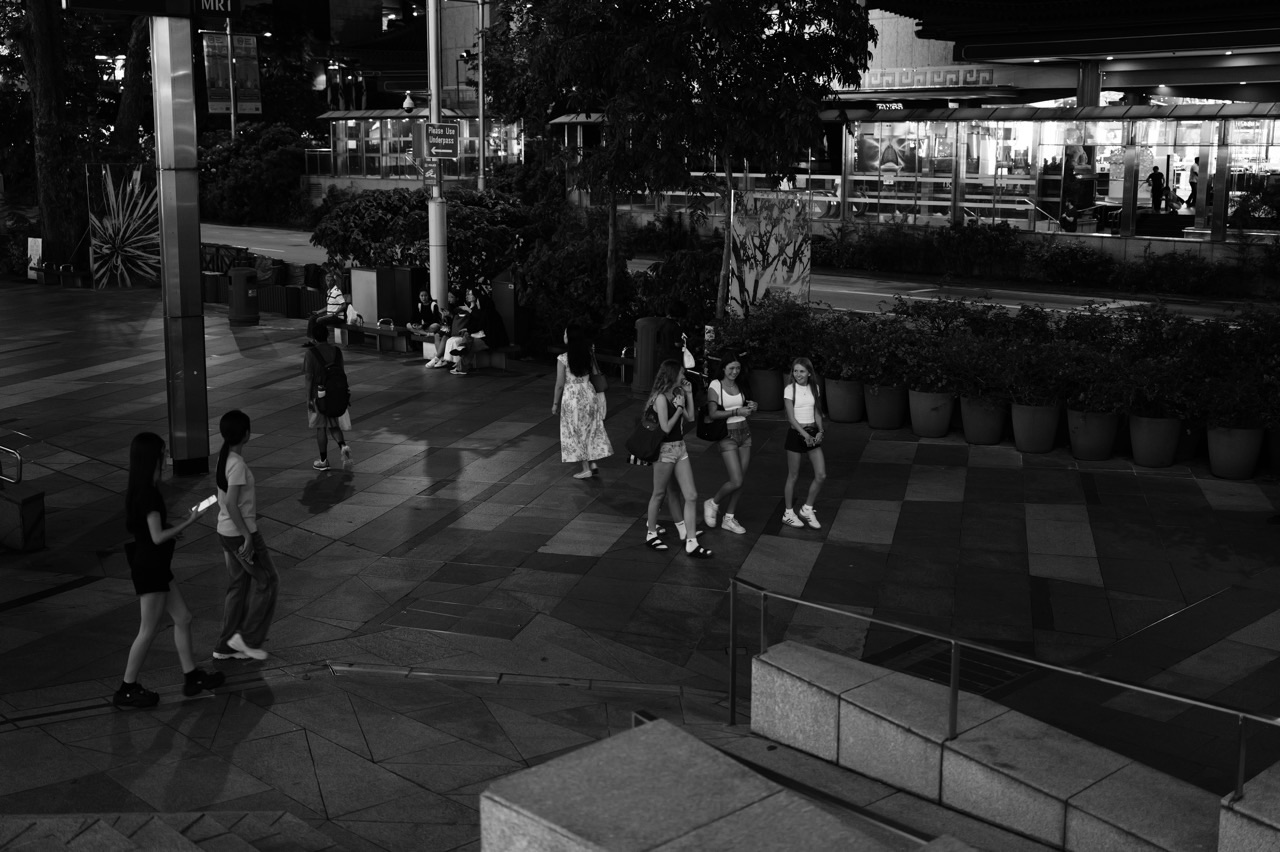
Want to photograph Orchard Road in Singapore at night? Its illuminated shopping malls, pedestrian crossings, reflective windows and passing traffic offer an exciting mixture of architecture and everyday city movement. Start around Orchard MRT with ION Orchard, Tang Plaza and Shaw House, then add Wheelock Place, Ngee Ann City or Paragon if time permits. You do not need an expensive camera: a phone used carefully can create a wonderful short photographic record.
The practical approach is to choose one subject and decide whether to keep it sharp or allow movement. For an illuminated building, hold the phone steady and expose for the bright signs. On supported iPhones, Night mode can help with static low-light scenes but may blur pedestrians. With a manual camera, shutter speed, aperture and ISO allow more control. Every setting is a starting point to test rather than a guaranteed recipe for all lighting conditions.
The photographs are eduKateSG’s real October 2026 Orchard Road images, including a Leica night street scene, night crossings, decorated ION Orchard and Paragon at sundown. They are accurately dated; no exposure settings have been invented for them. Seasonal lighting, crowds and weather will not necessarily match a future visit.
Orchard Road night photography: quick camera and route guide
- Start: Orchard MRT (NS22/TE14), with nearby views of ION, TANGS, Shaw House and Wheelock.
- Static illuminated architecture: try Night mode or a stable handheld exposure, protecting highlights.
- Moving pedestrians: a shorter exposure can reduce blur, subject to available light.
- Light trails: require a safe stationary position and suitable exposure controls; never enter the road.
- Blue-hour appearance: look for remaining sky colour before full darkness; actual conditions vary.
- Temporary decorations: date photographs instead of promising permanent installations.
- Safety: take crossing photos only from a legal stationary pedestrian viewpoint.
- Privacy: respect strangers and private-property photography rules.
- Finish: Orchard MRT for a compact outing or Somerset MRT for a longer one-way walk.

Where is the best place to begin an Orchard Road night photo walk?
Orchard MRT is an excellent starting point because it brings you close to ION Orchard, Tang Plaza, Shaw House and Wheelock Place. The area has strong architectural forms, illuminated shopfronts, moving traffic and pedestrians crossing at busy signals. You can create a varied small photo series without travelling across the entire island.
Begin with one clear subject, such as ION’s curved building exterior, and spend a little time observing light and movement before raising the camera. Night photography becomes more enjoyable when you stop chasing every interesting sign and start noticing which combinations of buildings, people and reflections make a coherent frame.
Agree on a route and a return plan before walking into the busiest junction. A good one-hour outing can remain entirely around the Orchard MRT cluster, particularly when travelling with children or older companions.
The difference between an evening walk and a photography assignment
An ordinary Orchard Road evening outing may be about food, friends, movies or shopping. A photography-focused visit has a different purpose: noticing light sources, shutter speed, subject movement, viewpoint and the relationship between people and city architecture. The same street can provide both experiences, but the timetable should acknowledge the extra time used for photographs.
Choose three or four subjects rather than twenty. For example, an establishing photograph of ION, a crossing with movement, a building detail and an evening café or public-space scene form a complete short visual story. You can use a phone, compact camera or a dedicated interchangeable-lens camera.
Do not make companions wait for repeated attempts without discussing the plan. Photography is more enjoyable when the group knows whether the goal is a quick snapshot or a longer creative activity.
What the October 2026 Leica night photograph actually shows
eduKateSG’s October 2026 photo library contains a Leica-labelled image of pedestrians and shoppers walking along Orchard Road at night. This is an excellent main header because it documents the actual place, time-of-day atmosphere and everyday urban movement rather than using an unrelated generic night city image.
The photograph’s title and description identify the scene but do not provide an authenticated camera EXIF record of shutter speed, ISO or focal length in this guide. It would be misleading to claim the image was taken at an exact setting simply because a technique section recommends that setting as an example.
A good photography tutorial separates what the original image proves from what a reader might try on their own camera. That distinction makes technical advice more trustworthy.
Blue hour versus full night on Orchard Road
Blue hour is the short period around twilight when the sky may retain colour while electric lights become noticeable. It can be a lovely time to photograph retail façades because the background is not yet completely dark. But the exact duration and appearance change with clouds and weather.
Paragon’s October 2026 photo at sundown shows the transition between ordinary daylight and a more illuminated streetscape. It makes a useful teaching example without needing to assert the precise minute or label the capture as astronomical blue hour.
Try taking a similar building photograph before and after the lights become dominant. Compare how the storefront, people, reflections and sky contribute to the composition.

ION Orchard lighting: design, not only seasonal decoration
Singapore’s Urban Redevelopment Authority encourages thoughtfully designed night lighting for Orchard Road commercial buildings. ION Orchard’s dramatic façade is particularly interesting because glass, metal and media elements change appearance as illumination becomes stronger than natural daylight.
A photograph from October 2026 shows ION with decorative lighting. That captures one moment in a changing retail environment. The building is a lasting landmark; the particular seasonal display should not be treated as a permanent architectural installation or a guaranteed feature of the official Christmas programme.
When shooting the façade, expose for its brightest meaningful area rather than simply make every dark corner look bright. Preserving shape and highlight detail often communicates the building more clearly.

iPhone Night mode: when it helps
On supported iPhone models, Apple’s Night mode can activate automatically when the camera detects low light. The phone combines exposure information to brighten the scene and preserve more detail. That can work beautifully for a relatively static building, provided you hold the phone steady during the capture.
Apple’s current support guidance explains that exposure duration can be adjusted and that a stable surface or tripod, where permitted, can help. If the camera shows alignment indicators, follow them to reduce shake. Your phone’s model and software determine the exact controls, so do not assume every device has identical buttons.
Night mode is less ideal when a moving pedestrian needs to appear perfectly frozen. A longer capture can create ghosts or blur, which may be artistic or distracting depending on the intended photograph.
How to keep illuminated shop signs from turning white
Night shopfronts often contain very bright signs surrounded by dark walls. If the camera exposes for the shadowy surroundings, the sign may lose its letters or texture and become a bright featureless patch. Try tapping the sign or a nearby illuminated midtone and reducing exposure slightly.
The goal is to retain enough highlight detail to identify the building while allowing the nighttime shadows to remain believable. It is not necessary to brighten every corner to daylight levels. A city night should still look like night.
Take two versions if your phone makes exposure adjustment easy. Review them briefly and keep the one that balances readable signage with the atmosphere of the scene.
Why pedestrians blur in Night mode
Pedestrians move during a long exposure, so their positions change while the camera captures light. A still building can remain sharp while nearby people appear smeared or translucent. That is a natural consequence of motion rather than necessarily a fault in the camera.
If you want recognizable but anonymous human figures, try a shorter capture or increase available light by choosing a better-illuminated part of the street. If you want a sense of movement, some blur can enhance the atmosphere. The correct approach depends on the story the photograph should tell.
Never ask people to freeze in the middle of an active crossing. Accept the motion and compose safely from the pavement.
Freezing movement with shutter speed
With a camera offering manual shutter control, a faster shutter speed can help reduce blur in walking people. A starting experiment around 1/125 or 1/250 second may be useful in sufficiently bright areas, but the necessary speed depends on how quickly the subject moves and how steady the camera is.
A faster shutter admits less light, so you may need a wider aperture or higher ISO to reach a workable exposure. There is no single universal setting for Orchard Road because storefront brightness, lens capability and weather can vary considerably.
Test several exposures from a stationary permitted location and review whether faces, bags or legs are blurred more than intended. Keep privacy and respectful composition in mind when photographing strangers.
Motion blur as a creative choice
Not all blur is undesirable. A stationary view of a building with softly blurred pedestrians can communicate the rhythm of the city. You may prefer the feeling of movement to a frozen crowd that looks like an arranged group photograph.
To explore the effect, keep the camera steady while allowing moving subjects to cross the frame. A slower shutter or longer phone Night mode capture increases the chance of blur, but overlong exposures can remove people almost entirely or create distracting overlapping shapes.
Choose a scene where movement complements a strong architectural subject. The experiment should never involve placing yourself or equipment in a pedestrian stream.

How to photograph a night crossing without stepping into traffic
Orchard Road has marked signal-controlled pedestrian crossings around ION, Shaw House, Wisma Atria and Ngee Ann City. A dramatic image can be made from a stationary safe public viewpoint while pedestrians cross during the permitted phase. There is no artistic justification for standing in the carriageway when the signal changes.
Compose in advance, wait for the crossing phase and let the movement occur naturally. Do not block curb ramps, guide paths or the space needed by wheelchair users and people with strollers. Avoid making identifiable people the sole subject without appropriate consideration of privacy.
The October night crossing photographs in this guide show the energy of the road while also reminding readers that pedestrian safety is more important than the frame.

Light trails: an advanced technique with a safety limit
Vehicle light trails come from long exposures in which moving headlights or taillights leave continuous lines while the camera remains stationary. This can create an interesting contrast with a sharp building. A supported camera, suitable exposure controls and a secure permitted viewpoint are all needed.
Do not place a tripod on a traffic island, crossing, narrow pavement or any area where equipment obstructs pedestrians. Private shopping developments may have commercial or tripod restrictions, and those rules take priority over the desire for a particular effect.
If no lawful and safe place is available, skip the shot. You can still photograph an illuminated building or an ordinary night crossing without a long exposure.
Tripod versus handheld photography
A tripod can stabilise a camera for a long exposure, but it is not always practical or permitted on a busy shopping street. Handheld shooting is often better for a short casual visit, especially when people are moving quickly through the pedestrian space.
Use your phone’s stabilisation features, brace your elbows, hold the camera steadily and take more than one attempt when necessary. Some cameras offer optical or digital stabilisation, but these systems cannot freeze unrelated pedestrians during a long exposure.
Choose equipment that fits the situation. A large professional setup is unnecessary when a phone can capture a readable and enjoyable night photograph from a safe viewpoint.
Aperture and depth of field for buildings
An interchangeable-lens camera lets you choose the aperture. A wider aperture such as f/2.8 can gather more light, while a smaller opening such as f/5.6 or f/8 may improve depth of field when sufficient light and a steady support allow it. Lens sharpness and focal length also affect the result.
At night, you may have to balance depth of field with motion blur and ISO noise. There is no universally correct aperture for ION or Tang Plaza. Test the exposure in the actual light and prioritise the subject you want sharp.
A compelling architectural night photograph does not require every object from the nearest pavement to the farthest tower to be perfectly focused.
ISO: the useful compromise at night
Higher ISO can make a short handheld exposure possible in low light, but it may increase image noise or reduce fine detail depending on the camera. Very low ISO may look clean on paper yet produce a blurred result when the camera cannot remain steady long enough.
Use the lowest ISO that permits the shutter and aperture combination you genuinely need for the subject. Auto ISO can be a helpful starting point when light changes rapidly as you move between shops and crossings.
Compare results at normal viewing size rather than judge every image at extreme zoom. A little grain can be entirely acceptable when the photograph captures an authentic city moment.
White balance: controlling warm and cool city lighting
Orchard Road contains mixed light sources: warm storefronts, cool building illumination, traffic lights and occasional coloured seasonal displays. Automatic white balance may produce a pleasing compromise, but sometimes an image looks unexpectedly yellow, blue or green.
If your camera offers a white-balance adjustment, experiment with a neutral setting and compare it with automatic results. Do not remove every colour difference; the variety of lighting is part of the night experience. A warm shop window against a cooler street can be visually interesting.
When editing, aim for believable colour rather than an exaggerated neon effect that makes the location difficult to recognise.
Reflections on glass and wet pavement
ION, Wheelock Place and other Orchard Road buildings use reflective materials that create interesting secondary images. In dry weather, windows can mirror traffic or signs; after rain, wet ground may produce additional reflections when it is safe to stand nearby.
Never pursue puddle reflections during lightning or on a slippery exposed route simply because the camera would benefit from dramatic light. If conditions are uncomfortable, move indoors and photograph a suitable sheltered interior instead.
Look for a reflection that supports the main subject rather than filling the frame with multiple competing bright areas. Simplicity can make a night photograph feel more confident.
Wheelock Place: a conical shape that changes after dark
Wheelock Place at 501 Orchard Road is a recognisable architectural landmark near Orchard MRT. Its glass cone creates interesting reflections and geometric lines, making it a different subject from the sweeping ION façade. Even a short exterior view can contribute variety to a night photo walk.
The October 2026 media collection also shows decorations at Wheelock Place, but such installations should be captioned by their date rather than presented as a permanent building feature. The distinctive cone remains the reliable subject.
Choose a public viewpoint that includes enough of the cone to establish the shape. A tighter crop may highlight the glass pattern, but an establishing frame helps a reader find the building.

Paragon at sundown: a useful transition photograph
The October 2026 Paragon photograph was captured at sundown with pedestrians passing the shopping frontage. It is not a full-night shot, and describing it accurately helps readers understand how the quality of light changes across an evening outing.
Try using the same building as a subject before and after its signs become prominent. An architectural detail may appear clearer while ambient light remains, while later illumination can emphasise shopfronts and crowd movement.
Paragon is also a useful place to rest or have a meal when the photo walk becomes tiring. The perfect photographic hour is less important than the comfort of the people travelling with you.
Ngee Ann City: a broad façade and open plaza
Ngee Ann City’s monumental exterior at 391 Orchard Road makes a strong contrast with the glass cone of Wheelock and curved ION façade. Its open frontage, fountain and sculpture surroundings can provide composition possibilities when access and lighting permit.
The October library contains a daytime view of these features, which is included only as a location reference. A photographer planning a night visit should not assume that every fountain or lighting feature runs continuously or that an earlier picture represents the current installation.
A wide view can emphasise the façade’s symmetry or scale. Keep entrances clear and respect event barriers or temporary works.

Tang Plaza and Shaw House: two generations of visual identity
Tang Plaza’s green-tiled roof and red architectural elements reference the original C. K. Tang store, while Shaw House is linked to the long-running Lido cinema. Seen together, the buildings provide a compact story about the history of Orchard Road retail and entertainment.
An evening photograph of the junction can bring out illuminated signs and contrasting architectural forms. But do not imply a daytime photo from the October collection was taken at night; use separate accurate captions for location references.
Agree on a safe photographic viewpoint before crossing. A busy road is not an appropriate place to stop because the buildings align perfectly for a few seconds.

How to handle temporary Christmas lights in photo captions
Orchard Road can feature elaborate seasonal lighting, but individual malls and the district-wide Christmas on A Great Street programme have their own dates and designs. A decorated ION or Paragon image from October 2026 cannot automatically prove when the official annual light-up began.
Caption the display with the known venue and capture period. If you intend to publish a guide to a current programme, verify its organiser, dates and access conditions separately. A colourful image should not be turned into an invented evergreen event.
Seasonal photography can be wonderful, but its value comes partly from documenting change. A dated caption helps future readers understand what they are seeing.

Street photography and respect for strangers
A public street contains people who are simply going to work, meeting friends or returning home. A photographer should consider their privacy and dignity, particularly when children, vulnerable people or someone in an embarrassing situation could become the main subject. A wide urban scene can tell a strong story without intrusive close-up portraits.
If you want a posed photograph of a recognisable person, ask for consent when appropriate. Avoid blocking a business or following people to capture an image they clearly do not welcome. Commercial photography may require venue permission in privately managed spaces.
Responsible behaviour makes a city more enjoyable for everyone and usually produces more authentic images than an overly staged encounter.

Editing night photos without losing the atmosphere
Start with modest adjustments to exposure, highlights and shadows. Recover some detail where possible, but leave enough contrast for the scene to feel nocturnal. Over-brightening a black sky can increase noise and make illuminated signs look unnatural.
Crop to remove distractions while retaining the building or street clues that identify Orchard Road. Straighten leaning architectural lines when the perspective requires it, but avoid distortion that misrepresents the building’s real form.
Keep a copy of the original image and an accurate caption. A travel photograph is most useful when its location and time context remain clear.
Phone versus dedicated camera: the best one is the one you can use
A modern phone offers computational Night mode, automatic focus and convenient portability. A camera with manual shutter, aperture and ISO may provide more control over motion and long exposures, particularly when conditions permit secure support.
Neither system guarantees a better photograph. The subject, composition, safety and understanding of light often matter more than the purchase price of the device. A phone used thoughtfully can create a lovely series of Orchard Road images.
Practise with the equipment you already own before deciding that the night walk requires a new lens or camera body.

A one-hour Orchard MRT night photography route
Begin at Orchard MRT and photograph ION from an appropriate public area. Take one establishing building view and one detail of the illuminated façade. Then choose a safe stationary position near the Tang Plaza or Shaw House side for a second architectural perspective or a crossing scene.
Leave time to check the images and make one thoughtful adjustment rather than taking hundreds of nearly identical photographs. If the surrounding area is crowded or a crossing is unsuitable, change the subject instead of forcing a risky angle.
Finish near the same MRT station for a compact outing. The goal is a coherent photo series, not maximum distance.

A longer one-way Orchard Road photo itinerary
For a longer route, continue from the Orchard MRT cluster towards Wisma Atria and Ngee Ann City, then choose Paragon and the Somerset shopping area if the group remains comfortable. This offers varied façades and pedestrian environments without needing to visit every shop.
Plan a food or drink stop and identify the return station. Somerset MRT may be a convenient endpoint for a one-way walk, but the correct choice depends on how far you actually travel and any accessibility needs.
A night photo walk becomes much more enjoyable when its timetable allows for stopping, waiting and appreciating the atmosphere.
Photography with children and teenagers
Children may enjoy looking for colours, shapes and reflections rather than using a complicated technical camera setup. Teenagers can compare an ordinary phone photograph with Night mode and discuss why a moving person looks different in each. Keep the lesson simple and supervised.
Teach the safety rule before beginning: never stop in a crossing, leave ramps and walkways clear, and stay with the group. The picture is never more important than the journey home.
A small set of photographs can become a lovely family record. Invite children to select one favourite image and explain what they noticed about the city.
A simple exposure-time mathematics exercise
A camera shutter open for 1/30 second collects light for twice as long as a shutter open for 1/60 second, with other settings unchanged. That can brighten an image but also increase the chance of motion blur. Likewise, a 1/125-second exposure is shorter than 1/60 and can better freeze some movements at the cost of less light.
This simple ratio helps students understand the relationship between time and photographic result. Real cameras also change aperture, ISO and computational processing, so shutter speed alone does not determine the final brightness or quality.
The exercise is an example, not a recommendation to use a precise setting on every Orchard Road night. Experiment according to the actual light and subject.
What to do when it rains during the photo walk
Rain can create attractive reflections, but Singapore thunderstorms also bring lightning, reduced visibility and slippery pavements. When conditions become unsafe, seek suitable indoor shelter and postpone exposed photography. Do not hold a metal tripod in an open area during lightning simply to catch a colourful reflection.
Some mall and MRT links offer shelter, though not the entire Orchard Road route is connected underground. An indoor café or meal can be an enjoyable backup activity while waiting for better weather.
If the rain does not pass, finish the evening comfortably. The buildings will still be there another night.
How to store and organise an Orchard Road photo series
Name or tag photographs by building, subject and capture date: ION exterior, Tang Plaza junction, Paragon sundown or night crossing. A useful folder can distinguish architecture, people and temporary displays without forcing the photographer to remember every detail months later.
Write truthful alt text if publishing online. Describe what is actually visible instead of stuffing the caption with repeated keywords or claiming a seasonal light-up was permanent. When a person is the primary subject, consider privacy before sharing the image widely.
One coherent, accurately captioned group of images is often more valuable for readers than an unsorted collection of hundreds of similar shots.
Frequently asked questions about Orchard Road night photography
Where can I photograph Orchard Road at night?
The ION Orchard, Tang Plaza, Shaw House, Wheelock and Ngee Ann City areas provide recognisable subjects from safe public viewpoints.
Can I use an iPhone for night street photography?
Yes. Supported iPhones have Night mode, and a steady handheld approach can work well for illuminated architecture.
Why are pedestrians blurred in my night pictures?
Long exposure collects light while people move, so moving subjects appear blurred even when buildings remain sharp.
Is Night mode always better than ordinary Photo mode?
No. It can brighten static low-light scenes but may blur moving subjects; choose the mode that suits the intended image.
What shutter speed can reduce walking-person blur?
Experiment with a suitably fast speed such as 1/125 or 1/250 second where light permits; the actual requirement varies.
How do I stop illuminated signs from appearing featureless?
Expose for the bright sign or a suitable nearby area and avoid over-brightening dark surroundings.
Can I use a tripod on Orchard Road?
Follow current property and pedestrian safety rules; do not set up equipment where it blocks paths, lifts or crossings.
How are car light trails created?
A secure long exposure records vehicle lights moving through the frame. Only try it from a permitted safe stationary viewpoint.
Are ION Orchard’s seasonal displays permanent?
No. The October 2026 photographs document particular lighting arrangements that may change.
Does the Paragon sundown photo show full nighttime darkness?
No. It shows transitional light at sundown and is captioned accordingly.
Can I photograph Wheelock Place decorations all year?
Do not rely on an old picture. Temporary decorations and displays change with the venue’s programme.
Can I stop while crossing to photograph the lights?
No. Take crossing scenes from a lawful stationary place on the pavement without obstructing others.
Should I ask before photographing a stranger close up?
Consider privacy and consent, especially for identifiable portraits of children or other individuals.
How much editing should a night photo need?
Adjust exposure and contrast thoughtfully while preserving believable nighttime light and the scene’s real appearance.
Which MRT station is best for an evening photo walk?
Orchard MRT is a useful start near ION, while Somerset can be a convenient endpoint for a longer route.
Are camera settings provided for the historic photos?
No. This guide does not invent exposure metadata for its October 2026 media-library photographs.
Can teenagers learn street photography on Orchard Road?
Yes, with safe crossings, short routes and practical experiments in light, composition and motion.
What should I do if a storm begins?
Seek appropriate shelter, avoid exposed photography during lightning and save the outdoor route for safer conditions.
Create a little story from Orchard Road’s city lights
A good night photo series does not need dozens of expensive equipment choices. A recognisable building, a thoughtful crossing scene and one detail of light or reflection can tell a complete story about Singapore’s famous shopping street. Look carefully, wait patiently and let the city move naturally around you.
Enjoy the experience, keep the public space safe for everyone and preserve accurate captions. Your photos can become a lovely record of a particular October evening, even as Orchard Road changes in the years ahead.
Continue with Orchard Road morning photography and breakfast walk and Orchard Road underground connections for rain for another useful side of the Orchard Road experience.
Photography guidance and connected Orchard Road reading
Apple Support: using iPhone Night mode
Apple iPhone Camera guide: Night mode exposure controls
URA 2026 Orchard urban design and night lighting
SMRT Orchard MRT exit directory
Orchard Road Business Association current events
Orchard Road at night: dining and walking itinerary
Orchard Road architecture guide
Orchard Road Christmas lighting and photo spots
Orchard Road one-day itinerary
How to get to Orchard Road by MRT and bus
Updated October 2026. All location photos belong to eduKateSG’s October 2026 collection. Suggested camera settings are educational examples, not recovered metadata from the photographs. Individual mall lights, seasonal displays, crowds and photography restrictions can change.