
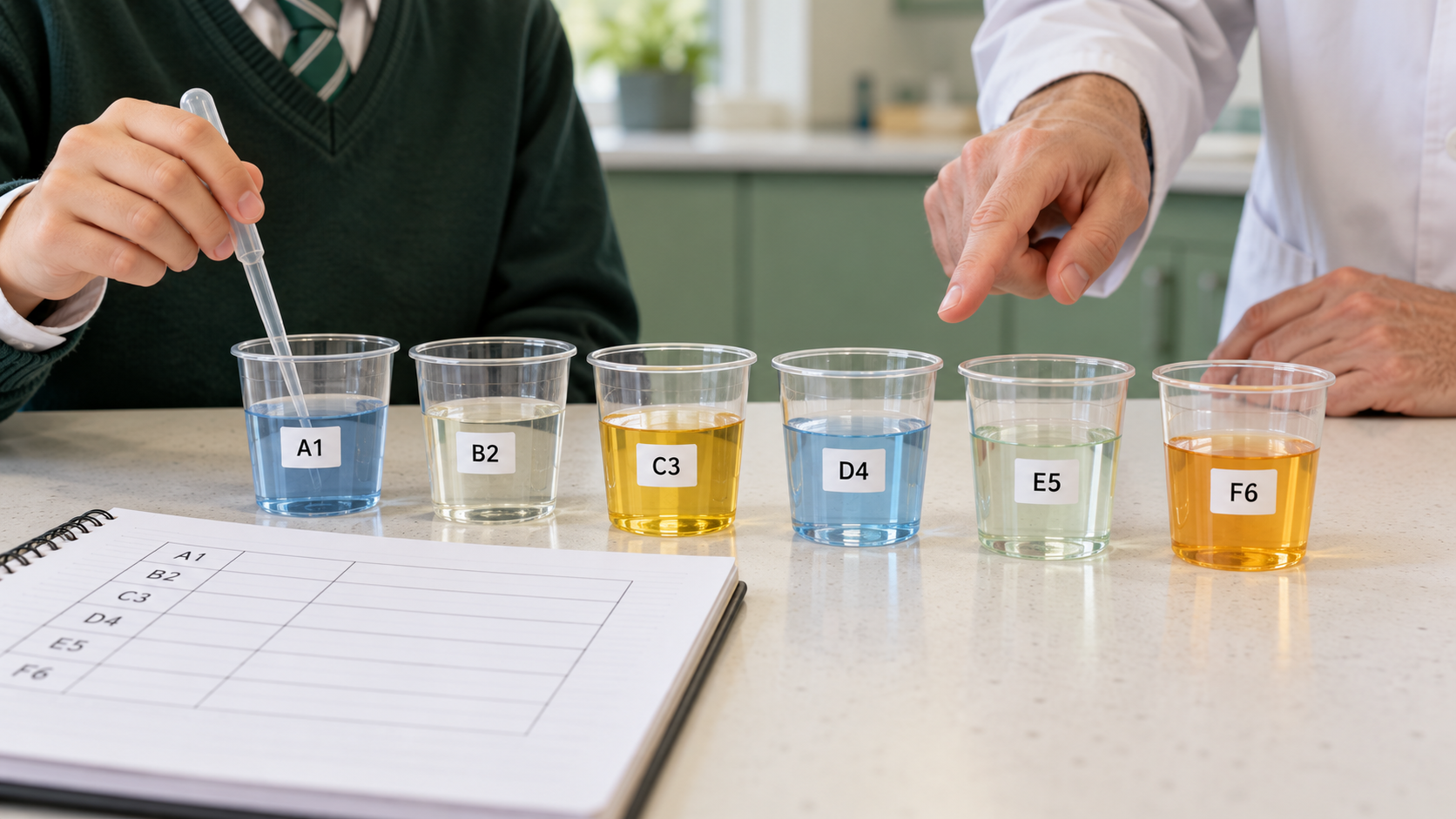
What happens in a Primary 4 Science hands-on performance task? The pupil may be asked to observe a setup, follow instructions, change a stated condition, record measurements in a table and explain what those observations support. The most useful preparation is to practise safe, simple investigations while distinguishing what was changed, what stayed the same, what was measured and what can actually be concluded.
Not every Singapore P4 school uses the same hands-on assessment. One documented example is Anglo-Chinese School (Junior)’s 2026 handbook, which described a Science weighted bite-sized task involving an investigation and recorded results. That school’s 2026 design is not a national SEAB P4 paper or a promise of your school’s 2027 arrangement. This guide offers original, school-agnostic examples for Science enquiry skills.
- First: read the teacher’s entire procedure before touching materials.
- Next: check labels, quantities and units, and record initial observations honestly.
- During: change only what the task instructs; keep relevant other conditions comparable.
- After: describe the result and distinguish it from the explanation.
- Safety: do not improvise with flame, mains electricity, boiling water or unknown chemicals.
- Practice: twelve age-appropriate tasks, four recording examples and question-answer coaching.
What does the official syllabus expect P4 pupils to do?
The MOE Primary Science Teaching and Learning Syllabus presents Science as a combination of core ideas, practices and attitudes. Its enquiry progression says that by the end of P4, pupils should recognise a fair test involving changed and unchanged variables; designing a fair test independently is a more advanced P6 outcome. P4 learners also practise observation, recording and comparing evidence with guidance.
That distinction changes how families should prepare. A reasonable P4 task may give two experimental setups and ask whether the comparison is fair. It may supply a table for the pupil to complete and ask for a pattern. A parent does not need to require a full research proposal with advanced terminology to develop these skills.
For a real-world illustration, Anglo-Chinese School (Junior) Primary Four Assessment Information Booklet, 2026 listed P4 Science weighted bite-sized assessments in 2026. Its first Science assessment included a hands-on performance component in which students carried out an investigation and recorded results. The 2026 handbook described this as part of a 15-mark, 35-minute bite-sized assessment. Those are that school’s dated arrangements only; do not assume any other school or 2027 cohort uses those marks or timings.
The same handbook described later structured Science assessments and an end-of-year examination with MCQ and open-ended components. This variety is a reminder that the school paper’s actual instructions matter more than a generic website claiming one nationwide P4 examination format.
The six stages of a simple performance task
- Read: identify the question and the information the teacher has provided.
- Set up: check that materials are correctly identified and in suitable condition.
- Observe: state what can be seen or measured before suggesting a cause.
- Record: put readings under the correct headings and units, without altering results to match a prediction.
- Interpret: compare measurements, identify any pattern and note relevant conditions.
- Explain: connect the scientific principle to the result and recognise when the evidence is insufficient.
Pupils can prepare these stages without performing a hazardous demonstration. Many of the same skills can be practised by reading a prepared dataset or manipulating paper diagrams. The purpose of hands-on learning is scientific thought, not spectacular equipment.
What does an effective observation record look like?
A useful notebook has a question at the top, then a simple table with headings. For a shadow task, the columns might be ‘Torch–toy distance (cm)’ and ‘Measured shadow width (cm)’. The units are part of the evidence. A row labelled only ’10, 14′ is ambiguous if the reader does not know which number describes distance and which describes width.
A model record can include the prediction below the table and the conclusion after the results. If the readings contradict the prediction, the pupil should keep the actual measurements and say what happened. Changing the table to make the prediction look correct is not science.
In an open-ended explanation, the response should also be proportionate. If the question asks for one relevant unchanged factor, naming ‘same cardboard toy’ may be sufficient. If it asks why the shadow grew, the pupil may need to connect the movement of the light source to the changed projection of blocked straight-line light paths.
Twelve safe or paper-based P4 Science performance-task rehearsals
Task 1: A — Classifying objects as matter
Topic: Matter. Setup: A sealed air-filled pouch, a small solid object and a sample of water are represented by photographs or safe objects.
What the pupil does: Ask the pupil to observe which items have mass and occupy space, and sort them without relying on colour or visibility. What to record: Recorded classification of solid, liquid and gas, with a statement that all are matter.
Science explanation: Air is matter even when it is not visible. A flexible pouch changes shape without eliminating the gas.
Safety or limitation: Do not use small swallowable objects around younger children or attempt pressurised apparatus.
Original assessment prompt: Explain why a pouch containing air counts as matter even if it looks mostly transparent.
Task 2: B — Transferring a fixed volume
Topic: Matter. Setup: Use a small measured amount of room-temperature water and two unbreakable containers of different shapes.
What the pupil does: Measure the starting volume, transfer without deliberate loss and observe the new liquid outline. What to record: Initial volume, final approximate volume, and qualitative change in shape or height.
Science explanation: The liquid takes the container’s shape but normally keeps its sample volume if none is lost.
Safety or limitation: Household measuring cups can be imprecise; do not pretend tiny differences are exact.
Original assessment prompt: A wide bowl has a lower water depth than a narrow cup. Does that prove less volume?
Task 3: C — Reading a water-displacement diagram
Topic: Matter. Setup: Use a paper diagram with initial reading 46 mL and final reading 64 mL after a suitable fully submerged stone.
What the pupil does: Record the two readings separately, then subtract. What to record: Initial 46 mL, final 64 mL, displacement 18 mL.
Science explanation: Under suitable conditions, an irregular object’s volume equals displaced water.
Safety or limitation: No need to lower heavy stones into breakable glass at home.
Original assessment prompt: Why is the stone’s volume 18 mL rather than 64 mL?
Task 4: D — Matching plant parts and functions
Topic: Plant system. Setup: Use a drawing of an intact potted plant and paper labels for root, stem and leaf.
What the pupil does: Identify the parts and pair each with one relevant function. What to record: A correctly annotated diagram and three function descriptions.
Science explanation: Roots take in water/mineral salts and anchor; stem supports; leaves make food.
Safety or limitation: Do not pull out roots or cut off leaves for a demonstration.
Original assessment prompt: Which function may be affected if roots are damaged?
Task 5: E — Comparing hypothetical plant conditions
Topic: Plant system. Setup: Two cards describe similar plants. A has normal roots, B has damaged roots, while watering and light are equal.
What the pupil does: State what differs and predict one supported consequence. What to record: Changed factor: root condition. Possible outcome: B may absorb less water.
Science explanation: Matching relevant conditions strengthens the inference about damaged roots.
Safety or limitation: No actual plant needs to be harmed; use cards only.
Original assessment prompt: What would change about the conclusion if B also received less water?
Task 6: F — Digestive-system route cards
Topic: Human system. Setup: Five cards: mouth, gullet, stomach, small intestine, large intestine; five separate function cards.
What the pupil does: Place organs in route order and match the correct functions. What to record: Correct order, organ names, absorption distinctions.
Science explanation: Different organs transport, mix, digest or absorb; the functions are not interchangeable.
Safety or limitation: No need to involve real food, ingestion or anatomical experimentation.
Original assessment prompt: Which organ absorbs digested nutrients and which absorbs water from undigested material?
Task 7: G — Human-system identification
Topic: Human systems. Setup: Five schematic cards showing digestive, respiratory, circulatory, skeletal and muscular roles.
What the pupil does: Match one everyday body activity to the most relevant system. What to record: Correct broad role matching with one-sentence reasons.
Science explanation: P4 requires broad recognition, not advanced anatomy.
Safety or limitation: Avoid labelling a classmate’s health or physical ability based on a paper activity.
Original assessment prompt: Which system primarily supports body structure, and which helps movement?
Task 8: H — Reflected light from a book
Topic: Light. Setup: An ordinary book under a small LED torch is seen in normal indoor conditions.
What the pupil does: Identify the emitting light source and the illuminated object. What to record: Source: operating torch; book: reflects light to the eyes.
Science explanation: An object can be visible without being a light source.
Safety or limitation: Keep the light away from eyes; avoid lasers or direct sunlight viewing.
Original assessment prompt: Why does the book remain visible when a lamp shines on it?
Task 9: I — Shadow width at three distances
Topic: Light. Setup: Cardboard shape and paper screen fixed; same small torch moved between three safe marked positions.
What the pupil does: Change torch-object distance only and record shadow widths. What to record: A two-column distance/width table with observations and units.
Science explanation: Light travels in straight lines and the setup’s geometry affects projected shadow size.
Safety or limitation: Use a battery-powered torch; avoid pointing it at anyone’s eyes.
Original assessment prompt: Why is it necessary to use the same toy in each trial?
Task 10: J — Rotate the shadow-making object
Topic: Light. Setup: Fix torch and screen; rotate a rectangular cardboard cut-out broadside then edge-on.
What the pupil does: Change orientation while keeping source and screen fixed. What to record: Two sketched shadow outlines and a description of the changed shape.
Science explanation: The object can produce different projections without changing mass or actual material dimensions.
Safety or limitation: Prepare the cut-out safely and use stable supports.
Original assessment prompt: Did the card physically shrink when its shadow became narrower?
Task 11: K — Interpreting room-temperature readings
Topic: Heat. Setup: Use a safe household thermometer or prepared table showing 27 °C and later 29 °C.
What the pupil does: Record temperature with °C, describe the change and avoid guessing the exact cause. What to record: An increase of 2 °C, labelled as a temperature observation.
Science explanation: A thermometer measures temperature, not a total amount of heat energy.
Safety or limitation: Do not touch hot cookware or alter electrical appliances to force a temperature change.
Original assessment prompt: Can the readings alone prove what caused the room to warm?
Task 12: L — Paper comparison of heat conductors
Topic: Heat. Setup: Cards depict a metal pan body, a wooden handle, a plastic covering and a metal spoon.
What the pupil does: Classify broad good and poor conductors and explain the design choice. What to record: Metal is generally a good conductor; wood and plastic are poorer conductors.
Science explanation: The property helps explain material selection without guaranteeing a hot handle is safe.
Safety or limitation: Do not conduct contact tests with heated metal or boiling water.
Original assessment prompt: Why might a pan use metal for its body but a poorer conductor on its handle?
How to distinguish observation, inference, prediction and conclusion
Suppose a pupil measures shadow widths of 12, 10 and 8 cm at three recorded source distances. The readings are observations. Saying that the width decreased across the trials is a description of their pattern. Predicting that another farther source position may give a smaller shadow is a prediction based on the observed trend and model. Explaining that moving the source changes the geometry of blocked light paths is an application of Science.
A conclusion answers the investigation’s question using results. For example: ‘In this setup, the measured shadow became smaller as the torch was moved farther from the fixed toy.’ That is stronger than ‘the shadow was nice’ and safer than ‘every shadow in the world always becomes smaller whenever anything moves.’
The child should practise when not to infer a cause. If a plant looks wilted but no root condition or watering record is given, the observer can state that it is wilted. They cannot prove that damaged roots caused it. This is an appropriate place to ask what additional evidence would make an inference stronger.
Four recording templates the child can reuse
Template 1: Two-column table
Structure: A column for what was deliberately changed and another for the measured result. Example: distance (cm) and shadow width (cm).
Example: Every heading needs a quantity and unit where appropriate.
Avoid: Putting ‘cm’ in the title but nowhere near the values can still confuse a reader; use clear headings.
Template 2: Before-and-after observation
Structure: An initial reading, final reading and a short statement describing the difference.
Example: For volume displacement, record initial and final water level, then calculate the change.
Avoid: Do not treat a final reading as identical to the change caused by an object.
Template 3: Compare-two-setups sheet
Structure: A left column for Plant A conditions and a right column for Plant B, followed by unchanged and changed factors.
Example: Use matched information: same plant type and care, but root condition differs.
Avoid: If two factors change, do not attribute the result to just one without caution.
Template 4: Diagram plus explanation
Structure: A simplified labelled drawing, then sentences for what was observed and why.
Example: Label source, object and screen in a light setup; label the relevant plant part in a systems question.
Avoid: The drawing can be not to scale; use stated values and scientific functions rather than appearance.
An independently written six-part practice investigation
Consider this fictional question: A small LED torch, cardboard toy and screen are arranged in a line. The toy and screen remain fixed. The pupil records the shadow width for torch–toy distances of 10 cm, 15 cm and 20 cm. The widths are 13 cm, 11 cm and 9 cm. These numbers are original practice data, not a universal result for every torch.
- What was changed? Torch–toy distance.
- What was measured? Shadow width, in centimetres.
- Name one relevant unchanged factor. The same toy or unchanged toy–screen distance.
- Describe the recorded pattern. Shadow width decreases from 13 to 9 cm as the recorded torch distance increases.
- Explain a plausible cause in this arrangement. The changing source position changes the projection of light paths blocked by the toy.
- Why not claim every lamp behaves identically? Other sources, alignments and distances may differ; this test concerns its stated setup.
This exercise integrates observation, fair comparison, numerical reading and explanation without requiring a complicated experiment. A pupil who can answer all six parts has shown more than familiarity with a shadow diagram. They have shown that they can reconstruct the reasoning independently.
The mark-making error: how a record becomes unreliable
A pupil may perform an activity correctly but lose useful evidence through poor recording. Examples include writing a number with no unit, putting all results under the wrong column, labelling a prediction as an actual measurement, or changing an unexpected reading to fit the predicted answer. These are separate from not knowing the Science.
Teach a final recording check: does every value have the correct heading? Did the student write the actual observed value? Is the table in the correct order? Does the conclusion refer only to what was compared? Does the scientific explanation rely on a relevant known principle rather than an invented mechanism?
Data integrity is a valuable habit. If one reading seems surprising, it is legitimate to repeat a measurement if the procedure allows it and to report both observations. It is not legitimate to erase a genuine result simply because it differs from what the child expected.
How a parent should evaluate a home performance rehearsal
Do not pretend that a homemade activity has the same official marking rubric as an individual school’s task. The parent can nevertheless evaluate useful aspects: whether the child followed instructions, recorded observations carefully, interpreted a pattern and gave a scientifically supported explanation. These are practice observations, not formal marks.
A family self-check may ask: Did the pupil name the changed condition? Did they measure the requested outcome? Were units correct? Were relevant conditions kept comparable? Did the explanation fit the observations? For a child who misses one element, practise that skill directly instead of rerunning the entire activity.
The school itself decides the actual score and marking guidance. One school’s 2026 handbook described how full answer components may be required, but that marking description must not be treated as a universal SEAB P4 rubric.
Ten common performance-task problems and their repairs
Problem 1: The child starts before reading the procedure
Repair: Pause and identify the intended question, materials, sequence and any safety instructions first.
A useful follow-up is to give a new setup with a changed material, labelled unit or question command. The child should show that the corrected habit transfers beyond the first familiar exercise. A correction is complete only when the pupil can act on the principle without being reminded at every step.
Problem 2: Two variables are changed together
Repair: Where the task permits, keep relevant other conditions comparable or state why the comparison cannot isolate the intended factor.
A useful follow-up is to give a new setup with a changed material, labelled unit or question command. The child should show that the corrected habit transfers beyond the first familiar exercise. A correction is complete only when the pupil can act on the principle without being reminded at every step.
Problem 3: Readings have no units
Repair: Write the instrument’s quantity and unit, such as shadow width (cm), water volume (mL) or temperature (°C).
A useful follow-up is to give a new setup with a changed material, labelled unit or question command. The child should show that the corrected habit transfers beyond the first familiar exercise. A correction is complete only when the pupil can act on the principle without being reminded at every step.
Problem 4: The table uses the wrong headings
Repair: Check which variable was changed and which outcome was measured before entering values.
A useful follow-up is to give a new setup with a changed material, labelled unit or question command. The child should show that the corrected habit transfers beyond the first familiar exercise. A correction is complete only when the pupil can act on the principle without being reminded at every step.
Problem 5: A surprising measurement is erased
Repair: Record actual observations honestly; investigate possible measurement difficulties rather than inventing a preferred result.
A useful follow-up is to give a new setup with a changed material, labelled unit or question command. The child should show that the corrected habit transfers beyond the first familiar exercise. A correction is complete only when the pupil can act on the principle without being reminded at every step.
Problem 6: A prediction is written as an observation
Repair: Label what was expected separately from what was seen or measured.
A useful follow-up is to give a new setup with a changed material, labelled unit or question command. The child should show that the corrected habit transfers beyond the first familiar exercise. A correction is complete only when the pupil can act on the principle without being reminded at every step.
Problem 7: An inference is stated as absolute fact
Repair: Use the evidence supplied and recognise when more information is necessary.
A useful follow-up is to give a new setup with a changed material, labelled unit or question command. The child should show that the corrected habit transfers beyond the first familiar exercise. A correction is complete only when the pupil can act on the principle without being reminded at every step.
Problem 8: The question asks for a comparison but only A is discussed
Repair: Compare the same requested property in A and B.
A useful follow-up is to give a new setup with a changed material, labelled unit or question command. The child should show that the corrected habit transfers beyond the first familiar exercise. A correction is complete only when the pupil can act on the principle without being reminded at every step.
Problem 9: An explanation contains only keywords
Repair: Join the stated condition to a relevant scientific principle and its outcome.
A useful follow-up is to give a new setup with a changed material, labelled unit or question command. The child should show that the corrected habit transfers beyond the first familiar exercise. A correction is complete only when the pupil can act on the principle without being reminded at every step.
Problem 10: The child handles equipment unsafely to impress the assessor
Repair: Follow the teacher’s instructions and safe procedures; a risky extra step is not better Science.
A useful follow-up is to give a new setup with a changed material, labelled unit or question command. The child should show that the corrected habit transfers beyond the first familiar exercise. A correction is complete only when the pupil can act on the principle without being reminded at every step.
Seven-day hands-on and paper-based practice plan
- Day 1: read a procedure carefully and label the changed, unchanged and measured factors.
- Day 2: use paper cards to classify Matter and the roles of human or plant systems.
- Day 3: record a small room-temperature water transfer with appropriate volume headings.
- Day 4: reconstruct a light setup and interpret a supplied shadow-width table.
- Day 5: practise plant-function and digestive-route diagrams as model tasks.
- Day 6: complete one six-part written investigation using original fictional data.
- Day 7: review the two most frequent record-keeping or explanation errors through changed examples.
When the school is not using a performance task this term, these activities can still support Science process skills without being treated as an examination simulation. A small amount of deliberate practice is enough to highlight the key behaviours.
Frequently asked questions
Does every P4 student have a hands-on Science examination?
No. Assessment formats vary by school. A published 2026 example from one school cannot establish a national P4 practical paper or another school’s 2027 arrangements.
Are these MOE or SEAB official practical tasks?
No. They are original instructional examples aligned with MOE P4 inquiry skills. SEAB does not set a national Primary 4 Science examination.
Does a child need a laboratory kit?
No. Cards, paper diagrams, a battery-powered torch and simple safe observations provide useful practice. Follow school instructions if official apparatus is required.
Should children design an experiment from scratch?
MOE’s P4 progression emphasises recognising fair tests and guided work. More independent design expectations develop later, although a school may offer enrichment.
Is there a universal number of marks for P4 practical Science?
No. For example, Anglo-Chinese School (Junior)’s published 2026 handbook described specific marks and duration for its own bite-sized assessment, not a rule applicable to every school.
What if the child cannot read a measuring scale?
Practise identifying units and the value of each interval on clear example diagrams. Do not create false confidence by guessing values on blurred pictures.
Should observations always match predictions?
No. An unexpected observation should be recorded honestly and interpreted carefully. A prediction is not a guaranteed outcome.
What is a safe way to teach heat transfer?
Use diagrams, thermometer values and teacher-controlled demonstrations. Avoid boiling water, hot cookware and mains-powered experiments in unsupervised home revision.
How can parents support a child who becomes anxious around practical tasks?
Rehearse the procedure with safe paper models, divide instructions into small steps and use school-approved support when needed. Avoid turning every home activity into a timed test.
What should be revised after the task?
Examine the exact error: procedure reading, measurement, units, fair comparison, observation or explanation. Then practise a changed task targeting that error.
Official and supporting references
- MOE Primary Science Teaching and Learning Syllabus
- Anglo-Chinese School (Junior) Primary Four Assessment Information Booklet, 2026
- Twelve safe P4 Science home activities
- Recognising fair tests and interpreting tables
- P4 Science process skills
- Visual reading challenges
- SEAB: national PSLE information
Small-group Science tuition is useful when the learner needs targeted help distinguishing the observation, procedure and scientific explanation. eduKateSG’s teaching can examine the exact point where a pupil’s reasoning or recording stops working and guide an independent follow-up. For current information, see Primary Science tuition.
A final practice conversation after each hands-on task
After completing a simple investigation, the adult can ask five connected questions without suggesting the answer: What question were you investigating? What did you deliberately change? What observation did you record? Which other conditions mattered? What does the evidence support? A pupil who can answer independently has begun to coordinate procedure, measurement and explanation rather than performing steps mechanically.
If the student gives an incorrect answer, avoid redoing the entire activity immediately. Identify the missing part. For example, a child who knows the shadow changed but cannot name the changed distance needs to label the source, object and screen before trying a new diagram. A child who reports a temperature change without its unit needs practice with measurement notation. The repair should be short and specific.
Finally, ask for one new situation with the same principle and different objects. A successful answer to an altered question is stronger evidence of learning than repeating the familiar observation. This is also the reason that safe paper-based tasks have value: they make it possible to change a condition and examine the pupil’s scientific reasoning without repeating a complicated setup.
Editorial note (November 2026): The school-specific example is from Anglo-Chinese School (Junior)’s published 2026 handbook, not a claim about 2027 nationwide assessment. All practice tasks and sample readings here are original. Where official school instructions conflict with a general example, follow the school’s directions and safety rules.
How to handle a task with incomplete equipment. A school experiment may be interrupted because an instrument does not work as expected. The pupil should follow the teacher’s instructions rather than invent an alternative setup or a number. In home practice, the correct response to an unreadable measuring cup is to state the limitation and use a clearly drawn representation instead. A fabricated reading is never evidence.
Why recording order matters. A table with readings entered in the wrong row can reverse the apparent trend. Students should check the row label before copying each measurement. In a temperature task, write the time beside the correct reading. In a shadow task, write the torch distance beside the width measured at that distance. This reduces errors that look like conceptual confusion but are actually record-keeping problems.
Why a control is more than a familiar phrase. A child may write ‘keep everything the same’ without identifying which condition matters. For shadow width, keeping the object and screen fixed is directly relevant. For comparing plants, watering, light and plant type matter. A useful P4 answer names one or more relevant unchanged factors in the setup. An irrelevant control does not make the comparison scientifically stronger.
How to distinguish a description from an explanation in a practical task. ‘The shadow width became smaller as distance increased’ reports a measured pattern. ‘The changed source position altered the projected paths of blocked light’ provides a scientific account. Both may be requested in a structured task, and the response should not substitute one for the other. Practising this distinction with the same dataset helps pupils understand different command words.
What a parent should do after a failed rehearsal. If the child mixed up the rows, practise a smaller two-row table. If the child reversed the direction of heat transfer, practise two labelled temperatures on paper. If the child could not name an unchanged variable, present two contrasting setups with only one difference. Targeted repair is more useful than repeating a complex practical activity that combines too many demands.