
For a Johor Bahru trip during Singapore’s public holidays in 2027, choose your return-home deadline before choosing restaurants, shopping centres or a hotel. A manageable trip needs valid travel documents, a suitable crossing method, one main reason to visit and enough room for a slower border journey. Start with the shortest itinerary that would still feel worthwhile if you arrived later than expected.
A three-day weekend does not require three days away. You might visit Johor for one day, stay one night and keep the last day at home, or postpone the crossing when your family needs a more predictable break. The useful question is how much enjoyable time remains after travelling, checking in, eating, resting and returning. This guide helps Singapore-based families make that decision using the official holiday dates and entry information available when checked on 8 November 2026.
- Choose the shape of the trip: a focused day visit, a relaxed overnight stay, or a longer visit with a clear purpose.
- Check every traveller separately: nationality, passport, visa and arrival-card requirements can differ within one family.
- Carry physical passports: digital clearance does not remove the need to bring travel documents.
- Keep the first activity flexible: avoid building the day around an expensive appointment immediately after the crossing.
- Plan the return before departure: include the journey home from the Singapore checkpoint or arrival point.
- Give shopping its own limit: a cheaper purchase can still make the whole outing more expensive.
- Check again near departure: entry procedures, transport services and traffic conditions can change before your 2027 trip.
EDUKATE · PUBLIC HOLIDAYS 2027
Plan the visit and leave space for the journey
Start with the decision in front of you, or read the chapters in order.
Choose your visit
Compare the dates, trip length and transport. ROUTE 2 · CHAPTERS 5–7
Check documents and cost
Apply each traveller’s rules and build a full budget. ROUTE 3 · CHAPTERS 8–11
Shape the family day
Use flexible itineraries and plan purchases carefully. ROUTE 4 · CHAPTERS 12–16
Prepare to return
Protect the journey home and complete the checklist.
A good short trip has a clear centre. It could be lunch with relatives, a hotel rest, a particular attraction or a modest shopping list. When everyone knows the purpose, decisions become easier. You can remove a secondary stop without feeling that the whole outing has failed.
Consider a family whose main reason for travelling is to see grandparents. Their useful plan may be transport, a long visit, a nearby meal and home. Adding two shopping centres does not automatically improve that day. It creates extra journeys and another reason to leave the family visit early.
Another family may want a night away after a demanding school term. A hotel close to the places they intend to use may suit them better than a more elaborate property that requires repeated transfers. The important feature is the rest they can actually enjoy, not the length of the facilities list.
Write one sentence before comparing options: “We are going to Johor because we want to ______.” Then ask each person what would make the trip difficult. A child might dislike long periods without a meal. An older relative might need reliable seating. A parent might be concerned about driving home when tired. These are planning inputs, not objections to having fun.
Give the trip a small set of priorities. One essential activity, one optional activity and one fallback meal are often enough for a short visit. Everything else can remain a possibility rather than becoming a promise.
CHAPTER 2 OF 16 · Choose your visit
2. Which 2027 public-holiday weekends can you consider?
Singapore’s Ministry of Manpower has published the 2027 public-holiday dates. The following windows are calendar calculations for someone who normally does not work on Saturday or Sunday. They do not guarantee employer leave, school absence approval, attraction opening or a particular border waiting time.
| Singapore holiday | Possible time away from ordinary Monday–Friday work | Planning point |
|---|---|---|
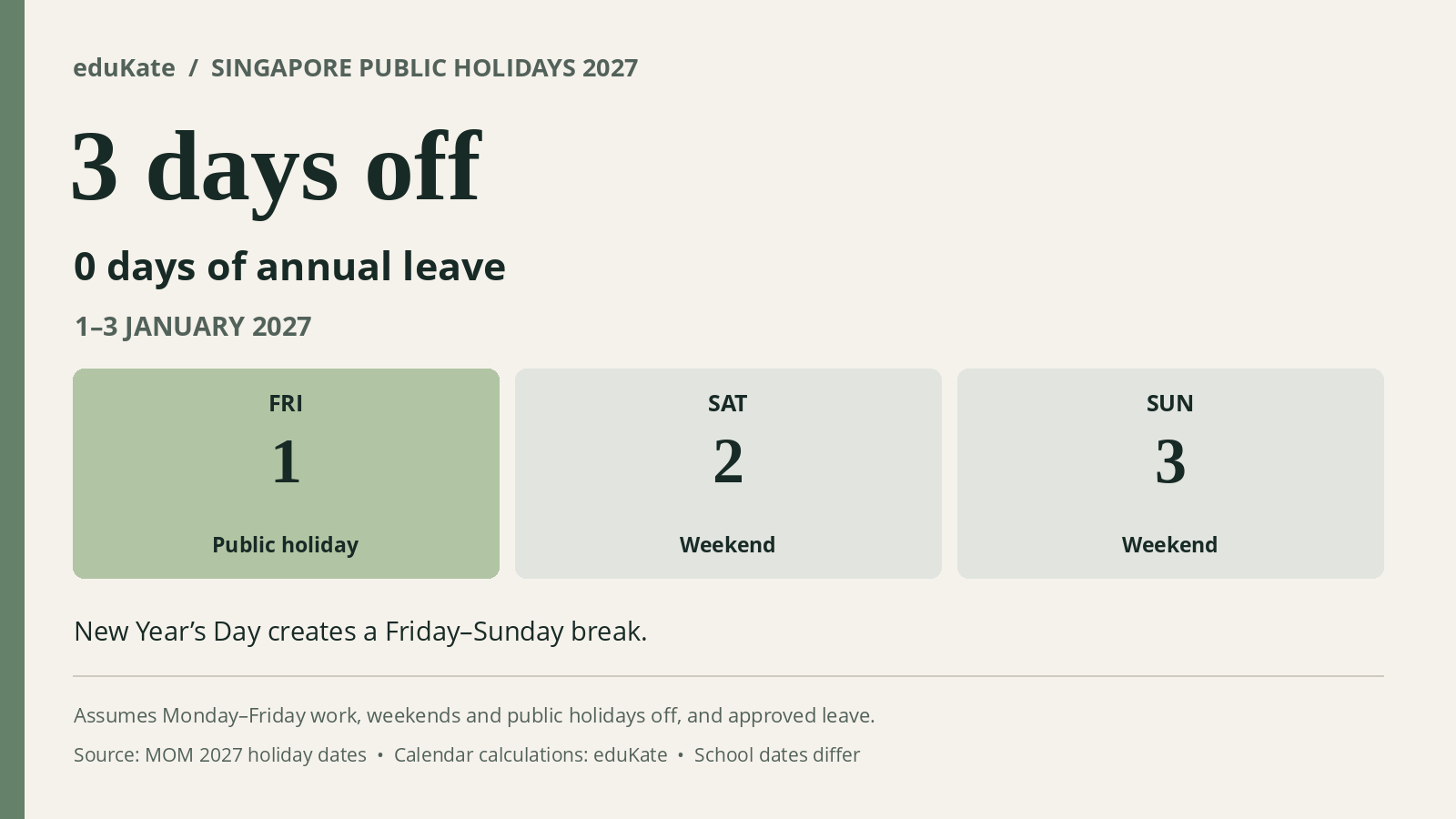
| New Year’s Day, Friday 1 January | 1–3 January | Keep the return and any early-January commitments in view. |
| Chinese New Year, 6–7 February; Monday 8 February is also a public holiday | 6–8 February | Confirm family visits and individual businesses’ festive arrangements. |
| Good Friday, Friday 26 March | 26–28 March | One night away can leave a separate day for settling back home. |
| Hari Raya Haji, Monday 17 May | 15–17 May | Check all travellers’ calendars before committing. |
| National Day, Monday 9 August | 7–9 August | A local celebration or family commitment may also matter. |
| Vesak Day, Thursday 20 May | 20–23 May if Friday 21 May leave is approved | The Friday is not automatically a holiday for every traveller. |
| Deepavali, Thursday 28 October | 28–31 October if Friday 29 October leave is approved | Check school and assessment commitments separately. |
For the complete calendar, including Saturday holidays and school-specific distinctions, use Public Holidays 2027 Singapore. If you are still choosing the length of your break, begin with the three-day getaway planning guide.
These are Singapore holiday windows. They are not a Malaysian or Johor holiday calendar. Check the Malaysian dates relevant to your visit and the actual operating notices of the places you intend to use. A Singapore day off does not tell you whether a particular Johor business is open.
CHAPTER 3 OF 16 · Choose your visit
3. Day trip or overnight stay: choose by what you need
A day trip suits a small, flexible purpose
Choose a day trip when the main activity can fit comfortably inside a shortened day. A family meal, one attraction or a tightly defined shopping visit is easier to adapt than a sequence of timed bookings. You also avoid packing for a night away and managing hotel arrangements.
The weakness is that both crossings sit inside the same day. If the outward journey takes longer than your family can comfortably tolerate, the sensible response is to shorten the visit. Trying to recover every lost hour by returning late simply moves the cost into the evening.
An overnight stay creates space between the crossings
One night can separate arrival day from departure day. It gives you somewhere to rest and may make a visit with children or grandparents easier to organise. However, it also adds accommodation cost, luggage, check-in conditions and another set of decisions.
Pay for a night because you will use the time and space. If your plan has you arriving late, leaving early and spending almost no waking time at the hotel, compare that honestly with a simpler day visit on another date.
| Your situation | Option worth considering | Main condition to check |
|---|---|---|
| One flexible meal and a small shopping list | Day trip | You can remove shopping if the crossing takes longer. |
| Children need a quiet break between activities | Overnight | Room access, occupancy and nearby meals suit the family. |
| Visiting relatives with enough space to rest | Day or overnight visit | The host agrees on arrival, departure and sleeping arrangements. |
| Several timed activities in different areas | Simplify or extend | Transfers and delays do not make the schedule brittle. |
| An important commitment early the next morning | Return a day earlier or choose another outing | The trip leaves a realistic recovery margin. |
Compare the journey from your front door to the place you want to visit, then back again. The crossing is only one part. Include reaching the departure point, walking, luggage handling, local transport in Johor and the final journey home.
Driving
A car can keep family belongings together and help with a visit involving several locations. The driver also carries responsibility for navigation, parking and the return journey. Ask whether that person will still enjoy the outing after doing the travelling work.
Before driving, read MFA’s Malaysia driving advice and complete the applicable requirements through JPJ’s official VEP portal. Separately, Singapore Customs requires Singapore-registered petrol, diesel and CNG vehicles leaving by land to have fuel tanks at least three-quarters full. For petrol/CNG hybrids, both tanks must meet the requirement. Confirm the vehicle documents, permitted use and insurance before departure.
Bus or an authorised booked service
For a bus journey, establish how much walking and waiting each traveller can manage with their belongings. Read the operator’s current boarding, luggage, immigration and reboarding instructions. Keep a photograph or saved copy of the actual departure point, rather than relying on a loosely remembered neighbourhood name.
If you book a paid cross-border service, verify the provider and its authority to operate that journey. Obtain the collection point, destination, total price, waiting arrangement and cancellation terms in writing. A quoted travel time is not an immigration-clearance guarantee.
Rail when the service is operating and available to book
Check the actual operator for your intended date. For example, KTMB’s Shuttle Tebrau information explains that passport details are required for ticketing. Follow the current rules for boarding and any passport change after booking.
For any new service, including the RTS Link, confirm that passenger operations, tickets and the necessary travel arrangements are available for your trip. An announced target date is not a booking confirmation.
The eduKate Johor Bahru and checkpoint transport guide provides wider route context. The Malaysia coach guide is useful when a Johor visit becomes part of a longer journey.
CHAPTER 5 OF 16 · Check documents and cost
5. Check the documents of each person travelling
Make one row for each traveller. Do not write “family documents done” until every row is complete. A household can include different nationalities, Singapore residence statuses and passport-expiry dates.
Passport and entry requirements
Singapore’s Ministry of Foreign Affairs Malaysia advice states that Singapore passports must have more than six months’ validity at entry and be in good condition. It also states that Singaporeans do not require a visa for visits of up to 30 days. Travellers using other passports must check their own requirements.
Inspect the document itself. Check the name, expiry date and condition, then confirm that bookings use the correct details. A saved photograph helps you retrieve information; it does not replace the physical passport needed for travel.
Malaysia Digital Arrival Card
The Malaysian High Commission’s published guidance lists Singapore citizens among the categories exempt from the Malaysia Digital Arrival Card. Other travellers should check the full exemption list and, where required, complete the MDAC within the applicable three-day period before arrival through the official Malaysian immigration portal.
Being a Singapore permanent resident is not the same as being a Singapore citizen. Equally, a person may qualify for another Malaysian exemption. Work from the person’s actual citizenship and documents, not simply the fact that they live in Singapore.
If you intend to enrol for Malaysian automated clearance, check those steps separately. MFA’s Malaysia guidance includes an MDAC submission step for Singaporeans enrolling fingerprints for subsequent e-gate use. The ordinary declaration exemption does not answer every enrolment question.
Singapore Arrival Card on the return
ICA’s SG Arrival Card guidance exempts Singapore citizens, permanent residents and long-term pass holders travelling through Woodlands and Tuas checkpoints. Other returning travellers need to check their requirements. Where required, submission is within three days, including the arrival date, and is free through official channels.
Do not carry that land-checkpoint exemption over to a different mode of arrival. If your journey changes to air or sea, check again. The Malaysian arrival declaration and the Singapore arrival declaration are separate requirements.
QR clearance and physical passports
ICA’s MyICA QR guidance covers eligible travellers using cars, motorcycles, lorries and buses at Woodlands and Tuas. Everyone must still carry a physical passport. First-time foreign visitors, and travellers entering on a passport not previously used to enter Singapore, must present that passport for clearance on that entry; they can use QR clearance on subsequent eligible trips. Rail passengers should follow their operator’s boarding and immigration instructions separately.
Malaysia has its own clearance systems and eligibility rules. Follow the instructions for the lane and system you actually use. Prepare digital profiles before travelling, ensure the group contains the correct people and keep travel documents readily accessible.
CHAPTER 6 OF 16 · Check documents and cost
6. Read the border information without turning it into a promise
ICA’s September 2026 school-holiday advisory reported that some car travellers during the preceding National Day weekend waited up to three hours at peak periods. That is evidence that substantial delays can happen. It is not a forecast, average or maximum for your 2027 trip.
Before departure, read the latest ICA notice and check LTA’s checkpoint traffic-camera information. Use the information to make a decision while you can still change the plan.
Prepare three versions of the same visit
Normal arrival: enjoy the main activity and consider the optional stop afterwards.
Later arrival: keep the meal and main activity; remove the optional stop.
Much later arrival or a tired family: have the simplest suitable visit, inform anyone expecting you and begin the return plan earlier.
These are decisions about your own itinerary. They are not predictions of how the authorities will manage the queue. Do not treat a clear camera view as proof of an empty journey ahead, or a friend’s fast crossing as a timetable for your family.
Choose any early or late departure with the traveller in mind. A time that looks attractive for traffic may be unsuitable for a tired driver or a child who needs sleep. The aim is a manageable total day.
CHAPTER 7 OF 16 · Check documents and cost
7. Make a budget for the trip, not only for the shopping
Give travel, meals, activities and shopping separate amounts. If a purchase looks attractive, you can then see whether it fits the shopping allowance without borrowing money from the return journey or essential family expenses.
The following example is a hypothetical planning exercise in Singapore dollars for a family of four. These figures are not quotations, current Johor prices or a statement that a particular fare or room is available.
| Budget category | Illustrative day trip | Illustrative one-night trip |
|---|---|---|
| Cross-border transport and local transfers | S$90 | S$100 |
| Accommodation | S$0 | S$160 |
| Meals and drinks | S$90 | S$150 |
| Planned activity | S$40 | S$60 |
| Shopping limit | S$80 | S$80 |
| Subtotal planned spending | S$300 | S$550 |
| Unspent contingency available | S$60 | S$100 |
| Cash capacity allocated to the plan | S$360 | S$650 |
In this example, the extra night adds S$250 to planned spending. The question is whether the family values the extra rest and time at that amount. There is no need to describe the overnight trip as a saving merely because one component appears cheaper than a Singapore equivalent.
The contingency is money available if needed, not another shopping allowance. If unused, it remains unspent. Budget separately for any applicable tax, insurance, parking, tolls or booking charges missing from your actual quotations.
Keep currencies clear
Record which amounts are in Malaysian ringgit and which are in Singapore dollars. Use the exchange rate and fees relevant to your actual payment method when making the final comparison. Do not combine two currencies in a total and hope that a rough mental conversion will be close enough.
Price the whole basket
Suppose your planned purchases save an illustrative S$40 compared with buying the same necessary items at home, while additional travel spending is S$70. The shopping alone has not saved the household money. You may still value the outing, meal and company, but those are separate reasons to go.
This distinction keeps the trip enjoyable. You do not need to buy more things to justify being there.
This sample is a sequence, not a promised timetable. Replace the activities with places whose current opening arrangements, accessibility and booking terms you have checked.
Before leaving home
Confirm the main purpose, the return decision time and the fallback. Check documents, transport information and the latest traffic situation. Have a manageable meal before starting if that suits the family. Keep the arrival day free of a tightly timed first booking unless the consequences of being late are acceptable.
After completing entry
Pause before rushing onwards. Account for every person and important bag. Confirm the next destination and transport. If anyone needs a toilet, drink or a seat, settle that before adding another transfer.
Reassess the plan using the time you have now, not the time you hoped to have. A later arrival should produce a shorter itinerary, not a more hurried family.
Main activity and meal
Keep these close together where possible. A shopping visit can include a meal in the same area. A visit to relatives can use a nearby restaurant instead of a separate cross-city outing. Choose the main experience and give it enough time to be pleasant.
Optional stop
Ask three questions: do we still want this, can everyone manage it, and does it leave the return margin intact? All three should be answered positively. A stop that exists only because it was written down yesterday can be removed.
Start home at the agreed point
The return decision time is when you stop adding activities and begin the journey back. It is not the time you expect to appear at your front door. Keep the final connection in Singapore in the plan, especially if your transport does not drop you near home.
An enjoyable meal, one worthwhile activity and a comfortable return can be a complete day.
For an overnight stay, choose a base that supports your actual activities. Map the hotel, the main reason for visiting, meal choices and the departure point together. Repeated transfers can use the space you hoped the extra night would create.
Day one: arrive and settle
Leave the first part of the visit flexible. Confirm the hotel’s check-in time and luggage arrangement directly; arriving in Johor does not mean a room will be available immediately. If early room access is essential, obtain the specific arrangement before paying.
Plan a nearby meal and a modest evening. If the hotel is part of the reason for travelling, allow time to use it. A family that books a property for its pool but spends the entire afternoon elsewhere has paid for an experience it did not schedule.
Day two: one purpose, then return
After breakfast, choose one activity that fits between packing and the return plan. Check the actual checkout deadline and luggage policy. Keep a change of clothes or essential items accessible if your room is no longer available.
Avoid using checkout as the starting signal for a second full day of unrelated stops. The trip still includes a border crossing and a journey home.
Use the third holiday day deliberately
If your break has three days, consider returning after one night and reserving the final day for ordinary life. That could mean laundry, grocery shopping, time with another relative, school preparation or simply an unscheduled afternoon.
Returning earlier has value even if it produces fewer hotel nights. Decide whether your family wants more time away or more breathing space around the trip. Both are reasonable choices.
CHAPTER 10 OF 16 · Shape the family day
10. Make the itinerary work for children and grandparents
Start with what each traveller can comfortably do. A lively teenager, a preschool child and a grandparent may all enjoy the same destination but need different pacing.
Reduce changes of place
Every additional stop creates another departure, arrival and regrouping. Check whether a new location adds enough value to justify the move. On a short family trip, a nearby second activity may be more useful than the most talked-about activity across town.
For someone using a wheelchair or walking aid, ask venues and transport providers specific questions about access. Check the route from the drop-off point to the entrance, toilet access and seating. A general claim that a venue is suitable for families does not answer those practical questions.
Share the work
One adult can handle bookings while another checks belongings and supports the children. Share essential information so the trip does not depend on a single phone. Older children can look after a small day bag or help count the group when moving, without taking responsibility for immigration or younger siblings’ safety.
Make waiting manageable
Pack a few familiar activities that do not depend on streaming or constant connectivity. Let children know the journey may include waiting and that you will update them when there is useful information. Repeatedly promising that arrival is only minutes away creates frustration if nobody knows the actual time.
Keep food, water and personal necessities appropriate to the journey and applicable carriage rules. For regular medicines, check the destination’s requirements where relevant and follow the person’s existing care arrangements. Travel planning should accommodate those needs rather than hoping the day will run exactly to schedule.
CHAPTER 11 OF 16 · Shape the family day
11. Buy things you can legally and practically bring home
Shopping decisions should include the return journey. Before buying a bulky item, ask who will carry it, how it fits the transport arrangement and whether it remains worthwhile after any applicable tax or charge.
Singapore Customs’ current traveller guidance explains GST import relief, who is eligible and what goods are excluded. Eligibility depends on traveller category and time spent abroad; it is not a blanket allowance shared by everyone who lives in Singapore. Keep receipts and use the official declaration guidance when payment is due. Travellers arriving from Malaysia do not receive duty-free liquor concessions.
Food has separate rules. Check the Singapore Food Agency’s allowed-food list before buying items to bring back. Product type, source and quantity matter. For example, SFA’s specific advice on Malaysian bak kwa and meat products says these are not permitted for private import under the stated source rules.
Use a short shopping list
Divide the list into necessary, enjoyable and optional. Write a maximum amount beside each category. If someone asks you to bring something back, check the relevant rules before agreeing; carrying goods for another person can affect their treatment under Customs rules.
Keep the final shopping stop small. A last-minute purchase should not force you to change the whole return plan. A useful question is: “Would we still buy this if it meant leaving the main activity now?” If the answer is no, the item probably does not need to control the day.
Plan backwards from the first commitment after the trip. A child’s school morning, an adult’s early shift or an important appointment deserves more protection than an optional evening errand.
Write down four stages: leaving the last Johor activity, reaching the departure point, completing the crossing, and travelling home in Singapore. If you focus only on the crossing, you can overlook a surprisingly inconvenient final leg.
Separate the hoped-for return from the fallback
Your hoped-for return is the comfortable plan. The fallback answers what you will do if the journey takes longer: who needs an update, what can be cancelled, where essential information is stored and how you will complete the final journey safely.
If driving, the driver’s condition is part of the decision. Do not make keeping a dinner reservation more important than being able to drive attentively. Agree beforehand that the driver can ask to shorten the visit or rest without having to persuade a disappointed group.
Finish the trip before bedtime
Where practical, pack school bags and prepare the next working day before leaving Singapore. Then the return does not immediately become a rush to find uniforms, finish essential work and organise breakfast.
This is especially useful when the household has only one fully free day. A trip that leaves Monday morning harder may need a different return plan, even if the Sunday afternoon was enjoyable.
Make changes while they still help. Before departure, a serious document problem means the affected traveller’s journey needs to be resolved before travelling. A transport cancellation means checking the actual alternatives and costs, not assuming another provider will accept the same ticket.
Once in Johor, start with the main purpose. If that remains possible, protect it by removing lesser activities. If it is no longer possible, choose a smaller day rather than spending heavily to recreate the original plan.
If a venue is closed
Use a nearby fallback that you have already identified. Confirm that it is open before travelling there. Moving from one unverified option to another consumes both time and patience.
If someone wants to stop
Ask what they need: food, a seat, a quieter place, a shorter walk or an early return. An adult can be disappointed about cancelling an activity and still make the sensible choice for the group.
If a document or immigration record appears wrong
Speak to the relevant immigration officers before leaving the checkpoint. MFA’s Malaysia guidance advises travellers to check the stamps or electronic entry and exit records appropriate to their clearance method. For lost documents or other serious problems, use official assistance channels and the MFA Malaysia advice page.
If you decide to stay in Singapore
Keep one local alternative ready. The eduKate Woodlands outing guide offers ideas to explore, but check each venue’s public-holiday arrangements before using it. A library in an itinerary should never be assumed open merely because it is a useful indoor option.
Before making non-refundable bookings
- Confirm who is travelling and the purpose of the trip.
- Check the actual dates against work, school and family commitments.
- Review every passport and each traveller’s entry requirements.
- Choose day trip or overnight stay using the whole cost and journey.
- Verify the provider, room occupancy or ticket details, cancellation terms and departure point.
- Decide how much flexibility you need on the first and last day.
In the days before departure
- Recheck official entry and transport information.
- Complete any required declarations within their submission windows.
- Prepare eligible digital-clearance profiles and keep passports ready.
- Confirm the main activity, the meal option and one practical fallback.
- Share the plan and key booking information with another adult.
- Check payment access, phone connectivity and charging arrangements.
On the departure morning
- Read the current traffic situation and relevant official notice.
- Reconsider the plan if conditions or the family’s needs have changed.
- Count people, passports and essential bags before leaving.
- Confirm the return decision time with everyone who needs to know.
Before beginning the return
- Check documents, purchases and any declaration requirement.
- Confirm the final transport connection in Singapore.
- Remove optional shopping if the return margin is narrowing.
- Tell anyone expecting you if the plan changes.
Keep the checklist short enough to use. Its purpose is to help the family begin the trip calmly, not to create another administrative project.
Is a public-holiday Johor Bahru day trip worth it?
It can be, when you have one clear purpose and can accept a shorter visit if travel takes longer. Compare the complete cost and time with what your family wants from the day. A trip for a meal with relatives may be worthwhile even without shopping; a shopping-only journey needs a more careful cost comparison.
Should we use the entire three-day weekend?
Only if the extra time serves a purpose. One night away with a separate day at home may fit some households better than a full three days away. Decide what you want the next working or school morning to feel like, then work backwards.
What is the best time to cross?
There is no time this guide can guarantee for a future holiday. Read the latest official advice and current conditions. Compare any traffic advantage with the effect on sleep, driving and family routines. A theoretically quieter hour is not automatically the most suitable hour for your group.
Does everyone living in Singapore have the same arrival-card rules?
No. Check nationality, residence status, destination rules and mode of arrival for each traveller. The document section above separates Malaysia’s MDAC from Singapore’s SGAC. A family should make these checks person by person, including a visiting relative joining the outing.
Can we leave passports at home if we use QR clearance?
No. Bring the physical travel documents and follow the current eligibility rules for the clearance system you use. Digital convenience should make the document check easier, not cause you to skip it.
Can we rely on the RTS Link for a 2027 holiday?
Check the operator’s actual passenger-service announcement and booking arrangements for your date. Build a paid itinerary around services that are operating and confirmed for your journey. Keep proposals and target dates separate from tickets you can use.
Is an overnight hotel stay automatically more relaxing?
No. It helps when the location, room arrangement and available time meet your needs. Check-in uncertainty, several transfers and an overloaded second day can remove much of the benefit. Schedule time to use the hotel before deciding that the extra night is worth the cost.
What if the children want different activities?
Let each child choose from a small set that already fits the route and budget. Agree on one main activity together, then keep another choice for a future visit. Promising every requested stop can turn a short holiday into a negotiation at each departure.
How much should we set aside for shopping?
Choose an amount after funding transport, meals, necessary accommodation and a contingency. The right number depends on your household. Keep a list of intended purchases and compare like with like, including currency conversion and any applicable import charges.
What is the most useful final check?
Ask: “If the outward journey takes much longer than we hoped, is there still a version of this trip that we would enjoy?” If yes, keep that version ready. If no, simplify the bookings, change the date or choose an outing with a more predictable shape.
Use the official sources closest to departure for current requirements. This article’s itineraries and budget figures are planning examples, not operator promises or live quotations.
- MOM: Singapore public holidays for 2027
- MFA: Malaysia travel advice and consular information
- Malaysia Immigration: official MDAC portal
- ICA: QR clearance at land checkpoints
- ICA: SG Arrival Card requirements
- Singapore Customs: traveller concessions and GST import relief
- SFA: food allowed for private consumption
- eduKate: Public Holidays 2027 Singapore
- eduKate: planning a three-day getaway
- eduKate: Johor Bahru, Woodlands, Tuas and cross-border transport