
Can families in Punggol get financial assistance for primary school textbooks, uniforms, canteen meals and transport? Yes—eligible Singapore Citizen students at government and government-aided schools can receive support through the Ministry of Education Financial Assistance Scheme (MOE FAS). For the 2026 scheme, the stated income criteria are gross monthly household income of S$4,000 or below, or per-capita income of S$1,000 or below. Families should check the applicable school type, eligibility criteria and latest benefit details before applying.
The practical first step is to go to MOE’s financial assistance information, or use the Financial Assistance service inside Parents Gateway and your child’s school’s official application link. Edgefield Primary School’s 2026 parent information gives a local Punggol example: the revised primary-level support covers fees, textbooks and uniforms, school meals and eligible transport arrangements. The precise combination of benefits depends on the scheme and circumstances.
If money is tight, the important thing is to ask early, before buying school materials that may be covered. This guide walks Punggol parents through what to check, how to apply safely, what to do when they are unsure about eligibility, and how to keep the child’s school day steady while the application is being processed. No family should have to guess its way through a school form.
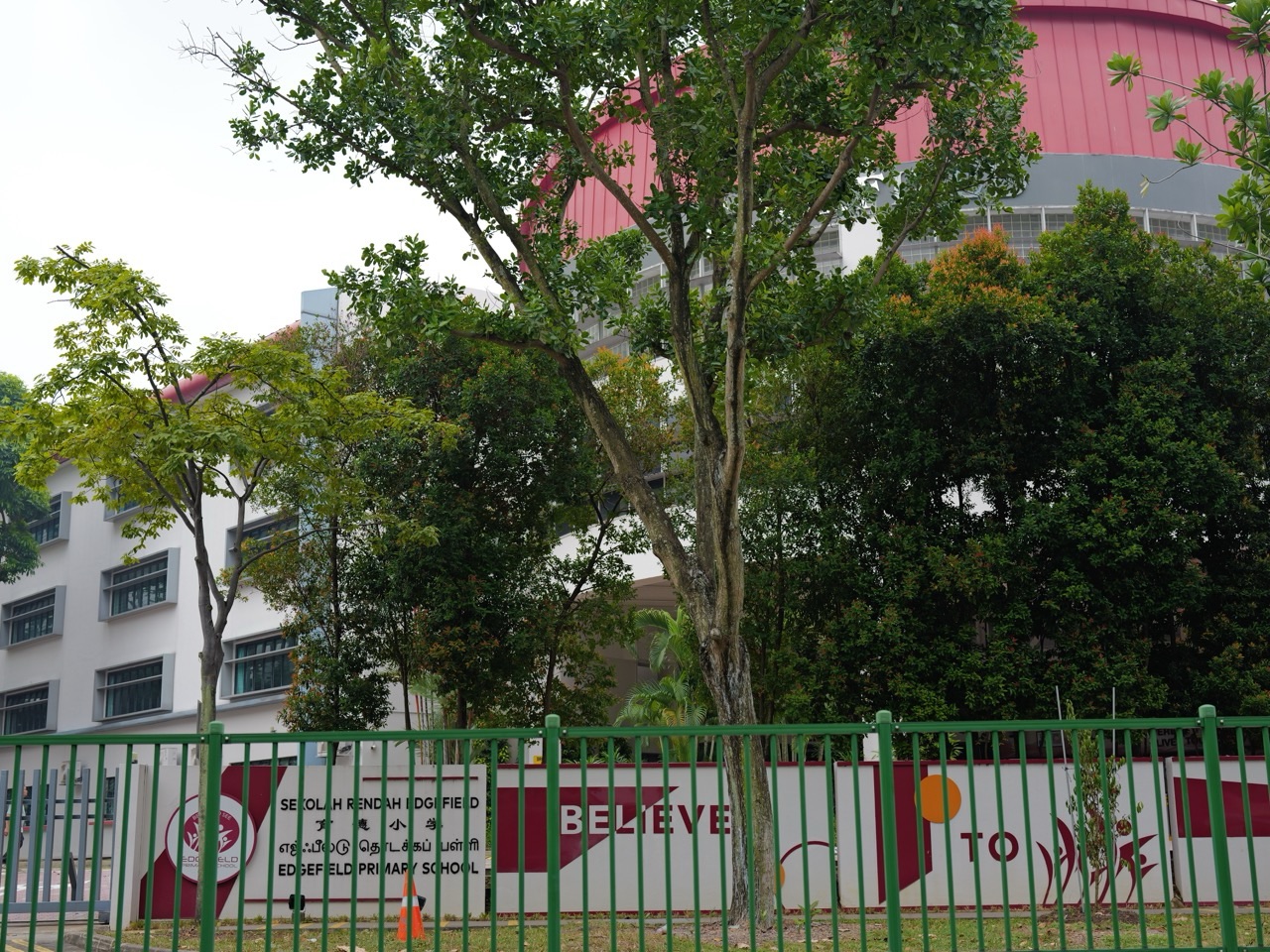
Local photograph: Edgefield Primary School exterior in Punggol. This is a neighbourhood school photograph, not a photograph of an individual financial assistance recipient.
Choose your reading route
Article contents
Sections 1–6
1. Check who qualifies for the 2026 MOE FAS
2. Apply safely through Parents Gateway or official school channels
3. What the scheme can help pay for
4. If you are unsure or do not meet the published threshold
5. Plan uniforms, books, canteen meals and transport before term begins
Financial assistance is not a reward for good grades. It exists so financial difficulty need not prevent a child from accessing schooling. For government and government-aided schools, the 2026 MOE FAS framework described in official school notices is for eligible Singapore Citizen students whose household meets one of two income tests. Meeting the gross-income test or the per-capita test may satisfy that financial threshold, subject to the full scheme conditions.
Gross monthly household income looks at combined income. Per-capita income divides the eligible household income figure by the number of household members under the scheme’s assessment rules. That second measure matters for larger families: two homes with the same total income may have very different numbers of people depending on it. Do not rely on an informal calculation alone when the application asks for particular household details.
The 2026 information published by Edgefield Primary School states gross household income of S$4,000 or less, or per-capita income of S$1,000 or less. Schools offering independent-school bursaries or other assistance can have different arrangements. Confirm the relevant scheme rather than assuming one published threshold applies to every Singapore school.
- Check whether the child is a Singapore Citizen and which school scheme applies.
- Use the income period and household-member definitions requested by the official application.
- Confirm whether the application concerns 2026 or a later school year.
- Ask your school if you are close to a threshold or your financial circumstances have changed.
Parents Gateway is a familiar communication channel for Singapore school families, but a financial assistance application is still a separate administrative process. Some schools direct parents to the eFAS service within Parents Gateway; others provide the approved application link through official school pages. The safest starting point is your child’s school’s website or MOE’s own website, not an anonymous message circulating in a parent group.
The 2026 Punggol View Primary School forms page links families to the official MOE FAS online application. The Edgefield Primary parent information page also lists an official application route. These are examples of Punggol school communication; they are not evidence that each campus has identical collection deadlines, paperwork or school-based support.
Prepare the information the official application requests, answer accurately and keep the submission confirmation somewhere private and accessible. If income is irregular, employment has changed or household circumstances are unusual, ask the school for guidance. Avoid entering NRIC numbers, income records, bank logins or other sensitive details into unofficial forms.
- Open the official school or MOE link, not a forwarded unknown form.
- Read which documents and details the application actually requests.
- Use Parents Gateway where the school directs you to do so.
- Save an application reference or confirmation.
- Contact the school’s general office if you need help completing the process.
The school bill is wider than tuition fees. Families buy exercise books, textbooks, socks, shoes, PE clothes, meals and transport. A properly designed assistance scheme reduces those everyday costs together, because a free textbook has less value if the student cannot reliably travel to class or eat at recess.
The official Edgefield Primary 2026 notice lists fee subsidies and free textbooks and uniforms for eligible pupils. It also describes primary school meal support amounting to at least seven meals per week at S$3.20 per meal under the 2026 provision. The same notice identifies enhanced transport assistance, including support for eligible school-bus or public-transport arrangements. Conditions and calculation methods matter: the notice should not be read as a guarantee of every type of subsidy for every child.
For a Secondary 1–4 student, support amounts and the relevant items may differ. For example, official secondary-school 2026 guidance describes the secondary-level provisions. Parents moving from Primary 6 to Secondary 1 should review the new school’s information rather than carry forward the primary school figures automatically.
- School and miscellaneous fees, where covered by the particular scheme.
- Textbooks and school attire provided under approved assistance.
- School meal subsidies, subject to the applicable rules.
- School-bus or public-transport assistance where eligible.
- Any additional school-based aid that the school may assess separately.
Families do not always fit neatly into a threshold. One parent may lose work midway through the year. A grandparent may become a caregiver. A household may have an unusual expense or an arrangement that is not captured by a simple monthly figure. When that happens, it is worth discussing the situation with the school’s general office instead of deciding silently that no help is possible.
A school may have school-based financial assistance or other referral routes in addition to MOE FAS. Their availability, criteria and assessment process should be confirmed, not assumed. An unsuccessful MOE FAS application does not prove that a family’s difficulties are unimportant. Likewise, a form on a different school’s website does not give automatic entitlement at the child’s own school.
The 2026 MOE education announcements also describe strengthened support for students from disadvantaged backgrounds, including school-based interventions and coordinated support. Such broader programmes are not a replacement for completing a financial assistance application; they show why communicating a student’s real circumstances can matter.
- Ask the general office what school-based help, if any, is currently available.
- Explain material changes in household circumstances accurately.
- Check whether additional information is requested.
- Avoid treating a neighbour’s award as proof of your child’s eligibility.
SECTION 5 OF 6
Plan uniforms, books, canteen meals and transport before term begins
One of the most practical lessons is to avoid buying a complete set of books or uniforms before you understand how approved support will be supplied. Some school notices ask applicants awaiting an FAS decision not to buy certain items because purchases before approval may not be reimbursed. For example, Xinmin Secondary School’s 2026 application notice makes this clear for its own school. Always follow your school’s current instructions.
Write down four things: which items are essential for the first day, which items may be issued by the school, where meal support is activated if applicable, and whether the transport arrangement has its own application or redemption steps. It is a small checklist with a large purpose—making sure a parent’s successful application actually translates into a smoother school week.
Travel and meals are part of the same learning routine. Our Punggol school transport guide helps families plan journeys, while our canteen and pocket money guide explains how younger children can learn to manage recess independently.
- Confirm the school’s instructions before making purchases.
- Ask when approved textbooks and attire can be collected.
- Check whether meal or transport benefits require card activation, redemption or other steps.
- Follow up privately if the child needs supplies before a decision arrives.
- Do not circulate another family’s application documents.
When a child arrives with the correct materials, can eat during the day and has a manageable journey home, school becomes less fragile. These are not glamorous educational interventions. They are the foundations that allow attention to remain on reading, explaining, calculating, experimenting and participating with friends.
Families may also need help identifying academic gaps. Our parent–teacher meeting guide can help structure a conversation about learning. If a subject is genuinely causing difficulties, the next step is to understand the missing concept or habit—not automatically add paid tuition to an already strained budget. School-led support and any assistance provisions should be explored first.
The larger eduKate idea is straightforward: students learn best when their everyday systems stay connected. Finance, transport, meals, materials, communication and teaching are different parts of one school day. A good plan lets those parts support the child instead of compete for the family’s energy.
Frequently asked questions
What are the 2026 MOE FAS income limits?
The 2026 school guidance for eligible Singapore Citizen students at government and government-aided schools gives gross monthly household income of S$4,000 or less, or per-capita income of S$1,000 or less. Check the full rules and the relevant academic year.
Can Punggol parents apply for financial assistance using Parents Gateway?
Many schools direct families to the official eFAS service via Parents Gateway or an official school link. Confirm the application route on your child’s current school website.
Should I buy textbooks and uniforms before my FAS application is approved?
Check your school’s instructions first. Some schools advise applicants not to make covered purchases in advance because reimbursement may not be available.
Explore the connected Punggol guides
Continue with canteens and pocket money, school bags and booklists, daily school transport, and Parents Gateway communication.
Sources and accuracy notes
- Edgefield Primary School: Admin Information for Parents (updated September 2026; includes revised 2026 primary FAS criteria and benefit examples).
- Punggol View Primary School: Forms (includes the official MOE FAS application route).
- Ministry of Education: Financial Assistance (check latest policies and application links).
- Peicai Secondary School: 2026 Financial Assistance Scheme (example of secondary-level provisions; not a Punggol-specific entitlement).
- MOE 2026 Announcements (broader support for disadvantaged students).
Independent eduKateSG guide for parents and students. Check the latest official MOE instructions and your child’s school’s current notices before making financial, enrolment or learning decisions. Exterior school photographs illustrate the locality; they do not establish the school’s current policies.