
How much pocket money should a Primary 1 child bring to school in Punggol, and how do you teach a child to buy food independently during recess? Start with the child’s actual school information: what food is available, how payment works, when recess happens and whether any dietary or medical instructions must be communicated. Practise the simple sequence at home—choose, queue, order, pay, collect and find a safe place to eat. The goal is a child who can manage a normal school morning without a small uncertainty becoming a large worry.
There is no sensible one-size-fits-all canteen budget for every Punggol primary school. Prices, portions, payment options and individual appetites differ, and arrangements can change. Rather than copying somebody else’s daily allowance, check the school’s latest notices, plan the cost of a suitable meal and allow a modest contingency. If the child is using cashless payment, confirm whether that option is actually supported at their school before depending on it.
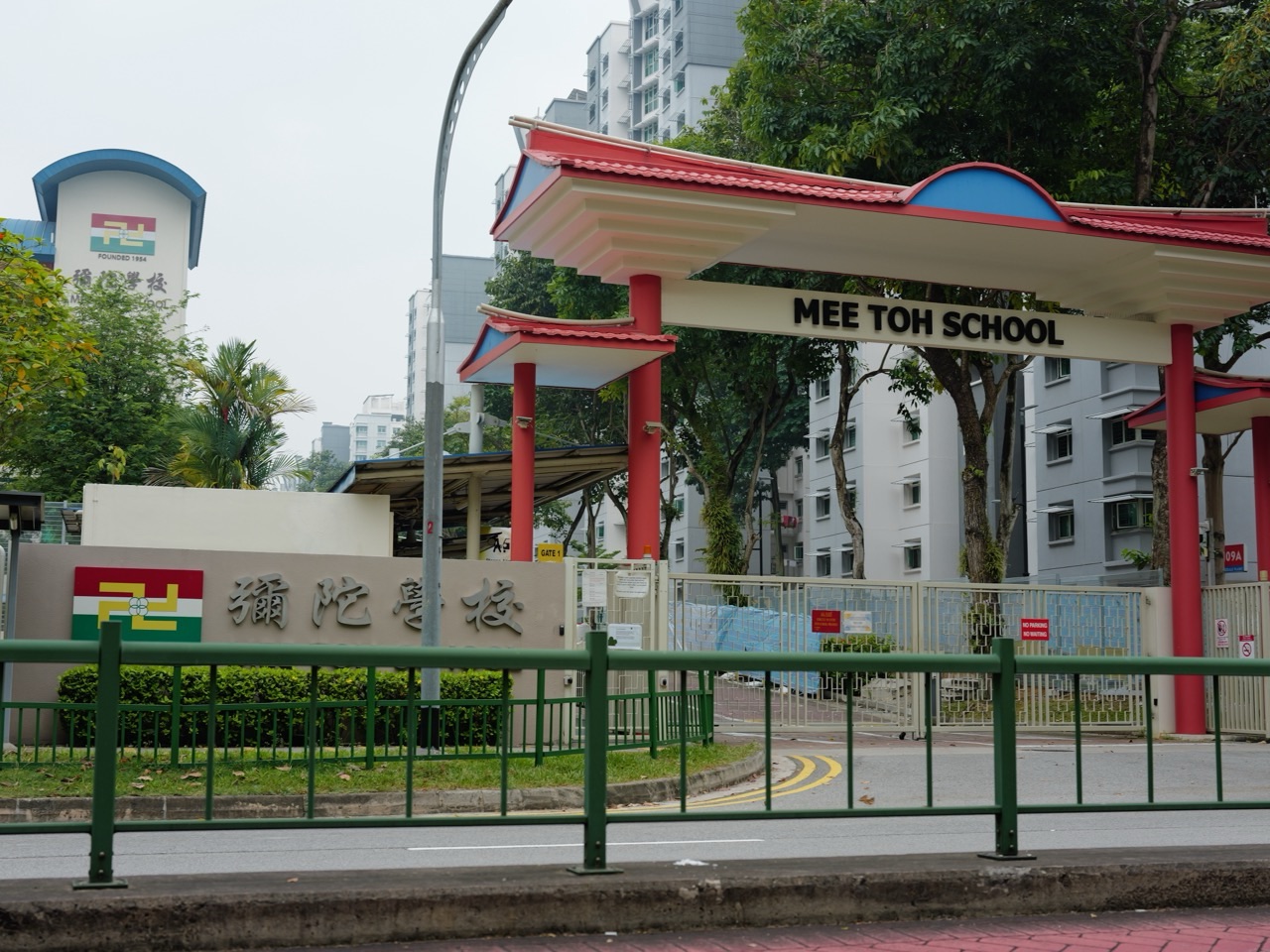
This Punggol school-life guide uses the neighbourhood photographed around Mee Toh School as a starting point for a wider parent question: how does an ordinary recess help a child learn independence, nutrition, Mathematics and social confidence? The answer is more interesting than the price of one bowl of noodles.
Local photo: the entrance of Mee Toh School, Punggol, from the eduKate school-photo collection. The photograph does not show the school canteen, menu or current prices.
Choose your reading route
Article contents
Explore this practical guide
1. What a Primary 1 child really needs to know about recess
2. How to decide pocket money without guessing a universal dollar figure
3. Healthy school food is a system, not a photograph of one meal
4. The hidden social lesson: confidence at the counter
Adults often imagine recess as a break in teaching. For a younger child it is a practical lesson in managing the world. There are people to speak to, choices to make, time to notice, money to handle and friends to find. The academic timetable may be carefully designed, yet a child’s confidence can hinge on being able to ask a canteen vendor a clear question.
Before the first weeks of school, rehearse the process with play rather than pressure. One person is the vendor, another is the customer, and the child practises stating an order politely. Swap roles. Make an occasional mistake and show how to correct it calmly. You can do this at home without pretending that any particular Punggol school follows the same ordering sequence.
If your child is moving into Mee Toh School, Punggol View Primary or another Punggol school, the school’s own notices and orientation guidance come first. Our Primary 1 readiness guide covers the larger transition.
- Recognise the school’s designated recess time and where to go
- Understand the school’s method of paying for food
- Practise saying an order audibly and politely
- Know whom to approach when confused or short of money
- Allow time to eat, drink water and return for the next lesson
SECTION 2 OF 6
How to decide pocket money without guessing a universal dollar figure
A useful pocket-money plan starts with actual prices at the child’s school, not a national average taken from an old discussion. Ask what a suitable meal costs, whether the child also buys a drink, and whether the family normally packs anything from home. Identify which purchases are necessary and which are optional. Then practise keeping enough aside for the necessary item.
For younger students, separate everyday buying from a larger lesson about saving. Give the child a small number of choices that are easy to understand. If the child runs out of cash or cannot find a payment card, teach the appropriate help-seeking step rather than encouraging borrowing from unfamiliar people.
A child can learn the mathematics naturally: recognising money, comparing two prices, checking change and predicting what remains. These are practical extensions of number sense. That does not mean recess should turn into an exam. When the child can buy lunch comfortably, the mathematical ideas can be discussed later at home.
- Check your own school’s current canteen menu and payment notices
- Set a meal budget based on real prices and the child’s needs
- Explain what the emergency contingency is for
- Rehearse safe handling of cash or approved school payment
- Review whether the amount works after the first school week
Singapore’s Health Promotion Board describes its Healthy Meals in Schools Programme as a collaboration involving schools, canteen vendors, teachers and students. The emphasis is on making healthier choices practical in the school environment. That official programme gives parents a reliable starting point; it does not tell us the menu of any one Punggol school on any one day.
Keep food decisions manageable for children. Encourage them to notice whether a meal is satisfying and varied, whether they have drunk water and whether they have enough time to eat. Avoid dividing food into moral categories that make a child anxious. Families managing food allergies, dietary restrictions or specific health needs should follow the school’s communication procedures and the appropriate professional guidance.
You can also bring the neighbourhood into the conversation. Food choices at Waterway Point, One Punggol or a nearby home kitchen may be different from those at a school canteen. The useful skill is not memorising one menu; it is transferring the ability to make a reasonable choice wherever the child eats.
- Confirm dietary restrictions and allergy procedures with the school
- Explain balanced food choices using everyday examples
- Encourage water and enough time to eat
- Avoid assuming a school follows another school’s current canteen menu
Picture a child who knows exactly what to buy but whispers the order so softly nobody hears. It looks like a food problem, yet the missing step is communication. That is why recess can be a small training ground for English, listening and social confidence.
A helpful family game is to practise a complete exchange: greeting, request, clarification, thanks. For example, the child might ask what an item contains or whether it is available. The adult can respond with a gentle request to repeat more clearly. Keep the game cheerful. The child needs a working sentence, not a performance review.
If the child sits alone or regularly avoids eating because of social difficulties, listen carefully and involve the school when support is needed. Canteen behaviour can be an early window into belonging, but one quiet recess does not diagnose a relationship problem.
- Use short, complete sentences to ask for food
- Practise polite clarification rather than staying confused
- Teach the difference between asking for help and relying on friends for every decision
- Ask about the school day without turning the child into an interrogation subject
The best feedback is specific. Did the child have time to eat? Could they find the queue? Did the payment work? Was the amount sufficient? Did the child know what to do when something unexpected happened? Four clear answers are more useful than asking only whether recess was ‘good’.
A small change can fix a big source of friction. Perhaps the child needs a simpler purse, a revised meal budget, clearer instructions or reassurance that asking a teacher is allowed. Most adjustments do not require a complicated system; they need an adult to notice one repeated problem and solve it with the child.
For communication channels and practical notices, see our guide to Parents Gateway and school communication. The school’s current instructions remain the source of truth.
- Ask one concrete question about food and one about independence
- Adjust the routine only after checking what actually happened
- Give the child a chance to solve manageable problems
- Contact the school when the issue involves safety, allergy or ongoing distress
At eduKate, we often explain learning continuity as the ability to keep useful knowledge connected across days and situations. Recess is a lovely example. A student learns number in Mathematics, language in English, routines at home and self-management at school. In the canteen, those pieces suddenly have to work together.
If a child can choose, communicate, pay, check and return to class calmly, several small abilities have become one dependable routine. That is education happening in plain sight. Next time the family visits the One Punggol Library learning guide, the same child can practise checking a borrowing date, following a sign and asking a librarian a question.
Good tuition should support such independence rather than compete with it. For families considering eduKate’s small three-student tutorials, the starting question is always what the child genuinely needs help with—not how many additional activities can be packed into the week.
Frequently asked questions
How much pocket money should my P1 child bring to a Punggol school?
Check the actual school canteen prices, the child’s meal needs and the school’s payment arrangements. There is no reliable amount that fits every Punggol primary school.
Should a child bring cash or use a cashless system?
Use whichever methods the child’s school currently accepts and the family can manage reliably. Do not assume that a payment system used in another school is available here.
What if my child cannot buy food independently?
Practise a short ordering and payment routine at home, teach the child whom to ask for help at school, and speak to the school if difficulties persist.
Read further with eduKate
Start with starting Primary 1, continue into school communication, and explore learning from the Punggol neighbourhood. Parents looking for a structured subject-level learning plan can explore eduKate Punggol.
Sources and accuracy notes
- Health Promotion Board: Programmes and Resources for Primary Schools (updated 2 October 2026).
- MOE school canteen and bus services: school canteen selection criteria (updated September 2026); canteen prices and menus are determined at school level.
- Punggol school-specific details and canteen payment arrangements must be confirmed through each school’s official parent information; exterior photographs are not a source for those details.
This is an independent eduKateSG parent-and-student guide. Check your child’s own school for current programmes, menus, canteen payment rules, timings, access arrangements and student support procedures. School exterior photographs illustrate the locality; they are not evidence of inside-school practices.