
Punggol Library is at 1 Punggol Drive, One Punggol #01-12, Singapore 828629. For a student borrowing books, start with a suitable title and an active NLB membership, then check the actual loan and due date. NLB’s published standard book loan period is 21 days; membership-specific privileges and renewal conditions still matter.
For English practice, a manageable book that a child wants to read is a useful starting point. Preview a short section, check whether the student can explain it and choose a realistic amount to read. Borrowing a large stack is not the same as building understanding.
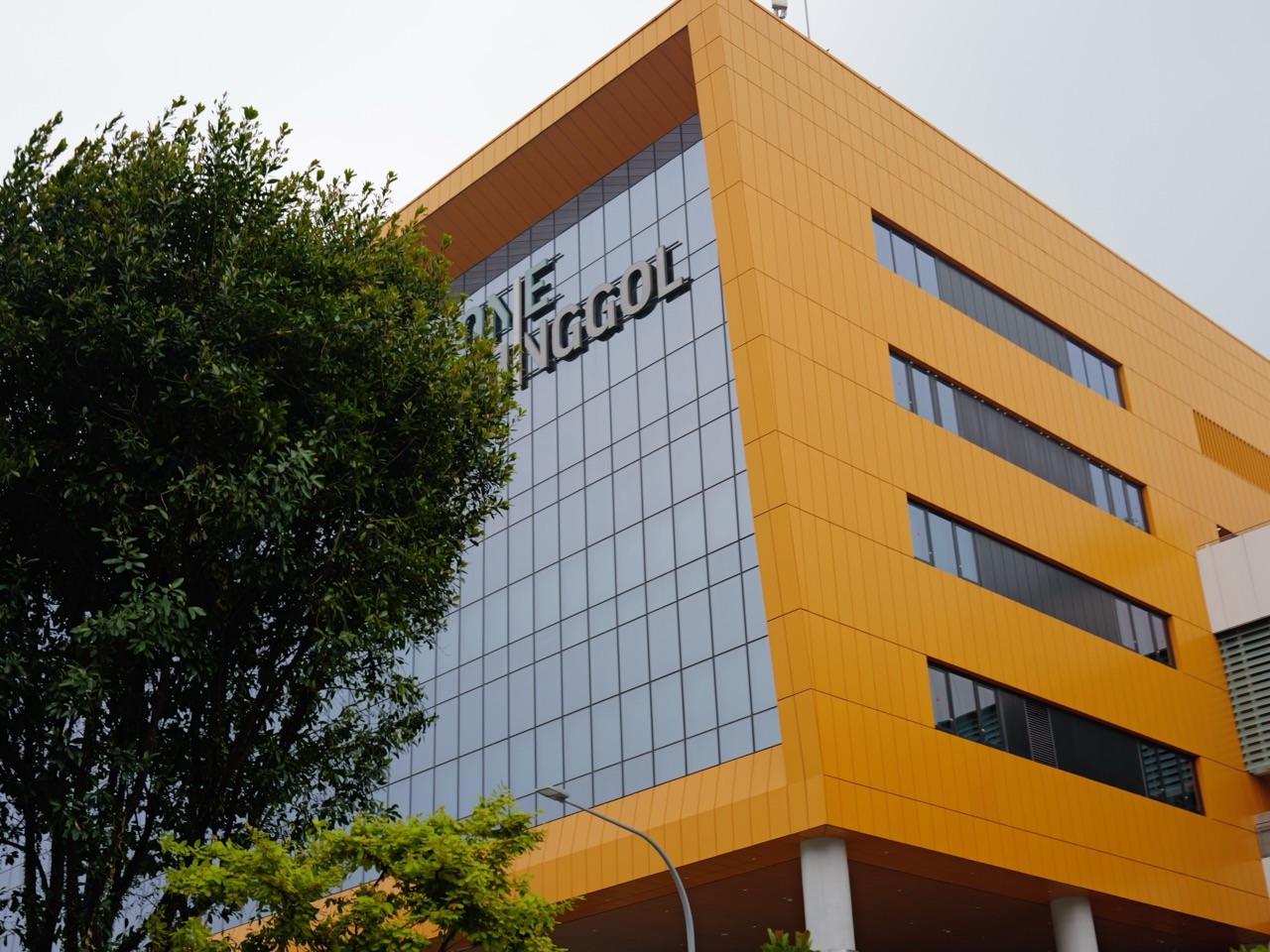
The uploaded One Punggol photograph places this guide in the neighbourhood. Below are practical ways to choose, borrow and discuss books, alongside official NLB information. The reading activities are eduKate suggestions, not a school reading list or a promise of examination results.
Uploaded photograph: One Punggol's yellow-clad exterior, windows, signage and surrounding trees. Punggol Library's location within One Punggol is confirmed by NLB; the image does not show its shelves, borrowing facilities or readers.
Choose your reading route
Understand the setting · Try a practical activity · Find the next useful support
Article contents
Sections 4–6
4. Learn a few words in their actual context
Use the official Punggol Library page for current visitor details. NLB lists the main library’s regular hours as 10am–9pm daily, with extended access from 9am–10am and staff-assisted services from 10am. Holiday arrangements differ, so check before travelling.
The separate Level 3 Study Zone has different access hours. Do not assume that access to that zone means the book collections or staff services are open. Our Punggol study-place guide handles that distinct question.
For this visit, choose a small goal: find a story the child wants to continue, a factual book connected to a question, or a suitable alternative to an unfinished book. Leave time to preview it before borrowing. The yellow exterior in the photo identifies the hub, not a particular shelf location.
NLB’s membership information states that Basic Membership is free for Singaporeans. Other membership categories have their own eligibility and fee arrangements. A child’s student status or address alone is not enough to infer every entitlement; use the category that actually applies.
The borrowing and reservation guidance lists a Basic Membership quota of 16 physical items and 16 eBooks, including eAudiobooks. A quota is a limit, not a reading target. Choose what the family can reasonably manage.
Standard book loans are listed as 21 days, with a further 21-day renewal only when the item has not been reserved and is not overdue. Accessible Membership has different loan privileges. Check the due date shown for each actual loan and confirm a renewal succeeded; do not assume every book can be kept longer.
For current instructions on borrowing, returning, renewing and checking loans, start at NLB Loans and Reservations. Follow the official process rather than sharing account credentials with another family or tutor.
Ask what the student would like to discover: a mystery, a funny character, animals, inventions or a familiar place. Interest supplies a reason to continue. Then preview a short section together and ask the student to explain what happened or what the passage taught them.
If every sentence requires help, try a more manageable text or agree on supported reading. If the passage is easy but enjoyable, it can still be a worthwhile pleasure read. There is no need to make every borrowed title the hardest book the child can attempt.
For a teenager, allow genuine choice while checking suitability for the individual reader. A book’s length, cover or popularity cannot by itself establish that fit. Ask for help finding options when needed, and check catalogue availability rather than promising that a particular title is waiting at Punggol Library.
| What you notice | A useful next move | What to avoid |
|---|---|---|
| Interested and able to explain the passage | Borrow a manageable amount and agree on a reading time | Turning enjoyment into a long worksheet |
| Interested but frequently lost | Try supported reading or a more accessible option | Equating difficulty with laziness |
| Understands but has little interest | Explore another topic or format | Selecting only by adult preference |
| Enjoys an easier book | Keep room for pleasure reading | Demanding every book be a challenge |
Choose a small number of useful unfamiliar words rather than copying every unknown word. Ask what each seems to mean in the sentence, check an appropriate reference and reread the passage with that meaning in mind. Context helps determine which meaning is relevant.
Then ask the student to explain the word in plain language and use it in a new sentence. A copied definition does not establish that the student can recognise or use the word independently. Revisit it later in another passage or conversation.
Our eduKate vocabulary resources provide a supplementary route for language practice. Keep the practice connected to the student’s level and the reading in front of them; a large unrelated list can distract from understanding the book.
After a short section, ask one good question. For fiction: what changed for the character, and which part helped you notice? For a factual book: what was the main idea, and which example explained it? Let the student point to the passage before extending the discussion.
A younger child can retell an event aloud or draw a scene. An older student can write a brief summary and separate the author’s claim from supporting examples. These are optional practice activities, not requirements for every library book.
If there is a school assignment, follow the teacher’s instructions and have the student produce their own work. Avoid copying an online review as a reading response. A simple honest explanation tells you more about understanding than a polished paragraph the child cannot explain.
Before leaving the library, check which items were successfully borrowed and note their due dates. At home, give borrowed books a regular place and agree who checks the account. A reminder before the due date creates time to return an item or investigate whether renewal is available.
At the next visit, ask what the student enjoyed, where they lost the thread and what they want to try next. An unfinished book can still give useful information about interest, vocabulary or reading stamina. Change the next choice thoughtfully rather than treating every unfinished title as failure.
For broader learning beyond lessons, continue to our One Punggol library learning guide. If comprehension repeatedly breaks down, bring a suitable example and the child’s own response to an eduKate learning discussion. Begin with the precise difficulty before deciding on additional support.
Explore A Student’s Life in Punggol for the wider neighbourhood picture. Reading can be part of an ordinary week, alongside school, friends and family. eduKate’s independent guide does not imply affiliation with NLB.
Sources and review
Reviewed 11 October 2026. Official sources support the place and policy facts; activities and illustrative calculations are eduKate suggestions. Follow current official visitor, transport and school instructions for a particular visit.
NLB: Punggol Library visitor information
NLB: membership types and privileges