
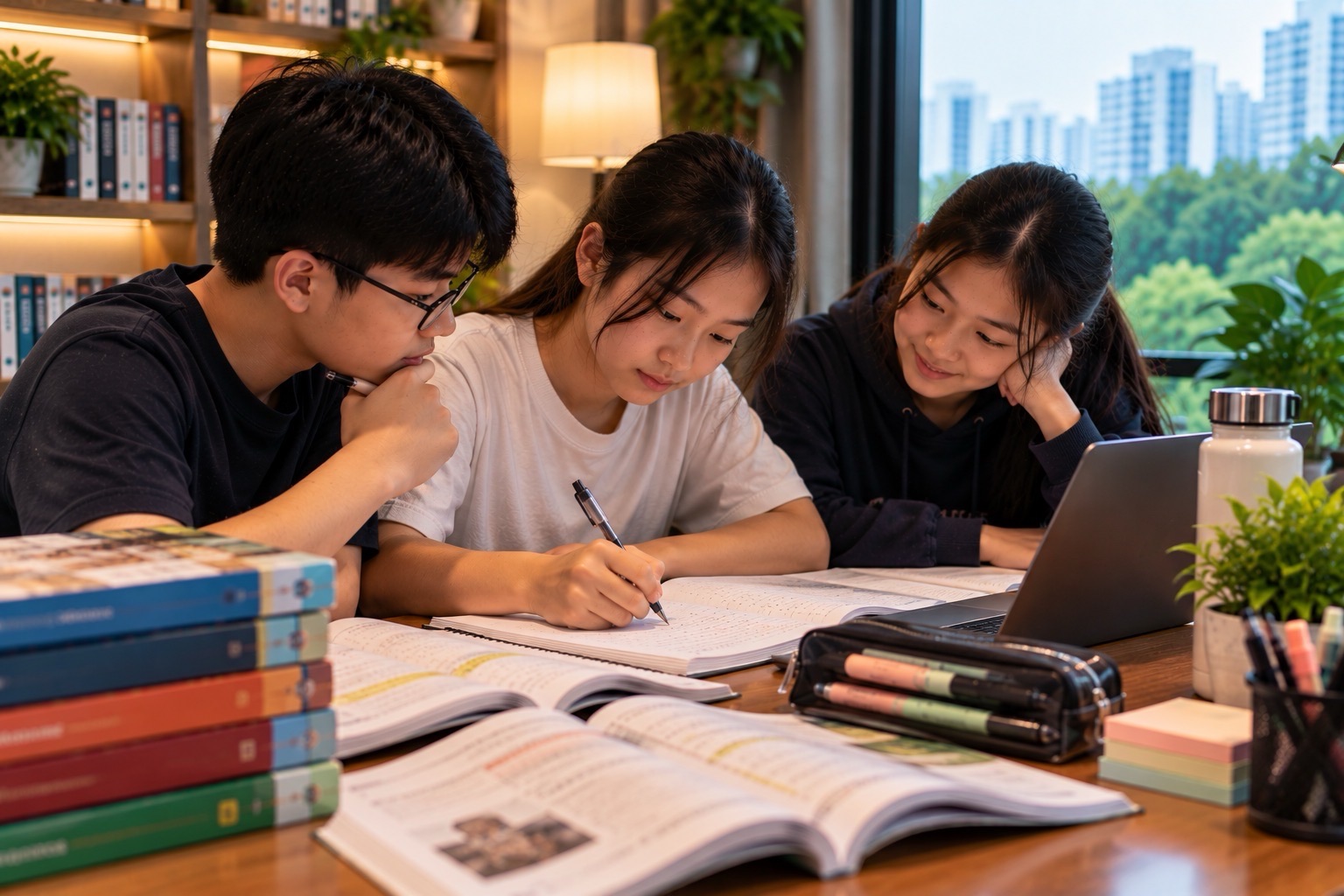
EDUKATE · HOLLAND ROAD · SECONDARY 1 · G1/G2/G3 PHYSICAL SCIENCE · PREMIUM THREE-PUPIL TUTORIALS
Secondary 1 Physics Tuition | Holland Road Weekday or Weekend Parent Dilemma
For Holland Road parents, choose weekday Physics-related tuition when the child’s school Science misconception is fresh and attention remains strong; choose a weekend when the pupil benefits from careful measuring, modelling and independent follow-up. The best result is not a fuller timetable but a learner who can explain and solve a changed question alone.
In Secondary 1, physical Science is ordinarily part of lower-secondary G1, G2 or G3 Science rather than a separate Pure Physics examination course. Bring actual schoolwork before deciding on a tutor. The guidance below starts with measurement, physical meaning, fair testing and original worked examples.
Holland Road is a corridor rather than a single teaching estate. NParks locates Holland Village Park at Holland Road and Holland Avenue. The established eduKate premium three-pupil centre reference is 8 Fourth Avenue near Sixth Avenue MRT. This article does not claim a teaching branch inside the park or at Holland Village.
| Parent consideration | Weekday | Weekend |
|---|---|---|
| Potential benefit | Fresh school errors are remembered | Time to observe, test and explain patiently |
| Potential limitation | CCA, travel, fatigue and meals | Too many enrichment activities, reduced recovery |
| Better evidence | Changed question solved after a delay | Changed question solved after a delay |
| Parent decision | Choose the slot that improves first-step reasoning without exhausting the child | |

A practical guide to Secondary 1 physical-science mastery
- How Holland Road parents can make the first good tuition decision
- Holland Road is a corridor, not a single tuition estate
- Secondary 1 Physics is usually part of lower-secondary Science
- G1, G2 and G3 require a genuine curriculum check
- The Primary 6 to Secondary 1 shift is a reasoning transition
- Weekday tuition: the advantage of fresh school feedback
- Weekend tuition: the advantage of a complete investigation
- Measure the whole family’s schedule, not just the class slot
- A real place inspires a question but supplies no experimental numbers
- Original worked example: the ruler does not have to start at zero
- How repeated readings reveal measurement quality
- Water displacement measures the rise, not the final reading
- Density requires both mass and volume
- Mass, volume and weight answer different physical questions
- An average-speed calculation is about total path length
- Distance, displacement and an honest choice of extension
- Read the axes before reading the shape of a graph
- Forces should be attached to an object and an interaction
- Friction can be useful, not simply unwanted
- Thermal energy and temperature are not synonyms
- Original cooling-rate calculation and what it cannot show
- Fair tests protect the meaning of comparisons
- Particles and representations should not invent matter
- A good Science paragraph separates claim, evidence and reasoning
- The Fencing Method keeps one scientific relationship visible
- Repair, Stabilisation and Extension are different responses
- The Four Contact Points around a learner should cooperate
- A possible ninety-minute three-pupil lesson
- A four-week parent check shows whether the timetable works
- A sensible first consultation and the final parent decision
How Holland Road parents can make the first good tuition decision
A Secondary 1 child who finds physical Science confusing does not necessarily need a longer worksheet or a separate Pure Physics course. Start with one question from school that the pupil cannot yet explain. Perhaps the final mark on a ruler was mistaken for an object’s length, or an observed event was treated as proof of an unmeasured cause. These are diagnosable problems, not evidence that the entire chapter has failed.
The right tutor asks for the first independent attempt, identifies the earliest wrong decision and teaches the missing relationship with a clear example. A new question then changes the setting so that the learner must decide whether the method still works. This is a more useful test of understanding than copying a model answer.
For parents deciding on a weekday or weekend class around Holland Road, the answer is practical: choose the slot that leaves the child alert enough to think and offers a chance to retrieve the corrected method later. An enjoyable session is welcome, but independent reasoning is the educational outcome that matters.
Holland Road is a corridor, not a single tuition estate
Holland Road is a real road corridor connecting several recognisable parts of Singapore. NParks identifies Holland Village Park at the junction of Holland Road and Holland Avenue, near Holland Village MRT. The National Library Board’s history of Sixth Avenue also notes that the avenue was extended to connect with Holland Road. These are useful geographic facts, but they do not establish a single uniform journey for every Holland Road household.
Families nearer Holland Village may have different transport choices from families farther along the road toward the Sixth Avenue area. A weekday journey may begin at school, while weekend travel usually begins at home. The actual lesson venue matters more than a search result’s neighbourhood label.
The established eduKate premium small-group reference describes 8 Fourth Avenue, Singapore 268674, near Sixth Avenue MRT. This Holland Road guide does not claim a classroom at Holland Village Park or an additional teaching branch along the road. Confirm the exact address, schedule and current subject availability directly.
Secondary 1 Physics is usually part of lower-secondary Science
A parent may type ‘Secondary 1 Physics tuition’ because the child is struggling with motion, energy or measurement. In school, however, these physical-science ideas generally belong to lower-secondary Science rather than a separately examined Pure Physics subject. This distinction prevents the child from being given examination papers intended for an older course.
MOE publishes G1 and G2/G3 lower-secondary Science curriculum frameworks, while schools determine how units are sequenced within their programmes. A pupil may be learning laboratory measurements this month and practical explanation next month. A generic acceleration booklet might be unnecessary even if the tutor knows advanced mechanics very well.
Ask for the school subject level, latest learning outcomes and recently marked work. The tutor should explain which activity addresses the current requirement and which activity is an optional extension. The purpose of tuition is to connect the student’s present learning to a stable future foundation, not to produce impressive but poorly timed formulas.
G1, G2 and G3 require a genuine curriculum check
Subject-Based Banding is not simply three labels pasted onto the same worksheet. G1 Science and G2/G3 Science have officially defined teaching frameworks, and schools select the appropriate level, emphasis and sequence. A child who performs well on one kind of task may still need development in another: scientific vocabulary, graph reading, experimental planning or numerical relationships.
For a G1 pupil, the next useful exercise may ask for an appropriate instrument and a clear reason. A G2 or G3 pupil might be ready for a more involved set of measurements, a model or a comparison of possible explanations. Neither approach is inherently superior; the correct challenge depends on the student’s current course and understanding.
A tutor should not silently swap in a Pure Physics exercise for a lower-secondary Science goal. Parents can ask the simple question: ‘Which part of my child’s actual Science lesson does this activity strengthen?’ A clear answer is a sign of careful planning rather than indiscriminate acceleration.
The Primary 6 to Secondary 1 shift is a reasoning transition
Primary Science already teaches observation and fair testing, but Secondary 1 often requires more explicit treatment of quantities, variables, graphs and assumptions. A pupil may have learned that a toy moves faster on one surface and now be asked to identify what evidence would support such a conclusion. The words look familiar, while the reasoning demands more precision.
A useful bridge begins with a concrete scene, then a drawing, then a verbal explanation and finally, where appropriate, numerical notation. This progression prevents the formula from appearing as an unexplained command. The child should know what a measurement refers to before being asked to calculate a derived quantity.
Parents should not describe this transition as an automatic academic decline. The important question is where the student’s earlier method stops working. If a familiar strategy still gives correct reasoning, preserve it. If it fails in a new representation, repair the specific gap and check that the corrected understanding transfers.
Weekday tuition: the advantage of fresh school feedback
Suppose the child receives a marked worksheet about measuring cylinders on Monday. A weekday class can reconstruct the exact error before the pupil forgets why the wrong answer seemed reasonable. The tutor might discover that the learner read the final level correctly but did not subtract the initial water level. That can be corrected promptly with a physical explanation and a changed cylinder problem.
The benefit disappears when the child reaches class exhausted. CCA, school dismissal, meals and travel may leave little attention for a thoughtful experiment. A neat corrected answer produced under constant prompting is not enough to justify an additional evening commitment.
Test the arrangement by asking for a different question the following day. If the student can set up the subtraction and explain it unaided, the timing is contributing to useful learning. If repeated weekday lessons end in fatigue and forgetting, rethink the schedule or teaching approach rather than automatically adding hours.
Weekend tuition: the advantage of a complete investigation
A weekend lesson can give the learner time to make a prediction, measure something safely, notice an unexpected reading and explain possible sources of error. A simple ruler or measuring-cylinder investigation may require only ordinary supervised equipment, yet can expose important misunderstandings that a rapid worksheet hides.
More available hours do not guarantee more learning. A pupil who spends the entire weekend travelling between tuition and enrichment classes may arrive at Monday school more tired. A two-hour stretch of copied solutions can also be less valuable than a focused ninety-minute lesson with a good independent exit task.
A practical compromise is to note confusing school questions during the week and bring them to the weekend session. Preserve the original thinking in a sentence. After the class, schedule a short changed problem rather than another full worksheet. The weekend is useful when it enables this full learning cycle without sacrificing recovery.
Measure the whole family’s schedule, not just the class slot
An advertised ninety-minute lesson can occupy much more than ninety minutes once travel, waiting, meals and return-home time are included. A Holland Road family should compare the actual route from school on weekdays with the actual route from home on weekends. The route may pass different interchanges or bus stops depending on where the student starts.
Ask for the teaching address and start time rather than relying on a broad Holland Road description. Holland Village MRT and Sixth Avenue MRT are distinct stations, so the name of the district is not enough to establish convenience. Do not infer a measured journey time from a street photograph or a road map’s straight-line distance.
Over two weeks, record alertness at the beginning of class, the topic repaired and whether a new problem can be solved after a delay. Also note bedtime and school workload. The preferred slot is the one that makes independent work more reliable while allowing the learner to remain a healthy, engaged student.
A real place inspires a question but supplies no experimental numbers
Holland Village Park sits at Holland Road and Holland Avenue, according to NParks. A family may notice movement, light, shade and temperature differences during an ordinary visit. These observations can become good scientific questions: what could be measured, how would an instrument be used, and what would make a comparison fair?
Seeing a pedestrian reach a point before another does not establish the first person’s greater average speed if distances differ. Similarly, seeing a shaded patch does not reveal the exact thermal energy transferred or temperature measured. The difference between a familiar setting and a verified dataset is essential.
For this reason, every numerical exercise in this guide is identified as illustrative. A tutor can use local contexts to make Science inviting without inventing values for real people, park objects or roads. The child should learn to ask for missing evidence rather than insert an attractive assumption into the answer.
Original worked example: the ruler does not have to start at zero
Imagine a pencil aligned with a ruler so that its left end is at 4.3 cm and its right end is at 17.1 cm. The pencil’s length is the interval 17.1 – 4.3 = 12.8 cm. A student who reports 17.1 cm has read the right-end coordinate as though it were the object’s entire length.
Now slide the pencil to a new position, with ends at 1.8 cm and 14.6 cm. Its length is still 12.8 cm. Ask the pupil to predict that the answer must remain unchanged before calculating. The physical size of the pencil has not changed; only its position relative to the ruler has.
This example also creates a discussion of measuring practice. The ruler should be aligned with the object, readings should be taken without unnecessary viewing-angle error, and precision should reflect the scale. A student who can explain those conditions has understood more than a subtraction trick.
How repeated readings reveal measurement quality
Suppose the same length is measured three times and the readings are 12.8 cm, 12.7 cm and 12.9 cm. A simple average is (12.8 + 12.7 + 12.9)/3 = 12.8 cm. But the average alone does not prove the result is perfectly accurate. A consistently tilted ruler could bias every reading.
Ask what was held fixed, whether the same endpoints were used and how the scale was viewed. A repeated result can show consistency while leaving a systematic problem undetected. This is why a method description matters just as much as the final number.
A tutor might ask for one improvement to the procedure rather than a fourth nearly identical calculation. Using a suitable instrument and a consistent observation position can be more meaningful than adding many decimal places to an uncertain result. Scientific confidence should follow the evidence.
Water displacement measures the rise, not the final reading
A measuring cylinder contains 34.0 mL of water before a non-porous solid is fully immersed. The new reading is 59.0 mL. Under the simplified assumptions, the solid’s volume is 59.0 – 34.0 = 25.0 mL, equivalent to 25.0 cm³. This is not the same as reporting the final cylinder level.
The subtraction works because the original water was already present. The increase is attributed to the volume displaced by the solid. The student should recognise the assumptions: complete immersion, no substantial trapped air, no dissolving and a suitable cylinder reading.
For a transfer test, change the starting level to 41.0 mL and the final level to 66.0 mL. The answer remains 25.0 cm³. A pupil who understands the model can handle the change without copying the first example’s numbers. These are deliberately fictional classroom data, not readings taken at Holland Village Park.
Density requires both mass and volume
If the solid from the previous example has a mass of 61.25 g and occupies 25.0 cm³, density is 61.25/25.0 = 2.45 g/cm³. Density is mass per unit volume, so a heavier object is not necessarily denser than a smaller one.
A second object could have mass 96 g and volume 48 cm³, giving a density of 2.0 g/cm³. It has greater total mass but lower density. Ask the learner to explain why this is possible before doing another calculation. The ratio, not the appearance of the object, determines the comparison.
Now hold mass constant while increasing volume. Density must decrease. Asking for this prediction is useful because it reveals whether the student understands proportional relationships. The tutor should also check whether the child’s school course has reached density at the relevant depth; the example can be a suitable extension rather than a compulsory task for every Secondary 1 pupil.
Mass, volume and weight answer different physical questions
Mass describes a different quantity from volume, while weight is a gravitational force. Mass is commonly measured in kilograms or grams; weight is measured in newtons. Students hear the word ‘weight’ used for mass in everyday shopping, but formal Physics uses the distinction carefully.
Two objects can have equal volume yet different masses because their materials differ. Two objects can have equal mass while occupying different volumes. These examples prevent pupils from equating visual size with mass or density. They can be demonstrated with safe classroom objects and suitable instruments.
Introduce W = mg only if appropriate to the taught course or a carefully explained extension. The immediate goal is to identify what a balance or force-measuring device is showing and to report the unit correctly. A pupil who chooses the right quantity before calculating is better prepared for later mechanics than one who uses every visible number.
An average-speed calculation is about total path length
Imagine a fictional journey over a measured route of 210 m completed in 175 s. Average speed equals total distance divided by total time, giving 210/175 = 1.20 m/s. A second fictional journey covers 300 m in 250 s, also yielding 1.20 m/s.
The equality reveals that different distances and times can produce the same average speed. A child who declares the second journey slower simply because it took longer has overlooked the larger distance. Ask for a prediction before performing the division and then explain why the ratios are equal.
These numbers are not real travel measurements on Holland Road. The local setting helps pupils imagine a journey, but real speeds require measured distances and times. A scientific explanation must not turn a hypothetical model into a claim about actual pedestrians or traffic.
Distance, displacement and an honest choice of extension
A model walker moves 5 m east and then 5 m west along the same line. The total distance travelled is 10 m, while displacement is zero because the final and initial positions are identical. Both statements are correct when their quantities are named accurately.
Change the return leg to 3 m west. Total distance becomes 8 m and displacement becomes 2 m east. A student who writes 2 m for distance has confused the journey’s path length with its net position change. Drawing arrows makes the distinction visible.
Formal treatment of displacement may belong to later taught material for some lower-secondary students. Use it as a deliberate extension when appropriate, not as evidence that every Secondary 1 class must already be doing upper-secondary kinematics. The important transferable habit is to read the requested quantity before choosing an equation.
Read the axes before reading the shape of a graph
A distance–time graph is not a sketch of the physical walkway. Its vertical axis represents a defined distance quantity and its horizontal axis typically represents elapsed time. A line rising upward on the page does not mean the route climbs a hill.
If a straight line joins 0 m at 0 s to 15 m at 5 s, the distance changes at 15/5 = 3.0 m/s over that interval. A horizontal segment means the plotted distance does not change during that part of the model. A steeper segment can indicate a greater rate only if the scale and quantities are understood.
Ask the pupil to explain one point and one line segment before calculating a gradient. Change the axis scale in a fresh exercise. If the child still reasons from numerical values rather than visual slope alone, graph literacy is becoming stronger.
Forces should be attached to an object and an interaction
A stationary book on a table experiences forces even though it is not accelerating. Its weight acts downward and the table exerts a supporting contact force upward. In a simple balanced example, these can sum to zero. ‘It does not move, so there are no forces’ is not a correct physical explanation.
Before drawing arrows, identify the chosen object and which other objects interact with it. Do not put arrows representing forces exerted by the book onto the table on the book’s own free-body diagram. The diagram should be an argument about one chosen system.
For Secondary 1 learners who have not reached formal Newtonian mechanics, the same principle can be explored through push, pull, support and friction in age-appropriate language. The model should develop with the school course, not be rushed into advanced formulas to sound impressive.
Friction can be useful, not simply unwanted
A child may remember that friction opposes sliding and then assume friction always stops useful movement. In walking, contact friction between footwear and the ground can help prevent slipping. In a vehicle, frictional interactions can provide traction. The role of friction depends on the surfaces and motion being considered.
A safe tabletop investigation can compare the force required to move a small object along different surfaces, using school-approved equipment and a consistent procedure. No experiment should encourage pupils to run on slippery park paths or interfere with traffic. The aim is a fair comparison, not a dramatic effect.
Ask the learner to name both interacting surfaces and explain what tendency to slide the friction resists. If they can find an example where friction helps and another where it causes unwanted energy transfer, they have moved beyond a one-line definition.
Thermal energy and temperature are not synonyms
A warm object and a hotter object cannot have their total energies compared solely from one temperature reading without further details. The system’s mass, material and process can matter. A common beginner error is to treat a thermometer’s number as though it directly states total thermal energy.
Consider a metal spoon placed in comfortably warm water during a supervised activity. The spoon may become warmer through energy transfer, but a single thermometer reading does not establish every mechanism and quantity involved. Ask which objects interact and what change is observed.
Formal heat-transfer explanations should follow the student’s lower-secondary Science sequence. The immediate teaching goal is to separate observed temperature from the inferred transfer process and to avoid claiming a precise amount of energy without relevant data. This habit remains valuable through later Physics.
Original cooling-rate calculation and what it cannot show
In a fictional experiment a sample cools from 72 °C to 60 °C in four minutes. The change is 60 – 72 = -12 °C, so the average rate of temperature change is -3 °C per minute. The minus sign reports that temperature decreased over the interval, not that the sample had a negative temperature.
A second sample cools from 72 °C to 66 °C over the same interval, giving an average rate of -1.5 °C per minute. Its rate has a smaller magnitude. Ask the student to predict this before dividing and to attach the correct rate unit.
The data do not independently prove whether conduction, convection, radiation or evaporation caused each part of the cooling. A suitable physical model and further evidence are needed. The temperatures are invented classroom values, not measurements from actual Holland Road buildings.
Fair tests protect the meaning of comparisons
Suppose a school investigation compares how two cup materials affect water cooling. If the starting temperature, water volume and air movement differ unpredictably, a later temperature difference could have several causes. The method should keep relevant conditions comparable while the proposed independent variable changes.
Instead of asking students merely to name independent, dependent and controlled variables, ask why each control matters. What alternative explanation would remain if one container held twice as much water? How would a different thermometer position affect the readings? The pupil should understand the logic of fairness.
Real measurements can vary, and a good investigation reports that variation. Repeating readings and describing limitations are better than rewriting the table to produce a smooth, expected trend. The objective is an honest conclusion proportional to the data.
Particles and representations should not invent matter
An introductory particle model describes matter through particles and their behaviour, but drawings can mislead if students treat every sketch literally. A diagram with dots spaced farther apart after heating should not imply that new particles spontaneously appeared in the same closed sample. The representation is intended to explain a particular change.
Ask a learner to distinguish what can be observed directly from what a particle model proposes. Temperature change is measured using an instrument. Individual particles in a simple school model are not being counted visually by looking at a cup of water. The explanation therefore needs both the observed effect and the scientific model.
A tutor can use concrete, representational and abstract stages: a safe observable event, a simple particle sketch and a precise written description. This transition helps children see why diagrams are useful without believing every drawing is a photograph of the invisible system.
A good Science paragraph separates claim, evidence and reasoning
A pupil may write ‘the object is denser because it is heavy’. That is not enough. A stronger response states the claim, compares the relevant calculated densities and explains that density represents mass per unit volume. It uses the measurements provided rather than introducing a casual impression.
For a graph, start with the pattern and support it using plotted quantities and units. If the question asks for an explanation, connect the observation to an appropriate physical model, while acknowledging any assumptions. Do not invent a cause merely because it is plausible.
This answer structure can be rehearsed using short, age-appropriate tasks. One clear paragraph often demonstrates more understanding than a long list of disconnected scientific words. The target is precise, useful reasoning that remains readable under assessment conditions.
The Fencing Method keeps one scientific relationship visible
The eduKate Fencing Method begins with a clearly bounded problem. For ruler reading, hold the ruler and unit fixed while changing only the starting position. When the pupil can calculate the interval reliably, introduce a different scale, a damaged zero end or a unit conversion. The fence expands only after the core idea is stable.
For density, begin with one mass and one volume in compatible units. Then change both values, compare two samples or introduce volume measurement by displacement. Each additional condition tests a new decision. If the learner fails, the tutor can identify which added feature caused difficulty instead of declaring the whole topic misunderstood.
The method is not about protecting children from hard questions indefinitely. It is about separating concept development from arbitrary complexity. A challenging unfamiliar problem is valuable when the learner has the tools to interpret it independently.
Repair, Stabilisation and Extension are different responses
Repair is appropriate when a prerequisite is missing. A pupil who reports the measuring cylinder’s final volume as the object’s volume needs to revisit what the readings mean. More density equations will not solve the first conceptual problem.
Stabilisation suits a child who understands during tuition but forgets days later or mixes methods when topics are shuffled. Use short retrieval, changed diagrams and unprompted questions. The tutor should gradually remove hints until the student selects the right model without seeing the original worked example.
Extension is suitable when understanding is secure. Challenge the learner with a counterexample, a comparison of measurement methods or a practical limitation that requires explanation. These are choices about the present skill, not permanent classifications of children. The same pupil may need repair in units and extension in experimental design.
The Four Contact Points around a learner should cooperate
eduKate’s Four Contact Points are School, Parents, Tutor, and Friends and Peers. School provides formal teaching, curriculum coverage and marked assessments. Parents provide routines, rest and thoughtful decisions about learning time. The tutor identifies why a student’s first independent answer failed and designs a targeted correction. Friends and peers influence effort and whether it feels normal to ask questions and compare explanations honestly.
When the four contact points cooperate, the learner receives consistent guidance. A school Science mistake becomes an opportunity for precise tuition, while parents protect a manageable follow-up at home. Peers may share different methods but should not become a source of copied answers.
A useful shared target could be ‘read non-zero ruler marks correctly in a changed context this week’. It is small enough to observe and important enough to build on. The aim is coordinated learning rather than competing demands.
A possible ninety-minute three-pupil lesson
The established premium eduKate reference describes up to three learners with a usual 1.5-hour weekly tutorial. One possible Secondary 1 lesson devotes ten minutes to independent recall, fifteen to locating a genuine misconception and twenty to explaining a physical idea using a measurement or diagram.
The next twenty minutes might allow separate attempts on changed questions, followed by ten minutes of moderated discussion and fifteen minutes for an independent exit task and a short error-to-action note. These allocations total ninety minutes and illustrate a teaching structure, not a verified open class slot.
Every learner should make their first attempt individually. One child may confuse a position with a length; another may have a unit issue; a third may be ready to design a fair test. Small size is valuable only when the tutor observes and responds to those differences rather than relying on one confident voice.
A four-week parent check shows whether the timetable works
In Week 1, record the actual Science level and two marked examples of confusion. Set a short unseen measurement or graph task and note how much prompting the child needs. Week 2 repairs the most important prerequisite and tests it through an altered example.
Week 3 revisits the concept after a delay, mixing it with an earlier stable skill. Week 4 uses a small independent task and reviews both accuracy and the school-week routine. The tutor and parent should discuss what improved, what remains unstable and whether the chosen lesson time is sustainable.
This process does not guarantee a specific jump in marks. It gives the family evidence. When the child makes better first choices with less help, tuition is becoming worthwhile. When the same mistakes recur despite attendance, change the diagnosis or method rather than simply extending hours.
A sensible first consultation and the final parent decision
Bring the child’s current Science course, a school assessment, the topic sequence and realistic weekday/weekend time windows. Ask the tutor to show how the first wrong decision would be repaired and independently tested. Ask whether a general Science programme may be more suitable than a narrowly labelled Physics class.
Confirm the actual teaching address, current tutor, fees, group size and available programme. Holland Road is the family search corridor in this guide; it is not an announced teaching location. The established premium small-group reference remains at 8 Fourth Avenue near Sixth Avenue MRT.
Choose the class that gives the student clearer physical reasoning and a sustainable school routine. A child who learns to ask what has been measured, identify relevant assumptions and explain a changed problem without hints is building a foundation that will remain useful well beyond Secondary 1.
Parent questions and answers
Is Physics separately examined in Secondary 1?
Physical-science concepts usually belong to lower-secondary Science. Confirm the school’s actual G1, G2 or G3 level and current assessment topics.
Is Holland Road one uniform tuition neighbourhood?
No. It is a road corridor; actual journeys and lesson locations vary. The eduKate teaching reference is at 8 Fourth Avenue near Sixth Avenue MRT.
Can weekday tuition be better than weekend tuition?
Yes, when fresh school misconceptions can be reconstructed and the child still has energy. Weekend time may instead support more deliberate investigation.
Does this page announce an eduKate branch at Holland Village Park?
No. The park provides an officially documented local reference, not a claim about tuition classrooms or available seats.
Does a three-pupil lesson suit different strengths?
It can if the tutor observes all first attempts and gives individual corrections. Parents should verify current group composition and course fit.
What is the Fencing Method in Science?
Teach one bounded physical relationship first, then deliberately add a new condition and check whether the child can still apply it.
What are the Four Contact Points?
School, Parents, Tutor, and Friends and Peers are interacting influences that should support a consistent learning goal.
What proves that tuition has worked?
The learner independently solves a changed question after a delay, with correct units, reasoning and less prompting.
Official curriculum, local references and connected Physics articles
- MOE Full Subject-Based Banding
- MOE G1 lower-secondary Science syllabus
- MOE G2/G3 lower-secondary Science syllabus
- NParks Holland Village Park at Holland Road and Holland Avenue
- NLB history of Sixth Avenue and Holland Road
- Established Clementi premium three-pupil tutorial reference
- Holland Close Secondary 1 Physics companion
- Holland Drive Secondary 1 Physics companion
- Holland Road Secondary 2 Physics progression
- Holland Road Secondary 3 Physics progression
- Holland Road Secondary 4 Physics progression
Enquire about an appropriate tutorial
Bring your child’s school Science level, current learning outcomes, a marked question and two practical lesson windows. Ask eduKate about present Science support, tutor fit, current location, fees and available small-group places at https://edukatesg.com/contact-2/ . Holland Road describes a family’s search corridor, not a newly announced classroom.