
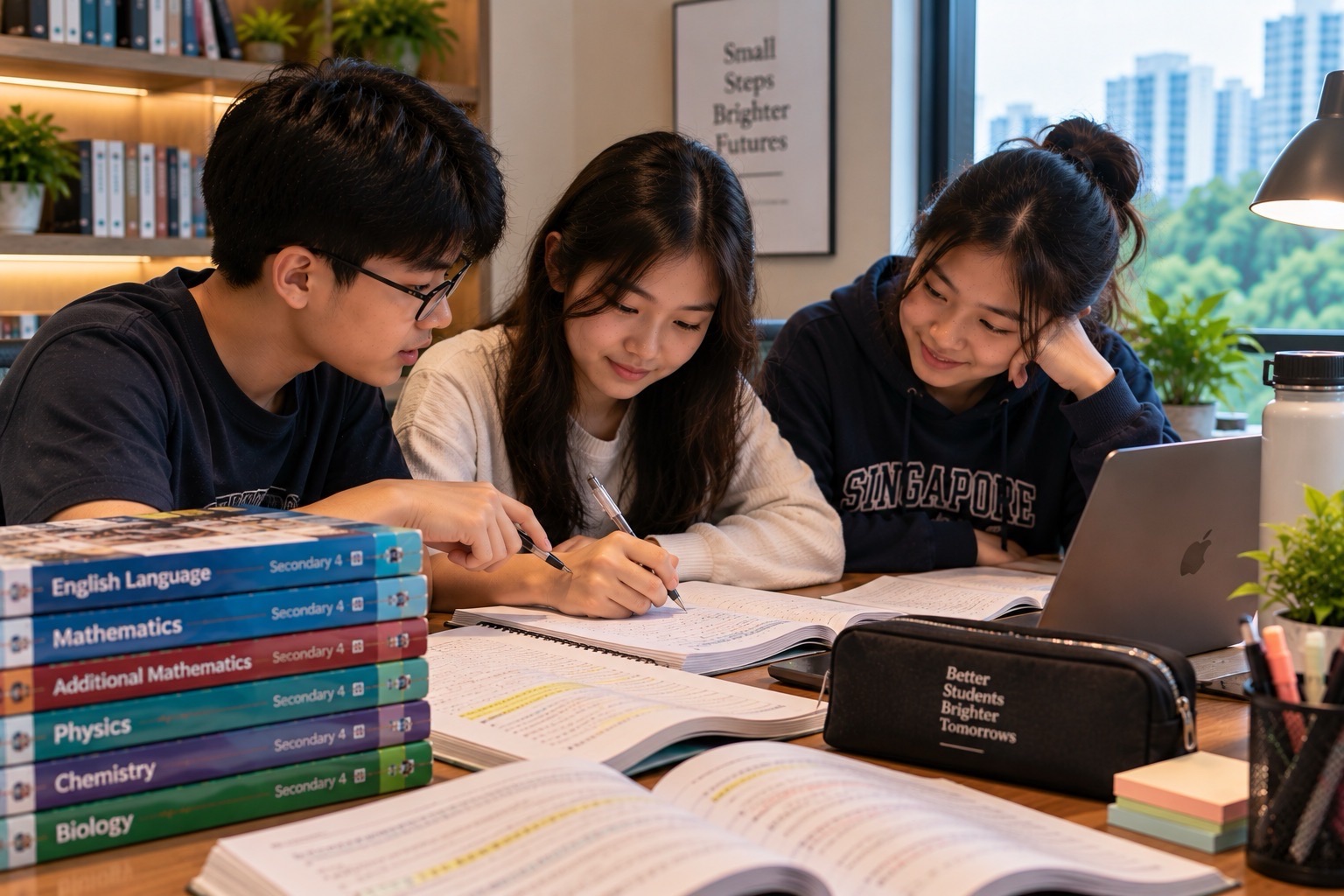
EDUKATE · HOLLAND ROAD · SECONDARY 2 PHYSICAL SCIENCE · G1/G2/G3 · PREMIUM THREE-PUPIL LEARNING
Secondary 2 Physics Tuition | Holland Road Weekday or Weekend Parent Dilemma
Should Holland Road families book weekday or weekend Secondary 2 Physics tuition? Choose the time when a pupil can correct the first wrong scientific idea and then independently solve an altered question. Weekdays may preserve fresh school feedback; weekends can allow careful light, circuit or heat investigations. Neither timetable is better without evidence of learning.
At Secondary 2, Physics-related topics typically form part of lower-secondary Science at the child’s G1, G2 or G3 level. The actual school’s module order matters more than a separate Pure Physics workbook. This guide focuses on ray diagrams, current paths, sound, thermal models, fair testing and independent scientific explanation.
Holland Road is a road corridor, with Holland Village Park officially located at Holland Road and Holland Avenue. The established premium eduKate three-pupil reference names 8 Fourth Avenue near Sixth Avenue MRT. This is not an advertisement of a Holland Village Park branch or a claim that places are currently available.
| Question | Weekday tuition | Weekend tuition |
|---|---|---|
| Potential advantage | Correct newly taught school rays and circuits | Time for a safe prediction-observation-explanation cycle |
| Potential obstacle | After-school travel, CCA and mental fatigue | Enrichment congestion and loss of recovery time |
| Learning evidence | Unseen altered diagram handled after a delay | Unseen altered diagram handled after a delay |
| Best choice | Course fit, independent reasoning and sustainable school routine | |

A practical chapter guide to Secondary 2 physical Science
- What changes when a Secondary 2 Science question gets harder
- Lower-secondary G1, G2 and G3 Science remain the actual courses
- Subject choice is coming, but premature acceleration is not compulsory
- Holland Road context: park junction, road corridor and actual classroom
- Weekday lessons can preserve the school misconception
- Weekend lessons can complete the prediction-observation-explanation loop
- Do not compare two calendar slots without the entire school week
- The reflection law begins with an invisible reference line
- Original worked example: angle to the surface versus the normal
- Shadows and light paths make good predictions, not automatic conclusions
- A circuit is defined by connections, not by artwork
- Series and parallel describe paths, not the number of drawn lines
- Original junction-current example and conservation reasoning
- Potential difference and current are not interchangeable measurements
- A counterexample can repair a false electrical rule
- Sound begins with vibration and needs a medium
- Original echo problem: the distance is for the whole journey
- Heat transfer begins with a chosen system
- Original temperature–time calculation: signed change versus temperature
- Graphs require labels before slopes and patterns
- Energy transfers need useful systems and honest limitations
- Fair testing: controls must rule out plausible alternatives
- A Science conclusion should not overstate what the evidence proves
- The Fencing Method makes one variable of complexity visible
- Repair, Stabilisation and Extension should be diagnosed separately
- The Four Contact Points around the student
- How a ninety-minute three-pupil Science session could work
- A four-week pathway from school error to independent explanation
- A parent should choose the tutor before choosing the busiest timetable
What changes when a Secondary 2 Science question gets harder
The tricky part of Secondary 2 physical Science is often the connection between ideas. A student might know that light reflects from a mirror but mismeasure an angle because the normal has not been identified. Another might recognise a battery, lamp and switch but cannot tell whether a conducting path is complete when the drawing is rearranged.
Before choosing tuition, ask for two marked questions showing where the student first became uncertain. Was the error in a scientific definition, the physical model, the diagram, numerical work or the explanation? A correct answer copied from a marking scheme does not reveal which ability has improved.
For Holland Road parents, the best weekday or weekend tutorial is the one that gives the pupil enough attention to make those first decisions independently. A tutor should check a changed question after teaching and return to the problem a few days later. The timetable serves that learning cycle; it should not be the purpose of tuition by itself.
Lower-secondary G1, G2 and G3 Science remain the actual courses
Secondary 2 students normally study physical-science ideas within lower-secondary Science, rather than a separate Pure Physics examination course. Full Subject-Based Banding provides subject levels G1, G2 and G3. MOE’s G1 and G2/G3 lower-secondary frameworks differ in learning expectations, and a school may sequence its modules in a distinctive order.
If the current class has not introduced formal circuit equations, a complex resistor network should not become the main tutoring activity merely because the child enjoys electricity. A model of current paths may be more appropriate. Conversely, a pupil with secure foundations can be stretched through unfamiliar representations, clear explanation and experimental design.
At consultation, show the current school notes and topic list. Ask the tutor which requirements are compulsory now and which tasks are optional extensions. A child should not be judged weak for failing a question from a different course, nor declared ready for upper-secondary Physics solely because an advanced worksheet was rehearsed.
Subject choice is coming, but premature acceleration is not compulsory
Secondary 2 is often the period when families begin discussing upper-secondary Science combinations. Parents may be tempted to enrol in separate Physics tuition immediately to secure a future pathway. A more reliable readiness indicator is how independently the pupil reasons with measurements, graphs, variables and explanations across their present Science course.
A student who can describe the normal in a reflection diagram, recognise an electrical connection and explain the limits of a simple experiment is building useful foundations. Repeated reliance on the tutor’s first hint suggests a weaker foundation, even if advanced vocabulary appears in the exercise book.
School offerings, course levels, the child’s interests and the subject-allocation process all matter later. SEAB’s 2027 SEC list illustrates the distinction between G3 separate Physics, Combined Science and G2 Science, but a Secondary 2 student in 2026 is generally considering a later examination year. The family must verify the syllabus that applies when the child’s cohort actually graduates.
Holland Road context: park junction, road corridor and actual classroom
NParks confirms that Holland Village Park is at the junction of Holland Road and Holland Avenue, near Holland Village MRT. The National Library Board’s account of Sixth Avenue explains that Sixth Avenue was extended to connect with Holland Road. These references help establish the local geography, not the availability of Physics tutors at every nearby address.
Families along different sections of Holland Road will have different travel plans. One student may finish school far from home; another may have CCA nearby. A weekday school-to-lesson journey can therefore differ from a weekend home-to-lesson route. No responsible article should invent the distance or time from a family’s starting point.
The established eduKate premium three-pupil tutorial reference describes 8 Fourth Avenue near Sixth Avenue MRT. Holland Road in this title refers to the family search corridor, not a newly announced branch at Holland Village Park. Confirm the actual teaching address, subject support, fees and free places directly.
Weekday lessons can preserve the school misconception
Suppose a Secondary 2 pupil receives a marked reflection problem on Tuesday and remembers thinking that the angle of incidence was measured from the mirror surface. A weekday tutorial can reconstruct that first thought while the original school diagram is still fresh. The teacher can draw the normal clearly and test the corrected rule using a rotated mirror.
This advantage is lost when the child is exhausted after CCA, commuting and school homework. A pupil may follow the explanation during class simply because the tutor supplies the diagram, then be unable to begin a changed question on their own. The parent should consider alertness rather than whether the timetable contains an empty hour.
Use the following day for a brief independent task. If the child marks the normal and identifies both angles without prompting, the weekday has provided useful learning. If the same first error returns, change the teaching approach or schedule instead of assuming that more evening exercises will fix it.
Weekend lessons can complete the prediction-observation-explanation loop
A weekend class may create breathing room for a safe light or electrical model. The learner can predict an outcome, draw a diagram, compare it with a supervised classroom observation and explain why the model fits. This can provide a deeper understanding than hurriedly filling in blanks on a worksheet.
Longer available time still needs careful use. A child with several weekend commitments may be less ready for Monday school, while a tutor who assigns dozens of identical diagram questions may create only familiarity with one representation. The value of an experiment lies in identifying a clear relationship and then testing it under a changed condition.
Keep a brief error note during the school week so the weekend lesson can address the real misconception. A short delayed retrieval task afterward is essential. The preferred weekend is the one that protects recovery and produces explanations the learner can still give when the notes are closed.
Do not compare two calendar slots without the entire school week
A nominal ninety-minute class also requires travel, food and the transition back into homework. For a Holland Road family, the start location changes according to school, CCA and day of the week. A local park or MRT label does not establish a uniform journey to the actual teaching room.
Record when the child finishes school, whether they have eaten, how alert they are and what happens after class. Compare these conditions with a weekend option. The goal is sustained attention across the week, not maximum visible hours occupied by education.
Over two or three lessons, ask how much prompting the pupil needed to begin a new problem. A better timetable should reduce that dependence, improve the clarity of explanations and remain manageable alongside other subjects. The schedule is part of the learning design and should be revised if the evidence is poor.
The reflection law begins with an invisible reference line
When light is modelled as a ray striking a plane mirror, the normal is a construction line perpendicular to the surface at the point of incidence. The angle of incidence and the angle of reflection are both measured from this normal. Pupils who measure from the mirror itself can produce a neat diagram with the wrong angles.
Have the child draw the surface, point of incidence, normal and two rays before using any numbers. Ask what each line represents. The normal is not a second source of light; it is a geometric reference for the angles. This distinction is especially important when the mirror is drawn upright or diagonally.
A changed exercise should rotate the surface while preserving the physics. A pupil who still constructs the normal correctly has learned the principle. A pupil who needs the familiar horizontal mirror may be recalling a picture rather than reasoning geometrically.
Original worked example: angle to the surface versus the normal
In an illustrative reflection question, an incoming ray makes an angle of 37 degrees to the normal of a plane mirror. The reflected ray also makes 37 degrees to the normal, according to the law of reflection. Its angle to the mirror surface is 90 – 37 = 53 degrees. The two numbers describe different references.
Now change the wording: the incoming ray makes 24 degrees to the mirror surface. The angle of incidence is therefore 90 – 24 = 66 degrees, and the reflected angle to the normal is also 66 degrees. A pupil who answers 24 degrees for the incidence angle has measured from the wrong line.
Ask the learner to explain why the sum of the surface-reference and normal-reference angles is 90 degrees. The geometry is not decoration; it defines the problem. This original example can be used as an extension where the school’s current Science module includes the ray model.
Shadows and light paths make good predictions, not automatic conclusions
A shadow forms when an opaque object blocks light reaching part of a screen or surface. Its apparent size and shape can depend on the arrangement of source, object and screen. A child who memorises that moving any object nearer a light source always makes the shadow larger may apply the phrase incorrectly when the geometry changes.
An age-appropriate classroom setup can fix the source and screen, then move the blocking object along one defined line. Predict the result before manipulating the apparatus. Keep other distances consistent so the explanation can be linked to the intended change.
Holland Village Park offers a familiar context for discussing natural light and shadows, but a photograph does not supply precise Sun angles, times or shadow lengths. Those would require real observations. Teach pupils to separate an interesting place from measurements that have not been made.
A circuit is defined by connections, not by artwork
Circuit symbols are a compressed way to describe a physical electrical network. An open switch interrupts a path in a simple model; a closed switch can complete it. A lamp drawn near a battery does not necessarily light merely because the components appear close together on the page.
Ask the pupil to trace a complete conducting route through the source and components. Then redraw the same network with curved wires or the lamp placed in a different position. If the connections are unchanged, the simple circuit behaviour should remain unchanged.
Use low-voltage school-approved equipment under appropriate supervision. Do not experiment with household mains sockets or dismantled appliances. The point of the practical demonstration is safe reasoning about the connection model, not generating dramatic electrical effects. A student who can narrate the path is ready for more complex circuit diagrams when the course requires them.
Series and parallel describe paths, not the number of drawn lines
In a suitable simple series circuit, current travels along one branch through the components. Parallel branches provide multiple paths connected across the same two nodes. Students who identify series merely because the drawing looks like one straight line can be misled when the wires are bent or the components appear at different heights.
Mark the junctions on the diagram and ask whether each branch joins the same endpoints. Then give another drawing with identical electrical connections. The pupil should recognise the same network even if the visual layout is changed substantially.
Be careful with simplistic claims about lamp brightness. The brightness of real lamps depends on electrical characteristics, source conditions and the arrangement. First teach the relationship between complete paths and components. Later calculations should be introduced only when they fit the child’s subject level and actual syllabus sequence.
Original junction-current example and conservation reasoning
Suppose an illustrative steady circuit supplies 0.75 A to a junction dividing into two branches. One branch carries 0.28 A; the other must carry 0.75 – 0.28 = 0.47 A, assuming no additional branches. The arithmetic is easy, but a correct explanation must identify which currents enter and leave the junction.
If the pupil adds the branch current to the total instead, ask them to draw arrows and label the unknown quantity. The underlying idea is that charge does not accumulate indefinitely at the junction under the steady-state model. The branch currents add to the current entering.
Now rearrange the circuit diagram so the junction is shown on the opposite side of the page. The current relationship remains 0.28 + 0.47 = 0.75 A. This is an extension for classes ready for quantitative circuit reasoning; it should not be represented as a compulsory requirement for every Secondary 2 Science course.
Potential difference and current are not interchangeable measurements
Current and potential difference describe different physical quantities with different units. Current is measured in amperes, while potential difference is measured in volts. A child who uses the everyday word ‘electricity’ for both may struggle to interpret what a meter actually measures.
In an appropriate school circuit, an ammeter is connected in series with the current path being measured and a voltmeter is connected across the component or points whose potential difference is required. Instrument connections have a physical purpose; they are not arbitrary symbols to memorise.
Ask the student to choose the quantity first and then explain the meter arrangement in a diagram. This is a better foundation for Ohm’s law than assigning numbers before the learner knows what volts and amperes mean. Supervised low-voltage classroom methods remain the safe setting for practical work.
A counterexample can repair a false electrical rule
A student might conclude that opening one switch in any circuit turns off every lamp. That statement is false for some networks with separate parallel branches. The tutor should show a simple diagram with two branches and a switch controlling only one branch, then ask which conducting paths remain complete.
The changed case is more valuable than repeating the original one-lamp diagram. It forces the child to identify the network rather than use the slogan ‘open switch means all off’. The tutor can then widen the model with a shared switch that interrupts both branches, making clear why the outcome now differs.
This controlled progression is ideal for a small group. One pupil may need repair of the complete-path idea, while another is ready to discuss branches. A well-chosen counterexample exposes the limits of an oversimplified rule without making the lesson unnecessarily complicated.
Sound begins with vibration and needs a medium
A vibrating source can produce sound that propagates through a suitable medium such as air. Popular films sometimes depict sound in the vacuum of space, but mechanical sound waves do not travel through a vacuum as they do through air. Children benefit from distinguishing a storytelling convention from a scientific model.
A safe supervised demonstration might involve a vibrating ruler at the edge of a desk or a suitable tuning fork. Ask what vibrates, what is heard and what evidence supports the explanation. Avoid putting vibrating objects near faces or ears in unsafe ways.
The exact formal sound content depends on the school’s course. Even without advanced wave mathematics, the learner can connect a physical source to a travelling disturbance and describe why sound cannot be understood as a material object flying continuously from speaker to listener.
Original echo problem: the distance is for the whole journey
An optional sound extension specifies an echo returning 0.60 s after a short pulse, with a model sound speed of 340 m/s. Total distance travelled by the pulse is 340 × 0.60 = 204 m. Since the pulse travels outward to the reflecting surface and returns, the one-way distance is 204/2 = 102 m.
The critical reasoning step is the return journey. A pupil who reports 204 m as the one-way separation has multiplied correctly but selected the wrong physical distance. Draw two arrows and label the outward and return paths before calculating.
This is fictional numerical practice, not an echo measurement near Holland Road residential buildings. No public experiment should create disruptive loud noises. The example is useful only when sound travel and its mathematics suit the student’s actual school sequence or deliberate enrichment.
Heat transfer begins with a chosen system
Consider a metal spoon standing in a safe container of warm water under supervision. Part of the spoon may become warmer as energy is transferred through the system. A learner should identify the objects involved and which change is observed before automatically listing conduction, convection and radiation.
Different arrangements involve different combinations of processes. In a comparison of insulated containers, the amount of water, starting temperature, container geometry and surroundings may affect the result. A single measured temperature does not establish the precise contributions of every mechanism.
A thoughtful explanation distinguishes the measurement from the model. ‘The spoon became warmer’ describes an outcome; a physical explanation should specify a relevant transfer pathway. This habit supports later Physics, where correct vocabulary is useful only if it is attached to the actual conditions of the question.
Original temperature–time calculation: signed change versus temperature
A hypothetical sample cools from 70 °C to 55 °C over five minutes. The temperature change is 55 – 70 = -15 °C, and the average rate of temperature change is -15/5 = -3.0 °C per minute. This does not mean the sample’s temperature is minus three degrees. The negative sign belongs to the rate of change.
In a second interval, suppose the sample cools from 55 °C to 49 °C over five minutes. The average rate is -6/5 = -1.2 °C per minute, a smaller cooling-rate magnitude. The pupil should predict the smaller magnitude before calculating.
A graph of these observations describes what was measured but does not prove why each rate changed. Additional information about the environment, material and transfer mechanisms would be needed for a full causal account. The values are original teaching examples, not measured data from Holland Road.
Graphs require labels before slopes and patterns
A pupil may describe a line as steep without reading the graph’s axes. Begin by identifying the horizontal quantity, vertical quantity, units and scale. A temperature–time graph and a distance–time graph can both have rising or falling lines, but their gradients represent different physical relationships.
Select two well-read points and ask for the corresponding changes. A line appearing steeper in a small plot than in another does not necessarily mean the physical rate is larger if the scales differ. Numerical interpretation must precede visual comparison.
Where the data are scattered, avoid forcing a perfect line through every point to make the worksheet look neat. A suitable best-fit representation and a discussion of anomalies should follow the question’s instructions. The student should describe evidence without inventing unmeasured causes.
Energy transfers need useful systems and honest limitations
A battery-powered toy may transfer energy from a chemical store through electrical processes into movement, sound and thermal effects. The pupil should name the chosen system and the task’s intended useful output before deciding which transfer counts as useful.
Avoid saying that unwanted energy literally disappears. Energy is conserved in the scientific model even when it becomes less useful for the original purpose. A simple energy-flow diagram can represent the important pathways without inventing exact percentages where no relevant readings were provided.
This conceptual understanding is a good bridge to later Physics. It is not necessary to force advanced efficiency calculations on every Secondary 2 learner. The school subject level and the child’s understanding determine whether the next step should be a clearer verbal explanation, a diagram or a carefully introduced ratio.
Fair testing: controls must rule out plausible alternatives
Suppose a pupil investigates how different covering materials affect the cooling of warm water. If the initial water amounts differ substantially, a different final temperature may not be attributable to the coverings alone. The method should keep other relevant conditions comparable and explain why each control matters.
Ask the child to name the independent variable, measured outcome and key controlled conditions, then justify each choice. The response ‘because it is a fair test’ is circular. A better explanation identifies a competing factor that could also influence the reading.
Repeated results may differ. Rather than silently adjust data to fit the prediction, record observations honestly and consider the limitations of the instrument and method. An unexpected result can teach valuable scientific judgement when investigated carefully and safely.
A Science conclusion should not overstate what the evidence proves
A correct calculation is not necessarily a complete scientific answer. Suppose a pupil measures that one model circuit lamp illuminates while another does not. The observation supports a claim about what happened under those conditions, but it does not necessarily identify every possible fault in an unknown real circuit.
In written responses, teach the student to distinguish a claim, evidence and physical explanation. Use values or diagrams actually provided. Avoid generic language such as ‘there is more electricity’ when the question requires a precise comparison of current or potential difference.
A tutor who rewards careful qualification helps children become more persuasive, not less confident. Students can give clear answers while acknowledging which assumptions were needed. This precision becomes increasingly valuable when they reach upper-secondary structured and practical Science assessments.
The Fencing Method makes one variable of complexity visible
A useful Physics-oriented Secondary 2 lesson begins with one clear model. In reflection, first fix the mirror orientation and introduce the normal. Only after the learner can explain it should the tutor change the angle wording or rotate the mirror. Each new feature tests a different decision.
In circuits, first show a source, lamp and one switch in a complete conducting path. Then introduce an open switch, followed by a second branch. Only after the path model is stable should quantitative current questions appear where appropriate to the syllabus.
The Fencing Method is not a plan to avoid unfamiliar questions. It is a way to build the physical model deliberately before widening the problem. If a student fails after one change, the tutor can locate the exact additional difficulty and repair it without reteaching everything.
Repair, Stabilisation and Extension should be diagnosed separately
Repair is appropriate when a learner measures an incidence angle from the wrong line or cannot recognise a closed circuit path. The tutor returns to the missing foundation and makes its physical meaning clear before adding more complexity.
Stabilisation is needed when the child can answer directly after teaching but makes the same mistake on a later worksheet. Use short spaced retrieval, unfamiliar orientations and mixed questions without obvious topic labels. The goal is to reduce reliance on hints and remembered pictures.
Extension fits a student who already explains the principle consistently. The tutor can introduce competing heat-transfer mechanisms, a changed circuit topology or the limitations of a simplified model. These approaches describe the present topic, not permanent categories for pupils. One child may need repair in rays and extension in fair testing on the same day.
The Four Contact Points around the student
The Four Contact Points are School, Parents, Tutor, and Friends and Peers. School establishes the course, provides the class lesson and marks assessments. Parents maintain a workable routine and realistic learning expectations. The tutor diagnoses the earliest wrong decision and designs an independent correction. Friends and peers help shape the child’s attitudes to effort, explanation and honesty about mistakes.
A family should encourage cooperation across these roles. A tutor should respect the school subject level rather than demand an unrelated upper-secondary worksheet. Parents can ask for a short independent follow-up without replacing all leisure time with revision. Peer discussion can provide useful alternative reasoning, but copying a shared answer is not mastery.
A practical weekly goal might be ‘identify reflection angles correctly in two unfamiliar diagrams’. Everyone can support this target in a clear, proportionate way. The objective is stable independent competence, not pressure from four directions.
How a ninety-minute three-pupil Science session could work
The established eduKate small-group reference describes up to three pupils for a usual 1.5-hour weekly tutorial. A possible lesson uses ten minutes for independent retrieval, fifteen minutes for error diagnosis and twenty minutes for first-principles instruction with a diagram or safe physical model.
The next twenty minutes can involve separate attempts, followed by ten minutes of moderated comparison and fifteen minutes for an unseen exit task and concise error note. These allocations total ninety minutes. They describe an illustrative teaching structure, not a guarantee that a particular Physics slot is currently available.
Each pupil should make the first move alone. One may confuse the normal and surface, another may not recognise an electrical branch, and a third may need stronger written explanation. Small-group learning has value when the tutor sees and responds to these differences rather than allowing one confident child to answer for all three.
A four-week pathway from school error to independent explanation
Week 1 should identify the actual school subject level and collect marked work showing at least two recurring problems. An unseen ray, circuit or graph task provides a baseline for the child’s first independent choices.
Week 2 repairs one high-value misconception, using an explicit model and a changed example. Week 3 revisits that model after a gap, mixed with an earlier topic the student already knows. Week 4 asks for a short independent assessment and considers both progress and timetable sustainability.
The parent review should identify the error that disappeared, the one that returned, the amount of prompting still needed and the next appropriate topic. No four-week programme guarantees a specific exam score. It offers a disciplined way to decide whether tuition is helping.
A parent should choose the tutor before choosing the busiest timetable
Some Holland Road Secondary 2 pupils require a broad Science programme because they struggle with experimental reasoning across several topics. Others have a specific difficulty with light, circuits, heat or physical models and may benefit from a more targeted lesson. Ask the tutor to identify the actual scope and prevent unnecessary duplication of programmes.
Confirm current course-level support, lesson room, teacher, three-pupil group arrangements, fees and availability. The established eduKate premium tutorial reference is near Sixth Avenue MRT; this Holland Road article does not claim a new centre at Holland Village Park or elsewhere along the road.
The best decision is one the family can sustain. Look for better first attempts on unfamiliar tasks, clearer physical explanations and a pupil who still has enough energy for school. That is a stronger reason to continue than the mere number of pages completed.
Frequently asked parent questions
Is Secondary 2 Physics a separate national examination course?
Usually no. Physical-science concepts are studied within lower-secondary Science at the pupil’s actual G1, G2 or G3 subject level.
Should a 2026 Secondary 2 pupil use 2027 SEC papers immediately?
Not automatically. The 2027 codes explain pathways for that examination year; the pupil’s future cohort and school subject choices require their own later syllabus checks.
Is Holland Road the same area as Holland Close?
No. Holland Road is a road corridor; Holland Close and Holland Drive are distinct nearby neighbourhoods. The lesson venue must be confirmed.
Is it safe to experiment with home electrical sockets?
No. Electrical learning should use suitable low-voltage equipment with proper school or adult supervision, not mains wiring.
When is a weekday better for light and circuit tuition?
When school mistakes remain fresh and the child is alert enough to reconstruct the reasoning independently.
What makes a weekend class useful?
Enough time for a targeted safe investigation, thoughtful correction and delayed retrieval, without overcrowding the family’s recovery time.
How should the tutor address repeated errors?
Repair missing concepts, stabilise fragile knowledge with changed questions, or extend secure ideas into new contexts.
What should a parent bring to a consultation?
The student’s subject-level information, a marked Science paper, current school topic and realistic travel and timetable constraints.
MOE, SEAB and local references
- MOE Full Subject-Based Banding
- MOE G1 lower-secondary Science syllabus
- MOE G2/G3 lower-secondary Science syllabus
- SEAB introduction of SEC examinations in 2027
- NParks Holland Village Park, Holland Road and Holland Avenue
- NLB Sixth Avenue history and connection to Holland Road
- Clementi premium three-pupil teaching reference
- Holland Drive Secondary 2 Physics related guidance
- Holland Road Secondary 1 Physics companion
- Holland Road Secondary 3 Physics companion
- Holland Road Secondary 4 Physics companion
Arrange a schoolwork-led consultation
Bring a recent marked Science question, the student’s current subject level, school topic sequence and realistic weekday/weekend options. Ask about the actual programme, classroom, tutor, fees and premium three-pupil places. Contact eduKate via https://edukatesg.com/contact-2/ for current details; the road name is a search locality rather than a promised teaching venue.