
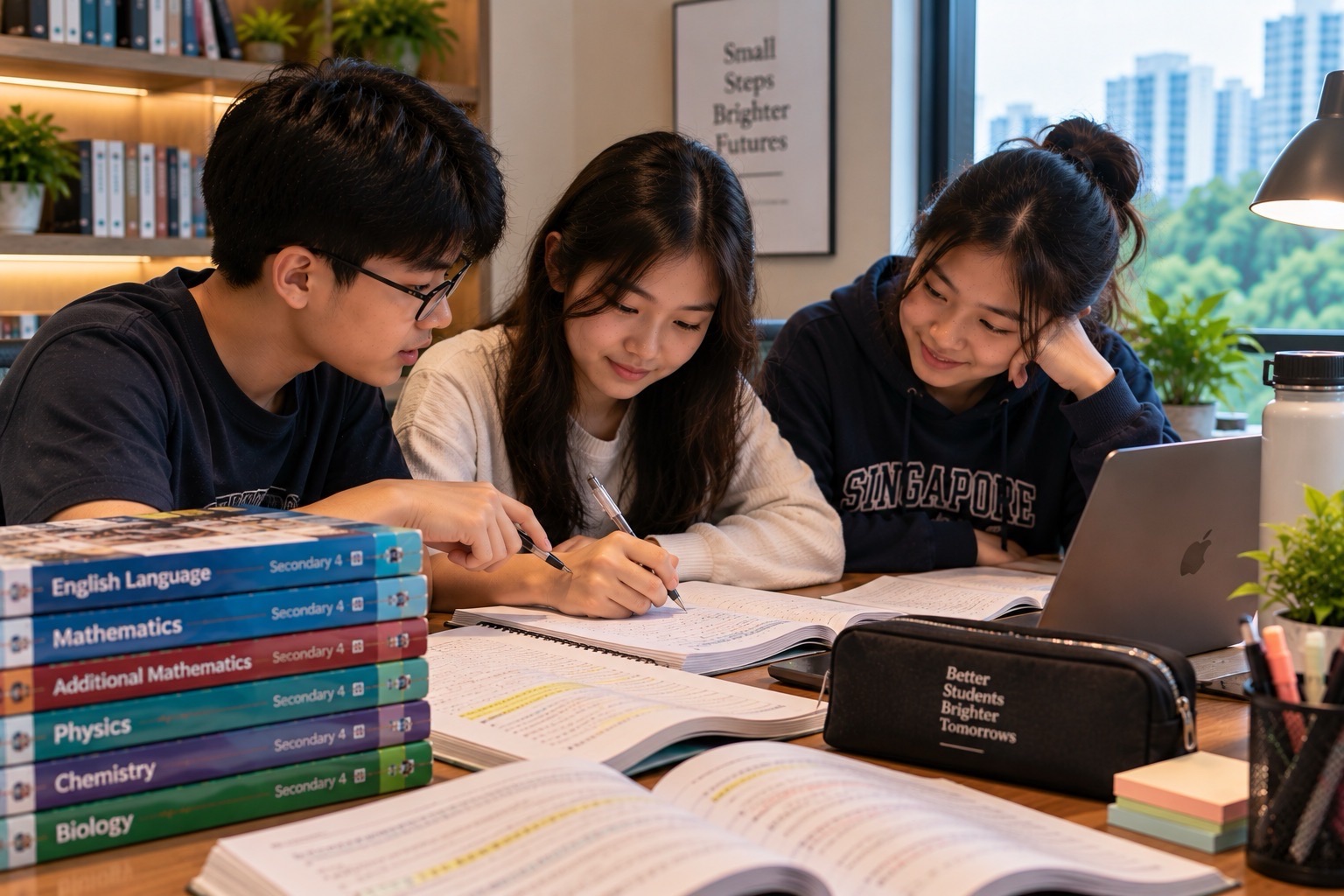
For parents comparing Secondary 1 Science tuition around Kim Seng Road, the best choice between a weekday and a weekend is the one that lets the child think independently after a misconception has been corrected. An early secondary-school learner may know that rainfall is measured in millimetres but still believe that a bigger collecting container always means heavier rain. Another pupil may correctly read a water level but mistake cubic centimetres for millimetres. A tutor should discover which explanation is unstable before adding more worksheets.
Kim Seng Road is a genuine road beside the Singapore River and Great World precinct. Great World’s official getting-here page lists bus access along Kim Seng Road and Great World MRT station. The National Library Board’s account of the river’s historic tongkangs describes boatyard history in the Kim Seng area. These sources explain the geography and its history, not local rainfall observations. All rainfall depths, collection volumes and dates in this article are invented classroom data. No weather gauge has been placed at Great World, Kim Seng Park, a nearby apartment or the river.
The teaching benchmark comes from eduKate’s Clementi three-student tutorial model: teach the principle, inspect each learner’s original error, provide specific feedback and check a different question later. This guide adapts that model to lower-secondary Science; it does not establish a current Kim Seng Road teaching venue or available Science class. Contact eduKate to verify present subjects, tutors, fees and places.
Quick answer: choose the appointment that repairs the actual mistake
A weekday can work well when a fresh school worksheet shows confusion about rainfall, area or a controlled variable and the pupil is still alert. A weekend can provide an unhurried period for reading a fictional rainfall table, planning a fair comparison, choosing a graph, and evaluating whether the measured quantity supports the conclusion. The same child may need different arrangements at different school periods.
The outcome should be visible: several days after teaching, the student can explain why an equal rainfall depth can produce different collected volumes in collectors of different areas. An excellent lesson leads to more independent reasoning, not merely more teacher-written notes.
Compare weekday and weekend learning needs
| Decision | Weekday | Weekend |
|---|---|---|
| Best when | A new area, depth or units misconception is fresh and the pupil is alert | A full fair-test, four-day dataset and independent interpretation need time |
| Core practice | Correct one collection-area diagram and one depth conversion | Compare two collector areas, graph invented data and examine limitations |
| Risk | School-day fatigue makes the learner copy formula steps | Long demonstrations replace the student’s own written explanations |
| Independent check | Convert an unfamiliar volume-and-area pair to mm later | Explain a new comparison and state one valid limitation without hints |
Travel from home to an actual confirmed teaching venue, CCA, dinner, school homework and sleep should all influence the timetable. The presence of Great World MRT does not mean a tutor teaches there. Families should verify the address rather than infer a location from an educational article.
Ten chapters: rainfall, measurement, fair tests and scientific honesty
1. A recognisable riverside setting can start a question without supplying data
Rivers, promenades and roads make water-related questions easy to imagine. Yet the existence of the Singapore River does not establish how much rain fell at a specific point on a particular date. None of the readings in our exercise comes from a local weather station or government rainfall feed. They are deliberately hypothetical values used for a beginner’s data task.
The imaginary experiment uses open-top collectors with stated horizontal opening areas. A student is asked whether a wider collector necessarily indicates deeper rain. The correct answer depends on understanding the difference between volume of water caught and depth of rainfall. Those quantities have different units and meanings.
A tutor might begin by asking a pupil to finish this sentence: “If two collectors experience the same rain and collect different volumes, I need to know ______.” The useful missing information is each collector’s effective opening area and whether they collected water consistently. That is a more revealing diagnostic than asking whether the child memorised the phrase “rain gauge”.
2. Volume and depth cannot be used as interchangeable labels
Volume describes how much three-dimensional space water occupies, commonly measured in millilitres or cubic centimetres in a school task. Depth is a length, measurable in millimetres or centimetres. One millilitre equals one cubic centimetre, but that equality does not turn volume into depth without information about collection area.
Imagine pouring 60 mL of water into a narrow and a broad container. The resulting depths can differ even though the water volume is the same. Conversely, uniform rainfall of the same depth over two different opening areas can yield different collected volumes. The student should explain these comparisons before attempting a formula.
A child who writes “the rainfall was 60 mL” may be describing the measured catch rather than the standard rainfall depth. Ask what quantity the question requests. This distinction will later help with pressure, density, area-based rates and many Science investigations, even when the immediate topic is not meteorology.
3. A collector’s opening area matters more than its decorative shape
In the simplest ideal model, collected water volume is the rainfall depth multiplied by the horizontal area effectively collecting the rain. A container with a vertical-sided body and a square opening can be modelled easily using area equals length times width. Real rain gauges may have funnels or more complex designs; their calibrated catchment area must still be considered.
A pupil can be misled by the full exterior dimensions of an object. If an imaginary funnel has a wide rim but a narrow measuring tube, the relevant catchment area may be the rim, not the tube’s cross-section. The teacher should ask which surface receives rain before choosing numbers from the diagram.
For a lower-secondary pupil, the principle can first be expressed in words: same depth over bigger opening means bigger collected volume. The numerical extension should only be taught after the child can identify the opening correctly. First-principles learning is more robust than immediate substitution into an unfamiliar triangle.
4. A fair rainfall comparison still requires controlled conditions
A fictional investigation might ask whether changing a collector’s opening area alters the amount of water caught under the same artificial rainfall. The manipulated variable is opening area, and the responding variable is collected volume. The rain exposure, duration, placement, measurement method and absence of overflow should be comparable. Otherwise a different result could arise for several reasons.
If one container is left outdoors for an hour and the other for five minutes, the readings cannot cleanly answer an area question. Likewise, a collector sheltered beneath an awning is not directly comparable to one in the open. The student should identify the confounder and suggest a valid correction rather than merely write “make the test fair”.
Our worksheet is not an instruction for children to collect real rain on station property or building ledges. Paper diagrams and invented data suffice. Any actual school investigation needs suitable teacher guidance and safe, approved placement of equipment.
5. Measurement units and scale readings can mislead
A cylinder with 1 mL graduations should not be reported to arbitrary hundredths of a millilitre unless the instrument’s reading procedure supports that precision. Similarly, a pupil should not copy “mm” from the question into a recorded volume column because rainfall is commonly reported that way. The data table must say what was actually measured.
Ask the child to identify which reading belongs to a balance, measuring cylinder or ruler in a hypothetical apparatus picture. They should then name the quantity and unit. A neat chart with the wrong unit is still scientifically wrong.
A further challenge is converting centimetres to millimetres. One centimetre equals ten millimetres. When a calculation produces a depth of 0.6 cm, that is 6 mm, not 0.6 mm or 60 mm. A small conversion error can change the physical conclusion by a factor of ten and should be caught by a tutor before more complex work is assigned.
6. Original worked problem: 60 mL in a 100 cm² collector
In a completely fictional rain-gauge worksheet, a rectangular open-top collector has a 10 cm by 10 cm horizontal opening, giving an effective area of 100 cm². It captures 60 mL of rainwater during the stipulated observation period. Assume that it catches all rain falling on the opening without loss, evaporation or overflow.
Since 60 mL equals 60 cm³, depth equals volume ÷ opening area = 60 cm³ ÷ 100 cm² = 0.60 cm. Convert to millimetres: 0.60 × 10 = 6.0 mm. The answer is a rainfall depth of 6.0 mm in the model, not “60 mm because the container caught 60 mL”.
Ask the learner to describe why dividing a cubic-centimetre volume by a square-centimetre area leaves centimetres. This simple dimensional check prevents blindly using the numbers 60 and 100 in the wrong order. No real Kim Seng Road weather condition is implied by the calculation.
7. A smaller collector can record the same rainfall depth
Now imagine a second, otherwise comparable collector with a horizontal opening area of 50 cm², exposed to the same hypothetical rain. If it captures 30 mL, the calculated depth is 30 cm³ ÷ 50 cm² = 0.60 cm = 6.0 mm. It catches half the water volume of the bigger device yet reports exactly the same rainfall depth under our model assumptions.
A common wrong answer says the first location must have received double the rain because 60 mL is twice 30 mL. This fails to account for the collector areas. The difference disappears once each volume is divided by its corresponding catchment area.
For independent transfer, change the large collector’s catch to 90 mL with its area still 100 cm². Its model depth is 0.90 cm = 9.0 mm. The pupil should compute that without being told to copy the original 6 mm value. A changed problem reveals whether the principle, not the numbers, has been learned.
8. Daily totals and averages answer different questions
A second fictional exercise gives rainfall depths of 3, 6, 2 and 9 mm on four school-model observation days. The total depth across the four days is 3 + 6 + 2 + 9 = 20 mm. The simple mean daily depth is 20 ÷ 4 = 5 mm per day over these four days.
The largest individual daily depth is 9 mm, not 20 mm. The four-day total of 20 mm is not a forecast, a rate during a storm or a real weather observation at Great World. A student who uses the wrong time basis may report a correct number with an incorrect physical meaning.
Ask the learner which number would answer each question: “How much cumulative rainfall was recorded over the four days?”, “What was the average per day?” and “Which day had the greatest depth?” This check teaches accurate interpretation of a table before graphing and prepares the pupil for later time-series Science questions.
9. A graph cannot transform hypothetical readings into local facts
A bar chart with day categories and rainfall depth in millimetres can represent the invented daily values. A time-series graph can also show them, provided the axis labels and scope are clear. The figure’s title should indicate it is a fictional classroom series rather than a published NEA weather record.
A learner might write “Day 4 received the most rainfall in Singapore” after seeing the highest bar of 9 mm. That goes far beyond the data. The correct sentence is that Day 4 has the largest depth among the four invented days. The visual prominence of a bar does not widen the evidence.
The tutor should ask for one observation, one possible limitation and one extra piece of evidence that would be needed before comparing actual neighbourhood weather. This helps the pupil avoid overconfident conclusions in Science and in everyday information encountered online.
10. Three students can need three completely different interventions
Consider a small group of three. The first student calculates the area as 10 + 10 = 20 cm². The second calculates 0.60 cm correctly but forgets the conversion to millimetres. The third obtains 6 mm and still claims the calculation is an actual rainfall report for Kim Seng Road. Arithmetic, units and evidence scope are three different weaknesses.
A meaningful three-pupil tutorial should address each separately. The first needs area and units, the second needs centimetre-to-millimetre conversion, and the third needs practice distinguishing models from measured observations. One shared perfect solution would conceal which idea each person has misunderstood.
The tutor should record an initial individual answer, explain the precise error and provide a changed, unseen question. The family can then judge whether the child’s new answer is becoming independent. That is a better indicator of small-group quality than a promise about how many worksheets fit into an hour.
A possible 90-minute three-student Science lesson
First 10 minutes — independent retrieval. Ask each learner to label an imaginary collector diagram and decide what a 60 mL reading means. The tutor records the initial response before providing the solution.
Next 15 minutes — first principles. Rebuild the distinction between volume, catchment area and depth. Use simple drawings before asking for numerical conversion.
Next 20 minutes — experimental design. Compare two hypothetical collection methods and identify timing, area, location and overflow controls. Each pupil should explain a different flaw.
Next 15 minutes — the worked example. Solve 60 cm³ divided by 100 cm² and convert 0.60 cm into 6.0 mm. Check the unit cancellation aloud.
Next 15 minutes — independent changed example. Ask the child to solve 30 cm³ over 50 cm², then one new scenario without a heading announcing the formula.
Next 10 minutes — individual error audit. Compare the first and final attempts and ask why the original answer was wrong.
Final 5 minutes — delayed practice plan. Set a new, brief question for later in the week. This lesson sequence is illustrative, not a verified current programme or timetable.
Four weeks to judge whether the selected tuition day helps
Week one: collect real school evidence. Bring the current school Science chapter and one marked question. Classify errors in diagrams, variable choice, calculations, units and written explanation. Do not make a fixed judgement about the child from a single result.
Week two: teach the missing principle. If measurement and data interpretation are appropriate, rebuild volume, area and depth. If the school is studying cells or mixtures instead, teach the actual school content with the same diagnostic sequence.
Week three: check transfer to new values. Give an unfamiliar collector with different dimensions, plus a short day-by-day rainfall table. Ask for a calculation and a statement that is strictly supported by the fictional data.
Week four: retest independently. Hide the previous model solution and ask the pupil to explain a fresh situation several days after teaching. Discuss whether the weekday or weekend leaves sufficient time for schoolwork, rest and independent practice.
Repair, consolidate and extend
Repair suits a child who does not yet understand which area catches rain or who confuses volume with depth. Use one diagram and a small, clearly labelled calculation.
Consolidate suits the learner who understands the model but misses unit conversions or makes unsupported claims. Mix short questions involving different area and volume pairs, and require one restrained conclusion.
Extend suits a pupil who can reason independently. Discuss the effect of overflow, uneven exposure, a funnel with a larger catchment rim, and measurement precision. Such extension should develop scientific judgement, not introduce complexity for its own sake.
Parent FAQ: Secondary 1 Science tuition near Kim Seng Road
Is there a confirmed eduKate Science classroom on Kim Seng Road?
This guide does not establish one. Great World and its transport connections are verified local context, not a classroom listing. Confirm actual teaching venue, fees, tutor and timetable with eduKate.
Are the 6 mm and 9 mm readings real rainfall near Great World?
No. Every quantity is fictional, and no local rain gauge was consulted. The numbers are used only to teach volume, area and depth.
Can a smaller collector measure the same rainfall depth as a larger one?
Yes, in the ideal model. The captured volume scales with collection area under equal rainfall depth and otherwise comparable conditions, so dividing volume by opening area can yield equal depths.
Should a Secondary 1 pupil learn these area calculations if school is covering another topic?
The school’s actual current Science programme should govern tuition. The mathematics here is an optional, integrated measurement example rather than a claim about compulsory coverage in every school term.
Is weekend tuition guaranteed to produce better results?
No. It may provide more time for fair testing and explanation when the student is rested, while an attentive weekday can repair one mistake sooner. Compare changed independent answers.
Do 2027 SEC G2/G3 papers replace the child’s Secondary 1 Science work now?
No. Those are future final-year examination specifications. Use the current lower-secondary school curriculum and actual subject level first.
Follow the eduKate Science and neighbourhood learning routes
Secondary 1 Science Tuition | Havelock Road explains an original forces-and-fair-testing model; Secondary 1 Science Tuition | Beo Crescent compares friction data. Secondary 1 Mathematics Tutor Clementi | Small Groups Tutorials describes the learning method. The Singapore Science Tuition by Area Index helps parents find wider educational reading routes.
Official and verified source links
Great World: Getting Here confirms Kim Seng Road access and Great World MRT. NLB BiblioAsia: Tongkangs provides historic Singapore River and Kim Seng context. SEAB’s 2027 SEC G2 school syllabuses and G3 school syllabuses describe future exam routes, not this hypothetical rainfall data or today’s Secondary 1 course.
Make the tuition decision from an actual marked answer
Bring your child’s current Science worksheet, chapter list, and a realistic weekday/weekend routine. Ask the tutor to diagnose one error and test whether a different question can be completed independently. Contact eduKate to verify current Science tutor, subjects taught, venue, duration, fee, class size and places.
Five changed diagnostic questions for parents
Question A — same rain, different sizes. Imagine one collector with a 200 cm² opening catches 120 mL and another with a 100 cm² opening catches 60 mL. Both give 120/200 = 0.60 cm and 60/100 = 0.60 cm, or 6 mm. A child who labels the first reading “twice as rainy” has ignored collection area.
Question B — calculate a square opening before dividing. A fictitious collector with a 5 cm by 5 cm opening has 25 cm² area. If it catches 20 mL, the model depth is 20/25 = 0.80 cm = 8 mm. The student must first multiply the side lengths to obtain area, not add them. A diagram with a changed shape tests the same understanding.
Question C — identify possible loss. Suppose a collector overflows before measurement, but the pupil divides the remaining water volume by its area as though all rain had been retained. The reported depth would likely underestimate the true model rainfall. More decimal places in the final answer would not repair the missing water.
Question D — an awning changes exposure. If one imaginary collector is beneath shelter, its captured volume may differ for reasons unrelated to opening area. The tutor should ask which variable was not controlled and how the comparison could be redesigned fairly. Repeating two badly placed containers does not make their exposures equivalent.
Question E — read a new time series. An artificial five-day list shows 0, 4, 5, 1 and 10 mm. The sum is 20 mm, with a mean of 4 mm per day. The maximum daily value is 10 mm. These three correct numbers answer three different questions, and none is an observed Singapore weather reading.
The family should ask for the original student response, a precise correction and at least one changed answer completed without adult cues. The tutor can then advise whether a narrow weekday session or a fuller weekend learning sequence is appropriate. The aim is durable independent thinking rather than filling every available hour.
Continue the complete Kim Seng Road Secondary Science tuition series
Secondary 2 Science tuition | Kim Seng Road weekday or weekend · Secondary 3 Science tuition | Kim Seng Road weekday or weekend · Secondary 4 Science tuition | Kim Seng Road weekday or weekend. Every level explores an original, different Science problem. Families should choose the student’s actual school level and enrolled Science subject. These related articles are learning routes, not confirmation of any tuition classroom in the Kim Seng Road precinct.