
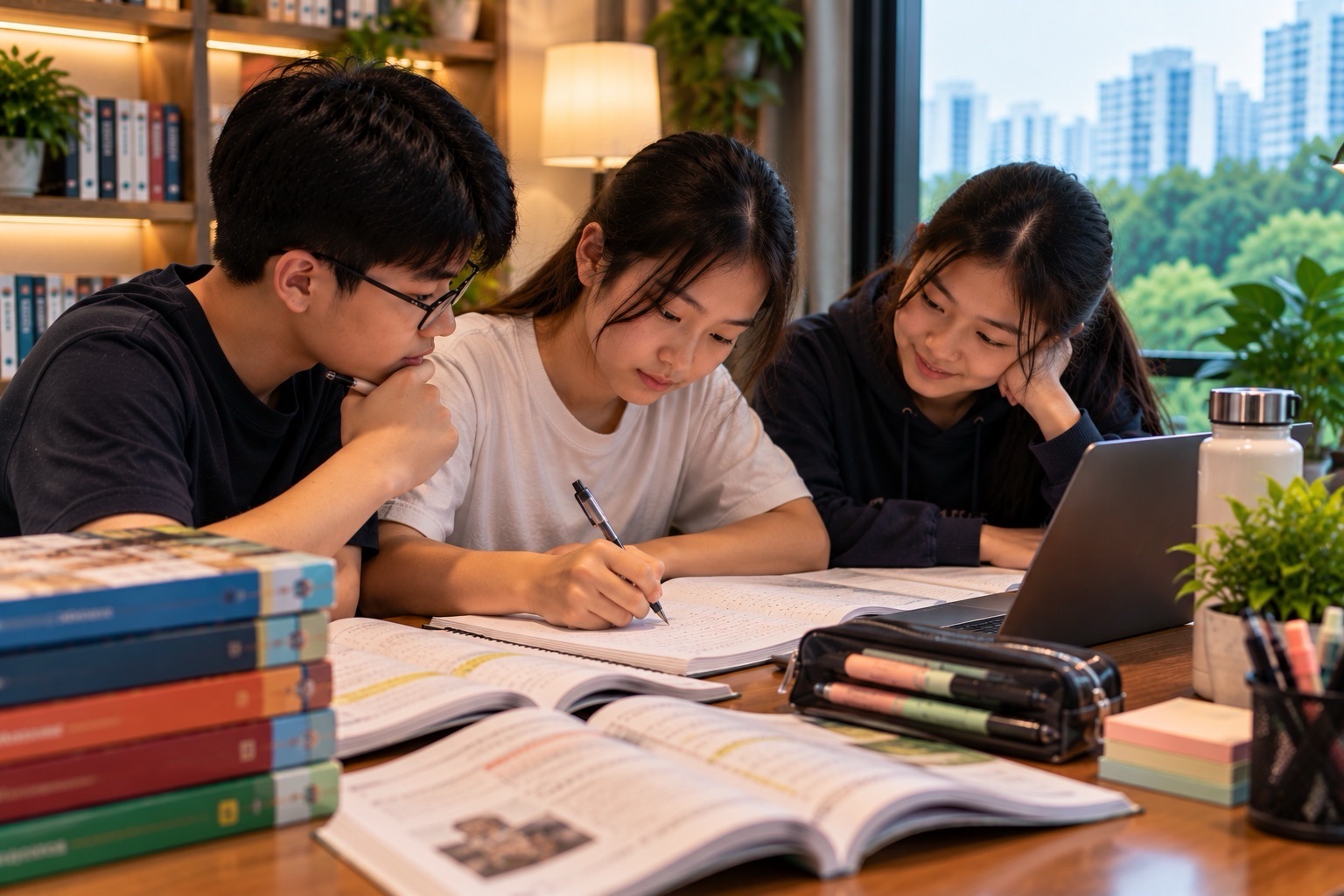
A family comparing Secondary 2 Science tuition near Kim Seng Road can learn more from one short diagnostic question than from a general promise of extra revision hours. Ask the teenager to interpret a fictional cooling experiment. One student may believe a container that cools faster has transferred exactly twice as much heat, even though the two containers may not have equivalent contents. Another might correctly observe temperatures but call degrees Celsius per minute “joules of heat”. These mistakes demand concept repair, not indiscriminate drilling.
Great World’s official transport guide confirms the Kim Seng Road corridor and Great World MRT connections. NLB’s historical article about Singapore River tongkangs describes past activity near Kim Seng Road. This busy urban setting helps a family imagine shade, buildings and materials, but the guide is not an evaluation of indoor temperatures, air-conditioning, heat insulation or energy use at Great World, nearby homes, shops or the river. All cups, materials, times and thermometer readings below are invented for teaching.
The eduKate Clementi small-group tutorial reference establishes the standard: a pupil first attempts a task alone, the tutor identifies the precise misunderstanding, teaches from first principles, and checks another independent answer. This approach works for Science data as well as Mathematics. The guide does not establish an actual eduKate class on Kim Seng Road. Verify subjects, tutors, locations and current places directly with eduKate.
The parent decision: a narrow weekday repair or a broader weekend investigation
Choose a weekday if the child has just received a marked school question about heat transfer and still has energy to review one critical misunderstanding. A weekend can suit the pupil who needs to analyse a whole fictitious investigation, compare data and controls, draw a suitable graph and explain why a result has limits. There is no universal scientific rule that every weekend student retains more.
The result to look for is whether the teenager can calculate an unfamiliar temperature-change rate, distinguish temperature from thermal energy and identify an unfair comparison several days after the lesson. Any worked thermal example must follow the school’s actual Science chapter; the subject is not automatically taught in the same term at every Secondary 2 school.
Compare weekday and weekend before committing
| Decision | Weekday | Weekend |
|---|---|---|
| Best when | A recent Celsius, interval or heat-transfer misconception remains fresh | A full cooling experiment, comparison table and limitation need more thinking time |
| Pupil’s work | Correct one five-minute temperature-rate calculation independently | Compare fictional insulated and unwrapped samples and critique fair-test design |
| Main risk | The pupil is fatigued and copies temperature formulae | Long explanations crowd out unfamiliar individual questions |
| Evidence a week later | Solve a changed time and temperature interval with correct °C/min units | Select valid controls and interpret unseen cooling data without prompts |
Ask the teenager how the schedule affects homework, CCA, meals and sleep. Confirm the real tuition venue before estimating the journey. The nearby Great World development is a location reference, not an assertion about a Science teaching branch.
Ten chapters: cooling, insulation, variables and evidence
1. An urban cooling question requires its own experiment
A shopping precinct and riverfront create familiar places where people notice temperature changes. Yet one cannot infer the thermal performance of a named building from a map or a photograph. The experiment in this article uses an imaginary pair of containers placed in comparable classroom conditions, rather than any actual room or business on Kim Seng Road.
A student should first identify the research question: “Does a particular covering change how quickly an otherwise identical liquid sample cools under specified conditions?” That is clearer than asking whether a shopping mall is “hot” or “cold”. It gives the tutor a basis for deciding what must be measured and kept constant.
Ask the learner whether two hypothetical thermometer readings are observations or explanations. The reading is a number with a unit. A statement about why the temperature changed is an inference that requires a model and an appropriate fair test. The distinction is central to lower-secondary Science.
2. Temperature and heat are not synonyms
Temperature indicates how hot or cold a substance is and relates to particle behaviour. Heat is energy transferred because of a temperature difference. Saying that an imagined liquid contains “70 degrees of heat” treats a temperature reading as an energy quantity. In school tasks, temperature may be reported in °C while energy transfers may be reported in joules.
A simple cooling curve can show the temperature decreasing, but it does not by itself determine the total amount of energy transferred unless mass, material properties and additional assumptions are known. Two different masses of water can experience the same temperature change while transferring different amounts of energy.
The tutor should ask the student to state the physical quantity before choosing a calculation. A weekday lesson can focus entirely on this vocabulary distinction when it is the first unstable idea. A clear explanatory sentence is preferable to copying an unfamiliar higher-level equation.
3. Conduction, convection and radiation describe different mechanisms
Conduction involves thermal energy transfer through interactions within or between materials, without requiring overall transport of the material from one location to another. Convection involves bulk movement within fluids, often arising from temperature-dependent density differences. Radiation transfers energy through electromagnetic waves and does not require a material medium.
A pupil may describe all heat loss as “cold entering the water”. That vague explanation does not identify a mechanism. In a container, several mechanisms may operate simultaneously: conduction through the wall, convection with surrounding air and radiant exchange with the environment. A covering can affect more than one pathway.
An effective tutor uses a labelled diagram and asks which parts of the simplified setup each mechanism could involve. The aim is a coherent school-level explanation, not a demand to calculate every heat-transfer coefficient. Students should know which conclusions can reasonably be made from the data supplied.
4. Insulation reduces some transfers but is not a magical barrier
An insulating material can reduce certain rates of energy transfer, depending on its structure and how it is used. It does not necessarily prevent all transfer forever. A pupil who sees a warmer final temperature in a covered container may conclude that the material “creates heat”, rather than recognising that energy may have left more slowly.
The teacher should ask what the word “insulation” means in the actual experimental arrangement. Does the fictional container have the same material except for a removable sleeve? Is the top open in one setup? Are the containers otherwise the same? Without those details, one cannot be certain what caused any difference.
A weekend session can analyse multiple control conditions and describe an appropriate improvement. A focused weekday session may be enough to repair the narrow idea that insulating simply means “keeping heat in” without specifying relevant transfer pathways.
5. A fair test begins with equal starting conditions
Suppose both fictitious cups initially contain the same mass of water at 70°C. One is wrapped in a stated insulation layer, while the other is unwrapped. The intentionally changed factor is the wrapping; the responding observation is temperature at agreed times or the rate of temperature change. Controlled conditions should include cup dimensions, contents, initial water temperature, thermometer procedure, ambient conditions and exposure duration.
If one cup begins at 90°C and the other at 70°C, a difference in final temperature does not isolate wrapping. If the first is placed near moving air and the second sheltered in a box, airflow becomes another factor. The tutor should encourage a child to recognise the confounder before constructing a graph.
Paper-based data are sufficient for the parent-facing lesson. Actual use of hot water should occur only in an appropriately supervised school setting, with safe temperatures and protective procedures. This article does not ask children to perform hot-water experiments at home or in public.
6. Original worked example: two five-minute temperature changes
Consider entirely invented readings. Container A without the hypothetical sleeve begins at 70°C and reaches 55°C after 5 minutes. Container B with the sleeve begins at 70°C and reaches 62°C after the same 5 minutes. All other relevant conditions are assumed comparable for this simplified worksheet.
Container A’s change is 55 − 70 = −15°C; its average temperature-change rate is −15 ÷ 5 = −3.0°C/min. B changes by 62 − 70 = −8°C, corresponding to −8 ÷ 5 = −1.6°C/min. The negative signs indicate cooling in both cases. In magnitude, A cools 1.4°C per minute faster on average than B during this fictional interval.
This is a comparison of temperature-change rates, not a direct determination of joules per minute or an actual efficiency percentage. Those would require more information. The student must not label −3.0°C/min as “three joules lost” merely because energy transfer provides part of the physical explanation.
7. An average rate does not describe every instant
An average rate of −3.0°C/min over five minutes does not require the temperature to fall exactly three degrees during each one-minute interval. Cooling may be faster initially and slower as the difference between the liquid and its surroundings decreases. Only the initial and final readings are supplied in the worked example.
If the pupil draws a perfectly straight cooling curve from two points, that line may be a schematic representation, not a measured minute-by-minute record. A tutor should ask which portions of the graph come from given observations and which are interpolations or assumptions.
A changed question might supply intermediate readings and ask for the average between minute two and minute five. The child must then subtract the values at those endpoints and divide by the corresponding three-minute interval, not divide an entire five-minute change by five again. This skill transfers to many Science graphs.
8. Compare two new data sets before making a claim
Imagine an independent variation in which both cups begin at 65°C. After 10 minutes, invented Cup C measures 45°C while Cup D measures 53°C. C’s average change is (45 − 65) ÷ 10 = −2.0°C/min. D’s is (53 − 65) ÷ 10 = −1.2°C/min.
A careful student can state that C has the larger average cooling-rate magnitude under the given model conditions. They should also recognise that this different ten-minute exercise cannot automatically be compared with the original five-minute trial as though the time intervals and starting temperatures were identical.
The new readings test whether the learner understands change divided by elapsed time rather than recalling −3 and −1.6. An unfamiliar task answered independently after a delay is a stronger measure of tuition value than recognising a previously completed worksheet.
9. A graph must show temperature, not an invented energy meter
For repeated measurements over time, a line graph with time / min horizontally and temperature / °C vertically can be appropriate. If only final values are compared, a clear table may communicate more honestly than a continuous curve. The student should distinguish measured points from a line drawn for visual guidance.
A common weakness is labelling the vertical axis “heat loss” although only temperatures are recorded. Another is taking a gradient measured in °C/min and presenting it as watts. These are mistakes of physical meaning, not drawing accuracy. The tutor should insist on the actual measured quantity in each axis label.
A pupil can be asked to criticise a deliberately misleading graph: it begins at an arbitrary temperature scale without stating that fact, or its title claims to show a real shopping mall’s cooling efficiency. Such exercises train evidence literacy without making unsupported claims about the local environment.
10. A three-student tutorial needs three distinct interventions
Imagine three learners solving the original cooling task. One reverses the signs and says A’s temperature increased by 15°C. A second computes the correct −3.0°C/min but calls it −3 watts. A third gives both correct rates and concludes that an actual Great World building must use better insulation than its neighbours. Each pupil needs a different correction.
The first needs clear before-and-after subtraction and sign language. The second needs the difference between temperature-change rate and energy-transfer power. The third needs an explanation of hypothetical model data versus a real site survey. Asking all three to copy one model paragraph cannot repair the underlying errors.
A small group has value when the tutor can inspect each student’s reasoning, assign an appropriate new question and retest later. The Clementi-style formative approach is effective when it makes the learner less dependent, not merely when a brochure says “small class”.
An illustrative 90-minute Secondary 2 Science tutorial
First 10 minutes — independent diagnostic. Ask learners to label a cooling table and identify temperature change, elapsed time and what remains unknown. Record misconceptions before teaching.
Next 15 minutes — principles. Distinguish temperature from energy transfer and discuss conduction, convection and radiation in the simplest relevant model.
Next 20 minutes — experimental plan. Compare two possible cup procedures, identifying the manipulated variable, responding observation and important controls. Ask individual questions to each pupil.
Next 15 minutes — worked cooling rates. Calculate −15 ÷ 5 and −8 ÷ 5, naming the quantities and units.
Next 15 minutes — independent transfer. Supply a new ten-minute scenario or an interval question using multiple readings. No hints should be given until a first attempt is complete.
Next 10 minutes — error review. Compare original and changed responses. Identify whether the remaining difficulty is concept, units, subtraction or an unsupported claim.
Final 5 minutes — delayed retrieval. Assign one short unseen question for later in the week. This is an instructional illustration, not a confirmed teaching timetable in the Kim Seng area.
Four-week learning plan: focus on evidence, not just hours
Week one: gather the real school problem. Bring the child’s current school Science chapter, a marked data-response question and their own explanation of the error. Identify whether the missing idea concerns heat-transfer mechanisms, variables, graph interpretation or units.
Week two: rebuild first principles. If the school is studying thermal science, explain temperature versus heat and how an insulating layer might affect a process. If another chapter is current, teach that chapter instead using the same diagnostic model.
Week three: practise changed data. Give unfamiliar starting and final temperatures, different durations and one flawed experimental design. Ask the pupil to explain each numerical answer and one limitation.
Week four: check independence and routine. Test without notes several days after teaching. Compare with the original mistake and evaluate whether the weekday or weekend slot leaves enough time for schoolwork, rest and independent learning.
Repair, consolidate and extend
Repair is for a student who does not yet know what a thermometer measures or who says cold “enters” the container as a substance. Use one clear model and a short written explanation.
Consolidate suits a learner who understands the general mechanism but makes mistakes in rates, signs, units or graph labels. A small mixed set with accurate feedback is better than pages of identical arithmetic.
Extend suits a pupil able to interpret unfamiliar cooling tables independently. Ask how surface area, material type, air movement or thermometer precision could affect the claim. This strengthens scientific evaluation without demanding out-of-syllabus heat-transfer engineering.
Parent FAQ: Secondary 2 Science tuition near Kim Seng Road
Is the thermal experiment about air-conditioning inside Great World?
No. Every container and temperature reading is fictional. Great World’s website supplies geographic and transport context, not indoor cooling results.
Does a cooling rate in °C/min measure energy lost per minute?
Not directly. It reports how the temperature changes with time. Calculating energy transfer generally requires additional information and suitable assumptions.
Does a lid or sleeve always stop cooling entirely?
No. It may reduce some pathways of energy transfer under appropriate conditions, but a real system can still exchange energy with its surroundings.
Is weekday tuition better when a school worksheet has just been returned?
An attentive weekday can help correct a fresh mistake promptly, while a rested weekend may suit a fuller investigation. Ask for an unfamiliar independent answer afterwards.
Is the 2027 SEC Chemistry or Physics specification the child’s present Secondary 2 course?
No. Final-year SEC subject lists are relevant to future pathways, not a replacement for the actual lower-secondary school chapter.
What evidence should parents request from a three-student Science group?
An initial student response, the precise misconception, individual feedback and a changed unseen answer. Also verify the actual current class size, venue, tutor and vacancies.
Links to other verified eduKate learning guides
Kim Seng Road Secondary 1 Science explores rain-gauge measurements. Havelock Road Secondary 2 Science explains magnetic separation, while Beo Crescent Secondary 2 Science develops cell osmosis and evidence. The Science Tuition by Area Index connects other locations and subject-level guides.
Sources for location and subject pathways
Great World: Getting Here confirms access via Kim Seng Road, while NLB: Tongkangs gives historical Singapore River context. SEAB 2027 G2 school syllabuses and G3 school syllabuses explain future examination pathways. The correct current topic comes from the student’s actual school.
Decide on tuition using real marked Science work
Ask the student to bring one recent thermal-science or other relevant school question, the actual topic sequence and realistic weekday/weekend constraints. Request an initial diagnosis and an independent retest after teaching. Contact eduKate to verify current Science tutor, subject, fees, teaching venue, duration, group size and available sessions.
Five additional questions to diagnose transfer
Question A — different duration. A fictional container cools from 60°C to 48°C in six minutes. Its average temperature change is −12°C and the average rate is −2.0°C/min. A pupil who divides by 60 instead of six has confused a temperature with elapsed time.
Question B — same final temperature, different starting temperature. Cup X begins at 70°C and ends at 55°C; Cup Y begins at 65°C and also ends at 55°C after an equal period. Their temperature changes are −15°C and −10°C. Equal final temperatures do not imply equal average cooling rates or equal transferred energy.
Question C — a flawed comparison. Suppose the insulated cup contains only 50 mL while the unwrapped cup contains 200 mL, with all else unspecified. A difference in readings cannot be attributed solely to the covering because water quantity also differs. The tutor should ask what must be controlled and why.
Question D — express the conclusion narrowly. A hypothetical table can show a smaller cooling-rate magnitude for one cup. It does not prove that the cup is more energy-efficient in every real situation, nor establish performance of any building or product. Name the measured period and assumptions in the conclusion.
Question E — explain a temperature unit. A temperature difference of 10°C has the same numerical magnitude as a difference of 10 kelvin. However, an absolute temperature of 10°C is not 10 K. This distinction helps the pupil avoid unit conversion mistakes when moving between temperature scales in later Science learning.
After attempting these changed questions, the student can explain to a parent whether the difficulty lies in arithmetic, vocabulary, experimental validity or interpretation. That makes the weekday/weekend decision evidence-led instead of anxiety-led. An effective tuition plan reduces reliance on the tutor over time.
Continue the complete Kim Seng Road Secondary Science tuition series
Secondary 3 Science tuition | Kim Seng Road weekday or weekend · Secondary 4 Science tuition | Kim Seng Road weekday or weekend. Every level explores an original, different Science problem. Families should choose the student’s actual school level and enrolled Science subject. These related articles are learning routes, not confirmation of any tuition classroom in the Kim Seng Road precinct.