
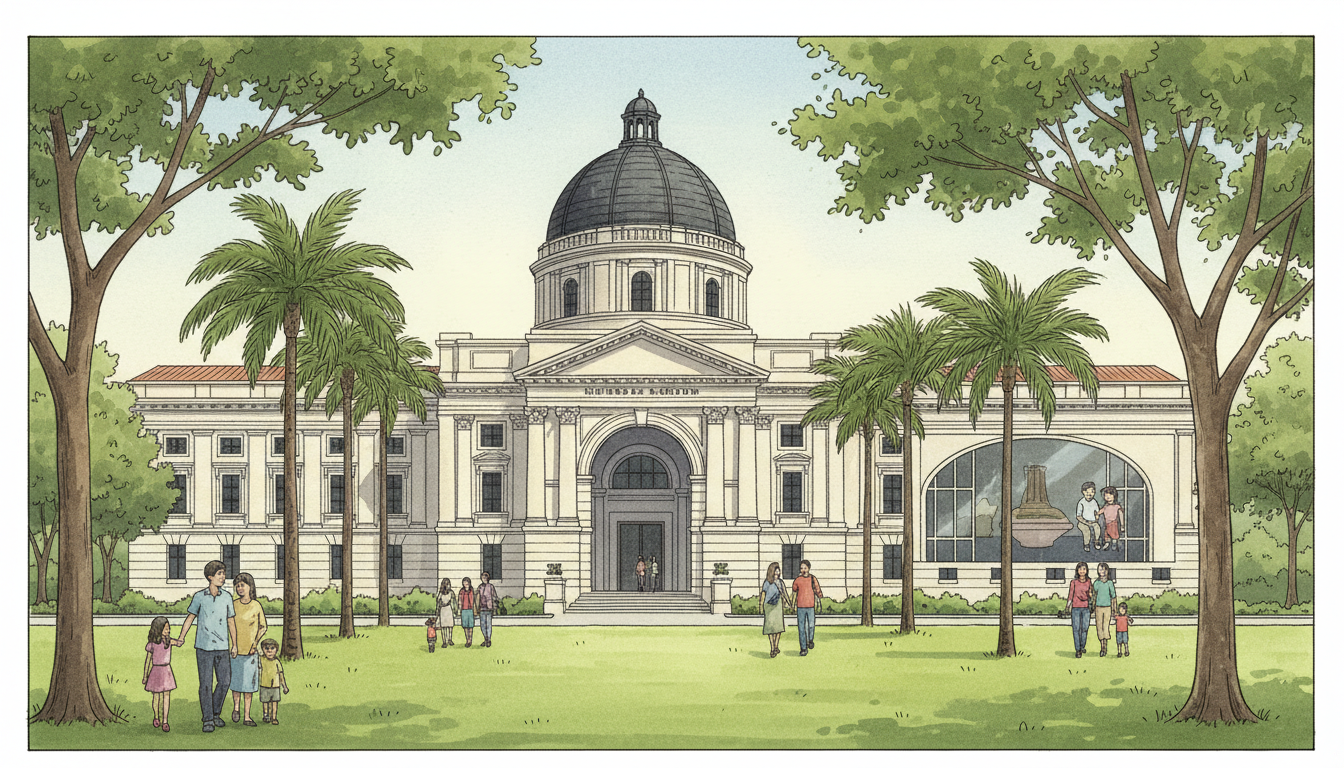
Did you know that the former St Joseph’s Institution in Bras Basah was used as a Red Cross hospital when Singapore faced the Japanese invasion? Its classrooms became wards, before the site was used for other purposes during the Occupation. That sequence makes an excellent Secondary 2 G3 History lesson: one building can have several wartime roles, and each claim needs evidence for its particular date.
eduKateSG teaches Secondary 2 G3 History through a premium three-student, weekly 1.5-hour tutorial near Sixth Avenue MRT, not in Bras Basah. Each lesson begins with a genuine marked History response, then works on wartime chronology, source comparison, purpose and evidence limits. Bras Basah landmarks are teaching examples; the school syllabus and actual marked tasks still determine what the child must learn.
The structure follows the immutable eduKateSG small-group reference. Historical wartime details draw on the NHB Second World War heritage trail and account of monuments during the Japanese Occupation.
What happens in a Secondary 2 G3 History tutorial?
A tutor asks to see the pupil’s marked school source question. Some students can identify a date but cannot explain its historical significance. Others read an occupation-era directive and assume it proves every civilian behaved as ordered. Still others write that a school’s wartime use must have been the same as its pre-war classroom function. Each weakness requires a different intervention.
In a premium three-student tutorial, the pupil has to justify an inference using a visible source clue, compare it with an alternative and then write independently on a second school-relevant document. The weekly class is near Sixth Avenue MRT rather than Bras Basah; families should consider a feasible journey.
A lower-secondary History course is not a final-year paper
At Secondary 2, G3 History develops historical enquiry, wartime understanding and post-war reasoning within the student’s actual MOE and school syllabus. National-paper question structures can be useful later, but the present lesson should first repair the child’s source-reading foundation and secure the factual chronology of what is being taught.
The first Singapore-Cambridge SEC takes place in 2027. A Secondary 2 student may sit the national examination in another year and under a later registered combination. The tutor does not assume that every child currently needs the same K330 or K336 final-year plan.
Bras Basah was a school district before the war
Bras Basah was home to several prominent educational institutions, including the original sites of Raffles Institution and St Joseph’s Institution. The existence of a school before the war does not prove its pupils and teachers were able to continue ordinary lessons when conflict arrived.
The tutor places founding dates and wartime changes in separate timeline rows. A photograph of a grand school facade can show architecture before the conflict, but cannot establish what the classrooms held during the bombing or occupation without further records.
SJI was founded in 1852, and the war came decades later
St Joseph’s Institution was established in 1852 and used its Bras Basah school premises long before 1942. National Heritage Board records describe the school shutting when the conflict intensified. The institution’s long pre-war educational role is essential context for understanding the shock of wartime repurposing.
A pupil should not mistake the 1852 founding for an Occupation milestone or call every historic school photograph a 1942 image. School history is layered: founding, building completion, pre-war operation, emergency use and later relocation belong to different dates.
Bomb damage and the danger of exaggeration
NHB’s World War II heritage trail notes that a classroom and the inner courtyard at SJI were hit during bombing. The account states that these particular blasts caused no casualties and that a crater remained noticeable for decades. The report concerns specific damage at the school, not every incident in the city.
An accurate paragraph says what happened at this site and avoids inventing deaths where the source does not record them. Responsible historical writing is especially important when discussing human suffering; dramatic but unsupported details weaken understanding.
A school turns into a Red Cross hospital
As the fighting approached Singapore, St Joseph’s Institution was used as a Red Cross hospital for military casualties. Classrooms were converted into wards and a Map Room was adapted as an operating theatre. The building’s architecture continued to exist, but its immediate function changed from teaching to emergency medical care.
A school photograph may help explain how rooms were arranged. It does not automatically show the quality of medical treatment or how every wounded patient experienced the hospital. We seek contemporary medical or personal evidence to answer those different questions.
The treatment of naval survivors is a specific account
The NHB war-trail guide says many survivors from HMS Prince of Wales and HMS Repulse were taken to the temporary hospital at SJI. This reflects the growing emergency medical demands of the campaign, but one summary cannot establish that every survivor was treated in the same building.
The historical method is to use qualifiers faithfully, state whose experience is being discussed and seek additional hospital records when a precise count or individual account is required. An official heritage guide is a synthesis, not itself the medical ward’s complete register.
Air Raid Precautionary work and its distinct purpose
SJI also accommodated Air Raid Precautionary activities during the war. This was different from classroom education and from treating casualties. Even where the same site supported both functions, the people involved, operational aims and sources to investigate may differ.
Students learn to identify which source establishes the hospital role and which addresses civil-defence preparations. A photograph of stretchers, for instance, may not establish who coordinated every emergency warning. Different activities should not be compressed into one vague phrase such as ‘war headquarters’.
1942: temporary barracks under the occupying forces
After the fall of Singapore, the Japanese used the former school premises as temporary barracks. NHB also describes how the brothers associated with the school were required to leave as the occupation administration consolidated control.
An occupying army’s use of a building reveals a change in authority and function; it does not prove what all former teachers believed. The tutor asks the child to distinguish a source about official requisition from a diary about individual experience.
Bras Basah Boys’ School was a wartime reorganisation
NHB records that the former SJI reopened as Bras Basah Boys’ School under the Japanese occupation system. A learner should not mistake the wartime institution’s name for the founding of an unrelated school or assume that the pre-war curriculum continued unchanged.
The school and building form a useful continuity-and-change exercise. Some educational activity resumed, yet the political authorities, language priorities and daily demands had changed. Explain which feature continued and which did not rather than saying everything was the same or completely different.
Growing crops was tied to wartime shortages
One heritage account describes pupils at Bras Basah Boys’ School growing vegetables in the grounds during lesson time as part of the ‘Grow Your Own Food’ campaign. That specific activity was connected to the problem of scarce food under the occupation.
A photograph of pupils cultivating land is useful evidence of visible activity. It does not independently prove the exact yield, whether every student participated or how successful the broader policy was. A source about an official campaign shows intention; an outcome requires different evidence.
Food self-sufficiency was a policy aim, not a guaranteed result
An occupying authority can order or promote vegetable cultivation because it hopes to relieve shortages. That official aim can be established from the relevant order or campaign message. Whether every household benefited is an empirical question that needs records of production, distribution and people’s experiences.
The tutor demonstrates this distinction using the school garden, then changes to another Japanese Occupation source. The pupil must be able to use ‘aimed to’ when the evidence is a plan and ‘resulted in’ only when consequences are adequately supported.
One wartime photograph cannot represent every pupil
The archival image of Bras Basah Boys’ School pupils growing crops is a powerful glimpse into school life under Japanese rule. However, the image depicts people at a particular moment. It cannot show the daily routine of every child throughout the Occupation or prove that the activity was universally welcomed.
A careful inference describes the visible work, relates it to the policy in its historical context and names the limits. This avoids taking one illustration as a complete social history.
Source purpose, usefulness and reliability are different skills
A government propaganda notice is useful for understanding what authorities wanted residents to believe. It may be less reliable for measuring public support. An individual diary could be valuable for someone’s response but limited for general population claims. The labels ‘biased’ and ‘official’ alone cannot determine which source is best.
Students are taught to state the enquiry first and then choose evidence suited to it. ‘Useful for studying policy intentions, limited for testing universal compliance’ is a more meaningful evaluation than ‘biased therefore useless’.
Who made the source, and for what audience?
A wartime education circular, a private student letter and a post-war museum label have different likely audiences and purposes. The first may communicate policy, the second a personal experience and the third a researched interpretation for later readers. They are not interchangeable records.
A purpose answer should say what the source maker wanted a specified audience to know, believe or do, supported by content and context. Claiming every document was made ‘to inform people’ offers little historical explanation.
What a 1942 official order cannot establish
Imagine an instruction to grow food at school. If authentic, it could show a policy and perhaps a duty placed on students. It cannot by itself prove the size of harvests or what every family ate. To study implementation, a researcher could compare school diaries, harvest accounts, food reports and independent testimonies.
The tutor uses this example to teach the evidential gap between issuing a directive, carrying it out and experiencing its consequences. It transfers directly into other post-war political history tasks.
Raffles Institution had a different occupation experience
NHB’s Civic District history notes that Raffles Institution was used as a military camp during the Japanese Occupation. SJI’s history includes hospital and wartime school uses. These are distinct institutions with separate wartime roles, even within the same broad district.
A student comparing school histories must name the building and identify the relevant date before drawing conclusions. One school cannot be used as evidence that all schools in Singapore had the same experience.
1945: the occupation ended, but consequences remained
The Japanese Occupation ended in 1945. The formal Japanese surrender in Singapore took place at the Municipal Building on 12 September of that year. This date is not the same as the British surrender in February 1942.
The end of occupation did not automatically restore every school, household and workplace immediately. Pupils should distinguish formal political events from the slower recovery of institutions and livelihoods. An opening notice establishes an intention or stage of recovery, not complete social normality.
1959, 1963 and 1965 must stay distinct
Singapore gained full internal self-government in 1959, merged with Malaysia in 1963 and separated in August 1965. A source written about one milestone should be interpreted using that period’s political context. An early merger proposal cannot be judged simply by assuming its author knew the later outcome.
The tutor builds a three-line political timeline and asks pupils to name the actor and institution involved. History is not improved by collapsing years into an imprecise slogan about independence.
1960: the National Museum name is another institutional milestone
The nearby former Raffles Library and Museum became known as the National Museum in 1960, following the earlier administrative division and Singapore’s 1959 self-government. A museum renaming is historically relevant to national identity and collecting priorities, but it is not the date of self-government itself.
The student learns to distinguish a political event from a later institutional response. Two sources can report different years accurately because they refer to different steps.
St Joseph’s Institution moved in 1988, long after the war
SJI relocated from its Bras Basah site to Malcolm Road in 1988. The historic building was later protected as a monument and used for the Singapore Art Museum, which opened in 1996. A photograph of the modern art museum is therefore not proof of how the hospital wards appeared in 1942.
A pupil can use a modern image to identify which elements of the building survive, but cannot project contemporary gallery fittings into the wartime scene. Dated archives and museum research are needed.
A historical monument may carry several meanings
The former SJI building is associated with pre-war learning, wartime medical emergency, occupation-era schooling and modern arts. Which role is most historically significant depends on the question and criterion being examined.
For the survival of civilians in 1942, wartime hospital use may be important; for the development of education or public art, another period matters. The tutor asks the child to name the affected group and consequences before claiming an event was ‘most significant’.
Comparison needs a shared historical issue
Two sources about Bras Basah may discuss very different questions. One could describe a hospital’s shortage of supplies, while another discusses changes in school lessons. They are both wartime histories, but not automatically agreeing or disagreeing about the same proposition.
To compare, define an issue both sources address, state each position with relevant evidence, then explain similarities or differences. Source type and author may help explain the contrast, but cannot replace analysis of the actual claims.
Corroboration is not simply repeated wording
Several modern history pages may use the same older archive photograph. Their agreement does not make them independent eyewitnesses to an event. Stronger corroboration involves separate evidence paths that speak to the precise historical proposition.
Students practise asking whether a source confirms a policy’s announcement, its actual implementation or the experience of a named person. Confirming one aspect does not prove every other part of the story.
An evidence-based historical investigation
An appropriate question is ‘How did the uses of the former St Joseph’s Institution premises change between late 1941 and 1945?’ The pupil can consult NHB’s wartime account, a dated school photograph and a suitable contemporaneous source if available. The scope is bounded to one site and period.
An enquiry should identify uncertainty rather than fill it with invention. Even if the child cannot find a first-hand pupil diary, they can state that their sources support institutional changes more strongly than universal personal experiences.
The best evidence of learning is a new school answer
After practising wartime purpose and comparison with SJI, the tutor moves to a different source from the pupil’s actual assessment chapter. If the child can justify an inference, explain a purpose and evaluate a limitation without copying the original example, the skill is beginning to transfer.
A polished paragraph about SJI is not enough if the child remains unable to handle another wartime or political source. Every correction should produce a new, individually written response.
A short home routine for Bras Basah families
Ask your child to put three dated events on paper: a school building’s emergency hospital use, wartime school reorganisation and the eventual end of occupation. Then have the child explain what evidence proves each event and what remains uncertain.
Parents do not need to memorise every detail of the war. They can ask for a precise source clue and discourage universal claims such as ‘all pupils felt exactly the same way’ unless broad evidence is available.
A 90-minute three-student tutorial: from error to correction
- First 10 minutes: date and actor retrieval from the child’s school war-history chapter.
- Next 15 minutes: read a real marked source response and isolate one mistake.
- Next 20 minutes: teach one inference, purpose, comparison or chronology move.
- Next 20 minutes: each pupil answers an unfamiliar source without copying the model.
- Next 15 minutes: test the quality of evidence, source limitations and causal links.
- Final 10 minutes: a second transfer task, concise error log and home practice.
The allocation is illustrative, not mandatory. A learner confused about 1942 and 1945 needs stronger chronology before advanced reliability judgements; another with secure facts may work immediately on comparing positions.
An illustrative ten-week Secondary 2 source pathway
- Week 1: school syllabus, marked scripts and reading diagnostic.
- Week 2: construct an accurate wartime chronology.
- Week 3: distinguish official policy from actual implementation.
- Week 4: read source creator, audience and purpose.
- Week 5: make inferences from decisive source clues.
- Week 6: compare positions about one shared issue.
- Week 7: assess reliability for a precise factual proposition.
- Week 8: assess usefulness without dismissing all partisan sources.
- Week 9: explain causes and consequences with the correct actors.
- Week 10: answer unfamiliar school-topic sources independently.
This is a possible route rather than a promised change in grades. School deadlines and the pupil’s actual written progress determine the next lesson.
Original fictional source laboratory: twelve reasoning exercises
The miniature sources below are original fictional classroom prompts, not genuine wartime instructions, survivor testimony, NHB archival material or SEAB past-paper questions. Their use is to teach one reasoning move before reading authentic historical sources.
Practice 1: Bomb-damage report
Fictional source: Fictional 1942 school note records a damaged classroom and courtyard.
Question: Can we invent a casualty count? Reasoning: No. A specific report defines what is known.
Independent transfer: State the site and extent accurately.
Practice 2: Hospital conversion memo
Fictional source: Fictional directive orders classrooms to become wards.
Question: Does it prove all beds were occupied? Reasoning: It establishes intention or instruction, not complete use.
Independent transfer: Find a ward register.
Practice 3: Military casualty letter
Fictional source: Fictional nurse describes treating one injured sailor.
Question: Can this represent every survivor? Reasoning: It offers a named experience only.
Independent transfer: Ask for broader hospital evidence.
Practice 4: An air raid warning
Fictional source: Fictional emergency notice tells residents where to shelter.
Question: Does the notice prove everyone complied? Reasoning: No; order and action are different.
Independent transfer: Find a civilian diary.
Practice 5: Temporary barracks
Fictional source: Fictional occupation order requisitions a school.
Question: What changes? Reasoning: Official intended use and authority, not all actual routines.
Independent transfer: Identify later on-site evidence.
Practice 6: School rename
Fictional source: Fictional 1942 circular names Bras Basah Boys’ School.
Question: Was the institution first built in 1942? Reasoning: No; distinguish school name and premises history.
Independent transfer: Write a dated sequence.
Practice 7: A garden work photo
Fictional source: Fictional pupils cultivate a vegetable plot.
Question: Can we estimate all harvests? Reasoning: No; activity at one moment is visible.
Independent transfer: Suggest a crop log.
Practice 8: An occupation campaign poster
Fictional source: Fictional official flyer calls for self-sufficiency.
Question: Is it proof the policy succeeded? Reasoning: It is evidence of an official aim.
Independent transfer: Name independent results data.
Practice 9: A 1945 surrender account
Fictional source: Fictional newspaper reports the end of Japanese rule.
Question: Did every school reopen immediately? Reasoning: No. Political surrender and institutional recovery differ.
Independent transfer: Identify a school reopening record.
Practice 10: An old school photograph
Fictional source: Fictional 1950 photo shows an undamaged building front.
Question: Can it reconstruct 1942 interiors? Reasoning: Not by itself; check date and framing.
Independent transfer: Find a wartime plan.
Practice 11: A 1988 relocation notice
Fictional source: Fictional school announcement gives a new campus address.
Question: Did the school cease to exist? Reasoning: No; its organisation moved.
Independent transfer: Separate building and institution.
Practice 12: An unfamiliar school source
Fictional source: Fictional wartime food-distribution list records one neighbourhood.
Question: What transfers? Reasoning: Historical context, population scope, provenance, and corroboration.
Independent transfer: Write a bounded conclusion.
Five costly Secondary 2 mistakes and repairs
- ‘SJI was always a wartime hospital’ → separate founding, classroom, hospital and Occupation phases.
- ‘Bombs struck, so people must have died in these particular blasts’ → use the documented casualty statement without inventing deaths.
- ‘The garden photograph proves every household had enough food’ → distinguish activity from programme outcomes.
- ‘Bras Basah Boys’ School was a completely new building’ → separate renamed wartime institution and pre-war premises.
- ‘The 1996 art museum photograph reconstructs a 1942 classroom’ → compare the correct periods and original evidence.
Frequently asked questions for Secondary 2 G3 History families
Was SJI simply shut throughout the entire Occupation? It closed as war approached, then had wartime uses including a hospital and occupation-era schooling under a different name. The timeline needs each phase.
Is it enough to memorise the building’s dates? No. School assessments ask pupils to interpret evidence, compare perspectives and explain historical change in relevant contexts.
Do all sources written by authorities prove their own success? No. An order may demonstrate intention without proving complete implementation or universal support.
Where does the tutorial meet? Near Sixth Avenue MRT, not at the former SJI campus. Parents should consider a feasible journey.
Official wartime and curriculum sources
The main factual references are NHB’s war-trail booklet, monuments and the Japanese Occupation, NLB’s Bras Basah schools history, Singapore Art Museum’s former SJI history and the National Museum chronology. For school-level objectives use the MOE G2/G3 lower-secondary History syllabus. Later national paper codes should be checked in the SEAB G3 subject directory.
The three-student teaching model is based on the immutable Clementi reference. To discuss school-specific History support, families can bring a marked script to eduKate Singapore.
Continue the Secondary 1–4 G3 History learning sequence in Bras Basah
Secondary 1 G3 History tuition Bras Basah, Secondary 3 G3 History tuition Bras Basah, Secondary 4 G3 History tuition Bras Basah. The earlier and later guides cover enquiry, wartime sources, historical causation and cohort-specific SEC examination preparation.