
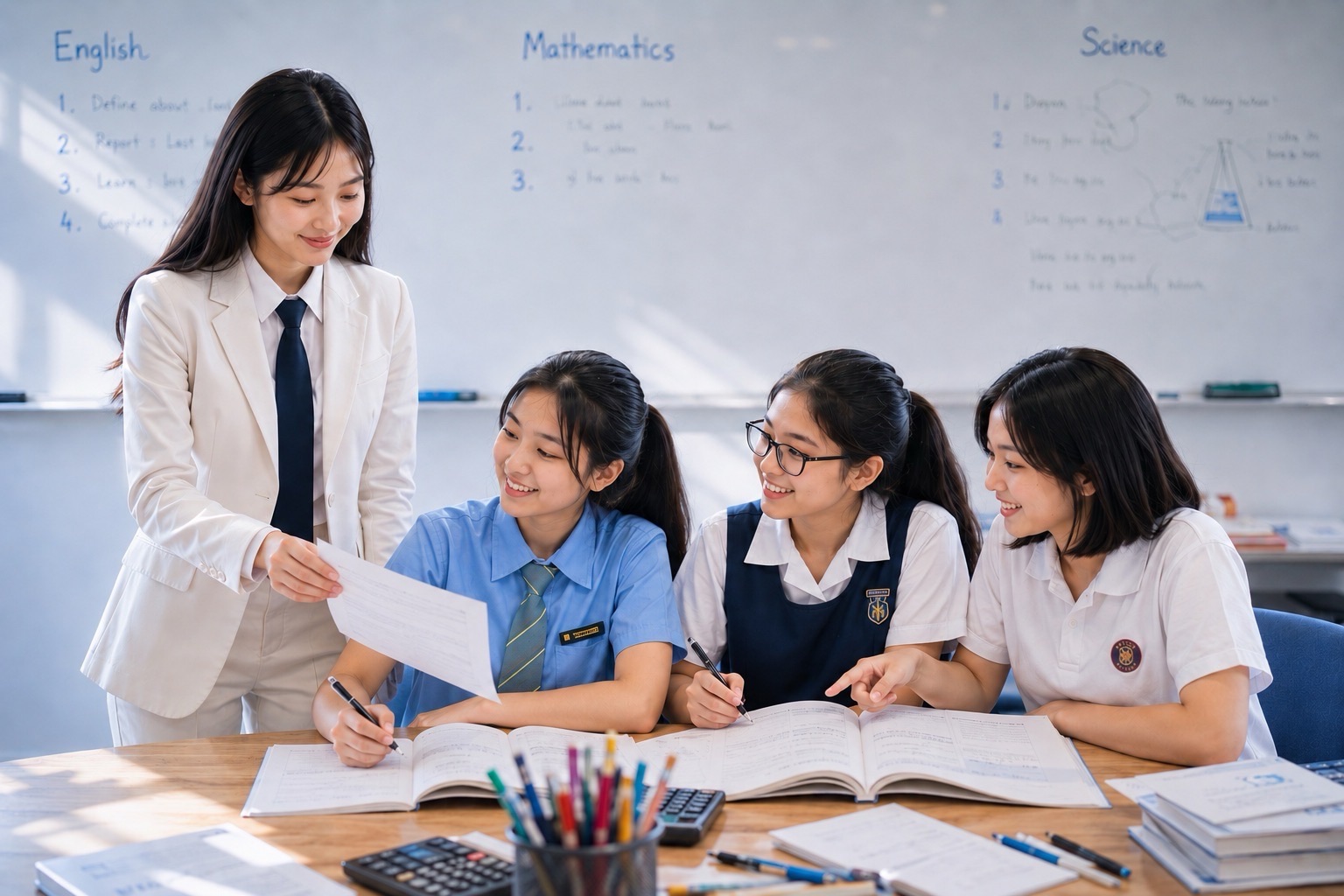
Secondary 4 Additional Mathematics tutor for Clementi students. Premium 3-pax A-Math tutorials near Sixth Avenue MRT, with algebra repair, calculus, trigonometry and examination preparation.
Secondary 4 Additional Mathematics Tutor Clementi | 3-Pax Small Group Tutorials
Stronger algebra. Connected concepts. Calm, precise examination preparation.
At eduKateSG, we provide premium 3-pax Secondary 4 Additional Mathematics tutorials for Clementi students attending lessons near Sixth Avenue MRT.
Secondary 4 A-Math is where two years of advanced Mathematics must become one usable examination system.
Students are expected to move confidently between:
- quadratic functions and equations;
- surds and logarithms;
- polynomials and partial fractions;
- trigonometric functions and identities;
- coordinate geometry;
- differentiation and integration;
- stationary points and optimisation;
- area under curves; and
- displacement, velocity and acceleration.
These topics cannot remain as separate chapters.
During an examination, the paper does not always tell the student which mathematical idea to use. A question may begin with a polynomial, require simultaneous equations and finish with calculus. Another may appear to be about trigonometry but depend on strong algebraic factorisation.
Our Secondary 4 Additional Mathematics tuition helps students complete four essential tasks:
- repair the algebra supporting the entire subject;
- consolidate the full A-Math syllabus;
- recognise connections across topics; and
- execute both papers accurately within time.
Classes are limited to three students.
Lessons are 1.5 hours weekly, with focused teaching, examination-style practice, error analysis and preparation around school assessments and national examinations.
Arrange a parent–student consultation with eduKate Singapore
Secondary 4 A-Math Is the Year of Integration
Secondary 3 introduces much of the machinery of Additional Mathematics.
Secondary 4 must make that machinery work together.
A student may have completed every chapter and still find full papers difficult. This is because chapter completion and examination readiness are not the same thing.
During topical practice, the student is already told what kind of Mathematics is required.
A worksheet titled “Differentiation” has removed the first decision.
A full examination paper does not provide that assistance.
The student must decide:
- what information matters;
- which mathematical structure is present;
- which method should begin the solution;
- whether several topics are connected;
- how much working must be shown;
- whether an exact answer is required; and
- when to move on and return later.
Secondary 4 Additional Mathematics is therefore not only about knowing more.
It is about seeing more clearly.
Why Additional Mathematics Feels Different from E-Math
E-Math covers a broad range of mathematical applications.
A-Math places a deeper and more sustained demand on algebraic reasoning.
In A-Math, algebra is not merely one topic.
It is the working language beneath almost every topic.
A student may understand differentiation conceptually but still lose the question because:
- brackets were expanded incorrectly;
- a negative power was mishandled;
- a common factor was missed;
- a fraction was simplified illegally; or
- the resulting equation was solved inaccurately.
Similarly, a student may remember a trigonometric identity but fail to complete the proof because the expression cannot be factorised or reorganised.
This means many apparent A-Math weaknesses are actually algebra weaknesses appearing inside advanced content.
A good Secondary 4 Additional Mathematics tutor must therefore teach at two levels:
- the advanced concept being tested; and
- the algebraic system carrying that concept.
The Official Additional Mathematics Structure
For 2026 GCE O-Level school candidates, Additional Mathematics is examined under syllabus 4049. The syllabus is organised into three principal strands:
- Algebra;
- Geometry and Trigonometry; and
- Calculus.
It assumes knowledge of O-Level Mathematics and places particular emphasis on mathematical reasoning, communication, application and connections across topics. (Isomer User Content)
From the 2027 Singapore-Cambridge Secondary Education Certificate examinations, G3 Additional Mathematics is listed under subject code K341, with 4049 shown as the corresponding code used for 2026 and earlier candidates. (SEAB)
For families, the practical principle is straightforward:
The student should prepare according to the syllabus and examination route assigned to the graduating cohort.
Our consultation considers:
- graduating year;
- school programme;
- current syllabus;
- preliminary examination schedule;
- recent results;
- present content coverage; and
- post-secondary Mathematics requirements.
The Three Engines of Secondary 4 Additional Mathematics
Algebra
Algebra allows the student to rearrange, transform and expose mathematical structure.
The official syllabus includes areas such as:
- quadratic functions;
- equations and inequalities;
- surds;
- polynomials;
- remainder and factor theorems;
- partial fractions;
- binomial expansions;
- exponential functions; and
- logarithmic functions.
Geometry and trigonometry
This strand requires students to work with:
- trigonometric functions;
- exact values;
- degrees and radians;
- graphs;
- identities;
- compound-angle and double-angle formulae;
- trigonometric equations;
- R-formula applications;
- coordinate geometry;
- equations of circles;
- linearisation; and
- geometric proofs.
Calculus
Calculus requires students to connect symbolic procedures to gradients, rates of change, areas and motion.
The syllabus includes:
- differentiation;
- product, quotient and chain rules;
- increasing and decreasing functions;
- stationary points;
- second-derivative classification;
- tangents and normals;
- connected rates of change;
- maxima and minima;
- integration;
- definite integrals;
- areas bounded by curves and lines; and
- displacement, velocity and acceleration.
The student must eventually see these not as three isolated regions, but as one connected mathematical landscape.
Algebra: The Load-Bearing Structure of A-Math
When a building develops cracks on several floors, the true problem may be lower in the structure.
A-Math behaves similarly.
A student may appear weak in:
- logarithms;
- differentiation;
- trigonometric identities;
- coordinate geometry; and
- integration.
However, all five difficulties may be emerging from the same unstable algebra foundation.
We therefore inspect whether the student can reliably:
- expand and factorise;
- manipulate fractions;
- control negative signs;
- solve linear and quadratic equations;
- recognise common factors;
- work with indices;
- complete the square;
- substitute carefully;
- rearrange formulae; and
- preserve equivalence across several lines.
These are not elementary details.
They determine whether the advanced method reaches a correct conclusion.
Quadratic Functions and Equations
Quadratics appear throughout Additional Mathematics.
Students should be able to work with:
- completing the square;
- maximum and minimum values;
- discriminants;
- nature of roots;
- intersections between lines and curves;
- tangent conditions;
- simultaneous equations;
- quadratic inequalities; and
- quadratic models.
The difficulty is not simply remembering the quadratic formula.
Students must learn to decide whether the question requires:
- factorisation;
- completing the square;
- the discriminant;
- graphical interpretation;
- substitution; or
- a condition involving roots.
A common weakness
A student may know that the discriminant is (b^2-4ac), but not understand what it reveals.
We teach the relationship clearly:
- positive discriminant: two distinct real roots;
- zero discriminant: one repeated real root;
- negative discriminant: no real roots.
The student then learns how this connects to:
- a line cutting a curve twice;
- a line touching a curve once; or
- a line not meeting the curve.
The formula becomes part of a geometric and algebraic system.
Surds, Indices and Logarithms
These topics reward precision.
A single invalid transformation can make an otherwise convincing solution incorrect.
Students need control over:
- operations involving surds;
- rationalising denominators;
- equations involving surds;
- laws of indices;
- laws of logarithms;
- change of base;
- exponential equations;
- logarithmic equations; and
- domain restrictions.
Why logarithms often become unstable
Students may memorise:
[
\log_a mn=\log_a m+\log_a n
]
but then incorrectly assume that:
[
\log_a(m+n)=\log_a m+\log_a n.
]
The second statement is not valid.
This error is not solved by telling the student to remember harder.
The student must understand the boundary of the law.
This is where our Fencing Method becomes useful: we define precisely what the logarithmic rule permits, practise within that boundary and then introduce expressions designed to test whether the boundary is understood.
Polynomials, Remainder Theorem and Partial Fractions
Polynomial questions test both conceptual recognition and procedural accuracy.
Students may be required to:
- divide polynomials;
- apply the remainder theorem;
- use the factor theorem;
- determine unknown coefficients;
- factorise cubic expressions;
- solve cubic equations; and
- decompose rational expressions into partial fractions.
The hidden demand
A student may know the theorem but still lose marks because of:
- incorrect substitution;
- sign errors;
- weak simultaneous-equation solving;
- incomplete factorisation; or
- choosing the wrong partial-fraction form.
We teach students to inspect the denominator before beginning a partial-fraction decomposition.
The structure of the denominator determines the required structure of the numerators.
This is not a decorative step.
It decides whether the entire method is valid.
Binomial Expansion
Binomial expansion questions may appear routine, yet they frequently expose weaknesses in notation and term selection.
Students need to understand:
- factorial notation;
- binomial coefficients;
- the general term;
- powers of each factor;
- coefficients of selected terms; and
- how to locate a required power without expanding everything.
A student who relies entirely on writing the full expansion may work too slowly or create unnecessary arithmetic risk.
We teach the student to see the term structure.
The objective is not only to expand.
It is to select efficiently.
Trigonometric Functions and Exact Values
Secondary 4 trigonometry becomes significantly more demanding than basic triangle calculations.
Students must work with:
- six trigonometric functions;
- angles of any magnitude;
- degrees and radians;
- exact values;
- amplitude and period;
- trigonometric graphs;
- identities;
- compound-angle formulae;
- double-angle formulae;
- R-formula transformations; and
- equations within stated intervals.
Calculator answers are not always enough
Many A-Math questions require exact values.
Students must know when an answer should remain in forms involving:
- square roots;
- fractions;
- (\pi); or
- exact trigonometric values.
Premature decimal conversion can hide structure and reduce accuracy.
Degree and radian control
One of the simplest but most expensive mistakes is using the wrong calculator mode.
Students are trained to check:
- whether the angle is in degrees or radians;
- whether the interval is stated correctly;
- whether all required solutions have been found; and
- whether the answer belongs inside the required range.
Trigonometric Identities and Proofs
A trigonometric proof is not the same as solving an equation.
In a proof, the student should normally transform one side until it becomes the other.
Students need to learn:
- which side is more complex;
- whether to convert everything into sine and cosine;
- when to factorise;
- when to use a standard identity;
- how to avoid circular reasoning; and
- when an algebraic transformation is preferable to a trigonometric one.
Why memorising identities is insufficient
Knowing an identity does not guarantee that the student will recognise where it should be used.
For example, the student may know:
[
1+\tan^2x=\sec^2x
]
but fail to recognise it inside a fraction or factorised expression.
Our practice therefore changes the visual form of familiar identities.
Students learn to recognise the underlying structure, not only the textbook arrangement.
R-Formula Questions
Questions involving expressions such as:
[
a\cos\theta+b\sin\theta
]
require students to express the result in an appropriate (R)-form.
The process depends on:
- selecting the requested sine or cosine form;
- matching coefficients correctly;
- calculating (R);
- determining the auxiliary angle;
- respecting the sign and quadrant; and
- using the transformed expression to find maximum, minimum or solution values.
The final formula is often not the end of the question.
It may be used to solve an equation or determine an extreme value.
Students must understand both the transformation and its purpose.
Coordinate Geometry and Circles
Coordinate geometry questions may combine:
- gradients;
- parallel and perpendicular lines;
- midpoints;
- areas;
- equations of straight lines;
- equations of circles;
- tangents;
- intersections; and
- simultaneous equations.
The official syllabus includes circles in centre-radius and general forms, as well as the transformation of relationships into linear form.
A common examination problem
The student may correctly identify the centre and radius of a circle but lose control while completing the square.
This is another example of an advanced-looking geometry question being decided by algebra.
We teach the student to move comfortably between:
- geometric meaning;
- algebraic form; and
- graphical interpretation.
Differentiation: More Than Applying a Rule
Students first learn differentiation as a procedure.
By Secondary 4, they must use it as a decision-making tool.
The derivative may represent:
- the gradient of a curve;
- the gradient of a tangent;
- an instantaneous rate of change;
- velocity;
- a condition for a stationary point; or
- part of an optimisation problem.
Students need control over:
- power rules;
- trigonometric derivatives;
- exponential and logarithmic derivatives;
- product rule;
- quotient rule;
- chain rule; and
- combinations of these rules.
The recognition problem
The student must recognise the function’s structure before choosing a rule.
For example:
- a product requires product rule;
- a quotient may require quotient rule;
- a function inside another function requires chain rule;
- a product containing a composite function may require more than one rule.
A student who begins differentiating before reading the structure may choose an incomplete route.
We train the reading before the operation.
Stationary Points, Maxima and Minima
Finding a stationary point involves more than setting the derivative equal to zero.
Students may need to:
- differentiate;
- solve the resulting equation;
- find the corresponding coordinates;
- classify the stationary point;
- use a second derivative;
- interpret the answer in context; and
- distinguish between local and contextual restrictions.
The working must remain organised.
A student who finds the correct (x)-value but fails to determine the corresponding (y)-value has not completed the coordinate.
A student who finds the point but does not classify it may leave available marks behind.
Tangents, Normals and Rates of Change
Students should understand that:
- the derivative gives the gradient of a tangent;
- a normal is perpendicular to the tangent;
- perpendicular gradients multiply to (-1), where defined;
- the gradient must be evaluated at the correct point; and
- an equation of a line still requires a point and gradient.
Connected-rate questions add another layer.
The student must:
- identify the changing quantities;
- establish the relationship between them;
- differentiate with respect to the correct variable;
- substitute values at the appropriate stage; and
- retain units and direction.
The calculus may be short.
The modelling is often the real challenge.
Integration: Reversing and Reconstructing
Integration is often introduced as the reverse of differentiation.
That is correct, but incomplete.
Students must also use integration to reconstruct:
- functions;
- areas;
- displacement; and
- relationships from rates of change.
They need to control:
- standard integration rules;
- composite linear expressions;
- constants of integration;
- definite integrals;
- areas above and below the axis;
- limits;
- intersections; and
- contextual interpretation.
The constant of integration
When performing indefinite integration, the constant of integration is not optional decoration.
It represents an unknown constant lost during differentiation.
Students must know:
- when (+C) is required;
- how an initial condition determines (C); and
- why it does not appear as an additional term after evaluating a definite integral.
Area Under a Curve
Area questions require both calculus and geometric judgement.
The student may need to:
- sketch or interpret the region;
- find points of intersection;
- determine the correct limits;
- identify whether part of the curve lies below the axis;
- divide the region into sections; and
- decide whether a definite integral represents signed area or physical area.
An integral below the (x)-axis produces a negative value.
A physical area remains positive.
Students must understand the distinction rather than changing the sign mechanically.
Kinematics: Displacement, Velocity and Acceleration
In linear kinematics:
- displacement is differentiated to obtain velocity;
- velocity is differentiated to obtain acceleration;
- acceleration is integrated to obtain velocity; and
- velocity is integrated to obtain displacement.
However, the question may require more than carrying out these operations.
Students must interpret:
- when a particle is at rest;
- direction of motion;
- changes in direction;
- distance versus displacement;
- initial conditions; and
- motion within a stated time interval.
A negative velocity does not mean that the calculation is wrong.
It indicates direction.
This is where conceptual interpretation must remain connected to the algebra and calculus.
The Two A-Math Examination Papers
Under the 2026 syllabus, Additional Mathematics has two written papers.
Each paper is 2 hours 15 minutes, carries 90 marks and contributes 50% of the subject result.
Paper 1 contains 12 to 14 questions of varying lengths, with up to 10 marks per question. Paper 2 contains 9 to 11 questions, with up to 12 marks per question. All questions are compulsory. Essential working must be shown, and approved calculators may be used in both papers. (Isomer User Content)
This creates a paper that rewards both technical fluency and sustained reasoning.
Paper 1 priorities
Students require:
- fast topic recognition;
- secure standard techniques;
- disciplined algebra;
- controlled pacing;
- clean working; and
- the ability to recover quickly after a difficult question.
Paper 2 priorities
Students require:
- longer concentration;
- multi-topic integration;
- careful reading;
- strong route selection;
- persistence;
- organised working; and
- enough time to complete high-mark questions.
Both papers assess the complete syllabus.
A student should not assume that one paper is purely algebra and the other is purely calculus.
Essential Working Must Be Visible
Additional Mathematics is not assessed only through final answers.
The official assessment scheme states that omitting essential working can result in lost marks.
This matters because students sometimes attempt to save time by compressing too many operations into one line.
That can create three problems:
- method marks become difficult to award;
- the student cannot locate the error;
- signs and factors are more easily lost.
We teach students to show enough structure without writing unnecessary commentary.
Good A-Math working is:
- logical;
- economical;
- readable;
- correctly notated; and
- easy to check.
Examination Accuracy and Exact Forms
The 2026 examination instructions specify that non-exact numerical answers should generally be given to three significant figures, or one decimal place for angles in degrees, unless the question specifies otherwise. (Isomer User Content)
Students are trained to distinguish between:
- exact answers;
- decimal approximations;
- degrees;
- radians;
- intermediate calculator values; and
- final rounded answers.
Common accuracy losses
- rounding too early;
- giving three decimal places instead of three significant figures;
- converting an exact answer unnecessarily;
- omitting (\pi);
- giving a degree answer in radian mode;
- failing to include every solution in an interval; and
- using a rounded intermediate value in later parts.
These may appear to be minor details.
Across a complete paper, they can decide a grade boundary.
Why Students Lose Marks Even When They Understand the Topic
A-Math mark loss usually falls into several categories.
Concept error
The student does not understand the mathematical relationship.
Recognition error
The student knows the method but does not recognise that the question requires it.
Algebra error
The higher-level concept is correct, but manipulation fails.
Route error
The student selects an inefficient or incomplete method.
Notation error
Symbols, intervals, constants or exact forms are used incorrectly.
Calculator error
The wrong mode, entry or rounding is used.
Presentation error
Essential working is missing or difficult to follow.
Timing error
Too much time is spent on one question, leaving later marks inaccessible.
Pressure error
The student abandons a familiar method because the question appears unfamiliar.
The correction depends on the category.
Telling every student to “do more practice” is too imprecise.
Our A-Math Diagnostic Process
We examine more than the final percentage.
Recent school papers allow us to see:
- which topics remain incomplete;
- where the student stops;
- whether the correct method was recognised;
- how long algebra remains controlled;
- whether earlier marks are secured;
- which errors repeat;
- whether the paper was completed;
- where exact values were lost; and
- whether the student’s method would earn working marks.
We then separate the student’s needs into four layers.
Layer 1: Foundation
Does the student possess the required E-Math and algebra base?
Layer 2: A-Math content
Have the main concepts and procedures been learned?
Layer 3: Integration
Can the student connect topics inside unfamiliar questions?
Layer 4: Examination execution
Can the student complete the work accurately within time?
This creates a clearer programme than simply beginning with the chapter currently taught in school.
Four Secondary 4 A-Math Pathways
Rescue pathway
For students who are failing or leaving large sections blank.
The immediate priorities may include:
- essential algebra;
- high-frequency topics;
- standard differentiation and integration;
- quadratic methods;
- logarithmic laws;
- basic trigonometric equations;
- showing usable working; and
- securing accessible marks.
The first objective is to restore entry into the paper.
Stabilisation pathway
For students who understand lessons but produce inconsistent assessment results.
The programme focuses on:
- retrieval;
- mixed-topic recognition;
- reduction of algebra errors;
- completion of longer solutions;
- timing;
- correction routines; and
- greater score reliability.
Distinction pathway
For students moving from a B towards A1 or A2.
The remaining weaknesses may include:
- difficult trigonometric identities;
- complex calculus applications;
- unfamiliar polynomial questions;
- exact-value precision;
- incomplete explanations;
- inefficient routes; or
- several small errors across the paper.
The work becomes increasingly surgical.
High-performance pathway
For students already producing strong results.
The focus moves towards:
- unfamiliar problem structures;
- alternate methods;
- difficult mixed sets;
- full-paper conditioning;
- resilience after a difficult question;
- high-level accuracy;
- time efficiency; and
- stable distinction performance.
First-Principles Teaching Before Speed
Students often carry procedural phrases such as:
- “move it across”;
- “flip the sign”;
- “cancel these”;
- “bring the power down”; or
- “just substitute”.
These phrases may appear to work in familiar questions.
They become dangerous when the structure changes.
At eduKateSG, we teach the valid mathematical operation beneath the shortcut.
Students learn:
- what quantity is being changed;
- which operation preserves equivalence;
- why a rule applies;
- when it does not apply; and
- how the transformation can be checked.
Once the principle is stable, the procedure can become fast.
Speed built on understanding is durable.
Speed built on imitation disappears when the paper changes shape.
The Fencing Method for A-Math
We introduce complexity in controlled stages.
A student learning differentiation may begin with:
- one power term;
- positive integer powers;
- no brackets;
- no products; and
- no composite functions.
The fence then expands to include:
- negative and fractional powers;
- several terms;
- trigonometric functions;
- exponentials and logarithms;
- products;
- quotients;
- chain rule;
- stationary points; and
- applied optimisation.
For trigonometric identities, the fence may progress from:
- one standard identity;
- simple substitutions;
- expressions in sine and cosine;
- factorisation;
- compound angles;
- double angles; and
- multi-stage proofs.
The student sees exactly what new demand has been added.
This prevents advanced practice from becoming undifferentiated confusion.
Retrieval and Interleaving
A-Math must remain available across the year.
A student who studied partial fractions in January may need to recognise the topic immediately in September.
We therefore use:
Retrieval practice
Students recall methods after a delay.
Spaced review
Important concepts return across several weeks.
Interleaving
Algebra, trigonometry and calculus appear within the same practice set.
Error recurrence
Previously incorrect questions return later in altered forms.
Cumulative micro-tests
Short tests reveal whether earlier content remains usable.
The examination is mixed.
Preparation must eventually become mixed as well.
A Typical 90-Minute Secondary 4 A-Math Tutorial
Opening retrieval
Students begin with selected questions from earlier topics or previous error patterns.
Precision lesson
The tutor addresses one important concept, connection or misconception.
Guided application
Students attempt carefully selected questions while the tutor observes their working.
Independent practice
Tutor prompts are removed so that genuine control can be assessed.
Timed examination set
Students complete a short sequence under a defined time limit.
Error analysis
Mistakes are classified, corrected and converted into a prevention routine.
Focused continuation work
Home practice is selected according to the student’s immediate requirement.
The lesson does not end with a random stack of questions.
It ends with a clear next step.
Why 3-Pax Tutorials Work for Secondary 4 A-Math
Additional Mathematics errors often occur several lines before the final wrong answer.
The tutor must see the working while it is being produced.
In a maximum 3-pax tutorial, the tutor can observe:
- how each student reads the question;
- which method is selected;
- where hesitation begins;
- how the algebra is organised;
- whether notation is secure;
- how long the route takes;
- whether corrections are retained; and
- how the student responds under timing.
Immediate feedback
A faulty algebraic habit can be corrected before it spreads across an entire worksheet.
Individual priorities
One student may require trigonometric repair.
Another may need calculus applications.
A third may need paper completion and time management.
The small class allows these needs to be managed without turning the lesson into a generic lecture.
Frequent explanation
Students are asked to justify their method.
Explanation reveals whether the structure is understood.
Calm accountability
There is little room to remain passive, but the environment remains supportive and measured.
Useful peer learning
Students can compare methods, see alternative routes and learn how another student organises a difficult solution.
Preparing for Preliminary Examinations
Preliminary examinations serve several purposes.
They test:
- content completion;
- retention;
- paper stamina;
- timing;
- recognition;
- accuracy;
- examination behaviour; and
- the student’s ability to recover after difficult questions.
Before prelims, we gradually move from topical repair towards:
- mixed-topic sets;
- timed sections;
- complete papers;
- school-specific practice;
- error reduction; and
- paper-management routines.
After prelims, the paper becomes a diagnostic map.
We identify:
- marks lost through missing knowledge;
- marks lost despite knowing the method;
- questions abandoned too early;
- inefficient routes;
- recurring algebra failures;
- exact-value errors;
- timing breakdowns; and
- topics requiring final repair.
The prelim result is not simply a judgement.
It is information for the final preparation phase.
Starting A-Math Tuition in January
A January start gives the student the widest runway.
There is time to:
- inspect Secondary 3 foundations;
- repair algebra;
- complete remaining content;
- revisit forgotten topics;
- connect the syllabus;
- build mixed-topic control;
- prepare for prelims; and
- develop full-paper stamina gradually.
This is particularly useful for students whose school has moved quickly through Secondary 3 content.
Starting After the First School Assessment
A disappointing early result often reveals that the Secondary 3 foundation has not transferred safely into the examination year.
There is still meaningful time to respond.
We identify:
- whether the issue is topic-specific;
- whether the syllabus base is broad but fragile;
- whether errors are mainly algebraic;
- whether paper timing is already weak; and
- which repairs will produce the greatest benefit.
The student should not wait for the same result to repeat across several assessments.
Starting in June
A June start requires sharper prioritisation.
The programme may need to distinguish between:
- topics that must be rebuilt;
- topics that require only retrieval;
- topics already strong enough to protect;
- high-frequency errors;
- examination habits; and
- realistically recoverable marks.
The student may not need every chapter retaught from the beginning.
The student needs the correct weaknesses repaired in the correct order.
Starting After Preliminary Examinations
There is still useful work to be done, but the purpose becomes narrower.
We focus on:
- examination paper analysis;
- marks that were available but lost;
- dangerous recurring weaknesses;
- completion rate;
- timing;
- standard methods that remain unreliable;
- high-value topic repair; and
- final confidence through evidence.
This stage is not about manufacturing certainty.
It is about reducing avoidable loss.
Paper Strategy for Additional Mathematics
A-Math rewards students who can manage both the Mathematics and the paper.
Secure accessible marks
Students should not allow one difficult early question to consume time needed elsewhere.
Read mark values
A high-mark question normally requires more mathematical development than a short question.
Show enough working
Essential steps protect method marks and make checking possible.
Skip intelligently
A temporary skip can preserve the paper.
The question should be marked so that the student can return efficiently.
Preserve exact values
Decimal conversion should not be introduced before it is necessary.
Check strategically
The student should prioritise:
- blank parts;
- lost signs;
- constants of integration;
- interval restrictions;
- exact-value instructions;
- calculator modes;
- final units; and
- solutions that appear mathematically impossible.
Good examination technique does not replace understanding.
It allows understanding to reach the mark scheme.
What Meaningful Progress Looks Like
Parents may first notice that the student:
- begins questions more independently;
- recognises topics faster;
- writes cleaner algebra;
- makes fewer sign errors;
- completes longer solutions;
- remembers older chapters;
- uses exact values more confidently;
- selects differentiation rules correctly;
- shows greater control in trigonometric proofs;
- leaves fewer blanks;
- finishes more of the paper; and
- produces a narrower range of assessment scores.
The objective is not one unusually high paper.
It is reliable performance across different papers.
What Parents Can Bring to the Consultation
Useful materials include:
- recent A-Math test papers;
- Secondary 3 final examination papers;
- Secondary 4 weighted assessments;
- preliminary papers;
- school revision plans;
- marked assignments;
- teacher comments;
- current topic coverage; and
- examples of questions the student avoids.
We are interested in the working, not only the total.
Two students who both score 50% may have very different needs.
One may know most of the syllabus but complete too little of the paper.
Another may have substantial gaps in algebra, trigonometry and calculus.
Their tuition plans should not be identical.
Frequently Asked Questions
Is Additional Mathematics mainly difficult because of calculus?
No.
Calculus is important, but many students lose A-Math marks through algebra, trigonometry, logarithms, polynomials and equation solving.
Calculus itself also depends heavily on accurate algebra.
My child understands the lesson but cannot do unfamiliar questions. Why?
The student may possess procedural familiarity without flexible recognition.
We use retrieval and interleaving so that the student must identify the required Mathematics without being told the chapter.
Can a student improve significantly in Secondary 4?
Yes, but the possible rate depends on:
- the starting point;
- the size of the foundation gap;
- time remaining;
- attendance;
- independent practice;
- school workload; and
- willingness to correct established habits.
The later the start, the more selective the programme must become.
Do you teach both G3 and O-Level A-Math?
We teach according to the student’s cohort, school programme and relevant syllabus.
For 2026 O-Level school candidates, Additional Mathematics is syllabus 4049. For the 2027 SEC G3 route, Additional Mathematics is listed as K341, with 4049 identified as the earlier reference code. (SEAB)
Do students also need strong E-Math?
Yes.
The official A-Math syllabus assumes knowledge of O-Level Mathematics. E-Math algebra, geometry and numerical skills may be required indirectly within A-Math questions. (Isomer User Content)
How do you reduce careless mistakes?
We avoid treating every mistake as generic carelessness.
Errors are classified as:
- conceptual;
- algebraic;
- recognition-based;
- numerical;
- notational;
- calculator-related;
- presentation-related; or
- timing-related.
The checking system is then matched to the actual pattern.
Do you provide full-paper practice?
Yes.
However, full papers are introduced according to readiness.
A student with large gaps may first gain more from targeted repair. The programme then moves through mixed sets, timed sections and complete-paper conditioning.
Do you teach examination technique or only content?
Both.
Students need mathematical understanding, but they must also manage time, show essential working, preserve exact values, read intervals and recover from difficult questions.
My child is already scoring an A. Is tuition useful?
It may be useful when the student is seeking:
- greater A1 consistency;
- more demanding questions;
- stronger paper strategy;
- fewer small algebraic errors;
- improved timing;
- better handling of unfamiliar applications; or
- preparation for post-secondary Mathematics.
A student who is already consistently strong and independent may not require tuition.
Can my child join halfway through Secondary 4?
Yes, subject to a suitable 3-pax placement.
We first review recent work so that limited preparation time can be used appropriately.
Is a 3-pax class suitable for a quiet student?
Yes.
The student receives frequent opportunities to respond without speaking before a large room. The tutor can also notice hesitation and invite participation carefully.
Do you promise an A1?
No responsible tutor can guarantee a national-examination grade.
We provide a structured route towards stronger understanding, more accurate execution and better examination control. The final result also depends on the student’s starting point, attendance, practice and performance on the examination day.
Convenient Access from Clementi to Sixth Avenue MRT
eduKateSG conducts premium small-group Mathematics tutorials near Sixth Avenue MRT, with convenient access for families travelling from Clementi and nearby western districts. The existing Clementi Secondary Mathematics programme is positioned around 3-pax teaching and first-principles support at the Sixth Avenue location. (eduKate Singapore)
Students travelling by MRT can take the East–West Line from Clementi to Buona Vista, transfer to the Circle Line for Botanic Gardens and continue on the Downtown Line to Sixth Avenue.
The value of the journey is not simply geographical.
It gives the student access to a quiet class in which every line of working can be seen, questioned and improved.
Location: eduKateSG near Sixth Avenue MRT
Format: Premium 3-pax small-group tutorials
Duration: 1.5 hours weekly
Subject: Secondary 4 Additional Mathematics
Attendance: By consultation and suitable class placement
Class Details
Level: Secondary 4
Subject:
- O-Level Additional Mathematics;
- G3 Additional Mathematics;
- IP Additional Mathematics support; and
- school-specific advanced Mathematics, subject to syllabus compatibility.
Format: Maximum three students
Duration: 1.5 hours weekly
Programme elements:
- initial diagnostic review;
- algebra repair;
- syllabus consolidation;
- trigonometry;
- coordinate geometry;
- differentiation;
- integration;
- kinematics;
- retrieval and interleaving;
- timed micro-tests;
- school-examination preparation;
- preliminary-paper analysis;
- full-paper conditioning; and
- personalised error correction.
Materials may include:
- curated concept notes;
- targeted topic sets;
- mixed-topic revision;
- examination-style questions;
- timed sections;
- complete papers;
- error-repair exercises; and
- focused continuation work.
Additional clinics may be arranged before major assessments, subject to scheduling.
Limited trial lessons may occasionally be possible when the 3-pax class configuration permits. The usual first step is a parent–student consultation.
How Placement Works
Parent–student consultation
We discuss:
- school and cohort;
- present A-Math grade;
- topic coverage;
- recurring concerns;
- examination schedule;
- target outcome;
- study habits; and
- time remaining.
Paper review
Recent work is examined to locate the actual mark-loss pattern.
Class matching
Students are placed according to:
- syllabus;
- present readiness;
- pace;
- timetable; and
- compatibility with the existing group.
A-Math roadmap
The first teaching priorities are identified.
The student may begin with:
- algebra repair;
- logarithms;
- trigonometric identities;
- differentiation;
- integration;
- coordinate geometry;
- paper completion; or
- examination timing.
The programme begins where the student’s Mathematics begins to break.
Helpful Reading for Clementi Parents
- Secondary Mathematics Tuition Clementi — 3-Pax Small Groups
- Secondary 4 Additional Mathematics Tuition Bukit Timah — The Examination Year
- Secondary 4 Mathematics Tutor in Bukit Timah — 3-Pax Small Group
- What to Expect for Secondary 4 Additional Mathematics Tuition
- MOE Secondary Curriculum and Mathematics Syllabuses
- SEAB 2026 GCE O-Level Syllabuses
- SEAB 2027 SEC G3 Syllabuses
Secondary 4 Additional Mathematics Tutor for Clementi Students
Additional Mathematics becomes manageable when its parts stop behaving like separate obstacles.
Algebra supports trigonometry.
Trigonometry enters calculus.
Calculus describes gradients, areas and motion.
Graphs provide a visual form for equations.
Equations hold the entire system together.
This is the real work of Secondary 4 A-Math tuition.
The student is not merely revising more chapters.
The student is building one connected mathematical instrument that can be used under examination conditions.
At eduKateSG, our 3-pax tutorials provide the space to see precisely where that instrument is failing.
For students who are behind, we restore entry into the subject.
For students who are passing, we make performance more stable.
For students approaching distinction, we reduce mark leakage and refine difficult applications.
For strong students, we develop the accuracy, flexibility and paper control required for reliable A1 performance.
The final goal is simple to state, although careful to build:
The student should enter the examination able to recognise the Mathematics, choose a valid route, carry the algebra safely and complete the solution with calm precision.
Arrange a Parent–Student Consultation
Speak with eduKateSG about your child’s:
- present A-Math performance;
- algebra foundation;
- difficult topics;
- preliminary-examination schedule;
- paper-completion concerns;
- target grade; and
- suitable 3-pax class placement.
eduKateSG
Near Sixth Avenue MRT
Premium 3-pax Secondary 4 Additional Mathematics tutorials
1.5-hour weekly lessons
By consultation and suitable class placement
Properly taught kids shine a bright light into the future.