
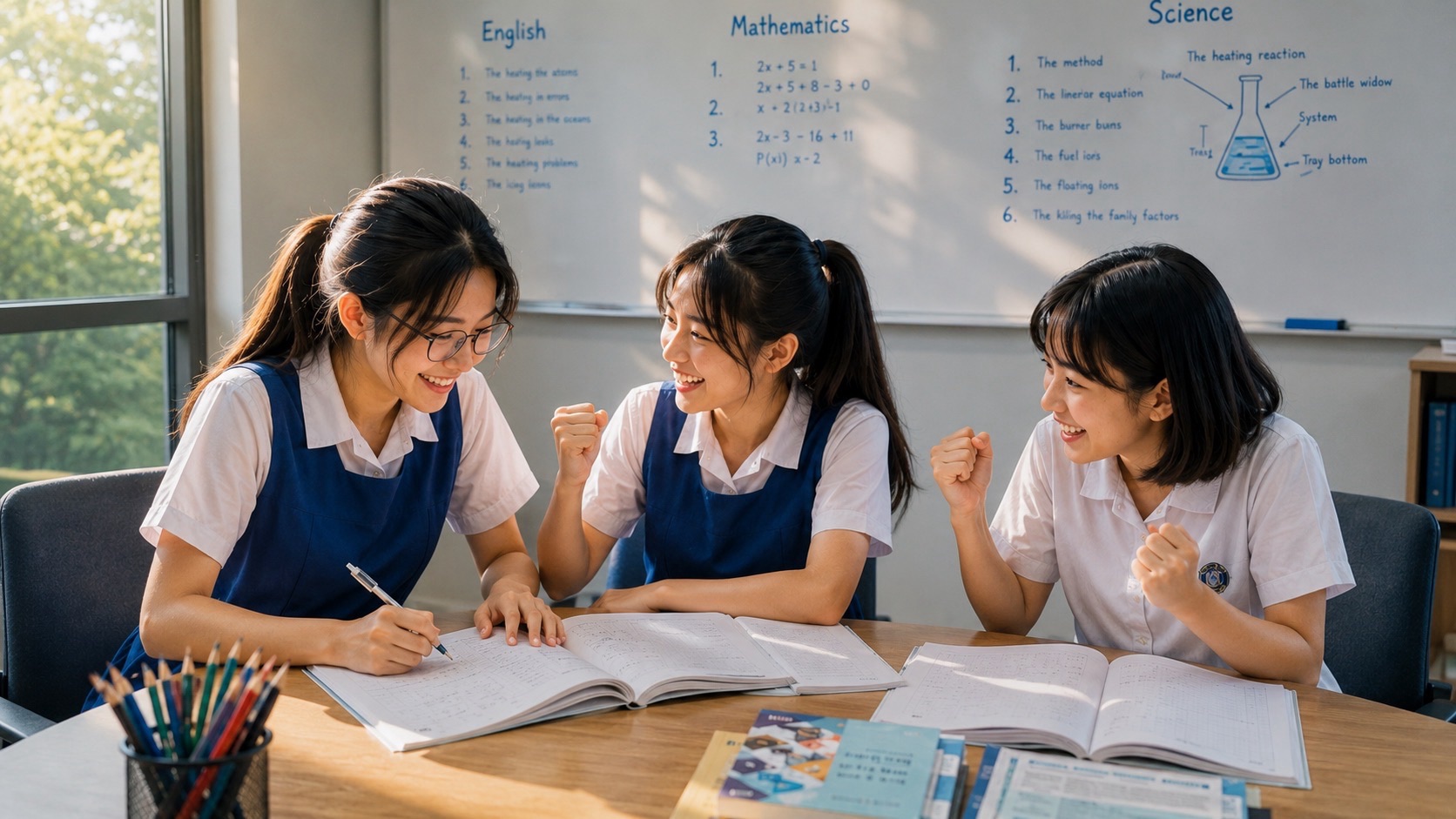
Find a Mathematics tutor for Clementi students who can diagnose learning gaps, rebuild foundations and prepare for PSLE, G1–G3, E-Math and A-Math in focused 3-pax classes.
A good Mathematics tutor does more than explain answers. eduKateSG helps Clementi students understand concepts, repair weak foundations and develop reliable independent performance in focused 3-pax classes.
Mathematics Tutor Clementi
A good Mathematics tutor does not begin by asking how many worksheets a student can complete.
The tutor begins by asking a more useful question:
Why is this student unable to produce the correct Mathematics independently?
The answer may be a missing concept. It may be weak number sense, incomplete algebra, difficulty interpreting mathematical language, poor method selection or unstable working under time pressure.
Two students can make the same mistake for entirely different reasons.
One may not understand the topic.
Another may understand it but forget the method.
A third may know the method but apply it to the wrong question structure.
A fourth may complete the entire solution correctly before losing the answer through a sign, unit or calculation error.
The visible mistake is only the surface.
The Mathematics tutor’s work is to find the mechanism underneath it.
For Clementi families looking for a Mathematics tutor, this distinction matters. The right tutor should not simply keep the student occupied. The tutor should be able to read the student’s present learning condition, identify the earliest important weakness and build forward in the correct order.
One-Sentence Answer
A Mathematics tutor for Clementi students should be able to diagnose why performance is breaking, teach concepts from first principles, correct recurring errors and gradually develop independent PSLE, G1–G3, E-Math or A-Math performance.
A Mathematics Tutor Is Not Just an Answer Provider
It is easy to recognise a tutor who knows Mathematics.
It is more difficult to recognise a tutor who knows how to teach Mathematics to the particular child sitting in front of them.
Subject knowledge is essential, but it is only the beginning.
A strong Mathematics tutor must also know:
- what the student should already understand;
- which earlier topic supports the current topic;
- why a particular mistake is occurring;
- when to explain and when to let the student struggle;
- how much guidance to provide;
- when the student is ready for harder work;
- and whether an apparent improvement will survive the next academic transition.
A tutor who explains every step beautifully may still produce a dependent student.
During the lesson, everything appears clear. At home, without the tutor’s voice, the student cannot begin.
This happens when the tutor becomes the thinking system instead of training the student’s thinking system.
The purpose of a Mathematics tutor is therefore not to remain permanently necessary.
The tutor should help the student become increasingly capable of:
- reading the question accurately;
- identifying its mathematical structure;
- selecting an appropriate method;
- carrying out the method cleanly;
- checking whether the result is reasonable;
- and correcting the approach when it fails.
That is how supported learning becomes independent performance.
Mathematics Tuition and a Mathematics Tutor Are Not the Same Thing
Parents often use the terms interchangeably, but there is a useful difference.
Mathematics tuition refers to the wider learning arrangement:
- the syllabus;
- lesson schedule;
- curriculum;
- class size;
- materials;
- practice sequence;
- examination preparation;
- and learning environment.
The Mathematics tutor is the active person operating within that arrangement.
The tutor decides:
- what to notice;
- what to prioritise;
- what to explain;
- what to leave for the student to attempt;
- what to repair first;
- and what the student should do next.
A strong programme can be weakened by poor teaching decisions.
A skilled tutor can also be limited by an unsuitable class structure, mismatched students or insufficient time for individual observation.
The most useful question is therefore not merely:
“Is this a good tutor?”
It is:
“Can this tutor work effectively with my child, at this level, inside this class structure, for the next stage of Mathematics?”
What Should a Mathematics Tutor Notice?
Before attempting to improve marks, the tutor needs to notice where the student’s mathematical process becomes unstable.
This usually appears in one or more layers.
1. Knowledge
Does the student know the relevant facts, definitions, formulas and procedures?
Examples include:
- multiplication facts;
- fraction rules;
- algebraic identities;
- angle properties;
- trigonometric ratios;
- differentiation formulas;
- and statistical definitions.
If the knowledge is missing, the student may have no suitable tool to begin with.
However, knowing a formula does not mean the student understands when or why it should be used.
2. Meaning
Does the student understand what the mathematical objects represent?
A Primary student may be able to calculate a percentage without understanding what the percentage is relative to.
A Secondary student may be able to manipulate an equation without understanding equality.
An A-Math student may differentiate an expression mechanically without understanding the relationship between a function and its rate of change.
When meaning is weak, methods become fragile.
The student may succeed with familiar questions but collapse when the appearance changes.
3. Representation
Can the student convert the question into a useful mathematical form?
Depending on the level, this may involve:
- drawing a model;
- constructing a diagram;
- forming an equation;
- organising information in a table;
- sketching a graph;
- introducing a variable;
- or identifying the relationship between quantities.
Many students do not fail because they cannot calculate.
They fail because they cannot represent the problem clearly enough to begin calculating.
4. Method
Does the student know a valid and efficient route?
A method should not be a collection of mysterious instructions.
The tutor should help the student understand:
- why the method is permitted;
- the correct sequence of steps;
- what must remain unchanged;
- where common errors occur;
- and how to verify the result.
5. Transfer
Can the student use the learning when the question looks different?
Transfer is one of the most important distinctions between classroom familiarity and genuine mastery.
A student may complete ten questions when they are arranged under the heading “Ratio”. The difficulty appears when ratio is hidden inside a geometry, percentage or speed problem.
The tutor must therefore vary the surface of the question while preserving the underlying mathematical structure.
6. Execution
Can the student produce the solution accurately, cleanly and within the required time?
Execution includes:
- copying correctly;
- handling signs;
- controlling brackets;
- showing sufficient working;
- writing units;
- using the calculator appropriately;
- managing time;
- and checking strategically.
A student can understand Mathematics and still lose many marks through unstable execution.
7. Recovery
What happens when the first method does not work?
Strong students are not students who never become stuck.
They are students who can respond usefully when they become stuck.
They may:
- return to the information given;
- draw a clearer diagram;
- test a simpler case;
- work backwards;
- identify a related formula;
- check an earlier step;
- or try a different representation.
A Mathematics tutor should teach recovery as part of problem-solving, not treat every moment of uncertainty as something to remove immediately.
The Tutor Must Find the Earliest Important Break
Mathematics is cumulative.
A visible problem in the current chapter may have begun several chapters or several years earlier.
A Secondary 1 student struggling with algebra may have weak control of negative numbers and arithmetic operations.
A Secondary 3 student struggling with quadratic equations may have incomplete factorisation skills.
An A-Math student struggling with differentiation may be losing control during algebraic simplification rather than during differentiation itself.
A Primary 5 student struggling with percentage may not have stable fractions or multiplicative reasoning.
The tutor should therefore distinguish between the current difficulty and the originating difficulty.
These are not always the same.
Consider a student who cannot solve a percentage increase problem.
The tutor could repeatedly demonstrate the procedure:
Original amount × percentage increase.
That may help temporarily.
A deeper investigation may reveal that the student does not understand:
- what 100% represents;
- the relationship between the original amount and the new amount;
- why an increase of 20% produces 120%;
- or how multiplication represents scaling.
The useful repair is then not simply another worksheet.
It is a reconstruction of meaning.
Once that meaning is stable, many related questions become easier together.
This is more efficient than correcting each question as though it were an isolated failure.
How eduKateSG Approaches Mathematics Teaching
eduKateSG treats Mathematics as a connected learning system rather than a sequence of disconnected worksheets.
The broad route is:
Understand → Represent → Operate → Practise → Connect → Transfer → Perform → Review
Students first need to understand the mathematical idea.
They then learn how to represent and operate it correctly. Practice builds control. Connections show how the idea relates to earlier and later topics. Transfer prepares the student for unfamiliar questions. Examination work then develops reliable performance under realistic conditions.
This reflects the broader eduKate Mathematics Learning System, which positions mastery as cognitive progression, confidence construction and systemised thinking rather than memorisation alone.
Parents who would like to understand the subject more deeply can also begin with eduKateSG’s explanation of [how Mathematics works], which describes Mathematics as a system of precise meanings, valid rules and reliable transformations.
A Tutor Should Teach From First Principles
Teaching from first principles does not mean making every lesson theoretical.
It means ensuring the student understands the stable ground beneath the method.
For example, a student may be told:
“When a term crosses the equal sign, change its sign.”
This shortcut can produce correct answers, but it hides the actual operation.
Nothing has physically crossed the equal sign.
The equation remains balanced because the same mathematical operation is applied to both sides.
Understanding this makes later algebra more dependable.
Similarly, a student may memorise:
“To divide fractions, invert and multiply.”
The rule is useful, but the tutor should eventually help the student understand why it works and what division by a fraction means.
First-principles teaching gives the student something to reconstruct from when memory becomes incomplete.
It reduces dependence on arbitrary instructions.
It also allows the student to detect when a remembered rule has been applied in the wrong situation.
What a Good Mathematics Lesson Should Feel Like
A productive Mathematics lesson is not necessarily silent, fast or effortless.
It should have a clear intellectual rhythm.
The tutor observes
The tutor watches how the student begins, where hesitation appears and what assumptions are being made.
The student attempts
Students need genuine opportunities to produce the Mathematics themselves.
Watching a solution is not equivalent to constructing one.
The tutor intervenes precisely
The tutor provides the smallest useful correction.
Sometimes this is a full explanation.
Sometimes it is a question:
“What does this quantity represent?”
“What must remain equal?”
“Which earlier topic does this resemble?”
“Where did the negative sign first appear?”
Precise intervention preserves more of the student’s thinking.
The student reconstructs
After correction, the student should attempt the process again.
A solution repaired entirely by the tutor may look complete on paper without becoming available to the student later.
The learning is tested again
The student should meet a related question with some variation.
This shows whether the learning has transferred or whether it remains attached to the tutor’s example.
Why eduKateSG Uses 3-Pax Mathematics Classes
A tutor needs enough proximity to observe the student’s actual working process.
In a large class, it is easy to see whether an answer is correct.
It is much harder to see:
- why the student selected a method;
- where the reasoning changed direction;
- which step was uncertain;
- whether the student copied from a nearby example;
- or whether the correct answer was produced through an unreliable process.
eduKateSG offers focused 3-pax tuition for Primary and Secondary English, Mathematics and Science, including PSLE, G1–G3 Mathematics, E-Math and Additional Mathematics.
The small-group structure gives the tutor greater visibility while preserving the advantages of learning beside peers.
Students can:
- compare methods;
- explain reasoning;
- hear useful questions from one another;
- observe alternative approaches;
- and recognise that difficulty is a normal part of serious learning.
Three students also create enough variation for the tutor to distinguish between a whole-class misunderstanding and an individual learning gap.
However, a three-student class only works when it is carefully operated.
The tutor must ensure that:
- one student does not dominate;
- a quiet student does not disappear;
- stronger students continue to progress;
- weaker students receive sufficient support;
- and each student remains intellectually active.
A small group should provide greater teaching resolution, not simply a smaller audience for the same lecture.
Primary Mathematics Tutor for Clementi Students
A Primary Mathematics tutor is responsible for more than preparing the child for the next school test.
Primary school is where the student builds the fundamental mathematical machinery needed for later learning.
MOE’s current Primary Mathematics syllabus covers Primary 1 to Primary 6 and forms part of the wider Primary school curriculum.
The tutor should therefore protect both immediate performance and future readiness.
Primary 1 and Primary 2
The early focus should include:
- number sense;
- place value;
- addition and subtraction;
- multiplication and division foundations;
- measurement;
- mathematical vocabulary;
- visual representation;
- and confidence in explaining simple reasoning.
At this age, speed should not be confused with understanding.
A child who answers slowly but accurately may be building meaning.
A child who answers quickly through memorised cues may become unstable when the question changes.
The tutor should develop fluency without bypassing understanding.
Primary 3 and Primary 4
At Primary 3 and Primary 4, Mathematics becomes more layered.
Students encounter:
- larger numbers;
- multiplication and division;
- fractions;
- measurement;
- geometry;
- tables and graphs;
- and increasingly complex word problems.
The tutor should begin connecting these areas.
A student must learn that a word problem is not a separate branch of Mathematics. It is a mathematical relationship expressed through language.
The work is to translate the language into a form that can be reasoned with.
Primary 5
Primary 5 is a significant integration year.
Fractions, decimals, percentage, ratio, area, volume and multi-step problem-solving place greater pressure on earlier foundations.
The tutor should pay close attention to:
- multiplication fluency;
- fraction control;
- proportional thinking;
- model construction;
- question interpretation;
- and the organisation of longer working.
Primary 5 is also the appropriate time to repair important weaknesses before the compressed demands of Primary 6.
Primary 6 and PSLE Mathematics
A PSLE Mathematics tutor must connect content mastery with examination performance.
The student needs to know the syllabus, but also needs control over:
- question selection;
- time allocation;
- non-calculator fluency;
- calculator discipline;
- multi-step working;
- method marks;
- checking;
- and recovery after a difficult question.
Paper practice should not become the repeated measurement of the same weaknesses.
Every completed paper should reveal:
- which topics remain unstable;
- where time is being lost;
- which errors are recurring;
- which methods are incomplete;
- and which improvements should be made before the next paper.
The tutor should turn the examination paper into a source of learning information.
Secondary Mathematics Tutor for Clementi Students
Secondary Mathematics changes the operating style of the subject.
Primary Mathematics contains substantial calculation and concrete problem-solving. Secondary Mathematics increasingly uses symbols, abstraction, generalisation, graphs and formal relationships.
This transition can surprise students who performed well in Primary school.
It does not necessarily mean the student has become weaker.
The student may simply be entering a mathematical environment that requires a different form of control.
Secondary 1 Mathematics Tutor
Secondary 1 is a transition and recalibration year.
The tutor should help the student manage:
- negative numbers;
- algebraic expressions;
- equations;
- ratios and rates;
- graphs;
- geometry;
- mensuration;
- statistics;
- and more formal mathematical working.
Algebra is particularly important.
Students should not experience algebra as arithmetic with letters placed inside it. They need to understand variables, equivalence, structure and valid transformation.
A stable Secondary 1 foundation makes later E-Math and A-Math considerably more manageable.
Secondary 2 Mathematics Tutor
Secondary 2 is where hidden weaknesses begin to accumulate across a larger system.
The tutor should examine whether the student is ready for upper-Secondary demands.
Important areas may include:
- algebraic manipulation;
- equations;
- proportional reasoning;
- geometry;
- graph interpretation;
- statistics;
- and independent multi-step working.
Under Full Subject-Based Banding, Secondary students may take subjects such as Mathematics at G1, G2 or G3 according to their strengths and learning needs, with opportunities to adjust subject levels at suitable points.
The tutor must therefore understand the student’s actual subject level and route rather than teaching a generic version of “Secondary Mathematics”.
Secondary 3 Mathematics Tutor
Secondary 3 is an expansion year.
Students may be managing E-Math, Additional Mathematics or a faster IP or international-school sequence.
The tutor should protect the connections between topics.
For example:
- weak algebra affects functions;
- weak equations affect coordinate geometry;
- weak manipulation affects trigonometry;
- weak graph understanding affects interpretation;
- and weak working discipline affects every extended solution.
The tutor should not wait for the end-of-year examination to reveal that these dependencies have become unstable.
Secondary 4 Mathematics Tutor
Secondary 4 is the conversion year.
The student must turn accumulated understanding into dependable examination performance.
The tutor’s role shifts towards:
- mixed-topic retrieval;
- examination recognition;
- efficient method selection;
- time management;
- error reduction;
- strategic checking;
- and complete-paper stamina.
At this level, simply doing more questions may not be enough.
The tutor needs to identify why marks are still being lost and whether those losses are caused by knowledge, interpretation, transfer or execution.
E-Math Tutor Clementi
E-Math requires broad control across multiple branches of Mathematics.
Students need to move reliably between:
- number and algebra;
- equations;
- graphs;
- geometry;
- mensuration;
- trigonometry;
- statistics;
- and probability.
The challenge is often not one extremely difficult idea.
It is maintaining stable performance across a wide syllabus.
An E-Math tutor should help the student develop:
- rapid recognition of familiar structures;
- accurate standard methods;
- clear working;
- appropriate calculator use;
- and reliable checking.
The tutor should also identify whether a weak topic is isolated or whether it is being caused by a more central weakness such as algebra.
A-Math Tutor Clementi
Additional Mathematics is more symbolically concentrated.
The student must manipulate expressions accurately while maintaining the meaning and validity of each transformation.
A-Math may include areas such as:
- quadratics;
- equations and inequalities;
- indices and surds;
- logarithms;
- functions;
- coordinate geometry;
- trigonometry;
- differentiation;
- and integration.
A student can understand the main idea and still lose the entire solution through one early algebraic error.
An A-Math tutor therefore needs to observe the intermediate working closely.
The tutor should help the student recognise mathematical structure rather than memorise a separate procedure for every surface variation.
eduKateSG describes A-Math as a first-principles process of recognising structure, applying valid transformations, solving, checking and using feedback to correct and retest until the skill becomes stable.
The Difference Between Explaining and Teaching
An explanation is successful when the student understands what the tutor has said.
Teaching is successful when the student can later perform without the explanation being repeated.
The difference is significant.
A student may nod throughout a clear lesson because every step makes sense while it is being shown.
The tutor should then ask the student to:
- complete a similar question;
- explain the reasoning;
- identify the relevant principle;
- solve a changed version;
- and return to the skill after time has passed.
This reveals whether understanding has become usable memory.
A good tutor should not be satisfied because the lesson felt smooth.
Some friction is necessary.
The student must retrieve, decide, attempt, discover errors and reconstruct.
The tutor’s skill lies in controlling that difficulty so it becomes productive rather than overwhelming.
Should a Mathematics Tutor Teach Ahead of School?
Teaching ahead can be useful when it is done carefully.
The student meets the topic before it appears in school. When the school teacher later introduces it, the lesson becomes reinforcement rather than first exposure.
This can improve:
- classroom confidence;
- participation;
- recognition;
- retention;
- and the student’s ability to ask more precise questions.
However, teaching ahead is not automatically good.
It becomes harmful when the tutor:
- rushes through prerequisites;
- values syllabus speed over understanding;
- teaches advanced work to create an appearance of progress;
- or overloads a student whose current foundation is already unstable.
eduKateSG’s preferred sequence is:
Repair what is necessary → Introduce what is next → Practise until stable → Connect it to school learning
The student should move ahead from a position of readiness.
Questions Parents Should Ask a Mathematics Tutor
Parents do not need to test the tutor with difficult Mathematics questions.
The more useful questions concern how the tutor thinks about learning.
“How will you identify what my child is struggling with?”
A thoughtful answer should go beyond asking for the latest score.
The tutor may discuss:
- school papers;
- error patterns;
- topic dependencies;
- student explanations;
- confidence;
- speed;
- working habits;
- and independent attempts.
“What will you do if the weakness comes from an earlier year?”
The tutor should be willing to repair prerequisites rather than repeatedly forcing the student through the current chapter.
“How do you know whether my child understands?”
Look for more than “I will ask whether the child understands.”
The tutor should test understanding through explanation, independent work, variation and later retrieval.
“How do you support different students in a small group?”
The answer should address individual observation, suitable work, participation and class matching.
“Will my child become dependent on prompts?”
A good tutor should have a method for gradually reducing support.
“How do you use school examination papers?”
Papers should be analysed for patterns, not merely corrected question by question.
“When will you teach ahead, and when will you repair foundations?”
The tutor should be able to balance both.
“How will progress be recognised?”
Marks matter, but the tutor should also observe improvements in working, independence, accuracy, transfer and confidence.
Warning Signs When Choosing a Mathematics Tutor
Parents may wish to be cautious when:
- every student receives exactly the same work;
- the tutor focuses only on answers;
- the child watches more than attempts;
- mistakes are labelled careless without investigation;
- the tutor races ahead despite weak foundations;
- advanced worksheets are used mainly to create prestige;
- the student cannot explain what was learned;
- school papers are marked but not analysed;
- or the child remains unable to work independently after prolonged support.
Another warning sign is permanent activity without direction.
A student may complete many pages each week while the same weaknesses continue to return.
Volume can create the appearance of serious tuition.
The better measure is whether the student’s mathematical system is becoming more stable.
Signs That a Mathematics Tutor Is Helping
Useful progress may appear before a dramatic improvement in marks.
Parents may notice that the student:
- begins questions with less hesitation;
- writes more organised working;
- explains the meaning of a method;
- detects errors independently;
- asks more precise questions;
- remembers earlier topics;
- transfers learning into unfamiliar questions;
- requires fewer prompts;
- and recovers more calmly when stuck.
These changes matter because they improve the student’s ability to continue learning.
Marks should eventually reflect the stronger system, but a single score can still be affected by the paper, topic mix, timing or examination conditions.
The tutor should look for improvement across several signals rather than using one result as the entire story.
Mathematics Tutor Near Clementi
eduKateSG’s Secondary Mathematics tuition page for Clementi describes focused Sec 1–4 E-Math and A-Math classes conducted near Sixth Avenue MRT, with access from Clementi through the western MRT network.
The eduKateSG Bukit Timah centre is also described as serving families from nearby areas including Clementi, Holland and Bukit Timah.
Location is important, but it should not be considered alone.
Parents should also examine:
- the tutor’s teaching approach;
- the student’s level;
- class compatibility;
- travel fatigue;
- lesson timing;
- the child’s temperament;
- and the academic route ahead.
A convenient class with poor fit may add weekly activity without producing reliable progress.
A carefully matched class may justify a slightly longer journey when it gives the tutor enough visibility to teach the student properly.
Who May Benefit From an eduKateSG Mathematics Tutor?
The programme may suit a student who:
- needs Mathematics retaught from first principles;
- has accumulated gaps from earlier levels;
- understands lessons but cannot perform independently;
- makes the same mistakes repeatedly;
- needs support with Primary Mathematics or PSLE;
- is moving from Primary 6 to Secondary 1;
- requires G1, G2 or G3 Mathematics support;
- is preparing for E-Math;
- is struggling with A-Math;
- is passing but inconsistent;
- has plateaued below the desired result;
- or needs a more focused environment than a large class provides.
When a 3-Pax Mathematics Tutor May Not Be Suitable
A small group is not automatically the correct setting for every student.
A different arrangement may be preferable when:
- the student requires constant one-to-one behavioural supervision;
- highly specialised learning support is needed;
- the available group is at an unsuitable academic level;
- the student’s schedule prevents regular attendance;
- travel produces excessive weekly fatigue;
- or the student is not prepared to participate in guided practice.
Responsible placement begins by considering fit, not merely filling a place.
What to Bring to a Mathematics Consultation
Parents can help the tutor understand the situation by bringing:
- recent school examination papers;
- class tests;
- topical worksheets;
- homework showing recurring difficulty;
- the student’s present subject level;
- information about upcoming examinations;
- and a brief description of what the child experiences during Mathematics work.
It is also useful to know:
- how long homework takes;
- whether the child can begin independently;
- which topics create avoidance;
- whether the student performs differently at home and in school;
- and what improvement the family hopes to see.
The purpose is not to produce a harsh diagnosis.
It is to locate a useful starting point.
Frequently Asked Questions
What is the difference between a Mathematics tutor and a Mathematics tuition centre?
The tuition centre provides the wider programme, materials, timetable and learning environment. The tutor makes the teaching decisions inside that system.
Both must work together.
Should I choose a tutor based on qualifications?
Qualifications and subject knowledge matter, but parents should also examine whether the tutor can diagnose learning, explain clearly, manage errors and develop independent performance.
Knowing Mathematics and teaching Mathematics are related but different abilities.
Is a Mathematics tutor only for weak students?
No.
Students may need a tutor for:
- foundation repair;
- academic transitions;
- greater consistency;
- subject-level movement;
- examination preparation;
- or distinction-level transfer and precision.
The important point is to define what the tuition is meant to accomplish.
Can the tutor help if my child has gaps from earlier years?
Yes, but the earlier weakness must first be identified.
Effective repair may begin below the student’s current school chapter before reconnecting with present work.
Can a tutor stop careless mistakes?
Some mistakes are genuinely momentary.
Repeated “careless” mistakes usually deserve closer examination. They may be caused by weak working habits, excessive cognitive load, incomplete understanding, poor checking or examination pressure.
The tutor should identify the pattern rather than simply remind the child to be careful.
How quickly should improvement appear?
The timeline depends on:
- the size of the gap;
- the student’s current level;
- lesson frequency;
- practice between lessons;
- examination timing;
- and whether the difficulty is conceptual or procedural.
A single method error may improve quickly. A foundation accumulated over several years requires a longer and more careful repair.
Does eduKateSG teach Primary Mathematics?
eduKateSG provides small-group tuition across Primary and Secondary levels, including Mathematics and PSLE preparation.
Does eduKateSG teach Secondary G1, G2 and G3 Mathematics?
Yes. Suitable placement should reflect the student’s actual subject level, present performance and school route.
Does eduKateSG teach E-Math and A-Math?
Yes. E-Math and Additional Mathematics are supported as related but distinct subjects, each with its own learning and examination demands.
Does eduKateSG offer one-to-one tuition?
eduKateSG’s central model is focused 3-pax tuition. A consultation can determine whether an available small group is an appropriate match for the student.
A Considered Next Step for Clementi Parents
A Mathematics tutor should make the subject more visible.
The student should gradually see:
- what the question is asking;
- which mathematical structure is present;
- why a method works;
- where an error began;
- how the topic connects to earlier learning;
- and what to do when the first attempt fails.
This is different from making Mathematics artificially easy.
The student will still meet difficult questions.
The difference is that difficulty becomes something the student can enter, examine and work through.
For Clementi parents, the first step can remain simple.
Bring the student’s recent work and the clearest recurring concern.
Perhaps the child cannot begin word problems.
Perhaps fractions remain unstable.
Perhaps Secondary algebra has become confusing.
Perhaps E-Math marks fluctuate despite substantial practice.
Perhaps A-Math solutions collapse during manipulation.
Perhaps the student is performing well but has stopped progressing.
eduKateSG can then examine:
- the student’s present level;
- the earliest important weakness;
- the next school demand;
- the amount of repair required;
- and whether a suitable 3-pax Mathematics class is available.
The right Mathematics tutor does not merely supply more answers.
The tutor helps the student build a system that can continue producing answers when the tutor is no longer beside them.