
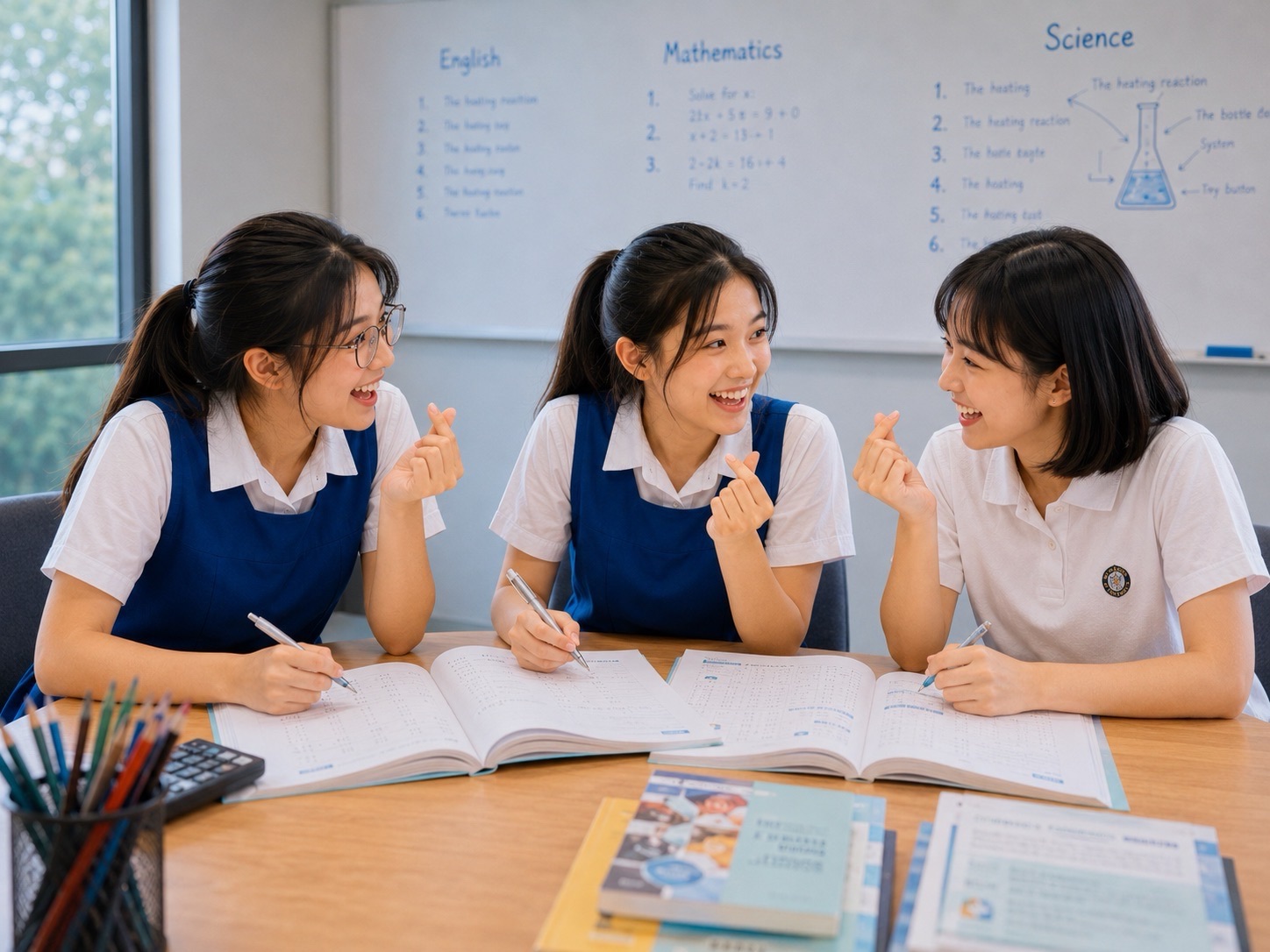
Secondary 4 Mathematics tuition for Choa Chu Kang students who need careful topic repair, stronger examination technique and calm, reliable performance under timed conditions.
At eduKateSG, we provide premium 3-pax Secondary 4 Mathematics tutorials at our Bukit Timah location near Sixth Avenue MRT. Each 90-minute lesson combines clear explanations, closely observed practice, mixed-topic revision and focused examination preparation.
The purpose is not simply to complete more worksheets.
It is to help the student convert four years of Mathematics into marks that can be produced accurately, independently and within the time available.
Secondary 4 students learn to:
- repair concepts that remain unstable from Secondary 1 to Secondary 3;
- recognise which mathematical method a question requires;
- connect topics inside unfamiliar questions;
- present essential working clearly;
- reduce repeated accuracy losses;
- manage Paper 1 and Paper 2 more deliberately;
- recover when a difficult question interrupts the paper; and
- build the stamina required for the final examination period.
Class size is limited to three students.
Lessons are 1.5 hours weekly, with curated materials, guided corrections, focused continuation work and additional preparation around important school assessments where class arrangements permit. eduKateSG’s current programme information describes its secondary tutorials as small-group lessons with individually adjusted support and teaching that may move ahead of the school sequence when the student is ready. (eduKate Singapore)
Arrange a parent–student consultation with eduKate Singapore
Immediate Concerns of a Secondary 4 Mathematics Parent and Student in Choa Chu Kang—and How eduKateSG Can Help
Secondary 4 Mathematics often feels different from every year that came before it.
The syllabus may look familiar. The student may already have completed most of the major topics. School lessons may appear to be moving towards revision. Yet this is usually the point when parents and students begin to feel the greatest pressure.
There is less time to repair weak foundations. Preliminary examinations are approaching. School assignments become more demanding. Timed papers begin to expose mistakes that ordinary homework did not reveal.
For a Secondary 4 student in Choa Chu Kang, the immediate concern is no longer simply whether a chapter has been taught.
The more important questions are:
- Can the student recognise what a question is testing?
- Can the student choose the correct method independently?
- Can the student complete the paper within the time limit?
- Can the student avoid losing marks through careless working?
- Can earlier topics still be recalled accurately?
- Is the current grade strong enough for the student’s intended post-secondary pathway?
At eduKateSG, Secondary 4 Mathematics tuition is organised around these practical concerns. The aim is to help students become more accurate, more independent and more composed before their final examinations.
The First Concern: “There Is Not Enough Time Left”
This is often the first thought that enters a parent’s mind.
A student may still have gaps in algebra, geometry, graphs, trigonometry, probability or statistics. At the same time, the school may already be assigning full examination papers.
The family begins to feel caught between two needs:
- Revising the entire syllabus.
- Repairing the specific weaknesses that are still costing marks.
Trying to cover everything equally is rarely the most efficient response.
A student who is already secure in vectors does not need to spend the same amount of time there as a student who is still making repeated errors in algebraic manipulation. Similarly, a student who understands the concepts but cannot finish a paper requires a different plan from one who does not yet understand the methods.
eduKateSG begins by identifying the student’s present working level.
The tutor looks at how the student approaches questions, where working breaks down, which concepts are unstable and whether the problem is caused by knowledge, application, accuracy or timing.
This allows the remaining preparation time to be used deliberately.
The objective is not rushed coverage. It is targeted improvement.
The Second Concern: “My Child Understands in Class but Cannot Do the Questions Alone”
This is a common Secondary 4 difficulty.
A student may follow the teacher’s explanation and feel that the lesson makes sense. However, when the numbers, diagram or wording change, the student may no longer know how to begin.
This usually means that the student has learned to recognise a demonstrated method but has not yet developed independent mathematical control.
Examination questions rarely announce the method directly. Students must interpret the information, connect it to a concept and decide what to do next.
At eduKateSG, students are guided through this transition carefully.
The tutor may begin with a structured example, but support is gradually reduced. Students are then expected to explain the question, identify the relevant information, select a method and complete the working independently.
The tutor can observe the exact moment when the student becomes uncertain.
In a class capped at three students, hesitation is difficult to hide. The tutor can ask:
- What is the question asking you to find?
- Which information is useful?
- What topic does this resemble?
- Which formula or relationship may apply?
- How can you check whether your answer is reasonable?
These questions help students build a repeatable thinking process.
The goal is not simply to help the student complete one question. It is to help the student know how to begin the next one.
The Third Concern: “The Marks Keep Changing”
Some students score well in one test and perform poorly in the next.
This inconsistency can be confusing for both parents and students. It may appear that the student is improving, only for the next result to suggest otherwise.
Changing marks usually indicate that the student’s knowledge is not yet stable across different topics and question types.
For example, a student may perform well when:
- The tested chapters were recently revised.
- The questions resemble familiar school exercises.
- There is enough time to work slowly.
- The paper contains fewer multi-topic questions.
Performance may fall when:
- Earlier topics return unexpectedly.
- Questions are presented in unfamiliar ways.
- Several steps must be connected.
- Time pressure increases.
- A mistake in an early part affects later answers.
eduKateSG uses mixed-topic practice to strengthen retrieval and adaptability.
Rather than practising one chapter repeatedly until the method becomes predictable, students are also given questions that require them to decide which method is appropriate.
This is important because the final examination does not separate the paper into comfortable revision blocks. Topics appear in mixed order, and students must shift quickly between different forms of mathematical thinking.
Over time, the student becomes less dependent on familiar patterns and more capable of responding to the paper as it appears.
The Fourth Concern: “Careless Mistakes Are Costing Too Many Marks”
Parents often hear the same explanation after a test:
“I knew how to do it. I was just careless.”
Occasional slips are normal. Repeated careless mistakes, however, usually point to a system problem.
The student may be:
- Skipping written steps.
- Copying values incorrectly.
- Losing negative signs.
- Rounding too early.
- Misreading units.
- Using the calculator without checking the entry.
- Failing to answer in the required form.
- Moving too quickly because of time pressure.
These are not solved merely by telling the student to be more careful.
Students need a disciplined method of checking.
At eduKateSG, the tutor helps the student identify recurring error patterns. The student is then taught specific checking routines appropriate to the type of question.
For example:
- Substitute the answer back into an equation.
- Check whether a probability lies between 0 and 1.
- Confirm that a length is positive and reasonable.
- Re-read the instruction before writing the final answer.
- Compare the calculator entry with the written expression.
- Check units and required accuracy.
- Review signs when expanding or factorising.
When checking becomes part of the working process, accuracy becomes more reliable.
The student no longer depends entirely on concentration or luck.
The Fifth Concern: “My Child Cannot Finish the Paper”
A student may understand most of the syllabus and still lose marks because the paper is incomplete.
This can happen when the student:
- Spends too long on an early question.
- Repeats calculations unnecessarily.
- Writes more working than needed.
- Becomes stuck and refuses to move on.
- Uses an inefficient method.
- Panics after encountering a difficult question.
- Has not practised enough under timed conditions.
Speed should not be trained by asking students to rush.
It develops through stronger recall, cleaner methods and better decisions.
At eduKateSG, timing practice is introduced with purpose. Before expecting the student to complete an entire paper quickly, the tutor first checks whether the underlying methods are secure.
Once the student can solve questions accurately, timed sections and full papers can be used to improve pacing.
Students learn to distinguish between:
- A question that needs more thinking.
- A question that should be attempted immediately.
- A question that should be temporarily skipped.
- A question that can be checked quickly.
- A question where the method should earn marks even if the final answer is uncertain.
This creates better examination control.
The aim is for the student to manage the paper, rather than allowing one difficult question to manage the student.
The Sixth Concern: “Earlier Topics Have Been Forgotten”
By Secondary 4, students are expected to remember concepts taught across several years.
A student may understand a current topic but struggle because an earlier skill is weak. A problem involving graphs may also require algebra. A geometry question may require accurate manipulation. A statistics question may depend on careful interpretation.
Mathematics is cumulative.
When an earlier layer is unstable, the difficulty appears later in a different form.
eduKateSG teaches from first principles when necessary.
This does not mean restarting the entire syllabus without direction. It means returning to the precise foundation that is preventing progress.
For one student, this may be algebraic manipulation. For another, it may be fractions, indices, coordinate geometry or the interpretation of word problems.
Once the missing foundation is repaired, the tutor reconnects it to the Secondary 4 question the student is trying to solve.
This gives the student a complete chain of understanding rather than another temporary shortcut.
The Seventh Concern: “My Child Has Lost Confidence”
Confidence in Mathematics is closely connected to control.
When students repeatedly face questions they cannot begin, they may start to believe that they are simply not good at the subject.
Some become quiet. Some avoid showing their working. Some rush because they want the task to end quickly. Others stop asking questions because they do not want to reveal what they have forgotten.
A small class can make an important difference.
With a maximum of three students, the tutor has time to observe each learner closely. Questions can be addressed without the student having to compete for attention in a large room.
The tutor can also adjust the level of challenge carefully.
Work that is too easy may create false confidence. Work that is too difficult may deepen discouragement. The student needs questions that are demanding enough to produce growth but structured enough to remain achievable.
Confidence is then rebuilt through evidence:
- The student can now start the question.
- The working is more organised.
- Fewer prompts are needed.
- Timed sections are completed more calmly.
- Previous mistakes are no longer repeated.
- Marks begin to stabilise.
This is more durable than encouragement alone.
The student begins to trust a process that works.
The Eighth Concern: “Should We Focus on Passing, Improving or Reaching A1?”
The correct target depends on the student’s current position.
A student who is struggling to pass may first need to secure the high-frequency foundational marks. A student working around the middle grades may need stronger application and fewer avoidable errors. A student aiming for A1 may need greater precision, speed and confidence with unfamiliar questions.
The preparation should reflect the goal.
For a Student Trying to Pass
The immediate priorities may include:
- Essential formulas and concepts.
- Reliable algebraic skills.
- Common question structures.
- Clear working for method marks.
- Better paper completion.
- Reduction of blank responses.
For a Student Trying to Move from a Mid-Range Grade
The priorities may include:
- Connecting multiple concepts.
- Interpreting unfamiliar wording.
- Improving accuracy.
- Strengthening weaker chapters.
- Managing time across the full paper.
For a Student Aiming for A1
The priorities may include:
- Complex multi-step questions.
- Efficient solution methods.
- Precise presentation.
- Advanced checking habits.
- Strong performance under full timed conditions.
- Recovery strategies when a difficult question appears.
eduKateSG does not assume that every student requires the same worksheet or revision pace.
The tuition plan is shaped around what will produce the next meaningful improvement.
The Ninth Concern: “School Is Moving Too Quickly”
Secondary 4 school lessons often move with urgency.
Teachers must complete the syllabus, revise earlier work, prepare students for preliminary examinations and manage the needs of an entire class.
A student with a weak chapter may not receive enough time to rebuild it during school lessons.
eduKateSG provides a second learning environment where the student can slow down when understanding is incomplete and move ahead when a topic is secure.
Where possible, lessons are taught ahead of the school schedule. This allows students to meet school topics with some prior familiarity.
Instead of hearing the concept for the first time in a fast-moving classroom, the student can use the school lesson to reinforce what has already been introduced.
During the examination period, the emphasis shifts towards consolidation, mixed-topic practice, correction and timed performance.
The approach remains responsive to the student’s immediate needs.
The Tenth Concern: “Is Tuition Adding More Work Without Solving the Real Problem?”
This is a reasonable concern.
Secondary 4 students already have school lessons, homework, revision, tests and other subjects to manage. Tuition should not simply add another stack of worksheets.
Effective tuition should reduce confusion.
At eduKateSG, lesson work is selected to reveal and correct specific problems. The tutor explains why a mistake occurred, what concept is missing and how the student should approach similar questions in future.
Students are not expected to memorise disconnected tricks.
They are taught to understand the mathematical structure beneath the question.
This makes later revision more efficient because the student is building a connected system of knowledge rather than collecting isolated answers.
How an eduKateSG Secondary 4 Mathematics Lesson May Work
A lesson may include several stages, depending on the student’s needs.
1. Immediate Review
The tutor checks recent schoolwork, test results or questions that caused difficulty.
This helps identify what requires attention now.
2. Concept Repair
If the problem comes from a weak foundation, the tutor explains the concept from the appropriate starting point.
The student is guided through clear examples before attempting similar work independently.
3. Application Practice
Questions are varied so that the student learns to recognise the concept in different forms.
The tutor checks whether the student understands the method or is merely copying a pattern.
4. Mixed-Topic Retrieval
Earlier topics are brought back regularly.
This strengthens memory and prepares the student for examination papers where chapters are not presented separately.
5. Error Correction
Mistakes are examined carefully.
The student learns whether the error came from misunderstanding, method selection, algebra, presentation, calculation or time pressure.
6. Timed Work
When the foundations are sufficiently stable, timed questions, sections and papers are introduced.
The focus is not only on speed, but also on decision-making and accuracy under pressure.
7. Next-Step Planning
The tutor identifies what should be reinforced before the following lesson.
This gives the preparation a clear direction.
Why Three-Student Classes Matter in Secondary 4
At Secondary 4, small differences in understanding can produce large differences in examination performance.
Two students may write the same wrong answer for entirely different reasons. One may have misunderstood the concept. The other may have selected the correct method but made an algebraic error.
A large class may only reveal that both answers are wrong.
A small class allows the tutor to find out why.
With no more than three students, eduKateSG can provide:
- Frequent individual checking.
- More opportunities for students to explain their reasoning.
- Faster correction of misconceptions.
- Work adjusted to different levels.
- Greater accountability during practice.
- A quieter environment for asking questions.
- Closer observation of examination habits.
Students still benefit from learning beside peers, but they do not disappear into the group.
What Parents Can Do at Home
Parents do not need to reteach Secondary 4 Mathematics.
A more useful role is to help create stability around the preparation process.
Parents can:
- Ask which specific topics are being improved.
- Look for patterns rather than reacting to one test score.
- Encourage the child to show working.
- Protect regular revision time.
- Avoid comparing the child constantly with classmates.
- Ensure that corrections are completed, not merely acknowledged.
- Watch for exhaustion, avoidance or growing anxiety.
- Discuss post-secondary goals realistically.
A helpful question is:
“What caused the lost marks, and what are you doing differently now?”
This shifts the conversation away from blame and towards improvement.
Signs That a Student May Need Immediate Support
Parents in Choa Chu Kang may wish to seek support when the student:
- Frequently leaves examination questions blank.
- Cannot remember methods from earlier topics.
- Understands worked examples but cannot solve variations.
- Scores fluctuate sharply between tests.
- Repeats the same careless mistakes.
- Cannot complete timed papers.
- Avoids Mathematics revision.
- Becomes increasingly anxious before tests.
- Has a target grade significantly above the current result.
- Does not know how to organise the remaining revision period.
The earlier the real problem is identified, the more effectively the remaining time can be used.
A Calm and Structured Path Forward
Secondary 4 Mathematics preparation does not improve through panic.
It improves when the student knows:
- What is weak.
- Why it is weak.
- What must be repaired first.
- Which questions should be practised.
- How mistakes should be checked.
- How time should be managed.
- What progress should look like.
eduKateSG provides a structured small-group environment where these questions can be addressed closely.
The student is taught from the necessary foundation, guided towards independent problem-solving and prepared to work accurately under examination conditions.
For some students, the first objective is to pass securely. For others, it is to move from an inconsistent grade to a stable one. For those aiming higher, the focus may be precision, efficiency and confidence with unfamiliar problems.
The destination may differ, but the principle remains the same:
Understand the student clearly, teach what is needed and build the performance one reliable step at a time.
Secondary 4 Mathematics Tuition for Choa Chu Kang Students
For families considering Secondary 4 Mathematics tuition in Choa Chu Kang, the most important decision is not simply whether to add more lessons.
It is whether the tuition will identify the real difficulty and use the remaining time well.
eduKateSG’s three-student small-group Mathematics tuition is designed for close teaching, careful correction and purposeful examination preparation.
Students receive the attention needed to repair weaknesses, strengthen core methods and approach their final examinations with greater control.
Properly taught students do not merely complete more Mathematics questions.
They learn how to think through them.
Secondary 4 Is the Execution Year
Secondary 4 Mathematics is sometimes treated as a final round of revision.
That description is incomplete.
Revision suggests that the student already possesses a stable mathematical system and only needs to remember it. In practice, many students enter Secondary 4 with a mixture of strengths and weaknesses.
They may remember the formula but not recognise when to use it.
They may understand algebra in a topical worksheet but lose control when it appears inside geometry, graphs or a real-world application.
They may complete individual chapters comfortably yet struggle when several topics are mixed in one paper.
They may know enough Mathematics to obtain a strong result, but continue losing marks through incomplete working, premature rounding, calculator handling, weak question selection or rushed decisions.
Secondary 4 is therefore not only a knowledge year.
It is a conversion year.
The student must convert:
- concepts into usable methods;
- methods into independent solutions;
- solutions into properly presented working;
- working into awarded marks;
- topic knowledge into mixed-paper recognition; and
- classroom confidence into examination stability.
That conversion is where careful Secondary 4 Mathematics tuition becomes valuable.
The Hidden Mathematics Problem: Knowing Must Become Performing
A student can understand a method and still perform poorly.
Consider a student who knows how to solve simultaneous equations.
During a familiar lesson, the student may correctly use substitution or elimination. However, an examination question may first require the student to:
- interpret a written relationship;
- define two unknown quantities;
- form the equations;
- select an efficient solving method;
- carry out the algebra accurately; and
- interpret the solution in context.
The algebra is only one part of the task.
The full question tests whether the student can identify, construct, execute and verify the solution without being told which chapter it belongs to.
This becomes more important in Secondary 4 because the examination is cumulative. Earlier ideas may appear beneath later ones.
A graph question may depend on algebra.
A trigonometry question may depend on careful diagram reading.
A mensuration question may depend on ratio, unit conversion and accuracy.
A statistics question may require interpretation rather than direct calculation.
A real-world application may combine information from diagrams, tables, rates, percentages and graphs.
For students taking the current 2026 Singapore–Cambridge O-Level Mathematics syllabus, the assessment is designed around three broad capabilities: applying standard techniques, solving problems in varied contexts, and reasoning or communicating mathematically. Their approximate weightings are 45%, 40% and 15% respectively. (Isomer User Content)
This means strong performance cannot be built through formula memorisation alone.
The student must know what to do, understand why it works and remain accurate when the surface of the question changes.
Why Choa Chu Kang Parents Choose 3-Pax Mathematics Tutorials
A three-student class creates a particular kind of precision.
There is enough interaction for students to compare approaches, hear mathematical explanations and learn through carefully directed discussion.
At the same time, the group remains small enough for the tutor to inspect how each student thinks.
This matters because the final wrong answer is only the visible result.
The useful question is:
Where did the reasoning first change direction?
A student may have:
- copied a negative sign incorrectly;
- expanded only part of a bracket;
- selected the wrong trigonometric ratio;
- confused length scale with area scale;
- used an unsuitable average;
- interpreted a cumulative frequency graph inaccurately;
- rounded too early;
- substituted values into the wrong formula;
- treated a vector magnitude as a vector;
- overlooked a restrictive word in the question;
- omitted essential algebraic working; or
- spent too long protecting one question while leaving easier marks untouched.
These errors require different corrections.
A concept error needs rebuilding.
A reading error needs a better annotation routine.
A presentation error needs clearer mathematical sequencing.
A timing error needs controlled paper practice.
A recognition error needs mixed-topic training.
In a 3-pax tutorial, the tutor can pause at the exact line where the student’s method becomes unstable. The correction is made while the thought process is still visible.
The advantages of three students
- Immediate feedback during practice
- Frequent opportunities to answer
- Detailed inspection of working
- Less room to hide confusion
- Pacing that can be adjusted carefully
- Questions selected for individual weaknesses
- Calm peer momentum
- More purposeful correction before school tests
- Easier transition from guided to independent work
- Closer monitoring during the examination period
The group is deliberately small.
It preserves the useful energy of learning with peers while allowing teaching to remain personal.
Secondary 4 Mathematics Across Different School Routes
Not every Secondary 4 student is preparing for the same Mathematics paper.
Families may refer to the route through G1, G2 and G3 subject levels, or through familiar N-Level and O-Level terminology, depending on the student’s cohort and school programme.
The label alone does not tell us what the student needs.
We consider:
- the exact Mathematics syllabus being taken;
- the student’s school sequence;
- recent weighted assessments;
- preliminary examination expectations;
- the standard of the school’s papers;
- the student’s existing foundation;
- the amount of syllabus coverage completed;
- recurring errors across several papers;
- time remaining before the final examination; and
- whether the student is also managing Additional Mathematics.
A student scoring 55% because several topics are missing requires a different plan from a student scoring 55% after attempting nearly every question correctly but losing marks through signs, units, rounding and incomplete presentation.
Similarly, a student already performing strongly may not need more routine drilling.
That student may need:
- unfamiliar applications;
- more demanding mixed-topic questions;
- faster recognition;
- better paper strategy;
- stronger checking protocols; and
- greater stability across complete papers.
The class must meet the student at the correct point.
The Core Aim of eduKateSG’s Tutor in Class for Secondary 4 Mathematics Tuition in Choa Chu Kang
The core aim of an eduKateSG tutor in a Secondary 4 Mathematics class is not simply to help students complete more questions.
It is to ensure that every student can understand the mathematics, recognise what a question requires, choose an appropriate method and carry the solution through accurately under examination conditions.
By Secondary 4, students are no longer preparing for only the next class test. They are approaching the final stage of their secondary-school Mathematics education, where several years of learning must come together in a clear, reliable and usable form.
For students attending Secondary 4 Mathematics Tuition in Choa Chu Kang, the tutor’s responsibility is therefore very precise:
To turn accumulated knowledge into dependable examination performance.
The Tutor Is Building a Complete Mathematics Student
A Secondary 4 student may know many formulas and still struggle during an examination.
The difficulty may come from several places:
- The student cannot recognise which topic is being tested.
- Earlier algebraic foundations remain unstable.
- The student understands the chapter but misreads unfamiliar questions.
- Working is incomplete or poorly organised.
- Too much time is spent on difficult questions.
- Careless errors appear under pressure.
- The student depends on hints before knowing how to begin.
- Knowledge from different chapters cannot yet be connected.
The tutor’s aim is to identify where the mathematical process is breaking down.
This is important because two students receiving the same mark may require completely different forms of help. One may need stronger conceptual foundations, while another may need better accuracy, question interpretation or time management.
At eduKateSG, the tutor does not teach only according to the worksheet placed on the table. The tutor observes how each student thinks.
That observation guides what happens next.
Understanding Must Come Before Speed
Secondary 4 Mathematics can feel urgent. Preliminary examinations, school assessments and national examinations are close, and students may feel that they must immediately begin completing large numbers of papers.
Practice is essential, but practice without understanding can reinforce weak habits.
A student who repeatedly applies a memorised method without understanding why it works may succeed when the question looks familiar and become lost when the wording or structure changes.
For this reason, the first classroom aim is clarity.
The tutor helps the student understand:
- What the question is asking
- Which information is relevant
- Which mathematical concept applies
- Why a particular method works
- How each line of working follows from the previous line
- Whether the final answer is reasonable
Once the reasoning becomes clear, speed can be developed safely.
This order matters. Speed built on confusion creates rushed mistakes. Speed built on understanding creates confidence.
Securing the Foundations That Secondary 4 Mathematics Depends On
Secondary 4 Mathematics is cumulative.
A student may be working on coordinate geometry, probability, trigonometry or mensuration, but the real obstacle may still be algebra learned several years earlier.
Weaknesses in basic manipulation can affect almost every later topic. A student who cannot rearrange expressions confidently may struggle with equations, graphs, geometry, statistics and applied problems even when the main concept has been understood.
The tutor therefore watches for foundational difficulties such as:
- Incorrect handling of negative signs
- Weak fraction operations
- Unstable algebraic manipulation
- Errors when expanding or factorising
- Confusion when changing the subject of a formula
- Poor substitution habits
- Inaccurate use of brackets
- Difficulty interpreting graphs
- Weak proportional reasoning
- Unclear understanding of units and scale
These gaps are corrected directly rather than hidden beneath more advanced practice.
This is not moving backwards. It is strengthening the structure so that the student can move forward without repeatedly collapsing at the same point.
Teaching Students to Recognise the Question Beneath the Wording
One of the most important abilities in Secondary 4 Mathematics is question recognition.
Examination questions do not always present themselves in the exact form students saw during lessons. A familiar concept may be placed inside a diagram, a practical situation, a graph or a multi-step problem.
The tutor teaches students to look beyond the surface wording.
Students learn to ask:
- What quantities are known?
- What must be found?
- Which relationship connects them?
- Is a formula required?
- Is the answer expected to be exact or approximate?
- Does the problem require one step or several connected steps?
- Can the result be checked using another method?
This process helps students become less dependent on recognising an identical question from memory.
Instead, they begin recognising the mathematical structure.
That is the difference between practising questions and learning how to solve problems.
Making Mathematical Working Clear and Mark-Worthy
Correct thinking must be communicated clearly.
In examinations, students are assessed not only on whether the final answer is correct but also on whether the mathematical reasoning is shown properly. A student who performs too much working mentally may lose method marks when a small arithmetic error appears.
The tutor develops disciplined presentation habits.
Students are taught to:
- Write the relevant formula before substitution
- Show important intermediate steps
- Use mathematical symbols correctly
- Keep equations balanced
- Label diagrams where necessary
- State units clearly
- Avoid excessive or confusing working
- Present final answers in the required form
- Check whether rounding instructions have been followed
Good working is not merely neatness.
It allows the student to think more clearly, locate mistakes more quickly and protect marks even when the final answer is not perfect.
Correcting Errors at Their Source
A useful Mathematics lesson does not end when the correct answer is shown.
The tutor needs to understand why the original answer was wrong.
An error may come from:
- Misreading the question
- Selecting the wrong formula
- Using the correct formula incorrectly
- Weak algebra
- Calculator input
- Incorrect rounding
- Missing units
- Poor diagram interpretation
- Rushing
- Failing to check the final answer
Each type of error requires a different correction.
Simply telling the student to be more careful is rarely enough. The tutor must show the student what “being careful” means at that exact stage of the solution.
For example, a student who repeatedly loses negative signs may need a more structured way of writing each algebraic line. A student who presses the calculator incorrectly may need to separate substitution from calculation. A student who misreads questions may need to underline conditions and identify the required quantity before beginning.
At eduKateSG, corrections are intended to change the student’s future behaviour, not merely repair one completed question.
Using Small Groups to Keep Every Student Visible
Secondary 4 students can appear independent even when they are quietly confused.
In a large class, a student may copy corrections, remain silent or follow the solution without truly understanding how it was produced.
eduKateSG’s small-group setting allows the tutor to observe each student more closely.
The tutor can see:
- Who begins confidently
- Who waits for another student to start
- Who uses an unnecessarily long method
- Who understands the concept but calculates inaccurately
- Who avoids particular question types
- Who can explain an answer
- Who becomes uncertain when the question changes slightly
With a maximum of three students, the tutor can adjust explanations without losing the pace of the class.
One student may require a foundational explanation. Another may be ready for a more demanding variation. A third may need timed practice and greater discipline.
They can work within the same lesson while receiving different forms of attention.
Building Independence Rather Than Permanent Reliance
The long-term aim of tuition is not to make the student increasingly dependent on the tutor.
It is to make the student increasingly capable without the tutor.
This means the tutor does not immediately provide every next step. Students may be asked to explain what they know, identify the relevant topic, suggest a possible method or locate the line where the solution began to go wrong.
Support is provided carefully.
Too little support can leave the student stuck. Too much support can create the illusion of understanding.
The tutor gradually reduces assistance as the student becomes more competent.
A healthy progression may look like this:
- The tutor demonstrates the complete method.
- The tutor and student complete a similar question together.
- The student completes a question with prompts.
- The student completes a question independently.
- The student explains and checks the solution.
- The student applies the same concept in an unfamiliar context.
By the examination period, the student should be able to begin, continue and verify a solution independently.
Connecting Topics Instead of Learning Them as Separate Chapters
Secondary 4 Mathematics examinations require students to move between topics.
A single question may involve algebra, geometry, graphs and numerical reasoning. Students who store every chapter as a separate set of procedures may struggle when concepts are combined.
The tutor therefore helps students see the relationships between topics.
For example:
- Algebra supports coordinate geometry and graph interpretation.
- Ratio and proportion appear in scale drawings, similarity and applied problems.
- Trigonometry connects angles, lengths, bearings and three-dimensional situations.
- Statistics requires both calculation and interpretation.
- Graphs may represent algebraic relationships, rates of change or real-world data.
- Mensuration requires formulas, units, spatial reasoning and accurate substitution.
These connections make Mathematics more coherent.
Students begin to see the subject as a system rather than a collection of unrelated techniques.
Preparing for Examination Conditions
Knowing how to solve a question during tuition is different from solving it independently within a timed paper.
The tutor must eventually transfer learning into examination conditions.
This includes teaching students how to:
- Read the whole paper calmly
- Allocate time according to marks
- Secure accessible marks first
- Avoid remaining stuck for too long
- Return to difficult questions strategically
- Check calculator entries
- Review units, signs and rounding
- Use remaining time productively
- Maintain working quality under pressure
Timed practice is introduced with purpose.
The objective is not to create unnecessary stress. It is to make examination conditions familiar enough that the student can think clearly when they matter.
A student should know not only how to solve Mathematics questions, but also how to manage a Mathematics paper.
Teaching Ahead While Protecting Current School Performance
Where appropriate, eduKateSG teaches ahead of the school schedule.
This gives students an early introduction to upcoming topics, allowing school lessons to become reinforcement rather than first exposure.
However, teaching ahead does not mean rushing through the syllabus.
The tutor balances three priorities:
- Repairing important earlier weaknesses
- Supporting current school topics
- Preparing students for upcoming content and examinations
This balance is especially important in Secondary 4, where students cannot afford to ignore either present school demands or long-term examination readiness.
A well-managed class keeps the student moving forward while ensuring that unresolved gaps do not continue to interfere.
Building Confidence Through Evidence
Mathematics confidence should not be based only on encouragement.
It should be built through evidence.
A student becomes genuinely confident after experiencing that they can:
- Recognise a question independently
- Select the correct method
- Complete the working accurately
- Explain why the method works
- Correct their own mistake
- Solve a more difficult variation
- Perform within a reasonable time
The tutor creates these experiences progressively.
This is particularly important for students who have begun to believe that they are simply “not good at Mathematics”. Often, the problem is not a lack of ability. It is a history of incomplete foundations, repeated confusion and practice that was not matched to the student’s actual needs.
When the learning sequence is rebuilt properly, confidence often returns because the student can finally see improvement happening.
What the Tutor Is Looking for During Every Lesson
During a Secondary 4 Mathematics class, the tutor is continually assessing more than right and wrong answers.
The tutor is looking at:
- Conceptual understanding
- Accuracy
- Method selection
- Mathematical communication
- Speed
- Independence
- Error patterns
- Retention from earlier lessons
- Ability to connect topics
- Response to unfamiliar questions
These observations shape the next explanation, question or correction.
This is why the quality of tuition cannot be measured only by the number of worksheets completed. A student may finish many pages without correcting the reason marks are being lost.
The lesson must produce better thinking, not merely more written work.
The Core Classroom Sequence at eduKateSG
Although each student has different needs, a purposeful Secondary 4 Mathematics lesson commonly moves through several stages.
1. Establish the Lesson Objective
The tutor identifies what the student should understand or perform by the end of the lesson.
This keeps the class focused.
2. Check Prior Knowledge
Important prerequisite skills are reviewed briefly. If a serious gap appears, it is addressed before advanced work continues.
3. Explain the Concept Clearly
The tutor teaches the reasoning, demonstrates the method and highlights common misconceptions.
4. Guide Initial Practice
Students attempt carefully selected questions with support.
5. Observe and Correct
The tutor studies the student’s method, identifies errors and corrects them at their source.
6. Increase Complexity
Questions become less familiar, more connected or more demanding.
7. Require Independent Work
Students complete questions without immediate prompting.
8. Consolidate the Learning
The tutor reviews key ideas, recurring errors and what the student should remember.
9. Prepare the Next Step
The lesson connects to upcoming schoolwork, revision or examination practice.
This sequence ensures that students do not merely watch Mathematics being done. They must understand it, attempt it, explain it and eventually perform it independently.
For Students Who Are Currently Struggling
The immediate aim is to stabilise the subject.
This may involve rebuilding essential foundations, simplifying difficult concepts and restoring a reliable question-solving routine.
The tutor prioritises high-impact weaknesses rather than trying to repair everything at once.
As the student becomes more stable, the class progresses towards broader syllabus coverage, mixed questions and timed practice.
The first success may not be a dramatic grade jump. It may be fewer blank questions, clearer working, better recognition or a reduction in repeated errors.
These are important changes because they create the conditions for later improvement.
For Students Who Are Already Passing
A passing grade can still contain significant instability.
The tutor examines where marks are being lost:
- Inconsistent accuracy
- Weak performance on multi-step questions
- Difficulty with unfamiliar applications
- Poor time allocation
- Missing method marks
- Incomplete checking
- Uneven topic mastery
The aim is to convert partial understanding into reliable performance.
A student moving from a pass towards a stronger grade often does not need every topic retaught from the beginning. The student needs precise correction, stronger connections and more disciplined execution.
For Students Aiming for the Highest Grades
High-performing students require more than additional routine questions.
The tutor helps them refine:
- Efficiency of method
- Precision of mathematical language
- Recognition of hidden structures
- Flexibility between approaches
- Performance on demanding multi-step problems
- Accuracy under time pressure
- Quality of checking
- Ability to recover when the first method does not work
At this level, small errors become expensive.
The aim is to make strong performance consistent, not occasional.
The Parent’s View of Progress
Parents may naturally look first at marks.
Marks matter, but they are often a delayed indicator of what is changing inside the student’s learning process.
Earlier signs of meaningful progress may include:
- Homework is started with less resistance.
- The student asks more specific questions.
- Working becomes clearer.
- Fewer steps are skipped.
- The student can explain mistakes.
- Familiar questions are completed more quickly.
- The student is less dependent on examples.
- Test corrections become more thoughtful.
- Confidence becomes calmer and less fragile.
These changes suggest that the student is gaining control over the subject.
When the underlying process improves, examination results have a stronger foundation from which to rise.
The Final Aim: Calm, Accurate and Independent Performance
The core aim of eduKateSG’s tutor in class for Secondary 4 Mathematics Tuition in Choa Chu Kang is to bring the student towards calm, accurate and independent performance.
The student should enter an examination able to:
- Understand what is being asked
- Recall the relevant knowledge
- Select a suitable method
- Show clear mathematical working
- Complete calculations accurately
- Manage time sensibly
- Check answers intelligently
- Continue thinking when a question feels unfamiliar
This is more than examination preparation.
It is the development of disciplined reasoning.
Secondary 4 is the point where foundations, techniques, habits and confidence must come together. The tutor’s role is to guide that convergence carefully, ensuring that the student does not simply know more Mathematics, but can use it when it matters.
At eduKateSG, the class is therefore designed around one central outcome:
The student should leave increasingly able to think, solve and perform without needing someone beside them.
Why Choose eduKateSG’s Small Groups Secondary 4 Mathematics Tutor for Choa Chu Kang?
Secondary 4 Mathematics is no longer simply about learning the next chapter.
It is the year when students must bring together several years of mathematical knowledge, recognise what a question requires, choose an appropriate method and complete the solution accurately under examination conditions.
A student may understand individual topics during lessons but still struggle when:
- several concepts appear in one question;
- familiar questions are presented differently;
- calculations become longer;
- time pressure increases;
- an early error affects the rest of the solution; or
- the student cannot decide how to begin.
For families in Choa Chu Kang, choosing a Secondary 4 Mathematics tutor should therefore involve more than finding another place for the student to complete worksheets.
The tutor must be able to see how the student thinks, locate the point where the Mathematics becomes unstable and rebuild the necessary knowledge without losing sight of the approaching examinations.
At eduKateSG Bukit Timah, our Secondary 4 Mathematics tutorials are kept to a maximum of three students. This gives the tutor enough visibility to teach closely while preserving the independence that every student eventually needs in the examination hall.
The purpose is clear: to help the student convert what they have learned into dependable mathematical performance.
Secondary 4 Is the Conversion Year
By Secondary 4, most students have already encountered a substantial part of the Mathematics syllabus.
The problem is not always a complete lack of knowledge. More commonly, the knowledge is present but fragmented.
A student may remember an algebraic procedure but not recognise when to use it. Another may know a formula but apply it incorrectly when the diagram changes. Some students can solve questions during guided practice but become uncertain once the tutor is no longer prompting them.
Secondary 4 is the year when these separate pieces must become a connected system.
The student must learn to move through the full mathematical process:
Understand the question.
Represent the information correctly.
Select a suitable method.
Carry out the operations accurately.
Present the working clearly.
Check whether the answer is reasonable.
Recover calmly when the first attempt does not work.
This conversion is one of the main reasons parents choose eduKateSG’s small-group Secondary 4 Mathematics tuition.
We are not merely trying to expose students to more questions. We are developing the thinking and control required to solve questions without depending on the tutor.
A Maximum of Three Students Gives the Tutor Better Visibility
In Mathematics, a wrong answer does not always reveal the real problem.
Two students may produce the same incorrect answer for completely different reasons.
One may have misunderstood the concept. Another may understand the concept but have made an algebraic error. A third may have selected an inefficient method and run out of time.
The tutor must see more than the final answer.
In a class of up to three students, the tutor can observe:
- how each student begins a question;
- whether the student reads all the information;
- which method the student selects;
- where hesitation begins;
- whether working is logically organised;
- which errors are repeated; and
- how well corrections are retained.
This visibility changes the quality of the lesson.
Instead of waiting until a worksheet has been marked, the tutor can intervene at the exact point where the reasoning begins to drift.
The correction becomes immediate, specific and easier for the student to understand.
Small Groups Provide Attention Without Creating Dependence
Individual attention is important, but Secondary 4 students must also learn to work without continuous assistance.
In a very dependent learning environment, students may become accustomed to receiving a hint whenever they pause. This can make practice feel comfortable while hiding an important weakness: the student cannot independently decide what to do next.
Our three-student format provides a careful balance.
The tutor remains close enough to guide and correct, but students are still expected to attempt, explain and defend their methods.
They may be asked:
Why did you choose this formula?
What information in the question led you to this method?
Can the problem be represented another way?
Where did the sign change?
How could you check this result?
These questions help students become active mathematical thinkers.
The aim is not to make the tutor faster at solving the question. It is to make the student more capable of solving it.
We Find the First Unstable Point
Mathematics is cumulative.
A weakness that began in Secondary 1 or Secondary 2 may remain hidden until a more advanced Secondary 4 question depends on it.
For example, a student struggling with a complicated equation may appear to have a Secondary 4 problem. However, the real difficulty may come from an earlier weakness involving:
- negative numbers;
- fractions;
- algebraic manipulation;
- expansion and factorisation;
- changing the subject of a formula;
- graph interpretation; or
- translating words into mathematical expressions.
Simply repeating the current question may not solve the underlying difficulty.
At eduKateSG, we work backwards until we find the first unstable point. We then rebuild from there.
This is a more reliable approach than teaching a shortcut that works only for one familiar question format.
Once the foundation is repaired, the student can return to the Secondary 4 topic with greater control.
We Teach Meaning Before Procedure
Students often try to remember Mathematics as a collection of steps.
This can work temporarily when a question closely resembles the example used in class. It becomes less reliable when the examination changes the wording, diagram or arrangement of information.
A student who understands only the procedure may ask:
Which formula do I use?
What is the first step?
Have I seen this exact question before?
A student who understands the underlying Mathematics is better able to ask:
What is the relationship between these quantities?
What does the graph show?
What information is fixed?
What is changing?
What am I being asked to find?
At eduKateSG, procedures are still taught carefully. However, they are placed inside a larger understanding of why the method works and when it should be used.
The lesson progresses from meaning to method, and then from method to transfer.
This makes it easier for students to handle unfamiliar or combined questions.
Secondary 4 Students Need Mixed-Topic Recognition
School lessons are usually taught one chapter at a time.
The examination is different.
A student may encounter algebra, geometry, graphs, statistics, probability and real-world applications within the same paper. The student must repeatedly change mathematical modes and recognise the topic without being told what chapter is being tested.
This is why mixed-topic practice becomes increasingly important in Secondary 4.
A student who performs well during a chapter exercise may still struggle when the chapter heading disappears.
We gradually introduce interleaved practice so students learn to identify questions through their mathematical features rather than through the worksheet title.
They must decide:
What kind of problem is this?
Which information matters?
Which method is efficient?
Is more than one topic involved?
What should the final answer look like?
This recognition stage is often where examination improvement begins.
Paper Performance Requires More Than Topic Knowledge
A student can know the syllabus and still lose marks through poor paper management.
Common problems include:
- spending too long on an early question;
- leaving straightforward marks unfinished;
- failing to show sufficient working;
- using a correct method but making a sign error;
- copying information incorrectly;
- rounding too early;
- forgetting units;
- answering only part of a multi-part question;
- becoming unsettled after one difficult question; or
- finishing without enough time to check.
These are not always content problems. They are performance problems.
As the student becomes ready, tuition must therefore move beyond chapter practice into timed sections, mixed-topic sets and full-paper work.
The tutor reviews not only the score, but also how the paper was attempted.
We look at where time was lost, which questions caused hesitation, what errors could have been prevented and whether the student’s checking method was effective.
The examination paper becomes a source of information about the student’s decision-making.
Error Review Is Part of the Learning
Many students correct a wrong answer, understand the explanation and then move on.
Unfortunately, the same error may return several weeks later.
A correction becomes useful only when the student understands:
What went wrong?
Why did it go wrong?
What should have been noticed?
What will I do differently next time?
At eduKateSG, recurring errors are treated as patterns rather than isolated accidents.
A student may repeatedly:
- lose negative signs;
- expand brackets incorrectly;
- substitute values into the wrong expression;
- misread scales;
- omit essential working;
- confuse similar formulas;
- rush through easier questions; or
- abandon a method too early.
Once the pattern becomes visible, the tutor can design practice around it.
The student also becomes more aware of their own mathematical habits.
This self-awareness is important because the tutor will not be beside the student during the examination. The student must eventually become capable of noticing and correcting their own work.
Clear Working Protects Marks
Secondary 4 Mathematics is not only about reaching the final answer.
The working must communicate the mathematical process clearly.
Disorganised working makes errors harder to detect. It can also cause students to lose method marks when the final answer is incorrect.
We train students to present solutions in a way that is:
- logically sequenced;
- mathematically accurate;
- easy to check;
- sufficiently detailed; and
- efficient under time pressure.
Clear working is not decorative.
It supports thinking.
When each step follows naturally from the previous one, the student is less likely to skip an operation, lose a sign or confuse two quantities.
It also allows the tutor to see precisely where a misconception begins.
Confidence Should Come From Competence
Secondary 4 students sometimes say they have lost confidence in Mathematics.
Confidence is important, but reassurance alone is rarely enough.
A student becomes more confident when they can repeatedly:
understand the question;
choose the correct method;
complete the working;
identify an error;
make the correction; and
solve a similar question independently.
This is competence-based confidence.
It is quieter and more dependable than confidence built around one good test result.
In a three-student class, the tutor can calibrate the level of difficulty carefully. Work should not be so easy that the student merely feels comfortable, nor so difficult that every lesson becomes discouraging.
The student needs an appropriate level of challenge, supported by clear teaching and achievable progression.
The Tutor Can Adjust the Lesson for Different Starting Points
Secondary 4 students do not all arrive with the same needs.
One student may be performing well but losing marks through speed and presentation. Another may have several weak chapters. A third may be doing adequately in school but struggling with mixed-topic questions.
A small class allows the tutor to maintain a shared lesson direction while adjusting the support given to each student.
For a student with weak foundations
The priority is to identify the earliest missing knowledge, rebuild it clearly and reconnect it to current Secondary 4 work.
For a student who understands but makes frequent errors
The focus may shift towards disciplined working, checking routines, algebraic accuracy and better control under time pressure.
For a student aiming for a higher grade
The tutor may concentrate on method efficiency, unfamiliar applications, multi-step reasoning, examination strategy and reducing avoidable mark loss.
For a late-starting student
The programme must become more selective.
The tutor identifies the highest-impact weaknesses, secures accessible marks and builds a realistic examination plan around the remaining time.
The destination may be similar, but the route should reflect the student’s actual starting point.
We Teach Ahead When It Helps the Student
Where the student’s foundations are stable, teaching ahead of the school sequence can be useful.
Early exposure gives the student time to become familiar with a concept before it is introduced in school. The school lesson then becomes a second encounter rather than the first.
This can improve confidence and reduce the pressure of learning a difficult topic quickly.
However, teaching ahead should not mean rushing through the syllabus.
A student who carries unstable algebra into a later topic may appear to be progressing while becoming increasingly dependent on memorised procedures.
We therefore move ahead when the student is ready, while continuing to retrieve and strengthen earlier knowledge.
Progress must remain connected.
Retrieval Helps Knowledge Stay Available
Understanding something once does not guarantee that it will remain accessible months later.
Secondary 4 students need to retrieve knowledge repeatedly so that important methods can be recalled under examination pressure.
We revisit earlier topics through short questions, mixed exercises, verbal explanation and cumulative practice.
This helps students retain:
- formulas;
- mathematical vocabulary;
- standard methods;
- visual representations;
- common question structures; and
- checking procedures.
The goal is not only to store knowledge, but to make it available when the student needs it.
An examination tests retrieval as much as learning.
The Lesson Moves Towards Independence
A well-structured Mathematics lesson should gradually transfer responsibility from the tutor to the student.
The tutor may begin by explaining and modelling a method. The student then completes guided examples, followed by increasingly independent questions.
As the student improves, the tutor provides fewer prompts.
The progression is deliberate:
First, the student watches.
Then, the student attempts with guidance.
Next, the student explains the method.
Finally, the student performs independently.
This prevents the lesson from becoming a demonstration in which the tutor does most of the thinking.
By the later stages of Secondary 4, students should be able to begin questions, make decisions and review their own work with considerably less intervention.
Why the Three-Student Class Matters During Examination Preparation
As the examination approaches, the tutor needs to know each student’s paper-level behaviour.
This is difficult to understand from marks alone.
The tutor must observe whether the student:
starts calmly;
allocates time sensibly;
recognises accessible questions;
returns effectively to difficult questions;
maintains accurate working;
checks strategically; and
recovers after an error.
With a maximum of three students, examination practice can remain closely supervised.
The tutor can identify where performance begins to deteriorate and address the cause directly.
One student may need faster recognition. Another may need more disciplined checking. Another may need to stop spending excessive time trying to perfect one difficult question.
These refinements can make a meaningful difference when the syllabus knowledge is already present.
A Calm Environment Supports Better Thinking
Mathematics becomes harder when a student is anxious, rushed or afraid to reveal uncertainty.
In a small class, students have more opportunities to ask questions and explain what they do not understand.
The tutor can also distinguish between a student who genuinely understands and one who has simply copied the procedure quietly.
The environment remains focused but not intimidating.
Students are expected to think carefully, attempt honestly and accept correction as part of learning.
Mistakes are not ignored, but they are handled constructively.
The purpose is to create a classroom where mathematical precision and intellectual confidence can grow together.
Why Choa Chu Kang Families May Choose eduKateSG Bukit Timah
Families naturally consider convenience when selecting tuition.
However, Secondary 4 is a limited and important year. Some parents therefore choose according to teaching fit rather than postcode alone.
Choa Chu Kang families may consider eduKateSG Bukit Timah because they are looking for:
- a maximum three-student class;
- close observation by the tutor;
- first-principles foundation repair;
- structured O-Level preparation;
- teaching that moves from understanding to independent performance;
- mixed-topic and full-paper practice;
- careful error analysis; and
- a calm, academically focused learning environment.
Our Bukit Timah classes are conducted near Sixth Avenue MRT. The decision to travel should always be weighed against the quality and suitability of the learning environment.
For some families, a carefully chosen weekly lesson is more valuable than a nearby class that cannot provide the same degree of attention.
When Secondary 4 Mathematics Tuition Is Most Useful
Tuition may be useful when a student:
understands lessons but cannot perform consistently in tests;
has recurring weaknesses from earlier Secondary levels;
struggles to begin unfamiliar questions;
depends heavily on hints;
loses marks through careless or algebraic errors;
cannot complete papers within the available time;
has large differences between topic scores;
is becoming anxious as the examinations approach; or
needs a more structured plan for revision.
Parents do not need to wait for a severe failure before seeking support.
Earlier intervention gives the tutor more time to repair foundations, build retention and develop examination stability without forcing the student into a rushed recovery programme.
What Parents Should Look for in a Secondary 4 Mathematics Tutor
A good Secondary 4 tutor should be able to do more than solve difficult questions.
The tutor should be able to explain clearly, diagnose accurately and adjust the teaching to the student.
Parents may wish to consider whether the tutor can:
identify the real source of an error;
explain concepts from first principles;
teach both method and meaning;
connect earlier knowledge to current topics;
prepare students for mixed-topic papers;
develop time management and checking routines;
reduce dependence gradually; and
provide an honest account of the student’s progress.
The tutor’s own mathematical ability is important, but teaching requires an additional skill: making the Mathematics visible to the learner.
What Improvement May Look Like
Improvement does not always begin with an immediate jump in marks.
The first signs may be quieter.
The student begins questions with less hesitation.
Working becomes more organised.
Repeated errors appear less frequently.
The student explains methods more clearly.
Homework takes less time.
Corrections are remembered.
Mixed-topic questions become more manageable.
Test performance becomes less volatile.
These changes often appear before the larger score improvement.
They show that the student’s mathematical system is becoming more stable.
The Aim Is Reliable Performance
The purpose of Secondary 4 Mathematics tuition is not to make every worksheet look perfect.
It is to prepare the student to perform when the questions are unfamiliar, the clock is moving and the tutor is not present.
That requires more than exposure.
It requires:
clear foundations;
connected understanding;
accurate methods;
strong retrieval;
disciplined working;
intelligent checking;
paper-level strategy; and
the confidence to continue after difficulty.
A maximum three-student class gives the tutor the visibility to develop these qualities closely.
Choosing the Right Learning Environment
For Choa Chu Kang families, the right Secondary 4 Mathematics tutor should provide both academic precision and a clear route forward.
At eduKateSG Bukit Timah, we keep the class deliberately small so that each student can be seen, taught and corrected properly.
We begin from the student’s actual level.
We repair what is unstable.
We connect knowledge across topics.
We develop examination control.
Most importantly, we move the student from guided understanding towards independent mathematical performance.
Secondary 4 is not simply the final year of learning Mathematics before the O-Level examination. It is the year in which several years of learning must become usable, accurate and dependable.
When students are properly taught, they do not merely complete more questions.
They learn how to think, decide, check and recover.
That is why families choose eduKateSG’s small-group Secondary 4 Mathematics tutor.
Properly taught kids shine a bright light into the future.
What We Teach in Secondary 4 Mathematics Tuition
Schools may complete and revise topics in different sequences. Our tutorials coordinate with the student’s school programme while protecting the complete Secondary Mathematics foundation.
For the current O-Level Mathematics syllabus, content is organised across Number and Algebra, Geometry and Measurement, and Statistics and Probability. Reasoning, communication and application are assessed alongside procedural proficiency. (Isomer User Content)
Number, ratio and proportional reasoning
Students strengthen their control over:
- integers and rational numbers;
- standard form;
- indices;
- approximation and estimation;
- ratio and proportion;
- direct and inverse proportion;
- percentages and reverse percentages;
- rates and speed;
- unit conversion;
- simple and compound interest; and
- personal-finance applications.
These topics may appear straightforward in isolation.
Under examination conditions, however, students must decide which relationship is present, maintain units and interpret the result sensibly.
Algebraic expressions and formulae
Students revise and consolidate:
- expansion;
- factorisation;
- algebraic manipulation;
- algebraic fractions;
- changing the subject of a formula;
- substitution;
- identities;
- linear and quadratic expressions;
- equations and inequalities;
- simultaneous equations; and
- forming algebra from written information.
Algebra is not treated as one separate chapter.
It is the operating language that connects much of Secondary Mathematics.
Functions and graphs
Students learn to work confidently with:
- coordinates;
- linear graphs;
- gradient and intercept;
- quadratic graphs;
- exponential graphs;
- graphical interpretation;
- tangent gradients;
- intersections;
- distance–time graphs;
- speed–time graphs; and
- relationships represented in several forms.
The objective is not merely to draw a graph.
The student must understand what the graph represents, how its features connect to the equation and what conclusions can be made from it.
Geometry and measurement
Lessons may include:
- angle properties;
- polygons;
- congruence and similarity;
- scale drawings;
- bearings;
- symmetry;
- geometrical constructions;
- coordinate geometry;
- perimeter and area;
- surface area and volume;
- circles;
- arc length and sector area; and
- properties of two- and three-dimensional figures.
Students are taught to use diagrams as reasoning tools.
A diagram should help the student organise relationships, identify missing information and plan the solution.
Trigonometry
Students work on:
- Pythagoras’ theorem;
- sine, cosine and tangent;
- angles of elevation and depression;
- bearings;
- sine rule;
- cosine rule;
- area of a triangle using trigonometry; and
- three-dimensional applications where relevant.
Many trigonometry errors do not begin with the calculator.
They begin when the student misreads the diagram, selects the wrong triangle or identifies the wrong relationship.
We correct the reasoning before asking for speed.
Vectors and transformations
Depending on the student’s syllabus, support may include:
- vector notation;
- magnitude and direction;
- position vectors;
- vector addition and subtraction;
- scalar multiplication;
- geometrical reasoning with vectors;
- translations;
- reflections;
- rotations;
- enlargements; and
- combined transformations.
The student must learn to distinguish between an object, its movement and the notation used to describe that movement.
Statistics and probability
Students strengthen their understanding of:
- data collection and representation;
- averages;
- range and spread;
- frequency tables;
- histograms;
- cumulative frequency;
- box-and-whisker plots;
- scatter diagrams;
- probability;
- combined events; and
- interpretation of statistical information.
Calculation alone is insufficient.
Students must explain what the result means and avoid drawing conclusions that the data cannot support.
Real-world and mixed-topic applications
For the current O-Level 4052 examination, Paper 2 ends with an extended problem centred on a real-world scenario. Such questions may integrate several topics and require students to analyse information from tables, graphs, schedules, financial contexts or other practical situations. (Isomer User Content)
We therefore teach students to:
- separate useful information from background detail;
- identify the quantities involved;
- define relationships;
- choose an appropriate model;
- preserve units;
- estimate before calculating;
- interpret the final result; and
- check whether the answer is reasonable within the context.
Our First-Principles Teaching Method
A useful Secondary 4 Mathematics programme should do more than demonstrate solutions and assign large quantities of similar practice.
Students need a structure that keeps knowledge usable when the question is unfamiliar.
1. Diagnose the exact weakness
We avoid broad descriptions such as:
- “weak in Mathematics”;
- “careless”;
- “cannot do Paper 2”; or
- “does not understand algebra.”
A student described as careless may actually be struggling with:
- weak negative-number control;
- premature rounding;
- inaccurate calculator entry;
- poor copying discipline;
- incomplete reading;
- insufficient checking time;
- notation confusion;
- weak spatial interpretation;
- slow algebra;
- poor method selection; or
- anxiety when the question looks unfamiliar.
The correction depends on the cause.
We inspect recent papers, ask diagnostic questions and observe how the student begins, develops and checks a solution.
2. Rebuild from the first unstable point
When an earlier skill is affecting current work, we return to it.
This is not wasting Secondary 4 time.
It is protecting the remaining preparation period from repeated failure.
A student struggling with trigonometric applications may need to repair basic angle interpretation.
A student making errors in algebraic fractions may need to revisit ordinary fraction operations and factorisation.
A student unable to solve graph applications may need stronger control of algebraic substitution and coordinate relationships.
Once the first unstable connection is repaired, several later topics may improve together.
3. Use the Fencing Method
We establish a clear mathematical boundary before increasing complexity.
For example, a student learning a difficult mensuration application may begin with:
- one shape;
- clearly labelled dimensions;
- consistent units;
- one required quantity; and
- a direct formula.
Once this is secure, we add:
- composite figures;
- missing dimensions;
- different units;
- percentage change;
- ratio;
- internal spaces; and
- written constraints.
Each additional difficulty is introduced deliberately.
The student learns what remains constant, what has changed and how the method must adapt.
4. Connect concepts instead of storing isolated chapters
Secondary 4 questions frequently require more than one topic.
Students are taught to recognise the bridges:
- algebra inside graphs;
- ratio inside geometry;
- percentages inside financial Mathematics;
- trigonometry inside three-dimensional figures;
- equations inside word problems;
- area scale inside similarity;
- gradient inside motion graphs; and
- statistics inside real-world interpretation.
This changes revision from chapter recollection into mathematical navigation.
5. Ask students to think aloud
Students may be asked to explain:
- what the question requires;
- which information is important;
- what mathematical relationship is present;
- why a method is suitable;
- what each line of working achieves;
- where an error is most likely to occur; and
- how the final answer can be checked.
Explanation reveals understanding.
It also exposes uncertainty early, before it becomes a repeated examination habit.
6. Retrieve and interleave
Earlier topics are revisited after the original lesson.
Old and new concepts are mixed so that students must identify the method independently.
This is different from completing twenty questions immediately beneath a worked example.
Blocked practice can make the student feel fluent because the required method is already obvious.
An examination does not announce the chapter.
Interleaving trains recognition.
7. Build examination discipline
Students develop routines for:
- reading command words;
- annotating important restrictions;
- showing essential working;
- writing one logical step at a time;
- maintaining correct equal signs;
- preserving units;
- using appropriate accuracy;
- checking calculator entries;
- estimating answers;
- deciding when to move on;
- returning to incomplete questions; and
- protecting the final checking period.
For the 2026 O-Level Mathematics examination, Paper 1 and Paper 2 are each 2 hours 15 minutes, worth 90 marks and weighted at 50%. The syllabus also warns that omitting essential working can result in lost marks. (Isomer User Content)
Working is therefore not decoration.
It is part of the examination response.
What Happens During a 90-Minute Lesson
Each tutorial is adjusted to the students, but a typical lesson follows a stable rhythm.
Retrieval warm-up
Students begin with a short set from earlier learning.
This allows the tutor to check whether important methods remain available and to reactivate skills needed for the lesson.
Concept instruction or repair
The tutor introduces, revises or rebuilds the central concept.
Explanations focus on meaning, structure, common misconceptions and the conditions under which a method is valid.
Guided practice
Students attempt selected questions with the tutor close by.
Prompts are provided only where necessary and gradually removed as the student gains control.
Independent application
Students complete questions without step-by-step support.
This reveals whether the method can be used independently.
Mixed or timed practice
The current topic may be combined with earlier chapters.
Short timing controls are introduced when appropriate, especially for students who understand the work but execute too slowly.
Error review
Mistakes are classified.
The student learns whether an error arose from:
- conceptual misunderstanding;
- inaccurate reading;
- weak recall;
- algebra;
- arithmetic;
- notation;
- calculator handling;
- poor organisation;
- inappropriate method choice;
- timing; or
- rushing.
Focused continuation work
Home practice is purposeful.
The aim is not to create an indiscriminate pile of worksheets. It is to reinforce the lesson, revisit the student’s error pattern and prepare the next useful step.
Three Secondary 4 Student Pathways
Not every student enters tuition for the same reason.
The repair pathway
This student may be struggling with:
- several incomplete topics;
- weak algebra;
- graphs;
- geometry;
- trigonometry;
- word-problem translation;
- repeated failing or near-failing results; or
- difficulty beginning schoolwork independently.
The immediate priority is to stop further drift.
We locate the earliest high-impact weakness, rebuild it and reconnect it to the current school programme.
The aim is not to reteach every page from Secondary 1.
It is to repair the parts that are preventing present-day Mathematics from working.
The stabilisation pathway
This student is passing, but the results remain inconsistent.
One paper may produce a comfortable score while the next drops sharply.
The student may:
- understand during lessons but forget later;
- perform well topically but struggle with mixed questions;
- lose marks through signs or rounding;
- complete Paper 1 but run out of time in Paper 2;
- make strong starts but weak finishes; or
- depend too heavily on familiar question formats.
The priority is reliability.
Knowledge, retrieval, recognition, accuracy and timing must begin working together.
The extension pathway
This student is already coping well and wants a stronger final result.
Work may include:
- less routine applications;
- unfamiliar question structures;
- deeper mixed-topic integration;
- alternative methods;
- faster mathematical recognition;
- stricter full-paper timing;
- stronger verification habits; and
- more demanding real-world problems.
The priority is not to rush through more chapters.
It is to deepen control and protect the marks already within reach.
Why Full-Paper Practice Receives Special Attention
Topical worksheets are useful.
They are not sufficient.
A topical worksheet tells the student what kind of Mathematics is required. A full paper removes that guidance.
The student must decide:
- which topic is being tested;
- whether the question is routine or unusual;
- how many steps are likely to be required;
- which representation will help;
- how much time the question deserves;
- when to leave and return;
- how much working to show; and
- how to check without repeating the whole solution.
A complete paper also reveals cumulative effects.
One difficult question can consume time.
That time loss can create rushing.
Rushing can create copying errors.
Those errors can reduce confidence.
Reduced confidence can cause the student to hesitate on questions they ordinarily know how to solve.
Full-paper training therefore develops more than endurance.
It develops recovery.
The student learns how to continue after a difficult question without allowing one interruption to control the rest of the examination.
How We Reduce “Careless” Mistakes
“Careless” is often too broad to be useful.
Different errors require different interventions.
Reading errors
The student may overlook words such as:
- exact;
- estimate;
- hence;
- perpendicular;
- similar;
- maximum;
- minimum;
- total;
- remaining;
- at least; or
- not drawn to scale.
Correction requires deliberate annotation and more disciplined question reading.
Sign errors
The student may lose control when subtraction, negatives, brackets and movement between lines appear together.
Correction requires slower symbolic handling, clearer spacing and concept repair before speed is restored.
Accuracy errors
The student may round too early, use an inappropriate number of significant figures or record an angle inaccurately.
Correction requires an explicit accuracy protocol rather than a general reminder to “be careful”.
Calculator errors
The correct method may be entered incorrectly.
Correction may include:
- bracket discipline;
- line-by-line entry;
- independent estimation;
- checking the displayed expression; and
- reversing the operation where possible.
Copying errors
A number, exponent or symbol may change between lines.
Correction requires cleaner layout and a deliberate scan before the student proceeds.
Method errors
The student may apply a familiar method to a question with a different structure.
Correction requires comparison between similar-looking questions and attention to the condition that makes each method valid.
Presentation errors
The answer may be mathematically correct but insufficiently supported by working.
Correction requires a clear understanding of which intermediate steps must be shown.
Time-pressure errors
The student may rush early, become trapped on one question or leave too little time for checking.
Correction requires timed micro-sets, question triage and full-paper rehearsal.
We track patterns rather than treating every wrong answer as an isolated event.
Once the pattern becomes visible, the correction becomes precise.
Teaching Ahead Without Rushing
In Secondary 4, teaching ahead does not always mean opening a completely new chapter.
It may mean preparing the student for what comes next in the school’s examination cycle.
Before topical revision begins in school, we may repair the prerequisites that will allow that revision to work.
Before timed papers begin, we may strengthen recognition and checking routines.
Before preliminary examinations, we may expose the student to mixed-topic pressure.
Before the final examination period, we may stabilise paper strategy and recovery.
The purpose is not to race.
It is to ensure the student’s first encounter with the next level of demand happens in a calm, supported environment.
When the same demand later appears in school:
- the structure is familiar;
- the student knows how to begin;
- common traps have already been discussed;
- school practice becomes consolidation; and
- confidence begins from recognition rather than surprise.
New load should not be placed on an unstable foundation merely to claim faster coverage.
What Progress Should Look Like
Progress is not limited to one test score.
Parents may first notice that the student:
- begins Mathematics work with less resistance;
- asks more precise questions;
- shows clearer working;
- identifies the topic more quickly;
- checks signs, units and accuracy;
- recognises repeated errors independently;
- completes routine questions faster;
- remains calmer when a question looks unfamiliar;
- abandons fewer questions prematurely;
- returns to difficult questions more strategically; and
- produces more stable school results.
Marks usually improve when understanding, retrieval, recognition, accuracy and execution begin operating together.
Responsible tuition does not promise an instant grade after one or two lessons.
The rate of progress depends on:
- the size of the existing gap;
- the student’s current subject route;
- attendance;
- school demands;
- practice between lessons;
- willingness to correct old habits;
- proximity of assessments;
- whether syllabus coverage is complete; and
- the time remaining before the final examination.
Our role is to make the improvement process visible, structured and teachable.
When Should a Choa Chu Kang Student Begin Secondary 4 Mathematics Tuition?
Support may be useful when the student:
- has entered Secondary 4 with unresolved Secondary 3 gaps;
- cannot remember earlier topics reliably;
- understands examples but cannot begin unfamiliar questions;
- performs well topically but poorly in mixed papers;
- repeatedly loses marks through signs, units or rounding;
- cannot finish papers;
- leaves long questions blank;
- depends heavily on answer keys;
- is uncertain about algebra, graphs, geometry or trigonometry;
- experiences large swings between test results;
- has reached a grade plateau;
- wants a stronger preliminary examination result; or
- needs a more structured final examination plan.
Parents do not need to wait for a serious failure.
Earlier support leaves more room for diagnosis, repair, consolidation and full-paper verification.
Later support can still be useful, but the plan must become more selective.
When time is short, the priority is not equal coverage of everything.
It is to repair the weaknesses causing the greatest mark loss while protecting the topics the student can already perform well.
When to Start eduKateSG’s Small Groups Secondary 4 Mathematics Tuition for Choa Chu Kang?
For a Secondary 4 student, the best time to begin Mathematics tuition is not simply “when the grades become poor.”
It is when there is still enough time to repair weak foundations, complete the syllabus properly, practise across topics and prepare for the actual demands of the national examination.
For most students in Choa Chu Kang, the ideal starting window is during the November–December holidays before Secondary 4 begins. Starting in January is still timely. Beginning after the first school assessment can work, but the programme must become more focused. By June, tuition usually shifts from careful development to an accelerated recovery plan.
The correct starting point therefore depends on three things:
- How secure the student’s Secondary 1 to Secondary 3 foundations are
- Whether the student is taking G2 or G3 Mathematics, and whether Additional Mathematics is also involved
- How much time remains before the school preliminary examinations and the GCE O-Level examinations
At eduKateSG, we do not treat every Secondary 4 student as though the same calendar and teaching sequence will work for everyone. Our small-group classes allow the tutor to see where each student is starting, what has been missed and how quickly the programme should move.
The Best Time: November or December Before Secondary 4
The strongest time to start is immediately after the Secondary 3 examinations.
This gives the student a valuable period in which Mathematics can be rebuilt without the daily pressure of Secondary 4 schoolwork, tests, assignments and preliminary examination preparation.
During the year-end holidays, the student can:
- Repair weak algebra and manipulation skills
- Review important Secondary 3 topics
- Strengthen formula use and mathematical presentation
- Begin selected Secondary 4 chapters ahead of school
- Develop a more reliable question-solving routine
- Enter January with familiarity rather than uncertainty
This early start is especially useful for students who ended Secondary 3 with marks that looked acceptable but were not stable.
A student may have scored 65 per cent in one examination and 48 per cent in another. The average result may not look alarming, but the movement between the two papers suggests that the student’s understanding is still highly dependent on question type, revision timing or familiarity.
Secondary 4 is not the best year to leave such instability unattended.
The year-end period gives us enough room to improve the student carefully. We can teach from the beginning of the difficulty instead of rushing directly into examination papers.
For a student who is already strong, starting during this period serves a different purpose. The focus may be on securing accuracy, moving ahead of the school schedule and preparing for higher-difficulty questions before the academic year becomes crowded.
Starting in January: The Most Practical Window
January is the most common and practical time for many families.
The advantage is that the student begins tuition at approximately the same time that the school starts its Secondary 4 programme. This makes it possible for tuition and school learning to support one another.
At eduKateSG, we generally aim to teach ahead where appropriate. When a student has already encountered the main ideas before the school lesson, the school classroom becomes a second exposure rather than the first.
This changes the learning experience.
Instead of trying to understand the topic while copying notes, the student can listen more carefully, recognise the method and notice details that may have been missed during tuition. The second encounter strengthens memory and makes school assignments more manageable.
A January start gives us time to build a full progression:
Stage 1: Stabilise the foundations
We check whether the student can work confidently with algebra, equations, graphs, geometry, trigonometry, statistics and other prerequisite areas relevant to the syllabus.
Stage 2: Learn the Secondary 4 content properly
New chapters are introduced with explanation, worked examples and guided practice. The student learns not only what method to use, but why it works and how to recognise when it is appropriate.
Stage 3: Connect topics
Examination questions do not always remain neatly inside one chapter. Students must learn to move between ideas and choose the correct approach without being told the topic.
Stage 4: Build examination readiness
Later, we develop speed, accuracy, checking habits, time management and the ability to recover when a question initially appears unfamiliar.
Starting in January allows all four stages to take place without unnecessary compression.
Starting After the First School Assessment
Some parents begin looking for tuition after the first test or weighted assessment.
This is still a workable time to start, especially when the result has revealed a clear weakness. However, it is important to understand what the mark is actually showing.
A weak result may come from:
- Incomplete understanding of the current topic
- Weak Secondary 2 or Secondary 3 foundations
- Careless algebraic manipulation
- Poor time management
- Inability to interpret unfamiliar questions
- Insufficient practice
- Memorising procedures without understanding
- Anxiety during timed papers
- Difficulty presenting working clearly
These are different problems and should not receive the same response.
Simply giving the student more worksheets may help if the issue is insufficient practice. It will not solve a conceptual misunderstanding or a missing foundation.
In our small-group Secondary 4 Mathematics tuition, the tutor can observe the student’s working closely. The written answer alone does not always reveal the real difficulty. The sequence of steps, the hesitation before choosing a formula and the way the student reacts after making an error often provide more useful information.
Once the difficulty is identified, the programme can be adjusted.
The student may continue with the current Secondary 4 syllabus while receiving targeted revision for earlier topics. This prevents the student from falling further behind while foundational gaps are being repaired.
Starting in March or April
A March or April start is not too late, but there is less room for slow experimentation.
By this stage, schools are moving steadily through the Secondary 4 syllabus. Tests and assignments are increasing, and students may also be managing several other examination subjects.
The tuition programme must therefore be more deliberate.
We normally need to establish:
- Which topics are already secure
- Which topics are weak but recoverable quickly
- Which foundational gaps are affecting several chapters
- Which school deadlines are approaching
- Whether the student is struggling with content, application or examination technique
- How much independent revision the student can realistically complete each week
The aim is not to cover everything again without distinction.
A student who understands statistics but struggles with algebra should not spend equal time on both. A student who can solve routine questions but loses marks in multi-step applications needs a different programme from a student who cannot begin the basic exercise.
Small-group tuition becomes especially useful here because the tutor can maintain a class direction while giving each student targeted intervention.
The student remains part of a focused learning environment, but does not disappear into a large classroom where everyone is given the same worksheet and expected to progress at the same pace.
Starting During the June Holidays
June is an important turning point.
There is still time to make meaningful improvement, but the programme has to be more intensive and carefully prioritised. For many schools, the preliminary examinations are only a few months away. The student may also have several incomplete chapters and accumulated weaknesses from earlier years.
At this point, we usually work through three priorities.
Priority One: Secure High-Value Foundations
Some skills affect many parts of the Mathematics paper.
For example, weak algebra can cause difficulties in equations, graphs, geometry, trigonometry and word problems. Improving algebra may therefore raise performance across several chapters at once.
The goal is to identify these high-impact areas first.
Priority Two: Complete the Syllabus
The student must have a workable understanding of the examinable syllabus before full-paper practice becomes productive.
Attempting paper after paper while several topics remain unfamiliar can create frustration without producing much learning. The student repeatedly meets questions that cannot yet be solved and may begin to believe that Mathematics is beyond reach.
We prefer to establish sufficient content knowledge before increasing the volume of examination papers.
Priority Three: Move Into Examination Conditions
Once the necessary content is in place, practice becomes increasingly timed and integrated.
The student learns to:
- Select questions strategically
- Allocate time sensibly
- Show sufficient working
- Check signs, units and substitutions
- Recognise when an answer is unreasonable
- Return efficiently to difficult questions
- Protect marks in familiar sections
- Maintain accuracy under pressure
A June start can still produce a substantial difference, especially when the student attends consistently and completes the required work between lessons.
However, improvement must now be managed with greater urgency.
Starting After the Preliminary Examinations
A poor preliminary examination result often causes families to seek immediate help.
At this stage, the student may feel that there is no longer enough time. That is not always true, but expectations must be realistic.
The period after the preliminary examinations is not the time to rebuild the entire subject at a leisurely pace. It is a focused final intervention.
We examine the paper carefully and separate the lost marks into categories:
- Topics the student did not know
- Questions the student misunderstood
- Methods the student knew but could not complete
- Marks lost through careless manipulation
- Marks lost through poor time allocation
- Questions left blank
- Working that was correct but insufficiently presented
- Errors caused by panic or fatigue
This allows us to decide where the remaining time will have the greatest effect.
For some students, the priority is to secure the easier and medium-difficulty questions consistently. For others, the content is already strong and the main work is accuracy, speed and examination judgement.
Even at this stage, blindly completing large numbers of papers is not necessarily the fastest solution. Every paper should produce information. Errors must be classified, corrected and revisited.
The purpose is not to prove that the student has studied. It is to change what the student can do in the next paper.
Is It Ever Too Early to Start?
A student does not need to wait until Secondary 4 to prepare for Secondary 4 Mathematics.
Strong examination readiness is usually built through stable learning across Secondary 1, Secondary 2 and Secondary 3. Students who have learned topics carefully in earlier years need less emergency repair in the final year.
However, starting early does not mean forcing a student to complete the entire syllabus years in advance.
The purpose is to build readiness.
A well-prepared Secondary 3 student should enter Secondary 4 with:
- Reliable algebraic skills
- Confidence with equations and graphs
- Accurate mathematical notation
- Clear working habits
- Reasonable speed in routine questions
- The ability to explain a chosen method
- The discipline to correct mistakes properly
- Sufficient confidence to attempt unfamiliar problems
When these foundations are present, Secondary 4 becomes a year of refinement and examination preparation rather than continuous repair.
Do Strong Students Need to Start Early?
Strong students benefit from early preparation for a different reason.
A student aiming for an A1 may already know how to complete routine questions. The challenge is often maintaining near-perfect accuracy across an entire paper.
At the higher grade range, small errors become expensive.
The student may lose marks because of:
- An omitted negative sign
- An inaccurate graph
- A premature approximation
- A missing unit
- An incomplete statement
- A failure to answer the exact question
- A calculation error late in a multi-step solution
- Spending too long on one difficult item
Early tuition gives the tutor time to study the student’s error patterns and improve the quality of execution.
For these students, tuition is not simply about being taught more content. It is about becoming more mathematically controlled.
The student learns to work with clarity, anticipate common traps, verify answers and preserve concentration throughout the paper.
When Should a Struggling Student Start?
A struggling student should generally begin as soon as the difficulty becomes persistent.
Parents do not need to wait for a failing grade.
Warning signs may include:
- The student avoids Mathematics homework
- Revision takes a long time but produces little improvement
- The student can follow examples but cannot solve a new question independently
- Marks fluctuate widely between tests
- The student repeatedly says, “I understand in class, but I cannot do the questions”
- Earlier topics are forgotten quickly
- The student depends heavily on answer keys
- Working is disorganised or incomplete
- The student leaves many questions blank
- Confidence is steadily declining
These patterns usually become more difficult to address when left until the preliminary examinations.
Starting earlier allows us to reduce the difficulty into manageable parts. The student can experience small, genuine improvements and rebuild trust in their own ability.
Confidence should not be manufactured through praise alone. It becomes durable when the student can see that previously difficult questions are now within reach.
Why Small Groups Matter in Secondary 4
Secondary 4 students require both teaching and observation.
In a large class, it is possible for a quiet student to appear attentive while remaining uncertain. The student may copy the model solution, nod during the explanation and leave without being able to reproduce the method independently.
In eduKateSG’s small-group classes, the tutor can ask the student to explain a step, attempt a question and correct the work while the thinking is still visible.
This creates a more responsive lesson.
The tutor can notice:
- Whether the student understands the language of the question
- Whether the formula is being recalled accurately
- Whether the student knows why a method was selected
- Where the working begins to lose direction
- Whether the student is checking the answer
- Whether the same mistake is recurring
- Whether the student is ready for a harder question
The small-group format also gives students the benefit of hearing how others approach a problem.
One student may notice a pattern. Another may ask the question that the others were hesitant to raise. A third may present a different solution. These interactions help students become more flexible without losing the close guidance of the tutor.
The Difference Between Starting Early and Starting in Crisis
When a student starts early, we can ask:
“What is the best way to develop this student?”
When a student starts very late, the question becomes:
“What can produce the greatest improvement within the remaining time?”
Both questions are valid, but they lead to different programmes.
An early start allows time for:
- Careful explanation
- Foundational repair
- Topic-by-topic development
- Repeated retrieval
- Mixed practice
- Examination strategy
- Confidence building
- Correction of persistent habits
A late start requires stronger prioritisation. Some areas may need to be secured first while others receive less attention.
This is why the starting date matters. Tuition is not only a weekly lesson. It is a sequence of learning, practice, correction and consolidation. Each part requires time.
A Practical Starting Guide for Parents
Start in November or December when:
- Secondary 3 foundations are uneven
- The student is moving into an important examination year
- You want tuition to teach ahead of school
- The student needs time to rebuild confidence
- The goal is a systematic improvement rather than emergency revision
Start in January when:
- You want a full Secondary 4 programme
- The student needs consistent weekly support
- You want tuition and schoolwork to reinforce each other
- The student is aiming for a strong O-Level result
- You want sufficient time for both content and examination preparation
Start after the first assessment when:
- A weak result has exposed a specific difficulty
- Marks are fluctuating
- The student is beginning to fall behind
- Current revision methods are not working
- The student needs more individual feedback
Start by June when:
- Several topics remain weak
- The student needs an accelerated recovery programme
- Preliminary examinations are approaching
- Full-paper performance is still unstable
- There is enough commitment for consistent work between lessons
Start after the preliminary examinations when:
- Immediate, targeted intervention is required
- The student needs a paper analysis rather than general revision
- Marks are being lost through identifiable patterns
- Expectations can be kept focused and realistic
- The remaining weeks will be used with discipline
The Right Time Is Before the Problem Becomes Expensive
The clearest answer is this:
A Secondary 4 student should begin Mathematics tuition while there is still time to learn calmly, correct mistakes properly and revisit the material until it becomes stable.
For most students, that means starting during the year-end holidays or in January.
For students already experiencing difficulty, the right time is now rather than after the next major examination. Waiting may provide more evidence that the problem exists, but it also reduces the time available to solve it.
At eduKateSG, our small-group Secondary 4 Mathematics tuition for students from Choa Chu Kang is designed around careful observation, clear teaching and steady progression. We begin from the student’s actual level, strengthen the necessary foundations and move towards confident examination performance.
The goal is not simply to rush through more questions.
It is to help the student understand what they are doing, recognise what each question requires and carry that understanding reliably into the examination hall.
Fastest Way to Improve with Small Groups Sec 4 Math Tuition for Choa Chu Kang
For a Secondary 4 student in Choa Chu Kang, the fastest way to improve Mathematics is not to complete the largest possible number of worksheets.
It is to identify exactly where marks are being lost, repair the underlying weaknesses in the correct order, and practise until the student can apply the method independently under examination conditions.
This is the purpose of eduKateSG’s small-group Secondary 4 Mathematics tuition at Bukit Timah and Punggol.
With a maximum of three students in each class, the tutor can see how every student thinks, where each solution begins to go wrong, and what must be corrected before the mistake becomes a repeated examination habit.
The fastest improvement usually comes from precision.
A student does not need more random work. The student needs the right work, taught clearly, corrected immediately and revisited until it becomes stable.
Why Secondary 4 Mathematics Improvement Must Be Precise
By Secondary 4, Mathematics is cumulative.
A difficulty with an O-Level question may not have started with the current chapter. It may come from an earlier weakness in:
- algebraic manipulation;
- fractions and indices;
- changing the subject of a formula;
- interpreting graphs;
- coordinate geometry;
- trigonometry;
- mensuration;
- probability;
- mathematical presentation; or
- translating a word problem into equations.
This is why simply giving a student more Secondary 4 examination papers may not solve the problem.
The paper reveals the weakness, but it does not automatically repair it.
A student may repeatedly practise quadratic equations while still making errors when factorising. Another may understand trigonometric ratios but select the wrong sides because the diagram has not been interpreted carefully. A third may know the mathematics but lose marks through incomplete working, premature rounding or poor time management.
These students do not need the same lesson.
In a small group of three, the tutor can keep the class moving through the Secondary 4 syllabus while giving each student the specific correction needed.
That is where speed begins: not by teaching faster, but by removing unnecessary repetition and confusion.
The Fastest Route Begins with Finding the Real Problem
Parents often describe the concern through the final mark:
“My child is stuck at 55%.”
“The Mathematics result suddenly dropped.”
“My child understands during tuition but cannot do the examination.”
“The mistakes are careless.”
These observations are useful, but they are not yet diagnoses.
The tutor must look beneath the mark.
For example, a student scoring 55% may have:
- weak foundational knowledge;
- acceptable knowledge but poor question interpretation;
- strong Paper 1 performance but weak Paper 2 performance;
- difficulty connecting several topics in one question;
- slow working speed;
- inconsistent mathematical presentation;
- anxiety when faced with unfamiliar questions; or
- insufficient recall of formulas and procedures.
Each problem requires a different response.
Calling every lost mark a “careless mistake” can delay improvement. A repeated sign error may indicate weak algebraic control. A blank question may indicate that the student cannot recognise the underlying topic. A wrong formula may show that knowledge has been memorised without sufficient understanding.
At eduKateSG, the tutor studies the student’s working, not only the final answer.
The written steps show where the student’s reasoning diverged from the correct path. Once that point is identified, the tutor can correct the exact misconception instead of reteaching everything.
Step 1: Stabilise the Essential Foundations
The fastest way forward may initially look like a small step backwards.
When a Secondary 4 student is struggling with advanced questions, there is a temptation to focus immediately on difficult O-Level problems. However, advanced questions become much easier when the underlying mathematical operations are secure.
The tutor may first stabilise essential areas such as:
- algebraic expansion and factorisation;
- solving linear and quadratic equations;
- fractions and algebraic fractions;
- indices and standard form;
- substitution;
- formula manipulation;
- graphical interpretation;
- ratio and proportion;
- basic geometry; and
- accurate calculator use.
This is not a return to “easy Mathematics”.
It is the construction of a reliable operating system.
When these skills become automatic, the student uses less mental energy on basic manipulation. More attention becomes available for interpreting the question, choosing a strategy and checking whether the answer is reasonable.
A student who hesitates over algebra will naturally be slower in coordinate geometry, functions, trigonometry and applied problems. Repairing algebra can therefore improve several chapters at once.
This is one reason foundational teaching often produces faster improvement than repeated examination drilling.
Step 2: Teach the Student to Recognise Question Structures
Many Secondary 4 students believe that every unfamiliar question requires a completely new method.
Usually, it does not.
Examination questions often present familiar mathematical structures in unfamiliar language, diagrams or contexts. The student’s task is to recognise what remains mathematically unchanged.
For example, a question may appear to be about:
- the height of a building;
- the path of a moving object;
- the dimensions of a container;
- a business transaction;
- the gradient of a road;
- a map;
- population growth; or
- the probability of an event.
Behind the context, the question may still require a familiar method involving simultaneous equations, trigonometry, similarity, graphs, mensuration or probability.
The tutor teaches students to pause and ask:
- What information has been given?
- What quantity must be found?
- Which topic or combination of topics is involved?
- Which formula, relationship or representation applies?
- What intermediate result is needed first?
- Does the final answer make sense?
This structured reading process reduces panic and prevents students from beginning calculations without a plan.
The fastest students are not always those who calculate most quickly. They are often those who recognise the structure early and avoid unnecessary work.
Step 3: Correct Errors Immediately
A mistake becomes expensive when it is repeated for several weeks.
In a large class, the tutor may only see the final answer or mark the worksheet after the student has completed many similar questions. By then, the wrong method may have become familiar.
In eduKateSG’s small-group Mathematics classes, the tutor can observe the student while the work is being attempted.
This allows intervention at the point where the misconception appears.
The tutor may ask:
- Why did you choose this formula?
- What does this value represent?
- Which side is opposite the angle?
- Why did the sign change?
- Should this answer be larger or smaller?
- Have you rounded too early?
- What unit should the answer carry?
These questions help the student examine the reasoning rather than merely replace a wrong answer with a correct one.
Immediate correction shortens the error loop:
Attempt → detect → explain → correct → retry.
The shorter this loop becomes, the faster the student improves.
Step 4: Make the Student Redo the Question Independently
Understanding a tutor’s explanation is not the same as being able to solve the question alone.
A student may watch a clear demonstration and feel that the method is obvious. However, when the solution is removed, the student may still be unable to reproduce the steps.
For this reason, correction must be followed by independent retrieval.
After an explanation, the student should attempt the question again without copying. Similar questions can then be introduced with slightly different values, diagrams or wording.
This confirms whether the student has learned the method or only recognised it while the tutor was present.
At eduKateSG, the aim is not to create dependence on constant prompting. The tutor gradually removes support so that the student can:
- identify the topic;
- select the method;
- organise the working;
- complete the calculations;
- present the answer correctly; and
- check the result independently.
The student must eventually become the person carrying the solution from beginning to end.
Step 5: Use Targeted Practice Instead of Random Practice
Practice is essential, but the sequence matters.
A student who has not yet understood a method should not be given twenty difficult variations immediately. This can reinforce confusion and reduce confidence.
A more efficient progression is:
First: Learn the Core Method
The tutor explains the mathematical idea and demonstrates why the method works.
Second: Complete a Guided Example
The student works through a question with carefully reduced assistance.
Third: Attempt a Similar Question Independently
The tutor checks whether the student can reproduce the method without prompting.
Fourth: Introduce Variation
The wording, diagram, numbers or required unknown may change.
Fifth: Combine Topics
The student applies the method within a longer question involving several concepts.
Sixth: Complete the Work Under Time Pressure
The student must now retrieve the correct method efficiently under examination conditions.
This progression develops both understanding and examination readiness.
It is faster because the student is challenged at the correct level rather than being overwhelmed too early or kept on simple questions for too long.
Step 6: Separate Knowledge Problems from Examination Problems
Not every low mark is caused by weak mathematical understanding.
Some students know the topics but cannot convert that knowledge into marks.
Common examination problems include:
- spending too long on one question;
- failing to show essential working;
- using an inefficient method;
- misreading command words;
- leaving answers in the wrong form;
- rounding before the final step;
- forgetting units;
- copying numbers incorrectly;
- failing to check negative signs;
- stopping when the first method does not work; and
- leaving questions blank too quickly.
The tutor must therefore train two related but distinct abilities:
- how to do the Mathematics; and
- how to perform during the examination.
A student may need help learning when to move on, how to return to an unfinished question, how to estimate the available time per mark and how to secure accessible marks before attempting the most demanding sections.
This becomes increasingly important as the O-Level examination approaches.
Step 7: Build Paper 1 and Paper 2 Differently
Paper 1 and Paper 2 do not always expose the same weaknesses.
Paper 1 often requires students to retrieve methods quickly across many topics. Small errors can accumulate because the questions change rapidly.
Paper 2 usually demands longer reasoning, better organisation and the ability to sustain accuracy through several connected parts.
A student may therefore need different training for each paper.
Improving Paper 1
The tutor may focus on:
- rapid topic recognition;
- reliable formula recall;
- efficient working;
- reducing basic errors;
- calculator accuracy;
- short-question timing; and
- checking techniques.
Improving Paper 2
The tutor may focus on:
- multi-step planning;
- linking earlier answers to later parts;
- presenting logical working;
- interpreting diagrams and data;
- maintaining accuracy over longer solutions;
- recovering when stuck; and
- allocating time according to marks.
Treating both papers as one undifferentiated practice task can hide important weaknesses. Separating them allows the improvement plan to become more precise.
Step 8: Keep an Error Record
A useful error record is not simply a collection of wrong questions.
It should show why each error occurred.
Students can classify mistakes under headings such as:
- concept not understood;
- formula forgotten;
- question misread;
- wrong topic identified;
- algebraic manipulation error;
- calculator entry error;
- sign error;
- rounding error;
- unit omitted;
- incomplete working;
- time pressure; or
- answer not checked.
Patterns soon become visible.
For example, a student may discover that many lost marks come from premature rounding rather than poor conceptual knowledge. Another may realise that unfamiliar-looking questions are being skipped before the underlying topic is identified.
The purpose of the record is not to make the student feel worse about mistakes. It is to prevent the same mistake from repeatedly taking marks.
Once an error has been understood, corrected and retested, it becomes useful information.
Why Three-Pax Small Groups Can Accelerate Improvement
A three-student class creates a useful balance between individual attention and collaborative learning.
The tutor can observe each student closely while allowing students to hear alternative questions and explanations.
One student may ask about a step another student did not realise was unclear. A classmate may use a different but valid method. Students can compare working, explain ideas and recognise that difficulty is part of learning rather than evidence that they are incapable.
However, the group remains small enough for the tutor to know:
- who is guessing;
- who understands the method but works too slowly;
- who is copying without understanding;
- who avoids asking questions;
- who is ready for harder work; and
- who needs an earlier concept rebuilt.
This level of visibility is important in Secondary 4 because there is limited time to discover weaknesses before the major examinations.
The Tutor Must Control the Pace Carefully
The fastest route is not the same as rushing.
If the class moves too slowly, the student may not complete enough of the syllabus or receive sufficient examination exposure.
If it moves too quickly, understanding becomes fragile and the student begins memorising procedures without knowing when to use them.
The tutor must therefore adjust the pace continuously.
A topic that the student already understands can be consolidated efficiently. A weak foundational area may require slower explanation and several carefully selected questions. Once the concept becomes stable, the pace can increase again.
This is similar to correcting the route during a journey. Speed is useful only when the direction is correct.
How Soon Can a Secondary 4 Student Improve?
Improvement can begin quickly, but the visible result depends on the starting point.
A student with strong foundations but weak examination technique may gain marks relatively quickly once timing, presentation and error patterns are corrected.
A student with several years of accumulated gaps may need more rebuilding before the examination score rises consistently.
Early signs of improvement may include:
- attempting more questions;
- showing clearer working;
- making fewer repeated errors;
- identifying topics more accurately;
- asking better questions;
- completing work more quickly;
- becoming less dependent on prompts; and
- recovering more calmly when stuck.
These changes often appear before a major jump in school results.
Parents should therefore look not only at the next mark but also at whether the student’s mathematical behaviour is becoming more organised and independent.
What the Student Must Do Outside Tuition
Even a well-designed small-group lesson cannot replace consistent participation from the student.
To improve quickly, the student should:
- arrive with recent schoolwork and test papers;
- identify questions that caused difficulty;
- complete assigned practice;
- redo corrected questions;
- revise formulas and core methods;
- maintain the error record;
- ask when a step is unclear; and
- practise between lessons rather than only before examinations.
The tutor can design the route, explain the method and correct the work. The student must still travel that route through regular practice.
The strongest progress occurs when tuition, schoolwork and home revision reinforce one another.
When Should a Choa Chu Kang Student Start?
The best time to begin is when a weakness becomes visible, not when the situation has already become urgent.
A student should consider structured support when:
- Secondary 3 topics remain unstable;
- the Secondary 4 pace feels difficult to follow;
- test results are falling;
- the same mistakes keep returning;
- homework takes too long;
- the student cannot begin unfamiliar questions;
- confidence is declining;
- Paper 2 questions are frequently left incomplete; or
- preliminary examinations are approaching without a clear revision plan.
Starting earlier gives the tutor time to teach properly, revisit weak areas and build examination endurance.
Starting later does not make improvement impossible, but the plan must become more selective. The tutor may need to prioritise the chapters and error types most likely to produce meaningful mark gains within the available time.
The eduKateSG Approach for Secondary 4 Mathematics
At eduKateSG Bukit Timah and Punggol, Secondary 4 Mathematics tuition is designed around careful teaching, small-group observation and progressive independence.
The tutor does not simply hand out examination papers and wait for the student to improve through volume.
The process is deliberate:
- identify the current level;
- locate the most important weaknesses;
- rebuild the required foundations;
- teach the concept clearly;
- guide the first application;
- remove support gradually;
- introduce examination variation;
- practise under timed conditions;
- analyse errors; and
- revisit the skill until it becomes stable.
The goal is not merely to help the student survive the next test.
It is to create a more reliable mathematical system that can perform across school examinations, preliminary examinations and the O-Level paper.
The Fastest Improvement Is the Most Reliable Improvement
There are no useful shortcuts that allow a student to skip understanding entirely.
There are, however, efficient routes.
The fastest reliable route is to stop treating every wrong answer as a separate problem. Many mistakes emerge from a smaller number of underlying weaknesses.
Correct the underlying algebra, and several topics improve.
Teach accurate question recognition, and unfamiliar problems become more manageable.
Improve mathematical presentation, and partial knowledge begins to earn more marks.
Train timing, and more of the paper becomes accessible.
Build an effective checking routine, and avoidable losses begin to fall.
In a small group, these corrections can be made with greater precision because the tutor can see the student’s actual working process.
For Secondary 4 students in Choa Chu Kang, eduKateSG’s small-group Mathematics tuition at Bukit Timah and Punggol provides a calm, structured environment in which weaknesses are identified early, concepts are taught from the foundations and examination performance is developed carefully.
The fastest way to improve is not to rush through more material.
It is to make every lesson, every correction and every practice question solve the right problem.
Access from Choa Chu Kang to Sixth Avenue
eduKateSG’s Bukit Timah location is at 8 Fourth Avenue, near Sixth Avenue MRT on the Downtown Line.
For students travelling by public transport from Choa Chu Kang, the Bukit Panjang LRT connects the Choa Chu Kang and Bukit Panjang areas, where students can continue through the Downtown Line corridor towards Sixth Avenue. LTA describes the Bukit Panjang LRT as connecting Choa Chu Kang and Bukit Panjang to the North–South and Downtown Lines, while the Downtown Line directly serves Bukit Panjang and Bukit Timah. (Land Transport Authority)
Families may also choose a road or bus route through the western Bukit Timah corridor according to their starting point and lesson time.
For some students, travelling a short distance away from the immediate school or home environment provides a useful separation.
The student enters a calm learning space, completes a clearly defined piece of work and returns home with the week’s mathematical direction more settled.
Location: eduKateSG, 8 Fourth Avenue, Singapore 268674
Nearest MRT: Sixth Avenue MRT, Downtown Line
Attendance: By appointment
Class Details
Format: Premium 3-pax small-group tutorials
Level: Secondary 4 Mathematics
Subject support: Mathematics according to the student’s actual school level, syllabus and examination route
Duration: 1.5 hours weekly
Teaching approach:
- first-principles explanation;
- targeted foundation repair;
- guided and independent practice;
- retrieval and interleaving;
- error-pattern analysis;
- school-assessment alignment;
- mixed-topic recognition;
- timed-paper preparation;
- full-paper review; and
- carefully paced pre-teaching.
Materials may include:
- curated lesson notes;
- topical practice;
- mixed revision;
- examination-style questions;
- timed micro-sets;
- full or selected paper practice;
- error-ledger work;
- focused continuation exercises; and
- assessment preparation.
Additional support around important school assessments may be arranged according to class needs and availability.
Limited trial lessons may occasionally be possible when the 3-pax class configuration permits. The usual first step is a parent–student consultation.
What Parents Can Bring to the Consultation
Useful materials include:
- recent school test papers;
- marked assignments;
- topical worksheets;
- preliminary examination information;
- the school’s current revision schedule;
- the student’s Mathematics textbook;
- teacher comments;
- completed practice papers; and
- examples of questions the student finds difficult.
We are not only looking at the final score.
We are looking for repeated patterns.
A paper showing 60% may represent a student with substantial conceptual gaps.
It may also represent a capable student who understands most of the syllabus but repeatedly loses marks through time management, incomplete working and avoidable execution errors.
Those students require different plans.
The consultation helps us decide whether the student needs repair, stabilisation or extension.
Frequently Asked Questions
Is Secondary 4 Mathematics tuition mainly about doing examination papers?
No.
Full papers are important, but they are only useful when the student has sufficient knowledge and receives careful correction afterwards.
A complete programme may include:
- concept repair;
- topical strengthening;
- mixed-topic recognition;
- timed micro-practice;
- question-selection strategy;
- full papers; and
- error review.
Simply completing many papers without repairing repeated mistakes can reproduce the same result.
My child is already passing. Is tuition necessary?
Not automatically.
A student who learns independently, produces stable results and manages complete papers confidently may not require additional tuition.
Support becomes useful when the student needs greater consistency, closer error analysis, a stronger final result or more structured preparation.
Is it too late to begin during Secondary 4?
Not necessarily.
The available strategy changes according to the time remaining.
With more time, we can repair foundations, consolidate topics and develop complete-paper control gradually.
Closer to an examination, tuition must focus more sharply on high-impact weaknesses, mark protection and realistic paper strategy.
Will you restart the entire Secondary 1 to Secondary 3 syllabus?
Usually, no.
We return only to the earlier foundations affecting current performance.
A student struggling with algebraic fractions may need factorisation and fraction repair. A student struggling with trigonometry may need clearer diagram interpretation and angle control.
The objective is targeted reconstruction, not indiscriminate repetition.
Do you follow the school’s revision order?
We consider the school schedule, current chapters and upcoming assessments.
However, an earlier weakness may need attention before the school’s current revision can become productive.
Do you teach ahead of school?
Yes, when it is useful and the student is ready.
In Secondary 4, this may include preparing for an upcoming chapter, mixed-paper work, preliminary examinations or the final examination phase.
We do not rush forward when foundational knowledge remains unstable.
How do you help with careless mistakes?
We classify mistakes into specific categories such as reading, concept, sign, arithmetic, calculator use, copying, accuracy, presentation, method selection and timing.
The correction is matched to the actual pattern.
My child can complete worksheets but not examination papers. Why?
Worksheets often identify the topic in advance.
Examinations require the student to recognise the topic, select the method, manage time and work accurately while earlier and later concepts are mixed together.
The student may need transfer training rather than more examples of the same format.
How do you improve Paper 1?
Paper 1 preparation may focus on:
- breadth of syllabus recall;
- faster recognition;
- efficient routine methods;
- accuracy;
- short-question timing;
- avoiding unnecessary working; and
- protecting easily available marks.
How do you improve Paper 2?
Paper 2 preparation may focus on:
- longer solution chains;
- integrated questions;
- real-world applications;
- stamina;
- method presentation;
- time allocation;
- recovery after difficult sections; and
- checking intermediate results.
How quickly should improvement appear?
Some students show better organisation, confidence and error awareness within several lesson cycles.
Larger conceptual gaps require more time.
Meaningful progress depends on the student’s starting point, attendance, practice, school workload and proximity of assessments.
Can students join during the school term?
Yes, subject to a suitable 3-pax placement.
The student’s recent work should first be reviewed so that the class pace and support needs are reasonably compatible.
Why travel from Choa Chu Kang instead of choosing a larger class nearby?
A larger class may be adequate for a student who only needs general revision.
A 3-pax tutorial is more suitable when the student requires:
- close inspection of working;
- frequent questioning;
- individual pacing;
- targeted repair;
- detailed error tracking; or
- closely supervised examination preparation.
Helpful Reading for Choa Chu Kang Parents
- Secondary 4 Mathematics Tuition at eduKateSG
- Sec 4 Math Tutor and Secondary 4 Mathematics Tuition Guide
- Top Ways to Study Secondary 4 E-Mathematics for an A1
- How Mathematics Works
- SEAB GCE O-Level Examination Syllabuses
- Contact eduKate Singapore
Secondary 4 Mathematics Tutor for Choa Chu Kang Families
Secondary 4 is where the student’s accumulated Mathematics must become dependable.
Concepts must survive unfamiliar wording.
Methods must survive mixed topics.
Accuracy must survive time pressure.
Working must remain clear enough to earn marks.
The student must know when to continue, when to check and when to leave a difficult question temporarily so that the rest of the paper remains protected.
A carefully taught student does more than remember solutions.
The student learns to recognise structure, make controlled decisions and recover when the examination becomes demanding.
At eduKateSG, our 3-pax Secondary 4 Mathematics tutorials provide the space, attention and structure required for that work.
For students who are behind, we rebuild.
For students whose results fluctuate, we stabilise.
For students who are ready for a stronger final performance, we extend and refine.
The objective is not simply to finish Secondary 4 Mathematics.
It is to complete the year with clearer understanding, stronger paper control and the ability to produce the student’s best available Mathematics when it matters.
Arrange a Parent–Student Consultation
Speak with us about your child’s current level, recent results, recurring errors, school schedule and upcoming assessments.
eduKateSG
8 Fourth Avenue
Singapore 268674
Near Sixth Avenue MRT
Premium 3-pax small-group tuition
By appointment
Properly taught kids shine a bright light into the future.