
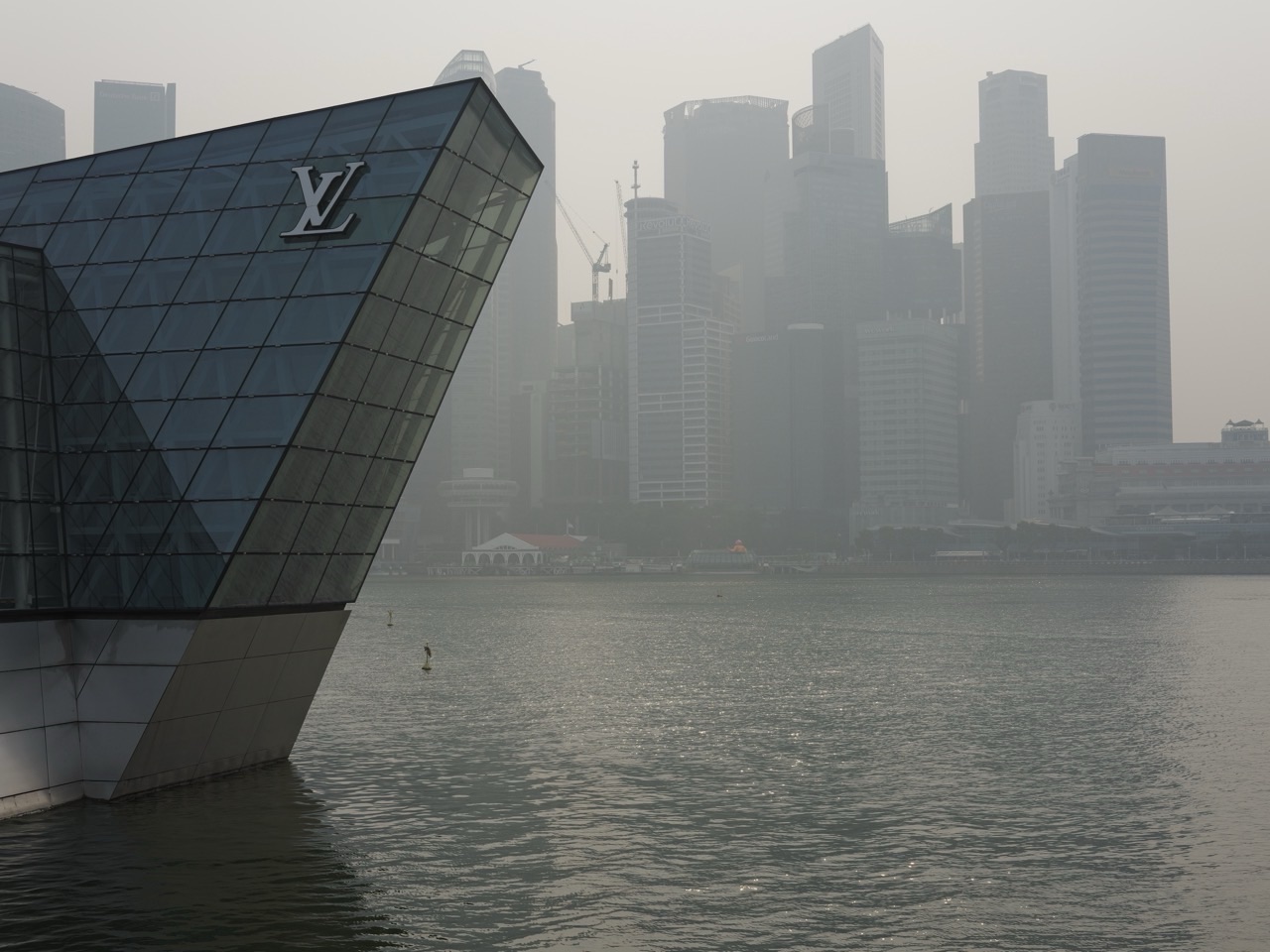
How should you travel around Singapore when the haze is unhealthy? Most essential journeys do not need to disappear, but the amount of time spent breathing outdoor air matters. Check the NEA one-hour PM2.5 reading before an immediate trip and the MOH haze health advisory to match your activity and health status. Where possible, reduce unnecessary outdoor waiting, choose a manageable door-to-door route, defer long recreational walks or cycling, and stay attentive to symptoms. An enclosed MRT carriage, an open-air bus stop, an underground station and a covered pedestrian walkway are different environments; none should be described as having identical air filtration.
This Singapore haze MRT, bus, walking and cycling guide explains commuting to school, office work, tuition, clinics and family activities across Singapore. It covers MRT and LRT stations, feeder buses, bus interchanges, taxis and private-hire trips, park connectors, last-mile walking, accessibility for older adults, children with asthma, N95 masks, weather changes and real-time transport information. The most useful decision is not always “take a taxi.” Sometimes a bus avoids a long walk; sometimes a sheltered but open-sided transfer takes longer than expected; and sometimes the best solution is to change a non-essential destination altogether. Our Singapore Haze Lifestyle Guide introduces the household method. This guide follows every segment of the actual commute.
Follow this specialist handoff: For trips that cross the Singapore–Johor border, do not use Singapore PSI as though it were Malaysia’s local API reading. The neighbouring jurisdiction is covered by Johor Bahru and Melaka smoke, travel and Malaysia API.
The Land Transport Authority’s MyTransport.SG app provides journey planning, bus-arrival information, MRT and road alerts and details about nearby transport. Transport information is useful but cannot replace an air-quality reading. In fact, LTA’s January 2026 announcements about inaccurate bus estimated-arrival displays are a reminder to treat predicted minutes as estimates, not certainty. Before changing a journey, check both environmental advice and the transport operator’s current status. Haze, train service disruptions and bad weather are different events with different official sources.
Start with a door-to-door journey, not just a train line
Imagine a student who travels from Bedok to a school in Bishan. A route-planning app may show the train ride clearly but compress the walk from home to the station, the wait on the platform, the transfer and the walk from the final exit into small grey segments. Those segments are where unnecessary outdoor exposure may accumulate during haze. The time on the train is only one part of the journey.
Write down the full route as five steps: home to the first transport stop, waiting, the main ride, transfer and final destination. Then identify which steps are outdoors, which are enclosed and which involve exertion. Do not treat an open elevated platform as identical to a fully enclosed underground concourse. You are making a practical distinction about spaces, not claiming that every underground station is a certified clean-air room.
Consider necessity too. School, work and clinical appointments often continue. A recreational walk to enjoy the view can be postponed. The purpose of planning is to save the essential journey and shorten what need not happen during poor air. This allows flexibility without suggesting that everyone must remain indoors at every reading.
For some families the best adjustment may be to use a closer bus stop or change a pickup arrangement. For others, the current route is already short and safe. There is no need to replace it with a long, expensive cross-town taxi journey merely because a headline says “haze.”
One-hour PM2.5 versus 24-hour PSI for commuters
NEA reports one-hour PM2.5 concentration for more immediate decisions and a 24-hour PSI forecast for planning ahead. PM2.5 is a fine-particle concentration measured in micrograms per cubic metre; PSI is an index. They are not interchangeable units and should not be added or subtracted. A rolling longer-period reading may differ from a recent one-hour value even when both are correct.
MOH’s one-hour PM2.5 bands are Normal, Elevated, High and Very High. The official activity advice considers intensity and personal vulnerability. At Elevated levels, healthy people should reduce strenuous outdoor activity; at High, avoid it; at Very High, minimise outdoor activity. Vulnerable people, including children, older people, pregnant women and those with chronic heart or lung disease, have more conservative advice. A brief essential commute and a vigorous long-distance cycle are not the same category of behaviour.
The 24-hour PSI forecast helps a family plan the next day and decide whether optional outside events should be rearranged. Use the specific MOH guide and current one-hour reading immediately before a significant outdoor component. Do not conclude that one train platform is clean solely from an islandwide forecast made the previous night.
If a traveller becomes wheezy, has significant difficulty breathing or feels unwell, symptoms require attention regardless of the index. The Singapore Haze Health Guide explains why chronic conditions and current symptoms change a person’s precautions.
MRT carriages, stations and open-air platforms
MRT travel can reduce time spent on long outdoor walks, but actual stations vary. Some are underground; others have elevated platforms open to outside air. There may be sheltered pedestrian links, outdoor staircases, lift lobbies and long crossings to reach buildings. A commuter needs to know the specific station and route, not a generic statement that every MRT space is safe.
Enclosed trains have controlled interior environments, but it would be misleading to promise that every carriage has a certain verified PM2.5 concentration at all times. Filtration, occupancy and outdoor-air entry vary. Transit can nevertheless be a practical way to avoid an extended open-air cycling trip when outdoor activity is discouraged. Make the comparison with the actual alternative.
A person transferring at Jurong East, Bishan, Paya Lebar, Tampines or Woodlands should not assume that all links are equally enclosed. Check the station map and wayfinding information. A shorter change may be possible depending on the route, but safe passenger movement comes first. Never rush across platforms, roads or escalators to save a few seconds of exposure.
Transport disruptions also need current information. LTA launched its real-time MRT and LRT train status service in December 2025. If a line is disrupted, the best alternative may differ from the route previously planned. A haze strategy should avoid trapping vulnerable commuters in unnecessary outdoor queues caused by an outdated train-status message.
Waiting for buses: predictability can reduce unnecessary outdoor time
Open-air bus stops are a very practical part of Singapore transport, but they are not clean-air chambers. Shelters provide protection from sun and rain, not necessarily from fine smoke particles. If the current guidance recommends limiting exposure, it can help to reduce unnecessary waiting by checking service information and timing departure reasonably.
The MyTransport.SG app offers bus arrival estimates, nearby stops, service information and journey planning. Save regular stops or routes where the service allows it. But use estimates as estimates. LTA reported a bus ETA technical issue in January 2026 and explained that inaccurate predictions did not mean bus operations themselves had stopped. That example is a useful reminder not to sacrifice road safety to chase an app countdown.
If a schoolchild uses a feeder bus, caregivers should agree on a suitable pickup or waiting point and avoid unsupervised shortcuts. A child under stress should not run across traffic because the haze makes waiting uncomfortable. If necessary, adjust the departure time or organise appropriate adult help.
Older commuters may need seating, accessible routes and extra time. Reducing exposure by forcing them to sprint to another stop is not an improvement. The right journey is one that respects mobility, breathing comfort and actual transport conditions.
The last kilometre: the part of a haze plan people forget
The phrase “last mile” sounds technical, but in Singapore it can mean a ten-minute walk from the MRT exit to an office or school. If the route crosses exposed roads, an open plaza or a park connector, the person may spend more time outdoors than expected. This matters especially when the trip happens twice daily during a prolonged haze episode.
Start by identifying any safe enclosed route or shorter external path. Some linked commercial buildings offer covered connections, but a covered walkway remains open to outside air unless genuinely enclosed and filtered. Do not confuse “rain-sheltered” with “particle-filtered.” A longer but shaded route may be more comfortable in heat yet not automatically better for haze.
A person with chronic lung disease may need to reduce unnecessary outdoor time more than a healthy colleague. An employer or school can sometimes help by choosing a practical pickup point, adjusting a meeting location or allowing a suitable alternative arrangement. Avoid making assumptions about the person’s medical condition in a public group chat.
If an essential trip still requires outside walking, move at a comfortable pace and follow the relevant official activity guidance. A frantic sprint with heavy bags increases exertion and can be counterproductive. The goal is a safe, predictable journey, not a record time.
Walking, running and cycling as transport
Singapore encourages walking and active mobility, and park connectors are a valuable way to move between neighbourhoods. During haze, however, long outdoor activity may require adjustment. Cycling to work can combine necessary travel with significant physical exertion; jogging home is clearly strenuous. The same activity may be appropriate on a clearer day and less suitable when PM2.5 is elevated.
Do not assume that greener routes remove smoke particles. A park connector beside a canal, reservoir or seafront is still outdoors. Trees are important for urban ecology and shade but do not produce an enclosed low-PM2.5 space. A sea breeze may feel fresh without proving that pollutant levels are low.
A reasonable substitution might be using public transport for a journey that would otherwise involve thirty minutes of fast cycling. The exact benefit depends on actual travel segments and personal health, not a universal claim that trains are “perfectly clean.” A short low-effort walk to reach the station may still be necessary.
For people who cycle for exercise rather than transport, the decision is simpler: an optional hard ride can often be postponed. See Singapore Haze Exercise Guide for training adjustments and appropriate indoor alternatives.
Is driving or taking a taxi always better?
A taxi or private-hire car can sometimes shorten outdoor waiting or make an essential journey more comfortable for someone with limited mobility. But it is not an automatic requirement for everyone during haze. Price, availability, traffic, pickup location, passengers’ needs and the actual transport route all matter.
A car with closed windows and suitable air-conditioning settings may have a different interior air environment from outside. Filtration effectiveness varies by model, filter condition and fresh-air settings. No article should promise that every car cabin removes all fine particles. In some cases, the waiting area for a taxi could be exposed, and repeated unsuccessful pickup attempts increase inconvenience.
For a family with an older member who has heart disease, a reliable accessible ride may be worth considering. A healthy student travelling a short distance may be able to use the existing public transport route with little additional adjustment. Avoid panic-booking expensive transport solely because a headline says the PSI rose.
Drivers and couriers also work through haze and traffic. Customers should give clear pickup instructions and avoid demanding unsafe driving, rushed stopping or illegal manoeuvres. The journey should protect everybody involved, not only the passenger.
Why N95 masks are not required for every short commute
There is understandable confusion about particulate respirators. MOH advises that N95 or equivalent masks are generally not needed for brief ordinary travel from home to work or school, or for indoor environments. The primary recommendation is to adjust prolonged or strenuous outdoor activity according to pollution conditions. When a person must remain outdoors for extended periods in specific higher bands, a well-fitted respirator may be relevant.
Fit matters. A loose mask can leak; an N95 also increases breathing resistance, which can be uncomfortable for some users, particularly with exertion or existing health conditions. Pregnant people, older adults and those with significant heart or lung disease who find breathing difficult should consider the detailed MOH caution and seek medical advice when appropriate.
Masks do not make a long outdoor run or strenuous cycle automatically advisable. If current guidance calls for avoiding hard outdoor exercise, the first question is whether the activity should be reduced or postponed. A respirator is additional protection in selected situations, not a permission slip to ignore the health advisory.
Parents should also avoid insisting on adult-size masks that do not fit children. MOH’s advice on children emphasises activity decisions, and there are specific concerns about standards and fit. Consult current official guidance rather than copying a social-media image of a schoolchild wearing an enormous respirator.
A student commuting to school during haze
Students have fixed start times and may not be able to select a different day for lessons. That makes planning particularly valuable. The parent and child should identify a safe route, the correct platform or bus stop, and a reliable pickup plan. If outdoor PE or CCA has been modified, the school communicates that separately from the normal journey.
A child with asthma may require extra caution and an individual care plan. Ensure the school knows relevant medication arrangements and contact procedures. Avoid discussing the child’s diagnosis unnecessarily in a class group chat. The parent’s goal is to support the real child, not to show that everyone can endure the same conditions.
The journey also offers a learning opportunity. A secondary-school student can check the one-hour PM2.5 band, explain why it differs from the PSI forecast and decide with a caregiver whether an optional outdoor detour should be removed. This is environmental literacy applied to daily life.
For examination journeys, current school and SEAB haze arrangements are important. Do not infer that an exam is cancelled because a training session is postponed. Our Singapore Haze Schools, PE, CCA and Exams Guide covers the education-specific details.
An office commuter and flexible working
Some office work can be completed from home or through online meetings, but many jobs require physical presence. A good workplace response takes account of the job, team needs and individual vulnerability rather than issuing a blanket message that every staff member must commute or every staff member must stay home.
If an employee has a chronic condition, a suitable arrangement could reduce an unnecessarily long outdoor transfer. Employers may consider meeting timing, hybrid work where practical or a closer suitable location. The MOM tripartite haze advisory encourages flexible and considered measures, especially for susceptible employees.
A working adult may also be responsible for a child’s pickup or an older relative’s medical appointment. Coordinate those journeys rather than multiplying outdoor errands. For example, groceries might be collected during one necessary trip instead of requiring a second exposed walk later.
Be careful about social pressure. A person with significant breathing concerns should not have to justify every environmental precaution in a group meeting. Appropriate workplace and medical channels should handle individual arrangements respectfully.
An older commuter who needs an accessible journey
Older adults vary greatly in health and fitness, but MOH includes them among vulnerable persons in the haze guide. A commuter who walks slowly or relies on lifts may need a more practical route than the journey planner’s theoretical fastest option. Reducing outdoor time is only helpful if the new route remains safe and manageable.
LTA’s guidance for older commuters describes accessible bus stops, priority seats and other features. A family can use the information to choose a suitable journey and avoid an unnecessary exposed wait. Do not assume every transport service has the same accessibility features at every stop.
For a hospital visit, confirm the appointment and transport before leaving. Medical care should not be abandoned because the air looks grey. If the person has symptoms or is medically vulnerable, ask the clinician about individual precautions. A clinic or hospital visit and an optional post-appointment park stroll are two separate decisions.
The best route often feels unremarkable: a predictable departure, a safe transfer, suitable seating and a timely return. That is good planning, not a failure to be adventurous.
Haze and public transport workers
Bus drivers, station staff, cleaners and transport support workers have jobs that continue while commuters change their travel plans. Some spend most of their day inside vehicles or buildings; others work at open-air interchanges, roadside stops or outdoor maintenance sites. Exposure and protective measures differ by task.
Employers with outdoor work should consult MOM haze workplace guidance and assess the actual work environment. Job rotation, reducing prolonged outdoor duties, indoor breaks and suitable respiratory protection where required can help. The public’s personal one-hour PM2.5 recreation guide should not simply be substituted for occupational PSI thresholds.
Customers can reduce unnecessary problems by following orderly boarding, providing clear directions and not demanding dangerous service changes. Public transport is a shared service. Keeping it safe during haze depends on considerate passengers and proper worker protection.
The Singapore Haze Outdoor Work Guide explains why the 24-hour PSI used by employers and the one-hour reading used for immediate personal activity have different purposes.
A commuter’s four-part morning routine
Before departure: Check NEA and the relevant MOH personal guide. Check LTA or operator notices for train disruptions and bus arrival information. If you are not beginning strenuous activity, do not overcomplicate the plan. Know the essential trip and the safest workable route.
At the first stop: Avoid unnecessary exposed waiting, but obey traffic and station safety rules. Do not run across roads to save a minute of haze exposure. Help younger children and older relatives according to their needs.
During transfers: Follow current wayfinding instructions. If a disruption forces an extended outdoor queue, reassess whether the journey is essential and what alternatives are workable. A taxi is one option, not a universal mandate.
At the destination: Complete essential errands efficiently and decide whether optional outdoor time should be postponed. Recheck the one-hour reading before significant later outdoor exertion. A morning reading should not be treated as unchangeable all evening.
Worked examples across Singapore
Jurong East to Clementi. An office worker has a short MRT ride but a longer exposed walk to a second destination. The worker keeps the essential meeting and moves an optional outdoor conversation indoors. If a colleague has asthma, they agree on a more suitable arrangement without asserting that every enclosed building has perfect filtration.
Bedok to East Coast Park. A healthy cyclist planned to commute to a recreational ride and then cycle home. When current guidance advises avoiding strenuous outdoor exercise, the recreational route is postponed. The cyclist can still choose practical transport for necessary errands. A ride is not essential simply because it was in the calendar.
Woodlands to a medical appointment. An older commuter is travelling across several stops. A family member checks accessible routes and service information, allows adequate travel time, and avoids unnecessary open-air waiting. The appointment remains the priority; an optional waterfront walk can happen on a better-air day.
Punggol school pickup. A parent normally combines collection with a long outdoor walk. On a hazy day they keep the necessary pickup, shorten the exposed leisure part and return home for a suitable indoor activity. They do not use the school route as an excuse for an additional hour of outdoor play when the child’s health guidance suggests otherwise.
These are planning examples, not live claims about readings or available transport at a particular minute.
Quick comparison of transport choices during haze
| Travel choice | Where outdoor exposure may occur | When it may help | What to verify |
|---|---|---|---|
| MRT or LRT | Station approach, some platforms, transfers | Avoid a long outdoor active-mobility journey | Current rail status, actual station links |
| Bus | Walk and wait at bus stop, interchange | Shorten a journey otherwise made on foot | MyTransport service and estimated arrivals |
| Taxi or private-hire car | Pickup and destination approach | Mobility needs, shorter exposed transfers | Availability, price, pickup safety |
| Walking | Entire outdoor segment | Brief necessary travel at appropriate band | Health, duration, safe route |
| Cycling | Long outdoor exertion | Normally useful active mobility | Current haze band and ride intensity |
| Sheltered walkway | Often open to outdoor air | Better sun and rain comfort | Enclosure, not presumed particle filtration |
| Remote meeting | Avoids a discretionary commute | Work or study permits it | Organiser requirements and personal needs |
Frequently asked questions about Singapore haze and transport
Are MRT trains safe when the PSI is Unhealthy?
Trains can be a practical way to reduce prolonged outdoor walking or cycling, but indoor conditions vary and no general guide can guarantee a particular air-quality concentration in every carriage. Follow the official personal guide and consider station approaches, transfers and the traveller’s health.
Does an underground MRT station always have cleaner air?
Underground and elevated stations have different environments, but enclosure alone does not prove specific filtration or PM2.5 levels. A true comparison requires actual measurements. Plan the route and reduce avoidable exposure when appropriate.
Do covered bus stops protect against PM2.5?
A roof protects from rain and sun, not necessarily from airborne smoke particles. Bus stops may remain open-sided. Check bus arrival estimates, keep waiting practical and obey road safety.
Should I wear an N95 on a normal school or work commute?
MOH says N95 or equivalent masks are generally unnecessary for brief ordinary commutes and indoor environments. Circumstances differ for necessary prolonged outdoor exposure at higher pollution levels, especially for vulnerable people. Follow current official advice and medical guidance.
Is it better to take a taxi whenever there is haze?
Not always. A taxi can reduce outdoor walking for some travellers, but cost, waits, route and individual health matter. A short existing public-transport trip may remain workable. Choose an option suited to the actual journey rather than applying a blanket rule.
Can I cycle to work during haze?
Consider the intensity, outdoor duration, current one-hour PM2.5 guide and your health. Cycling may be strenuous, especially over long distances. If MOH advises avoiding strenuous outdoor activity, using another suitable transport mode or changing arrangements may be prudent.
Are park connectors cleaner than roads during smoke haze?
Greener routes can have benefits for comfort and local environment, but trees and canals do not create filtered spaces. Transboundary haze can reach park connectors. Use current readings rather than assuming a shaded route is clean.
Can children still travel to school?
Follow current school communications and individual health arrangements. Classroom operations and outdoor PE may be managed separately. A child with asthma may need more cautious planning. Avoid unsafe shortcuts or unsupervised changes to pickup points.
What if the bus-arrival app is wrong?
Arrival times are estimates and can be affected by technical issues. LTA has previously published updates about ETA inaccuracies. Use official service information, allow appropriate flexibility and never take unsafe risks to reach a bus.
Does rain mean I can walk outside for an hour?
Rain may alter local air conditions without guaranteeing that regional smoke has cleared. Recheck the current one-hour PM2.5 and health guidance before significant outdoor exercise.
Can someone with COPD take a short bus journey?
That decision depends on their medical condition, symptoms and current environmental conditions. The official advisory includes more cautious recommendations for chronic heart or lung disease. Consult their clinical plan and arrange practical transport. Serious breathlessness requires medical attention.
Can a respirator make a long outdoor commute risk-free?
No. Fit and breathing resistance matter, and masks do not eliminate exposure or replace the advice to reduce strenuous or prolonged activity. A safer route or shorter journey may be more important than a poorly fitted mask.
Does the 24-hour PSI tell me the air at my exact bus stop?
It is a regional air-quality index, not a personal sensor at every stop. NEA’s one-hour PM2.5 is relevant to immediate outdoor activity, while PSI supports broader planning. Actual exposure depends on duration, location and individual conditions.
Continue through eduKate’s connected haze guides
Read How Haze Works | SEA 2026 for the regional smoke system. Singapore Haze Lifestyle Guide explains work and family decisions, while Singapore Haze Health Guide covers respiratory symptoms and vulnerable travellers.
For students, use Singapore Haze Schools, PE, CCA and Exams. For public transport versus physical training, read Singapore Haze Exercise. Food collection and delivery decisions are explored in Singapore Haze and Hawker Centres. For household air, see Singapore Haze at Home | HDB Windows and Filters.
The neighbourhood guides explain where the route differences matter: North Singapore, East Singapore, West Singapore and Central Singapore. For a scientific explanation, visit How Singapore Connects: PSI and Air Quality.
Official references and update note
Primary environmental guidance: NEA Haze Portal, MOH Haze Advisory and HealthHub Protect Yourself Against Haze. Transport information: LTA MyTransport.SG, LTA Train Status, LTA Transport Guidance for Seniors, and LTA’s January 2026 ETA service update.
Prepared as an October 2026 reference article. The page is not a live train tracker or a medical assessment. Check current operating information, official air-quality readings and health guidance before travelling. The best haze commute is not automatically the shortest or most expensive: it is the one that keeps essential life moving with a realistic, safe and manageable amount of outdoor exposure.