
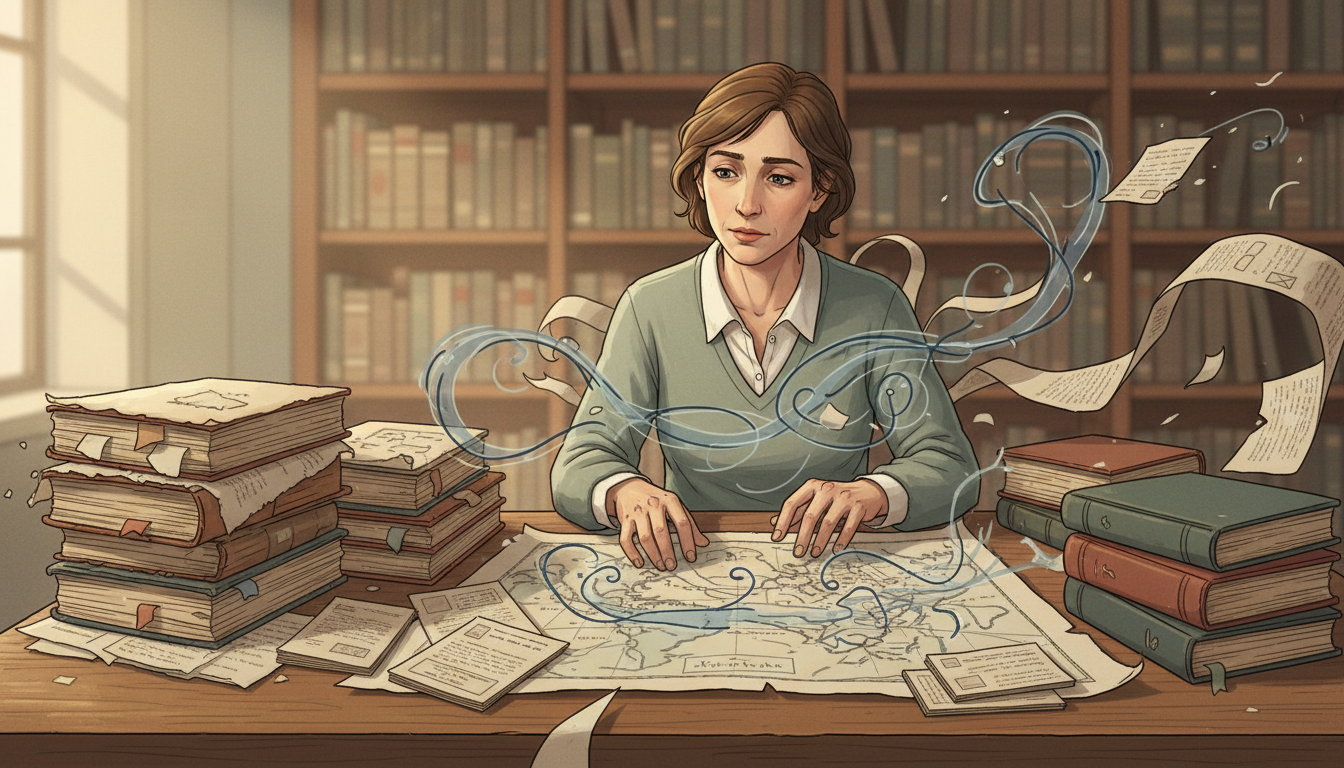
A preserved digital file needs more than storage. Future users must still understand its source, cultural context, rights and significant changes. This guide connects the technical work of preservation with the human responsibilities of cultural institutions and communities.
The worked cases are fictional. Actual technology, access permissions and legal responsibilities require appropriate expertise and institutional policy; this guide does not certify any repository.
Five reading routes
Chapter index
Identify the cultural record · Chapters 1–3
Preserve the authentic data · Chapters 4–6
Protect rights and interpretation · Chapters 7–9
Plan long-term stewardship · Chapters 10–12
Test failures and recovery · Chapters 13–17
- 13. Worked case: an archive retains recordings but loses their permissions
- 14. Worked case: a restoration invents a historic shop sign
- 15. Worked case: an interactive artwork loses its original software
- 16. Worked case: a cultural archive disappears with its contractor
- 17. Review preservation through authentic, authorised future use
1. An existing file is not necessarily a usable cultural record
A museum may preserve a recording in the cloud but lose its speaker’s name, language, circumstances and consent. The bits survive while the cultural context becomes unintelligible. A public catalogue might show an attractive image without revealing whether it is an original document, a modern enhancement or an imagined reconstruction. Digital storage and cultural preservation are different responsibilities.
The gold standard keeps files, source relationships, descriptive evidence, appropriate access and an accountable custodian together. The Library of Congress guidance distinguishes bit-level preservation from long-term usability. A cultural institution should therefore test not only whether a file exists but whether an authorised future reader can still understand it.
2. Define the collection, the cultural purpose and future users
A digital heritage collection may contain photographs, oral histories, performance recordings, manuscript scans, born-digital art, websites or complex software-dependent work. Each kind of material carries different important features. Timing matters to a performance, text layout to a manuscript and interactive behaviour to a digital artwork.
State what will be preserved, why it matters, who may use it and which restrictions apply. A community archive serving descendants may require different access arrangements from a public museum website. A responsible policy describes collection boundaries and preservation priorities rather than promising to keep every file forever regardless of quality, rights or resources. Choose formats and documentation based on intended future interpretation.
3. Capture source identity and provenance at the beginning
A filename such as ‘market_final_4.mp4’ does not establish which market was recorded, who filmed it, whether it was edited or who agreed to publication. If the project team leaves, the archive may become an untraceable set of images that future researchers mistake for verified documentary evidence.
Maintain stable identifiers, known creator and contributor roles, dates or date ranges, locations where appropriate, language, custody history, source description, permitted uses and significant processing. Keep uncertain claims qualified. Sensitive personal or cultural metadata may need controlled access rather than public display. Cultural Documentation explores the practical record that makes a file culturally interpretable.
4. Detect unexpected changes with fixity and version records
A file can be corrupted during transfer, overwritten by mistake or replaced with a similarly named version. Multiple copies are useful, but they may also carry the same error. Without an integrity record, the archive may not recognise that the material has changed.
Use appropriate checksums or other fixity methods, verification dates, stable identifiers and a documented process for investigating discrepancies. Distinguish intentional changes, such as authorised corrections, from unexpected corruption. The NDSA Levels of Digital Preservation provide a framework for building capability. Version 2.1, released in March 2026, includes a stronger focus on environmental sustainability. A framework informs a preservation programme; it cannot make losses impossible.
5. Test recovery instead of trusting a backup count
An archive may report that three backups exist while all depend on one login, one building or one software account. A backup is not a working recovery system until authorised staff can retrieve the correct source with its descriptive and rights records after a realistic failure.
Assign responsible custodians, document storage arrangements and access controls, separate meaningful failure modes, and practise a small restore using a representative item. Include provenance and permissions in the test, not only playable media. Additional copies can create privacy risks if unauthorised access is poorly managed, so resilience and security must be planned together. The specific technical approach belongs to competent professionals working within actual institutional resources.
6. Preserve renderability, not just file extensions
An interactive artwork may depend on an obsolete browser plug-in, an old operating system or specific hardware. A video might rely on an unsupported codec. A static screenshot preserves appearance but not the viewer’s original ability to interact with a work.
Record important dependencies and the properties necessary to interpret the item. Preservation staff may examine migration, emulation, documentation or an appropriately labelled access derivative, acknowledging what each transformation changes. Keep the original source where lawful and practical. Do not assume that converting all files into one familiar format retains timing, colour, layout, sound or interaction. A transparent partial reconstruction can be more responsible than a supposedly perfect copy that silently changes meaning.
7. Protect consent and culturally appropriate access
An oral-history contributor may permit use in a local school while withholding unrestricted online distribution. A performance recording may carry rights belonging to creators and performers. A family collection may contain private names and sensitive knowledge. Merely possessing the file does not authorise every new use.
Maintain permissions, attribution, restrictions and the rationale for access decisions as part of the preserved record. Distinguish custody, research consultation, education, public display and commercial reuse. Provide a way to ask for legitimate access or correction without releasing private data unnecessarily. Cultural Rights explains how participation and intellectual property connect to the cultural meaning of digital materials.
8. Preserve living practices with the people who carry them
A beautifully recorded craft demonstration can omit the most important professional judgement: how a maker chooses materials or recognises an error. A song uploaded without its language and occasion may become generic background audio rather than evidence of a living cultural practice.
Ask practitioners which moments matter, what can be shared and which knowledge has limits. Credit contributions and maintain correction pathways. Some skills need supervised teaching and suitable materials rather than more videos. A repository can support living cultural transmission, but it cannot replace the people, spaces and relationships through which a tradition continues. The Living Cultural Heritage guide develops that complementary responsibility.
9. Keep machine transcripts and AI reconstructions separate from sources
Speech-recognition software may mishear names, dialect terms and code-switching. An AI restoration tool may insert a convincing detail that was never in the original photograph. If the institution presents the processed version as untouched evidence, an automated guess can become a repeated historical claim.
Label raw sources, derivatives, machine drafts, verified transcripts, translations and conceptual reconstructions separately. Record significant transformations and competent human checks for consequential material. Do not upload restricted interviews to external tools without a suitable lawful and authorised arrangement. A generated image can help visualise an interpretation, but it cannot establish that the depicted event occurred. Cultural Authenticity explores truthful reconstruction.
10. Make collections discoverable without stripping cultural context
Researchers and families may need to find material across several museums and archives. Stable identifiers, documented relationships, useful descriptions and appropriate interfaces can make cultural records easier to discover. But interoperability is not a reason to publish restricted personal testimony without agreement.
The European Cultural Heritage Data Space Strategy 2025–2030, published January 2026, emphasises accessible and interoperable cultural data. It is a regional strategy, not a universal requirement for Singapore archives. Share the metadata and access permitted by the relevant rights and governance; an open catalogue can coexist with a restricted underlying file.
11. Plan sustainable storage and human capacity together
Digital collections consume ongoing energy, staff time, licences and replacement equipment. A project that spends its full budget on scanning and website design may discover that no one can preserve the files or maintain the descriptions after its opening event.
Assess preservation priorities, long-term storage costs, formats, integrity-check workloads, maintenance, accessibility and specialist skills. Sustainability does not mean deleting culturally significant sources simply to reduce storage; it means making preservation and environmental trade-offs explicit and reviewable. The NDSA Levels 2.1 environmental guidance offers a relevant framework. Funders and organisers should include recurring work rather than treating preservation as a one-time technology purchase.
12. Make an exit and handover plan for people and platforms
A community archive can depend on one volunteer who knows the passwords, source names and consent records. When that person leaves, the website may continue running but no colleague can interpret or update it. An outsourced platform can create the same dependency if its files and metadata cannot be exported.
Name custodians, permissions, technical dependencies, backup locations, training, contracts and a process for transfer or closure. Test a handover with someone unfamiliar with the system. The goal is not merely to retain bytes but to let the next responsible person restore, explain and correct the collection within its legal and cultural boundaries.
13. Worked case: an archive retains recordings but loses their permissions
A fictional local archive safely preserves hundreds of audio interviews in multiple locations. A new publicity team cannot find the contributor release records and plans to publish the collection online, assuming the existence of a backup proves the project owns the interviews.
The responsible staff separate technical recovery from permission to publish. They search for original agreements, document uncertainty and restrict disputed uses until an authorised decision is possible. A suitable catalogue description may remain discoverable without opening the recordings. The example shows why consent records and access decisions must survive with the files.
14. Worked case: a restoration invents a historic shop sign
A fictional museum uses generative software to improve a damaged photograph of a shopping street. A new sign appears in the restored image, although it is absent from the source. Staff present the result as an authentic documentary photograph and schoolchildren start citing the shop name as historical fact.
Curators retrieve the original, label or remove the misleading derivative, correct public claims and add a review process for future transformations. An imaginative visual can still be used when clearly identified as conceptual. The source photograph remains evidence; a fabricated reconstruction does not inherit its authority because it looks plausible.
15. Worked case: an interactive artwork loses its original software
A fictional museum holds a digital artwork whose original experience depends on a browser plug-in and a customised interface. The files survive, but the software cannot run on the modern public system. The institution posts one screenshot and claims the artwork is fully preserved.
Specialists document the original interactions, code and technical dependencies, consult appropriate creators or rights holders, and evaluate migration, emulation or a transparent partial record. The public label should explain which behaviours can still be experienced and which have been lost. Source retention and interpretive honesty matter more than describing an incomplete copy as a perfect reconstruction.
16. Worked case: a cultural archive disappears with its contractor
A fictional community-history portal launches successfully but its contract contains no reliable export or handover requirements. When the developer’s service ends, descriptions and public corrections become inaccessible even though some images remain with the community association.
The organisation investigates its actual agreements and surviving source files, obtains qualified migration support and establishes a maintained home for authorised records. A new procurement plan requires exportable masters, metadata, rights and a tested end-of-service procedure. An attractive interface is not preservation when the material cannot be responsibly moved to its next custodian.
17. Review preservation through authentic, authorised future use
The final audit follows a real user task. Can an authorised person locate a record, trace its source, identify significant transformations, understand rights, open a meaningful version and request a correction? Can custodians detect unexpected file changes and recover a representative item after a realistic outage?
Use evidence such as fixity checks, restoration tests, format assessments, metadata completeness, rights reviews, access testing and appropriate community consultation. Do not promise perpetual perfect preservation; record risks and responsible next decisions. The gold standard is a maintained cultural knowledge system that remains accountable to people and evidence as technology changes.
| Preservation duty | Evidence | Next action |
|---|---|---|
| Source integrity | Fixity, provenance and versions | Investigate changes |
| Rights | Contributor permissions and restrictions | Clarify lawful use |
| Future access | Formats, rendering and accessible interfaces | Plan migration or emulation |
| Custodial resilience | Tested recovery and handover | Repair weak dependencies |
Frequently asked questions
Is cloud upload enough?
No. Provenance, integrity checks, rights, formats, tested recovery and continued care are also necessary.
What is file fixity?
Evidence such as checksums used to detect unexpected changes to a digital file over time.
Does a backup permit open publication?
No. Permissions, privacy, copyright and cultural restrictions still matter.
Why keep original files?
They support traceability and future processing when access copies change or technologies become obsolete.
Can an AI enhancement be treated as historical evidence?
Only documented source-based details support historical claims; generated additions need clear disclosure.
What is new in NDSA Levels 2.1?
The March 2026 update brings environmental sustainability into preservation guidance.
Should every archive be open data?
No. Discoverability can be balanced with lawful and ethical limits on access to sensitive materials.
Can a screenshot preserve an interactive artwork?
It may document appearance but cannot reproduce the whole interactive experience and dependencies.
Is this a professional digital-preservation certification?
No. It is educational guidance, not accreditation or a claim that any particular system has been audited.
Connected Gold Standard directory
General Digital Preservation covers the wider technical field; this article focuses on cultural context, source identity, rights and human stewardship. Select the linked specialist guide responsible for the next actual problem.
- The Gold Standard of Culture
- The Gold Standard of Digital Preservation
- Cultural Documentation
- Cultural Memory
- Cultural Stewardship
- Cultural Rights
- Cultural Translation
- Living Cultural Heritage
- Cultural Accessibility
- Cultural Infrastructure
- The Gold Standard of Archives
- Cultural Exhibition Design
- Culture Further Reading Index
- Gold Standard Master Collection
- Deep Reading Index
Primary digital preservation and heritage references
- NDSA — Levels of Digital Preservation 2.1 (2026)
- Library of Congress — Bit-Level Preservation and Long-Term Usability
- European Commission and Europeana — Cultural Heritage Data Space Strategy 2025–2030
- Europeana — Impact Playbook
The cited frameworks and policies have distinct national and technical scopes. They do not certify this educational article or waive the permissions required for a real collection.