
Industrial automation is often pictured as a robot replacing a person at a workstation. The more important design problem is whether the complete process produces good results, stays safe when something fails and can be maintained by the people responsible for it.
The Gold Standard of Industrial Automation starts with physical tasks and measured constraints before selecting controllers, sensors, networks and robots. It separates process control from safety assurance and treats cybersecurity, quality and recovery as normal engineering responsibilities.
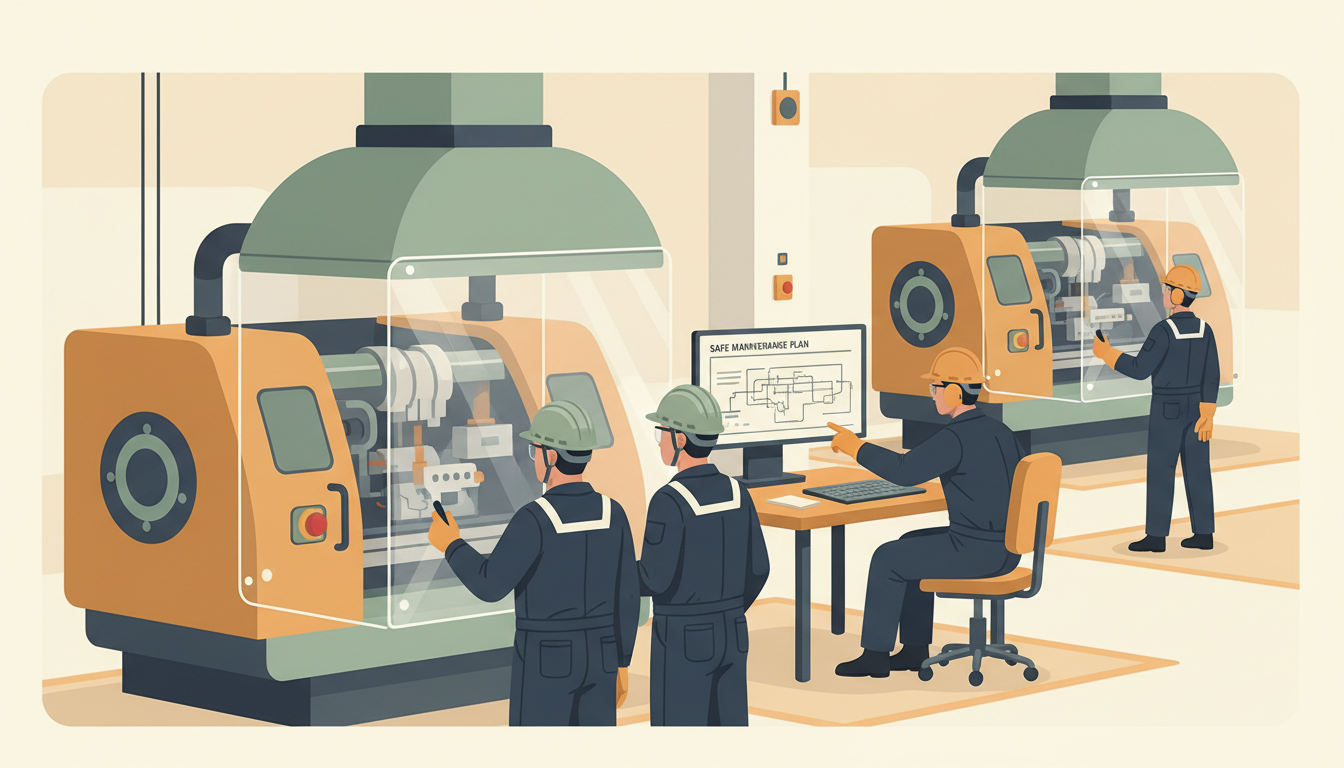
This 31-chapter guide includes checked fictional production and inspection calculations, operational test cases and authoritative sources. The shared industrial-safety cover is a conceptual illustration of hazard controls, not a photograph of a certified automated production line.
Chapter index
Physical process and safety foundations · Chapters 1–11
- Automation succeeds when the physical process is safer and more dependable
- Start with the process before selecting technology
- Distinguish mechanisation, automation and autonomy
- Follow the path from sensor to actuator
- Sensors require units, calibration and context
- Actuators turn commands into potentially hazardous motion
- PLC and controller logic must be reviewed as real software
- SCADA, DCS and HMI serve different functions
- Control feedback deliberately rather than by trial and error
- Interlocks and safety-related functions require separate assurance
- Design maintenance and energy isolation from the beginning
Controls, cybersecurity and production performance · Chapters 12–21
- Risk assessment must include nonroutine work
- Use the hierarchy of controls and verify the actual reduction
- Robot workcells need boundaries, sensing and planned access
- Automation architecture needs explicit failure domains
- Industrial cybersecurity protects people as well as information
- Apply the ISA/IEC 62443 lifecycle rather than citing a badge
- Engineer communication and data meaning together
- Document setpoints, recipes and change authority
- Worked example: calculate overall equipment effectiveness
- Throughput, lead time and utilisation are not identical
Inspection, operators, maintenance and audit · Chapters 22–31
- Treat machine vision as measured evidence
- Worked example: false rejects and missed defects
- Commission across startup, normal work and recovery
- Train operators as investigators rather than button-pushers
- Maintain calibration, spares and software together
- Measure energy and resource performance honestly
- Protect worker capability and meaningful responsibility
- Audit one production cycle from material to verified output
- Frequently asked questions about industrial automation
- Continue through the Gold Standard network
Quick decision test
| Question | Evidence to request |
|---|---|
| Will it operate safely? | Task risk assessment, safeguards and fault validation |
| Will it produce correctly? | Good-output samples and measurement checks |
| Can staff recover? | Approved stop, isolation and restoration records |
| Can it resist disruption? | Network, access, backup and change-control evidence |
1. Automation succeeds when the physical process is safer and more dependable
Industrial automation uses measurement, control logic, powered equipment and information systems to perform and coordinate physical processes. It includes factories, utilities, warehouses and other engineered environments. The goal is not simply to replace a repetitive manual action; it is to deliver reliable output within safety, quality, environmental and cost constraints.
The gold standard follows the complete outcome: did the machine produce the intended result, remain within its validated operating envelope, stop safely when necessary and allow people to recover from faults? A fast robot behind a weak guarding arrangement is not a successful automation project.
2. Start with the process before selecting technology
Write down inputs, outputs, operators, material flow, cycle times, quality criteria and sources of variation. Observe normal production, setup, cleaning, jams and maintenance. A process that is poorly understood will remain poorly understood after it is automated, but its defects may occur faster.
Define measurable outcomes such as good units per hour, exposure reduction, repeatable measurements or lower scrap. Compare automation with simpler changes in layout, fixture design, standard work or manual assistance before assuming expensive controls are the right answer.
3. Distinguish mechanisation, automation and autonomy
Mechanisation supplies powered assistance while a person may make many operating decisions. Automation uses defined sensing and control to perform parts of a workflow. Autonomy often describes more complex adjustment or decision-making within stated goals and constraints, but its meaning depends on the application.
None of these terms guarantees safety or quality. A conveyor with a basic stop sensor can be easier to validate than a flexible autonomous robot, while a tightly controlled autonomous inspection system may be valuable in a narrow setting. State the actual capability and limits rather than relying on labels.
4. Follow the path from sensor to actuator
A typical control loop measures a condition, converts the reading to a usable signal, applies logic or control laws and commands an actuator that changes the process. Feedback lets the controller compare observed behaviour with the desired condition. Sensors can drift; actuators can stick; wiring and timing can fail.
Draw each element and identify failure modes. A position switch reporting ‘closed’ does not prove that a mechanism is mechanically safe unless its design, installation and testing justify that interpretation. Control quality depends on instrument accuracy and physical design as much as software.
5. Sensors require units, calibration and context
Temperature, pressure, proximity, torque and machine-vision systems measure different properties using different physical principles. Their readings have resolution, sampling limitations, environmental sensitivities and possible bias. The chosen sensor must observe the physical condition relevant to the decision.
Record units, calibration state, range, response time and maintenance requirements. A sensor selected for room temperature should not be assumed accurate in a hot, vibrating industrial enclosure. Redundant measurements help only when common causes of error are considered.
6. Actuators turn commands into potentially hazardous motion
Motors, valves, heaters, drives and pneumatic devices create the physical effects of automation. Their energy sources can remain hazardous after a control screen displays ‘stopped’. Forces, stored pressure, gravity and unexpected restart must be evaluated within the actual machine design.
Specify what the system does on loss of power, communication or sensor input. Engineering assurance requires suitable safeguarding, isolation and verified behaviour; a warning banner on an HMI is not the same as a protective design.
7. PLC and controller logic must be reviewed as real software
Programmable logic controllers execute defined control logic under particular timing and input-output arrangements. Ladder logic, function blocks and other programming representations can help engineers implement sequences, but visual familiarity does not eliminate logical errors.
Use documented requirements, version control, change review, simulation and tests on approved systems. Avoid modifying live safety functions without a formally authorised process. A successful demonstration under one sensor state does not establish correct behaviour through startup, interrupted cycles and abnormal input combinations.
8. SCADA, DCS and HMI serve different functions
Supervisory control and data acquisition systems can support geographically distributed monitoring and supervisory control; distributed control systems coordinate many continuous-process control functions; human-machine interfaces present state and accept authorised operator actions. These categories overlap in contemporary products.
A screen’s displayed status may lag the physical process or depend on an unreliable communication link. Operators need clear alarms, timestamps and safe fallback procedures. An attractive dashboard cannot substitute for dependable control at the equipment level.
9. Control feedback deliberately rather than by trial and error
Closed-loop control adjusts an input in response to measured deviation. Proportional, integral and derivative concepts are common in suitable applications, but tuning requires a model of the process, measurement quality and safe operating bounds. Overshoot, oscillation and actuator saturation can matter more than fast setpoint response.
Commission through authorised engineering procedures with appropriate safeguards. Do not treat textbook tuning constants as universal settings for a hazardous machine. A process with substantial delay or nonlinear behaviour may require different control approaches and rigorous validation.
10. Interlocks and safety-related functions require separate assurance
An interlock may prevent a process step unless a defined condition is satisfied. Safety-related control functions need risk-based requirements, reliability and validation appropriate to the application. Normal production control and safeguarding may share information yet require different levels of independence and oversight.
Use competent engineering teams and applicable machinery safety standards. Do not bypass guards, defeat sensors or rely on operator attention as a replacement for properly designed protection. Test fault handling under an approved safety plan rather than improvising dangerous demonstrations.
11. Design maintenance and energy isolation from the beginning
Equipment can retain hazardous electrical, pneumatic, hydraulic, thermal or gravitational energy after shutdown. Maintenance tasks include jams, cleaning, tooling changes, inspections and unexpected repairs. The correct isolation process depends on all energy sources and applicable workplace requirements.
The US OSHA hazardous-energy guidance explains why servicing needs formal controls, including lockout/tagout where applicable. That US regulatory framework does not replace Singapore’s legal requirements. In all locations, safe servicing belongs in the machine lifecycle design, not as a later operator workaround.
12. Risk assessment must include nonroutine work
New automation changes work positions, material handling, human-machine interaction and failure patterns. Assess who might be harmed during setup, programming, maintenance, cleaning and recovery, not only during normal production. Include contractors and temporary workers.
Singapore’s Ministry of Manpower risk-management guidance requires identifying, evaluating, controlling, monitoring and communicating workplace risks. A task-specific assessment should be updated when machinery or the process changes.
13. Use the hierarchy of controls and verify the actual reduction
Eliminating exposure or designing out a hazard is generally stronger than depending solely on warnings or personal protective equipment. Automation can move someone away from dangerous lifting, hot surfaces or a dusty step, but can introduce new risks around robots, conveyor pinch points and maintenance.
Measure whether the intervention reduces exposure under realistic conditions. Track new hazards rather than announcing that a machine ‘removed human risk’ merely because it reduced staffing near one process.
14. Robot workcells need boundaries, sensing and planned access
Robot systems may move rapidly and interact with tools, payloads and surrounding equipment. Risk depends on motion, forces, end effectors, guards, access points and the mode of operation. Collaborative applications still require analysis; a manufacturer calling a robot collaborative is not a risk assessment.
Define safe human access for loading, teaching, recovery and maintenance with a qualified integrator. Validate barriers, sensors, stop functions and restart behaviour against the applicable standards. Do not transfer an example safety configuration from one cell to another without engineering approval.
15. Automation architecture needs explicit failure domains
A network failure should not automatically create uncontrolled physical motion. Local safety functions, controllers, supervisory networks and enterprise systems have different roles and performance needs. Define what each layer may command and what happens when upstream systems disappear.
Separate time-critical control from analytics or reports that can tolerate delay. Document dependencies on identity systems, time synchronisation, databases and supplier remote access. A single shared switch or account can become a hidden single point of failure.
16. Industrial cybersecurity protects people as well as information
Operational technology interacts directly with physical processes, so cyber incidents may impair safety, production and environmental controls. The NIST SP 800-82 Revision 3 provides guidance tailored to OT’s unique safety, performance and reliability constraints.
Asset inventories, network separation, authorised access, monitoring, backups and controlled maintenance matter, but changes must be tested for effect on operations. A protective IT patch deployed without process coordination can introduce an availability or safety problem.
17. Apply the ISA/IEC 62443 lifecycle rather than citing a badge
The ISA/IEC 62443 series addresses industrial automation and control-system cybersecurity through responsibility, risk assessment, secure development and operations. Its individual parts have distinct purposes and revision dates.
An organisation should state which requirements, system boundaries and evidence its assessment covers. Buying one certified component does not prove the complete plant is secure or that maintenance and supplier access have been managed.
18. Engineer communication and data meaning together
Controllers and software may exchange counts, status codes, temperatures, alarms and product identifiers. Define units, timing, state transitions and authorisation. A machine can send a perfectly formatted message while the receiving system mistakenly counts rejected parts as good output.
Use versioned contracts, representative fixtures and reconciliation tests. Network connectivity is not semantic interoperability. For deeper analysis, connect this topic to the existing Gold Standard of Interoperability Engineering.
19. Document setpoints, recipes and change authority
Production recipes, limits and calibration constants can change what a machine does. Identify who may create, approve, deploy and revert each change, and record what version ran for a particular lot. Protect against accidental overrides and undocumented copying of old settings.
An authorised change should be reviewed for product quality, machine capability, safety and downstream compatibility. A configuration file saved on a technician’s desktop is not a robust recipe-management system.
20. Worked example: calculate overall equipment effectiveness
Consider a fictional machine with 420 planned production minutes. It runs for 380 minutes, has an ideal cycle of two minutes per unit, produces 175 units and accepts 167 as good. Availability = 380 ÷ 420 ≈ 90.5%; performance = (175 × 2) ÷ 380 ≈ 92.1%; quality = 167 ÷ 175 ≈ 95.4%.
Multiplying the unrounded factors gives overall equipment effectiveness of (167 × 2) ÷ 420 ≈ 79.5%. The result diagnoses production losses under these definitions; it is not a safety score or independent proof of economic value. The ‘ideal cycle’ and classification of planned time must be stated before comparing machines.
21. Throughput, lead time and utilisation are not identical
Throughput measures completed output over time, lead time measures how long an item takes through a system, and utilisation describes the fraction of capacity being used. Increasing one machine’s utilisation can create queues and delay downstream work. The bottleneck often determines end-to-end capacity.
Observe complete material flow with actual good output, not a disconnected equipment speed test. Design buffers deliberately and monitor their effect on quality and work-in-progress. A fast workstation is not the same as a productive factory.
22. Treat machine vision as measured evidence
Vision inspection depends on lighting, optics, exposure, calibration, product presentation, algorithms and reference examples. A model that performs well in one pilot may fail when surface finishes, camera positions or lighting change.
Report false rejects and missed defects separately, with test populations and uncertainty. Retain approved samples and explain escalation for ambiguous cases. AI-labelled ‘pass’ should not automatically replace inspections required by product or safety rules.
23. Worked example: false rejects and missed defects
In a fictional batch of 1,000 items, 80 truly have a defined defect. A vision system correctly flags 60 of them and incorrectly flags 40 good items. Its defect-detection recall is 60 ÷ 80 = 75%. Precision among flagged items is 60 ÷ (60 + 40) = 60%.
That system missed 20 truly defective items and unnecessarily rejected 40 good items. Accuracy alone could obscure the different costs of those mistakes. Before deployment, compare the consequences of defects escaping versus valid products being scrapped and choose qualified acceptance criteria.
24. Commission across startup, normal work and recovery
Factory acceptance and site acceptance tests should address not only normal cycles but credible faults, emergency stops, power interruptions, failed sensors, blocked exits and recovery procedures. Identify acceptance criteria and signatures before tests begin.
Keep test evidence, deviations, as-built drawings and training records. Safety-critical tests must be performed under approved procedures by competent people; articles and simulated examples are no substitute for actual commissioning engineering.
25. Train operators as investigators rather than button-pushers
People need to understand the purpose of controls, warning meanings, safe stop conditions, limits on overrides and when to contact maintenance. Effective training includes observing real workflows and practising diagnosis without entering a hazardous area.
Design screens and work instructions that reduce confusion under stress. One person should not be expected to remember dozens of undocumented exception paths. A good automated line makes abnormal conditions visible and provides a safe, clear route to help.
26. Maintain calibration, spares and software together
Mechanical wear, contamination, sensor drift, software changes and network ageing can degrade an automation system. A maintenance plan should include the right evidence for each component: inspections, calibration, controlled backups, software versions and replacement-part compatibility.
Track recurring faults and repair times, not just scheduled service completion. A spare controller with the wrong firmware or missing recipe may not restore production. Test restoration procedures under safe conditions before treating inventory as resilience.
27. Measure energy and resource performance honestly
Automation may improve yield and reduce rework while using additional electricity, cooling or compressed air. Estimate whole-process resources per good unit and distinguish normal output from idle overhead. A reduction in staff hours does not by itself show improved environmental performance.
Compare like-for-like product mix, production period and accounting boundary. Include discarded materials and energy needed for supporting infrastructure. The desired outcome is useful production with transparent trade-offs rather than a claim that automation is automatically green.
28. Protect worker capability and meaningful responsibility
Automation changes skills, job design and the distribution of decisions. People may move from repetitive tasks to setup, analysis, maintenance and supervision, but the transition requires accessible training and realistic staffing. A system that depends on one indispensable programmer is fragile.
Invite operators and maintenance teams into design reviews. Their experience often reveals jams, cleaning tasks and ambiguous alarms that a demonstration misses. Workforce effects should be assessed with the same candour as cycle-time improvements.
29. Audit one production cycle from material to verified output
Trace one accepted product through source material, identification, sensor readings, control logic, equipment state, quality decision, data record and shipment or handoff. Reconcile scrap, rework, inventory and exceptions. Repeat the test for a jam, sensor fault, lost network and authorised maintenance.
Ask whether another engineer can reproduce the result from controlled documentation, with every safety and process boundary intact. A gold-standard system is testable both when production is routine and when real conditions change.
30. Frequently asked questions about industrial automation
Does automation remove all workplace hazards? No. Can a PLC replace an engineered safety system in every context? No; functional requirements and standards determine the needed protection. Is a collaborative robot automatically safe to touch? No. Is an OEE score a safety rating? No.
Can a successful network connection prove the downstream production count is correct? No. Do machine-learning predictions guarantee inspection accuracy? No. Must every industry use the same control architecture? No; process risk, timing and maintenance needs differ.
31. Continue through the Gold Standard network
Use Industrial Safety, Industrial Hygiene, Industrial Metrology, Engineering and Interoperability Engineering for deeper methods.
Authoritative reading routes: Singapore MOM risk management, OSHA hazardous-energy controls, NIST SP 800-82r3 and ISA/IEC 62443. All numerical cases are fictional educational calculations, not machinery settings or workplace compliance certifications.