
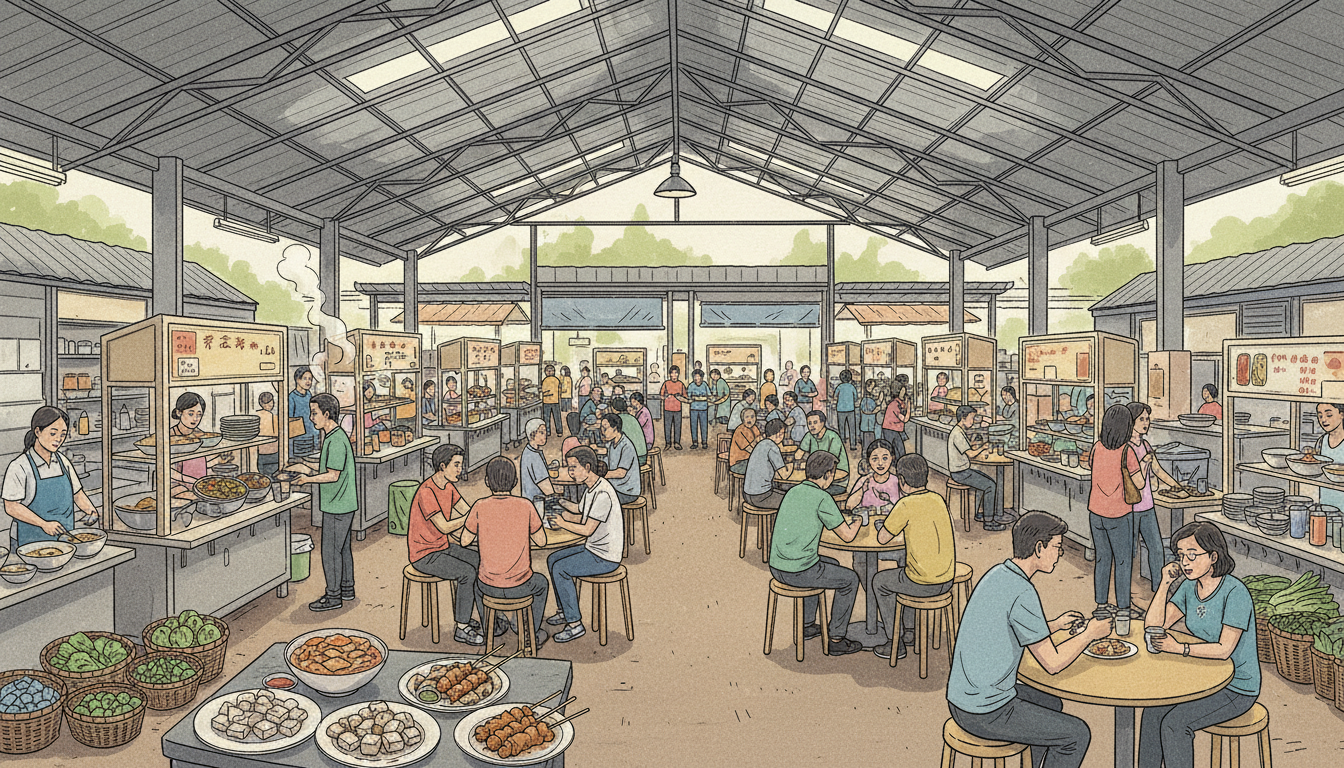
Intangible cultural heritage is a living body of knowledge, practices and expression carried by communities. It includes social meaning, skills and associated spaces or objects, but it cannot be safeguarded by placing an item in a museum or publishing a photo alone. Continuity requires people who can practise, teach, adapt and decide how their traditions are represented.
This ten-chapter guide connects the UNESCO 2003 Convention with respectful community participation, apprenticeships, economic viability, Singapore’s hawker culture and the multinational kebaya tradition. Worked examples show why attendance and apprentice outcomes must be reported with honest denominators and clear uncertainty.
THE GOLD STANDARD · INTANGIBLE CULTURAL HERITAGE
Safeguard living heritage with its practitioners
Ten connected chapters · Singapore examples · Community agency and evidence
Chapter index
Identify living heritage · Chapters 1–2
Document with communities · Chapters 3–4
Support continuity · Chapters 5–6
Measure and interpret · Chapters 7–8
Practise and connect · Chapters 9–10
Intangible cultural heritage means practices, expressions, knowledge and skills that communities identify as part of their heritage, along with associated objects and cultural spaces. Under UNESCO’s 2003 Convention, such heritage passes between generations while also being continually recreated. A traditional garment can be placed behind glass, but the display alone does not transmit the ability to design, sew, wear or understand its community meanings. A recorded performance preserves evidence of a particular event but not automatically the relationships that made the practice meaningful.
Safeguarding is therefore not equivalent to freezing a custom. A learner may use a modern tool, a craft may adapt to different materials, or a performance may change its setting. Practitioners can disagree about which variations matter. The strongest research describes those differences and asks what enables people to continue the practice voluntarily, rather than claiming that an outsider’s favourite historical version must be the only authentic one.
Start with the practice’s people, occasions, social functions, skills and continuity. Identify what can be observed directly and what requires testimony, historical records or long-term participation. Tourism popularity and public recognition may increase visibility, but neither establishes that a community has the resources, autonomy or opportunity needed to continue living heritage.
Field task: Define one practice through its practitioners, associated skills, shared meanings and methods of transmission.
UNESCO’s 2003 Convention recognises five broad domains: oral traditions and expressions, performing arts, social practices, rituals and festive events, knowledge and practices about nature and the universe, and traditional craftsmanship. Many practices connect several domains. A festival might integrate music, oral history, food preparation, clothing, ritual, local ecological knowledge and crafts. Classifying it solely as music can obscure most of the knowledge that sustains it.
National inventories may adapt their categories for local purposes. Singapore’s National Heritage Board identifies Food Heritage as a category in its intangible cultural heritage inventory, alongside other forms of practice. This is a documentation choice within a broader safeguarding framework, not a claim that UNESCO’s five domains exclude culinary knowledge. Classification is useful only if it helps people understand what actually happens.
Do not assume that everyone sharing an ethnicity or national origin follows one identical custom. Traditions may differ by family, region, occupation, gender, generation and personal preference. A community inventory should accommodate variant names and ways of practising rather than forcing every participant into an official-looking standard form. Words used for classification are tools, not substitutes for listening.
Field task: Select one practice and show how at least two heritage domains overlap without erasing regional or generational differences.
Article 15 of the UNESCO Convention encourages States Parties to ensure the widest possible participation of the communities, groups and individuals who create, maintain and transmit living heritage. It also calls for involving them actively in management. A project that consults people only after selecting the exhibition title, recording schedule and interpretation has not taken that principle seriously.
Begin by learning who the practitioners are and how authority and knowledge are distributed. Elders may have specialised knowledge, apprentices may understand barriers to entry, and community groups may disagree about publicity, access and the future direction of a practice. Avoid treating one highly visible representative as the voice of every person concerned. Record legitimate disagreement and create routes for correcting interpretations.
Documentation carries ethical obligations. Certain performances, rituals or know-how may be private, sacred, commercially sensitive or inappropriate for general online circulation. Seek permission suited to the proposed recording and use, explain potential audiences and future reuse, and respect documented restrictions. Making information searchable does not automatically make it culturally appropriate to publish.
Field task: Describe how practitioners help choose project aims, review recordings, identify sensitive knowledge and challenge misleading conclusions.
An inventory can document a practice’s name, variations, meaning, settings, bearers, transmission, risks to continuity and safeguarding activity. Useful evidence includes interviews, demonstration recordings, apprentices’ notes, archival photographs and accounts of associated places. Preserve dates, creator information, permissions and provenance. A video recorded by a visitor without context may be attractive but a poor source for explaining the complete practice.
Under the 2003 Convention, States Parties undertake identification and inventory work with community participation, with inventories updated over time. A single entry should not pretend to capture every version forever. Changes in tools, venues, apprenticeships or community priorities deserve renewed documentation. An archive can preserve earlier descriptions without mislabelling them as the only current position.
Think also about practical access. A practitioner may want teaching material shared among apprentices while preferring certain ceremonial knowledge to remain restricted. Create appropriate permissions, clear versions, correction procedures and arrangements for continued stewardship. Community-led inventories become stronger when they explain both what has been recorded and what the recording does not establish.
Field task: Draft a sample inventory entry with practice, variant, bearer perspectives, evidence, permissions, reviewer and next review.
Safeguarding can include mentoring, apprenticeships, local workshops, festivals, recordings and formal education. These activities serve different purposes. A public demonstration can attract interest, but practising a musical technique, craft skill or social custom may require repeated feedback and membership in relationships that cannot be recreated in a short class. A programme should separate awareness, introductory learning, sustained practice and proficiency.
Practitioners need time, materials, places to teach and recognition for teaching work. Making experienced bearers volunteer indefinitely while celebrating programme attendance can undermine the very practice being promoted. Include the costs of tools and venues, language barriers, appropriate compensation and apprentices’ ability to continue outside a showcase event.
Transmission need not follow a single age pattern. Adult learners may return, community members may migrate, and younger practitioners may adapt how skills are presented. Record continuity in purposes and practice while allowing reasonable change. The learner’s ability to participate meaningfully is more informative than merely reproducing one performance for a camera.
Field task: Design an introductory workshop and a longer apprenticeship, stating what meaningful progress can be demonstrated after each.
CHAPTER 6 OF 10
6. Learn from hawker culture in Singapore and kebaya across Southeast Asia
Back to contentsUNESCO inscribed Hawker culture in Singapore, community dining and culinary practices in a multicultural urban context, on its Representative List in 2020. The element concerns food knowledge, practitioners, everyday social interactions and shared dining spaces. Hawker centres bring people together; safeguarding cannot be reduced to preserving one photograph of a dish or promoting a tourist recommendation.
Ask how skills move from experienced hawkers to new practitioners, whether livelihoods and working conditions support continuation, and how shared dining remains accessible to different communities. A successful publicity campaign may raise awareness but cannot prove that apprenticeships, spaces and social practices remain resilient. The programme’s evidence should reflect what practitioners and communities identify as important.
In 2024 UNESCO inscribed Kebaya: knowledge, skills, traditions and practices, nominated by Brunei Darussalam, Indonesia, Malaysia, Singapore and Thailand. Design, fabric selection, cutting, embroidery, sewing, wearing and social occasions all contribute to the living practice. The multinational inscription reflects connections across Southeast Asia; it does not grant exclusive ownership of every design or variation to any one state.
Field task: For each case, separate the visible objects from skills, cultural spaces, community relationships and opportunities for teaching.
Living heritage depends on practical conditions. A craftsperson needs materials and opportunities to sell or teach; performing groups need space and time; food traditions depend on accessible places, training and sustainable livelihoods. Rising rent, inadequate apprenticeship income or the loss of venues can threaten continuity even when public admiration remains high.
Commercial activity can create resources for safeguarding, but market pressure can also reward simplified demonstrations that are easier to sell than the full practice. Tourism may bring customers while making local participation more expensive. Assess financial outcomes alongside practitioner autonomy, community meanings and opportunities for future learners. Do not confuse a rising price for a performance with evidence that its cultural significance has strengthened.
Authenticity is not settled solely by external observers. Practitioners may preserve techniques while adapting presentation, materials or social uses. Research should record why those changes occur and how different community members assess them. A good safeguarding plan can welcome innovation without treating every commercially successful adaptation as equivalent to the historical and social practice being protected.
Field task: Identify one financial barrier and one viable support measure that leaves cultural decisions with practitioners.
CHAPTER 8 OF 10
8. Worked example: distinguish assessed apprentices from the whole cohort
Back to contentsA fictional craft apprenticeship enrols 80 learners. One year later, 60 receive a community-agreed skills assessment, and 48 demonstrate the defined competence. The assessment pass rate is 48 divided by 60, or 80%. But 20 original learners were not assessed. Reporting an 80% success rate without specifying that denominator would conceal missing follow-up information.
The confirmed proportion demonstrating competence among all originally enrolled learners is 48 divided by 80, or 60%. Twelve assessed participants did not meet the chosen threshold; twenty others have unknown outcomes. It is not valid to assume all twenty failed, and an assessor should not quietly remove them when making a cohort-wide claim. Some may have moved, continued elsewhere or declined assessment.
Neither the assessed-pass rate nor the cohort-confirmed rate demonstrates the vitality of a living tradition. The evaluation should ask whether learners have access to practitioners, whether they can continue in meaningful settings, what skill criteria the community considers appropriate and what happens after the course. Qualitative follow-up and respectful consent complement the counts.
Field task: Reconcile 80 enrolled, 60 assessed, 48 confirmed competent, 12 assessed not yet competent and 20 outcomes unknown.
| Fictional apprenticeship cohort | Count | Interpretation |
|---|---|---|
| Enrolled | 80 | Initial cohort |
| Assessed after one year | 60 | 75% of cohort |
| Met assessed criterion | 48 | 80% of assessed |
| Assessment below criterion | 12 | Observed, not yet passing |
| No assessment | 20 | Unknown outcomes |
| Documented competent of enrolled | 48/80 | 60% |
Imagine a fictional programme that invites 120 earlier participants to describe their practice six months after a heritage workshop. Ninety reply; seventy-two respondents report continuing. The respondent continuation share is 72 divided by 90, or 80%. If measured against the original invited group, only 72 divided by 120, or 60%, are documented as continuing.
The thirty non-respondents cannot automatically be called inactive. The respondent rate might differ from the complete group’s rate because people who remain engaged may be more willing to reply. The two correct percentages therefore answer different questions. State which people were observed, what the wording ‘continuing’ means and whether the answers were independently verified.
Attendance, respondent continuation and mastery must not be collapsed into one measure. A practitioner might maintain a tradition through seasonal occasions rather than weekly activity; another may have developed advanced skills without responding to a questionnaire. Build programme reporting around what the community values and treat missing evidence transparently.
Practical check: Practice answer: 80% among respondents, 60% documented in the invited group; thirty outcomes are missing, not known failures.
Practice answer: 72 ÷ 90 = 80% of respondents; 72 ÷ 120 = 60% of all invited participants documented as continuing. Thirty non-respondents cannot be classified without evidence.
Begin with Culture for meaning and identity; Anthropology for careful interpretation of practices and communities; and Sociology for institutions, participation and social change. History helps evaluate how practices have developed, while Museum Studies examines documentation and public representation without reducing living heritage to displayed objects.
Oral transmission connects with Linguistics, and decisions about consent, authority and fair access connect with Ethics. Statistics supports honest interpretation of surveys and cohorts. Education links heritage safeguarding with apprenticeships, sustained learning and the transfer of understanding beyond a single classroom.
The gold standard is a safeguardable future defined with the people who keep a practice alive: accurate evidence, meaningful opportunities to learn, space for continuity and change, and respect for cultural agency. Students can apply this method by interviewing willing practitioners, comparing sources and preserving permissions rather than assuming every familiar tradition has one fixed story.
Field task: Create a community-guided research plan describing whose knowledge matters, what may be shared, how people learn and how future progress will be assessed.
Questions learners often ask
Is intangible heritage separate from every physical object? No. Objects and places can be associated with living knowledge and practice.
Does UNESCO inscription transfer a tradition’s ownership to one country? No. Practices may extend across communities and borders.
Must traditions remain unchanged? No. Their continued recreation is part of the UNESCO definition.
Does a large public audience prove successful safeguarding? No. Communities need sustained capacity, respect, resources and meaningful transmission.
Authoritative sources and limitations
The UNESCO 2003 Convention defines intangible cultural heritage and includes Articles 11, 12 and 15 on identification, inventories and participation. UNESCO explains the five broad heritage domains and the importance of community participation. Its inscriptions describe Hawker culture in Singapore (2020) and Kebaya across five Southeast Asian countries (2024). Singapore’s National Heritage Board describes local recognition of heritage stewards and inventory categories.
All apprenticeship and participation figures are fictional. Reporting programme outcomes does not determine community legitimacy or prove the long-term vitality of any specific tradition. Project decisions should respect appropriate permissions and practitioner participation.