
Archaeological fish operculum analysis studies gill-cover bones recovered from sites, settlements, lakes and other deposits. The four-element opercular series can retain taxonomic information and sometimes measurable structures useful for body-size estimation. Yet thin and porous plates may break into recognisable fragments whose full length can no longer be measured. Understanding that difference prevents a common error: turning a readily identified fossil into a falsely precise estimate of an ancient fish.
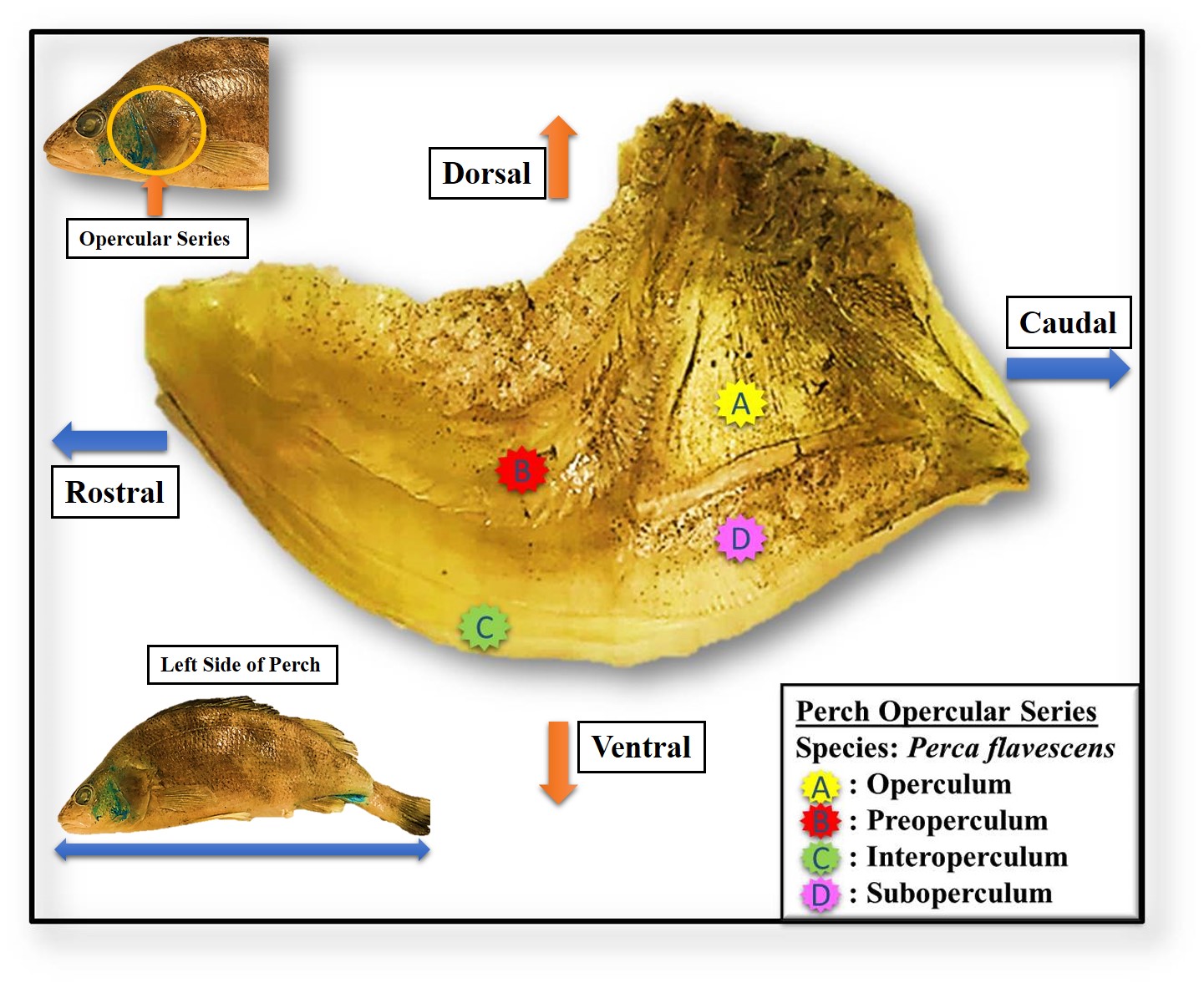
The featured photograph shows a real modern yellow-perch opercular series, not archaeological specimens. The original Harbour Marsh example below is entirely fictional, including its invented measurement equation and sediment counts. Readers can move through the chapter index to distinguish the bones, assess species identification, understand the Guye study and work the numbers with defensible limits.
For original published examples, read the Guye Chinese sea-bass study, the diagnostic opercle prey-fish study and the freshwater fish-bone photographic atlas.


1. Why gill-cover bones deserve their own archaeology lesson
In many bony fishes, the opercular series covers and helps move water over the gills. Its separate bony plates can survive as isolated remains in archaeological fish assemblages. They may help identify a fish taxon even if jaws, scales or vertebrae are missing. However, an opercle is not one complete gill, not one fish and not a universal estimator of body length. Thin margins can break, and the anatomical features needed for precise measurement may disappear long before the bone is identified to a broader category.
Begin by presenting a student with a modern opercular-series photograph and an isolated thin plate from a fictional excavation. Ask what the image directly establishes and what other evidence is needed for a species, size or fishing-history claim. This forces the useful distinction between naming an anatomical element and explaining how it entered a deposit. A convincing archaeological report makes each step visible.
2. Understand the four-part opercular series
The opercular series in a typical teleost includes the opercle or operculum, preopercle, subopercle and interopercle. Their shapes, articulations and degree of overlap vary by taxon. These plates help form the external gill cover and are moved in connection with the jaws and suspensorium. The operculum is not a substitute name for every plate in the series, and the preopercle is not merely a smaller example of the same bone.
The image of yellow perch featured in this guide labels the four elements and their positions. Students should identify the main opercular plate, the curved preopercular region and the adjoining inferior bones. Then remove labels from a second image and ask for the diagnostic traits that support each recognition. A complete compound gill cover offers more anatomical information than a single detached shard.
3. Locate the opercle without confusing it with gill filaments
The thin operculum shelters the gill apparatus, but the soft respiratory filaments and bony gill arches are different anatomical systems. An archaeologist may recover gill-cover bones when actual filaments have decayed, and gill rakers or pharyngeal teeth may survive separately. A piece of gill-cover plate therefore does not prove how many gill arches were present or how the fish fed. The location and the function of the bone must remain separate in the student’s anatomical vocabulary.
Have learners mark the external cover and internal gill structures on two complementary diagrams. They should explain what a fossil plate tells them about the outside of the head and which ecological variables cannot be inferred from that plate alone. This prevents the common mistake of turning a cover-bone count into a count of breathing organs or fish individuals.
4. Recognise the preopercle as a distinct structure
The preopercle often forms a curved bar-like element bordering much of the opercular series. Its angle, rim, ridges and spines may contribute useful diagnostic morphology in some fishes, and measurements may be possible even when the broader opercle is thin and fragmented. Species-specific reference keys must identify which processes or features are meaningful. A fragmentary preopercle without its diagnostic corner may be difficult to distinguish from unrelated curved head bones.
Students compare a complete modern preopercle with a fossil fragment missing the key angle. Their task is to record observed morphology and decide whether the element identification remains secure. An appropriately broad ‘opercular series fragment’ may be the scientific maximum. Naming a specific bone simply because a partial outline looks like one reference image makes later taxon and size estimates fragile.
5. Know the subopercle and interopercle too
Subopercular and interopercular bones may be smaller or more delicate than the main opercle, although their actual shapes vary. They articulate with adjacent elements and can retain useful surfaces. Their survival and recognisability depend on burial conditions and recovery methods. A study that considers only the largest plate may overlook a substantial subset of fish remains, while one that assigns every thin fragment to a named element may inflate the apparent complexity of the assemblage.
Create an identification practice tray with four genuine reference plates and several damaged pieces. Students classify intact bones, securely identified fragments and uncertain remains. They should report how many objects belong to each category without doubling a fragment’s identity under two overlapping labels. This is a direct introduction to archaeological quantification.
6. Use the modern yellow-perch figure responsibly
The featured photograph is an anatomical reference of the opercular series of yellow perch, Perca flavescens, by Liz0618, distributed under Creative Commons Attribution-ShareAlike 4.0. It shows which region is operculum, preoperculum, interoperculum and suboperculum. That image is not a fossil from the fictional archaeological exercises below, nor a universal species identification key. Even accurately labelled modern material can mislead if it is presented as documentary evidence from another site.
Ask learners to rewrite a deliberately false caption calling the perch figure ‘ancient fish gills excavated at Harbour Marsh’. They must preserve the actual species, author, anatomical meaning, source and licence. Figure accuracy is part of the credibility of the scientific explanation, not cosmetic publishing detail.
7. Describe side, surface and orientation
An isolated opercle may be left or right, viewed internally or externally, and its apparent outline changes with orientation. A reflected photograph may hide the articular face or make a caudal projection appear to point the wrong way. Taxonomic keys and size models are often based on one specified view or measurable border, so orientation should be recorded before any comparison is made.
Give students three differently oriented images of one modern bone. They must mark the side, articular region, anterior and posterior margins, and any intact process. For a badly distorted fossil, they can indicate orientation uncertain. This avoids both spurious species names and invalid measurements resulting from treating mirrored objects as different skeletal types.
8. Learn why opercular morphology can identify fish
Opercular bones may contain species-informative outlines, points, ridges and articular surfaces. Archaeological reference collections and osteology atlases document those traits alongside the fish skeletons from which they came. However, morphologies can overlap among related species and alter with growth. Identification should compare all realistic regional alternatives, including juveniles, and should not rely on a single pointed corner or the perceived robustness of one fragment.
Use the University of Nottingham’s Archaeological Fish Resource to compare a herring opercle with larger demersal-fish opercular structures. Ask which traits might be diagnostic and which are shared. A family-level assignment can be more defensible than a species label when the fossil lacks the particular feature needed to separate close relatives.
9. Do not convert a shape match directly into a species name
A photograph is a reference to one specimen, not the full range of within-species variation. The 2024 freshwater fish atlas notes that fish bone identification can be challenging because many taxa resemble one another. This applies to opercular bones as well as vertebrae and jaws. A confident species claim should rest on a defined character combination, a reference spanning growth stages and the exclusion of plausible other taxa.
Ask two students to classify the same fossil against different regionally appropriate collections. If their labels differ, their report should preserve the uncertainty and identify which extra character or comparable specimen could resolve it. The aim is useful reproducible classification rather than forcing consensus by authority.
10. Recognise the high-fragmentation problem
Gill-cover bones can be broad, thin and porous, making some of their edges vulnerable to fracture during fish processing, predation, burial and excavation. Large identifiable fragments may survive while complete measurable outlines rarely do. This produces a striking analytical paradox: a bone can be the most abundant identified category in a site yet be unsuitable for the most convenient body-size regression because its critical end points are absent.
Students should annotate each specimen with a completeness class before calculating an average operculum size. A fragment that preserves one diagnostic thickened process but lacks the posterior tip may remain useful for taxonomy while being unusable for maximum-width measurement. Retaining both judgments avoids treating the material as either all useful or all worthless.
11. Use the Guye site as a concrete lesson
In Yu and Cui’s 2022 Guye study of Late Neolithic Chinese sea bass, the opercle represented 167 of 443 selected sea-bass skeletal specimens, approximately 37.7 percent. The preopercle accounted for 30, around 6.8 percent. Despite the abundance of opercles, their porous nature and fragmentation made them problematic for the chosen osteometric reconstruction. The researchers therefore selected a robust dentary measurement with usable anatomical landmarks for estimating fish standard length.
The correct teaching inference is not ‘opercula are always impossible to measure’. It is that specimen frequency, taxonomic diagnosability and measurement completeness are separate criteria that must all enter the design. Students can repeat the actual 167 / 443 calculation, but should label the underlying Guye category and not call it an estimate of 167 individual fishes.
12. Separate species identity from body-length modelling
Body-size estimation uses a relationship between specified skeletal dimensions and fish lengths measured in a modern comparative sample. Operculum height, width or a distance between defined landmarks may be used, depending on species and reference. A taxonomically identified fragment might lack the exact landmarks needed for a particular model. Conversely, a complete plate of uncertain species does not justify borrowing a species-specific equation simply because the caliper provides an exact number.
Prepare a research matrix with one column for anatomical identity, one for taxonomic certainty, one for measurement completeness and one for model applicability. Students should discover that a valid fish-length estimate requires all four to be considered. A failure in one column is not repaired by increasing numerical precision in another.
13. Understand the 1988 prey-fish bone study
Hansel and colleagues examined opercles, cleithra, dentaries and pharyngeal arches from fish consumed by predators and evaluated their use for prey identification and original fork-length estimation. They studied 24 prey fish species and found some related taxa difficult to distinguish, while sufficient data supported useful relationships for selected species. This demonstrates that opercles can be measurable in suitable contexts and that digestive survival does not automatically eliminate all diagnostic information.
Students should name what the study actually validated: bones from specified prey fish and a particular digestion context. They should not transfer the length coefficients to unrelated fish or interpret every eroded archaeological plate as a fish caught by humans. The important research habit is to match specimen, taxon, process and target length.
14. Learn from southern African freshwater osteometry
Published research on three southern African freshwater species developed bone-to-standard-length predictors, including opercular relationships where suitable specimens survived. In that reference context, some opercular prediction ratios were broadly comparable among sampled taxa, but other skeletal ratios differed even between close relatives. Such findings motivate local validation; they do not justify a universal opercle-length formula for all freshwater fishes.
Invite students to contrast a reference study using a simple proportional predictor with another fitting a regression. They should identify the original reference range, variability and measurement axis. Even if two taxa share similar average ratios, overlap and prediction uncertainty remain important when inferring the size of an individual ancient fish.
15. Record exactly which opercle landmark is measurable
A protocol may specify maximal height, maximal width, articular-to-posterior-tip distance or another anatomical dimension. The named landmarks and viewing orientation are not optional. A fragment from which the posterior margin broke away might still have an intact articular region but cannot be measured for full width under a maximum-width model. Using the surviving fragment length as a substitute silently changes the input variable.
Give students a model with a line drawn between two landmarks and an incomplete opercle lacking one end. They must distinguish the observed preserved dimension from the intended full dimension. A reliable note may read ‘model measurement unavailable; taxonomic characters preserved’. That is a valid and scientifically useful outcome.
16. Apply species-specific modern references
Modern calibration should include a documented number of fish of known standard, fork or total length, their size distribution and the identical bone measurement used in the fossil. A relationship fitted only to juveniles may extrapolate poorly to large adults. A target species with unusual head-body proportions may differ from a closely related fish, and geographic populations can add variance. Allometry is biological, not merely a convenient equation typed into a spreadsheet.
Students design a toy modern sampling programme covering small, intermediate and large fishes of one species. They should specify the target length definition, measurement repeatability, statistical model and a plan to report prediction error. A single highly correlated data cloud does not guarantee accurate predictions at its extreme edge.
17. Use a fictional Harbour Marsh size formula
For arithmetic teaching, imagine an invented species whose complete opercle-height measurement relates to estimated standard length through the made-up rule: length in centimetres equals 5 plus 7 times opercle height in millimetres. A fictional height of 4.0 mm produces 33 cm; 5.5 mm produces 43.5 cm. The coefficients were invented for this exercise and do not describe yellow perch, Chinese sea bass or any real fish. Their only purpose is to practise units and model conditions.
Students should separate the directly measured input from the conditional numerical output. An ancient opercle that lacks the upper edge cannot be treated as a 4.0 mm complete bone just because the remaining fragment measures that amount. A mathematically correct calculation on an anatomically invalid input is not a scientific fish-length estimate.
18. Quantify the effect of missing margins
Suppose two readers measure a damaged opercle as 4.0 and 4.4 mm by choosing different surrogate endpoints. Under the invented toy rule, the corresponding lengths would be 33 and 35.8 cm, a 2.8 cm difference. This sensitivity exercise illustrates why ambiguous landmarks can dominate the apparent precision of a regression. Real model error and biological variation would add further uncertainty.
Ask learners to annotate the exact points selected by both observers. If the reference requires an intact edge that no longer survives, the correct response may be to withhold the length estimate rather than average their surrogate measurements. Precision must be tied to a valid anatomical definition.
Harbour Marsh: fictional complete-opercle height model
| Toy intact opercle height | Invented standard-length rule | Fictional predicted length |
|---|---|---|
| 4.0 mm | 5 + 7 × 4.0 | 33 cm |
| 5.5 mm | 5 + 7 × 5.5 | 43.5 cm |
| Missing upper edge | Same input unavailable | Prediction withheld |
19. Build an original fictional archaeological count table
Imagine two Harbour Marsh excavation units processed under one standardised recovery rule. Unit Lower contains 84 securely identified opercular-series fragments from 2.1 kg of dry sediment. Unit Upper contains 99 from 5.5 kg. Their observed rates are 40 and 18 fragments per kilogram respectively. Upper has more raw objects but a much lower fraction per processed sediment mass. These numbers are invented and are not the Guye study or a real archaeological dataset.
Students should calculate 84 / 2.1 and 99 / 5.5, label numerator and denominator, and explain why neither describes individual fish, meals or annual catches. One fish has paired opercular series with several bones, and each plate may fragment into several objects. Keeping the count unit visible prevents a large historical error disguised as a small arithmetic convenience.
20. Distinguish NISP, MNI and fragmentation
NISP describes the number of identified specimens under a stated counting rule. MNI attempts to constrain the minimum number of original animals, often using repeated anatomical side and taxonomic features in a defined context. Since a fish has left and right opercula, multiple fragments may derive from one original element. If refitting or sidedness is unavailable, it is often impossible to derive a precise MNI from the fragment tally alone.
Give students five matching right opercles of a secure taxon within a closed context and, separately, twenty unassigned bone shards. The first set may constrain a minimum if identification and independence are sound; the second is not twenty individual fish. This classroom contrast makes anatomical repetition and context part of quantitative archaeology.
Harbour Marsh: original recovery example
| Invented unit | Classified opercular-series fragments | Dry sediment | Objects per kilogram |
|---|---|---|---|
| Lower | 84 | 2.1 kg | 40 |
| Upper | 99 | 5.5 kg | 18 |
21. Assess sediment screening and detection bias
Thin plates can break into small fragments that pass through coarse sieves, while large robust species remain more detectable. Hand excavation, wet sieving and sorting duration all influence observed taxon distributions. A site processed with 1.5 mm mesh cannot be compared uncritically with one using only conspicuous hand-collected bone, even if both produced a list of opercles.
Have learners compare a fine-screened sample containing many small fragments against a coarse-screened sample dominated by larger fish. They should propose a harmonised recovery design or state which comparisons remain unsupported. Recovery methods may create an apparent historical change in fish size without any biological change in the original fishery.
22. Preservation and chemical damage complicate taxon counts
Opercular bones can be burned, digested, abraded, dissolved or trampled after the fish dies. Porous interiors and thin edges may survive differently from robust processes. A fragment may remain taxonomically diagnosable while losing most measurable dimensions, producing bias in any size distribution restricted to intact elements. Reports should separate identified total, intact measurable subset and unidentifiable remainder.
An exercise asks students to compute the proportion of intact measurable opercles in two layers. If it falls, that may reflect a taphonomic or preparation change rather than a shift to smaller fish. The next step is to assess damage and site formation before interpreting a population trend.
23. Do not assign every gill-cover bone to human food waste
Fish can die naturally, be consumed by predators, be transported by rivers, or be brought to settlements as fresh, dried or smoked products. Gill-cover bones may be discarded during processing, but their presence alone does not prove a particular meal. Burning near a hearth may occur after deposition rather than in cooking. A fish plate in a dry ditch can also arrive during occasional flooding.
Students construct three plausible histories for an opercle fragment from a settlement drain: food processing, a bird or other predator’s prey remains, and upstream sediment transport. They then choose independent observations—associated cut marks, assemblage anatomy, flood lamination or matching historical trade materials—that could discriminate the stories.
24. Trace imported fish to the final disposal context
A marine fish opercle recovered inland may reflect fish trade rather than an ancient shoreline. The fish’s biological range, capture site, processing location, market movement and burial place can differ by substantial distances. Even an accurately identified species does not place that fish in the local waterbody. This distinction becomes important when reconstructing regional diets and economies.
Draw a timeline of an imagined fish caught at sea, dried on a coast, transported to an inland town and eventually thrown into a drainage pit. Ask which archaeological observations constrain each step. Students should avoid inferring geography directly from the last position of a skeletal element.
25. Use chronological limits before discussing fishing technology
An opercular series does not directly date itself. The associated archaeological layer, datable features and chronology supply the temporal framework, and transported bones may be older than their final burial. A shift in species or size composition across sampled layers must be compared at resolutions justified by the site chronology. An artefact-rich deposit may span decades or centuries rather than one fishery season.
Give students two apparent opercle peaks with broad and overlapping dates. They should state what changed in the counted assemblage without assigning one precise fishing reform or historical event. If a causal claim is proposed, it needs independent dated fishing gear or other archaeological evidence.
26. Compare opercula with other diagnostic bones
Dentaries, cleithra, pharyngeal bones, otoliths and vertebrae may provide complementary evidence because they differ in taxonomic diagnostic value, mechanical strength, depositional pathways and size-model suitability. A record containing many incomplete opercles and fewer intact dentaries can be more useful for species presence than for opercle-based size reconstruction. Combining methods is strongest when each is used for the question it can answer rather than treating every bone as equally informative.
Ask students to design a research table with columns for taxonomic confidence, body-size model, completeness, source context and recovery bias. Their goal is to identify which element actually reduces the most consequential uncertainty in the archaeological question. Better inference does not require every available bone to yield a number.
27. Respect specimen stewardship and collection permissions
Archaeological fish remains may be fragile, unique or culturally protected. Preparing destructive sections, chemical cleaning or molecular sampling should follow appropriate permissions and specialist procedures. Most foundational teaching tasks can be completed using genuine licensed photographs, carefully curated modern comparative bones and synthetic data. An irreversible test that cannot improve the identification or historical claim may be unjustified.
Students should write a specimen care plan listing context, imaging, scale, condition, existing consolidants, requested analysis, expected information gain and retained material. The goal is evidence that survives peer review while preserving future possibilities for reanalysis.
28. Write a conclusion that can survive a methods audit
For the fictional Harbour Marsh data, the direct observation is that Lower yielded 40 identified opercular-series fragments per kilogram and Upper 18 under the invented protocol. A toy complete opercle may generate an arithmetic length prediction when all assumptions are satisfied. Neither finding establishes the number of original fish, exact catches or one historical fishing technique. Fragmentation, taxonomy, sediment deposition and chronology remain independent questions.
A publishable report states what was measured, how the specimens were classified, which reference models apply and which formation histories remain possible. It asks for the most discriminating next evidence rather than filling an uncertain story with confident prose. That is the gold standard of teaching gill-cover bone analysis.
Twenty-two applied archaeology and anatomy audits
The following scenarios are invented for teaching. Their conclusions require the evidence specified in each case; none represents a new excavation or a real ancient fishing event.
1. The four bones called one operculum
A complete opercular series is catalogued as one indistinguishable plate. Students identify its component opercle, preopercle, interopercle and subopercle and explain why skeletal categories are important for taxonomic comparison.
2. A modern yellow-perch image passed off as a fossil
The real Liz0618 anatomical image is incorrectly captioned as excavated fish remains. Learners correct species, date, attribution and purpose, separating genuine modern reference material from fictional archaeological counts.
3. The Guye abundance trap
A student equates the Guye site’s 167 opercles with 167 individual sea bass. Reviewers explain NISP, left-right paired anatomy and broken elements, and recalculate 167 / 443 as 37.7% of its selected skeletal count rather than fish population.
4. The preopercle measured like an opercle
An analyst takes maximum dimensions from a curved preopercle and enters them into a regression defined for opercle height. Students identify the incompatible bone category and refuse to publish the resulting length.
5. The missing posterior tip
A fossil retains a diagnostic articulation but lacks the distal endpoint of a size measurement. Learners record the taxon possibility and withhold the size prediction, despite the fragment being clearly fish.
6. An overly accurate classification
A partial opercle resembles two related species but lacks the discriminating ridge. Students identify both alternatives and report a broader taxon without a confident single-species label.
7. A left opercle compared with a mirrored right
Two photographs appear to show different forms but one is mirrored. The class checks side and orientation before recording taxonomic diversity.
8. A length metric mix-up
A study predicts standard length while a second source reports fork length. Students identify the anatomical length landmarks and explain why their numbers cannot be treated as the same target.
9. An invented equation as a scientific fact
A toy opercle height of 4 mm is entered into the invented rule 5 + 7 × height to obtain 33 cm. Students must label the result as arithmetic practice, not a measured fish length or real species regression.
10. The disputed endpoint
Two readers choose 4.0 and 4.4 mm on a broken opercle and the toy predictions differ. Learners discuss landmark validity and why the best answer may be to withhold a model estimate.
11. The two-kilogram recovery reversal
Fictional Lower holds 84 fragments from 2.1 kg; Upper holds 99 from 5.5 kg. Students calculate 40 versus 18 fragments per kg and distinguish sample normalisation from fish population.
12. The coarse sieve illusion
Large opercles are recovered from a coarse-screened site and small ones from a fine-screened site. The apparent fishing preference may reflect methods. Learners propose compatible recovery or limit the comparison.
13. Predator versus household refuse
One opercle appears in a pellet-like concentration rather than a sealed hearth deposit. Students consider digestion, prey selection and alternative source histories instead of assuming household processing.
14. A burned plate with no cooking evidence
The fish bone is blackened in a disturbed ditch. Students separate cooking, secondary refuse burning and natural fire, then propose context-based tests for each explanation.
15. The inland marine opercle
A herring opercle occurs at an inland settlement. Learners consider dried-fish trade and movement of animal products without inventing a marine local ecology.
16. A porous element selectively fragmented
An opercle survives in many diagnostic shards but only a few intact specimens. Students evaluate whether a size reconstruction based on intact plates could be biased toward particular fish or burial conditions.
17. The southern African equation
A body-size relation from one African freshwater fish is applied to a very different taxon. Learners identify taxonomic and shape transfer errors even if the reference correlations are high.
18. The duplicated right-side bone
Several right opercles from one secure taxon and context may support a minimum individual count. Students compare that information with a much larger set of unsided fragments that cannot simply be called separate animals.
19. Silt dilution as an alternative
Increased mineral sediment enters a lake and reduces fish fragments per gram, even if the supply of bones remains comparable. Learners distinguish concentration from biological source abundance.
20. The false precise fishery year
A fish-bone concentration shift spans an interval with uncertain dates. Students remove an invented exact-year fishing story and state the interval actually supported by the chronology.
21. A protected fragile thin plate
A curator is asked to destroy the only intact opercle to test an unrelated chemical method. The class evaluates consent, question-specific information gain and non-destructive alternatives.
22. The final identification-to-history audit
A draft claims one opercle proves a named species, a large fish, a local catch and a meal at a specific date. Students place each claim on an evidence ladder and retain only those with identifiable anatomy, valid measurement and site context.
Three-session course pathway
- Session 1: identify operculum, preopercle, subopercle and interopercle in labelled modern fish and genuine reference bones; record side, surface and key diagnostic characters.
- Session 2: compare bone identification with body-size measurability, examine Guye’s actual fragment frequencies and calculate the separate fictional Harbour Marsh equations and denominators.
- Session 3: reconstruct alternate taphonomic histories, investigate predator and human refuse contexts, evaluate chronology, research ethics and cross-proxy fish evidence.
- Student submission: annotated specimen images, preserved-landmark record, count and sediment-mass table, an explicit size-model applicability audit and a concise evidence-limited interpretation.
Scientific assessment rubric
| Criterion | Complete and defensible response | Unsupported shortcut |
|---|---|---|
| Anatomy | Bone type, side, view, diagnostic features and completeness recorded | All four gill-cover plates called one opercle |
| Taxonomy | Comparative species reference and identification uncertainty | One pointed fragment named as species |
| Body-length estimate | Species model, full matching measurement and prediction limits | Broken bone height substituted for complete opercle |
| Abundance | NISP and MNI distinguished; sediment and recovery denominators provided | One fragment treated as a fish |
| Human history | Fish processing, natural death, predation and trade considered | Any opercle in a ditch declared one meal |
| Transparency | Reference images, site context, equations, source permissions and uncertainties retained | Only a finished graph with unsupported exact dates shared |
Frequently asked questions
What is the fish operculum?
A major plate of the gill cover in many bony fishes, part of a series of connected bones around the gills.
Are opercle and preopercle the same bone?
No. They are different elements of the opercular series with their own positions and diagnostic morphology.
What other bones belong to the opercular series?
In many teleosts the opercle, preopercle, subopercle and interopercle are recognised as four related elements.
Can an opercle identify an ancient fish species?
Sometimes; diagnostic characters and suitable reference comparisons are required, and fragments may support only a broader taxon.
Can opercle size predict fish body length?
Under a validated species-specific model with the defined intact landmarks and length convention, sometimes. Not all archaeological specimens are measurable.
Why were opercles abundant but problematic at Guye?
Their diagnostic forms were commonly identified, but their relatively porous plates were heavily fragmented, hindering the desired size measurements.
Does one operculum fragment represent one caught fish?
No. Gill covers are paired, have several components, and can break into multiple fragments.
Could a marine opercle occur far inland?
Yes. Fish processing, trade and redeposition can transport bones far from a fish’s living habitat.
Is the featured yellow-perch photograph from an ancient site?
No. It is a modern labelled anatomical reference by Liz0618, used to explain the four-bone series.
Are Harbour Marsh counts and body-length predictions real?
No. Harbour Marsh and its mathematical examples are fictional teaching datasets, not archaeological or calibrated biological findings.
Published scientific sources and connected eduKate Gold Standard chapters
- Yu and Cui (2022), Chinese sea bass osteology and fishing at Late Neolithic Guye
- Hansel et al. (1988), diagnostic opercles and fish length reconstruction after predation
- Southern African freshwater fish bone-to-length osteometry, including operculum
- Davis et al. (2024), European freshwater and migratory fish bone atlas
- Fisheries measurements of opercles and other bones from eleven Eurasian cyprinid species
- Archaeological Fish Resource: comparative opercular photographs
- University of Nottingham’s herring opercular bone reference
- Leach et al., New Zealand red cod cranial bones and size reconstruction, Te Papa
- Liz0618 (2017), yellow perch opercular-series reference image and CC BY-SA 4.0
- Teaching Archaeological Fish Cleithrum Analysis
- Teaching Archaeological Fish Vertebra Analysis
- Teaching Archaeological Pharyngeal Tooth Analysis
- Teaching Archaeological Otolith Analysis
- Teaching Zooarchaeology
- Gold Standard master hub
The gold standard of teaching archaeological operculum analysis is a student who can identify the right gill-cover element, distinguish diagnostic fragments from complete measurable plates, calculate honest assemblage summaries and state which environmental or human-history claims still require independent archaeology. An observation that survives peer review is more valuable than a spectacular explanation built on missing bone margins.
Expert lab: the broken margin
A thin operculum can preserve species-informative ridges after the border needed for a length measure has broken away. Students should record this difference on a formal condition sheet and explain why loss of one inferential use does not remove all value of the fossil.
Expert lab: comparative orientation
A medial and lateral photograph of one opercle can appear different. Learners label consistent landmarks and identify which view the reference model requires, resisting the temptation to treat the two photographs as separate taxa.
Expert lab: predator damage
A partly digested opercle may have lost its thin rim but retained an articular zone. Students distinguish predator modification from later sediment abrasion using appropriate comparative studies and site context.
Expert lab: precision of a model
A numerical regression returns one decimal place, but its reference sample is small and the archaeological landmark ambiguous. Students report the measured bone and withhold or qualify the prediction as necessary rather than letting display precision dictate confidence.
Expert lab: a secure context and uncertain date
An opercle is identified confidently within mixed refuse. The fish taxon may be supported but timing and depositional source remain uncertain. Students separate these confidence levels and propose independent chronological evidence.