
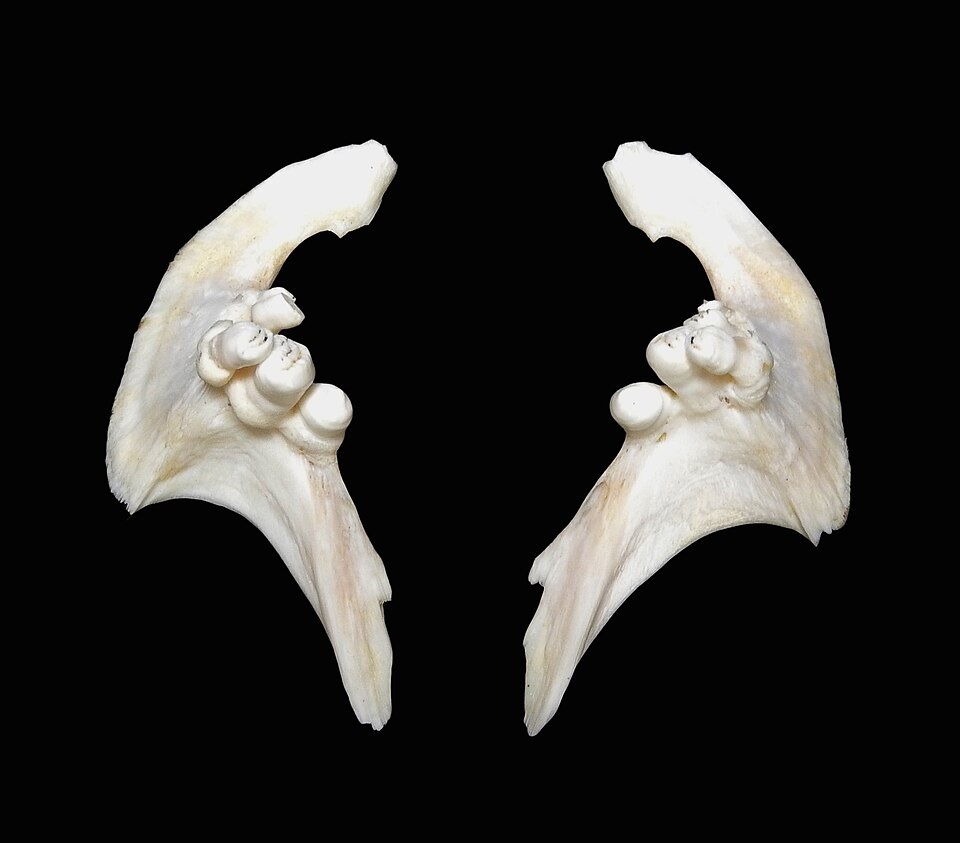
Cyprinid fishes such as common carp use specialised pharyngeal teeth to process food within the throat. These teeth may remain identifiable in archaeological sediment long after most soft tissues disappear. They can contribute to fish taxonomy and research on fishing, material selection and ancient freshwater habitats, but a single tooth is not one fish, a direct dietary record or a cultural activity. Sound interpretation begins with the tooth’s location, functional or replacement state, morphology and depositional context.
This teaching guide links freshwater-fish anatomy, dental formulae, tooth replacement and wear to published archaeology from Neolithic China and the Mesolithic Danube, then tests the distinctions through fictional Reedbank numbers. The featured image shows genuine paired common-carp pharyngeal bones photographed at Charles University. It is modern anatomical reference material and is not presented as a photograph from any archaeological site.
Begin with the evolutionary review of cypriniform dentition, the Tianluoshan freshwater-fishing study and the Vlasac ornament-use research.


1. Find the tooth before reconstructing the meal
Pharyngeal teeth are specialised feeding structures farther back in the throat of many fishes. In cyprinids such as carp, they develop on paired lower pharyngeal bones and process food without oral jaw teeth. Their hard crowns may survive archaeological sediments and help identify past freshwater fishes. However, an isolated tooth does not establish one fish, its last meal or a human food-processing event. The immediate question should be anatomical: is the object a pharyngeal tooth, where did it sit, and what diagnostic evidence survives?
Set three claims side by side: a tooth-like fossil has a cyprinid-type grinding crown; a common carp contributed material to the deposit; a particular household caught and ate carp. Each step requires additional taxonomic, taphonomic or cultural evidence. Learners should label direct observations separately from explanations and resist inventing a full fishing history from one attractive close-up photograph.
2. Locate the paired pharyngeal bones
Cypriniform fishes have modified fifth ceratobranchial elements that can bear teeth in their pharyngeal region. The paired bones curve around part of the throat and meet a specialised opposing surface for processing food. The article’s photographed common carp specimen shows these real tooth-bearing bones from a Charles University zoological collection. Its left and right sides demonstrate anatomy, not the composition of any invented archaeological assemblage. Other fish groups may also have throat teeth but differ in their skeletal organisation.
Students should map oral jaws, lower pharyngeal bones and the feeding pathway on an anatomical diagram, then identify the actual photographed tooth-bearing elements. The exercise prevents a mislabelled ‘fish jaw tooth’ from becoming a mistaken comparison with mammalian or predatory-fish oral teeth.
3. Distinguish attached teeth from isolated crowns
An intact bone retains information on tooth-row order, anatomical side and crown position. An isolated crown may preserve useful shape yet lack the very context required to reconstruct a dental formula. Roots, attachment surfaces, wear, developmental state and damage need separate notes. A crown whose tip remains intact but whose base is missing might support a broad morphotype without confirming its original row. Identification is therefore a combination of crown morphology and skeletal association.
Give learners paired reference images: one complete tooth-bearing pharyngeal bone and another bag of loose teeth. Ask which anatomical claims are possible only in the first record. A correct ‘position unknown’ entry is a defensible scientific conclusion, whereas adding an assumed row simply to complete a tidy table is not.
4. Teach the dental formula with its convention
Cyprinid dental formulae describe counts of functional teeth in specified rows on the two pharyngeal sides. One published example, 1,5–5,1, means a minor row of one and a major row of five on each side under that notation. It is not the formula of all carp, and row order conventions must be checked when comparing taxonomic literature. A goldfish may use 4/4 in a particular description, while common carp and other cypriniform lineages show other row arrangements.
Have learners create a labelled diagram with side, major and minor rows, and eligible functional teeth. They must write the rule below the formula, not simply copy a sequence of numbers. This helps when research reports use different row-order conventions and when a fragmented specimen preserves only one side.
5. Recognise continuous tooth replacement
Functional teeth are replaced during fish life. Developing replacements may be present near attached erupted teeth, and shed or unattached teeth can enter sediment as separate objects. Common research conventions describe dental formulae using functional attached teeth rather than every replacement visible within a preparation. A count of all tooth-like parts in a disarticulated sample can therefore overstate the number of original functional positions or fish.
A teaching tray contains five attached crowns, two developing replacements and three loose teeth. Students must record ten observed tooth-like objects without pretending the functional dental formula has ten teeth. They should explain which replacement states remain diagnosable and what would be needed to attribute the loose elements to a particular animal.
6. Describe the feeding surface and the opposing pad
Grinding and crushing tooth forms act against a specialised opposing pharyngeal surface. Their function depends on bite mechanics, musculature, food material and tooth location, rather than on the crown shape alone. Common carp can have broad molar-like pharyngeal teeth; other cyprinids may possess compressed, pointed or spoon-shaped forms. These morphological contrasts can help generate feeding hypotheses, but they do not identify one exact food plant, shellfish prey or manufactured object.
Students should describe crown width, curvature, occlusal face and ridges before naming a dietary mechanism. The experimental next question might involve wear under known food types rather than simply assigning the ‘shell-crusher’ label from one polished surface. Functional morphology supplies constraints, not a last-meal record.
7. Distinguish morphology from a feeding history
Tooth form contains evolutionary and taxonomic information as well as functional adaptation. The 2010 review of cypriniform pharyngeal dentition documented a variety of conical, compressed, spoon and molar-like forms across lineages. Similar broad forms may occur outside a single narrow taxonomic group. Therefore, morphological resemblance cannot independently establish evolutionary identity or ecological equivalence, even when it suggests a plausible feeding mode.
Give three teeth similar in outline but differing in attachment and row patterns. Students rank the value of shape alone, whole pharyngeal anatomy and genetic or molecular context for identification. The goal is to learn which evidence a fossil actually retains rather than to choose the story that best fits the shape.
8. Separate biological wear from sediment abrasion
A tooth may bear traces of food processing during life, replacement-related wear, post-mortem breakage and sediment abrasion. A flat, bright or ridged surface can result from different processes. Microscopic polish after water transport must not be called an ancient dietary facet without controls. Equally, damage produced during excavation or laboratory handling can imitate older wear. An interpretation should consider mark orientation, microtopography, context and relevant experiments.
Students compare reference micrographs from controlled feeding and from tumbled or abraded specimens where these are documented. They produce an observation table that lists marks first and possible causes second. The strongest account distinguishes what is seen from what may have happened and names a test that could separate the alternatives.
9. Record asymmetry and missing teeth honestly
Paired pharyngeal arches may differ in tooth condition or shape because of development, replacement, injury and preservation. Work on Chrosomus dentition has discussed asymmetry and developmental instability. A missing crown in a historical specimen does not necessarily indicate a taxon with a naturally reduced tooth row, especially if one tooth is being replaced or was lost after deposition.
Ask learners to score a hypothetical left-right pair with one apparent gap. They must consider attached functional teeth, visible replacements, damaged sockets, unidentifiable fragments and true asymmetry before reconstructing a complete dental formula. A reversible classification with supporting images is more valuable than an unsupported permanent species label.
10. Use appropriate microscopic and 3D imaging
Light microscopy can reveal crown ridges, root features and surface wear. Micro-computed tomography or other suitable imaging may expose teeth still developing within bone or clarify three-dimensional morphology without dismantling a reference specimen. Yet resolution and segmentation choices affect what can be seen, and no imaging technique guarantees a diagnosis beyond the available reference taxonomy. Material conservation, cost and the question being asked determine whether extra scanning is worthwhile.
Write a method-selection table for one whole jaw and a fragile isolated crown. Students should say what each instrument adds, where uncertainty remains and whether a non-destructive photograph already answers the research question. Technological sophistication is not a substitute for biological and archaeological provenance.
11. Use tooth position when estimating fish size
The dimensions of a tooth can be informative for fish size when a research team has measured corresponding tooth positions in reference fish of known body length. But different pharyngeal positions can vary greatly in crown dimensions within the same individual. An isolated crown with unknown row and side should not enter a regression calibrated for one specific position. Tooth wear or incomplete preservation can also distort the measured width, making an otherwise precise caliper value an unsuitable predictor.
Ask students to record tooth width and anatomical certainty in different fields. If the position is unknown, preserve the measurement while withholding a fish-length conversion. This is an example of good research restraint, not wasted data.
12. Read the 2022 seven-species morphology study critically
Jawad and colleagues compared pharyngeal bones and tooth rows among seven cyprinid species sampled in Iraq’s Kurdistan region. Their measurements and dental formulae illustrate how species-related variation can support taxonomy when whole anatomical context is available. However, the ranges of bone shapes and the limited number of sampled taxa constrain how far that identification resource can travel into other river basins or older fossil species.
A student should describe precisely which reference taxon, shape ratio and bone view is being compared. A crown recovered from a distant archaeological site should not automatically be identified by the nearest measurement in one regional table. The correct procedure records alternative taxa and the actual scope of the reference.
13. Consider archaeological sampling and recovery
Small pharyngeal teeth may be recovered through fine sieving, sediment washing and deliberate laboratory sorting, while coarser excavation preferentially retrieves larger robust fish elements. Samples with different processed volumes or sieve sizes may produce different counts even if original deposits were similar. Tooth composition can also be affected by dissolution, predator digestion and post-depositional transport. Comparing raw counts without recording preparation is an avoidable scientific error.
Imagine two excavation teams, one processing measured small fractions and one hand-collecting visible bones. Before claiming that historical fish use changed, students should request sediment mass, fraction, sorting intensity and the proportion of unidentified teeth. The original recovery decision is part of the evidence.
14. Understand Neolithic Tianluoshan without over-transfer
The archaeological study of crucian and common carp pharyngeal teeth at the Neolithic Tianluoshan site in Zhejiang, China, investigated freshwater fish remains and related size estimates to historical subsistence and wetland environments. The body-length interpretations were derived from specific comparative evidence rather than from a universally applicable tooth-width constant. This is a strong example of archaeological use of pharyngeal material under appropriate context.
Students distinguish securely observed tooth morphology, measured dimensions, calibrated length predictions and wider interpretations about fishing in a rice-cultivation landscape. They should not treat a reconstructed fish length as direct proof of one net or bait technology without independent material evidence.
15. Distinguish deep-time fossils from human fishing
Pharyngeal teeth also preserve exceptionally well in geological freshwater deposits predating people. Fossils from Japan’s Plio-Pleistocene and older South Chinese strata help investigate fish diversity and evolution, but their presence is not a human-use record. A tooth from a lake sediment has a biological history; whether it also contributes to archaeology depends on securely demonstrated human association.
Students compare a four-million-year-old fossil from a palaeolake and a cyprinid tooth from a documented Neolithic site. They should explain why similar anatomical classification can serve completely different historical questions. A sediment date and site-formation evidence determine which account is warranted.
16. Learn from the Capoeta isolated-tooth study
A 2019 PLOS ONE study of Pliocene Capoeta-related cyprinids in the Armenian Highland examined 247 isolated fossil pharyngeal teeth. Researchers used a defined set of shape characters and modern comparative samples to investigate long-term freshwater diversity and palaeogeography. The work shows how isolated teeth can be information-rich when measured carefully, but also why complex taxonomic reconstruction depends on reference quality and uncertainty.
Assign learners a research-reading task separating tooth shape observations, provisional species assignments and wider species-flock hypotheses. The archaeological lesson is methodological: a sophisticated ancient-lake analysis should not be accidentally described as proof of human fishing millions of years before the relevant human site.
17. Use tooth position and side to approach MNI
Many detached crowns from one taxon cannot be divided mechanically by a guessed number of teeth per fish. Counts depend on functional positions, replacement and fragmentation. Where a specific tooth position and side can be identified reliably, duplicate occurrences can sometimes supply a conservative minimum-individual constraint. A matched supporting bone can add information, but the sample’s archaeological context and possible refitting matter.
Have learners compare a bag of fifty generic crowns against a subset of matching right-side position-four teeth. The second subset can be more useful for a minimum count, but only after verification that the taxon and position determination are sound. The first is a specimen tally, not an animal tally.
18. Apply the 2017 Schela Cladovei example correctly
A 2017 Iron Gates ornament study reported 324 cyprinid pharyngeal teeth associated with Burial M38 at Schela Cladovei, of which 322 were analysed. Tooth-position and sidedness analysis supported a reported minimum of 66 fish; the researchers also investigated selection and modification of particular tooth positions for ornament use. This demonstrates why hundreds of ornaments need not correspond to hundreds of independent fish, and why diagnostic position can inform a conservative minimum.
Students should distinguish 324 recovered objects, 322 objects analysed and 66 inferred individuals under a particular study method. None of these values is a fish-catch-per-year rate or a count of meals. The burial context deserves appropriate cultural and custodial respect, and the study should not be reduced to a sensational tally.
19. Recognise the Vlasac ornament record
Cristiani, Živaljević and Borić studied 288 cyprinid pharyngeal-tooth appliqués from a Late Mesolithic burial at Vlasac in the Danube Gorges. The study assessed archaeological preservation, experimental comparative objects, microscopic traces and residues associated with how these items may have been suspended or attached. Its central lesson is that fish teeth can become intentionally selected and modified materials, not merely the undifferentiated waste of eating fish.
Tooth objects from burials should be discussed without inventing the wishes, status or private identity of the deceased. Students can evaluate wear or selection methods from cited publications and replicas rather than requiring access to human burial material. Proper archaeological interpretation joins technical evidence with ethical stewardship.
20. Separate suspension wear from feeding wear
Human handling and suspension may add polish, striations, perforations or residue patterns to teeth after their original biological use. Feeding produces its own wear, and sediment movement can produce a third set. A tooth with multiple histories should not be assigned one universal explanation from one surface mark. Experiments, location of wear and independent archaeological association help distinguish possibilities.
A classroom task uses photographs or approved replicas with recorded polishing, abrasion and contact with cord. Students identify which marks could support an attachment hypothesis and which could equally result from burial. They should name a discriminating control and keep ambiguous traces in their report rather than silently rewriting them as certain ancient technology.
21. Keep ornaments and food refuse as separate assemblages
Teeth selected as ornaments can have different positions, sizes, shapes and wear from those recovered incidentally within ordinary fish processing waste. Comparing their raw frequencies as if both samples were random catch records may generate false historical conclusions. Selection for visual effect, technical strength and perforation suitability can change which teeth appear in burial and craft assemblages. A larger tooth in an ornament set does not establish a larger average fishery catch.
Ask students to compare fictional ornament and midden tables. They should identify the different sampling and selection mechanisms and propose a comparison of source fish only after accounting for tooth position and deliberate human choice. Cultural material reuse can transform biological objects into a strongly biased archaeological sample.
22. Work the invented Reedbank sediment calculation
Consider two wholly fictional sediment units in a Reedbank Midden teaching exercise. Unit A yields 25 securely classifiable pharyngeal tooth elements from 1.25 kg of processed dry sediment. Unit B yields 30 from 3.0 kg. Under one imagined recovery protocol, the rates are 20 elements per kg in A and 10 per kg in B. Unit B has more raw teeth, but a lower concentration after sediment mass is considered.
This descriptive reversal does not mean Unit A’s residents caught twice as many fish. Replacement teeth, multiple crowns per individual, different depositional durations, recovery and cultural use all intervene. Students should preserve the numerator, denominator and possible taphonomic causes rather than translate a mathematically correct ratio directly into a fishing-intensity estimate.
23. Build an explicit toy tooth-width size model
A second fictional teaching problem uses an invented relation for one hypothetical fish and one specified tooth position: body total length in centimetres equals 12 plus four times the measured tooth-crown width in millimetres. A hypothetical 3.0 mm crown gives 24 cm; a 4.5 mm crown gives 30 cm. This is a made-up equation for dimensional arithmetic, not a scientifically established common-carp calibration.
Students should mark the original measurement and the model’s output in separate columns. If the tooth is worn, broken or unplaced, the equation’s input assumptions are not satisfied and the prediction must be withheld. A real model would need modern known-length fish, appropriate tooth positions, sample-size reporting, prediction error and validation in the relevant range.
Actual published research versus fictional teaching counts
| Context | Observed material | Permitted interpretation |
|---|---|---|
| Schela Cladovei, published study | 324 teeth recovered; 322 analysed; MNI 66 | Context-specific tooth-position analysis, not annual fish catch |
| Vlasac, published study | 288 cyprinid pharyngeal tooth appliqués | Ornament evidence requiring wear and cultural context |
| Reedbank, fictional | 25 teeth from 1.25 kg versus 30 from 3 kg | 20 versus 10 observed tooth objects per kg |
24. Learn how a small sampling error can mislead a diet story
Imagine a third fictional Reedbank category containing small pointed teeth, broad grinding teeth and unclassifiable damaged pieces. The broad crowns are much more robust, so they are recovered at a higher rate in the coarse fraction. If the analyst drops the indeterminate fraction and plots only identifiable crowns, the community may appear to have been dominated by crushing-toothed fish. This can be a preservation or measurement artefact rather than a genuine ecological preference.
Students should compare strict classification and a sensitivity table that includes unidentified fragments, noting which competing explanations remain possible. A well-documented denominator cannot remove selective preservation by itself, but it makes the limitation visible.
Reedbank’s invented tooth-width exercise
| Toy tooth width | Invented rule | Synthetic fish total-length prediction |
|---|---|---|
| 3.0 mm | 12 + 4 × 3.0 | 24 cm |
| 4.5 mm | 12 + 4 × 4.5 | 30 cm |
| Position missing | No validated input | Prediction withheld |
25. Do not transform fish body size into fish age
Pharyngeal crown size may be correlated with body size within a suitable reference series, but body size is not the same as biological age. Growth rate, feeding history, species differences and tooth replacement complicate the relationship. An archaeologist cannot identify a ten-year-old fish merely because the crown is large. Separate age evidence may come from otolith or other appropriately validated structures, and even those can have their own preservation limits.
Ask learners to compare one large-toothed fish with a smaller-toothed fish and provide plausible growth histories for both. They should understand why a comparative length model gives a size estimate, not a known birthday or harvest season. This connects the topic to the separate GS7 otolith and fin-spine guides without duplicating their teaching questions.
26. Protect evidence and cultural permissions
Archaeological teeth from ordinary fish refuse and those associated with people or protected heritage deposits can require different stewardship. Destructive sampling, chemical cleaning or high-energy imaging should be justified by a research question and authorized by the relevant custodians. Removing a residue or polishing a crown may irreversibly erase the very trace needed to interpret manufacturing. Good science treats future research potential as a real cost.
Students prepare a sample decision sheet with provenance, permissions, initial imaging, handling, retention and proposed analytic gain. The strongest plan may use non-destructive observation and published comparative collections rather than sacrifice rare material for a question unlikely to be answered.
27. Conclude with a layered evidence statement
A scientific report should give the direct anatomy, functional or replacement state, tooth-position confidence, measurements, wear observations, deposition context, raw counts and the interpretation method. It should distinguish specimen count from minimum individuals and distinguish an attached ornament from a fish-processing remnant. The Reedbank example supports only its invented per-kilogram contrast, not a quantified historic catch or a carp dietary reconstruction.
The gold standard is a conclusion that another scholar can retrace: here is the tooth, here is the anatomical reference, here is the denominator, and here are the plausible alternative sources. If the strongest justified claim is a broad cyprinid tooth group or a possible ornament-related use trace, that is a valid contribution to archaeology.
Twenty-four specialised case and peer-review exercises
These are fictional cases designed to practise different anatomical, quantitative and archaeological decisions. They are not additional excavated findings.
1. The dislodged replacement
A complete pharyngeal bone bears five functional crowns plus an unattached developing replacement. A student gives it a six-tooth functional dental formula. Reviewers identify which category was counted and explain why the accepted convention excludes the replacement. The correct report preserves the additional observation without silently changing tooth-row notation.
2. Unknown anatomical row
A loose tooth measures three millimetres across but has no secure original position. Learners record a reliable width and withhold a fish-length estimate based on a model calibrated for one known tooth position. The problem is not instrument precision but a missing biological assumption.
3. A contradictory photograph
The featured real common-carp jaws are miscaptioned as Neolithic Reedbank artefacts. Students correct provenance, species, collection, date and CC0 credit. They explain why using genuine photography responsibly includes saying what the image does not document.
4. The missing crown
One tooth position appears empty on a damaged arch. Learners consider replacement, natural variation, fracture during excavation and original asymmetry before proposing a new species-specific formula.
5. The 1,5–5,1 interpretation
Students label a reference diagram according to the left and right minor and major rows described by the notation 1,5–5,1. They must state the adopted convention and explain why the formula is not universal across cyprinids.
6. A grinding surface of uncertain origin
A broad crown shows a polished flat surface. Students compare possible feeding wear, human ornament polishing and sediment abrasion. They propose what experimental and archaeological observations could distinguish these histories.
7. The ancient last-meal claim
A tooth with crushing morphology is used to assert that a fish ate molluscs just before capture. Students distinguish a functional adaptation from a direct dietary residue and identify additional biological information needed.
8. A tooth from an ornament assemblage
One modified cyprinid tooth occurs with a group of appliqués. Learners separate intentional selection and attachment evidence from ordinary fish refuse, and avoid equating one ornament with one fish or one meal.
9. Respecting the Vlasac burial
Students assess published use-wear and residue findings from the Vlasac assemblage while keeping cultural association distinct from technical measurements. They avoid inventing personal meanings for burial objects and propose non-destructive reference work.
10. The Schela Cladovei count
The actual reported 324 recovered teeth, 322 analysed teeth and 66 minimum individuals become three columns with different meanings. Students show why they cannot be substituted for one another or treated as a count of annual fish catches.
11. The Pliocene fishing mistake
A fossil Capoeta tooth from geological lake sediments millions of years old is cited as proof of human river fishing. Learners correct the chronological category mistake and distinguish fish biogeography from human resource use.
12. The distorted diet histogram
A coarse sieve recovers robust grinding crowns but loses smaller pointed teeth. The resulting taxonomic pattern looks dominated by hard-food processors. Students audit recovery before treating the signal as ancient fish dietary composition.
13. Comparative taxonomic caution
One fossil crown resembles a carp tooth, but closely related taxa and tooth positions overlap. Students compare whole pharyngeal bone shape, tooth arrangement and appropriate regional modern references before choosing a taxonomic level.
14. The toy length model
Using only the fictional rule length = 12 + 4 × crown width, students calculate 24 and 30 centimetres for two imaginary tooth widths. They then explain why neither value is a validated common-carp measurement.
15. Two sediment masses
Reedbank A contains 25 tooth objects from 1.25 kg; B contains 30 from 3 kg. Students derive 20 versus 10 objects per kg while refusing a claim of twice as many original fish. Deposition duration and dental replacement remain unresolved.
16. The unequal fish context
A pile of loose crowns and two intact pharyngeal bones is counted as dozens of independent animals. Students record individual tooth pieces, bones, side and possible duplicate position, then calculate only defensible minimum constraints.
17. The left-right selection issue
An ornament assemblage favours tooth positions from one side. Students investigate deliberate material selection, preservation and sampling rather than assuming fish normally grew one-sided dentitions.
18. The poisoned burial surface
A tooth surface has old consolidant from museum treatment. An analyst interprets its residues as prehistoric glue. Students request the conservation history and compare experimental controls before claiming an ancient adhesive.
19. The hidden archaeological chronology
A tooth appears in one medieval drain deposit but could have been moved from older material by flooding. Learners distinguish source age, final burial and the date of nearby human occupation.
20. The independent age question
A broad tooth crown suggests a large fish under a suitable reference, but students cannot infer lifespan from size alone. They compare the separate evidential requirements for body length and age with the GS7 otolith guide.
21. The no-detection limitation
An archaeological site yields no identifiable pharyngeal teeth after only hand collection. Learners ask about species, preservation and mesh before stating that cyprinids were absent from the local water.
22. The final publishable argument
Students take a fictional tooth assemblage and write an evidence trail from morphology to context. Their conclusion preserves the raw counts, uncertainty in replacement and recovery, and alternative cultural or ecological histories, with a test that could separate them.
23. The old reference problem
A tooth key predates revisions to freshwater fish taxonomy. Students retain original historical names while checking current species groupings and reference coverage. Taxonomic revision can change interpretation without changing the bone.
24. The ethical measurement choice
A rare decorated tooth is proposed for destructive analysis that cannot answer the key question more clearly than microscopy. Learners prepare a reasoned decision respecting specimen stewardship and available alternatives.
Course design: a three-session practical
- Session 1 — anatomical evidence: examine modern paired pharyngeal bones, functional versus replacement teeth, tooth row notation, shape classes, wear and identification uncertainty.
- Session 2 — applied evidence: calculate Reedbank’s fictional tooth recovery and clearly labelled toy size model, then compare archaeological specimen counts with minimum individual constraints from tooth positions.
- Session 3 — interpretive and ethical reasoning: compare published Tianluoshan fish remains, Capoeta deep-time fossils and Iron Gates ornaments; test taphonomic and cultural alternatives before writing conclusions.
- Assessment submission — include reference-image attribution, specimen and context codes, anatomical confidence, raw counts and denominators, an alternative explanation table, permissions and at least one useful follow-up study.
The evidence-standard scoring rubric
| Question | Required direct support | Shortcuts to reject |
|---|---|---|
| Is this a pharyngeal tooth? | Anatomical characters, reference specimens, classification confidence | Any hard pointed object called carp |
| What dental formula can be recorded? | Side, row, functional teeth and stated counting convention | Unattached replacement counted as another functional row tooth |
| How many fish were involved? | Paired bones and duplicate tooth-position evidence within context | All tooth objects equated with independent animals |
| What caused tooth surface wear? | Documented marks and plausible feeding, handling and taphonomic controls | Every polished tooth labelled as a food or ornament |
| Does a size estimate apply? | Real modern reference, known tooth position, range and uncertainty | A fictional algebra rule used as species calibration |
| Is the cultural claim justified? | Secure site context and independent artefactual evidence | One tooth presumed to prove diet, trade or burial intention |
Frequently asked questions
Are cyprinid pharyngeal teeth in the front of the mouth?
No. They are mounted on paired pharyngeal bones farther back in the throat, while many cyprinids lack oral-jaw teeth.
Does a tooth formula count replacement teeth?
Common pharyngeal dental formulae describe functional attached teeth under a documented row convention; replacements require separate recording.
Can one isolated tooth identify common carp?
Sometimes diagnostic characters help, but isolated or worn material may support only a broader fish group without whole-bone context.
Does a crushing tooth mean the fish ate one type of food?
No. It can suggest processing capacity but does not establish a unique diet or an individual last meal.
What is the difference between a tooth and a fish individual count?
Each fish has multiple teeth, can replace them and may leave detached fragments, so tooth totals cannot be divided mechanically to recover animal numbers.
Can pharyngeal teeth be ornaments?
Yes. Published Late Mesolithic studies document selected and modified cyprinid pharyngeal teeth in personal ornament assemblages.
Were 324 teeth at Schela Cladovei 324 separate fish?
No. Researchers evaluated 322 of the recovered specimens and derived a much lower minimum number of individuals using tooth-position analysis.
Can a tooth width give fish body length?
Only when a tooth-position- and species-appropriate modern regression is validated. Fictional arithmetic examples are not usable size models.
Are Reedbank’s numbers measured at an actual site?
No. Reedbank and its size equation are entirely fictional classroom examples.
Why should archaeologists be careful with burial-associated tooth objects?
Their analysis, imaging and destructive sampling may be subject to heritage, legal and community responsibilities.
Primary scientific sources and connected eduKate Gold Standard studies
- Evolutionary trends of pharyngeal dentition in Cypriniformes
- Dental formulae, replacement teeth and pharyngeal asymmetry in Chrosomus
- Cyprinid pharyngeal bone and tooth morphology in seven fish species (2022)
- Freshwater and migratory fish skeletal atlas, Davis et al. (2024)
- Crucian carp and common carp pharyngeal teeth at Neolithic Tianluoshan
- Vlasac pharyngeal tooth ornaments, use-wear and suspension studies (2014)
- Iron Gates Mesolithic ornaments and minimum-individual tooth-position analysis (2017)
- Capoeta isolated fossil pharyngeal teeth and deep-time lake biogeography (2019)
- Jomon Awazu shell-mound pharyngeal-tooth remains
- Source and CC0 license for modern common-carp pharyngeal bone photograph
- Teaching Archaeological Fish Vertebra Analysis
- Teaching Archaeological Fish Scale Analysis
- Teaching Archaeological Otolith Analysis
- Teaching Zooarchaeology
- The Gold Standard master hub
The gold standard of teaching pharyngeal-tooth archaeology is a learner who can identify the object, record functional and replacement states and explain how taxonomic, wear, individual-count and cultural interpretations each require different evidence. A narrow conclusion supported by a good anatomical and contextual record is stronger than an elaborate reconstruction built on untested tooth counts.
Evidence clinic: verify tooth-position duplicates
A conservative individual count relies on recognising repeated copies of the same anatomical location rather than counting different teeth that may have come from one animal. Students should annotate left and right positions, check refits, note whether the reference species has consistent functional rows, and explain why the selected context matters. A tooth whose position remains uncertain may still be a valid identified specimen while contributing little to minimum-individual arithmetic.
Evidence clinic: stratigraphic association versus reuse
An ornament made from a fish tooth can be worn, repaired, transferred and eventually deposited long after the fish was captured. The chronology of the fish, the object’s manufacture, its cultural use and the final burial may differ. Students should list those distinct events and identify which archaeological observations constrain each. Dating a burial does not by itself establish when the original fish lived or when the object was first made.
Evidence clinic: one tooth with two kinds of polish
A cyprinid tooth may preserve feeding-related wear from the animal’s life and modification caused by humans after removal. Both could be partly obscured by soil abrasion. Learners should map the microtopography and position of each mark, compare appropriate modern examples and state whether one event might overlie another. The correct report can document a sequence of possible changes without claiming an exact biography that the physical evidence cannot sustain.
Evidence clinic: manuscript claims audit
Give two peer reviewers a fictional report that states the number of excavated tooth fragments, a precise carp species, exact fish lengths and household diet. Each reviewer identifies which claims are supported directly and which depend on unverified row assignment, recovery selection or invented regression. The revised version must preserve valid morphology, measured dimensions and the archaeological context while withholding predictions that lack a real comparative basis.