
Archaeological fish dentary analysis examines the anterior lower-jaw bone to identify fish remains and, where possible, reconstruct historical fish size. Some dentaries preserve robust diagnostic features even when larger gill-cover plates fragment. But a dentary fragment is not one complete fish, and a jaw measurement cannot become a reliable body-length estimate without matching anatomy and an independently calibrated model.
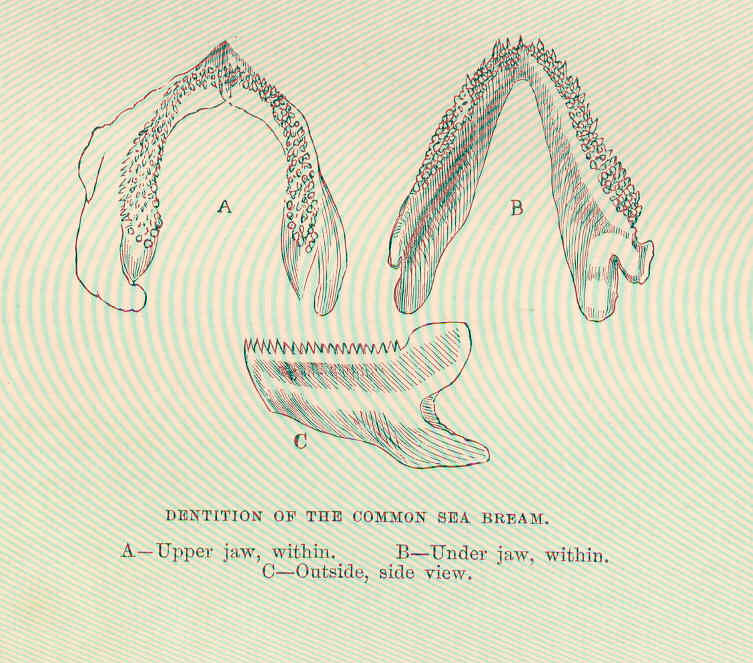
This reference guide covers lower-jaw anatomy, tooth-bearing versus toothless fish, modern skeletal comparisons, Den M1 measurement, NISP, MNI and the limits of inferring ancient fisheries. The original Saltbank examples are entirely fictional. The featured illustration is a real public-domain anatomical plate by Jonathan Couch (1877) and is not presented as a photographed archaeological specimen.
The core research is the Guye Chinese sea-bass measurement study, the 2024 fish-bone identification atlas and the diagnostic prey-fish-bone investigation.


1. Begin with the bone, not with a catch estimate
The dentary is a principal tooth-bearing bone of the lower jaw in many bony fishes. It may survive archaeological deposition as a robust anterior piece even when much of the head has fragmented. Its shape, preserved teeth and articular landmarks can help classify fish remains, and certain measurements may be used to reconstruct body size with a suitable modern reference. But a dentary is not one whole fish, nor does finding one establish when or where it was caught. Archaeological conclusions require the anatomical observation, taxonomic confidence, preservation and source context to be considered separately.
Invite students to describe an isolated lower-jaw element in three stages. First: what structures can actually be seen? Second: which fish taxa plausibly possess that anatomy? Third: how might the bone have entered its archaeological context? The sequence prevents a familiar shortcut in which a measured bone becomes a confident species, a fish length and a detailed fishing practice without intermediate evidence.
2. Find the dentary on a complete lower jaw
The lower jaw in many teleosts includes paired dentaries toward the front and additional elements such as the anguloarticular and retroarticular farther back. The dentary can bear oral teeth and form the anterior symphyseal region where the two sides approach one another. These structures differ markedly among fish groups. Students should not confuse the dentary with a maxilla or premaxilla of the upper jaw, nor with a pharyngeal bone located behind the mouth.
Use the historical sea-bream illustration featured in this guide, which shows upper and lower jaws from different views. Have learners identify the tooth-bearing anterior lower jaw and the larger bony arrangement it belongs to. The drawing is from an 1877 zoological reference, not an archaeological fossil from the fictional Saltbank exercise. Being precise about the image’s purpose is as important as being precise about the bone.
3. Distinguish dentary, anguloarticular and retroarticular
Some archaeological mandibles retain elements articulated together, while other contexts yield detached components. The dentary may appear as a robust tooth-bearing anterior segment; the anguloarticular contributes to the jaw articulation; the retroarticular is another distinct associated piece. If a complete compound lower jaw is measured as though every structure were dentary, an otherwise careful size equation may receive an incorrect input. A good analyst first determines where anatomical boundaries lie.
Prepare paired images of an articulated modern mandible and disarticulated bones. Students label the components, document their side and decide which landmarks belong to the dentary. A fragment that preserves one diagnostic tooth row but lacks the posterior margin should not automatically be reported as a complete mandible. The category ‘dentary fragment’ retains useful information without inventing missing anatomy.
4. Remember that not every fish has oral teeth
Common carp and many other cyprinids lack teeth on the outer oral jaws but possess pharyngeal teeth farther back. Predatory teleosts such as many sea bass may have visible oral dentition. Consequently, absence or presence of teeth on a recovered dentary can be taxonomically informative, but neither feature alone identifies a species. Some taxa lose or damage teeth after death, while juvenile forms may differ from adults. Anatomical reference work should cover alternatives rather than assuming every fish jaw is toothy.
Students examine a carp oral-jaw reference alongside a dentary from a tooth-bearing fish and an isolated pharyngeal bone. They should explain why a loose tooth from one fish system cannot be automatically placed on the other’s dentary. The connected GS7 pharyngeal-tooth guide treats the specialised throat dentition as its own question.
5. Record side and orientation consistently
Fish lower jaws are paired structures. A left dentary may be photographed laterally, medially, dorsally or ventrally, producing different silhouettes. A mirrored photograph can make two identical bones appear morphologically distinct. Taxonomic comparisons and measurements must therefore identify side, orientation and intact diagnostic regions. If the bone is distorted or fractured, some views may not be recoverable with confidence.
Give students four photographs of one modern specimen. They mark tooth row, symphysis, lateral openings or ridges and any surviving posterior articulation. Their record should state when side is uncertain. Proper orientation is not paperwork: it prevents misidentification, erroneous length measurement and inflated counts of supposed different taxa.
6. Recognise dentary shape as a conditional taxonomic clue
Dentaries can display informative changes in the depth of the anterior body, shape of the coronoid region, position of openings, tooth arrangement and pattern of processes. Related species may overlap substantially, especially when fragments lack the key landmark. Photographic atlases provide valuable starting points but cannot sample all within-species or developmental variation. A species label should be grounded in the combination of observed characters and an appropriate modern comparison.
Ask learners to compare dentary images of two plausible fishes of similar size and one fragmentary archaeological element. They should state what can be confidently excluded and where the fragment lacks the differentiating anatomy. A family-level identification is a scientifically useful result when a species-level claim would be unreliable.
7. Read the 2024 freshwater skeletal atlas critically
The European freshwater and migratory fish photographic atlas by Davis and colleagues documents isolated bones and identification difficulties among many taxa. Its purpose is to support osteology and training, not to provide a universal one-photo key. Fish from unrelated continents may resemble familiar European species, and the same species can change shape during growth. Reference scope matters when applying such atlases to archaeological material.
Students should document the fish species and anatomical view shown in a selected atlas image. Then consider an excavation outside the atlas’s geographic coverage. The correct strategy includes regional reference specimens or a broader taxon. A single image match is an initial hypothesis rather than a final scientific determination.
8. Use modern reference fish with known lengths
A proper body-size calibration begins with identified modern specimens of known species and defined length measures. Reference collections should ideally span the likely archaeological size range and include juveniles where relevant. Researchers take the same named dentary measurement from each fish and fit a relationship while evaluating error and outliers. If the fossil lies outside the training range or belongs to an uncertain taxon, the resulting prediction becomes weaker or inapplicable.
Ask a student to design a small reference survey that records taxon, sample count, total or standard length, bone side and dentary landmark definition. The plan must specify how repeated measurements and validation would work. The importance of a model lies in its biological and procedural fit, not merely the number of decimal places printed by software.
9. Separate standard length, fork length and total length
Standard length ordinarily ends near the base of the tail fin, fork length reaches the central tail fork where one exists, and total length reaches the posterior end of the tail under a defined convention. A dentary regression may target one of these measures, and they cannot be treated as synonyms. Ancient bones do not preserve the missing soft tail, so the inferred target comes solely from the modern model. Clear units are needed for every term.
Give learners two papers, one predicting standard length in millimetres and one total length in centimetres. Their task is to label target and units before comparing any findings. A numerically tidy graph that merges incompatible length definitions can invent a historical trend.
10. Know that fish bones are often more robust than fish images suggest
The anterior portion of some fish dentaries has relatively thick, distinctive structures that survive archaeological excavation well. That does not mean all dentaries preserve equally or that the largest bones indicate the most common fish. Thick articular ends may remain after delicate tooth-bearing margins break away. Sediment chemistry and mechanical disturbance select the surviving parts, and field recovery methods select them again.
Students record complete, partially diagnostic and unidentifiable dentary fragments as separate categories. A report that publishes only the few intact bones can produce a biased body-size distribution. Strong interpretation keeps the damaged remainder visible and discusses what it might have represented.
11. Use Guye as a practical selection case
In the 2022 study of Late Neolithic Chinese sea bass from Guye in coastal southern China, the opercle was the most abundant selected identified bone category but was often too porous and broken for the chosen measurements. Dentaries were less numerous yet retained a robust, consistently identifiable anterior region. Yu and Cui therefore used anterior dentary height, Den M1, to reconstruct fish standard length, supported by a species-specific modern reference regression. This is evidence that the best estimator is not always the most frequently recovered bone.
Students should identify exactly why the researchers preferred Den M1 over an opercle measure. The decision combined archaeological completeness with a high modern relationship, not the mere popularity of one anatomical bone. The authors’ conclusions belong to their taxon, recovery protocol and site; they must not be copied as a universal dentary rule.
12. Keep Guye’s actual counts in their proper denominator
The Guye paper listed 89 dentaries within a selected total of 443 identified Chinese sea-bass skeletal elements, or about 20.1 percent of that table. Its opercle category contained 167, about 37.7 percent. Those are NISP-like skeletal counts under a particular selection rule, not numbers of separate fish. The length analysis used measurements from dentaries whose required landmarks remained available, rather than treating every counted dentary as automatically measurable.
Have the class calculate both proportions and label the table’s actual unit. A wrong answer such as ’89 fish caught’ illustrates how quickly archaeological specimen counts can be inflated into biological individuals. Another important distinction is between bones present, bones confidently identified and bones intact enough for measurement.
13. Interpret the Guye regression conservatively
The Guye reference study collected 20 modern sea bass for skeletal measurement and produced regressions for selected dimensions. The reported association between anterior dentary height and standard length was strong within the sampled reference, and the archaeologists then reconstructed lengths for a subset of recovered dentaries. A high model R-squared indicates fit, but it does not eliminate prediction error, taxonomic uncertainty or possible differences between reference and ancient populations.
Students should identify the sample size, fish-size range and anatomical measurement required by the equation, along with the cultural and ecological context. A report on another fish species cannot simply reuse the published coefficients. Reliable osteometry requires that reference and archaeological input represent the same biological measurement.
14. Measure the anterior dentary height explicitly
A linear dimension such as Den M1 must be taken between prescribed anatomical points on the anterior jaw. It is not the maximum height anywhere on a broken bone, and a tooth tip is not necessarily one endpoint. Repeated measurements should use matching views and properly calibrated images. If the anterior region has fractured, its retained height may be shorter than the original reference dimension and unsuitable as an input.
Provide a modern reference image marked with the correct Den M1 endpoints and a fictional archaeological fragment missing one. Learners should record the surviving dimension without calling it Den M1 unless it follows the specified rule. The model is only as valid as the input landmark definition.
15. Use a fictional Saltbank length calculation
For mathematical teaching, imagine an invented fish taxon with a wholly fictional relation: predicted standard length in centimetres equals 4 plus 8 times anterior dentary height in millimetres. A hypothetical complete height of 3.5 mm would produce 4 + 8(3.5) = 32 cm, and a 5.0 mm height would produce 44 cm. These coefficients have no real species calibration and are provided only for arithmetic and model-applicability practice.
Students must label measured bone height separately from hypothetical fish-length prediction. A dentary fragment without the correct anterior endpoint would not qualify for the invented model regardless of measurement precision. No numerical output from this example should ever be presented as a real archaeological fish size.
Saltbank: fictional dentary height calculation
| Invented dentary height | Imaginary rule | Synthetic predicted standard length |
|---|---|---|
| 3.5 mm | 4 + 8 × 3.5 | 32 cm |
| 5.0 mm | 4 + 8 × 5.0 | 44 cm |
| Missing anterior landmark | Cannot apply equation | Withhold prediction |
16. Demonstrate measurement sensitivity
Suppose two readers select slightly different endpoints on a damaged fictional dentary, recording 3.5 and 3.8 mm. Under the toy rule, predictions become 32 and 34.4 cm, a 2.4 cm difference. That apparent precision is misleading if neither reader used the true original landmark. Rather than average two anatomically invalid estimates, a researcher may need to withhold body length altogether.
Ask learners to draw both selected landmarks and state how the observed measurements differ from the prescribed variable. A successful answer explains that accuracy is about whether the intended anatomical feature was measured, not how many digits an instrument displays.
17. Separate length models from fish age estimates
Body size and age are related through growth but are not equivalent. Different fish of the same age may grow differently because of food, water conditions or biological factors. A dentary measurement may support a modelled length without uniquely determining years lived. Age estimation requires another validated age structure or a growth model with substantial supporting assumptions. Archaeological fishery discussions should not present reconstructed centimetres as a direct age reading.
Give students two fish with the same toy body length but different plausible growth histories. They should explain why the bones alone do not identify one age. The connected GS7 otolith and fin-spine guides address separate methods for age and seasonality, each with its own limits.
18. Record right and left jaws when estimating individuals
Because dentaries are paired, confidence in side and taxon can sometimes help constrain a minimum number of fishes. Several independently identified right dentaries of one species within a well-defined context may support a lower bound if they cannot be refitted to the same bone. But numerous fragments from unknown sides may represent far fewer original fish than their tally suggests. Counting rules must be reported before deriving MNI.
Have students compare three complete right dentaries with fifteen unassigned fragments. The first set can sometimes constrain individuals; the second alone cannot be converted into fifteen catches. The exercise separates NISP from MNI and emphasises archaeological context.
19. Count fragments per processed sediment rather than meals
Imagine a fictional Saltbank excavation whose East unit yields 42 classifiable dentary fragments from 1.4 kg of dry sediment, while West yields 63 from 4.2 kg. The observed concentrations are 30 and 15 fragments per kilogram respectively. The West sample has more raw objects but a lower concentration after standardising by sediment mass. These figures do not measure how many fish were caught or eaten.
Students should calculate both ratios and then investigate what may affect the denominator: different accumulation periods, sampling volumes, excavation methods and preservation. A transparent unit is necessary for comparison but cannot by itself reconstruct an ancient fish population.
20. Consider the effects of sieving and sorting
Small oral jawbones and loose teeth may be missed in coarse screens, while larger robust dentaries remain conspicuous. Taxonomic composition and reconstructed size distributions can therefore be shaped by recovery methods rather than by the original catches. The Guye excavation used wet-sieved sediment, allowing a much more systematic faunal assemblage than casual hand collection. Not all archaeological collections have that comparability.
Ask students whether two sites can be compared when one used fine mesh and the other collected only visible bones. They should request consistent fractions, processed mass and sorting effort or confine the interpretation to limited descriptive observations.
Saltbank: fictional archaeological recovery denominator
| Invented unit | Identified dentary fragments | Processed dry sediment | Fragments per kg |
|---|---|---|---|
| East | 42 | 1.4 kg | 30 |
| West | 63 | 4.2 kg | 15 |
21. Test predator, human and natural depositional routes
Dentaries can accumulate through fish processing, discarded food, predation, natural death and water transport. The same element may be digested or burned under very different routes to burial. Hansel and colleagues examined jawbones that survived predator digestion and contributed to prey-size inference, illustrating a source pathway distinct from household archaeology. The ability to identify a jaw in sediment does not automatically identify who deposited it.
Students prepare a formation-history diagram for a dentary near a settlement. At least three pathways should be considered before declaring food waste. Useful independent evidence can include cut marks, thermal alteration, associated objects, predator traces and sedimentology.
22. Keep oral dentaries distinct from pharyngeal teeth
Many cyprinids lack oral dentary teeth but carry functional pharyngeal teeth on modified throat bones. A loose pharyngeal tooth in an excavation should not be catalogued as a fragment of the oral lower jaw. Conversely, a toothed oral dentary from a predatory fish is not evidence of the cyprinid throat system. The anatomical difference matters to fish diet, taxonomy and individual counts.
Use the published common-carp pharyngeal reference alongside a tooth-bearing lower jaw illustration. Students must mark which structure belongs to the front of the mouth and which lies behind it. A correct anatomical label prevents one research series from duplicating counts across incompatible skeletal categories.
23. Review potential dietary claims
Tooth form, jaw shape and gape can constrain feeding ability, but those characteristics do not reveal the exact food an ancient fish last consumed. Functional wear can be mixed with burial abrasion, and a mouth adapted to catching prey need not identify the prey available near an archaeological settlement. Fish diet should be investigated through modern ecology, direct residues and associated archaeological or environmental evidence where appropriate.
Ask learners to compare a dentary with sharp teeth and one with more blunt dentition, then list multiple plausible prey or processing functions. The gold-standard answer proposes testable dietary hypotheses rather than translating tooth shape into a specific historical meal.
24. Compare dentary with cleithrum and operculum models
The dentary may provide robust measurements where opercular margins fragment, while a cleithrum might retain a different set of diagnostic and measurable structures. A modern fish skeleton gives several possible proxies for body size, but selecting among them requires actual archaeological survival and appropriate species-specific modelling. Simply averaging predictions from unrelated models can hide incompatibility in target length, bone position and validation range.
Students design a selection matrix comparing taxonomic reliability, measurable landmarks, model uncertainty and specimen availability across three bones. Their final choice should be justified by the evidence that survives, not the visual prominence of one anatomical figure.
25. Use fish jawbones in wider archaeological trade studies cautiously
A fish taxon recovered from an inland settlement may have come from a coastal fishery through storage and trade. Its dentary can identify a source organism but not necessarily where it was caught or prepared. A large fish-size prediction may reflect selective transport of marketable individuals rather than local gear sophistication. Settlement location, cultural economy and original fish habitat are separate referents.
Have students map capture, processing, transport, consumption and disposal as different stages. The actual excavation location is only the final known position, and a historical reconstruction must identify the evidence connecting earlier events. Fish bones can illuminate trade without being miniature geographic passports.
26. Age-depth uncertainty limits historical attribution
Dentaries may occur in sediment with broad dating intervals, and older material can be moved into newer layers through flooding, cleaning or disturbance. A change in bone-size distributions should not be assigned to one exact fishing regulation or settlement event if chronology cannot resolve it. The sample’s archaeological date, the fish’s biological age and the date of its discard may all differ.
Give students an imaginary coastal midden with two overlapping chronological ranges and differently recovered dentary counts. They should report the observations while reserving causal historical claims for independent dating and archaeological corroboration.
27. Conserve original specimens and data
Archaeological jawbones can be fragile, rare or culturally important. Destructive collagen work, sectioning or chemical treatment requires a justified question, appropriate authorisation and preservation planning. Many useful morphology and measurement exercises can be completed from licensed anatomical images, scans or modern reference bones. A research plan should document specimen ID, context, imaging, reference models and any material consumed.
Students prepare a sample-handling and archiving plan. Its success criterion is that a second analyst can inspect photographs, reproduce measurements and understand which physical material remains available, rather than simply accepting a final numerical claim.
28. Conclude without claiming more than the jaw
The fictional Saltbank examples show how a complete dentary height can generate an arithmetic model output under stipulated toy assumptions and how 42 versus 63 fragments produce 30 versus 15 objects per kilogram after normalisation. Those patterns do not establish a real fish length distribution, population decline or fishing method. A publishable study would require validated reference material, secure identification and careful site-formation controls.
The gold standard is a learner who can identify what was directly recovered, measure only what is preserved, report uncertainty in every model and propose one specific independent observation that would reduce the largest historical ambiguity.
Twenty-two practical research and peer-review exercises
The following are fictional problems for learners. They are not real excavated deposits or additional fisheries findings, and each focuses on a different anatomical or inferential hazard.
1. Lower jaw versus upper jaw
A dentary is labelled a maxilla because both are tooth-bearing. Students use reference anatomy to identify the correct mouth region and explain how the wrong element would invalidate species-specific comparison.
2. The joint between dentary and anguloarticular
A compound lower jaw is measured as though all visible bone were dentary. Learners mark where the dentary ends and why a model’s named dimension must not include adjacent elements.
3. Toothy versus toothless cyprinid
A carp reference lacks teeth on the oral jaw, while a separate pharyngeal bone bears crowns. Students explain why the two structures are not contradictory and should not be counted within one oral dentary category.
4. The 1877 illustration as a fossil
An editor captions Jonathan Couch’s historical sea-bream drawing as an excavated Saltbank specimen. The class corrects authorship, date, subject and public-domain provenance and labels the image as reference only.
5. Juvenile and adult dentary
A small jaw fragment is assigned to a different species solely because its proportions differ from the adult reference. Learners evaluate ontogenetic shape and the need for growth-stage comparison.
6. A species assignment from one tooth
A dentary fragment preserves two oral teeth but not the diagnostic articular region. Students list taxa with similar teeth and select a conservative identification level.
7. The Guye 89/443 count
Students calculate about 20.1 percent for dentaries in the selected Guye skeletal table, then explain why those bones are not 89 distinct fish. NISP-like counts and individual animals are different units.
8. The more numerous opercle
Guye’s opercles were the largest category but many were fragmented. Learners explain why usable dentary height could be a better predictor of standard length than a more frequent incomplete bone.
9. The anonymous Den M1 value
A spreadsheet lists ‘height 5’ without identifying units or landmarks. Students request the Den M1 measurement definition and restore the measurement metadata before attempting a regression.
10. The invented 32 cm fish
A 3.5 mm tooth-bearing jaw height produces 32 cm under the explicitly fictional rule. Learners state why the result does not describe common carp or sea bass absent an actual modern calibration.
11. The missing anterior edge
An archaeological dentary lacks the anatomical endpoint required for Den M1. Students retain the surviving dimension while withholding a size prediction based on an intact measurement.
12. Reader endpoint disagreement
Two readers measure the damaged bone as 3.5 and 3.8 mm. The toy predictions differ by 2.4 cm. Students diagnose the cause and explain why averaging invalid inputs is not a scientific correction.
13. Right-sided duplicates
Three independently identified right dentaries occur in a secure context. Learners discuss a conservative minimum count, then contrast many unrefitted fragments whose individual source remains uncertain.
14. The East-West raw-total trap
Saltbank West has more fragments overall but processed triple the sediment mass. Students compute 30 and 15 per kilogram, keeping both raw totals and normalised rates in the same report.
15. Large fish through a coarse sieve
One excavation recovers mainly large dentaries because it used a coarse screen. Students propose how small-fish remains may be underrepresented and what a comparable sample would require.
16. Scorched jaw, uncertain meal
A blackened fish dentary is recovered near a ditch. The class considers cooking, secondary rubbish burning and natural fire before assigning a culinary history.
17. Predator deposit compared with fish market
Identical dentaries occur in predator prey remains and human refuse. Students list digestion, processing, spatial and associated-object evidence needed to distinguish source pathways.
18. The measured bone versus age
A relatively large lower jaw is called an old fish. Students separate body-size inference from biological age and identify different reference evidence needed for the two questions.
19. Overconfident length precision
A regression predicts 438.276 mm, but its model error and fossil landmark uncertainty are appreciable. Students present an appropriately qualified estimate rather than implying microscopic certainty.
20. A marine jaw far inland
A coastal fish dentary is found in an inland market. Learners consider traded fish and post-depositional movement rather than reconstructing an ancient local marine environment.
21. Old bone in a young flood lens
A flood carries an older fish jawbone into a younger sediment interval. Students distinguish biological source, transport and final burial from the layer’s age.
22. Peer-review final claim ladder
Students revise a paper that turns one dentary into species, exact length, historical catch technique and a named date. They preserve justified anatomy and numbers and label the additional archaeological evidence required for each stronger claim.
A three-session academic teaching pathway
- Session 1: identify lower-jaw elements, tooth positions, anatomical sides and trustworthy skeletal references, including the difference between oral dentaries and pharyngeal teeth.
- Session 2: analyse Guye’s actual dentary selection logic, apply the imaginary Saltbank height rule, record landmark and taxonomy uncertainty, and compute sample-normalised recovery counts.
- Session 3: compare possible natural, predator, processing and trade histories, then evaluate body size, chronology, destructive sampling and claims about historic fishing methods.
- Student deliverables: original specimen-condition log, reference attribution, correctly labelled measurements and units, raw counts and denominators, two competing formation histories and a defensible next-step research plan.
Gold Standard assessment rubric
| Research issue | Evidence required | Unsupported shortcut |
|---|---|---|
| Bone identity | Lower-jaw structure, side, articulation, completeness and diagnostic view | A curved jaw fragment automatically called a dentary |
| Taxon assignment | Matched modern reference and explicit confidence | One tooth used as proof of a species |
| Body-size modelling | True Den M1 or other defined landmark and valid reference model | Toy formula or damaged dimension applied to a real fish |
| Abundance | NISP versus MNI, recovery method and sediment denominator | One fragment equals one catch |
| Human activity | Processing, transport, predator and environment alternatives tested | All lower jaws treated as one food event |
| Reproducibility | Images, sampling records, method versions and uncertainty retained | Only a precise body-length histogram published |
Frequently asked questions
What is a dentary in a fish?
An anterior component of the lower jaw in many bony fishes, sometimes bearing oral teeth and useful for identifying skeletal remains.
Is a dentary the same as the maxilla?
No. The dentary is in the lower jaw; the maxilla and premaxilla are parts of the upper jaw system.
Do all fish dentaries bear teeth?
No. Some fish groups, including many cyprinids, lack teeth on the oral jaws while bearing pharyngeal teeth elsewhere.
Can one dentary identify an ancient fish species?
Sometimes, when diagnostic bone features and relevant comparative references are available; fragments may support only broader groups.
Why did the Guye researchers use dentary height?
The chosen anterior dentary region was robust and measurable even though more numerous opercles were often too fragmented for reliable size measurements.
Can dentary height estimate fish length?
For a validated species-specific model with the exact defined landmarks and target length type, it can support an estimate with uncertainty.
Does a measured dentary length reveal fish age?
No. A measured bone dimension and a modelled body length do not directly establish years lived.
Does one fish dentary fragment mean one fish was caught?
No. Jaws are paired and fragments can multiply; NISP and minimum individuals are different analytical measures.
Why does the collection method affect the apparent fishery?
Screen mesh, sample mass, sorting effort and bone survival can bias which fish sizes and taxa appear in the recovered assemblage.
Are Saltbank measurements actual archaeological findings?
No. Saltbank, its counts and the simple height-to-length rule are invented solely for teaching research methods.
Research papers, historical illustration credit and connected eduKate chapters
- Yu and Cui (2022): dentary osteometry of Chinese sea bass at Late Neolithic Guye
- Davis et al. (2024), European freshwater and migratory fish-bone photographic atlas
- Hansel et al. (1988), diagnostic dentaries, cleithra and opercles in prey fishes
- Leach et al., New Zealand kahawai cranial-bone size models, Te Papa
- Archaeological Fish Resource, University of Nottingham: dentary image collection
- Greater amberjack dentary medial view, University of Nottingham
- European hake dentary lateral view, University of Nottingham
- Couch (1877), common sea bream jaw anatomy, Freshwater and Marine Image Bank
- Marine Fish Osteology: A Guide for Archaeologists, SFU Archaeology Press
- Teaching Archaeological Fish Operculum Analysis
- Teaching Archaeological Fish Cleithrum Analysis
- Teaching Archaeological Fish Vertebra Analysis
- Teaching Archaeological Fish Pharyngeal Tooth Analysis
- Teaching Archaeological Otolith Analysis
- The Gold Standard master hub
The gold standard of teaching archaeological fish dentary analysis is a learner who identifies the correct lower-jaw structure, measures only valid preserved landmarks, separates direct skeletal observations from conditional model predictions and uses archaeological context before reconstructing historic fishing behaviour. A result another scholar can reproduce is stronger than one dressed up as a precise catch history without the necessary evidence.
Expert exercise: high fit, weak specimen identity
A regression reports a strong correlation between modern dentary height and fish length. Students are handed an archaeological bone of doubtful taxon. They must explain why the correlation does not make the fossil identification secure and why uncertainty in the source fish enters the predicted body size.
Expert exercise: species-specific ecology
The Guye study uses Chinese sea bass and a model built around its skeletal proportions. Students consider what would be required to apply the method to a carp or a catfish, noting differences in oral dentition, jaw shape, growth and the possible length target. The method can inspire a new study without transporting the old coefficients.
Expert exercise: selective survival
Older samples have few identifiable delicate jaw parts but many robust anterior dentaries. Students assess whether the assemblage’s skeletal composition reflects fishery practices or selective preservation. A comparative study of sediment damage and recovery can help distinguish causes.
Expert exercise: spatial context of bones
Dentaries from one fish species occur in a hearth layer, a ditch and a nearby lakebed. Students build three possible source histories and identify which bone marks or sediment features support human processing, predator deposition or natural transport.
Expert exercise: minimum individual constraint
Three confidently right-sided dentaries of the same taxon are recovered from one closed context, while additional unpaired fragments are present. Students state what the right-sided duplication may establish and why loose fragments should not be added directly to the inferred individual count.