
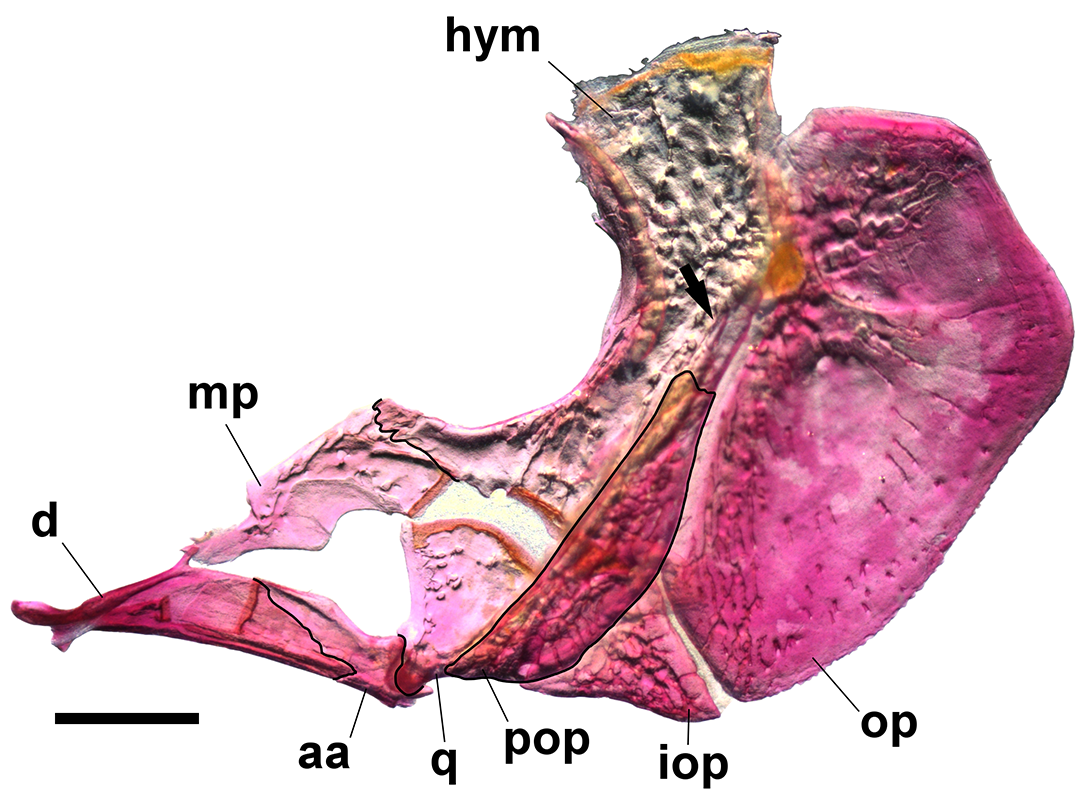
The quadrate forms an important part of the primary jaw joint of many bony fishes. In archaeological deposits, a quadrate may retain its articular condyle, dorsal plate or posterior process even when the rest of the skull has disappeared. Those features can assist taxonomic identification and reconstruct anatomical relationships, but they do not directly reveal how hard the fish bit, how old it was or whether ancient people caught it.
This reference explains quadrate anatomy, its connection to the anguloarticular, the symplectic and hyomandibula, taxonomic and developmental variation, and the archaeological effects of fragmentation and transport. The genuine comparative plate depicts modern Corydoras undulatus, while the worked Confluence Pond dimensions and counts are explicitly fictional.
Key primary references include Bono and colleagues’ 2019 fish-suspensorium study, the zebrafish quadrate anatomical definition and the study of variation in spottail shiner osteology.


Quick reference: quadrate evidence boundaries
| Observed finding | What it may support | What it cannot establish by itself |
|---|---|---|
| Quadrate joint condyle and dorsal plate | Fish skeletal-element identification | Unique species identity or bite force |
| Posterior process and articular contacts | Comparison with a matching reference skull | Jaw motion observed in life |
| Measurement of intact original landmarks | Defined shape description | Absolute fish body length without calibration |
| Sediment-normalised fossil counts | Description of sampled material | Historical fish population or annual catch |
| Bone near human artefacts | Possible site-activity hypothesis | Specific fishing method, meal or year |
1. Start with the jaw-joint bone, not a story about fishing
The quadrate is a bone forming the upper component of the primary jaw joint in many bony fishes. It articulates with the lower-jaw anguloarticular or related articular region. Archaeologists may recover the quadrate as an isolated fragment after a fish skull disarticulates. Its joint surface, plate and posterior process can help establish anatomical identity or sometimes taxonomic relationships. A detached quadrate does not independently reveal one fish’s bite force, a precise body length or the number of animals humans captured.
Ask learners to classify three statements: a quadrate articular condyle is visible, the bone belonged to a certain fish lineage, and the ancient settlement used a specified fishing technique. The first depends on direct anatomy, the second on comparative references and the third on independent archaeology. Every advance in the explanation needs additional evidence, and the teaching objective is to make those boundaries explicit.
2. Locate the quadrate in the actual jaw mechanism
In numerous teleosts the quadrate lies ventral to other suspensorial elements and contributes a condylar joint with the lower-jaw anguloarticular. It may have a broad dorsal plate and an extended posterior process. The nearby hyomandibula, symplectic, metapterygoid, palatine and preopercle provide essential anatomical context. When those neighbouring bones are missing, the quadrate’s orientation can be difficult to reconstruct from one flat fossil surface.
Students first label a complete scientific skull view, then remove surrounding elements in a second diagram. They should identify the lower jaw’s contact with the quadrate and state which preserved structures prove the isolated bone belongs to the jaw-support complex. Anatomical location precedes speculation about feeding behavior.
3. Understand the anguloarticular contact
The quadrate’s ventral condyle fits the articular region of the fish’s lower jaw. The anguloarticular itself is a different bone, even where its surface is tightly associated with the quadrate in a prepared specimen. This joint relationship is crucial for recognising jaw material and for understanding broad movement constraints. The two sides can separate after burial, and a bone from the lower side should not be recoded as an upper-joint quadrate because it was found beside it.
Show learners the labelled q and aa in the featured *Corydoras* figure. They identify the actual point of articulation, with a one-millimetre reference scale, and describe what would remain identifiable if the mandible had disarticulated. A reliable specimen card states the side of the joint and which articular surface survives.
4. Recognise the dorsal plate and posterior process
A quadrate can include a fan-shaped plate dorsally and a posteriorly projecting rod-like process. Their prominence and relationships differ with taxon. In some teleosts the posterior process is an important comparative character; its slender tip can be lost during excavation. A plate surviving alone might still support element identification while lacking the process needed for a narrower taxonomic diagnosis. The shape of the whole bone therefore cannot be inferred from one fragment.
Give students a modern complete quadrate and two photographs of fragments, one missing the dorsal plate and the other missing the process. They annotate preserved original margins and broken ends. An inference that depends on a lost process should be withheld even if the remaining piece has been measured precisely.
5. Distinguish quadrate from symplectic
The symplectic is a separate suspensorial element that can fit along the groove or notch associated with a quadrate’s posterior region in some teleosts. Its close contact can make partially articulated specimens confusing: one recovered object may contain both bones, or one slender part may be mistaken for a quadrate process. The anatomical boundary needs comparative evidence from a real skeleton rather than an assumed continuous outline.
Students compare the original elements before and after disarticulation and mark which surface belongs to which bone. In a fragmentary sample, ‘quadrate–symplectic complex, element uncertain’ can be more defensible than inventing a complete quadrate. The practice protects skeletal catalogues against false double counts.
6. Avoid mixing metapterygoid with quadrate
The metapterygoid sits within the suspensorium near the quadrate in many fish groups, but it possesses its own borders and contacts. A dorsal plate fragment can resemble one bone or the other when the distinctive joint condyle has broken away. The comparative study of eurypterygian fishes by Keivany documents variation in these elements across taxa, reinforcing why whole-region reference images are valuable.
Ask learners to compare lateral and medial views of documented specimens. They should name which landmark supports quadrate identity, which could support metapterygoid identity and what is missing on their fossil. A broad suspensorial designation is appropriate if the decisive contact is absent.
7. Use the *Corydoras undulatus* figure correctly
The featured real research figure shows a lateral view of the suspensorium and opercular series of *Corydoras undulatus*. The plate labels q for quadrate, aa for anguloarticular, hym for hyomandibula and other neighbouring elements. It is reproduced from Bono and colleagues’ 2019 PLOS ONE redescription, with an explicit scale. It illustrates genuine modern anatomical material and is not a fossil recovered from the fictional Confluence Pond described later.
Students should trace the contact between q and aa and identify the different articular and protective skeletal elements. Correct source attribution, species, figure meaning and licence are essential. Labelling the reference figure as an ancient excavation would be a scientific provenance failure even if its anatomy were drawn accurately.
8. Do not infer fish size from screen pixels
The scientific figure contains a one-millimetre scale bar. Resizing it for a web page changes image pixels but not the actual specimen’s dimensions. Comparisons using a computer screenshot without calibration are invalid. A reliable shape or size study uses the original bar, appropriate anatomical landmarks and known measurement orientation. A larger display of the quadrate does not mean its source fish was larger.
Have students measure an interval in the genuine panel using its scale and record the uncertainty of reading a small image. Then compare two panels only after calibrating each. This trains observation-based measurement instead of reliance on visual impressions.
9. Check the ZFIN quadrate anatomy definition
The Zebrafish Information Network identifies the quadrate as the bone forming the dorsal side of the jaw joint with the lower anguloarticular. It describes an adult form with a roughly triangular body and a posterior process, and supplies developmental context for when ossification becomes evident. Such ontology descriptions are valuable for standardising names and anatomical relationships. Their developmental timing is species-specific, however, and cannot be treated as the age timetable of every ancient fish.
Students should separate the broad element definition from the numerical larval stages documented for zebrafish. When another fish differs in ontogeny, that does not automatically mean it is a different ancient species. A standardized anatomical vocabulary supports comparison without erasing developmental diversity.
10. Understand the first jaw joint’s evolutionary origin
Comparative developmental work describes the quadrate within the palatoquadrate-derived cranial skeleton and its articulation with the lower jaw. That relationship has deep evolutionary significance, but geological lineage matters. The element in a modern-type teleost and the quadrate of other jawed vertebrate groups cannot be treated as mechanically identical merely because the term recurs. The anatomical homology is more general than any one contemporary jaw motion.
Students can make a labelled timeline distinguishing relevant jawed-fish groups and later terrestrial vertebrate transformations. They should not use a recently buried quadrate fragment as independent proof of a particular evolutionary transition. A fossil answers the questions supported by its taxon, age and preserved anatomy.
11. Do not confuse a fish quadrate with mammalian ear anatomy
In the evolutionary history of mammaliaforms the ancestral quadrate is connected to the origin of the incus in the mammalian middle ear, while the lower-jaw articular contributes to the malleus. This deep-time relationship differs from the hyoid-arch history associated with the stapes. A fish quadrate is therefore not a human incus in current function and should not be labelled as a modern hearing ossicle in an archaeological catalogue.
Ask learners to place quadrate–incus and hyomandibula–stapes on separate comparative diagrams, with their appropriate evolutionary branches. These are broad homology accounts requiring specialist fossil and developmental evidence; an isolated fish bone cannot establish the whole transition.
12. Variation within one fish species matters
A species’ quadrate shape may vary with body size, development, individual anatomy or preservation. The 2025 study of spottail shiner osteological variation documented differences among specimens in related suspensorial structures. This is why one modern skull drawing cannot represent every member of the species, let alone a whole genus. Taxonomic claims should evaluate variation in a reference series rather than rely only on one striking character.
Students compare two identified modern fish of one species and assess which traits are stable and which vary. They should not name an archaeological fragment as a new species simply because its dorsal plate differs from a single published drawing. Comparative sampling reduces overclassification.
13. The spottail shiner posterior process is informative
Detailed anatomical descriptions of spottail shiner include a quadrate with a dorsal blade, a ventral condyle forming the lower-jaw articulation and a posterior process contacting neighbouring elements. The particular shape of the process and adjacent bones can vary. This example is useful because it demonstrates the distinct observation of plate, condyle and posterior extension, instead of describing the quadrate as a featureless triangle.
An exercise asks learners to code plate preserved, condyle preserved, posterior process preserved and condition for several fictional fragments. They then identify which observations could be compared securely. A bone retaining only the dorsal plate may be useful for element-level recognition without meeting a species-identification threshold.
14. Learn from the blind cave cyprinid skeleton
A study of the blind cave cyprinid *Phreatichthys andruzzii* described a quadrate with an upper thin plate, a ventral condyle contacting the anguloarticular, and a posterior process closely associated with the symplectic and preopercle. This detailed reference shows how skull contacts can clarify identity, even in specialised fishes. Its morphology must not be transferred without qualification to common carp, catfishes or other distant taxa.
Students should compare the published description with the *Corydoras* figure, focusing on relationships rather than exact shape matching. They should identify which features are broadly anatomical and which are species-specific. Such careful comparison is more useful than memorising one unusual fish as a global standard.
15. Archaeological element coding needs a quadrate category
Colley and Brownlee’s archaeological fish-bone coding approach distinguishes diagnostic elements such as dentary, articular, maxilla, premaxilla and other cranial structures. Quadrates can have taxonomic value in suitable fish groups, but that does not mean every specimen is species-diagnostic. An effective database needs separate codes for element, side, taxon, completeness and context. An uncertain jaw-joint fragment should not appear simultaneously as two accepted bone types.
Students build a small data sheet and decide how to preserve competing identifications without duplicating counts. The process makes taxonomic uncertainty inspectable and prevents one piece from artificially increasing two skeletal categories.
16. Reference collections must include regional alternatives
A quadrate from an archaeological estuary can resemble bones from several fish taxa that share habitat or related ancestry. Photograph collections provide useful starting comparisons, but one geographical reference set may omit plausible local species. The University of Nottingham Archaeological Fish Resource includes quadrate images for fishes such as common carp and common sole. Those references should be expanded when the source fauna differs.
Ask a class to compare a freshwater carp quadrate and a marine flatfish reference while recording view and scale. They should not select species merely because one picture matches a curved process. Correct identification may remain at family or order if diagnostic contrasts are incomplete.
17. Do not mistake jaw mobility for captured prey
Quadrate shape contributes to the mechanical arrangement of the lower jaw, but exact movement, force and prey choice depend on other bones, cartilage, ligaments and muscles. The geometry of an articular condyle can constrain a biomechanical hypothesis without recording how a particular ancient fish opened its mouth. Feeding mode should be assessed with modern taxon ecology or validated models, not invented from one bone’s angle.
Give students a fictional quadrate with a well-preserved joint and missing rest of the skull. They should list which kinematic variables remain unknown. A cautious functional statement describes the joint’s anatomical position rather than bite force, capture speed or particular food.
18. Choose measurable quadrate landmarks explicitly
Length, height, condyle width and the posterior-process span may be measurable when original margins are intact. But any use of those dimensions for fish body size requires a matched modern calibration. A supposed maximum width obtained from a damaged edge is a partial-fragment measurement rather than the published model variable. Taxonomic position and developmental stage affect quadrate proportions, creating additional limits on direct comparison.
Students define two exact landmarks on a known modern reference and take repeat measurements. In an incomplete fossil, they should record whichever dimension genuinely survives and withhold an invalid converted fish size. Numerical precision cannot compensate for missing anatomical points.
19. A fictional Confluence Pond quadrate geometry exercise
Consider an entirely invented comparison using a quadrate condyle width divided by defined complete quadrate plate height, both measured in millimetres. A toy reference A has a condyle width of 1.8 mm and complete height of 4.5 mm, yielding 0.40. Toy reference B has a width of 2.0 mm and height of 5.0 mm, also yielding 0.40. These matching ratios do not establish that the fishes belong to the same species, or that their jaws have identical mobility.
Students should explain why a ratio can be identical even when absolute dimensions differ. A third damaged specimen lacks the original plate-height endpoint; its ratio should be withheld. The exercise teaches what a dimensionless shape descriptor can and cannot say.
20. Avoid converting a geometry ratio directly to fish body length
An osteometric size model predicts a specified fish-length type using a relationship calibrated among modern fishes of known identity and size. A quadrate ratio such as width divided by height is not itself a body-length equation. Even if the same fish species has a stable average ratio, the relationship may be affected by growth or bone position and is not guaranteed to predict absolute size. The target length, uncertainty and reference span must be stated.
Students should distinguish ‘quadrate ratio = 0.40’ from ‘total fish length = 40 cm’. No implication connects the two without independent empirical calibration. Inventing that connection would turn simple arithmetic into a false historical measurement.
21. Record original fragments and refits
A quadrate may fracture into a plate fragment, a condyle-bearing piece and a posterior-process shard. These can appear as several items in a specimen tally even when they came from one original bone. Refitting may establish that relationship, but it is not always possible. The number of identified specimens, or NISP, thus differs from an estimate of original skeletal elements or fish individuals.
Give learners three pieces that can be refitted and three unrelated pieces. They should preserve the physical fragment count while documenting the reconstructed original element count separately. The distinction is essential before comparing ancient fish assemblages.
Confluence Pond: made-up quadrate morphology ratios
| Toy specimen | Condyle width | Defined plate height | Width / height |
|---|---|---|---|
| A | 1.8 mm | 4.5 mm | 0.40 |
| B | 2.0 mm | 5.0 mm | 0.40 |
| Damaged C | 1.8 mm | Original endpoint missing | Withheld |
22. Paired quadrates complicate minimum individuals
Many fish have right and left quadrates, and a secure repeated side within one closed context can sometimes constrain the minimum number of animals. However, several unsided fragments may all derive from fewer fish. The analyst must account for taxonomic certainty, refits and the time span represented by the sample. An MNI number based on one large mixed context can have a different meaning from one based on several separate layers.
Ask students to compare four securely identified left quadrates with fourteen unplaced fragments. They can discuss a conservative minimum from the former when independence is established, but cannot automatically add all fragments as separate original fish.
23. Preservation changes anatomical visibility
Quadrate condyles and thin plates may be altered by burning, mechanical breakage, digestion, sediment abrasion and soil chemistry. Some surfaces remain recognisable while diagnostic posterior processes are missing. A study restricted to complete measurable quadrates can therefore exclude a large and potentially biased fraction of the assemblage. The identification and measurement datasets should be distinguished.
Students prepare a condition table and ask how the distribution of complete versus fragmented elements differs by layer. A difference in preserved morphology may arise from taphonomy without a real change in source fish species.
24. Recovery mesh and sorting effort change the inventory
Small quadrate fragments can be missed through coarse sieving or limited laboratory sorting, while large robust jaw-joint bones remain recognisable. Differences in processed sediment mass or fraction size can change apparent species composition. A new excavation with finer recovery can appear to reveal more small fishes even if the original ancient community was similar. Every comparative claim needs a comparable observation protocol.
Students should write mesh size, sediment mass or volume, sorting fraction and unidentified remainder beside each sample. A raw bone count without those conditions is a useful inventory, but an unreliable population comparison.
25. Confluence Pond’s fictional count comparison
In the invented Confluence Pond exercise, an older sediment sample has forty-two complete quadrates and eighteen fragmented quadrate objects from two kilograms of dry sediment, making sixty classified objects, or thirty per kilogram. A younger sample has twenty-seven complete and forty-five fragmented objects from six kilograms, making seventy-two classified objects, or twelve per kilogram. The younger layer has more raw objects but a much lower mass-normalised rate.
Students must present counts as observed bone objects, not fish or catches. The numbers and site are fictional. A lower object rate may reflect sedimentation, processing, bone supply or survival rather than a direct biological population decline.
26. A separate completeness audit is essential
Complete quadrates represent 42/60, or seventy percent, in the older fictional sample and 27/72, or 37.5 percent, in the younger. Complete elements per kilogram fall from twenty-one to 4.5. These are different variables from the total objects per kilogram and should be graphed separately. The large change in intact share calls for a preservation or recovery investigation before ecological attribution.
Ask students to name a follow-up able to distinguish damage during transport, excavation or chemical burial effects. A dataset can support a precise description of recovered condition without supporting a precise statement about ancient fish population.
27. The source fish may never have lived at the findspot
Quadrates enter deposits from natural fish deaths, predator feeding, human processing, flood transport and traded fish products. A marine fish quadrate recovered in an inland market may reflect exchange, not a local marine habitat. A freshwater quadrate carried by a flood may end up in a temporarily dry settlement ditch. Anatomical diagnosis and geographic provenance are separate questions.
Have students draw possible routes from living habitat to final excavated deposit and select independent evidence for each. Fish taxon, water sediments, processing marks and historical trade materials may all be relevant. One cranial bone alone cannot settle the entire route.
28. Human fish processing requires positive archaeological evidence
A quadrate near a hearth may be food waste, but bones can also be burned after disposal or deposited through other agents. Butchery marks, burning patterns, refitting, accompanying skeletal elements and spatial relationships help evaluate human processing. Predator-digested fish remains may show different damage, but interpretations can overlap and require appropriate controls. The strongest account tests alternatives rather than treating any bone in a village as proof of dinner.
Students should compare a sealed refuse lens with a flood-reworked deposit, both containing quadrates. They evaluate which context supports a human-use claim and identify unresolved processes. Observational honesty is more useful than an exaggerated cultural account.
Confluence Pond: fictional bone-count denominators
| Invented interval | Complete quadrates | Fragmentary objects | Total | Dry sediment | Objects/kg | Complete share |
|---|---|---|---|---|---|---|
| Older | 42 | 18 | 60 | 2 kg | 30 | 70% |
| Younger | 27 | 45 | 72 | 6 kg | 12 | 37.5% |
29. Fishery chronology must be independently established
A quadrate does not directly date its own deposition or fish’s age. Archaeological chronology comes from the surrounding layer, associated datable materials and stratigraphic models. Flooding or disturbance can move an older bone into a younger deposit. A count change between layers may represent years, decades or centuries depending on sedimentation and sampling. It cannot automatically be linked to one exact fisheries regulation or climatic event.
Students should plot sample depth and age uncertainty alongside quadrate counts. A reader should be able to see the actual chronological resolution rather than a smooth imagined annual history.
30. Do not confuse fish quadrate and bird quadrate studies
Birds and non-mammalian reptiles also have quadrates as part of their cranial apparatus, and comparative evolutionary literature uses the same term. Nevertheless, a species-identification character or geometric relationship documented for a dinosaur or bird quadrate is not a valid fish size model. The taxonomic lineage and skeletal context are different. This distinction is especially important when image searches yield visually appealing fossil quadrates from unrelated animals.
Students should identify the source clade of every reference image before using it. A quadrate’s evolutionary homology does not make the diagnostic measurements of distantly related lineages interchangeable.
31. Protect rare fish bones and preserve reference provenance
Archaeological quadrates may be rare, fragile or regulated heritage material. Destructive preparation, chemical treatment or sampling should be authorised and tied to a realistic information gain. Genuine published anatomy and approved modern comparative collections can support many teaching questions without consuming irreplaceable fossils. A figure’s original authorship, licence, identified organism and scale must remain accurate in teaching materials.
Students should prepare an archival record with specimen ID, site, layer, bone element, taxon confidence, condition, images, measured landmarks and research permissions. Another analyst should be able to reproduce the main observations from that record.
32. Write the result that the evidence supports
The fictional Confluence Pond data show that total recovered quadrate objects per kilogram and the fraction of complete bones both decline under a stated toy counting method. They do not prove a particular species became rare, that residents changed fishing gear or that jaw mechanics changed in the ancient population. Comparative morphology might justify a taxonomic hypothesis, while taphonomy and chronology may help determine the depositional history.
The gold standard of teaching quadrate analysis is a learner who identifies the joint accurately, respects the distinction between quadrate and anguloarticular, uses taxon-specific comparisons, measures only intact original landmarks and writes an archaeological conclusion that another researcher can reproduce and test.
Twenty-four independent archaeology and anatomy cases
All the following cases are original fictional teaching situations. They are not additional archaeological discoveries and must not be cited as real sites or numerical studies.
1. The joint sides reversed
An analyst labels the anguloarticular as quadrate because both sides touch. Students use the real *Corydoras* labels q and aa to identify the upper and lower joint bones correctly.
2. A quadrate mistaken for metapterygoid
An isolated dorsal plate lacks the condyle. Learners compare original contacts and use an uncertain suspensorial label where diagnosis is not secure.
3. The symplectic groove
A slender element adheres to the quadrate posterior process. Students record whether the specimen contains two articulated bones or one fractured process before counting.
4. A broken condyle
An articular surface was lost through post-depositional damage. The observer claims the species lacked a condyle. Reviewers distinguish biological absence from missing preservation.
5. Zebrafish developmental stages
A zebrafish anatomy ontology gives ossification details. Students explain why those numbers cannot directly date an archaeological fish or define developmental timing for every teleost.
6. The blind cave fish comparison
A *Phreatichthys* quadrate shows a posterior process and symplectic association. Learners compare anatomy without assigning all similar fragments to that specialised cave species.
7. Intraspecific variation
Two known spottail shiner skeletons differ in a suspensorial detail. Students decide which trait is variable and why one odd fossil should not automatically be named a new species.
8. The researcher uses a dinosaur figure
A bird or dinosaur quadrate image is chosen as the reference for a fish fossil. Students check lineage and original skull contacts and reject taxonomically invalid morphometry.
9. The made-up 0.40 geometry
A toy condyle width of 1.8 mm and height of 4.5 mm gives 0.40. Students state what the ratio measures and why it cannot identify species or body length without calibration.
10. An identical ratio from larger bones
Two toy quadrates have the same width-to-height ratio but different absolute sizes. Learners explain why matching shape does not establish one body size or taxon.
11. A missing plate height
The original margin is absent. Students retain the condyle measurement while withholding the full bone ratio rather than inventing a missing endpoint.
12. The fragment count doubles
One quadrate breaks into multiple pieces during recovery. Students record physical pieces and refits without turning them into several fish.
13. Four left quadrates
Four secure left quadrates of one taxon occur in a closed context. Learners identify what minimum-individual constraint may be reasonable and how other fragments remain uncertain.
14. The fifty-versus-seventy-two raw tally
Confluence Pond’s newer sample has more raw objects but much more sediment mass. Students calculate thirty versus twelve per kilogram and avoid population claims.
15. Complete proportions change
The toy complete share drops from seventy percent to 37.5 percent. Learners propose physical, chemical and recovery explanations before inferring ecology.
16. The fine sieve reveals new taxa
A second excavation finds additional small fish quadrates after using a finer screen. Students assess recovery methodology instead of announcing sudden ancient species arrival.
17. Burnt bone beside a hearth
A quadrate is darkened but lacks secure food-processing context. Students compare cooking, secondary burning, predator remains and post-depositional causes.
18. Predator accumulation
Quadrates occur within fish-bone material likely assembled by piscivorous animals. Students distinguish predator source history from human fishing discard.
19. Marine fish found inland
A diagnostic marine fish quadrate occurs in a city market deposit. Students discuss trade and transport rather than a false inland coastline.
20. The exact-date story
A broad archaeological age model is turned into a precise fishery-change year. Learners rewrite the claim to match actual temporal resolution.
21. The phantom bite force
A condylar angle is turned directly into a force measurement. Students identify the missing musculature, joint geometry and validated mechanics.
22. The gold-standard peer review
A manuscript infers species, fishing gear, age and population from one quadrate. Students retain observed anatomy and document the independent evidence needed for each additional claim.
23. The lost scale bar
A photograph is enlarged and the plotted fish bone appears huge. Students recover the original reference scale and state why screen dimensions cannot be used as biology.
24. The protected specimen question
A rare fish quadrate is proposed for unnecessary destructive sampling. Learners compare non-destructive imaging, permissions and likely information gain before deciding.
Three-session teaching and research plan
- Session 1: identify quadrate and anguloarticular as opposite sides of the jaw joint, compare posterior process, plate, symplectic and metapterygoid using the licensed actual Corydoras reference.
- Session 2: study developmental and taxonomic references, distinguish fish-specific anatomy from deep evolutionary homology, and complete the fictional quadrate geometry and sample-mass examples.
- Session 3: test fragment refits, archaeological recovery, NISP/MNI, natural or human source histories, chronological uncertainty and specimen stewardship.
- Student deliverable: properly attributed annotated anatomy, bone condition and classification confidence, correct numerical denominators, two competing deposition explanations and one independent follow-up test.
Gold Standard evidence rubric
| Scientific question | Standard met | Unsupported leap |
|---|---|---|
| Which bone? | Condyle, dorsal plate, posterior process and contacts checked | An anguloarticular or metapterygoid called a quadrate |
| Which fish? | Realistic species comparisons and uncertainty recorded | One pictured shape treated as unique global identifier |
| What function? | Taxon-specific full-joint mechanics available | Bite force calculated from bone angle alone |
| What dimensions? | Original intact landmarks and appropriate validation | Toy ratio converted into real body length |
| How many fishes? | Specimen counts, pairing, refits and sediment mass distinguished | Every identified object equated with one fish |
| Which past event? | Stratigraphy, processing, predators, transport and trade tested | Jaw bone near a village called a precisely dated fish meal |
| Can the finding be checked? | Raw records, original source and licensing preserved | Modern figure passed off as an excavation photograph |
Frequently asked questions
What is a fish quadrate?
The upper bony component of the primary jaw joint with the lower-jaw anguloarticular in many fishes.
Is the quadrate part of the lower jaw?
No. It articulates with lower-jaw bones but belongs to the jaw-supporting cranial skeleton.
How is it different from the hyomandibula?
Both belong in the broader cranial suspensorium, but they have distinct positions and contacts; the quadrate forms the joint with the lower jaw.
What is a quadrate posterior process?
A projection from the quadrate that can be associated with surrounding suspensorial elements in many teleost fishes.
Can quadrate shape identify an ancient fish species?
Sometimes, when sufficient diagnostic surfaces survive and matching modern reference taxa are available.
Can the bone reveal fish bite force?
Not by itself. Functional forces require species-specific joint, muscular and mechanical evidence beyond one bone.
Is a fish quadrate related to the mammalian incus?
Across vertebrate evolution, the quadrate is associated with origins of the mammalian incus, but a living fish quadrate is not a functional mammalian middle-ear ossicle.
Does one quadrate fragment equal one fish?
No. Quadrates are commonly paired and may fragment, so specimen counts differ from biological individuals.
Are Confluence Pond’s numbers real?
No. All Confluence Pond dimensions and sediment counts are fictional examples for teaching.
Why check completeness and sediment mass?
Differences in damage and recovery can change measured object counts independently of ancient fish abundance.
Primary osteology research, original figure and connected eduKate articles
- Bono et al. (2019), Corydoras undulatus suspensorium and operculum anatomy
- Bono et al. labelled quadrate and jaw-joint scientific figure, Wikimedia Commons
- Zebrafish Information Network, quadrate anatomical definition
- Australian Museum, labelled bony fish skull and quadrate anatomy
- Evolution and development of the fish jaw skeleton
- Assessing intraspecific osteological variation in the spottail shiner
- Phreatichthys andruzzii blind cave cyprinid skull osteology
- Oligocene fossil Guiclupea superstes with quadrate and articular joint
- Keivany, comparative osteology of fish suspensorium
- Colley and Brownlee, archaeological fish skeletal element names and codes
- Nottingham Archaeological Fish Resource, common carp and common sole quadrate images
- Teaching Archaeological Fish Hyomandibula Analysis
- Teaching Archaeological Fish Maxilla Analysis
- Teaching Archaeological Fish Dentary Analysis
- Teaching Archaeological Fish Vertebra Analysis
- The Gold Standard of Archaeology
- The Gold Standard master hub
The gold standard of teaching fish quadrate analysis is a learner who locates the actual jaw-joint element, identifies the articular contact and adjacent bones, separates anatomical observation from ecological and historical inference, and reports bone counts with their sediment and preservation denominators. A transparent, properly limited finding is stronger than a dramatic fishery story unsupported by its skeletal evidence.
Diagnostic head preservation
A complete articular condyle may support quadrate identity even when the posterior process is missing. Students report the bone confidently at the element level while leaving species uncertain if the distinguishing character is absent. This is more useful than either discarding the bone or naming one species by guesswork.
A false jaw-force calculation
An invented geometry ratio is entered into a formula for bite force without muscular inputs or validation. Students explain why a ratio of preserved lengths cannot directly quantify dynamic force. They propose which additional live-fish measurements a legitimate model would require.
An unclear sediment source
A jaw-joint fragment is located in a flood-affected settlement. Students identify natural fish death, predator remains, human refuse and upstream transport as alternatives and propose specific sedimentary or surface observations to narrow the possibilities.
Record the unknown class
A layer contains many fragments too small to assign confidently. Learners must preserve the indeterminate fraction when reporting the diagnosed quadrate assemblage, not silently remove uncertain bones and present percentages as a whole-fauna census.