
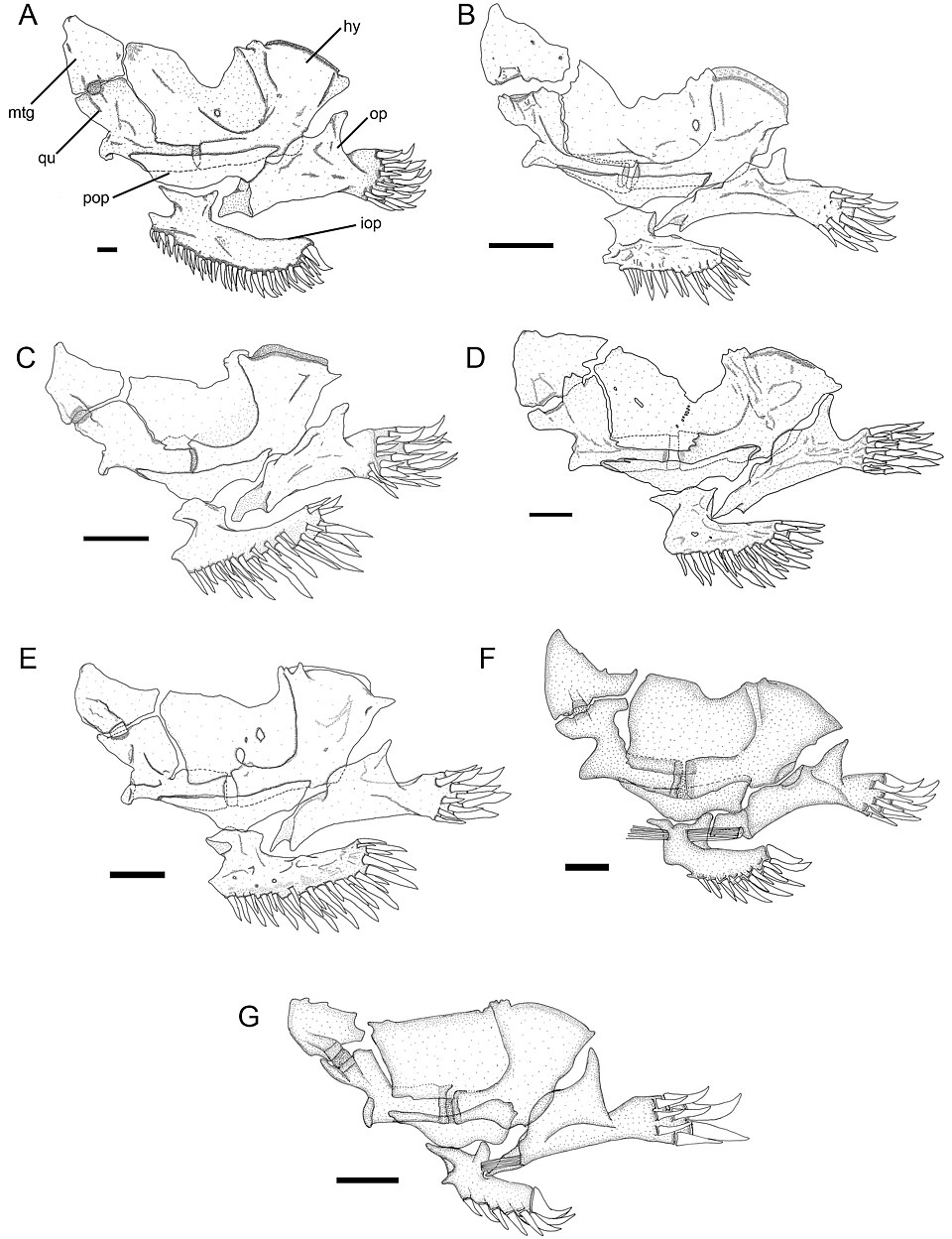
Fish hyomandibula analysis concerns a hyoid-arch bone that participates in jaw suspension and skull connections in many fishes. Archaeologists can sometimes identify this structure by its articular surfaces and relationships to the opercular and other suspensorial elements. But one isolated bone cannot reveal an exact bite force, count a fish population or establish what ancient people caught. The method succeeds when identification, preservation, deposition and historical interpretation remain distinct.
This detailed reference introduces the bone in the skull, explains comparative fish anatomy, distinguishes the evolutionary history of the hyoid arch from recent archaeological questions, and provides a completely fictional Pondside geometry and sediment-count exercise. The featured scientific figure depicts genuine identified South American trichomycterid catfishes, not the invented Pondside remains.
The primary scientific references include the 2018 trichomycterid osteology figure, Keivany’s comparative suspensorial study and the Panderichthys research on the evolution of the spiracular region.


Quick-reference evidence guide
| Direct observation | Possible inference | What extra proof is needed |
|---|---|---|
| Identified hyomandibula articular head | Taxonomic group | Matched regional modern osteology and excluding alternatives |
| Dorsal span and total height | Descriptive shape ratio | Undamaged original landmarks and comparative validation |
| More fossil fragments in one sample | Differences in sedimentary recovery | Matched mesh, mass, depositional duration and preservation |
| Fish bone near artefacts | Possible human-related fish handling | Processing marks, context, chronology and competing source tests |
| Similarity to Devonian hyomandibula | Evolutionary anatomical comparison | Phylogeny, geological timescale and original structural contacts |
1. What is a fish hyomandibula, and why study it?
The hyomandibula is an element of the hyoid arch that contributes to cranial and jaw-suspension relationships in many fishes. Depending on the lineage, it articulates with the braincase and neighbouring suspensorial or opercular elements. Archaeological specimens may preserve its articular surfaces even after the rest of the head separates. These surfaces can assist identification of a fish group, but a single hyomandibula is not a complete jaw or one whole fish. Nor does its presence prove a specific ancient fishing technique.
Begin with a fossil described only as a curved cranial bone. Students first record its visible articular regions, surface and condition. They then compare it with a documented reference skeleton before naming the element. Finally, they ask how that bone reached the archaeological layer. These are separate observations and inferences. A bone can be securely identified as a hyomandibula without supporting species, body-size, local-catch or exact-date claims.
2. Locate it in the fish skull
In many bony fishes the hyomandibula lies behind the orbit, associated with the neurocranium and suspensorium, and near the opercular series. The mandible, quadrate, metapterygoid, symplectic and opercle form distinct structures around this region. Their exact contacts and positions differ among fishes. A detached fossil may have lost the neighbouring bones that made its orientation obvious when the fish was alive. A labelled whole skull is therefore an essential first reference.
Students should locate each neighbouring element on a scientifically identified modern skull. When they examine an isolated sample, they should state which contacts remain visible and which are missing. It is useful to mark a dorsal and ventral direction in drawings, but never to invent a missing contact because a reconstruction looks more elegant with it.
3. Understand what jaw suspension means
Jaw suspension refers to structural relationships through which the jaws are connected to and supported by the skull. The suspensorium comprises several skeletal parts, and their arrangement varies across ray-finned fishes, cartilaginous fishes and deeper evolutionary branches. In many teleosts the hyomandibula is important, but it is not an independent jaw hinge operating on its own. Jaw movement involves further bones, joints, ligaments and muscles that rarely survive together in an archaeological assemblage.
Ask learners to draw a contact diagram rather than a single arrow labelled ‘jaw moves’. They should represent braincase, hyomandibula, quadrate, mandible and opercular contact as distinct nodes. The bone can constrain a model of suspension only when the relevant species and joint context have been established. A loose ancient element cannot yield feeding speed or bite force by itself.
4. Describe the dorsal articulations
Hyomandibular heads can contain articular regions that contact the braincase. Their shape, spacing and orientation can be useful descriptive characters, depending on the taxon. Some references describe anterior and posterior dorsal articulations and associated processes, but not every lineage presents the same clear geometry. An archaeological fragment with one damaged joint may still retain an identifiable shaft while lacking information needed for finer diagnosis.
Present a complete modern specimen and a second specimen with the articular head missing. Students should score each observed surface as intact, partly damaged, absent or not visible. The distinction matters: ‘not visible in this photograph’ is not a biological absence. Naming specific contacts requires matching the specimen to appropriate reference anatomy.
5. Separate the opercular process from the opercle
The hyomandibula can bear a process related to the opercle, while the opercle is a distinct dermal bone of the gill cover. A physical articulation between the two does not make them identical elements. A fish head may yield both bones as separate archaeological finds, or they may remain joined in a fragment of the suspensorium. Confusing them distorts identification lists and any attempt to count repeated skeletal structures.
Have students annotate an identified fish suspensorium and a separate opercle. They should draw the original contact where preserved. If the contact has broken away, the catalogue needs to say so instead of assigning an invented process. This distinction provides a bridge to the separate operculum teaching article without duplicating its gill-cover focus.
6. Distinguish hyomandibula, symplectic and quadrate
The symplectic and quadrate are other elements in the jaw-support complex in many teleosts. Their sizes, shapes and developmental relationships are not interchangeable with those of the hyomandibula. A slender fragment can be difficult to classify when its diagnostic articulation is missing; a quadrate’s jaw-joint region may make it distinguishable when intact. The original bone may also have fractured along an articulation, making a mixed piece appear to be one long structure.
Students should compare complete references for all three and list the observed features rather than rely on rough outlines. Where a fragment cannot be securely assigned, use ‘suspensorial element uncertain’ with photographs and candidate identifications. Such restraint protects downstream studies from treating a guessed element as a validated fossil measurement.
7. Include metapterygoid and palatine in the reference map
Keivany’s comparative osteological study of eurypterygian fishes describes the suspensorium in terms of palatine, ectopterygoid, endopterygoid, metapterygoid, quadrate, symplectic and hyomandibular bones. This supplies a useful anatomical vocabulary, but not a universal one-to-one species key. Relative dimensions and articulations can change with lineage, development and preservation. The archaeological investigator must determine which elements actually existed in the source fish and which have survived.
Build a labelled map for a chosen modern fish, then remove the metapterygoid and show how the remaining bones appear in isolation. Students should state which character becomes harder to diagnose without the neighbour. This practice teaches comparative osteology as a study of relationships, not a catalogue of memorised silhouettes.
8. What the 2018 trichomycterid figure actually shows
Katz, Barbosa, de Oliveira Mattos and da Costa published a comparative figure of the suspensory and opercular series of seven trichomycterid catfish taxa in their 2018 Zoosystematics and Evolution work. It identifies hyomandibula, metapterygoid, preopercle, interopercle and opercle. The image is a modern taxonomic reference derived from documented specimens, not an ancient pond excavation. Its value lies in showing how related fishes can differ in bone arrangement and size.
Students should read the labels for panels A through G before making any comparison. They should not name an unidentified archaeological fish simply because its fragment resembles one enlarged panel. A comparison becomes credible when the candidate taxa, view, preservation, scale and distinguishing character are all explicit.
9. Use the plate’s millimetre scale correctly
The published trichomycterid plate carries one-millimetre scale bars. When a web image is resized, the displayed number of pixels per millimetre changes, but the scientific scale remains the reference. Shape comparisons and measurements require calibrated bars or underlying specimen measurements. An image of an apparently large hyomandibula may simply have been magnified more strongly than another panel.
Have learners calculate a ratio of two clearly defined lengths on the same panel and note its limitations. Comparing measurements across panels may require separate calibration and consideration of fish size. The goal is correct scale interpretation rather than apparent numerical precision.
10. Recognise taxonomic variation within catfishes
The seven trichomycterid panels include related South American fishes whose hyomandibular and surrounding cranial configurations differ. Some outlines and contact features may be useful in a comparative diagnosis, yet related taxa can share characters and single specimens cannot show all possible variation. An isolated archaeological specimen from another region may have no suitable match in this particular reference set. Strong taxonomy compares plausible local alternatives rather than treating a limited illustrated sample as globally exhaustive.
Students should identify two features that vary among the illustrated panels and one that remains shared. They should then state why a fossil preserving only the shared feature cannot be identified to one of the seven species. A defensible genus, family or element-level label is preferable to unsupported species precision.
11. Use Keivany’s wider eurypterygian survey as background
Keivany’s 2015 comparative study examined suspensorial and opercular osteology in representatives of 49 genera and 41 eurypterygian fish families. It described hyomandibular foramina and diverse related structures while distinguishing the opercular series. The breadth of that sample makes it useful for learning comparative anatomical terminology. It does not provide a validated fish-length regression for archaeological hyomandibulae or prove that one character is unique to all members of a particular species.
Ask students to distinguish definitions that are broadly helpful from identifications that require a more specialised key. If a report uses a reference study outside the fauna of its excavation, the author should state the geographical and taxonomic limitations explicitly. Wide comparative scope is not identical to a complete reference collection.
12. Distinguish anatomical identity and biological function
A bone may be homologous across lineages because of shared evolutionary origins even when its mechanical role has changed. Conversely, different structures can perform superficially similar functions without being direct evolutionary equivalents. Homology is established by anatomical topology, development and phylogeny, not simply by matching shape or use. A fragmentary archaeological bone commonly supports a more limited structural description than a major comparative evolutionary claim.
Give students two labelled modern skulls and an ancient isolated element. They should mark what anatomical positions appear comparable and where missing evidence prevents certainty. A careful report can identify a likely hyomandibula without inferring the entire history of jaw evolution from that one recovered object.
13. Explain the hyoid arch in vertebrate history
The hyoid arch is one of the pharyngeal arch systems involved in the evolution of vertebrate heads. Its skeletal derivatives take on different roles in different lineages, including jaw support and associated respiratory or auditory structures. This evolutionary background helps explain why the fish hyomandibula is important, but it should not be confused with the archaeological task of naming a recently living fish’s isolated bone. Organism, geological time and evolutionary branch have to be stated clearly.
Students should produce two labels: ‘modern-type fish hyomandibula from an archaeological context’ and ‘hyomandibular region in a Devonian stem-tetrapod’. Then ask whether the two are interchangeable diagnoses. They are not; both require source-specific anatomy and chronology.
14. What Panderichthys reveals about the spiracle
Brazeau and Ahlberg’s 2006 research on Panderichthys documented a reduced distal hyomandibular portion and transformed spiracular anatomy. It contributed to understanding early stages in the evolution of tetrapod middle-ear architecture from structures involved in the fish head and spiracular region. This was not evidence that all living fish hyomandibulae function as hearing bones. It was a comparative interpretation of a particular Devonian evolutionary stage supported by complete anatomical relationships.
An instructional timeline can place Panderichthys alongside other tetrapodomorph references, with a separate note on later tetrapod stapes evolution. Students should distinguish a hypothesised functional transition from an exact measurement of ancient hearing. The report should avoid compressing tens of millions of years into one simplistic ‘fish jaw turned into human ear’ statement.
15. A fish hyomandibula is not a human stapes
In tetrapod evolution, derivatives of the hyomandibular region became associated with the stapes or columella, but the earliest stages likely involved spiracular and respiratory functions. This differs from the acoustic role of the middle-ear stapes in many later terrestrial vertebrates. Describing a modern fish hyomandibula as if it were a fully formed human ear ossicle is an anatomical and temporal category mistake. The source lineage matters at every point of comparison.
Ask learners to write a short correction to an exaggerated museum caption. A good version names the shared evolutionary origin while identifying the different skull roles and long evolutionary timescale. The explanation becomes both more accurate and more instructive without relying on sensational language.
16. Do not copy a shark jaw-suspension model into teleosts
Cartilaginous fishes such as sharks possess jaw-support arrangements that differ from those of many bony fishes with extensive dermal opercular elements. Words such as hyostyly appear in comparative discussions, but no single model describes every shark, skate, teleost or early fossil lineage. Even the material of the relevant elements and their persistence differ. Applying a catfish bone drawing to an unidentified shark cartilage would be unsupported.
Students should compare an elasmobranch cranial reference with a teleost skull and note which suspensorial contacts genuinely correspond. They should also consider that cartilage may survive archaeology differently from ossified teleost structures. The best lesson is taxon-specific comparison.
17. Understand that a feeding mechanism needs more than one bone
The hyomandibula participates in skull relationships, but fish feeding dynamics involve coordinated movement of the mandible, suspensorium, opercular apparatus and soft tissues. A detached bone cannot show live rotation angle, force, speed or actual prey capture. Even modern biomechanical models require defined joint positions and species-specific anatomical measurements. Ancient morphology can constrain possible mechanisms without recording a fish’s behaviour.
Have students choose two claims: ‘this bone has a preserved dorsal articular surface’ and ‘this fish generated a measured bite force of a specific magnitude’. The first is observable; the second cannot be derived from the fragment without independent modelling and many missing parameters. They should state how the relevant evidence differs.
18. Measure geometric ratios without making them species rules
For one type of shape description, an analyst may compare a specified dorsal condyle span with a defined total height on a complete hyomandibula. Ratios are dimensionless when both dimensions use the same unit, but their taxonomic or functional value must still be validated. A larger ratio is not automatically a species identification, body length or jaw strength estimate. Body-size scaling and distortion can influence such comparisons.
Give students a wholly fictional Pondside reference bone with span 2.4 mm and height 6.0 mm, yielding 0.40. A second toy reference has 2.1 mm and 7.0 mm, yielding 0.30. Both arithmetic results are valid under the given definitions, but neither is an empirical threshold for any real fish. This explicitly fictional example is for measurement literacy.
19. When an original margin is missing, withhold the ratio
If a fossil has lost the lower margin required by a total-height measurement, the surviving height is not the intended variable. Dividing a valid condyle span by a shortened preserved fragment can inflate the ratio while appearing mathematically precise. The same issue arises when a condyle is abraded or compressed. Instrument precision cannot restore anatomical landmarks that no longer exist.
Provide a third toy Pondside specimen with a known 2.4 mm span and missing total-height endpoint. Students should record the observed span and withhold the shape ratio. That conclusion is more scientific than a decimal derived from an invented original bone boundary.
20. Distinguish biological absence from taphonomic loss
Archaeological hyomandibulae may be burned, crushed, digested, abraded or dissolved after death. Articular processes can break preferentially, producing an apparent absence of the very feature used in taxonomy. A specimen lacking an opercular contact does not prove the living fish lacked that contact unless preservation and reference anatomy support the inference. Some damage patterns can also reflect the recovery and laboratory process itself.
Ask students to classify three states for every diagnostic feature: present, originally absent with evidence, or indeterminate because it is not preserved. Most damaged archaeological specimens belong in the third category for missing margins. This prevents preservation bias from becoming a false taxonomic discovery.
Pondside: fictional hyomandibular geometry
| Toy specimen | Dorsal span | Defined total height | Span / height |
|---|---|---|---|
| A | 2.4 mm | 6.0 mm | 0.40 |
| B | 2.1 mm | 7.0 mm | 0.30 |
| C | 2.4 mm | Original margin missing | Withheld |
21. Count physical fragments before inferring original bones
One original hyomandibula can break into several fragments, and many fish bear paired left and right elements. NISP describes identified specimens under a declared counting rule, not the count of living individuals. Where refitting is possible, fragments may be reunited to reconstruct original elements; without it, the number of distinct bones may be uncertain. Sidedness provides additional information only when confidently observed.
Have learners prepare two tables: raw identified physical pieces and reconstructed or sided elements. They should not substitute one for the other. A high NISP may reflect extensive fragmentation rather than a larger ancient fish community.
22. Estimate minimum individuals only when duplication is secure
A minimum number of individuals may sometimes be constrained by repeated instances of the same bone from the same side and taxon in a coherent context. Three confidently separate right hyomandibulae could suggest a minimum of three individuals if their skeletal diagnoses and context are secure. Fifteen unsided fragments might all derive from fewer original fishes; treating them as fifteen more individuals would not be justified.
Students should record which right-sided bones cannot refit or belong to one skeleton. They should also note the depositional interval used for the calculation. Combining centuries of mixed sediment in one MNI table changes the meaning of the estimate.
23. Recovery mesh can change the fossil inventory
Small or fragile cranial fragments may pass through coarse sieves, while robust elements remain visible to hand collectors. The processed sediment mass, mesh aperture, wet or dry preparation and sorting intensity influence which hyomandibulae are recovered. Comparisons among archaeological units require methodological compatibility. A newer dig with fine sieving can appear richer in small fishes even when the original deposits were similar.
Ask students to audit two excavation records and identify what is missing before comparing fossil frequencies. Where a fair comparison is impossible, they should describe the raw specimens and explain the limitation rather than produce a falsely comparable abundance trend.
24. The fictional Pondside specimen comparison
In an invented Pondside teaching case, an older layer yields fifty classified hyomandibular fragments, including twenty complete elements, from 2.5 kg of processed sediment. A younger layer yields sixty-five fragments, including thirteen complete elements, from 6.5 kg. The total recovered rates are 50/2.5 = 20 and 65/6.5 = 10 fragments per kilogram. The younger layer has more raw fragments but a lower normalised rate. No real archaeological fishery is represented.
Students should show the count and mass denominator in each calculation. They must state that the measured quantity is classified bone objects per processed mass, not fish per year or fish caught. Sediment accumulation, original bone supply and fragmentation remain unknown.
25. Pondside’s complete-element pattern requires a separate analysis
The complete share in the fictional older layer is 20/50 = 40 percent. In the younger layer it is 13/65 = 20 percent. Complete elements per kilogram therefore change from 20/2.5 = 8 to 13/6.5 = 2. This is a steeper decline than the total fragment rate. The difference may suggest changing fragmentation, preservation or recovery rather than a corresponding population decline. A rate can be perfectly calculated without identifying its cause.
Students should plot total fragments per kilogram and intact elements per kilogram separately. They then choose a discriminating follow-up, such as a blinded breakage classification or a sedimentological comparison. A more dramatic graph is not necessarily a stronger causal argument.
26. Compare predator and natural depositional agents
Fish skull bones can accumulate through natural mortality, piscivorous birds, larger fish or other predators, and water transport. Different agents may select prey sizes and modify the skeleton before deposition. A hyomandibula found in a cave or settlement-adjacent lens does not necessarily come from people. Digestion traces, element representation, spatial concentrations and associated deposits can help distinguish agents, though several may contribute to one layer.
Have a group propose owl or other predator input, a natural fish death and human food processing as competing interpretations for a fossil cluster. They should identify which features would support each and which observations remain ambiguous. Site formation is a central component of zooarchaeology.
27. Differentiate fish processing from general human proximity
One fish bone beside a hearth might be food refuse, but it may also have been transported, burnt after disposal or mixed with other sediments. Cut marks, butchery patterns, burning in a consistent context and related artefacts can strengthen an argument for human processing. None is sufficient in isolation without considering alternative histories. A fish’s taxonomic identification and its cultural role require separate evidence.
Students should compare a sealed refuse pit with clear butchery signatures against a disturbed drainage lens containing fish fragments. The correct report may make a strong food-use claim for one context and a tentative source hypothesis for the other. The same bone identity need not imply the same deposition process.
Pondside: fictional specimen recovery and completeness
| Fictional sediment | All classified fragments | Complete specimens | Processed dry mass | Fragments/kg | Complete share | Complete/kg |
|---|---|---|---|---|---|---|
| Older | 50 | 20 | 2.5 kg | 20 | 40% | 8 |
| Younger | 65 | 13 | 6.5 kg | 10 | 20% | 2 |
28. Trade separates the fish’s home from the findspot
A fish that grew in the sea can be processed, dried and carried to an inland market, leaving a hyomandibula in settlement refuse far from its habitat. Freshwater fish may similarly be moved to coastal sites. The final excavated location is not automatically a map of local living populations. Trade and food processing can also select which anatomical parts travel with the fish.
Students should draw a timeline of fish growth, capture, head removal, transportation, consumption and discard. They must distinguish the place and age of each event rather than collapse the entire history into the excavated sediment coordinate.
29. Chronology is independent of skeletal naming
Hyomandibular morphology ordinarily does not provide an exact historical date for an archaeological specimen. The surrounding sediment’s stratigraphy and scientific dating establish a chronological framework, and disturbed layers or later flood transport can create misleading associations. Even a securely identified taxon cannot assign a fish to the precise year of a local fishing rule or settlement event without appropriate temporal resolution.
Students should label sampled depth, modelled date ranges and possible reworking. A narrow chronological claim needs independent dating and context. A correct taxonomic identification does not repair a weak age model.
30. Integrate additional fish bones without double counting
Maxillae, premaxillae, dentaries, opercles, cleithra and vertebrae can contribute independent anatomical information, but one fish may produce all of them. Each skeletal element has its own diagnostic features, survival bias and potential size-calibration requirements. A regression defined for cleithrum length is not valid for a hyomandibular span, and simply adding all identified fragments cannot produce a fish population count.
Students should prepare a cross-element matrix listing taxon evidence, sidedness, completeness, recovery and potential duplication. A coherent synthesis may use several bones to confirm identification while keeping original-animal estimates conservative.
31. Handle protected specimens and source images responsibly
Archaeological material may be fragile, finite or subject to cultural and legal protections. Destructive sections or chemical procedures require appropriate permissions and a clear expected research benefit. Non-destructive imaging and genuine published osteological references may suffice for many identification questions. Scientific figures must retain accurate authorship, taxonomy and licence details; a resized modern plate should not be described as a fossil from an imaginary excavation.
Have learners write a custody and research plan specifying specimen ID, original layer, preparation history, image source, conservation constraints and proposed tests. The strongest plan sometimes decides not to consume the only diagnostic articular surface.
32. Write a bounded archaeological conclusion
The fictional Pondside observations establish differences in fragment rates and completeness under specified arithmetic assumptions. They do not show exactly how the source fishes opened their jaws, which species were caught, or whether people engineered a water feature. Real comparative anatomy may improve taxonomic confidence; preservation analysis and contextual dating may narrow formation history. A defensible final statement needs to identify which link in the reasoning chain remains untested.
The gold standard of teaching hyomandibula analysis is a learner who can locate the element in a skull, describe which joint surfaces survive, compare it within the proper lineage, compute honest observation rates and state what independent evidence is still needed for cultural or environmental history.
Twenty-four independent evidence and practical cases
Every case below is a fictional exercise. Their purpose is to practise distinct identification, taphonomic, quantitative and evolutionary judgments. None is an additional real excavation or historical fishery dataset.
1. Identify the hyomandibula versus an opercle
A detached fish-head element is called an opercle because it was found close to a gill-cover plate. Students compare articular contacts and explain why the underlying hyomandibula and dermal opercle are different bones. The corrected catalogue keeps bone identity separate from anatomical proximity.
2. Hyomandibula versus quadrate
A fragment preserves a projection but has lost the jaw-contact region. Learners compare complete modern suspensoria and decide which element-level identification can be defended. If the relevant contact is missing, uncertainty is preferable to a forced label.
3. Read the 2018 Katz figure faithfully
Seven modern catfish panels show different suspensory forms. Students mark the one-millimetre scale bars and labels without treating larger printed images as larger fishes. They keep the source specimens distinct from any fictional archaeological deposit.
4. The shared-character species trap
Two catfish references have broadly similar hyomandibular processes. A damaged fossil retains only that shared trait. Students select a broader taxon and identify the missing distinguishing character, documenting why a confident species diagnosis would be unsupported.
5. Missing opercular articulation
One articular process has broken away, but the analyst writes that the living species lacked it. Learners distinguish a not-preserved feature from genuine anatomical absence and request a suitable reference view.
6. The 49-genera survey mistaken for a global key
An anatomical paper includes 49 eurypterygian genera, and a student assumes it can identify all freshwater fish species. The class explains taxonomic coverage and the difference between terminology and species-level diagnosis.
7. The stapes misconception
A modern fish hyomandibula is called a human ear bone. Students explain evolutionary homology across separate lineages and timescales without equating the structures’ present functions.
8. Panderichthys misused for a local fishery
A Devonian anatomical finding is cited as proof of jaw anatomy in a recently living archaeological catfish. Learners distinguish evolutionary comparison, actual source species and archaeological chronology.
9. A shark figure applied to a teleost
A cartilage-based jaw suspension diagram is copied into an opercle-bearing bony fish. Students identify differences in skeleton and anatomical contacts before drawing any comparison.
10. The invented 0.40 shape ratio
A toy reference has 2.4 mm condyle span and 6.0 mm total height. Learners calculate 0.40 and explain why it is not a validated species diagnostic threshold.
11. The invalid ratio from a fractured margin
A specimen has an intact dorsal span but a lost height endpoint. Students preserve the measured span and withhold the full ratio rather than estimate missing anatomy from appearance.
12. Many pieces from one bone
A fish hyomandibula fractures into five recognisable objects during excavation. Students record the five physical pieces without declaring five fish and consider refitting if the evidence permits.
13. Three right-side elements
Three confidently identified right hyomandibulae are found in one closed context. Learners explain a possible conservative minimum and why additional unsided shards cannot simply add animals.
14. The Pondside raw-count reversal
An older sample has 50 fragments from 2.5 kg; a younger has 65 from 6.5 kg. Students calculate 20 versus 10 per kg and discuss why neither directly measures fish caught annually.
15. The intact-share warning
The toy complete fraction falls from 40 to 20 percent. The group proposes transport and preservation explanations and asks for independent damage observations before asserting fish population change.
16. A fine-sieve difference
Two contexts use different recovery mesh sizes. Students identify why small fish-head pieces appear in one and not the other and propose a comparable recovery strategy.
17. A predator-derived fish assemblage
Hyomandibulae occur with digested fish remains. Students compare predator input, natural deposition and human food waste as alternatives rather than accepting proximity to a settlement as proof of a meal.
18. A burnt bone in a mixed ditch
A darkened hyomandibula is called cooked fish. Learners distinguish cooking, secondary fire and later sediment mixing and identify archaeological indicators that could clarify the source.
19. A marine fish in an inland market
A securely marine taxon leaves jaw-support remains far inland. Students evaluate trade, processed fish and transport instead of inventing a past sea at the excavation location.
20. A borrowed cleithrum length equation
An osteometric formula for cleithrum width is applied to a hyomandibular span. Students explain why matching units do not make skeletal inputs biologically equivalent and withhold the result.
21. The precise historical date illusion
A fossil concentration appears in layers with wide age intervals. Students redraw the chronological plot and avoid assigning it to one named fishing event unsupported by dating.
22. The missing specimen identifier
An analyst can recognise a bone but cannot locate its excavation label. The morphological description remains potentially useful, while claims about date and spatial association require restored provenance.
23. Ethical sampling choice
A rare hyomandibular head is targeted for destructive testing when non-destructive images can answer the proposed question. Students evaluate authority, specimen value and genuine information gain.
24. The final peer review
A draft makes species, feeding-force, fish-population and human engineering claims from one bone and two fictional tables. Reviewers preserve actual observable features and arithmetic, then list the independent evidence needed for each stronger conclusion.
Three-session research learning pathway
- Session 1: locate hyomandibula within the suspensorium; distinguish quadrate, symplectic, metapterygoid and opercle, with the genuine Katz figure as a reference.
- Session 2: use published comparative and deep-time fish evolution evidence to understand how anatomical roles vary; perform the invented Pondside ratio and recovery calculations with clearly stated limitations.
- Session 3: evaluate archaeological recovery, bone duplication, natural deposition, predator remains, human processing, trade, chronology and specimen stewardship before reporting conclusions.
- Submission: annotated reference image, condition and taxonomic-confidence checklist, raw and per-kilogram count table, a competing formation-history diagram, source bibliography and one precise follow-up research test.
Gold Standard assessment rubric
| Evidence question | Research-ready answer | Unsupported shortcut |
|---|---|---|
| Which cranial element is present? | Articulations and anatomical neighbours compared to a correct skull | Every curved cranial fragment called hyomandibula |
| Is species identification secure? | Regional reference taxa, preserved characters and uncertainty | One osteology plate treated as a global species key |
| What is the evolutionary meaning? | Lineage, geological age and hyoid-arch homology stated | Fish jaw bone described as an already-human ear ossicle |
| Can measurements be used? | Original landmarks, compatible units and validated comparison | Toy ratio called fish length or jaw strength |
| How many fishes? | Paired elements, refits, NISP, cautious MNI and sediment mass reported | Each identified fragment treated as a caught fish |
| Does it prove human action? | Transport, predation, processing, chronological and trade alternatives tested | Bone found near people automatically classified as one meal |
| Is the work reproducible? | Figure attribution, specimen ID, counts, photos and model choices retained | Smooth conclusion without source or raw evidence |
Frequently asked questions
What is a hyomandibula in a fish?
A hyoid-arch skeletal element that participates in cranial suspensorial and opercular relationships in many fish lineages.
Is a hyomandibula the same as the opercle?
No. They are separate bones with different positions and contacts, even where they articulate with one another.
Does every fish use the same jaw suspension?
No. Skeletal support varies considerably among bony fishes, cartilaginous fishes and deeper evolutionary lineages.
Can an isolated hyomandibula identify fish species?
Sometimes, if diagnostic articular characters survive and an appropriate modern comparative reference is available.
Does a hyomandibula tell how hard a fish bit?
Not by itself. Bite or feeding mechanics requires species-specific complete-jaw and soft-tissue or validated modelling evidence.
Is it related to the human middle-ear stapes?
The hyoid arch is involved in the evolutionary origins of the tetrapod stapes, but a fish hyomandibula is not functionally identical to a human ear bone.
Can its shape measure ancient fish body length?
Only with a validated taxon-specific model using the exact anatomical dimension. A generic shape ratio cannot supply that estimate.
Does one hyomandibular fragment equal one fish?
No. Bones are often paired, may fragment and may be moved between sediments.
What is the 2018 Katz figure?
A genuine modern osteological comparison of suspensory and opercular bones among seven trichomycterid catfish taxa.
Are Pondside measurements genuine archaeological data?
No. Pondside is a wholly fictional teaching case used to demonstrate count denominators and geometric measurement limits.
Scientific references and related eduKate Gold Standard chapters
- Katz et al. (2018), trichomycterid comparative suspensory and opercular anatomy
- Katz et al. Figure 5 on Wikimedia Commons, CC BY 4.0
- Keivany (2015), suspensorial and opercular osteology in 49 fish genera
- Evolution and development of the fish jaw skeleton, systematic review
- Brazeau and Ahlberg (2006), Panderichthys and tetrapod middle ear origins
- Evolution of the spiracular region from jawless fish to tetrapods (2022)
- Keivany (2015), osteology of hyobranchial arches in eurypterygian fishes
- Teaching Archaeological Fish Maxilla Analysis
- Teaching Archaeological Fish Premaxilla Analysis
- Teaching Archaeological Fish Operculum Analysis
- Teaching Archaeological Fish Cleithrum Analysis
- Teaching Archaeological Fish Vertebra Analysis
- The Gold Standard of Palaeoecology
- The Gold Standard of Archaeology
- The Gold Standard master directory
The gold standard of archaeological hyomandibula teaching is a student who can locate the genuine fish skull element, describe what survives, place its evolutionary identity on the proper lineage and timescale, calculate clear sediment observations, and reserve cultural claims until independent archaeological evidence supports them. The completed analysis should be auditable and useful even where the fossil cannot be named to a precise species.