
Archaeological ostracod analysis studies tiny crustacean valves preserved in water-laid sediments to reconstruct past aquatic conditions. The shells offer ecological clues, and some retain information about the chemistry of water during calcification. Yet a valve does not directly measure ancient lake salinity, and a precise isotope value cannot by itself separate temperature from water composition, biological offsets or later mineral alteration.
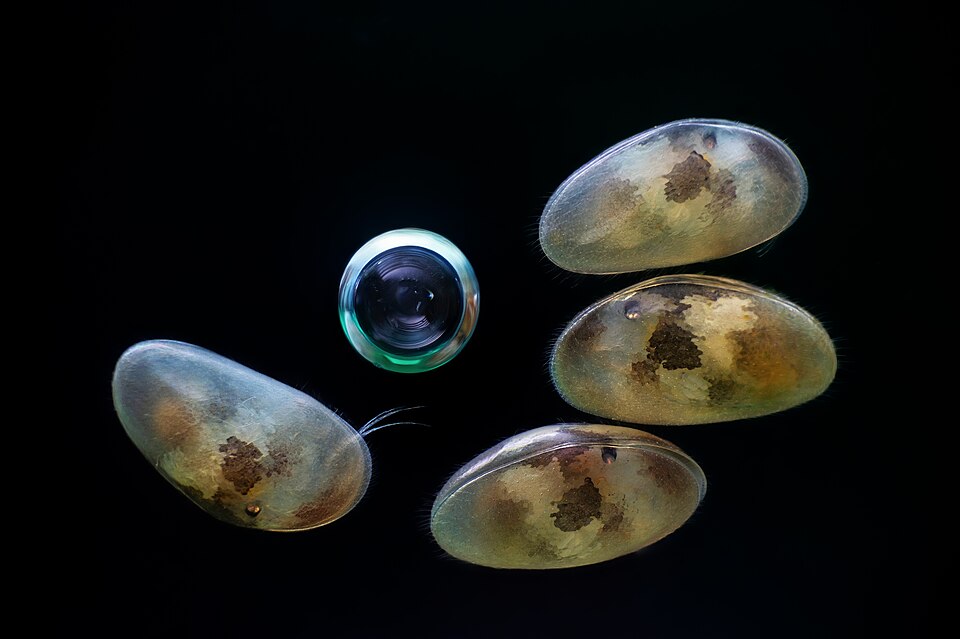
This detailed teaching chapter covers seed-shrimp anatomy, moulting and fragment counts, shell taxonomy, recovery bias, lake hydrology, oxygen and carbon isotopes, and an invented Brookmere Lake calculation. The featured image shows real modern ostracods photographed near Rakvere, Estonia, not fossil valves from Brookmere. The standard is to distinguish the observation, the ecological model and the proposed human history before any claim is published.
Start with the World Ostracoda Database and a scientific review of shell isotopes for organism-level and analytical background.


1. A small valve is evidence, not a ready-made lake history
Ostracods are small crustaceans with paired valves that may be preserved in lake, wetland and archaeological deposits. Their fossil remains can contribute evidence of past aquatic ecology and water chemistry. However, a valve is not a direct salinity meter or a calendar entry, and the isotope value of a calcified shell does not independently identify water temperature. Reliable interpretation requires a known taxon, stratigraphic setting, preservation checks and appropriate modern comparisons.
Begin with three different statements. A sample contains thirty identified ostracod valves. The aquatic environment probably changed between layers. People built a canal in a particular historical decade. The first may be checked by microscopy, the second requires context and ecology, and the third needs independent historical evidence. Students should learn to label which statement is an observation, an environmental inference or an untested account of human activity.
2. Recognise the animal behind the bivalve-like shell
Ostracods are crustaceans, sometimes called seed shrimps, and should not be mistaken for tiny bivalve molluscs. Their two hinged valves enclose a body with appendages used in their aquatic lives. Many species occur in fresh, brackish and marine water, though ecological tolerances vary considerably. A familiar oval shape identifies neither a species nor its habitat. The living animal and the isolated fossil shell answer different biological questions.
The photograph in this guide shows four modern ostracods collected near Rakvere, Estonia, not ancient fossils from the fictional Brookmere Lake. Ask learners to observe the paired covering and visible structures before viewing detached fossil valves. A scale-labelled diagram should distinguish anatomy from the depositional object that a sediment analyst eventually counts. This small distinction prevents large errors in abundance and life-history interpretation.
3. Learn valve, carapace and fragment vocabulary
An isolated valve is one side of a carapace, while a complete carapace retains the paired sides. A broken valve can generate several fragments. Those observations must not be silently converted into animal counts because ostracods moult and may leave several shells over their lives. A sedimentary layer can therefore contain remains from growth stages as well as death. Taxonomic identification and population estimation do not follow from one simple ratio.
Give students a toy collection with one articulated carapace, five individual valves and three pieces that refit to another valve. Require records for original specimen pieces, reconstructed elements and potential duplicate counts. The group should explain why dividing the number of visible pieces by two cannot yield a valid count of living animals. This is a strong introductory lesson in scientific denominators.
4. Identify juveniles and adult instars
Ostracods change through developmental stages, and shell size and shape can differ between juvenile and adult instars. Without developmental reference material, a class may mistakenly record juveniles as separate species or exclude them as unidentifiable debris. This changes the apparent community proportions. Juvenile and adult differences also matter to shell chemistry, since growth stages can form valves at different times or in different microhabitats.
Prepare a hypothetical sequence of three sizes attributed to a candidate taxon and ask what evidence would support one species progressing through growth rather than three distinct species. Their answer should include more than size: hinge, ornamentation, general morphology and suitable comparative collections. Uncertainty should be recorded when developmental stages cannot be resolved.
5. Use taxonomic characters and reliable reference collections
Valves can carry diagnostic hinge structures, pore patterns, marginal details, shape and ornamentation. Specialists compare these traits with established taxonomic keys and identified collections, sometimes using electron microscopy. Damaged or worn specimens may lose useful characters. Students must resist naming a species from a generic outline or from an appealing image found online without assessing its actual morphological match.
Offer two fictional micrographs: one clear enough to reveal diagnostic details and another eroded and fragmented. The learner should identify the first at the most specific justified level and assign a cautious broader category to the second. The aim is not maximum naming density, but an identification record that another expert could inspect and contest.
6. Choose a depositional archive for the intended question
Lake basins, marshes, ponds, irrigation ditches and archaeological water features have different source areas and formation histories. A deep central lake core may integrate shells transported from shallow habitats, while a small settlement pond can be affected by local drainage and cleaning. One setting may offer long-term palaeoclimate context while another relates more directly to human land use. The correct field approach starts by defining the spatial and temporal scale of the research question.
Ask two teams to design sediment recovery around a natural lake and a historic water channel. They should compare sample position, modern reference sites, seasonal measurements, recovery protocols and chronological resolution. The lesson shows why the same ostracod taxon can be relevant to both questions while supporting different scales of inference.
7. Record stratigraphy and sediment context precisely
A fossil valve means more when its sediment layer, core depth, orientation and adjacent materials are securely recorded. Floods, erosion, bioturbation and later human disturbance may move valves between layers. A layer’s colour or depth alone does not establish a date. Preservation of stratigraphic relationships is therefore as important as the shell itself, particularly when trying to link environmental change to a specific occupation period.
Give students a fictional core with one mixed horizon and a labelled water-channel cut. They should sketch crosscutting relationships and decide which valves can reasonably be associated with each event. When provenance is uncertain, the microscopic identification may still be valid but its historical placement becomes limited. Encourage a separation between specimen identity and depositional history.
8. Recognise transport, reworking and life remains
Empty ostracod valves can be carried by water and redistributed after the animal’s death or moult. Some accumulations may originate near where the organisms lived; others represent reworked shells from elsewhere in the basin or watershed. Abrasion, sorting, shell breakage, articulated carapaces and sediment characteristics can offer clues. No one feature creates an infallible local-versus-transported classification.
Present an imagined shore deposit containing smooth abraded valves and a quieter-water layer containing more intact carapaces. Students propose possible source histories and list the independent sediment observations needed to test them. They should avoid describing the first assemblage as evidence of a different living population until transport is evaluated.
9. Understand sieving and sample effort
Small valves, fragile juvenile instars and broken pieces can disappear from the recorded assemblage when field and laboratory sieves differ. Drying, washing, chemical treatment and sorting time can also change recovery. A study must report sample mass or volume, mesh fraction, preparation conditions and the identification criteria used. Numbers without those details are difficult to compare across sites or even between teams in one laboratory.
Run a classroom audit where two technicians process an identical toy sample with different mesh sizes. Their small-valve proportions differ. Learners should determine how this might resemble a false ecological trend, and propose a comparable recovery procedure or a transparent warning that the datasets cannot be merged uncritically.
10. Distinguish raw counts, concentration and proportion
A raw valve total describes observations but is not a concentration unless a sediment denominator is provided. A taxon’s share of the identified assemblage can rise because other taxa fall, even without an increase in absolute recovered valves. Concentration per gram or cubic centimetre supplies a different measure that itself can be affected by sedimentation, preservation and recovery efficiency. All values should be named precisely.
Students should write the number of recorded valves, amount of processed sediment and taxonomic total beside any ratio. If one sample contains fifty valves from a small mass and another the same fifty from a much larger mass, the raw totals match but the concentrations differ. The correct choice of variable depends on the research question rather than which graph looks most persuasive.
11. Separate water salinity from lake ionic composition
Salinity describes dissolved salts, while conductivity reflects ions and changes with temperature and composition. Two lakes with similar conductivity can have different dominant ions, alkalinity and biological communities. Ostracod distributions can depend on multiple water variables, including hardness, calcium availability, oxygen and substrates. A taxon’s presence does not carry one universal salinity value valid in every lake and climate.
Give learners two hypothetical water samples that share a conductivity reading but differ in major ions. Ask whether they must contain the same ostracod taxa. Their reasoning should involve ecological tolerances, life stages and local reference collections. This exercise is useful because many appealing reconstructions skip the chemistry behind the environmental category.
12. Use ecological ranges instead of rigid species labels
Modern aquatic surveys can identify environmental ranges within which ostracod species occur, but many taxa are ecologically flexible and may inhabit multiple settings. A familiar species associated with mildly brackish water in one region need not provide an exact salt concentration somewhere else. The composition of an assemblage can nonetheless be informative when taxa are correctly identified and their preferences are based on appropriate reference observations.
Assign fictional species broad freshwater-to-brackish tolerance bands rather than one optimum. Students compare overlapping intervals and determine whether a single fossil valve uniquely identifies any particular water chemistry. The strongest answers explain why multiple well-calibrated taxa can narrow a hypothesis without completely removing uncertainty.
13. Read changing lake levels as a spatial problem
As a lake expands or contracts, shallow margins, vegetation belts and deeper basins change location. Fossils in one fixed core may therefore reflect moving habitats as well as changing abundance or chemistry. A shore-associated taxon entering a deeper-core record could indicate a shoreline shift, transport or altered habitat conditions. The correct interpretation needs the basin’s sedimentary and geomorphological context.
Have students draw a lake cross-section at two hypothetical stages and mark where ostracods might live, die, moult and become deposited. Then ask whether the shells recovered from the core represent their precise living positions. The exercise makes environmental reconstruction spatial rather than merely a list of taxa.
14. Introduce oxygen-isotope chemistry without overclaiming
Oxygen-isotope ratios in ostracod shell carbonate may reflect the isotopic composition of surrounding water and the temperature of shell formation, modified by biological and preservation effects. Water itself varies with precipitation, evaporation, inflow and mixing. Therefore a higher carbonate delta-18-O is not automatically warmer water, greater salinity or reduced rainfall. One measurement can fit several plausible hydrological histories.
Students should compare two imaginary lakes at equal temperature but different water isotope composition, then two temperatures in otherwise comparable waters. The scenarios demonstrate why an apparent isotope difference need not have one cause. The study design should obtain relevant local measurements before converting chemistry into a historical story.
15. Understand species-specific vital offsets
Living ostracods can precipitate carbonate with isotope values offset from simple equilibrium predictions. Published work has measured taxon-specific differences under modern lake conditions. If an environmental series combines different species without considering offsets, changing taxonomic composition may look like changing water chemistry. Vital effects are not a nuisance to wave away; they are biological information required for an accurate reconstruction.
Give students two made-up taxa with different constant offsets and a sediment sequence in which their relative abundance changes. The class identifies how pooling their values can generate a false shift. A defensible geochemical report retains species and growth-stage information and explains any correction or limits of comparison.
16. Remember shells calcify at particular times
An ostracod valve may record the environmental conditions during its formation rather than the average of an entire year. Growth stages and seasonal biology can influence which temperature and water composition are represented. A mixed sediment sample may contain individuals from different months or years, even if all shells were ultimately deposited close together.
Ask learners what information is necessary to describe one carbonate value as ‘summer’ or ‘annual mean’. They should seek a species-specific growth reference and modern seasonal measurements, not infer timing from the elegance of a plotted curve. Biological chronology and geological chronology must be connected rather than conflated.
17. Explain carbon isotopes and the carbon cycle
Carbon-isotope composition of shell carbonate can reflect dissolved inorganic carbon sources, productivity, water exchange and biological fractionation. A shift in delta-13-C does not automatically signify one climatic or agricultural cause. Microhabitat effects may further complicate comparisons among taxa living at different depths or substrate types. Understanding the lake carbon system matters before an archaeological narrative is attached.
Give students two competing explanations for an invented carbon-isotope change: altered groundwater supply and increased aquatic productivity. They must identify independent measurements that could discriminate them. A professional answer should state what the geochemistry directly shows while treating the proposed cause as a tested hypothesis.
18. Preservation and diagenesis precede isotope analysis
Old carbonate valves may undergo dissolution, recrystallisation, cement growth, surface contamination or other alteration. A specimen can appear morphologically useful yet be chemically unsuitable for a particular isotope claim. Mineralogical checks and careful sampling protect against interpreting later secondary carbonate as original shell chemistry. High instrumental precision does not compensate for uncertain preservation.
Present two shells: one with clean structure and one with visible secondary deposits. Students prepare a sequence of checks and decide which question each shell may still answer. The second may remain taxonomically useful but unsuitable for precise chemical inference. This lesson teaches research design that protects irreplaceable samples and avoids expensive measurements without credible meaning.
19. Use an explicitly fictional Brookmere Lake dataset
Imagine that an older fictional sediment sample yields thirty-six valves provisionally grouped with freshwater-associated forms and twelve grouped with relatively brackish-associated forms. A newer fictional sample yields eighteen and thirty respectively. Each totals forty-eight classifiable valves. The brackish-associated category therefore rises from one quarter to five eighths of the classified assemblage, or twenty-five to 62.5 percent.
The arithmetic is correct but does not establish a measured salinity change. Our teaching categories are intentionally simplified and do not correspond to calibrated species boundaries. The result should prompt scrutiny of species diagnosis, recovery methods, sediment mass, shell condition, modern analogues and transport. Only after those checks can a cautious environmental hypothesis be developed.
20. Reveal the denominator hidden in the toy data
Suppose the older Brookmere sample came from fifty grams of sediment and the newer from two hundred grams. The same forty-eight classifiable valves now correspond to 0.96 valves per gram in the older sample and 0.24 in the newer. Assemblage composition and recovered-valve concentration tell different stories because they measure different relationships. Neither directly equals live population density.
Students calculate both values and present the result in a small table. They then explain why shells from moulting, selective preservation and variable sediment supply complicate biological abundance even when the arithmetic is transparent. The exercise is designed to build denominator literacy rather than announce ecological certainty.
Brookmere Lake: fictional identified-valve tally
| Layer | Freshwater-associated toy category | Brackish-associated toy category | Total | Brackish share |
|---|---|---|---|---|
| Older | 36 | 12 | 48 | 25% |
| Newer | 18 | 30 | 48 | 62.5% |
21. Read valves alongside taphonomic condition
Shell abrasion, breakage, articulation, marginal damage and preservation of ornamentation may help assess transport and burial. Recording condition separately by taxonomic group can reveal whether an apparent increase in one category accompanies better survival of that shell type. A change in relative frequency might otherwise be mistaken for ecological replacement. Such patterns can be suggestive without providing one unique depositional mechanism.
Have learners build an accompanying condition table for the fictional Brookmere material. The aim is to distinguish measured condition from explanations such as high-energy transport, chemical dissolution or reworking. A strong student names the additional sedimentary observations required before accepting one of those causes.
Denominator sensitivity
| Layer | Classified valves | Sediment processed | Valves per gram |
|---|---|---|---|
| Older | 48 | 50 g | 0.96 |
| Newer | 48 | 200 g | 0.24 |
22. Separate lake ecology from specific human decisions
Ostracod analyses may inform the aquatic environment surrounding settlements, irrigation channels, trackways and historic ponds. Yet changing shell assemblages do not independently prove canal construction, deliberate drainage or a particular land-management policy. Natural evaporation, groundwater changes, floods and land-use processes can occur together. Claims of human causation need archaeology and secure chronology.
Provide students with a hypothetical village on a lake margin and a possible salinity shift. Require them to identify engineering features, stratigraphic evidence, historical records or other independent signs of human intervention. A correct response can use ostracods to constrain water conditions while withholding the identity of the responsible cause.
23. Compare with diatoms and other aquatic evidence
Diatom assemblages and chemistry, sediment facies, other microfossils and documentary observations may offer complementary constraints on water history. They differ in preservation and ecological source area, so disagreement is not automatically an analytical failure. Multiple proxies strengthen an inference only after each passes its own taxonomic, chronological and methodological checks.
Create three curves with slightly different age uncertainties and ask students which changes truly overlap. They should consider why one proxy reflects shore habitat while another may represent deeper water. The lesson is how to construct a convergent argument without forcing every dataset into a preselected lake narrative.
24. Build a defensible local reference baseline
Modern calibration should document taxon identification, sampling season, depth, habitat, conductivity, major ions, temperature, water isotope composition and relevant growth stages. A reference dataset from a distant waterbody may illuminate general biology but may not support quantitative transfer to a chemically different lake. The laboratory method and environmental variables measured in modern material determine which fossil inferences are plausible.
Students design a Brookmere reference survey spanning inflows, shore and deeper water through different seasons. They must specify which observations are needed for ecological assemblage interpretation and which are required for carbonate isotope work. A useful calibration plan targets variables most likely to discriminate between competing explanations.
25. Link fossil records to chronological uncertainty
Lake cores turn depth into approximate time through dating evidence and age-depth modelling. Sediment mixing, hiatuses, flood events or older reworked shells can undermine simple associations. A narrow-looking faunal transition may span decades or longer. One observed valve cannot be assigned a historical year simply because it lies close to a dated artefact.
Give students a toy age range broader than the duration of a documented historical canal project. Ask whether the ostracod shift can be confidently attributed to that project. They should explain chronological overlap and alternatives and identify independent dating that would help. This is archaeology’s central lesson about time applied to an aquatic microfossil.
26. Protect specimens and archive analytical decisions
Destructive shell chemistry consumes material that may be scientifically unique or legally protected. Research should start with a precise question, specimen photographs, conservation history and appropriate authorisation. Raw counts, image scale, taxonomy, growth stage, instrument settings, laboratory controls and discarded-sample reasons belong in an accessible archive. Revisions should preserve the original observation rather than silently overwrite it.
Students prepare a specimen dossier and a hypothetical analysis request. They must justify why the chosen sample will reduce uncertainty and whether a non-destructive method would suffice. A peer should be able to reconstruct the main calculations without direct access to the person who made them.
27. Write the final historical interpretation within evidence
The Brookmere teaching data show a change in the proportions of two invented ecological categories under a stated counting rule. They do not establish a measured concentration of dissolved salts, the exact timing of a lake-level transition or whether people built a canal. A strong conclusion explicitly states the observed difference, identifies likely alternative explanations and requests the most informative independent measurements.
The educational goal is confidence without overclaiming. Students who can explain a valve, a count, a modern ecological reference, an isotope offset and an uncertain age model are ready to make useful environmental arguments. Those skills transfer into palaeolimnology, environmental archaeology, geology and careful scientific writing.
Twenty-eight applied research audits
The following cases are hypothetical teaching situations. They are designed to make the measurements and their limitations reproducible, not to represent real excavated data.
1. Count fragments honestly
A teaching tray contains one complete shell, several single valves and fragments that refit. Learners record specimens, reconstructed elements and possible duplicates separately. They explain why dividing a fragment count by two does not estimate animal population and why moulting further complicates the relation. The completed worksheet documents what is observed and the unit used for each summary.
2. Detect juvenile misidentification
A small valve is labelled a rare species, but adult reference material suggests it may be an immature instar of a common one. Students compare morphology and taxonomy and quantify how correcting the label would change assemblage percentages. The outcome should remain cautious if diagnostic details are inadequate.
3. Audit a low-pH interval
An interval with unusually low valve recovery is associated with aggressive chemical conditions. Students test whether carbonate dissolution may explain the difference before claiming ecological collapse. They list independent mineral and sediment evidence and specify how preservation affects interpretation.
4. Explain an isotope increase
Carbonate oxygen-isotope values become more positive. A classmate immediately announces a warmer climate. Learners identify changes in water isotope composition, evaporation, temperature, growth season and vital offsets as alternatives, then propose local measurements to distinguish them.
5. Correct a mixed-species curve
A report pools two ostracod taxa with different biological isotope offsets into one series, just as their relative abundances shift. Students explain how the resulting curve could reflect species composition instead of lake chemistry. They recommend taxon-specific records or justified corrections.
6. Interpret transport
A layer of highly abraded detached valves occurs in a high-energy sediment lens. Learners propose local production, storm transport and older reworking as competing pathways and identify sedimentary evidence needed before selecting one. Their report must not equate a shell concentration with living density.
7. Compare two sieves
Teams process similar sediment with different mesh sizes and report contradictory juvenile percentages. Students show how screen selection can create a false ecological difference. They prepare a comparable recovery plan or state the resulting limits explicitly.
8. Reassess exact dating
A thin fossil layer is called a single historical year’s event despite an age model spanning decades. Learners rewrite the conclusion using an appropriate interval and identify which independent dating evidence might narrow it. The result should be chronologically informative without false specificity.
9. Question a salinity optimum
A taxon survives across a broad modern conductivity gradient but is assigned one exact salinity value in a fossil report. Students inspect the ecological range and alternative water variables. The revised claim should describe plausible conditions rather than a fabricated single-number reading.
10. Resolve a diatom disagreement
Ostracod relative frequencies suggest one environmental direction while diatoms suggest another. Students compare depth habitats, preservation, identification and age models. A strong explanation preserves divergence and proposes data that could discriminate among several hypotheses.
11. Reject contaminated carbonate
A precise isotope result comes from a valve with evidence of secondary mineral growth. Learners explain why instrumental precision does not guarantee historical validity and identify preservation checks that should precede expensive analysis.
12. Reveal hidden mass
Two layers each contain forty-eight valves but are processed from fifty and two hundred grams of sediment. Students calculate 0.96 and 0.24 valves per gram and explain how raw totals and taxonomic percentages answer different questions. They must avoid calling either value a number of living animals.
13. Respect seasonal calcification
A shell forms during a restricted growth season, but its isotope value is called the annual lake average. Learners seek species-specific timing and water records and rewrite the statement to reflect what the mineral actually sampled.
14. Separate isotope and salinity
A study converts delta-18-O carbonate changes directly into dissolved salt concentration without water-isotope or temperature data. Students identify the missing physical links and propose a defensible modern baseline before quantitative reconstruction.
15. Challenge the canal story
A brackish-associated fossil category increases in a pond beside a settlement. The author attributes it to deliberate canal construction. Learners evaluate natural hydrological alternatives, engineering evidence and age overlap before accepting human causation.
16. Choose ethical sampling
A proposal would destroy the only intact rare valve for an isotope measurement that does not address the primary research question. Students consider permissions, voucher images and alternatives and explain why declining destructive analysis can be good scientific practice.
17. Revisit a fragmentary taxon
A shell is badly worn but its report uses a precise species label from a generic silhouette. Students identify diagnostic features missing from the specimen and recommend a broader category or additional comparative material.
18. Compare blind counts
Two analysts independently classify the same shells and disagree over instars and uncertain fragments. They develop a recording guide and retest without deleting the original results. The method audit should show whether the main environmental claim depends on classification choices.
19. Demand raw evidence
A polished publication includes only a colour-filled lake-history graph. Students list missing counts, sediment masses, chronology, isotope standards and morphology photos needed to reconstruct the finding. A transparent archive is part of the gold standard.
20. Compare freshwater and brackish categories
The fictional Brookmere older layer has twelve of forty-eight brackish-associated valves, while the newer has thirty of forty-eight. Students calculate twenty-five and 62.5 percent, then challenge whether these arbitrary toy categories justify any real lake salinity claim without ecological calibration.
21. Test an isotope vital offset
Two species produce carbonate with systematically different oxygen-isotope values in the same water. Learners compute how changing taxonomic proportions could change a mixed-sample mean. They explain why correction must be grounded in published species-specific data rather than an invented universal constant.
22. Analyse valve-size sorting
A flood deposit contains mostly robust large valves and few delicate juvenile shells. Students ask whether the size pattern reflects living community change, differential transport or preservation. They design a supporting grain-size and taphonomic assessment rather than simply announcing ecological replacement.
23. Distinguish life and death assemblages
Live ostracods are observed mainly in the shallow margin but empty shells accumulate in a deep-water sediment trap. Students map pathways from the living habitat to the final sample. They should explain why sampling location and habitat source are different concepts.
24. Interpret an empty fossil interval
A sample lacks recovered calcified valves but contains other aquatic indicators. Learners consider carbonate dissolution, unsuitable habitat, low sampling effort and laboratory filtering. A negative result should be described under its detection conditions, not turned into a universal ecological absence.
25. Review a mixed-depth core
One centimetre of sediment contains shells reworked from older deposits and valves formed in the more recent lake. Learners identify how an apparent ecological transition could be blurred or fabricated. They propose stratigraphic controls and cautious chronological language.
26. Prevent taxon-name drift
Two laboratories apply different species names or lump closely related forms differently. Students reconcile their taxonomic coding before merging time series. A shared label is not proof of identical identification rules; original decisions and references must remain accessible.
27. Map the source catchment
A shell-rich sample from a lake near river inflow is interpreted as local bottom fauna. Students map river transport, shore habitats, lake levels and flood stages. Their proposed survey includes more than one basin location to assess likely source areas.
28. Audit a final manuscript
A draft claims an exact salinity shift, a named drought year and human canal construction from forty-eight fictional valves. Learners highlight unsupported phrases, retain the observed taxonomic proportions and propose new measurements. The revised report must remain useful without inventing certainty.
Advanced professional evidence clinics
1. Valves versus individuals clinic
Set up a nested data model that distinguishes physical fragments, reconstructed valves, complete carapaces, moulting stages and inferred animals. Have students specify which units can legitimately enter a given denominator and which can be counted more than once. The exercise should conclude with a warning that a sedimentary valve concentration is not an abundance estimate of all living ostracods.
2. Water-baseline clinic
Ask students to design a modern sampling sheet with water temperature, oxygen isotope composition, conductivity, ionic concentrations, pH, lake depth, location, date and ostracod taxon. Explain that not all variables are required for every question but some are indispensable for a particular isotope model. The group prioritises the measurements that separate competing causes of an observed chemical difference.
3. Formation-season clinic
Present two age-matched shell groups, one calcifying in spring and the other mainly in summer. Students explain why their isotope values might differ even when they occupied the same waterbody over one year. The lesson encourages careful separation of shell-forming time, sediment deposition and historical chronological inference.
4. Confidence-category clinic
Have learners assign one of three confidence levels to each taxonomic identification and taphonomic observation. They then calculate how the main assemblage percentage changes if low-confidence specimens are excluded or regrouped. A scientific result strengthened by transparent sensitivity testing is preferable to one that quietly assumes every label is exact.
5. Sediment denominator clinic
A class compares counts per gram, counts per cubic centimetre and percentages of classified valves. Students inspect why rankings may change and whether sediment density or sample preparation could affect the conversion. They should conclude that different denominators answer different questions and must be named in every figure and caption.
6. Hydrological alternative clinic
A reconstructed lake transition could be caused by changing river inflow, evaporation, groundwater chemistry, basin geometry or human modification. Students draw a causal graph indicating which observed variables each pathway might affect. They then propose a minimal additional dataset designed to distinguish at least two plausible mechanisms.
7. Long-term ethics clinic
A curator permits non-destructive microscopy but not shell destruction. Students develop a valuable research question that can be answered from imaging, taxonomy and taphonomic comparisons alone. They must explain how data and voucher images will be archived for future analytical techniques. This teaches research planning that respects material stewardship.
8. Reproducibility handover clinic
The reporting analyst transfers a dataset of valve photographs and counts to another team without a spoken explanation. The second team attempts to reconstruct the main community graph. If it cannot, the group identifies missing codebooks, sample labels, microscope scales or calculation definitions and repairs the record before claiming a reproducible result.
9. Combined proxy clinic
Students compare ostracod ecology, diatom evidence, carbonate isotope ratios and sediment facies over broad but unequal age intervals. They should distinguish genuine independent agreement from shared sampling or chronological assumptions. Their final conclusion must preserve uncertainty rather than forcing every indicator to tell exactly the same story.
10. Method-change clinic
A lake series changes sieve mesh midway through processing, just as a small-valve taxon seems to decline. Students inspect preparation records and estimate which comparisons remain trustworthy. Their proposed repair may involve reprocessing archived sediment under one protocol, if permitted, or limiting the interpretation to compatible sample subsets.
11. Modern-data mismatch clinic
A reference dataset contains only summer water measurements but the fossils include unknown growth seasons. Students evaluate how seasonal differences might weaken isotope inference. A responsible calibration plan requires enough modern variability to cover the biological conditions most likely represented by the shells.
12. Final evidence ladder clinic
Learners write five claims in order: observed valve, identified taxon, likely habitat preference, reconstructed lake condition and proposed historical human cause. At each step they must identify the new supporting observation or assumption required. The aim is to keep explanatory writing readable without letting a persuasive narrative outrun the evidence.
Three-session course plan
- Session 1: ostracod anatomy, taxonomic identification, juvenile instars, fragment counting, sediment recovery and preservation.
- Session 2: modern aquatic ecology, conductivity and major ions, the fictional Brookmere assemblage counts and competing taphonomic explanations.
- Session 3: oxygen and carbon isotopes, vital offsets, dating limits, independent aquatic proxies, sampling ethics and a reproduced evidence-limited report.
- Final assessment: documented specimens with scale, raw counts and denominators, explicit geochemical limitations, chronology and at least two alternative lake histories.
Gold Standard assessment rubric
| Dimension | Meets standard | Unsupported shortcut |
|---|---|---|
| Morphology | Valve, growth stage and taxonomic uncertainty recorded | Species named from a generic outline |
| Sampling | Sediment mass, mesh and recovery effort documented | Raw totals merged from incompatible preparation |
| Quantification | Fragments, valves and carapaces correctly differentiated | One fragment counted as one animal |
| Chemistry | Water baseline, shell preservation and vital offsets evaluated | Delta-18-O called a direct salinity measurement |
| Chronology | Deposition and age-model uncertainty represented | One layer labelled as an exact historical year |
| History | Natural and human causes distinguished with evidence | One taxon shift treated as proof of canal construction |
Frequently asked questions
What are ostracods?
Tiny crustaceans protected by paired valves. Their remains occur in many aquatic sediments.
Do two valves always mean one animal?
No. Moulting, detachment, transport and fragmentation prevent naive population counts.
Can fossil valves indicate past salinity?
They may constrain ecological conditions when identification and local calibration support the inference, but do not usually yield one unique salinity number.
Is ostracod delta-18-O an exact thermometer?
No. It reflects water isotope composition and temperature together, modified by species effects and possible preservation changes.
Are all shell carbon isotopes controlled by productivity?
No. Dissolved inorganic carbon, water exchange, microhabitats and biology can affect the observed signal.
Does a lake change prove human engineering?
Not without independent chronological and archaeological evidence for the intervention.
Are the Brookmere values real data?
No. Brookmere Lake is a fictional classroom exercise using invented shell counts.
Why does taxon identity matter for isotope chemistry?
Different species and growth stages can have different biological isotope offsets and calcification timing.
Published research and connected eduKate reference chapters
- World Ostracoda Database and ostracod anatomy
- Ostracods and stable isotopes: palaeoenvironmental reconstruction review
- 1999 freshwater ostracod vital-offset experiments
- 2019 Lake Van ostracod ecology, salinity and isotope study
- 2023 Lake Turkana ostracod isotope calibration
- USGS Holocene ostracod record from Minnesota lakes
- Open-access review of paleolimnology and resurrection ecology
- Wikimedia Commons: original living ostracod photograph and license
- Teaching Archaeological Diatom Analysis
- Teaching Archaeological Foraminiferal Analysis
- Teaching Testate Amoebae Analysis
- The Gold Standard of Archaeology
- The Gold Standard master hub
The gold standard of teaching ostracod analysis is a student who knows the animal behind a shell, counts the right observation units, checks sediment and mineral history, understands isotope calibration and can explain the difference between evidence for environmental change and a claim about what people did.
Connect ostracod valves with other microfossil evidence, preparation bias and quantitative comparisons in The Gold Standard of Micropalaeontology.