
Archaeomagnetic Dating uses magnetic remanence in ancient heated materials to investigate when a relevant heating and cooling event occurred. It is not a method for extracting the construction date of a kiln from one compass reading. The gold standard combines the physics of remanent magnetisation, source orientation, independent calibration and event-specific chronology.
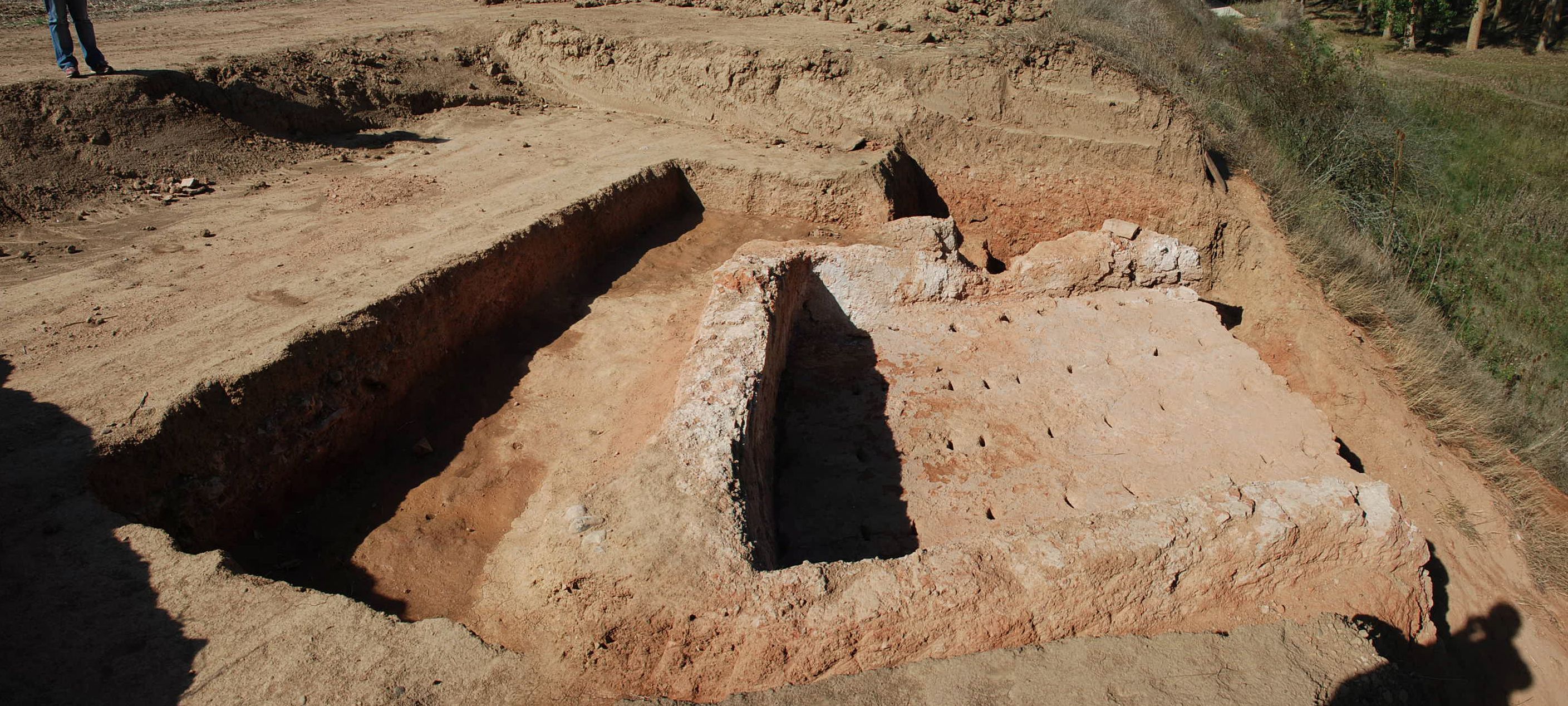
Our fictional Willow Kiln has an invented mean direction, D = 12° and I = 58°. Its simplified reference curve deliberately repeats those values at two hypothetical dates to illustrate uncertainty. The credited photograph shows a genuine Roman-period kiln at Abia de las Torres in Spain; it is not Willow Kiln and no archaeomagnetic result is claimed for it.
Professional reference points are the Magnetic Moments in the Past archive, Historic England scientific dating guidance and the eduKate Gold Standard master hub. The method should be teachable, source-linked and revisable.


1. What event does the magnetic date describe?
An archaeomagnetic date usually concerns a suitable heating and cooling event recorded in ancient material. It does not automatically date original kiln construction, every pottery vessel it produced, later repairs or abandonment. The fictional Willow Kiln in this guide has several possible episodes, and students need to specify which one the sampled floor could record. A date without a defined target event is ambiguous even if its laboratory statistics are excellent.
Ask pupils to make a timeline with construction, repair, last sufficient firing and collapse as separate rows. Only one may be targeted by the magnetic signal. Historic England’s scientific dating overview places archaeomagnetism alongside complementary archaeological methods. This exercise trains the capacity to identify the event represented by the physical evidence before drawing a conclusion.
Back to chapter index · Next chapter
2. How heated material can preserve magnetic remanence
Some magnetic minerals acquire a thermoremanent magnetisation when they are heated sufficiently and cool in the Earth’s magnetic field. A stable remanence can record information about the ancient field at the relevant cooling episode. But not every fired object was heated enough, and later reheating or chemical alteration may compromise its record. The laboratory measures a magnetic component, not an engraved calendar date.
The Simpson’s Malt kiln report documents wall material that did not yield a stable useful date, whereas the kiln floor retained a more informative component. Students compare a well-heated floor with a cool outer wall in the fictional exercise and explain why ‘both look burnt’ does not establish equivalent magnetisation history. It is the physical mechanism, not visual blackening, that matters.
Back to chapter index · Next chapter
3. The Earth’s field changes through time and space
Geomagnetic secular variation describes changes in the field’s direction and intensity through time. These changes vary geographically, so an archaeomagnetic dating reference curve must be appropriate to the site and period. A model for one region cannot automatically be transferred to another. Students should distinguish the underlying geomagnetic phenomenon from a reference curve assembled by researchers using independently dated observations.
The Magnetic Moments in the Past project shows how such evidence can inform archaeology. Ask students why a smooth plotted curve is itself a research product with uncertainty. Without knowing the field’s regional history, one measured direction cannot be converted into a year. A model value and an ancient observation are connected through calibration, not through simple arithmetic.
Back to chapter index · Next chapter
4. Declination, inclination and magnetic intensity
Declination is the horizontal angle of a direction relative to geographic north, while inclination is the angle above or below horizontal under the usual geophysical convention. Both are measured in degrees. The magnetic field’s intensity is a distinct property, and estimating ancient intensity has additional technical requirements. More columns in a table do not necessarily mean greater chronological precision unless the values are reliable.
The fictitious Willow Kiln mean direction is stated as D = 12° and I = 58°. Ask the class whether these are years, degrees Celsius or physical angles. The ADS database stores these fields and alpha-95 uncertainty separately. A good learner can distinguish a measured directional component from a modelled age window, while acknowledging missing or unsuitable intensity evidence.
Back to chapter index · Next chapter
5. Why field orientation is indispensable
Directional dating needs an appropriate record of a sample’s original orientation at the relevant magnetic-recording event. If a kiln wall tilts or a brick is removed without its original azimuth and upper surface being documented, the laboratory may measure stable remanence that no longer relates directly to geographic direction at firing. A loose sherd does not automatically provide the same source conditions as an in-situ floor.
Give students two fictional blocks, one documented in situ and another collected from disturbed spoil. Ask which supports directional dating, assuming both contain stable magnetic minerals. The Chester Royal Infirmary report explains a real kiln whose post-firing slumping prevented reliable archaeomagnetic dating. Better laboratory precision cannot reconstruct a physically unknown original orientation.
Back to chapter index · Next chapter
6. Field samples are not identical to laboratory specimens
A single independently oriented field sample may yield multiple smaller laboratory specimens. Counting specimen readings as independent field samples can exaggerate replication. A reliable report distinguishes collected positions, cut specimens, repeats and exclusions, and retains the orientation transfer and processing history. The number of samples needed for reliable results depends on specialist assessment of the feature and material.
Give a fictional sampling sheet with ten individually oriented blocks and twenty-four processed specimens. Ask how many independent field positions are represented. Pupils should not simply answer twenty-four. Published research on sampling methods discusses the significance of orientation and specimen records. No pupil needs to drill protected fabric; the conceptual problem can be taught safely from sample cards and diagrams.
Back to chapter index · Next chapter
7. Identify stable components after laboratory treatment
Natural remanent magnetisation may contain older or later components in addition to the one the dating question seeks. Specialists use demagnetisation procedures and directional analysis to decide whether a characteristic ancient component can be isolated. Some samples are too unstable or ambiguous to support a defensible date. A weak or absent useful component is an honest finding, not a reason to silently invent a direction.
The class examines an invented sequence of laboratory readings that becomes more consistently grouped after a secondary component is removed. Students explain the role of suitable stability tests without attempting specialist procedures. Historic England’s Pontefract case helps show that different parts of one structure can yield distinct measurement quality. Confidence begins with a reliable field and laboratory chain.
Back to chapter index · Next chapter
8. Respect multiple building and heating phases
A kiln may contain reused tiles, a resurfaced floor and blocked flues from different periods. Older bricks could preserve magnetisation from original manufacture if later firing did not reset them completely, while a replacement floor might record a later event. A magnetically datable feature is therefore not necessarily synonymous with the complete excavated structure.
The Worcester kiln study targeted separate use phases in its sampling. Give pupils a fictional stratigraphic diagram with earlier flues and later repairs, and ask what date each sample would aim to establish. A strong answer identifies the relevant episode and leaves unrelated building phases to separate archaeological evidence.
Back to chapter index · Next chapter
9. Calibrate against an appropriate regional reference
A secure archaeomagnetic date needs a regional secular-variation reference with documented chronological control, spatial suitability and uncertainty. A global average direction does not replace a local reference. Calibration may return one or more candidate windows because the field can change through similar values more than once.
In our toy model, the same D and I pair appears at imaginary AD 900 and AD 1100 values. This is not a real geomagnetic reference or date for any kiln. Students explain what further field history and archaeological constraints would be required before naming a plausible historical interval. ADS records identify reference curves and age bounds, illustrating why the model must be cited along with the result.
Back to chapter index · Next chapter
10. Report mean direction, scatter and calibration error
Several independently oriented samples can yield a mean directional estimate with statistical uncertainty. Alpha-95 is one parameter used to describe uncertainty in a mean direction under relevant assumptions. Small scatter can improve precision, but does not eliminate systematic orientation problems or model errors. Directional measurements also cannot be treated as ordinary scalar averages without appropriate statistical methods.
Create a fictional set with clustered readings and one possible outlier. Students identify the need to examine sample condition, orientation and laboratory behaviour before excluding it. The ADS reporting framework explicitly includes D, I, alpha-95 and confidence levels. A result shown as a single arrow without uncertainty is a poor substitute for a documented scientific record.
Back to chapter index · Next chapter
11. Why one direction can imply more than one date
A regional secular-variation curve can revisit similar directional values. The unknown feature’s directional uncertainty and the curve’s own error can intersect the reference in multiple places, yielding separate possible age ranges. Treating the closest printed point as the uniquely true year can be deeply misleading. A good report uses the appropriate calibration method to express all defensible intervals.
The imaginary reference table below repeats the pair D = 12°, I = 58° at AD 900 and AD 1100; both are hypothetical values. In the real Little Furnace Wood report, dating some fired structures produced alternative windows. Pupils learn that ambiguity can reflect the properties of a sound scientific method rather than faulty arithmetic or a failed class.
Back to chapter index · Next chapter
12. Last firing, construction, abandonment and other dates
The last sufficient heating of a sampled structure need not equal when the kiln was built, when the first vessel was fired, or when surrounding deposits accumulated. A reused structure can preserve several phases. Archaeomagnetic interpretation should identify precisely which material acquired or reset the remanence. If an old brick was incorporated into a later wall, the magnetic source history can be complex.
Students prepare a fictional event table with columns for evidence and dates. They should not copy the magnetic result into every row. Historic England’s Higham Ferrers report challenged documentary expectations and suggested that the dated kiln might differ from the structure identified in written sources. Chronological disagreement is a research question, not permission to erase an inconvenient observation.
Back to chapter index · Next chapter
13. Integrate independent methods without equating events
Radiocarbon, archaeomagnetism, ceramic typology and written evidence can complement one another, but may date different materials and events. A charcoal date may reflect a growth or deposition history, while a fired floor records magnetic cooling. A pottery typology may place production broadly and a document may identify a later repair. Scientific agreement requires checking source association.
The Pontefract report gives an archaeomagnetic floor interval of AD 538–1014 and related short-lived-charcoal radiocarbon evidence near cal AD 990–1050 at a reported 95% probability level. Pupils should distinguish overlap from proof of one exact year and explain why the archaeological interpretation may still be revised as associations are clarified.
Back to chapter index · Next chapter
14. Do not confuse magnetic survey with magnetic dating
Geophysical magnetometry measures contrasts across ground to suggest where buried features might lie. Archaeomagnetic dating examines remanence from appropriately preserved and oriented heated material to infer the timing of a magnetic recording event. A dark anomaly on a survey map does not contain its date by itself. The two techniques may support one project but answer different questions.
Give one fictional question about locating a kiln and another about its last firing. Students match each to the method and identify the independent evidence needed for verification. Historic England’s geophysical advice explains archaeological survey, while this article owns the chronological dating method. Pupils should be able to explain both without merging their outputs.
Back to chapter index · Next chapter
15. Protect fired archaeological material and report the method
Sampling can remove material from protected kilns and hearths, so it requires an authorised conservation and scientific plan. A full archaeomagnetic archive should include site location, source context, original sample orientation, field sample count, specimen and treatment history, stability, mean direction, uncertainty, calibration curve and all candidate age ranges.
The Magnetic Moments database provides a model for source-linked reporting. Give pupils a fabricated summary that says only ‘kiln dated AD 900′ and ask which missing metadata prevent evaluation. A responsible teaching activity uses paper and published data, not unauthorised removal of ancient bricks. Preserving the feature also preserves future researchers’ ability to re-examine the date.
Back to chapter index · Next chapter
16. Transfer to a different kiln with a disturbed wall
A new fictitious packet contains an oriented fired floor, a slumped wall, a set of laboratory measurements and two candidate intervals on a toy regional curve. Learners must determine which source is appropriate for directional study, explain why orientation matters, describe the calibration ambiguity and propose relevant independent dating evidence.
A strong answer may decline to name one year. It should say what magnetic event was recorded, which samples are reliable, what alternative periods remain and why construction and use phases need separate support. The gold standard of teaching Archaeomagnetic Dating is understanding that a precise-looking direction leads to a credible historical claim only through a complete, verifiable chain of physics, archaeology and chronology.
Worked toy model: matching an ancient direction to a repeating curve
All years and field directions here are fictional educational values. The table demonstrates ambiguity, not a professional calibration or a measured date for any real kiln.
| Hypothetical time | Declination | Inclination | Interpretation |
|---|---|---|---|
| AD 900 | 12° | 58° | Matches fictional mean |
| AD 1000 | 20° | 65° | Does not match the nominal values |
| AD 1100 | 12° | 58° | Another possible match |
| Willow Kiln | 12° | 58° | Not dateable uniquely from the toy table |
A single invented direction therefore cannot choose AD 900 over AD 1100 in this artificial model. Actual dating requires adequate orientation, stable remanence, a regional secular-variation reference and statistical uncertainty. A student who selects one exact year because it appears first has not solved the problem.
Expert case 1: floor heated enough, wall insufficiently heated
In the real Simpson’s Malt, Pontefract study, different kiln areas recorded different magnetic quality. Samples from wall lining were poorly stable, while floor material yielded a usable signal. Archaeomagnetic evidence from the floor was compatible with a last firing within AD 538–1014, while associated short-lived-charcoal radiocarbon samples suggested a later interval around cal AD 990–1050 at the stated probability level. This illustrates why one kiln is not one homogeneous magnetic source.
Students should explain the evidence behind each interval and the distinction between scientific precision and archaeological event association. They should not force all materials into an exact year or assume that one unstable wall invalidates the entire dating project. A comparison table with separate fields for wall, floor and charcoal is a better result than a single undifferentiated number.
Expert case 2: stable remanence without original orientation
The Chester Royal Infirmary kiln is a useful real counterexample: its magnetic samples retained stable signals, but post-firing slumping frustrated reliable orientation-based dating. Students may be tempted to call this a laboratory failure; instead, it is an evidential limitation arising from the archaeological structure’s movement. Measuring additional specimens cannot automatically restore an undocumented original azimuth.
Give a fictitious illustration of a tilted kiln wall and an intact floor. Ask which material could still preserve a meaningful ancient field orientation under the specified assumptions. A specialist may investigate structural reconstruction, but the teacher should not promise that every tilted sample can be mathematically repaired. An orientation problem is distinct from random laboratory scatter or ambiguous regional calibration.
Expert case 3: candidate ranges rather than one date
Little Furnace Wood provides real examples of different outcomes: one furnace can be dated within a range while another supports separated windows, and a hearth with poorly grouped directions may be unsuitable for a reliable date. This is why a complete report needs both the laboratory statistics and the age-calibration result rather than a single year.
Give three fictional short conclusions: a broad range, two alternative ranges and ‘no valid directional date’. Pupils state the reason each might arise. The strong response distinguishes sample stability, curve recurrence and missing orientation, rather than treating every indeterminate result as interchangeable. A scientific method is useful partly because it tells researchers when the data do not justify the desired answer.
Methods audit: a magnetic anomaly is not a dated kiln
Geophysical magnetometry might reveal a high-contrast feature across a field and suggest a kiln or furnace. That field map is a spatial survey of magnetic properties, not a direct last-firing date. An excavated, suitably oriented and stable fired feature may be a candidate for separate archaeomagnetic dating. The two methods can support one project without performing the same task.
Ask learners to place the output of each approach in its correct row: anomaly map, physical kiln context, independently oriented magnetic samples, laboratory mean direction and calibrated date windows. The source chain clarifies why an attractive magnetic survey map alone cannot give the feature’s construction or use chronology.
Safety and reporting audit: a heritage kiln is not a school experiment
Professional archaeomagnetic sampling may remove material from an ancient structure, requiring permission and conservation planning. A classroom should use published research, harmless paper orientations and synthetic data rather than physically sample protected kilns. The ADS database suggests what an auditable record should preserve: site, feature, position, laboratory, directions, uncertainty, curve and age bounds.
Pupils receive an incomplete fictional report saying only ‘Willow Kiln dated AD 900’. They identify which missing evidence prevents that conclusion from being checked. The highest-quality response does not simply add more precise digits; it states the scope of dating and acknowledges that a new orientation record cannot be invented after destructive sampling.
Final interpretation test: explain the kiln’s several dates
A fictional site contains original construction, a later repair, last firing, subsequent collapse and modern recovery. The archaeomagnetic floor might record one of those thermal events, while a displaced wall may retain a stable but unorientable component. The magnetic mean and reference curve may suggest two possible historical windows. Students should place all observations and inferred events on separate lines.
Ask each group to write a public-facing museum caption of seventy words that distinguishes observed fired materials from a proposed last-firing range. They should avoid giving the entire structure an exact construction year. A succinct, honest caption based on these data teaches more than a dramatic single date based on a fictional magnetic arrow.
Four lessons from fired material to historical chronology
- Lesson 1: explain thermoremanent magnetisation, secular variation and the difference between direction, intensity and age.
- Lesson 2: examine sample orientation, heating adequacy, laboratory stability and context phases.
- Lesson 3: compare the invented direction with the repeating toy reference curve and real Historic England kiln reports.
- Lesson 4: interpret a new fictional structure with slumping, different material histories and multiple candidate dates.
Advanced research exercise: what can distinguish the two candidate periods?
Assume the toy reference curve still gives two potential calendar matches for Willow Kiln. An excavation now reveals a securely documented construction level below the fired floor and a separate later demolition deposit above it. Those contexts could constrain the firing event if the stratigraphic relationships and dating evidence are reliable. They would not automatically identify one exact year. Students should explain which context is earlier, which is later and what a correctly associated independent date would contribute to ruling candidate periods in or out. If the floor has been moved or the site was rebuilt, the simple ordering might be inappropriate; a strong answer explicitly tests those assumptions instead of choosing the period that fits the student’s favourite story.
Next add a fictional written repair entry in a local archive. The entry mentions a kiln in the district but contains no plan proving it was Willow Kiln. Pupils should not use that document to select a magnetic age without establishing the feature’s identity. The report could support regional industrial activity while remaining unrelated to this particular structure. Ask learners to write two statements: one identifying the secure archaeological evidence and one explaining the unresolved documentary association. This prevents an appealing coincidence between a kiln date and a historical reference from becoming a false attribution.
Final quality checklist: five layers of evidence must remain distinct
| Layer | What the student should report |
|---|---|
| Material event | Which firing and cooling episode the sample might record |
| Field control | Original orientation and any slumping or displacement |
| Laboratory quality | Sample count, stability, mean direction and uncertainty |
| Reference comparison | Regional curve, candidate windows and its limitations |
| Historical interpretation | Related stratigraphy or independent dates, and what remains unknown |
This checklist can be used as an assessment rubric. A student who reports a stable mean direction but ignores post-firing movement has missed field orientation. One who gives only ‘AD 900’ when the calibration admits two separate windows has suppressed uncertainty. Another who correctly interprets a last heating but labels it as the kiln’s original construction has confused event definitions. Diagnose each misconception separately and give a new research packet to confirm transfer. The strongest result is not necessarily the narrowest reported interval; it is the best-supported account of what the material, method and archaeological context actually establish.
Frequently asked questions
Does the date show when a kiln was built?
Not necessarily. The sampled material usually concerns a relevant heating and cooling event.
Can a loose brick yield a normal directional date?
Without reliable original orientation, the standard directional relation to the ancient field may be lost.
Why might two dates fit?
Regional magnetic-field directions can recur through time, and calibration has uncertainties.
Is magnetometry surveying the same as dating?
No. A magnetic survey maps contrasts; archaeomagnetic dating analyses suitably recorded ancient remanence.
What should students do at a protected site?
Use approved research records and non-invasive models. Professional sampling requires authorisation.
Professional records and further reading
- ADS Magnetic Moments in the Past
- ADS Archaeomagnetic Database Overview
- Historic England Scientific Dating
- Pontefract Pottery Kiln Archaeomagnetism
- Chester Royal Infirmary Kiln
- Little Furnace Wood
- Higham Ferrers Kiln
- Real Roman Kiln Image by Valdavia (CC BY-SA 3.0)
- Teaching Archaeological Geophysics
- Teaching Chronology
- Teaching Ceramic Petrography
- The Gold Standard master hub
The Gold Standard of Teaching Archaeomagnetic Dating is a learner who can explain the physical record of an ancient firing, interpret its orientation and uncertainty, compare it against a relevant regional model, and state exactly which historical event a possible date represents.